
A content library can look healthy from the outside while failing every operational test that matters. Your team may have thousands of articles, podcast episodes, videos, research notes, and internal briefs, yet contributors still ask where the latest source lives, which version is approved, and whether an old asset can be trusted.
That confusion slows publishing, weakens editorial quality, and leaves useful material earning nothing. An organizational knowledge process fixes the operating model behind the library. It gives people clear ownership, shared language, reliable workflows, and evidence that reuse is improving business outcomes.
When Your Content Library Outgrows Your Memory
A publisher can accumulate a large archive without creating a usable knowledge asset. Articles sit in a CMS, interviews remain in folders, transcripts live in cloud storage, and editorial decisions disappear into chat threads. Everyone knows the information exists, but nobody can retrieve the right piece with confidence.
The familiar symptoms are easy to spot:
- No capture rules: Producers and editors save material in different formats, or skip documentation entirely.
- No shared vocabulary: One team uses “customer retention,” another uses “loyalty,” and a third uses both without a consistent distinction.
- No accountable owner: Nobody decides which taxonomy terms are valid, which assets need review, or when outdated material should be retired.
- No reuse habit: Writers start fresh research because searching the existing archive feels slower than opening a new browser tab.
The result is a library that grows in volume while declining in practical value. Your team publishes more slowly, repeats research, misses internal linking opportunities, and struggles to turn historical work into new articles, newsletters, episodes, products, or sponsored packages.
Practical rule: If contributors need personal memory, private bookmarks, or a colleague's help to find trusted material, the organization has a process problem, not a storage problem.
Knowledge management moved from informal workplace learning into a formal managerial discipline over roughly 15 years, from the momentum gained in the 1980s to IBM's established program by the mid-1990s and the publication of Davenport and Prusak's Working Knowledge in 1998 (historical overview of knowledge management). That history still matters. The field was built around making organizational memory explicit, shareable, and reusable, not merely putting more files into folders.
Start with governance. Define the stages, assign owners, establish contribution rules, design a taxonomy people can actually use, connect the process to editorial work, and measure reuse. Teams looking for a practical introduction to preserving working knowledge can also consult this guide to practical knowledge capture for teams from SpecStory, Inc.
What an Organizational Knowledge Process Actually Is
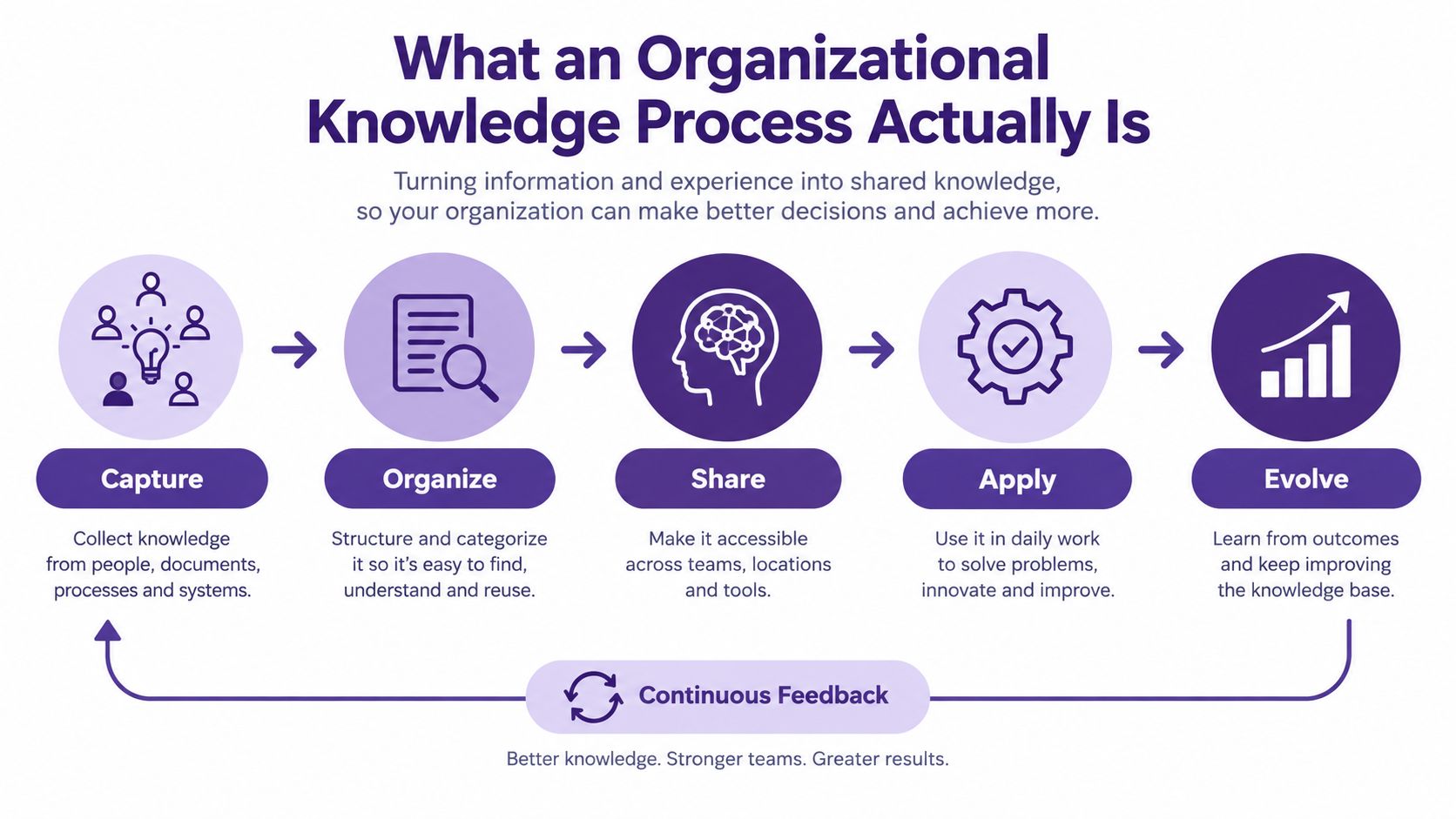
An organizational knowledge process is a repeatable operating system for turning expertise, research, and published material into assets that people can find, trust, apply, and improve. It isn't a software category. It is the set of decisions and actions that determine what enters the library, how teams describe it, who can use it, and how the organization learns from reuse.
Most content organizations need five recurring stages:
- Capture brings in interviews, research, transcripts, production notes, audience questions, and editorial decisions. A producer captures the substance of a guest interview rather than leaving it trapped in a recording.
- Curate separates useful signal from noise. An editor identifies the claims, examples, themes, and source material worth preserving.
- Organize applies taxonomy, metadata, ownership, dates, audience labels, and status. The archive becomes a map instead of a pile.
- Retrieve helps a contributor find the right material through search, browsing, recommendations, or a research brief.
- Reuse puts the knowledge into a new article, newsletter, episode, video, product, or sales asset, with enough context to preserve accuracy.
A podcast team might turn one transcript into a research brief, several articles, a newsletter sequence, and prompts for a future interview. A publisher can mine older explainers for definitions and background when producing a current story. A product marketing team can retrieve approved positioning language from internal briefs instead of asking different stakeholders to rewrite the same message.
Each stage needs four anchors:
- An owner who is responsible for the action.
- An input that defines what enters the stage.
- An output that another person can use.
- A quality bar that determines whether the output is good enough.
A process without those anchors is just a list of aspirations. The academic model of capture, organization, access, use, and creation reinforces this iterative view, where knowledge moves through work rather than sitting passively in a repository (academic overview of knowledge processes). For a broader treatment of enterprise knowledge management, keep the focus on those operational handoffs. Tools support the process, but they don't define it.
Governance Models Centralized Versus Distributed
Governance determines whether your knowledge system stays coherent as more people contribute. A centralized model places taxonomy, ingest standards, review, and access rules with a small central team. A distributed model lets each department or editorial group manage its own knowledge. A hybrid model combines local ownership with a central set of rules.
The choice affects every downstream activity. Centralization creates cleaner standards and more consistent reporting, but the central team can become a queue that frustrates subject-matter experts. Distribution preserves local relevance and speeds contribution, but teams often create duplicate tags, conflicting definitions, and uneven review habits.
The 2022 KM Program Benchmarks and Metrics Survey Report found a median of 8 full-time equivalent staff members directly supporting a knowledge management program, with a median cost of $2.09 per $1,000 in business revenue and about 880 regular active participants. The mean number of active participants was 4,693, while around half of programs used centralized governance and nearly a third used hybrid models (2022 KM Program Benchmarks and Metrics Survey Report).
| Dimension | Centralized | Hybrid |
|---|---|---|
| Taxonomy ownership | One central team defines and maintains terms | A central team governs core terms while domain editors manage local detail |
| Contribution rules | Consistent, tightly controlled | Shared minimum standards with workflow-specific flexibility |
| Editorial speed | Can slow when approvals queue up | Faster because contributors work within clear local boundaries |
| Quality control | Easier to audit centrally | Requires recurring audits and escalation rules |
| Best fit | A narrow portfolio with similar content types | Multiple brands, verticals, shows, or specialist teams |
For most content organizations, hybrid governance is the strongest default. Give a thin central team authority over the shared vocabulary, required metadata, naming conventions, retention rules, and measurement. Give domain editors responsibility for applying those rules to their own material.
Define the center of gravity
The central team shouldn't review every sentence or approve every tag. It should maintain the system that makes local contribution safe. That means publishing a taxonomy, resolving disputes, training contributors, auditing drift, and reporting whether reuse is improving.
Domain owners should decide whether an asset is accurate for their audience, whether a claim needs updating, and which related materials deserve prominence. Write those responsibilities into role descriptions. If ownership exists only in a meeting conversation, it will disappear when priorities change.
Building a Taxonomy That Aligns Teams
Taxonomy is the shared map of the library. The FAO describes it as a hierarchical structure that organizes a body of knowledge and helps people understand how groups relate to one another (FAO knowledge management guide). For publishers, that makes taxonomy a coordination tool, not a decorative layer of metadata.
Start with an audit. Sample existing articles, transcripts, videos, briefs, and campaign assets. Record the labels people already use, the concepts they search for, the questions they ask, and the distinctions that affect editorial decisions. Don't design the hierarchy from an empty document. Design it from the language already present in the work, then remove duplication and ambiguity.
Next, define broad pillars. A B2B publisher with a large archive might use Strategy, Operations, Leadership, Technology, Customer, Case Studies, and Research as top-level categories. Give each pillar a limited set of child terms, and document the difference between neighboring terms. “Technology” might describe systems and infrastructure, while “Operations” covers the processes that teams use to run the business.
Make tagging predictable
Use a controlled vocabulary for important terms. Contributors can add descriptive keywords, but core fields should use approved values. Define whether an asset can have one primary pillar or several, how audience is recorded, how content status is expressed, and who can create a new term.
A useful test is simple:
If two editors would tag the same article differently, the taxonomy isn't specific enough.
Review the taxonomy against real retrieval tasks. Ask a researcher to find material for a planned article, then watch where the labels help or hinder them. If the taxonomy makes reporting tidy but search frustrating, it needs revision. The best structure serves both human browsing and machine-assisted discovery.
When sales, content, and product teams use the same concepts, they can connect related assets, identify gaps, and build stronger internal links. A practical guide to content tagging and taxonomy can help teams translate those principles into a working library structure.
Operational Workflows for Capture and Reuse
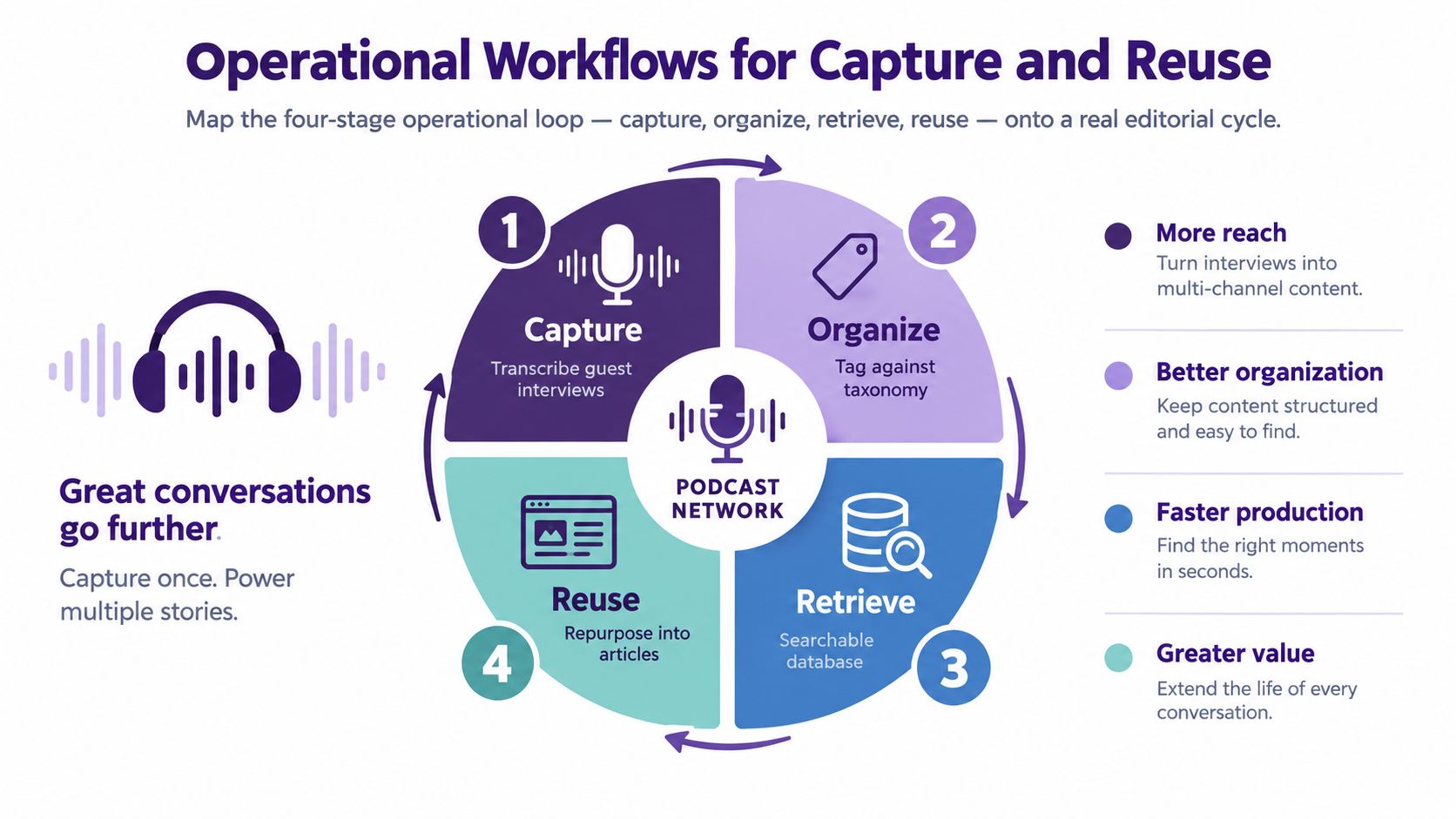
A podcast network provides a clean example of how the process should work. The producer records and transcribes the interview. An editor checks the transcript, removes noise, identifies substantive themes, and applies the approved taxonomy. A researcher retrieves relevant passages for a brief. A writer reuses those passages in an article, while the final piece links back to the source episode and related assets.
Assign each handoff explicitly:
- Producers capture: They submit the recording, transcript, guest details, rights information, and production context.
- Editors organize: They apply the taxonomy, identify key passages, mark sensitive claims, and confirm the asset's status.
- Researchers retrieve: They search the approved library before commissioning fresh research and record which sources informed the brief.
- Writers reuse: They adapt material for the new format while preserving attribution, context, and editorial accuracy.
The most common failure happens between capture and organization. Teams record the interview and upload the transcript, then move immediately to the next production task. The transcript technically exists, but nobody has made it findable. Later, a writer searches by episode title, finds nothing useful, and starts over.
Set lightweight service expectations. For example, require new transcripts to be tagged within an agreed operating window, and require research briefs to check existing material before a new search begins. The exact timing should reflect your staff and publishing rhythm. What matters is that the expectation is written, visible, and measured.
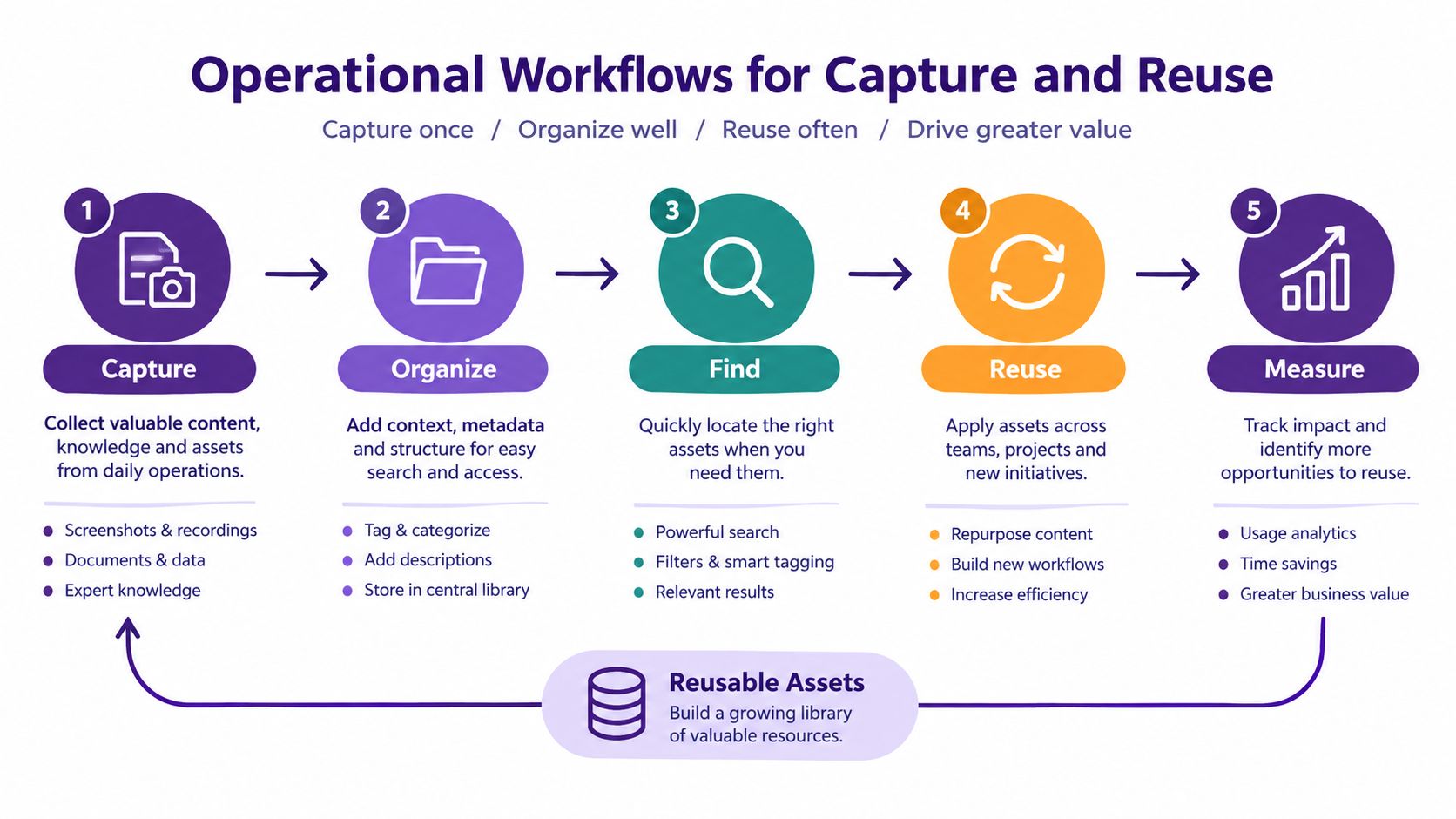
Every workflow needs a measurable output. Capture produces a complete source asset. Organization produces valid metadata. Retrieval produces a usable brief or source set. Reuse produces a new asset with traceable inputs. Measurement produces evidence about whether the loop is getting better.
Don't turn this into bureaucracy. Use templates, required fields, and short review steps. The aim is to make the right behavior easier than the improvised alternative.
Why Storage and Retrieval Drive Real Performance
Storage is rarely the hardest part of knowledge management. Retrieval is. A cheap archive still costs the organization time when contributors can't identify the authoritative source, understand its context, or locate the passage that answers the current question.
Information overload makes that cost visible. One source summarizes research indicating that heavily interrupted knowledge workers may face 275 interruptions per day, that refocusing can take 23 minutes and 15 seconds after an interruption, and that task switching can consume up to 40% of productive time (information overload and interruption data). These figures describe a broader knowledge-work environment, not a guaranteed cost for every content team, but they show why poor findability creates operational drag.
A separate empirical study reported a positive correlation of r = 0.69 between knowledge storage and retrieval and strategic performance. The same source reported a significant positive effect of broader knowledge management practice adoption on organizational outcomes, with β = 0.41 in SMEs (study of knowledge storage, retrieval, and performance).
| Metric | Benchmark | Annual Cost for a 50-person Team |
|---|---|---|
| Interruptions | Up to 275 per day in the cited summary | Calculate internally from observed interruption time |
| Refocusing after interruption | 23 minutes and 15 seconds in the cited summary | Calculate internally from your team's interruption pattern |
| Productive time affected by task switching | Up to 40% in the cited summary | Do not assume the maximum applies to your team |
| Storage and retrieval relationship | r = 0.69 in the cited study | Treat as research evidence, not a forecast |
The executive point is straightforward. The value of a library depends on the speed and accuracy of retrieval, not the amount stored. Search deserves editorial sponsorship because it determines whether existing work enters new production, informs decisions, and contributes to revenue.
Teams evaluating the architecture behind enterprise search should test actual work scenarios. Can a researcher find approved background for a current story? Can an editor identify every related asset? Can a producer see which themes have already been covered? If the answer depends on knowing the original filename, your search layer isn't doing enough.
Measuring Knowledge Velocity and Reuse Quality
Most knowledge dashboards measure inventory. They count documents, tags, uploads, or searches. Those numbers may describe activity, but they don't prove that the library is helping the business.
Use a scorecard tied to editorial outcomes. Knowledge velocity measures the time from asset creation to first productive reuse. Reuse rate measures how often new work draws on prior assets. Retrieval time measures how long a contributor spends finding usable source material. Revenue attribution connects reused knowledge to outcomes such as conversions, qualified leads, subscriptions, or sponsored placements.
Don't invent targets before you have a baseline. Capture the current state, agree on definitions, then set an improvement target based on your own workflow and capacity.
| Metric | What It Measures | Starting Baseline | Maturity Target | Owner |
|---|---|---|---|---|
| Knowledge velocity | Time from creation to first productive reuse | Establish from recent assets | Set after baseline review | Content operations |
| Reuse rate | Share of new work using prior approved assets | Sample recent articles, episodes, or campaigns | Increase without lowering quality | Managing editors |
| Retrieval time | Time contributors spend finding usable material | Observe real research tasks | Reduce while tracking source quality | Research lead |
| Revenue attribution | Business influence of reused knowledge | Define attribution events and record them | Connect reuse to agreed commercial outcomes | Revenue operations |
Quality matters as much as frequency. A writer who copies an outdated paragraph has technically reused knowledge, but the organization hasn't created value. Record whether the reused source was accurate, relevant, properly attributed, and appropriate for the new audience.
Review the scorecard quarterly with named owners. Look for relationships between measures. If retrieval time falls but reuse rate stays flat, contributors may find sources but lack workflow prompts or editorial incentives. If reuse rises while accuracy declines, the curation and review rules need attention. The measurement layer should lead to decisions, not become another neglected dashboard.
A systematic review of 33 articles describes knowledge management as a chain of identification, creation, sharing, transfer, acquisition, and utilization, with the aim of improving productivity, efficiency, cost reduction, and performance (systematic review of public-sector knowledge management). Your scorecard should reflect that chain. Measure whether knowledge moves into better work, not merely whether the repository is busy.
Fix Governance Before You Add AI
AI can't repair an undefined operating model. A writing assistant, retrieval-augmented system, or automated tagging tool will process the structure it receives. If contributors use inconsistent labels, outdated documents remain active, and nobody owns approval, the system can produce answers that sound polished while drawing from the wrong material.
Run a short diagnostic before buying another feature:
- Find the orphans: Identify assets with no owner, status, audience, or meaningful classification.
- Audit tag drift: Compare similar assets and look for synonyms, duplicate categories, and inconsistent hierarchy.
- Sample retrieval misses: Ask contributors to find known sources, then record which searches fail and why.
- Check authority: Determine whether people can distinguish approved, superseded, draft, and archived material.
- Name governance: Put one person or team on record for taxonomy decisions, contribution standards, and measurement.
The prerequisite stack is small, but it must be real:
- A documented taxonomy with definitions, examples, and rules for adding terms.
- A contribution checklist that makes required context part of capture.
- One retrieval surface that points contributors toward trusted material instead of scattering search across disconnected systems.
- A live scorecard that connects reuse to quality, speed, and commercial outcomes.
The six-domain lifecycle described in one knowledge-management taxonomy paper includes acquiring, creating, using, preserving, disseminating, and disposing knowledge (knowledge-management lifecycle domains). That final domain, disposal, is often ignored. A library becomes less useful when teams never retire duplicates, expired claims, or assets that no longer meet the quality bar.
AI becomes valuable after these controls exist. It can help classify large collections, surface related themes, retrieve passages, generate research lists, and support collaboration between people and systems. But governance remains the foundation. Without it, automation multiplies inconsistency faster than a small editorial team could create it manually.
Contesimal helps content organizations classify and organize documents, podcasts, videos, and articles, then use chat-based research, search, layered taxonomies, and collaborative workflows to turn existing libraries into new editorial value. Visit Contesimal to see how your team can give dormant content clear structure, better retrieval, and a practical path from reuse to revenue.