
Your content library probably looks familiar. A backlog of podcast episodes, YouTube videos, interviews, newsletters, transcripts, blog posts, half-finished outlines, and a few strong pieces that still bring in attention months later. You know there's value in that archive. The hard part is finding it fast enough to turn old work into new audience growth.
That's where most creators stall. Not because they lack ideas, but because the library gets too big to hold in one head. You remember a great riff from an old episode, a strong argument from a past article, or a story that landed in a video comment section. You just can't surface it when you need it.
Human and AI collaboration matters most in that moment. Not as a gimmick. Not as a shortcut to flood the internet with generic output. As a practical way to organize what you've already made, understand what still has value, and act on it before the next publishing cycle starts.
Beyond Automation The New Creative Partnership
A creator with a few years of output isn't starting from zero. They're sitting on raw material. A podcaster has recurring themes buried across episode transcripts. A YouTuber has strong explanations that can become shorts, threads, email sequences, or lead magnets. A publisher has archives that can be regrouped into fresh packages for new readers.
The problem isn't lack of content. It's dormant content.
Human and AI collaboration gives that backlog a job. The human sets the editorial direction, protects the voice, and decides what deserves another life. AI handles the scanning, sorting, clustering, and first-pass synthesis that would otherwise eat an entire week.
The upside is bigger than efficiency alone. Collaboration between humans and artificial intelligence could generate up to $15.7 trillion in economic value by 2030, according to the World Economic Forum, and for creators that points to a major opportunity to turn existing content libraries into new revenue streams through stronger reuse and smarter workflow design, as outlined in the World Economic Forum's view on human-AI collaboration.
What this looks like in real creator work
A long interview becomes a short-form series.
An old newsletter becomes a speaking pitch.
A strong blog post becomes a script, then a carousel, then a premium download.
None of that requires lowering quality. It requires retrieval, judgment, and format adaptation.
Practical rule: If a piece performed once because the idea was strong, it probably has more than one usable format left in it.
This is also where outside workflow examples can help. Teams experimenting with format shifts often benefit from practical references like Aicut insights on AI content creation, especially when they're trying to turn one core idea into multiple social outputs without rewriting from scratch every time.
The creators who make the jump from hobbyist to professional usually stop treating their archive like storage. They treat it like inventory.
Understanding Human and AI Collaboration
Human and AI collaboration is easiest to understand when you stop thinking about software as a replacement for creative work. It works better as a division of labor.
Think of AI as a fast research assistant with infinite stamina and uneven judgment. It can read across a library, surface repeated themes, group related ideas, and produce rough starting points. It can't decide what fits your audience, what matches your standards, or what kind of story is worth telling now. That part stays human.
The clean division of labor
In strong creative teams, AI usually handles work like:
- Pattern finding: spotting repeated themes, phrases, questions, and content clusters across transcripts and drafts
- First-pass drafting: producing outlines, summaries, option sets, or alternate framings
- Library navigation: helping teams find relevant material from older videos, podcasts, and articles faster
The creator or editor keeps control over different jobs:
- Editorial taste: deciding what's sharp, useful, original, and on-brand
- Context: knowing why something worked before, and whether it still fits now
- Final accountability: checking facts, protecting nuance, and shaping the finished piece
That's why this isn't just automation. Automation runs a routine. Collaboration works through interpretation.
Where it works best
The most useful thing to know is that human and AI collaboration is not equally good at every task. According to MIT research, human-AI teams don't always outperform individuals in general tasks, but they show meaningful synergistic benefits in content creation scenarios. When humans already perform well, adding AI as a collaborator can improve the result beyond what either could do alone, as summarized in MIT Sloan's analysis of when humans and AI work best together.
That matches what many content teams see in practice. AI is usually weak when the work depends on subtle trade-offs, sensitive judgment, or complex decisions with high downside. It's much more useful when the task is exploratory, generative, or organizational.
Use AI to widen the option set. Use humans to narrow it to the one worth publishing.
If your work involves scripts, show planning, article packages, research synthesis, content calendars, or repurposing systems, this kind of partnership is already relevant. A deeper look at AI for content creation workflows is useful if you're building a repeatable production process rather than just testing prompts here and there.
Three Models for Your Creative AI Partnership
Not every creator needs the same setup. Some need speed. Some need idea expansion. Some need help connecting a scattered team to a large archive. I think about human and AI collaboration in three working models.
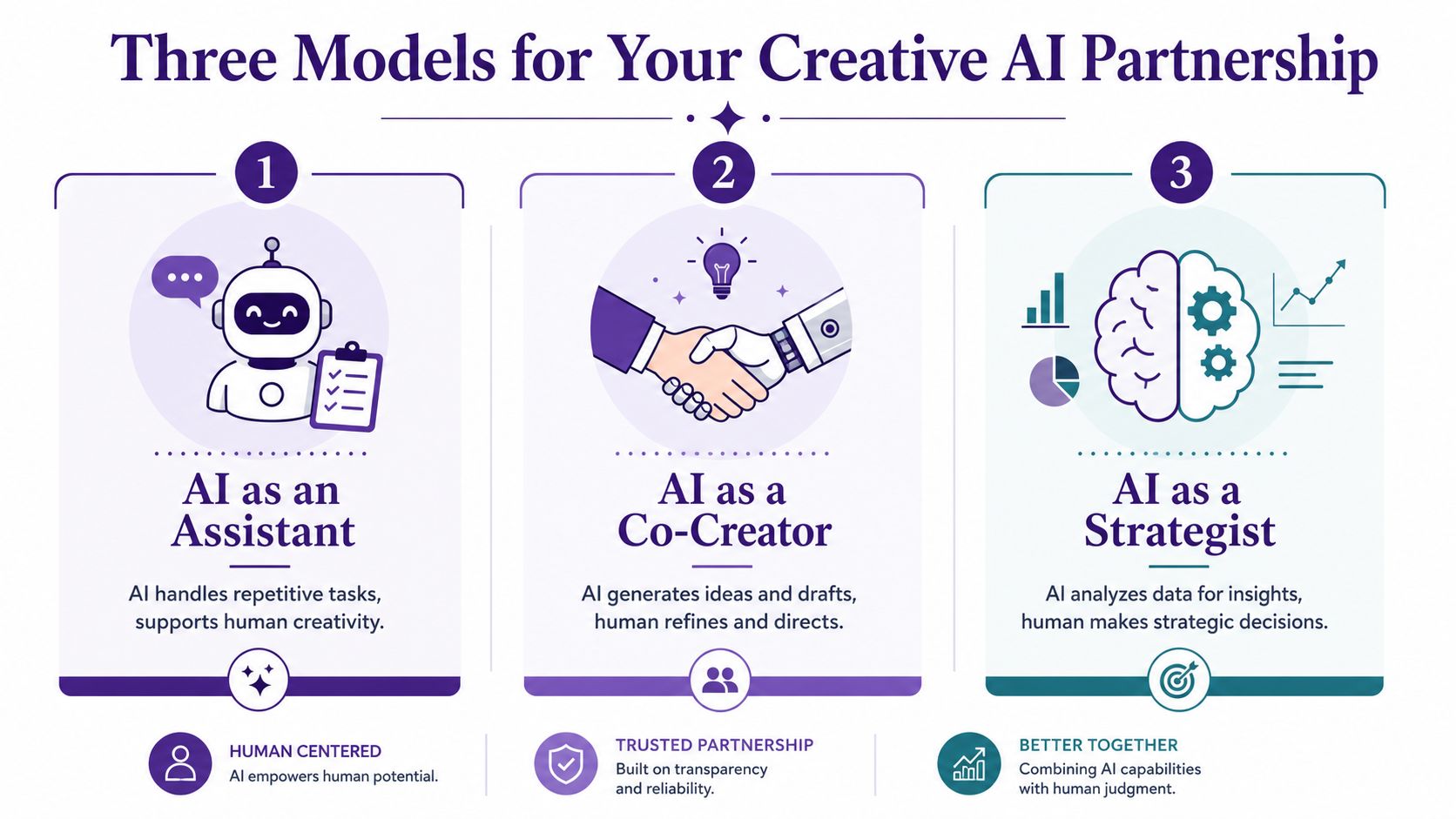
Augmentation for faster execution
This is the simplest model. AI supports the creator, but doesn't shape the final angle.
A YouTuber might drop episode transcripts into a system, ask for recurring objections from viewers, then use those objections to tighten the next script. A blogger might use AI to summarize old articles and extract candidate sections for an updated guide. A podcast producer might generate rough show-note drafts before an editor rewrites them in brand voice.
AI acts like an assistant. Fast, useful, and limited.
Co-creation for idea development
Co-creation starts when the output improves because the human and the model push against each other a bit. The human brings framing, taste, and constraints. AI brings options, alternate structures, and unexpected combinations from the library.
A publisher can use this model to build themed packages from archival material. An author can test five ways to reposition one core argument for different audience segments. A content marketer can turn a webinar transcript into campaign angles, then choose the one that fits the funnel.
This is the sweet spot for many professional creators. You're not outsourcing the work. You're accelerating the messy middle.
Mediation for teams and archives
This model gets less attention, but it's often where a significant advantage lies. AI helps people collaborate with each other by making a large content library easier to search, classify, and discuss.
An editor in chief might need to connect a writer with prior reporting hidden in old issues. A video team might need to identify all clips related to one theme across a year of uploads. A research-driven publisher might need a shared environment where multiple contributors can work from the same contextual base instead of reinventing the same background work.
If you want a parallel example from another workflow-heavy field, Halo AI's piece on hybrid AI-human support is useful because it shows how blended systems work when human judgment and machine speed need to coexist cleanly.
Models of Human-AI Collaboration for Content Creators
| Model | Role of AI | Creator's Role | Example Use Case |
|---|---|---|---|
| Augmentation | Handles repetitive support tasks and first-pass processing | Reviews, selects, and refines | Summarizing old podcast episodes into reusable research notes |
| Co-creation | Generates options, drafts, and alternate framings | Directs the brief and shapes the final piece | Turning one long video into a script series for multiple platforms |
| Mediation | Organizes and surfaces relevant knowledge across a library or team | Interprets findings and aligns contributors | Helping an editorial team find archival material for a new feature package |
The right model depends less on the tool and more on the bottleneck. If your problem is speed, augment. If your problem is ideas, co-create. If your problem is team alignment, mediate.
A Practical Workflow for Repurposing Content
Most creators don't need more advice about posting more often. They need a system that turns what they already made into a repeatable pipeline. The cleanest workflow I've found has three parts: organize, understand, and take action.
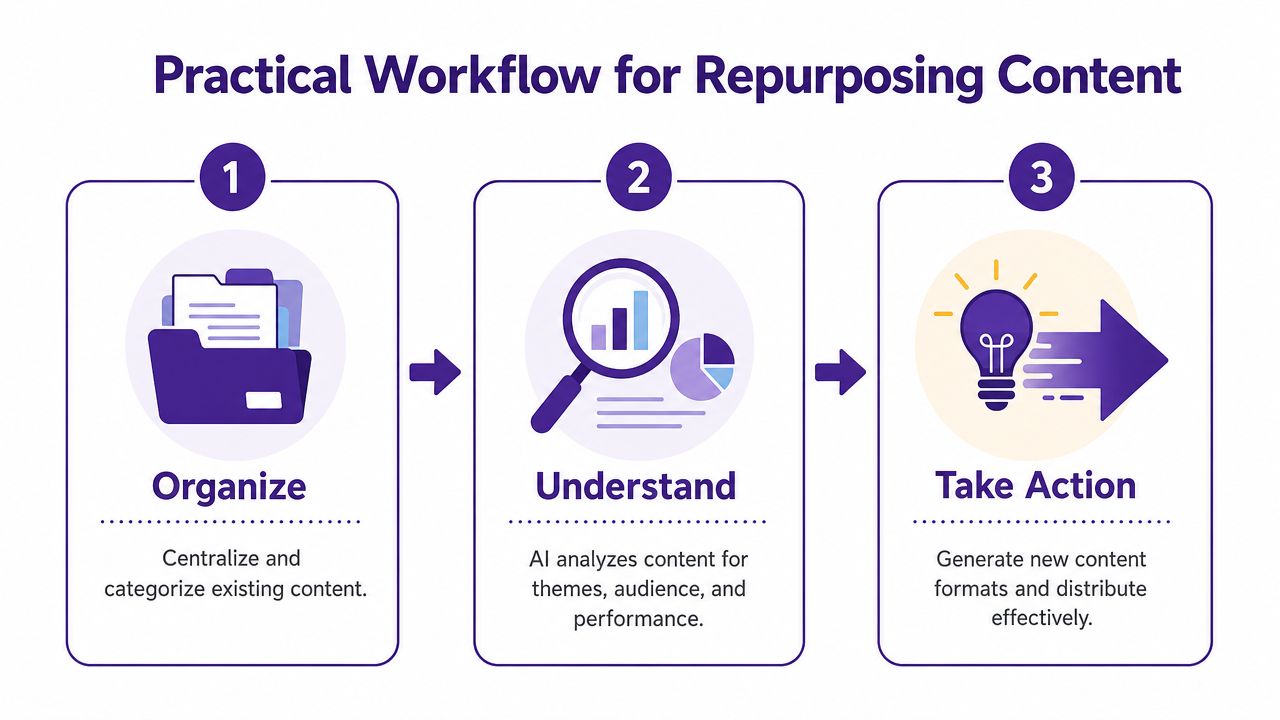
Organize the library first
Bring your longform material into one working environment. That means transcripts, articles, notes, video descriptions, old briefs, and finished assets. If your archive is spread across drives, docs, editing tools, and inboxes, AI won't fix the chaos. It will just process chaos faster.
At this stage, the goal is simple. Centralize enough of the back catalog that patterns can become visible.
A tool like Contesimal fits here because it lets teams classify, search, and work across large libraries of documents, podcasts, videos, and articles in one research-oriented environment. If repurposing is a core priority, content repurposing with AI workflows offers a useful operating model for building that system out.
Understand what the archive is actually saying
Once the library is centralized, AI becomes more interesting. Now it can tag themes, group related assets, identify recurring audience questions, and surface promising source material for new formats.
At this stage, creators usually uncover surprises:
- Hidden series potential: several unrelated posts turn out to support one bigger theme
- Repeatable hooks: old content reveals intros, questions, or analogies that consistently land
- Platform mismatch: a great longform idea was strong, but it was released in the wrong format for the audience
Field note: Don't ask AI only for summaries. Ask it to find tensions, repeated audience pain points, and ideas that appeared multiple times but were never turned into a full series.
Take action with format-specific output
Repurposing gets real when the archive starts producing deliverables, not just insights. Turn a webinar into a blog package. Turn a strong interview into newsletter lessons. Turn a research-heavy article into scripts, quote graphics, or discussion prompts for community channels.
By 2026, generative AI is projected to transform content creation by enabling hyper-personalized multimedia content at an unprecedented scale, allowing creators to design complex digital ecosystems without needing specialized technical skills, according to Globant's outlook on human-AI collaboration. The practical meaning for creators is straightforward. More formats become reachable without building a huge production stack.
A useful test is this: every successful longform piece should have at least one next format, one next audience, and one next revenue angle.
Real Benefits of AI Collaboration for Creators
The strongest case for human and AI collaboration isn't novelty. It's operational relief. Creators who use it well reduce friction in the parts of the process that usually cause slowdown: retrieval, research prep, format conversion, and idea expansion.
Already, 41% of companies are reporting measurable efficiency gains from implementing generative AI in their content workflows, according to Skyword's coverage of marketing and AI collaboration. For creators and publishers, that matters because efficient systems make consistency easier without asking the team to produce everything manually from scratch.
What gets better in practice
The most immediate gains usually show up in four places.
- More consistent output: teams can turn one strong idea into multiple assets without rebuilding the entire concept each time
- Better archive monetization: old material becomes usable inventory for new products, campaigns, episodes, and lead-generation assets
- Faster research cycles: source retrieval, clustering, and first-pass synthesis stop eating so much editorial time
- Higher-value human effort: writers, editors, hosts, and producers spend more time shaping and less time digging
Those gains matter most when you're publishing on several platforms at once. A creator with a podcast, email list, YouTube channel, and blog doesn't usually need more ideas. They need better conversion of one idea into four native formats.
What doesn't work
There are still failure patterns that show up fast.
One is using AI to generate fully finished content without enough human intervention. That usually creates flat writing, weak structure, and recycled angles. Another is skipping the archive altogether and using AI only for blank-page drafting. That misses the best asset most established creators already own, which is their body of work.
A more durable use case is to start from proven source material. If a past episode, article, or video already connected with your audience, AI can help you mine it for follow-ups, derivatives, and alternate packaging.
Good collaboration doesn't remove your point of view. It gives your point of view more surface area.
For creators trying to turn expertise into a business, that distinction matters. Output volume helps, but only if it compounds around a recognizable editorial identity.
Navigating Risks and Building AI Governance
Every serious content team needs rules for AI use. Not because AI is inherently dangerous, but because creative shortcuts become editorial liabilities when nobody defines boundaries.
The first risk is voice dilution. If multiple contributors use AI loosely, the brand starts to sound generic. The second is factual slippage. A rough draft that feels polished can still carry weak reasoning, missing nuance, or unsupported claims. The third is over-reliance. Teams stop developing original frames because the machine is always available to produce a passable one.

The undercovered risk is exclusion
A lot of AI guidance talks about speed and almost none of it talks enough about representation. A critical, undercovered angle is the AI divide. With 40% of global jobs affected by AI and Black Americans facing disproportionate exclusion, collaboration frameworks need to address how bias in data inputs can undermine AI-driven insights and perpetuate systemic inequities, as argued in Jo-Ann Rolle's discussion of the AI divide and leadership.
For publishers and creators, that isn't abstract. If the source material, tagging habits, prompts, and editorial review all reflect a narrow perspective, the system will keep surfacing a narrow perspective. Marginalized voices get overlooked twice. First in the archive, then again in the reuse process.
A practical governance baseline
You don't need a heavy bureaucracy. You do need checkpoints.
- Define approved uses: decide where AI can help, such as summarization, tagging, ideation, or transcript analysis
- Require human review: assign a person to verify claims, preserve voice, and make the final editorial call
- Protect sensitive material: set rules around uploads, source permissions, and internal research handling
- Check for originality and attribution issues: teams working with generated drafts should understand the editorial risks around reuse, which is why a resource on whether using ChatGPT counts as plagiarism is worth reviewing before workflows get formalized
- Audit for representation: review whose stories, language, and assumptions are being amplified and whose are being filtered out
Governance sounds boring until you need it. Then it becomes the difference between a workflow that scales and a workflow that creates cleanup.
Your First Steps to Smart AI Integration
The easiest way to start is to avoid the giant rollout. Don't try to redesign your whole content operation in a weekend. Pick one part of the workflow where your archive is already underused and friction is obvious.

Start with a library audit
List what you already have. Videos, podcast episodes, transcripts, evergreen blog posts, research notes, and any recurring series that performed well. Don't overcomplicate the audit. You're looking for clusters, not perfection.
If you've been curious about building a searchable knowledge layer around your own work, Iwo Szapar on AI second brains is a useful perspective because it connects memory, retrieval, and action in a way creators can use.
Run one pilot with low stakes
Choose a single winner from your archive. One strong video, one solid article, one episode with useful evergreen ideas. Then give it a simple repurposing brief.
For example:
- Pull the source asset: choose material with a clear angle and proven usefulness.
- Create derivative formats: turn it into short clips, a blog adaptation, an email, or a social sequence.
- Review hard: rewrite for platform fit, clean up language, and keep the original insight intact.
That's enough to see whether the workflow helps or just adds noise.
A quick walkthrough can help if you want to see the broader shift in action.
Choose tools that match collaboration, not just generation
A lot of AI products are good at producing text. Fewer are good at helping teams work from shared knowledge, old assets, and evolving editorial context. If your business depends on a content library, look for systems that support organization, retrieval, collaboration, and repurposing together.
That's the shift that matters. Human and AI collaboration works best when AI helps you think with your archive, not just type faster than your archive.
If you're ready to turn old episodes, articles, videos, and research into usable inventory, Contesimal is worth exploring. It's built to help creators and content teams organize large libraries, surface hidden value, and collaborate around shared knowledge so past work can become new output.