
Think of your content library—all those videos, podcasts, and articles you've poured your soul into—as a goldmine. For years, most of us have been chipping away at the surface, grabbing the easy nuggets and moving on. The manual process of finding new angles for old work is slow, expensive, and frankly, leaves the best stuff buried.
This is where content repurposing AI comes in. It’s your digital machinery for excavating that hidden gold. It takes one long-form piece of content and automatically transforms it into dozens of smaller, platform-specific assets. Think social media clips, blog posts, newsletters—all from a single source, maximizing your reach and ROI. This guide will show you how to upcycle your old content, reignite your library, and turn your existing assets into money-makers.
Unlocking Your Content Goldmine with AI

Content repurposing AI completely changes the game. This isn't just about recycling old content; it's about reigniting its potential and creating infinite content value. The technology acts as a smart analytical partner, scanning your archives to instantly pinpoint the most compelling hooks, insightful quotes, and valuable segments you might have missed. For YouTubers, podcasters, and professional creators, this is how you start to organize your library to create new value and ultimately make money with it.
Shifting from Treadmill to Ecosystem
The old model of content creation feels like a relentless treadmill, right? Create, publish, promote, repeat. It’s exhausting and deeply inefficient. Content repurposing AI helps you step off that hamster wheel and build a sustainable content ecosystem instead.
In this new model, every core piece of content you produce becomes a "pillar" asset. From that single pillar, AI helps you generate a cascade of derivative content, each perfectly tailored for different platforms and audiences. This approach lets you:
- Expand Your Reach: Distribute your core message across every channel that matters without creating everything from scratch.
- Boost Engagement: Serve your content in the formats your audience actually prefers, whether that’s a 30-second video, a detailed article, or a quick audio clip.
- Increase Efficiency: Dramatically cut down the time and resources you sink into content creation. That frees you up to focus on big-picture strategy and fresh ideas.
This shift represents a move from manual, time-consuming repurposing to a smart, automated workflow. It positions AI not as a replacement, but as a collaborative partner in value creation, helping you organize, understand, and act on your content library.
The Power of Human and AI Collaboration
The numbers tell a compelling story. A staggering 72% of B2B marketers now use generative AI for content tasks, saving them an average of 2.5 hours every day. While many are using it for brainstorming (62%) or summarization (53%), a growing number are applying it directly to repurposing.
But here’s the key: success lies in balance. Content with a human touch still gets significantly more traffic than purely AI-generated output, proving the power of a hybrid strategy. This is where humans and AI collaborate in a healthy and seamless way, allowing everyone to benefit from evolving technology.
Ultimately, to truly unlock your content goldmine, you have to grasp the full scope of unlocking the potential of content repurposing with AI. It's about building a system where your past work continuously fuels your future growth.
How Content Repurposing AI Actually Works
To really trust the output of a content repurposing AI, it helps to peek behind the curtain. What seems like magic is actually a pretty sophisticated system, built to mimic human analysis but at a blistering, inhuman scale and speed.
Imagine you have a team of researchers who can work at the speed of light. When you hand them a one-hour video or a 3,000-word article, they don't just see a file. They get to work instantly. First, they transcribe every single word, giving them a detailed text version of your audio or video to play with.
That transcription is just the raw material. From there, the real work begins.
Understanding Language and Context
The engine driving all of this is Natural Language Processing (NLP). This is the branch of AI that gives computers the ability to read, understand, and even interpret human language. Instead of just registering a string of words, NLP models see the connections between them.
This is what allows the AI to pick up on context and nuance. It can tell the difference between a sarcastic comment and a serious statement, pinpoint the main arguments you’re making, and even recognize which sentences carry the most emotional punch.
It’s like having an assistant who doesn’t just read your work but actually gets the underlying message, tone, and intent. The AI finds those 'aha!' moments—the powerful quotes, surprising stats, and memorable stories that make an audience lean in.
From Analysis to Actionable Output
Once the AI truly understands your content, it shifts from analysis to generation. It takes all the key themes and impactful moments it found and starts suggesting—and creating—new assets. And this is far more than a simple copy-and-paste job.
The AI can:
- Generate Accurate Summaries: It can take a long, winding podcast episode and boil it down to a tight newsletter summary, keeping all the essential takeaways.
- Extract Key Hooks: The system spots those punchy one-liners or surprising statistics that are perfect for social media captions or the first five seconds of a video.
- Suggest New Angles: By analyzing your core topics, it might propose a new blog post or a Twitter thread concept, all spun out from a single piece of pillar content.
Grasping how the AI works is what makes it so powerful. It helps you trust the output and use the tools more strategically. When you see the logic behind the suggestions, you can start collaborating with the technology instead of just taking orders from it. Knowing what’s happening under the hood helps you turn your archives into a living, breathing resource—a core principle of any strong content intelligence platform. Ultimately, it gives you the confidence to weave AI into your creative flow, turning your library into a machine that constantly generates new value.
Building a Practical Repurposing Workflow
Theory is great, but the real magic happens when you put it into practice. A solid workflow is what takes the idea of content repurposing AI from a cool concept to a repeatable system that milks every last drop of value from your best work. Think of it as the blueprint for turning one great piece of content into a full-blown, multi-platform campaign.
Let’s get our hands dirty with a real-world scenario. Imagine you just wrapped up a fantastic 60-minute podcast interview with an industry expert. In the old days, you'd publish it, push it hard for a week, and then watch it sink into your archives. But with an AI-driven workflow, that single hour of audio becomes the seed for an entire content ecosystem.
This isn’t just about being faster; it’s about being smarter. The goal is to build a machine where every long-form asset you create automatically populates your content calendar for weeks. You end up reaching your audience on the platforms they actually use, in the formats they love to consume.
From One Podcast to a Full Campaign
The whole process kicks off when you feed your main asset—that 60-minute podcast episode—into a content repurposing AI tool. The AI's first job is to tear it down, analyzing it from start to finish. This is where things get interesting, as the system breaks the raw material into its most valuable, bite-sized components.
This is what it looks like when an AI gets to work finding those golden nuggets in your content.
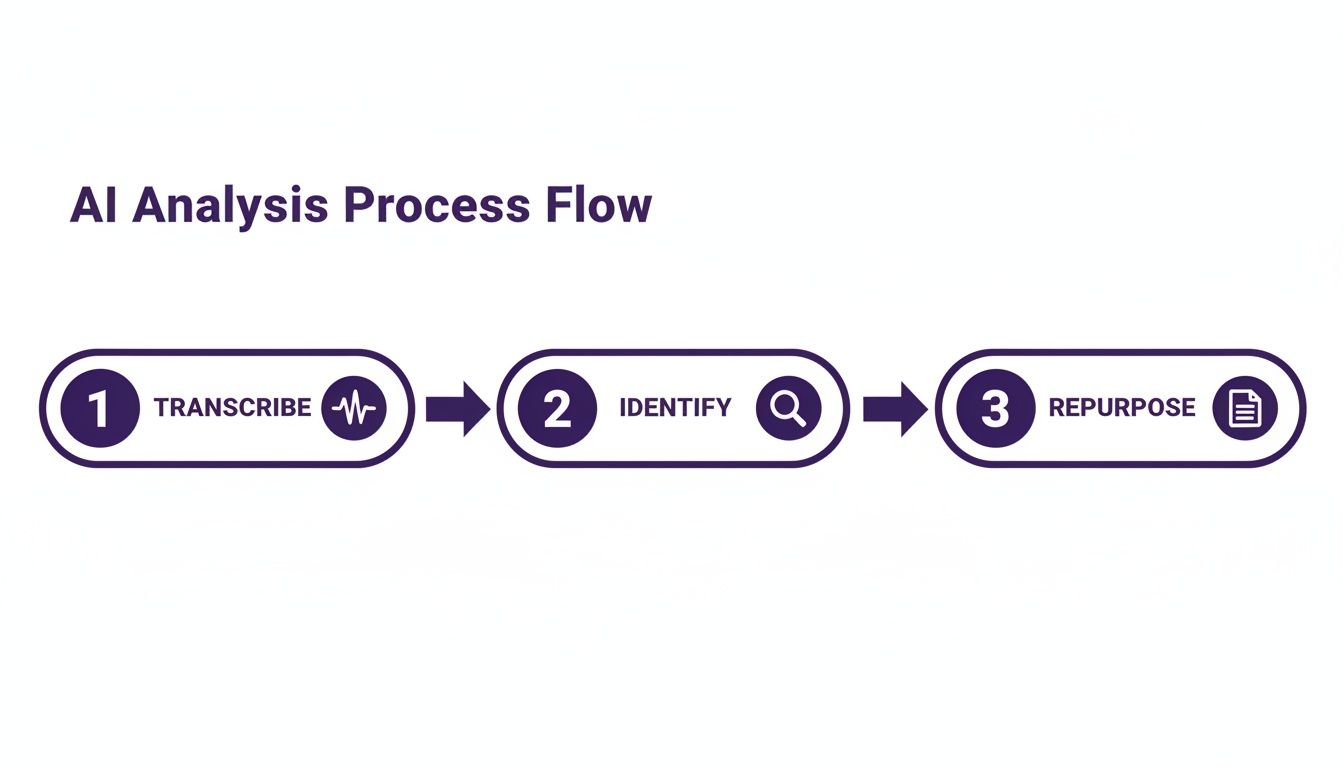
As you can see, good repurposing isn’t random. It starts with a deep analysis to pinpoint the moments with the most potential before a single new asset is created.
Once the analysis is done, the AI serves up a menu of potential content you can create. Your job is to pick the assets that actually line up with your marketing goals. Here’s what a typical haul from that single podcast episode might look like.
- A Comprehensive Blog Post: The AI can draft a 1,500-word article based on the podcast transcript, structuring it with clear headings, pull quotes, and key takeaways. It's instantly optimized for SEO and readability, giving you a powerful written asset to capture search traffic.
- Multiple Email Newsletters: Instead of one generic blast, the AI can spin up several versions. Maybe a quick summary for your main list, another focused on a single surprising insight for a specific segment, and a third in a "Top 5 Quotes" format to drive listens.
- A Series of Twitter/X Threads: The AI pinpoints the most compelling arguments or stories and structures them into engaging threads. Each tweet is crafted to build on the last, complete with relevant hashtags and a call-to-action to check out the full episode.
- Professional LinkedIn Posts: The AI understands the platform's professional vibe and extracts key thought-leadership moments. It can draft several posts that frame the episode's insights as valuable business advice, tagging your guest and relevant industry topics to get more eyes on it.
- Short-Form Video Clip Ideas: This is a goldmine for video creators. The AI can identify dozens of potential clips, giving you timestamps for the exact start and end points of viral-worthy moments. It can even suggest captions and on-screen text for platforms like TikTok, Instagram Reels, and YouTube Shorts.
Here’s a table that breaks down how this looks in practice, going from a single video to a full suite of content.
AI Repurposing Workflow From One Video to Multiple Assets
| Original Asset | AI-Generated Output | Platform/Use Case | Key Benefit |
|---|---|---|---|
| 60-Minute Webinar Video | 1,500-word SEO Blog Post | Website, Search Engines | Captures organic traffic and provides in-depth value. |
| 60-Minute Webinar Video | 3-Part Email Newsletter Series | Email Marketing | Nurtures leads with specific insights from the webinar. |
| 60-Minute Webinar Video | 5 Engaging X/Twitter Threads | Social Media (X/Twitter) | Drives conversation and directs followers to the full video. |
| 60-Minute Webinar Video | 4 Thought-Leadership LinkedIn Posts | Professional Networking (LinkedIn) | Establishes authority and engages a professional audience. |
| 60-Minute Webinar Video | 10 Short-Form Video Clips (Reels/Shorts) | Social Media (TikTok, Instagram, YouTube) | Maximizes reach with bite-sized, shareable content. |
This table shows just how much mileage you can get from a single piece of pillar content when you have the right system in place.
Why This Workflow Is a Game Changer
This systematic approach is exactly how professional creators and marketers are scaling their output without burning out. The numbers don't lie. In today’s fast-paced content world, 32% of marketers are already using AI to breathe new life into their existing assets. This strategy pays off big time, as brands that repurpose content weekly see a 3.5x increase in conversions compared to those posting just once a month.
Ultimately, a well-defined content repurposing AI workflow delivers a clear return. Content repurposing strategies have been shown to boost marketing ROI by an average of 32%, turning your content library from a static archive into a dynamic revenue driver. You can explore more data on how AI is reshaping content marketing strategies.
By adopting a structured workflow, you’re not just saving time—you're building a smarter, more integrated content engine. Every piece of pillar content you create becomes exponentially more valuable, ensuring you get every last drop of engagement from your hard work. This is how you move from being a hobbyist to a pro.
Organizing Your Content Library for AI Success

A content repurposing AI is a phenomenal tool, but it has one major weakness—it’s only as good as the content you feed it. Handing an AI a chaotic, messy library of assets is like asking a master chef to cook a gourmet meal with unlabeled cans from a disorganized pantry. They might come up with something, but it won’t be the masterpiece you were hoping for.
To get the most out of an AI, you first have to bring some order to your content archive. This isn’t just a digital spring cleaning; it’s the strategic groundwork that makes everything else possible. A well-organized library turns your old assets from a digital junk drawer into a structured, searchable knowledge base the AI can actually understand and use.
This prep work is becoming more important by the day. The market for AI in content creation, which includes content repurposing AI, is expected to jump from $9.3 billion in 2022 to a staggering $47.5 billion by 2030. Creators who get their libraries in order now will have a massive head start as AI begins to handle more repetitive content tasks. You can read more about the growth and adoption trends of AI in content creation.
Creating Your Content Taxonomy
The first move is to build a taxonomy—a clear, logical system for classifying everything you’ve ever made. Think of it as creating a detailed table of contents for your entire library. Instead of a single folder labeled "Videos," you create a system that lets you sort and find things on a much deeper level.
A solid taxonomy acts like a GPS for your AI tools. It tells them not just what a piece of content is, but what it’s about, allowing the AI to make smarter connections and generate far more relevant material.
Here’s what a practical content taxonomy looks like:
- Topic Clusters: Group your content by the main subjects you cover. A marketing creator might have clusters for things like "SEO," "Email Marketing," and "Social Media Strategy."
- Content Format: Be specific about the original format. Was it a "Podcast Interview," a "Solo Webinar," a "How-To Article," or a "Case Study"?
- Pillar Content: Flag your biggest, most comprehensive pieces. These are your "pillar" assets, and they are perfect candidates for being broken down and repurposed into dozens of smaller pieces.
The Power of Rich Metadata
Once your taxonomy is in place, the next step is to apply consistent metadata, or tags. If the taxonomy is the bookshelf, metadata is the detailed label on the spine of each book. This is where you add the context that helps both you and your AI understand the little details of each asset.
Metadata is what allows your AI to move beyond simple keyword matching and start understanding intent, sentiment, and audience fit. It's the difference between an AI that just pulls clips and one that suggests ideas.
A smart metadata strategy goes way beyond basic keywords. Think about tagging your content with information like:
- Target Audience: Is this for beginners, experts, or a specific industry?
- Sentiment and Tone: Tag content as "Inspirational," "Technical," "Humorous," or even "Controversial."
- Key Themes: What are the underlying ideas or recurring messages?
- Performance Data: Make sure to tag your best-performing assets so the AI knows what has already hit the mark with your audience.
By setting up this kind of structure, you turn your archive into an intelligent system. The AI can start spotting hidden patterns, like noticing that your "Inspirational" clips for "Beginners" always do better than anything else. That kind of insight lets you not only repurpose old content but also generate new ideas based on what you already know works. For a closer look at this, check out our guide on metadata management best practices.
Measuring the ROI of Your Repurposed Content
So, you're pumping out tons of fresh content from your original work. Great. But how do you actually know if your content repurposing AI strategy is making a difference? Throwing time and money at a system without checking the scoreboard is like flying blind. You have to move past simple view counts and other vanity metrics to see the real return on investment (ROI).
This is all about adopting a data-driven mindset. The real goal is to draw a straight line from that original pillar piece of content to all the smaller assets it spawned. When you can clearly see that a single podcast episode drove more website traffic, pulled in new email subscribers, and boosted social engagement, you’ve found a winning formula you can run again and again.
Key Metrics to Track for Repurposed Content
To get a clear picture of your ROI, you need to look at both efficiency and performance. Start by tracking a handful of core key performance indicators (KPIs) that tell the whole story. These numbers help you understand not just what is working, but why it's working.
- Engagement Rate by Platform: Don't just lump all your engagement numbers into one bucket. Track comments, shares, and likes for each repurposed asset on its home turf. A high share rate on LinkedIn for a webinar clip tells you that content hits the mark with a professional crowd.
- Click-Through Rate (CTR): How many people who saw that repurposed tweet or Instagram post actually clicked the link back to your main blog or video? A healthy CTR is a direct signal that your repurposed content is compelling enough to make someone take action.
- Conversion Rate: This is where the rubber meets the road. Track how many people who engaged with your repurposed content did what you wanted them to do, like signing up for your newsletter or downloading a guide. This connects your repurposing efforts directly to business growth.
A killer metric for measuring efficiency is the Content Utilization Rate. This is simply the percentage of your content library you've actively repurposed over a certain period. If that number is going up, it means you're successfully mining the gold sitting in your archives.
Identifying Your Pillar Content Champions
Once you start tracking these metrics consistently, you'll see powerful patterns emerge. Over time, you’ll notice that certain original assets—your 'pillar' content—are absolute rockstars at generating high-performing repurposed material. Maybe you'll find that your expert interview videos consistently spin off viral social clips, while your solo podcasts are better at creating deep-dive blog posts.
This creates a powerful feedback loop. The insights you get from measuring performance let you:
- Pinpoint Top-Performing Topics: You'll learn exactly which themes and subjects light up your audience across different formats.
- Double Down on Winners: Once you know which pillar assets are goldmines, you can focus your creative energy on making more just like them.
- Optimize Future Content: Your data will start to inform your entire content strategy, making sure you create new pillar content with repurposing potential baked in from the very start.
This analytical approach turns content creation from a guessing game into a calculated strategy. For any creator trying to go from hobbyist to pro, understanding the ROI of content marketing is non-negotiable. By measuring what matters, you can fine-tune your content repurposing AI workflow and build a sustainable engine for growing your audience and your revenue.
Creating a Human and AI Collaboration
Let's get one thing straight: the future isn't about AI replacing talented creators. It's about building a powerful partnership where technology amplifies human creativity, not makes it obsolete.
This new reality positions AI as your super-efficient creative assistant. It can tackle all the mechanical, time-sucking parts of repurposing—stuff like transcription, summarizing, and knocking out first drafts. This frees you up to focus on the things that actually matter: strategy, nuance, and telling a great story.
Think of it this way: AI can quarry a block of marble in seconds, but you're still the one who has to sculpt it into a masterpiece.
Preserving Your Authentic Brand Voice
A lot of creators worry that using content repurposing AI will water down their unique voice and make them sound like a robot. It’s a totally valid concern, but one that’s easily solved by putting the right workflow in place. The key is to treat AI-generated drafts as a starting point, never the final product.
A human editor always needs to be the final gatekeeper. Your job is to refine the AI’s output, making sure it perfectly aligns with your brand’s specific tone and quality standards. This is the step that keeps you connected with your audience.
Here’s how that partnership looks in the real world:
- AI does the heavy lifting: It spits out initial drafts, pulls interesting quotes, and suggests different angles based on your existing content.
- You provide the soul: Editors and creators jump in to inject personality, add personal stories, and double-check for factual accuracy.
This hybrid approach turns repurposing from a mind-numbing chore into a strategic process of discovery and refinement.
Co-Creating with Your Content Library
The most interesting platforms are built specifically for this kind of teamwork. They let you and your team essentially "talk" to your entire content library. Instead of just searching for keywords, you can ask your archive complex questions, bounce new ideas off of it, and co-create with the AI in real time.
This collaborative process truly combines the best of both worlds: the lightning-fast processing of AI and the irreplaceable gut feeling and insight of a human creator. The result is content that’s not only produced efficiently but is also deeply resonant and valuable.
For creators looking to go from hobbyist to professional, this is everything. Platforms like Contesimal are designed to structure this collaboration, allowing your whole team to gather around your collective knowledge. You can find new connections in old work and generate fresh value, turning a static archive into a living, breathing creative engine.
Still Have Questions About AI in Your Workflow?
Jumping into any new process, especially one involving AI, naturally comes with a few questions. It’s smart to be curious. Let’s clear up some of the common concerns so you can move forward with total confidence.
Will Using AI for Repurposing Make My Brand Sound Like a Robot?
Not if you’re smart about it. The secret is to treat AI as your incredibly fast, tireless assistant—not as the final creative director.
Think of it as a collaboration. The AI does the grunt work: transcribing hours of video, summarizing dense articles, and creating a first pass of social media drafts. Then, your team—the human experts who know your brand inside and out—steps in to refine everything. They add the nuance, polish the tone, and ensure every word aligns perfectly with your brand's voice.
AI handles the heavy lifting, but your creative judgment always has the final say.
Okay, I’m In. What’s the Very First Thing I Should Do?
Before you even think about plugging in an AI tool, get your house in order. The single most important first step is organizing your content library.
An AI can’t repurpose what it can’t find or understand. Start by building a simple taxonomy—just a straightforward system of categories and tags for your existing videos, articles, and podcasts. Tagging by core topic, the original format (e.g., "podcast interview," "product demo video"), and the intended audience is a fantastic place to start.
This foundational work makes any AI tool you use exponentially more powerful. A clean, organized library is the fuel for a high-performing content engine.
How Do I Know if Any of This is Actually Working?
You measure it. Don't just throw repurposed content out into the world and hope for the best. Track the engagement metrics for every new asset you create.
For instance, if you slice one long video into 10 social media clips, which ones get the most shares, comments, and clicks? Which ones are driving people back to your website? By monitoring these small-scale results, you start to see bigger patterns. Over time, you’ll learn exactly which original topics and formats produce the most effective spin-off content, letting you double down on what works.
Is AI Better for Repurposing Video or Written Content?
Honestly, it’s a powerhouse for both. AI tools are incredibly effective across different media types, just in different ways.
For your videos and podcasts, AI is a wizard at transcription, pinpointing key moments worth clipping, and suggesting powerful soundbites. For your written articles, it’s brilliant at generating summaries, rephrasing paragraphs for different audiences, or pulling out key stats and quotes for social media.
The best strategy isn't to pick one over the other. It’s to let AI loose on your entire library. You might be surprised when it finds a golden connection between a podcast episode and a blog post you wrote a year ago—a connection you would have completely missed.
Ready to stop letting your best work gather dust? Contesimal provides the platform you need to finally get your library organized, put AI to work, and generate real value from the content you've already created.
Learn how Contesimal can help you reignite your content today.