
The real magic of content marketing isn’t just about getting a quick win; it’s about generating compounding value that turns your creative work into a powerful business asset that grows stronger over time. Simply put, ROI measures the revenue your content generates against what it cost to create, proving that every blog post, video, or podcast is a strategic investment, not just an expense.
Why Content Marketing ROI Is Your Most Important Metric

Let's be honest—proving the financial impact of your creative work can be a real headache. For too long, content creators, from YouTubers to professional marketers, have struggled to draw a clear line from their efforts to the bottom line, which often leaves content feeling more like a cost center than a growth engine.
But what if you could completely flip that script?
Calculating your content marketing ROI is the key to trading confusing data points for confident, data-backed decisions. This isn't just about justifying your budget. It's about truly understanding what clicks with your audience and making smarter choices that fuel real, sustainable growth.
Content as an Orchard, Not a Billboard
Think about the difference between renting a billboard and planting an orchard. The billboard gives you a temporary burst of visibility. The moment you stop paying, the ad comes down, and its value vanishes. That’s traditional advertising—immediate but fleeting.
Content marketing, on the other hand, is like planting that orchard. It takes an upfront investment of time and resources, and the initial growth might feel a bit slow. But with consistent care, each piece of content—each tree—grows stronger, bearing fruit year after year.
A blog post from two years ago can still bring in new leads today. A classic video can continue building your brand's authority long after its publish date. This is the power of compounding returns in action.
Your content library isn't just a collection of past work; it's a treasure trove of untapped potential. Measuring ROI is the first step to unlocking that value and turning your creative history into future revenue.
The Financial Power of Consistent Content
This long-term value isn’t just a nice idea; the numbers back it up. When done right, content marketing delivers incredible long-term returns. For example, a well-executed thought leadership campaign can see its ROI scale dramatically, starting at 367% in its first year and climbing to over 650% by year three. You can dig into these content marketing ROI statistics to see the full financial breakdown.
This guide will give you the roadmap to measure that growth effectively. We'll walk through simple formulas, spotlight the metrics that actually matter, and show you smart tools that make calculating ROI something every creator can do—not just the data scientists. You’ll learn exactly how to transform your content from an expense into your most valuable asset.
Decoding the Metrics That Truly Matter
To really get a handle on content marketing ROI, you have to look past the flashy, surface-level numbers. It’s way too easy to get lost in a sea of data, high-fiving over a spike in page views or a jump in your follower count. We call these vanity metrics—they look great in a report, but they don't actually tell you if your content is moving the needle for your business.
We need to zero in on the numbers that show real audience interest and intent. Think of it like this: a thousand people walking past your storefront (page views) is nice, but the ten people who step inside and actually browse the aisles (engagement) are infinitely more valuable. Those are the ones who might actually buy something.
To cut through all that noise, let's group the meaningful metrics into three core buckets. Each one tells a different part of your content's story, helping you build a clear picture of what’s working before you even pull out a calculator.
Consumption Metrics: What Your Audience Sees
This is ground zero for measurement. It answers the most basic question: are people even finding and looking at your stuff? While these numbers alone don't prove ROI, they're the first domino that has to fall. If nobody sees your content, nothing else matters.
Imagine you're a podcaster. Your download numbers are a core consumption metric. For a YouTuber, it's video views. For a blogger, it's unique visitors or page views. These figures confirm your content is reaching someone.
But raw numbers can fool you. A far more telling metric in this category is Average Time on Page or Video Watch Time.
A high Time on Page is like a customer lingering in a store aisle, carefully reading product labels. It signals deep interest and suggests your content is genuinely resonating, not just getting a fleeting glance.
Engagement Metrics: How Your Audience Interacts
Engagement metrics show you who is interacting with your content and how deeply they're connecting with it. This is where you go from having a passive audience to building an active community. Engagement is the bridge between someone just seeing your content and them taking a meaningful step forward.
Key engagement metrics include:
- Likes, Comments, and Shares: These are the most direct signals that your content sparked a reaction. Shares are especially golden, since they're a personal endorsement to a whole new network.
- Backlinks: When another quality site links to your content, it’s a massive vote of confidence that boosts both your authority and your SEO.
- Email Open Rates and Click-Through Rates (CTR): If you have a newsletter, these metrics show how many subscribers aren't just getting your content in their inbox but are actively clicking to see more.
Strong engagement is a sign you're building trust and a loyal following—two things you absolutely need for long-term ROI. For a deeper dive on this, you can learn more about how to analyze content performance in our comprehensive guide.
Conversion Metrics: What Actions They Take
Alright, this is where the rubber meets the road. Conversion metrics are the most direct line to financial return because they track the specific actions that lead to revenue. These are the numbers that tie your creative work directly to business growth.
Think of a conversion as that magic moment when a viewer or reader takes a tangible step toward becoming a customer.
Common conversion metrics include:
- Lead Generation: This counts how many people filled out a form, downloaded a guide, or signed up for your email list. Every single lead is a potential future sale.
- Sales Attributed to Content: Using analytics, you can actually see how many customers bought something after engaging with a specific blog post, video, or webinar.
- Subscriber Growth: For creators who monetize through subscriptions or memberships, this is a direct measure of the revenue your content is generating.
By focusing on these three categories—Consumption, Engagement, and Conversion—you build a complete story. You can see how many people you reached, how many of them cared enough to interact, and finally, how many took a valuable action because of it. This structured view gives you the solid foundation you need before plugging anything into the final ROI formula.
The Simple Formula for Calculating Content ROI
Alright, we've nailed down the metrics that matter. Now it's time to get our hands dirty and put that theory into practice. Don't worry, calculating the ROI of your content isn't some dark art reserved for data wizards. It all comes down to a single, straightforward formula anyone can use to prove their impact.
The core formula is actually pretty simple:
Content Marketing ROI = ((Return – Investment) / Investment) x 100
What this gives you is a clean percentage that tells you exactly how much value you're getting for every dollar you spend. If it's positive, you're in the green. If it's negative, it’s a clear signal that something in your strategy needs a tweak. Let's break down what goes into each part of that equation.
Think of the journey from a simple page view to a paying customer. It’s a funnel, where each step builds on the last.
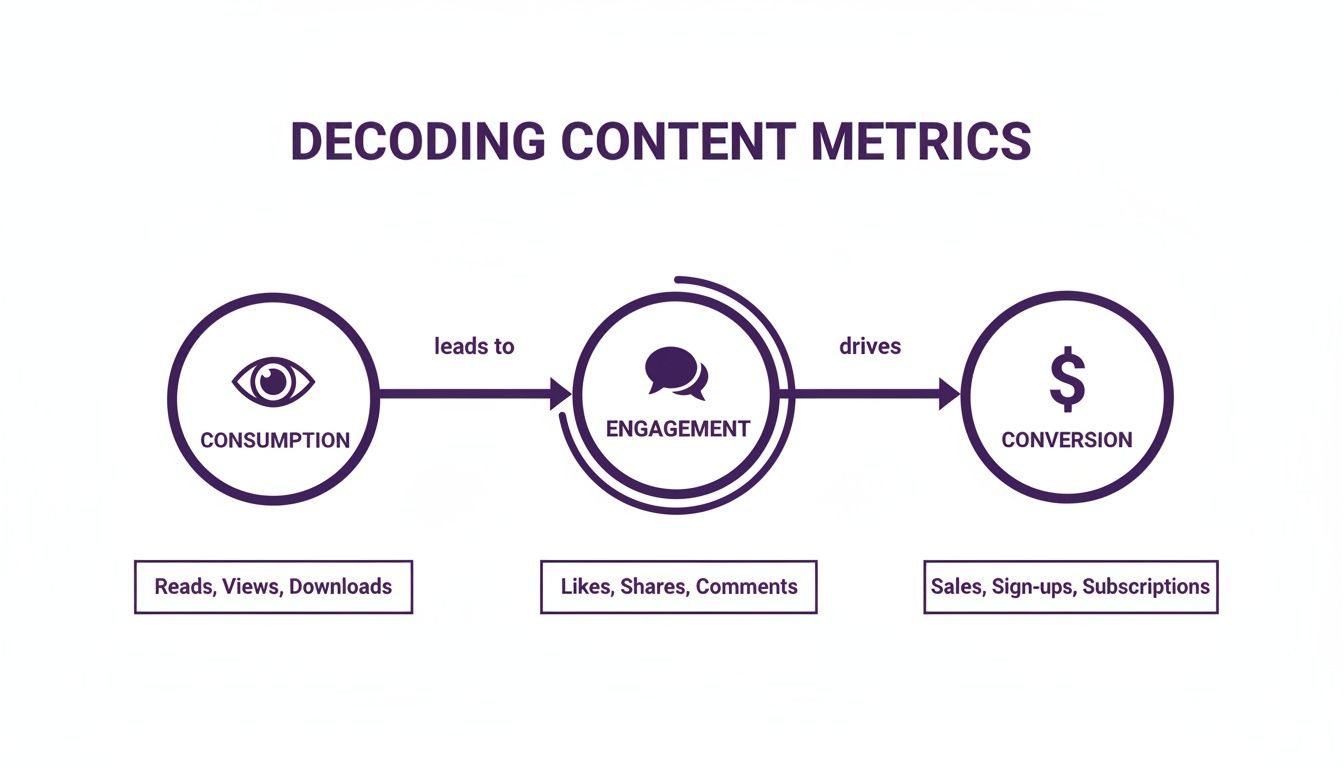
As you can see, getting eyes on your content is just the first step. The real magic happens when people engage, which is what ultimately leads to the conversions that pump up your ROI.
Defining Your Investment
The "Investment" side of the formula is the easy part. It's simply the total cost of everything that went into creating and promoting your content. The key is to be thorough so you get a truly accurate number.
Here’s a quick checklist of what to include:
- Your Time: This is a big one people forget! Slap an hourly rate on your own work, whether you're brainstorming, writing, shooting video, or editing.
- Software and Tools: Add up all those subscriptions for your editing software, hosting platforms, social schedulers, and analytics tools.
- Freelance and Team Costs: Any cash you paid out to freelance writers, designers, editors, or virtual assistants goes here.
- Ad Spend: This is the budget you put behind promoting your content on Google, social media, or anywhere else.
Tally all that up, and you’ve got your total investment. Simple.
Calculating Your Return
Now for the "Return," which is the total value your content generated. This can feel a bit fuzzy because not all wins are direct sales, but the goal is to assign a dollar value to the actions your content drives. To get a solid handle on this, learning how to calculate marketing ROI is a must.
Here’s how to put a price tag on some key conversions:
- Subscriber Value: If you run a subscription, this is a no-brainer—it’s just the monthly or annual fee.
- Lead Value: Let's say a blog post brings in a lead for a $500 service, and you know your sales team closes about 10% of those leads. That means each lead is worth $50 ($500 x 0.10).
- Affiliate Revenue: This is just the total commission you earned from any affiliate links you included.
This step is all about connecting the dots between your content and real business results. You have to know what a new subscriber, a qualified lead, or a sale is actually worth to your bottom line.
A Practical Example: A YouTuber's Video Series
Let's walk through a real-world scenario. Imagine a YouTuber who creates a five-part video series teaching video editing.
Investment Calculation:
- Her Time: 40 hours at $50/hour = $2,000
- Software: Monthly subscription for editing software = $50
- Ad Spend: YouTube ads to promote the series = $250
- Total Investment: $2,000 + $50 + $250 = $2,300
Return Calculation:
The videos all point to her premium editing course, which costs $300. Over the next three months, the series drives 20 sales.
- Total Revenue: 20 sales x $300/sale = $6,000
- Total Return: $6,000
Now, we just plug those numbers into our formula:
ROI = (($6,000 – $2,300) / $2,300) x 100
ROI = ($3,700 / $2,300) x 100
ROI = 1.608 x 100
ROI = 160.8%
The result? For every single dollar this YouTuber invested in her video series, she made $1.61 in pure profit. This is the kind of math that takes the guesswork out of your content strategy. You can apply this exact same logic to your own work and finally see what's actually moving the needle.
Choosing the Right Attribution Model
Figuring out which piece of content gets the credit for a conversion can feel like solving a puzzle. Let's say a customer reads three of your blog posts, watches a video, and then clicks a link in your email newsletter before finally buying something. Which one of those assets actually did the heavy lifting?
This is where attribution models come in.
Think of the whole customer journey like a basketball game. Multiple players might pass the ball (the assists) before one player scores the final basket (the conversion). An attribution model is just the rulebook you use to decide how to assign credit for that basket.
There’s no single “perfect” model that works for every creator or publisher. The right choice really hinges on your goals, how long your sales cycle is, and the way your audience typically interacts with your content. The key is to pick a model that actually reflects your strategy and helps you make smarter decisions down the line.
First-Touch Attribution: The Scouter
First-Touch attribution gives 100% of the credit to the very first piece of content a person interacted with before they became a lead or customer. In our basketball analogy, this is like giving all the glory to the player who first brought the ball down the court, completely ignoring who made the final shot.
This model is fantastic for understanding what content is best at sparking initial awareness. If you're a YouTuber focused on pulling in brand-new subscribers, First-Touch will show you exactly which videos are your best entry points. It answers the question: "What content is introducing people to my brand?"
Last-Touch Attribution: The Closer
On the flip side, Last-Touch attribution gives 100% of the credit to the final piece of content someone engaged with right before converting. This is like crediting only the player who scored the basket, overlooking all the assists that set them up for the easy shot.
This is the simplest model to track and it’s often the default setting in many analytics platforms. It’s most useful for creators with really short and direct conversion paths. For instance, if you're a blogger whose main goal is a quick email sign-up from a single post, Last-Touch gives you a crystal-clear picture of what content is sealing the deal.
But its simplicity is also its biggest weakness. It totally ignores all the earlier content that built trust and warmed up the audience, which can leave you with a skewed view of what’s actually valuable in a longer customer journey.
Choosing an attribution model isn't about finding the 'right' answer; it's about asking the right questions. Do you want to know what starts the conversation, what closes the deal, or how the entire journey works together?
Multi-Touch Attribution: The Team Player
Multi-Touch attribution is the most balanced approach because it spreads the credit across multiple touchpoints in the customer's journey. It gets that several pieces of content often work together to land a conversion, just like a great basketball team relies on solid teamwork.
This approach recognizes every assist and every pass, giving you a much more holistic view of what’s working. You'll find a few common variations within this category.
To make sense of it all, let’s break down the most common models.
Comparing Content Marketing Attribution Models
The table below offers a clear comparison of common attribution models. It’s designed to help you decide which approach best suits your content strategy and business goals.
| Attribution Model | How It Works | Best For |
|---|---|---|
| First-Touch | Gives 100% credit to the first interaction someone has with your content. | Understanding top-of-funnel content that drives initial awareness and brings new people in. |
| Last-Touch | Gives 100% credit to the final interaction right before a conversion. | Creators with short sales cycles or direct calls-to-action, like an immediate sign-up. |
| Linear | Distributes credit equally across every single touchpoint in the journey. | Getting a simple, baseline understanding of all the content that plays a role in the conversion path. |
| Time-Decay | Gives more credit to touchpoints that happened closer to the conversion. | Businesses with longer consideration periods, as it values the content that pushed the final decision. |
| U-Shaped | Gives 40% credit to the first touch, 40% to the last touch, and splits the remaining 20% among the middle touches. | Valuing both the content that started the journey and the content that closed the deal. |
Choosing the right model ultimately comes down to what you want to learn. Multi-Touch models are almost always a better fit for publishers, podcasters, and marketers with longer sales cycles where nurturing an audience is key. By understanding the entire path, you can optimize every stage of your content funnel and get a far more accurate picture of your true content marketing ROI.
How AI and Smart Tools Are Changing the ROI Game

Let's be honest: trying to manually track every metric, touchpoint, and conversion is a nightmare. For creators sitting on a mountain of backlogged content, it’s not just hard, it’s practically impossible. This is where modern tools are completely flipping the script on calculating the roi of content marketing.
Smart tools and AI platforms do the heavy lifting for you. They automate the mind-numbing parts of data collection so you can stop wrestling with spreadsheets and get back to strategy. They connect the dots between what you create and what your audience does, uncovering insights you’d almost certainly miss on your own.
Instead of just giving you page views, these systems can analyze user behavior to show you why a piece of content is a hit. They can pinpoint the exact second a viewer bounces from a video or tell you which blog post consistently brings in the best leads.
Finding the Buried Treasure in Your Content Library
If you’re a creator, publisher, or marketer with years of work piled up—old podcasts, video archives, and countless articles—you’re probably looking at it as a static cost. It just… exists. It's not actively making you money. That’s a huge missed opportunity.
Imagine having an AI that acts like your personal content strategist. It digs through your entire library to:
- Pinpoint your most valuable topics by analyzing long-term engagement and conversion data.
- Spot evergreen assets that are begging to be repurposed into new formats.
- Discover what truly connects with your most valuable audience segments.
This process gives a direct shot in the arm to the 'Return' side of your ROI calculation. It transforms your content archive from a digital storage closet into a dynamic asset that generates new revenue, breathing life and financial value back into the work you’ve already done.
The Power of Content Intelligence
Platforms like Contesimal are built specifically to help creators organize and understand their content libraries to create new value. Using AI to classify and analyze your whole backlog, you can suddenly see patterns and opportunities that were completely invisible before. This is the heart of what content intelligence platforms do—they turn raw data into actionable creative direction.
AI-powered content marketing is already delivering massive returns. In fact, 70% of marketers using AI for personalization have reported 200% or higher ROI. These strategies are proven to boost ROI by an average of 68%, showing just how effectively AI can turn a chaotic content library into an organized, profitable machine.
For YouTubers, podcasters, and publishers, your back catalog isn't just history—it's a goldmine of data. AI gives you the tools to excavate that value, helping you figure out what to create next by deeply understanding what already worked in the past.
If you’re serious about improving your ROI analysis, checking out a practical AI SEO tools comparison can help you pick the right platforms for tracking performance. By automating data collection and analysis, these tools don't just save you time—they paint a much clearer, more accurate picture of what's actually driving your success. This lets you make data-backed decisions that consistently improve your return on investment.
Turning Your Content History Into Future Revenue
Ultimately, calculating the ROI of content marketing isn’t just about justifying your budget—it’s about making smarter strategic decisions. It’s the shift in mindset that turns your content from a line item expense into a powerful, revenue-generating asset. This journey takes a bit of patience, a sharp focus on the metrics that actually matter, and the right tools to uncover all that hidden value.
When you measure ROI, you stop seeing your content library as just a collection of stuff you’ve already made. Instead, it becomes a treasure trove of untapped potential. Every video, podcast, and article you've published holds clues about what truly connects with your audience, what drives them to act, and where your next big idea should come from. The key is knowing how to unlock it.
From Content Archive to Active Asset
The content marketing industry is absolutely exploding, forecasted to rocket to $107 billion in revenue by 2026. That’s a testament to its massive scale. Creators and marketers who get strategic about their content are seeing incredible returns—bloggers are 13 times more likely to achieve positive ROI, and a whopping 70% of marketers are seeing more leads from their efforts. If you want to dive deeper into these trends, you can check out the latest content marketing statistics.
This is where smart platforms become your secret weapon. Tools like Contesimal are built specifically to help you organize, understand, and reignite your content library. By analyzing your entire history, you can quickly pinpoint evergreen topics, spot opportunities for repurposing, and collaborate more effectively to create new value from work you’ve already done. It turns your archive from a static cost center into a dynamic, strategic asset.
Measuring ROI is the map that guides your creative process. It shows you where you’ve been, what worked, and exactly where to go next for maximum impact.
By adopting a data-informed mindset, you can finally stop guessing and start building a content engine that reliably fuels your growth. If you're ready to get more from what you already have, read our guide on maximizing ROI by transforming your content library. This approach is how you turn your creative history into a predictable source of future revenue.
Still Have Questions About Content ROI?
Let's be honest: figuring out the ROI of content marketing can feel like trying to nail Jell-O to a wall. But it doesn't have to be that complicated. Let's tackle some of the most common questions that pop up for creators, marketers, and publishers trying to measure the real value of their work. This quick-fire guide should clear up any lingering doubts.
How Long Does This Actually Take?
Content marketing is a long game. It's a marathon, not a sprint. While you'll probably start seeing some good signs—like more traffic and people actually talking to you—within 3-6 months, a real, solid financial ROI usually takes 12-18 months to show up.
Think of it like pushing one of those giant, heavy flywheels. The first few shoves feel like they do almost nothing. But if you keep pushing consistently, your content starts to rank, you build authority, and you gather an audience that trusts you. The real magic happens when that momentum takes over, with returns often compounding like crazy in years two and three.
So, What’s a “Good” ROI Anyway?
There’s no single magic number here. A "good" ROI is completely tied to your industry, how your business makes money, and what you’re trying to achieve in the first place. That said, a common benchmark that many businesses shoot for is a 5:1 ratio. In plain English, that means you're making $5 for every $1 you spend.
Of course, the best campaigns can blow that out of the water, easily hitting a 10:1 ratio or more over time. This is especially true for evergreen content that just keeps pulling its weight long after you hit publish. So, instead of getting hung up on some universal number, focus on making steady, measurable progress and connecting your content directly to business goals, like getting qualified leads or straight-up driving sales.
Can I Do This Without Spending a Ton on Fancy Tools?
Absolutely. You can start getting a handle on your content's impact today with tools that are completely free. Google Analytics is your best friend for tracking website traffic, seeing what people do on your site, and tracking conversions. From there, you can mix in data from your email platform or social media accounts.
And for tracking what you've spent? A simple spreadsheet is all you need. Just log what you're spending on your own time, software, or any freelancers you hire.
While the more advanced tools can definitely automate things and give you deeper insights (especially if you have a massive content library), a manual approach is the perfect place to start. It helps you prove your content is working and build a rock-solid case for getting more budget down the line.
Ready to unlock the hidden value in your content library and get a clearer picture of your ROI? Contesimal is an AI-powered platform designed to help creators and publishers organize, analyze, and reignite their content archives. Turn your past work into future revenue by discovering what truly resonates with your audience. Learn more at https://contesimal.ai.