
Are you constantly scrambling to post something, anything, while your best videos are collecting digital dust? The answer isn't just to make more content. It's to get smarter with content calendar marketing. This is how you build a real roadmap for growth, turning your efforts from pure chaos into a consistent, profitable machine, letting you upcycle old content and create new value.
From Content Chaos To Strategic Clarity
If your content creation feels less like a well-oiled machine and more like a frantic treadmill, you're in good company. So many creators, from rising YouTubers transitioning from hobbyist to professional, to established publishers, hit that same wall. You're stuck in a cycle of reactive posting and an inconsistent schedule that just leads to burnout.
Meanwhile, your best assets get buried, great ideas are forgotten, and the pressure to always create something brand new is just crushing. That’s content chaos, and it’s the biggest thing standing between your passion and a sustainable business.
A modern content calendar is your way out. Forget the simple spreadsheet. A dynamic calendar is a strategic tool for organizing your content library, collaborating with your team, and consistently publishing content that actually connects with your audience. The first real step is learning how to create a social media content calendar that actually works.

Unlocking Your Content Library's Hidden Value
Here's where things get really interesting. A content calendar's true power goes way beyond just scheduling new posts. For any content creator, writer, or publisher with an existing library of content, it’s a treasure map. By planning things out, you can systematically pull your best-performing assets out of the archives, reigniting your content library and turning it into a fresh engine for engagement and revenue.
A well-maintained content calendar is the backbone of any successful content operation. It ensures every piece of content—whether brand new or repurposed from your archives—serves a specific purpose and supports your overarching goals to generate more value.
This shift in mindset is what separates the pros from the hobbyists. Instead of just grinding away on the next video or podcast, your calendar helps you see the entire board.
Suddenly, you can:
- Plan for Repurposing: Intentionally schedule the breakdown of a long-form video into social clips, blog posts, and newsletter highlights to generate audience across platforms.
- Identify Content Gaps: Visually spot where your content is thin and plan new pieces—or repurpose old ones—to fill those holes and build on successful concepts.
- Maintain Consistency: Build real trust with your audience by delivering valuable content on a reliable schedule, no matter the platform.
Ultimately, this guide is going to walk you through using a content calendar to Organize. Understand. Take Action.—transforming your content library from a passive archive into an active, money-making asset.
Building Your Strategic Content Foundation
A killer content calendar doesn't start with plugging dates into a spreadsheet. That’s the last step. It actually begins with a solid, strategic foundation. Before you even think about what to create or when to post it, you’ve got to nail down the why and the how. This early work ensures every single piece of content serves a real purpose, pushing you closer to your goals.
This means getting way more specific than just "get more page views." You need clear, measurable objectives—what some people call SMART goals. This framework is what turns fuzzy hopes into actual targets you can hit.
For instance, a YouTuber trying to go from hobbyist to pro might set a goal to increase average watch time on new videos by 15% within the next quarter. A publisher could aim to boost newsletter subscriptions from blog content by 20% in the next six months. These aren't just wishes; they're benchmarks that will shape every decision you make.
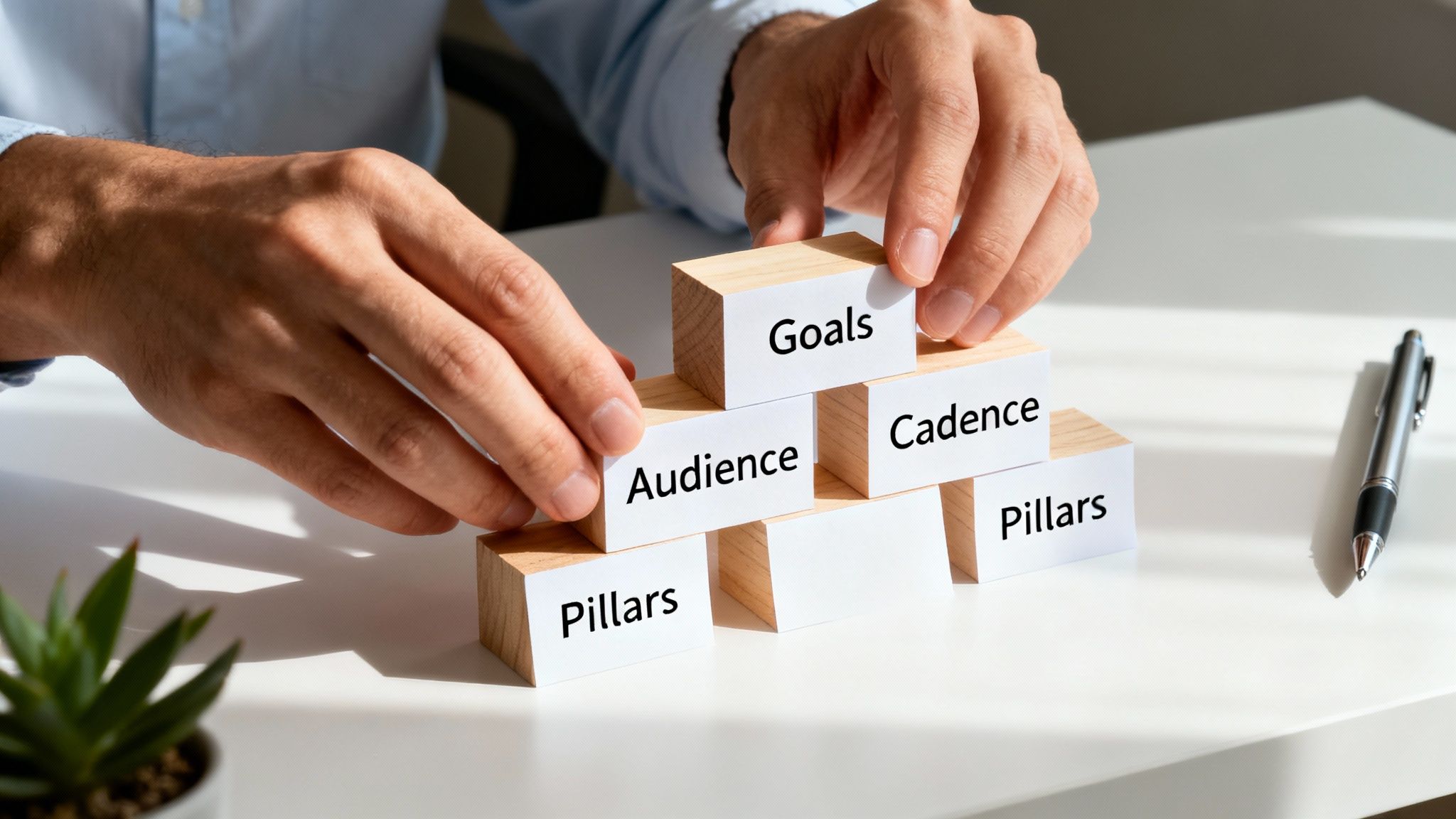
Map Your Audience Journey and Content Cadence
Once your goals are locked in, you need to get inside your audience's head. People don't just magically appear; they follow a path from discovering you to becoming a loyal fan. Your content calendar should strategically drop the right content at each stage of that journey, answering their questions exactly when they need it.
Think about your different platforms. Someone finding you on TikTok for the first time needs something completely different from a long-time podcast subscriber. Mapping this out helps you build a cohesive experience that guides them from one touchpoint to the next, building a much stronger connection.
This leads right into setting a content cadence you can actually stick with. This isn't about posting constantly. It's about finding a rhythm that works for you without burning out or letting quality slide. A smart cadence balances big, high-impact "pillar" content with smaller, related pieces.
- Pillar Content: These are your big-ticket items—the cornerstones of your strategy. Think of a deep-dive YouTube video, a massive guide on your blog, or a major podcast interview.
- Derivative Content: These are the smaller assets you spin off from your pillar pieces. That in-depth video? It can be chopped into short clips for social media, key insights for your newsletter, or slick quote graphics for Instagram.
This approach keeps you delivering value consistently without needing to reinvent the wheel every single day. Your calendar becomes the tool that orchestrates both the big splashy releases and the steady drumbeat of supporting content that keeps your audience hooked.
Your content calendar's job is to orchestrate a consistent rhythm of value. It balances the major beats of your pillar content with the steady, engaging pulse of derivative pieces, creating a flow that builds and retains an audience.
Build Your Strategy Around Pillars and Clusters
If you really want to establish authority and boost your visibility, structure your calendar around topic pillars and content clusters. This model is a total game-changer for any storyteller, podcaster, or marketer trying to dominate a niche. A pillar is a broad topic core to your brand, while clusters are all the specific subtopics that branch off from it.
Picture a podcaster whose main pillar is "Sustainable Entrepreneurship." Their calendar wouldn't be a random mix of episodes. It would be neatly organized into clusters:
- Cluster 1: Eco-Friendly Supply Chains (with interviews from sustainable suppliers).
- Cluster 2: Ethical Marketing Tactics (breaking down successful campaigns).
- Cluster 3: Conscious Leadership (sharing management tips and personal stories).
Every piece of content in a cluster links back to the main pillar page or asset, creating this powerful, interconnected web of information. This structure is also gold for SEO because it screams to search engines that you're an authority on that topic. You can see exactly how to apply this in our guide to developing an SEO content strategy.
By building this framework first, you guarantee your content calendar is more than just a schedule—it's a strategic map for building your brand's authority, one piece of content at a time.
Mining Your Archives For Content Gold
Your content library isn't just a dusty record of what you've published. It's a goldmine of proven ideas waiting to be unearthed, ready for you to upcycle and create new value.
For creators and publishers looking to scale, one of the smartest moves you can make is shifting from a constant, grueling creation cycle to a more strategic curation mindset. This is all about finding the hidden gems in your past work and giving them new life—and your content calendar is the perfect place to orchestrate this revival.
It all starts with a content audit, which sounds way more intimidating than it actually is. You're simply taking stock of everything you've already created. Every video, podcast, and article gets put on the table. But this isn't just about making a list; you're looking for patterns. You want to categorize each piece by performance, topic, and format to see what really connected with your audience.
Imagine a podcaster with a back catalog of hundreds of episodes. A quick audit reveals their interviews with startup founders consistently pull in 30% higher downloads than any other topic. That single insight is a roadmap for future content, both brand new and repurposed.
This process gives you the foundation for a much smarter content strategy—one that bets on proven winners instead of just guessing what might work next. It’s about letting your own history guide your decisions.
Supercharging Discovery With AI
Let's be real: manually sifting through a massive content library can be a soul-crushing time sink. This is where modern tools completely change the game for creators who are moving from hobbyist to professional.
Platforms like Contesimal use AI to turn what could be a week-long task into a matter of minutes. It helps humans and AI collaborate seamlessly, enabling you to discover insights in your library. Instead of you manually tagging old videos, the AI can automatically analyze transcripts, pull out key themes, and surface high-potential assets you probably forgot you even made.
Think about how this plays out in the real world:
- The YouTuber: A travel vlogger can instantly find every single segment across dozens of videos where they discussed "budget travel tips for Europe." This becomes the raw material for a new compilation video, a series of short-form clips for TikTok, and a detailed blog post.
- The Publisher: An online magazine can identify every article published in the last five years related to a suddenly trending news topic. This lets them quickly create a "definitive guide" by curating and updating their best archival content.
- The Podcaster: A creator can find every mention of a specific guest or concept across their entire episode history, generating a month's worth of shareable clips and articles in a single afternoon.
This AI-powered approach helps your team collaborate more effectively, uncovering connections and opportunities that would otherwise stay buried.
Creating a Robust Tagging System
Once you've audited your library, the next critical step is building a solid tagging system. This is the organizational backbone that makes your content library easily searchable for both your human team and any AI tools you're using.
A good tagging system goes way beyond generic labels. It should be multi-layered, including tags for:
- Core Topics: The main subject matter (e.g., "Content Marketing," "Video Editing").
- Sub-Topics: More specific themes within a core topic (e.g., "SEO for Blogs," "YouTube Thumbnails").
- Content Format: The type of asset (e.g., "Interview," "Tutorial," "Case Study").
- Performance: A label indicating its success (e.g., "High-Engagement," "Evergreen," "Top-Converter").
Creating this taxonomy transforms your archive from a messy digital closet into a structured, queryable database. When you’re planning your content calendar, you can then easily search for "high-engagement tutorials about YouTube thumbnails" and instantly pull assets to repurpose.
This systematic approach is essential for scaling your output. To dive deeper into this, check out our insights on unlocking new value by mining your content library.
The entire industry is waking up to the power of strategic content. In fact, global content marketing revenue is projected to hit a staggering $107 billion by 2026. This explosive growth shows just how much organizations worldwide are investing in content as a core business driver. You can discover more insights about these content marketing stats.
By effectively mining your archives, you're tapping into this trend without the massive cost of starting every single project from scratch.
Designing A Powerful Repurposing Workflow
Having a goldmine of tagged, searchable content is a huge win. But the real magic happens when you stop just curating your archives and start systematically breathing new life into them. This is where your content calendar becomes an active, dynamic force for growth.
A powerful repurposing workflow isn't some afterthought you tack on at the end. It's a core component you build directly into your planning from day one.
This is exactly how you break the endless content creation cycle and start working smarter, not harder. The whole point is to take one significant piece of "pillar" content—like a deep-dive YouTube video or a comprehensive podcast episode—and strategically plan its transformation into an entire ecosystem of smaller, platform-specific assets. You’re no longer just creating one video; you’re creating a month’s worth of value from a single effort.
This structured approach makes sure every asset in your library is pulling its weight, driving engagement and reach long after you first hit "publish."
From Pillar Content To a Content Ecosystem
Think of your pillar content as the sun and your repurposed assets as the planets orbiting it. Each piece is connected, yet serves its own unique purpose on a specific platform. Your content calendar is the map that lays out these orbits, guaranteeing a steady stream of value for your audience without burning out your production team.
For instance, a 30-minute YouTube video breaking down a complex topic can be deconstructed and scheduled over several weeks.
This table shows how one long-form video can fuel your content calendar for an entire month, with each new asset tailored for a specific channel.
Pillar Content Repurposing Map
| Source Content (Pillar) | Week 1 Asset | Week 2 Asset | Week 3 Asset | Week 4 Asset |
|---|---|---|---|---|
| 30-Min YouTube Video: "The Ultimate Guide to…" | Publish full video + companion blog post summarizing key takeaways. | Release 3 short, punchy clips on TikTok & Reels from the video, each focusing on a single, compelling point. | Create 2 quote graphics for LinkedIn & Instagram, pulling powerful statements from the original script. | Send a newsletter diving deeper into one aspect of the video, linking back to the full video and the blog post. |
This entire sequence is planned and slotted into your content calendar from the very beginning. It transforms a single launch day into a sustained, multi-platform campaign that keeps the conversation going and attracts different parts of your audience.
The flow below visualizes how to systematically mine your content library to fuel your workflow, moving from a broad audit to surfacing specific, actionable ideas.
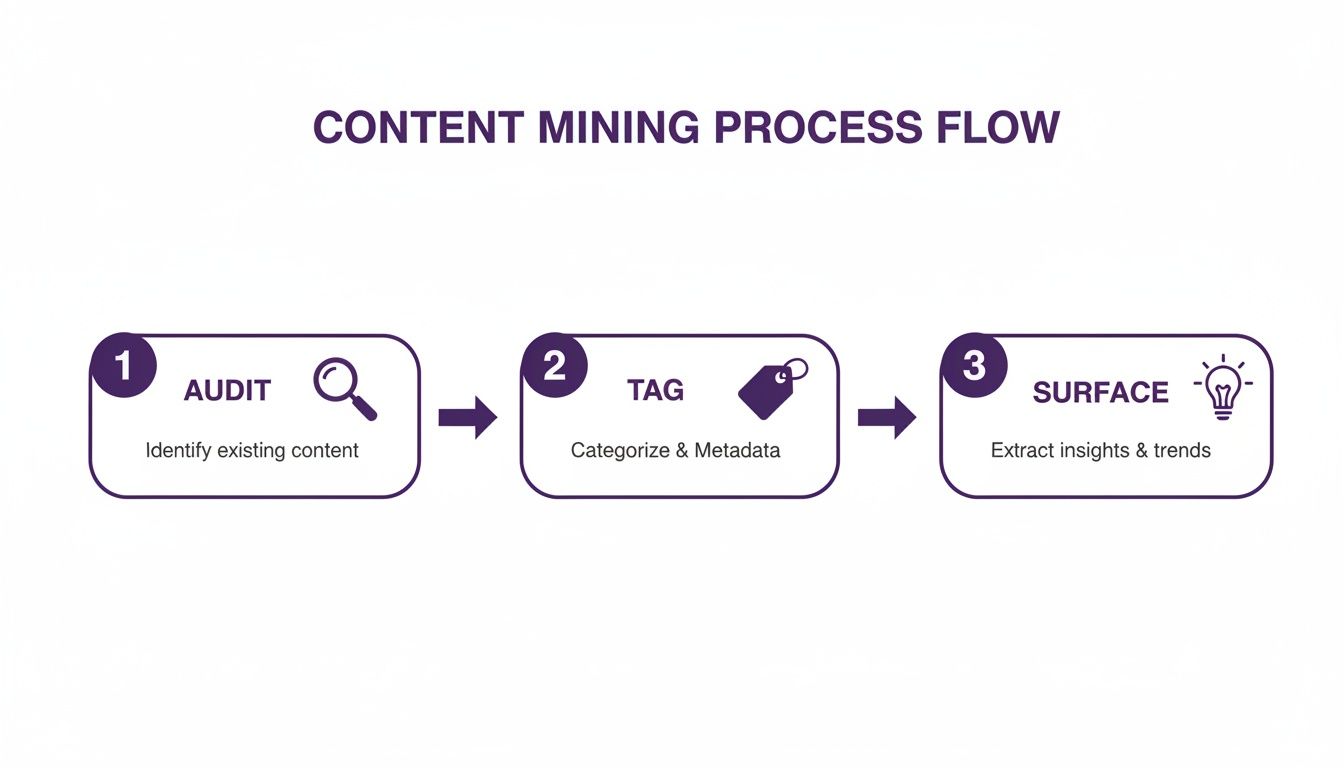
The key here is that a structured process of auditing, tagging, and surfacing insights turns a passive content archive into an active source of new material.
Building an Efficient Workflow
A really effective content calendar doesn't just list what you're going to post. It details the entire production and distribution workflow. For any creator trying to go from hobbyist to professional, this is absolutely crucial for scaling up, especially when you start bringing on collaborators like editors or social media managers.
Your workflow should clearly outline each stage of the repurposing process. A tool like Contesimal can put this on overdrive, letting you quickly surface relevant clips and concepts from your library to feed the production pipeline. It's built to help you and your team collaborate on discovering the best moments to turn into new assets.
Your workflow is the bridge between a great strategy and consistent execution. By defining the steps for scheduling, production, and distribution, you eliminate bottlenecks and empower your team to operate efficiently, even as you scale.
A simple, effective workflow might look something like this:
- Identification: Block out a "repurposing session" on your content calendar where you pick a pillar asset to break down.
- Asset Generation: Assign a team member to pull the raw clips, quotes, or data points from that pillar content.
- Production: Schedule the creation of the new assets (e.g., editing the short-form video, designing the graphics).
- Review & Approval: Set firm deadlines for reviewing the repurposed content to make sure it hits your quality standards.
- Distribution: Schedule the final, approved assets across their respective platforms right inside the content calendar.
The Critical Importance of Platform-Native Formatting
One of the biggest mistakes creators make is lazy cross-posting—just dropping the same exact video or text on every single platform. This completely ignores the reality that each platform has its own unique audience, algorithm, and culture. A successful content calendar marketing plan accounts for this with platform-native formatting.
This just means tailoring each repurposed asset to feel completely at home on its intended channel.
- For TikTok & Reels: Use vertical video, fast-paced edits, trending audio, and on-screen text captions.
- For LinkedIn: Focus on professional insights, use clean graphics, and write text that encourages thoughtful discussion.
- For Instagram: Combine high-quality visuals (carousels, graphics) with engaging, story-driven captions and relevant hashtags.
By building these platform-specific requirements directly into your repurposing workflow, you dramatically increase the chances of each asset actually performing well. Your content calendar should have separate entries for each platform, with notes on the specific formatting needed.
To see the full picture, check out our detailed guide on building a powerful content repurposing strategy. This approach maximizes your reach and ensures your content resonates deeply, no matter where your audience finds it.
Measuring Success And Optimizing Your Calendar
Your content calendar isn't a static document you create and then stuff in a drawer. Think of it as a living hypothesis—your best guess at what your audience actually wants. The real magic happens in the feedback loop, where you measure what's working, figure out why, and use those insights to make next month's calendar even smarter.
This is the jump from just publishing content to consistently improving its return on investment (ROI). Without measurement, your calendar is a fancy to-do list. With it, it becomes an engine for genuine growth, helping you stop guessing and start making data-driven decisions.
Defining The KPIs That Actually Matter
Drowning in data is easy. Instead of tracking every metric under the sun, zero in on a handful of Key Performance Indicators (KPIs) that connect directly to the goals you set earlier. Tying metrics back to your objectives is what separates vanity from real value.
For a creator shifting from hobbyist to professional, the KPIs might look something like this:
- Engagement Rate: Forget simple likes. Dig into comments, shares, and saves to see if your content is actually starting a conversation. A high engagement rate tells you the topic and format truly resonated.
- Click-Through Rate (CTR): When your content is meant to drive an action—like visiting a website or signing up for a newsletter—CTR is your most direct measure of success.
- Audience Growth: Keep an eye on your follower or subscriber count weekly or monthly. Are certain types of content consistently bringing new people into your orbit?
- Watch Time / Time on Page: This is a massive signal of quality. If people are sticking around to watch an entire video or read a whole blog post, you've created something genuinely valuable.
These metrics give you a clear picture of what's landing with your audience, providing a solid foundation for your next moves.
"A content calendar without a feedback loop is like driving with your eyes closed. Measurement provides the visibility you need to steer your strategy, dodge obstacles, and accelerate toward your goals."
Conducting Regular Performance Reviews
To turn that data into action, you need a consistent review process. Don't wait until the end of the quarter to see what worked. Block out time on your calendar—weekly or bi-weekly works great—for a quick performance check-in. This habit keeps you agile and lets you pivot fast.
During these reviews, ask yourself pointed questions:
- Which content formats crushed it this week? Did carousels outperform single images?
- What topics sparked the most shares or comments?
- Did our repurposed video clips on LinkedIn do better than the ones on Facebook?
- Which blog posts brought in the most newsletter sign-ups?
The answers are your marching orders for the next content cycle. Let’s say you find out that your short-form video clips are a smash hit on LinkedIn but fall completely flat on Facebook. Your calendar should immediately reflect that. You might double down on LinkedIn clips and test a totally different format for Facebook, maybe trying text-based posts or image carousels instead.
This is agile content calendar marketing in a nutshell. It’s all about making small, continuous tweaks based on real-world feedback. And it works. Content calendars are proven engagement multipliers, with 60% of marketers who use them reporting much higher audience interaction. This makes sense when you learn that 29% of marketers already spend 10-15 hours a week just creating, leaving almost no time for strategy if they don't have a plan.
Leaving Room For Agility And Timely Trends
While a solid plan is essential, your content calendar has to have some wiggle room. Some of the biggest engagement opportunities pop up out of nowhere—timely trends, breaking news, or unexpected cultural moments. A rigid calendar planned six months out can leave you on the sidelines of these crucial conversations.
A great approach is to schedule your core "pillar" content and repurposing workflows ahead of time but leave a few slots open each week for timely or reactive content. This gives you the best of both worlds: the consistency of a well-planned strategy and the agility to stay relevant.
When a new trend surfaces, you can quickly scan your content library to see if you have any existing assets you can repurpose to join the conversation. This is where a tool like Contesimal becomes invaluable, letting you search your entire archive for relevant clips or quotes in just seconds.
To make sure your efforts are truly effective, you have to dig into post-campaign optimization for better ROI. By continuously measuring, interpreting, and adjusting, your content calendar evolves from a simple organizational tool into a dynamic system that actively improves your results over time.
A Few Common Questions
Even with the best plan, you'll run into questions once you're in the thick of it. Getting practical answers to these common hurdles is often the difference between a calendar that actually works and one that gathers digital dust. Here are a few things that come up all the time.
How Far Out Should I Actually Plan My Content?
There's a real sweet spot here between being strategic and boxing yourself in. For most creators and publishers, planning one month in advance hits that perfect balance. It gives you enough runway to create high-quality stuff without the last-minute scramble, but you’re still nimble enough to jump on a trend or react to audience feedback.
A hybrid approach works wonders:
- Quarterly Themes: Map out your big-picture ideas, pillar content, and major promotions for the next three months. Think of this as your strategic roadmap.
- Monthly Details: This is where you get granular. Fill in the specific repurposed assets, social posts, and production deadlines for the upcoming month.
- Weekly Wildcards: Always leave a couple of open slots each week. This is your space for spontaneous, trend-driven content that keeps you part of the current conversation.
What's the Best Tool for a Content Calendar, Really?
Honestly, the "best" tool is the one your team will actually open and use every day. You don’t need to drop a ton of cash on a complex platform, especially if you're a solo creator or a tiny team.
Here's how I see the options breaking down:
- Spreadsheets (Google Sheets/Excel): The perfect starting point. They're free, you can customize them to death, and sharing is a breeze. Tabbing out different platforms and tracking the basics is super effective when you're getting started.
- Project Management Tools (Trello, Asana, Monday): This is the next level up. They bring much better collaboration features to the table, like assigning tasks and seeing everything on a visual workflow (Kanban boards are a lifesaver). Great for teams with a few different people touching each piece of content.
- Specialized Content Platforms: When you're serious about scaling, a purpose-built platform like Contesimal is where you'll want to land. It does way more than just scheduling—it's designed to help you dig into your existing library for repurposing gold, making the whole content lifecycle way more efficient.
Start simple. Only upgrade when your current system is causing real headaches.
How Do I Deal with Last-Minute Changes and Delays?
Let's be real: no content calendar ever goes exactly to plan. A production hiccup, a surprise opportunity, or a piece of content that just isn't landing—it happens to everyone. The secret is building flexibility right into your workflow from day one.
First, always keep a small stash of "evergreen" content ready to go. These are your timeless posts, videos, or graphics that you can drop in anytime a planned piece gets delayed. Second, make sure everyone knows how to communicate. If a writer is falling behind, they need to raise their hand early so the schedule can be adjusted without panic.
Your content calendar is a living document, not a stone tablet. The goal isn't perfect execution; it's consistent momentum. When things go sideways, just communicate, adjust, and move on.
And finally, please don't schedule yourself at 100% capacity. It's a recipe for burnout and leaves zero room for error. A calendar that's 80% planned and 20% flexible is way more resilient and a whole lot less stressful to manage. It's an approach that keeps you consistent without driving you crazy.
Ready to stop guessing and start seeing your content archives as a strategic goldmine? With Contesimal, you can finally organize, understand, and act on your entire library. Discover hidden gems, streamline your repurposing workflow, and build a smarter content calendar today. See how it works at contesimal.ai.