
You've finished the paper. The analyses are stable, the references are cleaned up, the abstract has survived twelve rewrites, and your co-authors have finally stopped sending “small edits” that somehow change the whole argument.
Then the harder question lands. Where should you submit it?
This is usually the moment when people start throwing around Impact Factor as if it were a final verdict on journal quality, career value, and intellectual worth. That's where many good researchers lose perspective. They stop asking, “Who needs to read this paper?” and start asking only, “What number looks impressive?”
That's a mistake.
A good impact factor for a journal isn't just about whether the number looks high. It's about whether the journal fits your paper, your field, your timeline, and your career stage. A specialized methods paper, an interdisciplinary paper, and a paper aimed at policy or practice may all belong in very different places, even if one journal has a bigger number than the others.
Think of journal selection less like chasing a trophy and more like choosing a home for your work. A famous address sounds nice. But if the right people never walk past it, your paper won't do what you need it to do.
The Moment of Truth Choosing Where to Publish
Most researchers reach this stage with a mix of relief and anxiety. Relief, because the paper exists. Anxiety, because journal choice can shape who reads it, how quickly it appears, and how it's judged by hiring committees, promotion panels, and collaborators.
The trouble starts when Impact Factor gets treated like a universal scoreboard. It isn't. It's one signal among several. It can help, but it can also mislead if you use it without context.
What people usually get wrong
Early-career authors often assume the highest number is always the best target. Senior researchers sometimes repeat rules they learned years ago, even when those rules don't fit the subfield. Departments may talk vaguely about “top journals” without naming the audience, scope, or publication strategy that is important for a specific paper.
That's how researchers end up submitting strong work to journals that are prestigious on paper but poor in fit.
A better starting point is to ask four practical questions:
- Who is the natural reader? Is this paper meant for specialists, clinicians, methodologists, or a cross-disciplinary audience?
- What kind of contribution is it? Some journals reward novelty above all else. Others value rigor, replication, software, data resources, or applied insight.
- How urgent is the timeline? A thesis deadline, job market cycle, or grant review can change what counts as a smart submission.
- What does this paper need to do for your career? Build a steady record, reach a niche community, or aim for a flagship venue.
A journal is “good” when it helps your paper reach the right readers and supports the kind of reputation you're trying to build.
That may sound less glamorous than “submit to the highest Impact Factor journal you can find.” It's also much more useful.
What Exactly Is a Journal Impact Factor
Before judging whether a journal's number is impressive, it helps to know what the number means.
Impact Factor is a journal-level citation metric. In plain language, it tells you how often, on average, recent articles from that journal were cited over a defined window. It does not tell you whether every article in that journal is excellent. It does not tell you whether your paper will be cited heavily if published there.
A simple analogy helps. Think of a restaurant's reputation among chefs. If other chefs keep recommending it, the restaurant gains prestige. Journal Impact Factor works in a similar way. If recent articles from a journal are cited often by other papers, the journal's number rises.
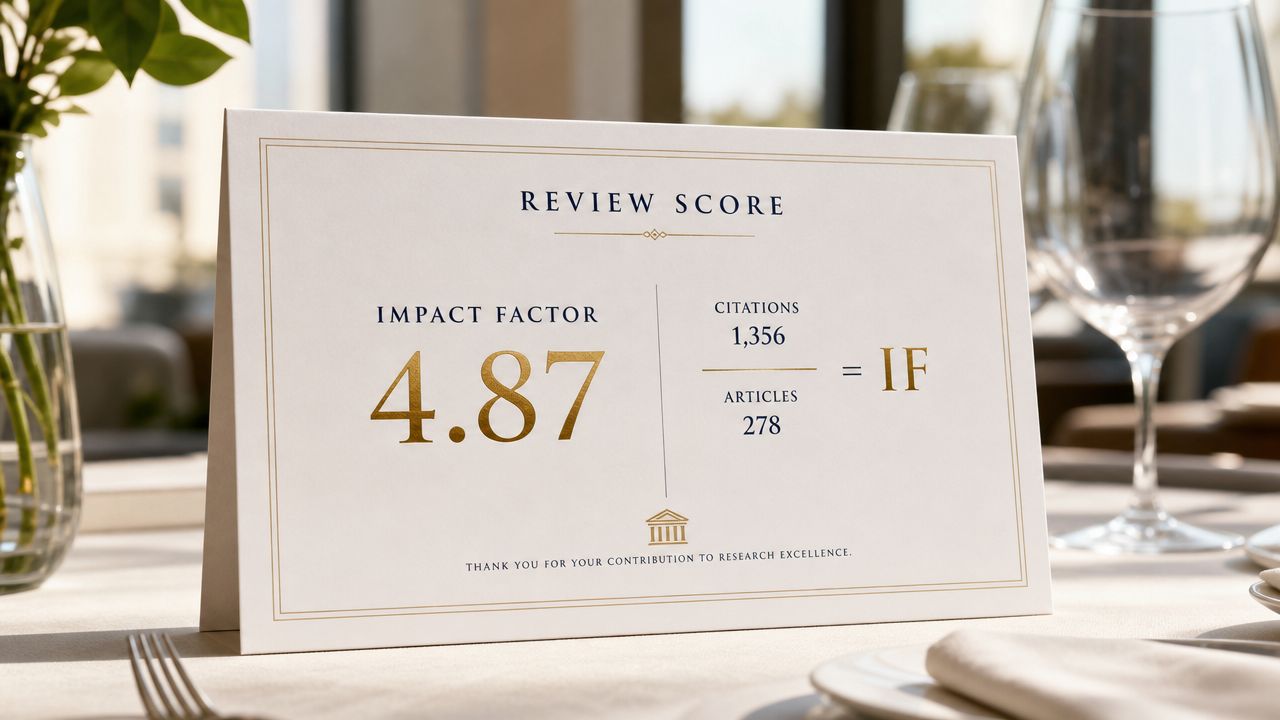
The basic calculation
The standard idea is straightforward:
- Count citations received in a given year to articles the journal published in the previous two years.
- Count the number of citable items the journal published in those same two years.
- Divide the first number by the second.
That gives an average citation rate for recent journal content.
The famous rule of thumb
A widely repeated benchmark says that an Impact Factor of 3 or above is generally considered good, while 10 or higher is typically viewed as excellent, even though the average impact factor across many fields is less than 1, as summarized in this discussion of journal impact factor benchmarks.
That rule of thumb is useful only in the way weather forecasts are useful. It gives you a broad signal, not a precise plan.
What the number does and doesn't say
Here's the part that confuses many authors. A journal with a higher Impact Factor has, on average, stronger recent citation activity. That's all. It does not mean:
- Every paper is influential
- The peer review is always better
- The journal is the right fit for your topic
- Your article will outperform one published elsewhere
A journal metric is an average. Averages hide variation. One heavily cited review article can pull the mean up. Meanwhile, many solid papers in that same journal may receive modest attention.
So if you're asking about a good impact factor for a journal, the honest answer starts here: first understand the number, then stop treating it like destiny.
Why a Good Impact Factor Is a Moving Target
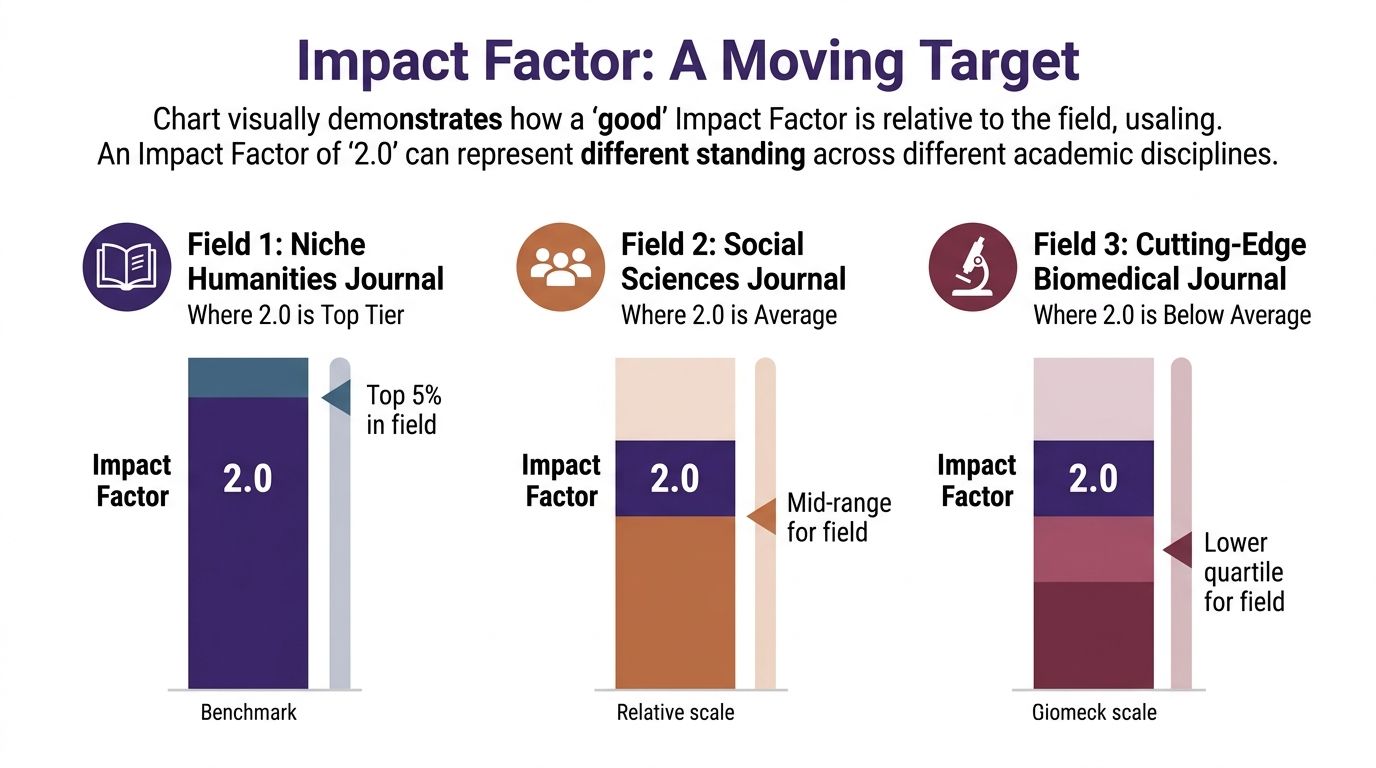
The most important truth about Impact Factor is simple. There is no universal “good” number.
A value that looks stellar in one discipline may be ordinary in another. This isn't because one field is “better” than another. It's because fields cite at different speeds, publish at different volumes, and build influence in different ways.
The same number can mean different things
A helpful benchmark comes from field comparisons summarized by Paperpile's overview of good impact factor by discipline. In a large survey of journals, the median impact factor was 1.8. But expectations differed sharply by area. In clinical medicine, impact factors can exceed 10. In many social sciences, values above 2 to 3 are already very strong. The same source notes that the median impact factor in clinical medicine was about 2.7, while in some molecular biology subfields it exceeded 7.
That's why asking whether “2.5 is good” without naming the field is like asking whether a race time is fast without telling me whether you ran the 100 meters or a marathon.
Quartiles matter more than raw numbers
Quartiles prove more useful than a bare citation figure.
Journals are often grouped within their subject category by quartile:
| Quartile | What it means in plain language |
|---|---|
| Q1 | Top group in that subject category |
| Q2 | Strong middle-upper range |
| Q3 | Established but less cited than the leaders |
| Q4 | Lower-ranked within that category |
If a journal is Q1 in your narrow field, that often tells you more than a raw Impact Factor alone. A modest-looking number may signal top-tier standing in a small specialty. A flashy-looking number may be routine in a citation-dense biomedical area.
Why researchers get trapped by prestige shorthand
People like shortcuts. “Above 3 is good” feels efficient. But shortcut thinking causes bad submissions.
Consider how this plays out:
- A humanities scholar may overlook an excellent niche journal because its number seems low compared with biomedical journals.
- A biomedical researcher may overestimate a journal that looks strong to outsiders but sits in the middle of its own competitive category.
- An interdisciplinary author may compare journals from neighboring fields that have very different citation cultures.
Practical rule: Compare journals with their true peers, not with journals from unrelated disciplines.
If your institution values quartiles, category rankings, or field fit, then the raw number alone won't answer the question. The right benchmark lives inside the subject area your paper belongs to.
A better way to think about “good”
Instead of asking, “Is this Impact Factor high?” ask:
- High relative to what field?
- High relative to what kind of journal?
- High relative to my paper's likely audience?
That shift sounds small. It changes everything.
How to Find and Use Field-Specific Benchmarks
Once you stop looking for one magic number, journal selection becomes more practical. You don't need mystical intuition. You need a shortlist, a category, and a realistic read on where your paper belongs.

Start with your paper's actual neighborhood
Researchers often choose journals based on reputation they've heard secondhand. That's risky. Instead, build your list from the literature your paper already cites.
Try this process:
Scan your reference list
Which journals appear repeatedly? Those titles reveal where your scholarly conversation is already happening.Check journal categories
Look up the subject category for those journals in tools such as Journal Citation Reports or Scopus. This tells you which peer group matters.Note the spread, not just the top title
Don't stare only at the highest-ranked journal. Look at the full range of realistic options.Match your paper type to the venue
Methods papers, software papers, applied studies, and theory pieces often thrive in different journals, even within the same field.
For researchers building disciplined workflows around article mapping and source organization, a strong process for systematic literature review methodology can make this stage much easier.
A concrete example from Statistics and Probability
The field of Statistics & Probability shows why context matters. In 2024, the two-year Journal Impact Factor in that category ranged from slightly below 1 for many solid regional journals to about 8.7 for leading review titles such as the Annual Review of Statistics and Its Application, according to OOIR's Statistics and Probability journal rankings.
That tells you something important. A journal doesn't need to sit near the top of that category to be respectable or useful. Plenty of journals below the leading titles still serve real communities, publish rigorous work, and reach the right readers.
How to turn benchmarks into a submission list
Don't build a list of twenty journals. Build a working list of three.
Use a simple comparison like this:
| Journal trait | What to ask |
|---|---|
| Scope fit | Does this journal regularly publish papers like yours? |
| Field standing | Where does it sit in its category or quartile? |
| Audience | Will the people you want to reach actually read it? |
| Article type | Does it welcome your kind of contribution? |
| Practical fit | Is the review and publication process realistic for your needs? |
A short explainer can help if you want to see how researchers approach journal metrics in practice:
If your paper is highly specialized, the right journal may be the one your ideal readers browse every month, not the one your relatives would recognize by name.
That's the heart of a smart publication strategy.
Beyond the Number The Limits and Pitfalls of Impact Factor
Impact Factor is useful. It's also easy to misuse.
The biggest problem is that people often treat it as a proxy for article quality. That leap doesn't hold. A journal metric summarizes citation behavior at the journal level. Your paper is an individual piece of work with its own fate, audience, and afterlife.
Why journal averages can distort reality
Citation patterns inside a journal are uneven. Some articles attract broad attention. Others serve a narrow but important readership. A journal can therefore have a strong Impact Factor while many of its individual papers receive modest citation counts.
Review articles also complicate the picture. They often gather citations more quickly than original research because they synthesize a field and become convenient reference points. Journals that publish many review pieces can look stronger on citation averages, even though that doesn't automatically tell you where an original empirical study will perform best.
The metric can be nudged
Editors and publishers know that metrics influence reputation. That creates incentives.
A few practices deserve caution:
- Heavy reliance on review content can raise citation averages.
- Journal self-citation patterns can make a title look stronger than its broader influence would suggest.
- Prestige spillover can tempt committees to judge the journal name instead of reading the paper carefully.
None of that means Impact Factor is meaningless. It means you should use it with the same caution you'd use for any summary metric.
A high-Impact-Factor journal can publish a forgettable article. A mid-range journal can publish a paper that shapes a field.
Credibility still requires reading beyond the badge
This is why experienced researchers evaluate journals with more than one filter. They look at editorial board quality, peer-review standards, article types, the journals they cite, and whether the venue is trusted in the community.
That same habit matters when evaluating literature more broadly. If you want a practical framework for that judgment, this guide on what makes a source credible is a useful companion to metric-based thinking.
The key point is plain. Don't outsource your judgment to a decimal.
Smarter Alternatives and Complements to Impact Factor
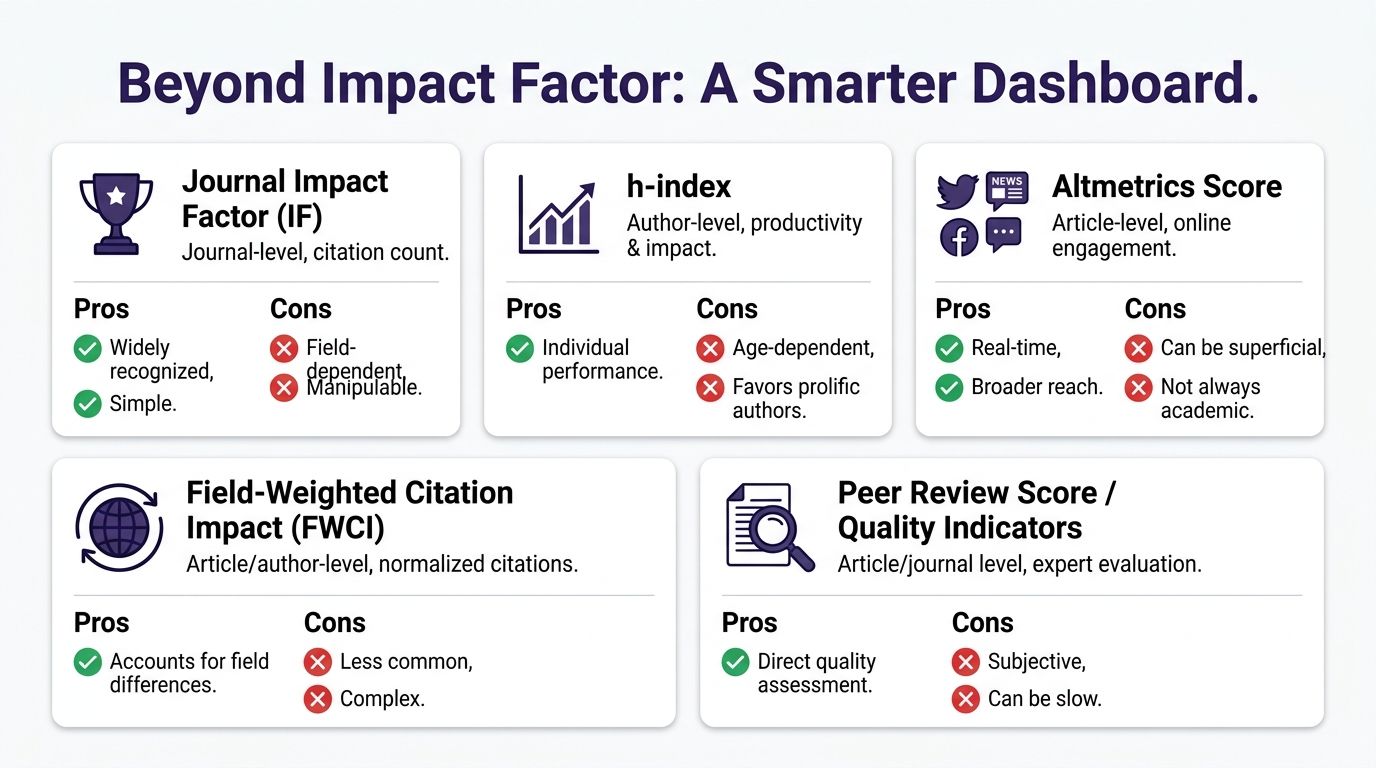
If Impact Factor is one instrument on the dashboard, what else should you look at?
Quite a lot. Different metrics answer different questions. One tells you about journal citation averages. Another says something about author productivity. Another tracks attention outside academic citation networks. None is perfect. Together, they give you a fuller picture.
Think in dashboards, not single gauges
A sensible publication decision often considers several lenses:
- CiteScore looks at citation performance through Scopus and offers another journal-level view.
- h-index is often used for author or journal influence across a longer history, not just a short citation window.
- Altmetrics can show whether a paper is being discussed in news, social media, or policy spaces.
- Field-normalized indicators help when comparing work across disciplines with very different citation cultures.
- Peer review quality signals still matter, even when they're less tidy than a numerical score.
For authors trying to understand how one common metric works at the scholar level, this explanation of how to calculate h-index is a useful complement.
Match the metric to the goal
Different career goals call for different emphasis.
If you want to impress a traditional promotion committee, journal standing and category rank may matter most. If you want your work cited by a narrow technical community, field fit may matter more than broad visibility. If you want public or policy uptake, article-level attention beyond citation databases may deserve more weight.
Here's a cleaner way to frame it:
| Goal | Useful signals to examine |
|---|---|
| Academic prestige | Journal standing, quartile, editorial reputation |
| Field reach | Scope match, who cites the journal, reader community |
| Individual visibility | Article-level attention, discoverability, indexing |
| Career development | Balance of ambition, fit, and realistic publication timing |
One useful test: If the journal vanished tomorrow, would the exact people you want to influence notice?
That question often reveals more than a metric report.
Conclusion Building Your Personal Publication Roadmap
A good impact factor for a journal isn't a fixed number floating above academia like a commandment. It's a contextual signal. Sometimes useful. Sometimes overrated. Never sufficient on its own.
The smarter question is this: What is the right journal for this paper, at this point in my career?
If you're early in your career, you may need a credible, field-respected venue that gives you a solid publication record. If you're aiming for a flagship contribution, you may choose a more selective journal and accept the risk. If your paper serves a specialized audience, the best journal may be the one your core readers already trust, even if the headline metric looks modest to outsiders.
Keep your framework simple:
- Check fit first
- Compare journals within the right field
- Use Impact Factor as one tool, not the whole toolbox
- Balance prestige with audience, timing, and article type
- Choose the venue that gives your work the best chance to matter
Researchers obsess over numbers because numbers feel objective. But publication strategy is a judgment call. Good judgment beats metric worship every time.
If you manage a growing library of articles, videos, podcasts, reports, or research notes, Contesimal can help you turn that archive into something far more useful than storage. It gives creators, publishers, and research teams a way to organize content, surface patterns, collaborate with AI and human contributors, and build new value from work they've already made. If you're moving from scattered output to a more strategic, revenue-minded content operation, it's worth a look.