
Let's be honest, "AI copywriting" sounds like something out of a sci-fi movie. But in reality, it's about using smart technology to help you create written content for your brand—think ad copy, YouTube descriptions, show notes, emails, and even entire blog posts.
The key is to see it not as a replacement for human creators, but as a seriously powerful creative partner. For YouTubers, podcasters, and content marketers, it’s a tool that can supercharge your brainstorming, drafting, and editing, all at a speed that would make your head spin. It lets you organize your content library, create new value, and ultimately, make money from your work.
So, What Is AI Copywriting, Really?
Let’s cut through the buzzwords. At its heart, AI copywriting is all about collaboration. It’s a tool designed to help you, the creator, get your ideas out into the world faster and more effectively.
If you're a podcaster drowning in a backlog of show notes, a YouTuber trying to script the next video, or a blogger staring at a blank page, AI can be the assistant you've always wanted. It takes on the grunt work—the repetitive, time-sucking tasks—so you can pour your energy into the stuff that really matters: strategy, storytelling, and building a real connection with your audience.
The old way of doing things relied entirely on a human copywriter's experience, research, and creative spark. The new, AI-powered workflow doesn't get rid of that human touch; it just adds the incredible data-crunching power of technology to the mix, helping humans and AI collaborate in a healthy, seamless way.
The New Creative Partnership
Picture this: you have a massive library of content—years of podcast episodes, blog articles, and video transcripts. Trying to manually dig through all that to find new ideas or repurpose old gems would be a nightmare. This is where you can upcycle your old content and create new value.
This is where an AI tool shines. It can scan your entire archive in minutes, spot recurring themes, and suggest fresh content ideas based on what’s already worked for you. For creators moving from hobbyist to revenue-generating professional, this is a total game-changer.
This human-AI partnership lets you:
- Kill the Blank Page: Get instant first drafts, outlines, or introductions just by giving the AI a simple prompt.
- Brainstorm on a Massive Scale: Generate dozens of headlines, social media hooks, or video titles in the time it would take to come up with a handful on your own.
- Analyze and Sharpen Your Work: Use AI to check your writing for tone, clarity, and SEO keywords, making sure your content is both engaging and easy to find.
It’s no wonder this approach is catching on. The global AI copywriting tool market was valued at a cool $1.1 billion in 2023 and is expected to rocket to $1.9 billion by 2030. That’s fueled by an explosive 45.2% compound annual growth rate. You can dive deeper into these numbers in the full market analysis on forinsightsconsultancy.com.
The goal isn't to let a robot write for you. It's to use a powerful assistant to help you write better and faster, freeing you to focus on the high-level creative work that only a human can do. It’s about organizing your content library, understanding its potential, and finally taking action to reignite it and create infinite value.
To make this distinction crystal clear, let's break down how the two approaches stack up side-by-side.
Human vs. AI Copywriting at a Glance
This table compares the core attributes of traditional human copywriting with modern AI-powered copywriting to help creators understand the strengths of each approach.
| Attribute | Traditional Human Copywriting | AI Copywriting |
|---|---|---|
| Speed | Slower, dependent on individual capacity. | Extremely fast, can generate drafts in seconds. |
| Creativity | High, driven by emotion, experience, and nuance. | Can be formulaic, but great for brainstorming. |
| Cost | Higher, reflecting professional expertise and time. | Lower, typically a monthly subscription fee. |
| Consistency | Varies by writer and day. | Highly consistent in tone and style once trained. |
| Scalability | Limited by the writer's bandwidth. | Nearly infinite; can produce huge volumes of content. |
| Research | Manual process, takes significant time. | Instantly pulls information from vast datasets. |
| SEO | Relies on writer's knowledge and tools. | Built-in SEO analysis and keyword integration. |
| Editing | A necessary, separate step for quality control. | Essential; all AI output requires human review. |
As you can see, it's not a question of which one is "better." The real magic happens when you combine the strategic, emotional intelligence of a human with the speed and scale of an AI.
How AI Copywriting Models Actually Work
So, what’s really going on behind the curtain when you feed a prompt to an AI and get a piece of copy back a few seconds later? It feels like some kind of digital wizardry, but it’s actually more like an incredibly sophisticated game of "what comes next?" The engine driving it all is a Large Language Model, or LLM.
Imagine an LLM as a student who has read, memorized, and indexed a mind-boggling amount of the internet—we’re talking books, Wikipedia, countless blogs, and billions of articles. By processing all that information, it doesn't learn to understand things like we do, but it gets unbelievably good at recognizing patterns. It learns how words, sentences, and ideas connect in countless different contexts.
When you give an AI a prompt, it's not searching a database for a ready-made answer. Instead, it takes your instructions as a starting point and begins generating text, one word at a time, based on which word is statistically most likely to follow the last. This is precisely why a detailed prompt is your best friend—it provides the context the model needs to narrow down the infinite possibilities and deliver the specific output you're looking for.
The Brains Behind the Words
This whole process is a sophisticated dance between your instructions and the model's massive library of training data. You might notice that different AI tools seem to have their own unique "personalities" or specialties. That's because they often use different LLMs, or they've fine-tuned a popular model for specific tasks. One tool might be a master of short, punchy social media copy, while another excels at crafting detailed, long-form articles.
Getting a feel for how this works changes your relationship with the technology. You stop being a passive user and become an active collaborator. Once you realize you're working with a prediction engine, you start writing prompts that are clearer, more direct, and better structured to get the tone, style, and format you need.
This is all about giving creators a massive advantage, helping them speed up production and scale their output in ways that just weren't possible before.
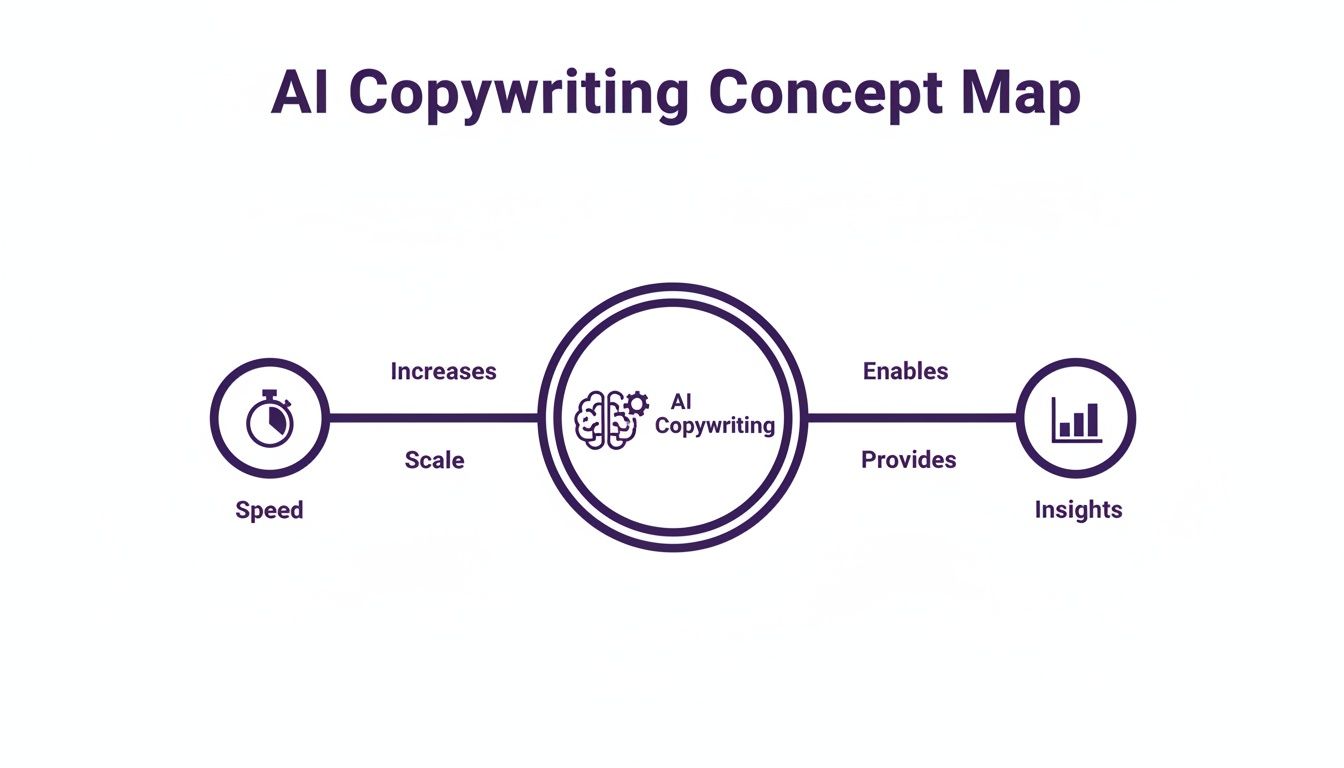
As you can see, AI becomes a force multiplier. It's not just about writing faster; it's about amplifying your ability to create and even uncover new ideas from the content you already have.
From Prompt to Polished Copy
What does this look like in a real-world workflow? Let's walk through the journey from a simple idea to a finished piece of content when you're working alongside an AI.
- The Prompt (Your Input): This is your creative brief. A strong prompt lays out the topic, who you're writing for (the audience), the tone you want, the format (like a blog post or a YouTube script), and any essential keywords or points to hit.
- Generation (The AI's First Draft): The model takes your prompt and runs with it, generating a response almost instantly. This is your "get-it-on-the-page" draft, the one that saves you from staring at a blinking cursor on a blank screen.
- Refinement (The Human Touch): This is where the magic really happens. You take what the AI gave you and make it yours. You infuse it with your unique voice, add personal stories, fact-check the details, and edit everything for flow and brand alignment.
Think of the AI as your tireless brainstorming partner and first-draft assistant. It does the heavy lifting, but the strategic polish, creative vision, and genuine connection with your audience? That comes from you.
This human-in-the-loop process is a game-changer. Instead of grinding for hours on a first draft, you can spend that time refining your message, analyzing what's working, and planning your next big project. With tools like Contesimal, you can even point the AI to your entire library of existing content, letting it generate fresh, on-brand material from the assets you've already worked so hard to create.
Putting AI Copywriting to Work: Real-World Uses for Creators

It's one thing to talk about the theory behind AI copywriting, but the real "aha!" moment comes when you see what it can actually do. For creators like YouTubers, podcasters, and bloggers, these tools are a practical way to deal with the daily grind of making content. They help you save time, smash through creative blocks, and find new ways to grow your brand.
Think about your workflow after wrapping up an hour-long podcast recording. The old way meant slogging through a manual transcription, then spending even more hours digging for key quotes, writing show notes, and maybe—if you had any energy left—drafting a blog post and a few social media updates.
With AI, you can take your longform content across platforms in one click. A good tool can transcribe the audio in minutes. From there, you can prompt it to spin that single recording into a dozen different assets. This isn't just about saving time; it's a force multiplier for your strategy, turning your old longform content into a money maker today.
For Podcasters and YouTubers
If you create video or audio content, you know the feeling of being on a relentless content treadmill. AI copywriting can take over the repetitive (but crucial) tasks that surround every episode, freeing you up to focus on what you do best: filming, recording, and connecting with your audience.
Here are just a few ways AI is changing the game:
- Brainstorming Titles and Thumbnails: Instead of staring at a blinking cursor, feed your video transcript or a quick summary to an AI and get 20 compelling title options in seconds. You can test different angles and pick the one that truly grabs attention.
- Outlining and Scripting: Feeling stuck on how to structure your next video? Give the AI a few talking points and ask for a detailed outline, complete with an intro, key segments, and a solid call to action.
- Generating Show Notes and Descriptions: Turn a full transcript into a sharp, SEO-friendly summary for your podcast notes or YouTube description. The AI can pull out timestamps, list guest bios, and add relevant links automatically.
For Bloggers and Content Marketers
For writers and marketers, the challenge is always producing high-quality, optimized content on a consistent schedule. Think of AI as your research assistant and drafting partner—one that massively accelerates the journey from a simple idea to a published article. It's especially powerful when you consider concepts like Generative Engine Optimization, which is all about using AI to create content that nails search intent right from the start.
AI helps by:
- Speeding Up Research: Ask an AI to summarize a dense report or pull together key stats on a topic. What used to take hours of digging can now be done in minutes.
- Drafting SEO-Friendly Articles: Give the AI a target keyword and a basic outline, and it can generate a well-structured first draft that already includes relevant terms and follows SEO best practices. (We cover how to blend these strategies in our guide to AI for SEO.)
- Creating Promotional Copy: Instantly whip up email newsletters, social media blurbs, and ad copy to get the word out about your latest post.
Unlock Your Entire Content Library
This might be the most powerful use of all: breathing new life into the content you’ve already created. Most creators are sitting on a goldmine—years of valuable videos, articles, and podcasts just collecting digital dust. This is where a more advanced system like Contesimal really shines.
Instead of treating your content library as a passive archive, AI allows you to treat it as an active, queryable database. You can ask it questions, uncover hidden themes, and generate new content based on your own proven ideas.
For instance, a publisher could have Contesimal analyze their entire back catalog of articles on a single topic. From there, they could ask the AI to compile the best insights into a comprehensive ebook or create a month's worth of social media posts. This lets you create new value from assets you already own, turning yesterday's work into tomorrow's opportunities.
Integrating AI into Your Content Workflow
Bringing AI into your content process isn't about firing your creative team (or yourself). It’s about giving them a serious upgrade. Think of it as a practical way to get back your most precious resource: time. You can hand off the tedious, repetitive parts of content creation and pour your energy into the big-picture strategy and creative flourishes that truly matter.
This is all about building a partnership. Your human creativity gets a massive boost from AI's incredible speed and ability to generate ideas at scale. The point isn't to automate your brand's voice away, but to give it a much bigger microphone. You can produce more content, test new angles faster, and connect with your audience in ways you simply didn't have the bandwidth for before.
The Human-in-the-Loop Model
The smartest way to work with AI is by using what’s called the "human-in-the-loop" model. It's less "robot overlord" and more "super-capable junior assistant." The AI does the heavy lifting—cranking out first drafts, brainstorming headlines, or summarizing research—but you're always the one in the driver's seat. You provide the strategic direction, you do the final editing, and you give it that essential human touch.
This collaborative approach guarantees that every piece of content still sounds like you. You’re not just pressing a button; you're the creative director, guiding the tool to create work that perfectly matches your brand’s personality and goals. It’s a workflow that relies on your expertise, not just the AI's algorithm.
It's a model that works. A whopping 71% of marketing experts believe AI will free up at least five hours of their work week. That’s more than a month of extra creative time every single year. This is likely why 27% of generative AI use is dedicated to pure copywriting, making it an indispensable tool for busy creators. You can discover more insights about generative AI statistics on Masterofcode.com.
Writing Prompts That Actually Work
Here’s the deal: the quality of what you get out of an AI tool is a direct reflection of what you put in. A lazy, one-sentence prompt will get you a generic, uninspired mess. But a clear, detailed, and thoughtful prompt? That’s like handing your AI a perfect creative brief.
A great prompt is so much more than just a topic. To get truly useful results, make sure your prompts include these four key ingredients:
- Role: Tell the AI who to be. "Act as an expert podcaster who specializes in true crime stories."
- Task: Be crystal clear about what you want. "Write three compelling YouTube titles for a video about the Zodiac Killer."
- Context: Give it the background it needs. "The video is for an audience new to the case and should feel mysterious, not gruesome."
- Format: Specify exactly how you want the output. "Format the titles as a numbered list. Keep each one under 60 characters."
When you structure your prompts this way, you stop getting random suggestions and start receiving targeted, high-quality content that needs way less editing.
Setting Up a Brand Style Guide for AI
To get consistent results, you have to teach the AI how to sound like your brand. This is where a dedicated AI style guide comes in. Instead of typing out your tone of voice and audience details every single time, you create a master document that you can simply paste into your prompts.
Think of your AI style guide as a cheat sheet for your brand's personality. It's the reference document that ensures every piece of AI-assisted content feels cohesive and intentional, whether it's a blog post, a tweet, or a video script.
Your AI style guide should include these core elements:
- Tone of Voice: List 3-5 key adjectives describing your brand (e.g., "witty, informative, and slightly irreverent").
- Audience: Give a quick sketch of who you're talking to (e.g., "YouTubers looking to turn their hobby into a full-time career").
- Core Messaging: Note any key phrases, taglines, or value propositions you always use.
- Formatting Rules: Specify any stylistic preferences, like "use short, punchy paragraphs" or "always end with a question."
Feeding this guide into your prompts is a game-changer. It ensures the AI's output isn't just well-written, but perfectly aligned with your brand right from the start, which dramatically boosts the efficiency of your AI for content creation.
Navigating the Risks and Ethical Considerations

It doesn't take long to see just how powerful AI copywriting tools are. But with that power comes a serious responsibility to use them ethically and with a good dose of common sense. If you just dive in without understanding the potential traps, you risk creating low-quality content that can undo all the hard work you've put into building trust with your audience.
The whole point is to make your work better, not to cut corners. That means staying aware of the risks and having a clear strategy to protect your brand's integrity. From accidental plagiarism to a voice that sounds more robotic than human, managing these challenges is what separates a successful human-AI partnership from a failed experiment.
Protecting Your Brand's Originality
One of the first things that worries most creators is originality. AI models learn by digesting massive amounts of text from across the internet, so there's always a chance their output might sound a little too close to something that's already out there. This brings up real concerns about plagiarism and, just as importantly, about keeping your brand voice unique.
The best way around this is to treat every piece of AI-generated text as a starting point—just raw clay, not a finished sculpture. It's your job to shape it with your own perspective, stories, and style.
- Run It Through Plagiarism Checkers: Make this a non-negotiable step. Before anything goes live, use a trusted plagiarism checker to ensure the content is truly original.
- Rewrite Key Sections: Never just copy and paste. Get in there and actively rephrase sentences and paragraphs to match your own voice and add unique insights.
- Add Personal Stories: This is your secret weapon. An AI can't tap into your life experiences. Weaving in your personal anecdotes is the quickest way to make any piece of content undeniably yours.
The Pitfall of AI Hallucinations
AI models are designed to create text that sounds convincing, but they don't actually understand what's true or false. This can lead to a bizarre problem known as an AI hallucination, where the tool confidently spits out wrong information, invents sources, or just plain makes up statistics.
For any creator, publishing something that's factually incorrect can be a credibility killer. A single bad stat can shatter the trust you've spent years building.
This is exactly why human oversight is absolutely essential. Every single fact, number, and claim an AI produces has to be rigorously fact-checked by you or someone on your team. Think of the AI as a research assistant, but you're the editor-in-chief.
Ultimately, you are the one responsible for the accuracy of what you publish. Don't let the temptation of speed compromise the truth—your audience counts on you to be a reliable source.
Keeping Your Content Human
Maybe the trickiest risk of all is the slow erosion of your authentic brand voice. If you rely too heavily on AI, your content can start to feel generic, predictable, and frankly, a bit soulless. It might be grammatically perfect, but it will lack the personality and warmth that made people want to follow you in the first place.
Unless you guide it carefully, AI tends to default to a bland, slightly corporate tone. Your audience didn't sign up to hear from a machine; they signed up to hear from you.
Here’s how to make sure your content always sounds like you:
- Use AI for Structure, Not Soul: Let the tool help you build an outline or get a rough first draft down. But the personality, the humor, the emotion? That has to come from you.
- Edit for Your Cadence: Read the text out loud. Seriously. Does it sound like something you would actually say in a conversation? If not, rewrite it until it does.
- Inject Your Unique Language: Sprinkle in the specific phrases, inside jokes, and terminology that your community knows you for. That’s what makes them feel connected to you.
By staying vigilant, you can tap into the incredible efficiency of AI copywriting without ever sacrificing the quality, accuracy, and authenticity that make your brand special.
How to Choose the Right AI Copywriting Tools
With a flood of AI copywriting tools hitting the market, picking the right one can feel like trying to find a needle in a haystack. Let's be clear: not all platforms are the same. What works brilliantly for a podcaster might be a terrible fit for a book publisher. The goal isn't just to find the "smartest" AI, but to find the one that slots perfectly into how you actually create content.
The trick is to match a tool's capabilities to your specific needs. Are you just trying to bust out a few snappy social media captions, or are you looking for a partner to help you structure a massive pillar page? Do you work solo, or does your whole team need to collaborate? Figuring this out first will save you a lot of time and headaches.
Define Your Primary Use Case
Before you get dazzled by feature lists, take a step back and get crystal clear on your main reason for using an AI tool. What’s the number one thing you need it to do? Your most common content format should guide your entire search. A tool that’s amazing at spitting out witty one-liners for ads will likely fall flat when you ask it to write a coherent 2,000-word article.
Think about your day-to-day grind. Where are the real bottlenecks?
- For Video Creators and Podcasters: You should be looking for tools with killer transcription and summarization features. The whole point is to turn one long recording into show notes, video descriptions, and a dozen promotional clips without pulling your hair out.
- For Bloggers and Marketers: Your focus is probably on long-form content, SEO, and maybe even a little research help. You need a platform that understands how to build an in-depth, discoverable article from the ground up.
- For Publishers and Teams: Collaboration is everything. You'll want a system where multiple people can work together, pull from a shared content library, and keep the brand voice consistent no matter who is writing.
It's also worth exploring the wider world of AI marketing tools, as many of them bundle copywriting features into a bigger package.
Create a Checklist for Evaluation
Once you know what you’re looking for, make a simple checklist to size up your options. It's easy to get distracted by flashy features you’ll never actually touch. Stick to the practical stuff that will make a real difference in your daily work.
Ask yourself these questions before you pull out your credit card:
- Integrations: Does this thing play nicely with the software you already live in? Think about your CMS, social media scheduler, or project management app.
- Collaboration Features: Can you bring your team along for the ride? Look for shared style guides or prompt libraries that help everyone stay on the same page.
- Content Library Management: Can the tool actually learn from your content? A platform like Contesimal lets you connect your entire library, which is a game-changer for repurposing old winners and generating new ideas based on what’s already worked for you.
- User Interface: Is it actually easy to use? A clunky, confusing interface just adds another layer of friction to your workflow, defeating the whole purpose.
The right tool shouldn't just generate text; it should feel like an extension of your creative process. It should simplify your workflow, not complicate it, empowering you to organize, understand, and take action on your content strategy.
Start with a Simple Test Project
The only way to truly know if a tool is a good fit is to take it for a spin. Most platforms offer a free trial, so make the most of it. Don't just toss in a few random prompts to see what happens—give it a real task you’d normally have to do yourself. For an even deeper dive, our guide on the best AI tools for content creation breaks down even more options.
Here’s an idea: try using it to generate an outline for your next YouTube video or podcast episode. This one simple test will tell you volumes. You’ll quickly see how well it grasps your intent, how much back-and-forth is needed to get it right, and whether it genuinely saves you time. This hands-on approach is what takes you from just "learning about AI" to actually doing something with it.
Frequently Asked Questions About AI Copywriting
As creators start digging into AI copywriting, a few key questions always seem to pop up. Getting straight answers is the best way to move forward with confidence and start using these tools effectively.
Let's dive into some of the most common ones.
Can AI Actually Replace Human Copywriters?
This is the big one, isn't it? The short answer is a firm no.
Think of AI as an incredibly powerful assistant. It can draft, brainstorm, and research at a speed and scale that's simply not humanly possible. But what it can't do is replicate genuine creativity, emotional intelligence, or that spark of connection that comes from shared human experience.
The future here isn't about AI versus humans; it’s about AI with humans. The smartest creators are using AI as a collaborator. They let it handle the heavy lifting, which frees them up to focus on what really matters: strategy, storytelling, and adding the unique personal touch that turns followers into a loyal community.
How Does AI Handle SEO?
AI tools are brilliant at the tactical, nuts-and-bolts side of SEO. They can weave keywords into a blog post, follow a specific outline for a pillar page, or whip up a meta description in a flash.
What they can't do is build a real SEO strategy from the ground up.
An AI doesn't understand the nuances of your niche, what your competitors are up to, or the subtle intent behind a search query. It’s an amazing tool for executing an SEO plan, but the strategic thinking—deciding which keywords matter and why—still absolutely requires a human at the helm.
"Good writing starts with good thinking." An AI can arrange the words, but the foundational strategy and critical thought behind content that truly ranks must come from you.
Will Search Engines Penalize AI-Generated Content?
Nope. Using AI to help create content will not automatically get you penalized. Google’s official stance is pretty clear: they reward high-quality, helpful content that serves the reader, no matter how it was created.
The real risk of a penalty comes from churning out low-quality, spammy, or unoriginal content at a massive scale—which, let's be honest, is easier to do with AI if you're not careful.
As long as you’re following that "human-in-the-loop" model to edit, fact-check, and add your own unique value, your AI-assisted content can perform just as well as anything written entirely by hand. The focus is always on the quality of the final product, not the process behind it.
Ready to turn your content library into an active, intelligent partner? Contesimal helps you organize, understand, and generate new value from your existing assets, blending the best of human creativity with AI's powerful capabilities. Discover how you can reignite your content.