
In 2025, 40% of podcast newcomers said they used YouTube most often for podcasts, according to Cumulus Media and Signal Hill Insights' 2025 Podcast Download study. A keyword list built only for podcast-app search misses an important entry point.
Podcast keyword research isn't just choosing words for episode titles. It's finding the listener's question, locating the strongest answer in your archive, and packaging that answer for the platform where someone will encounter it.
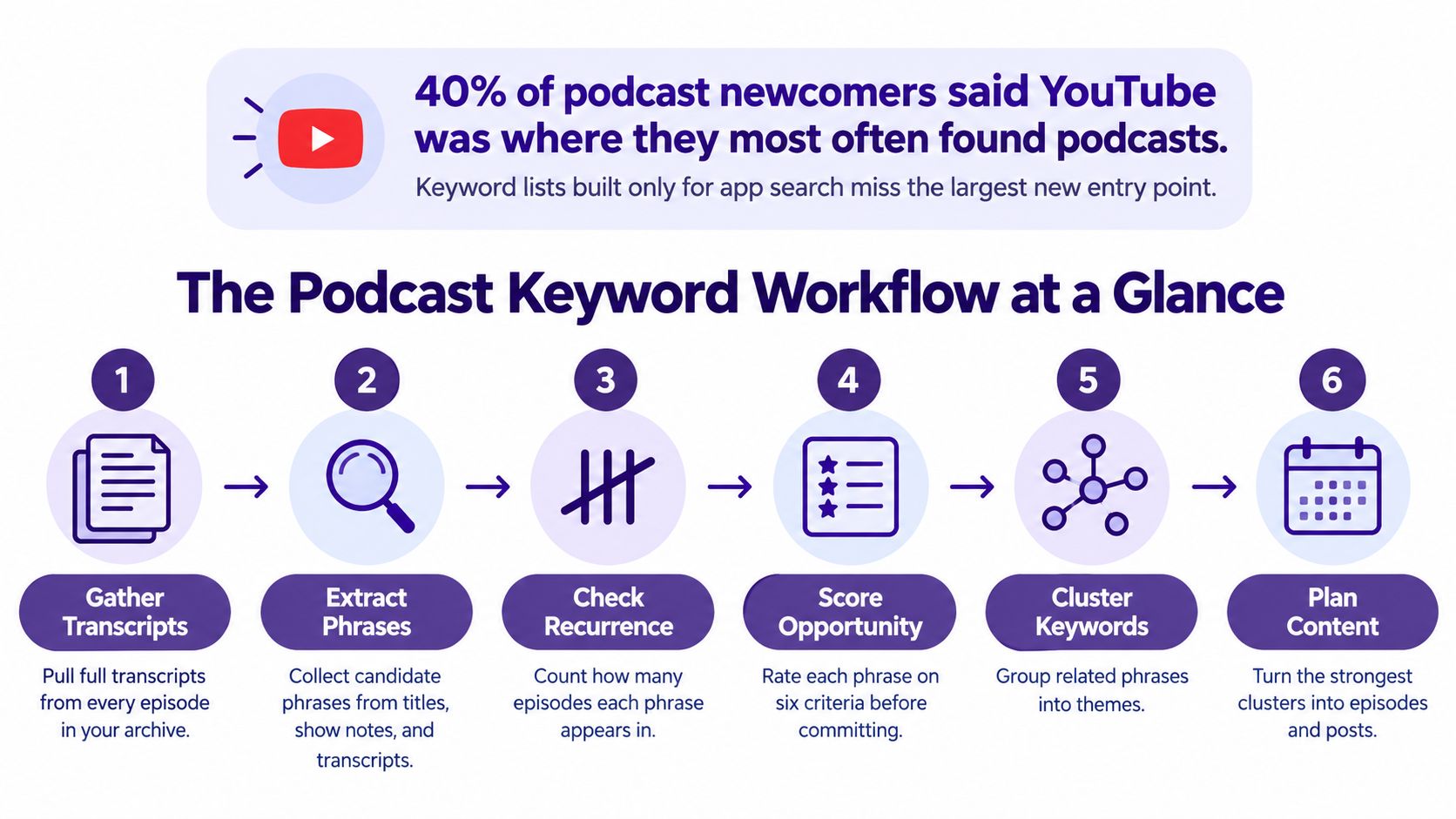
The Podcast Keyword Workflow at a Glance
Start with your back catalog, not a blank keyword-tool dashboard. Your archive contains explanations, disagreements, demonstrations, and audience questions that can become searchable assets. The job is to separate useful opportunities from words that happen to appear often.
Follow the workflow
- Map listener intent by platform. Identify what someone wants from Apple Podcasts, YouTube, Spotify, Google, or short-form video. Choose a destination before choosing the packaging.
- Harvest candidate phrases. Pull episode titles, show notes, transcripts, guest names, and available platform search information. Preserve the episode and passage behind every candidate.
- Clean and cluster. Normalize spelling, merge genuine variants, and remove generic words that don't distinguish intent. Group phrases by topic, audience, problem, format, and outcome.
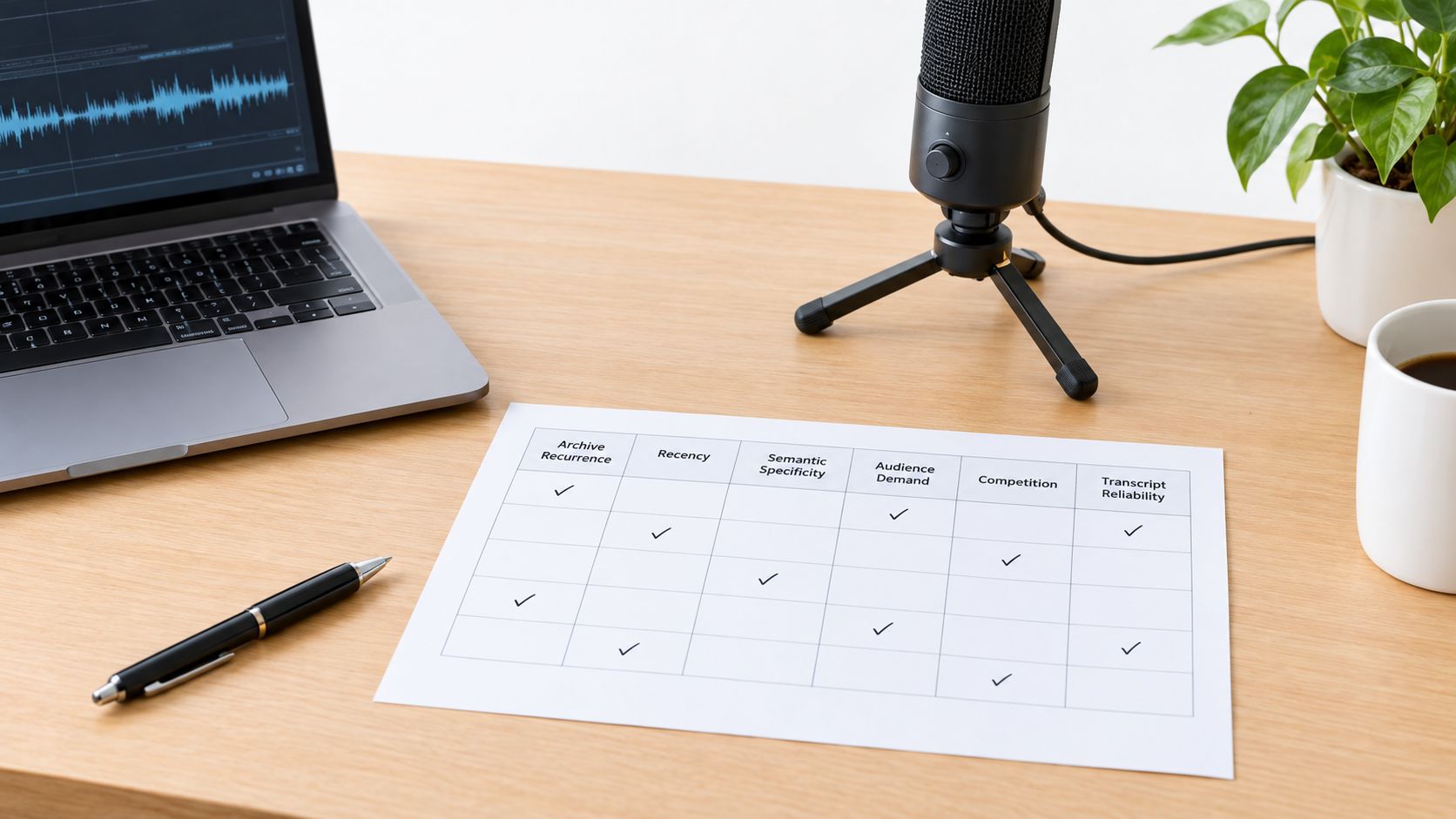
- Score the opportunity. Assess archive recurrence, recency, specificity, audience demand, competition, and transcript reliability. A large pile of mentions isn't automatically a publishing priority.
- Write platform-specific versions. Turn the strongest clusters into titles, descriptions, written headings, and video openings. Keep the underlying promise consistent while changing its presentation.
- Test and plan. Compare versions on reasonably similar episodes, inspect listener behavior, and give successful clusters a place in the publishing calendar.
Use this visual as an archive-processing checklist, with listener intent guiding the work throughout.
Define the deliverables
Finish with a ranked cluster list, a platform map for each cluster, and a dated publishing queue. Each queue entry should identify the source episode, proposed asset, owner, approval status, and review date.
Don't spend the entire project perfecting a taxonomy. Make the first batch small enough that an editor can check the evidence and a producer can publish it without delay. A usable queue beats a magnificent spreadsheet nobody opens.
Mapping Listener Intent Across Platforms
Listener intent and packaging by platform
| Platform | Typical Searcher Intent | Packaging That Fits | Signal to Watch |
|---|---|---|---|
| Apple Podcasts | Find a named show, host or episode | Specific show and episode titles, clear opening sentence in the description | Search-origin plays and follows |
| YouTube | Learn how to do something or find a guest | Question-led title, spoken opening line, readable thumbnail | Search impressions and click-through rate |
| Spotify | Browse by topic, mood or host | Plain-language episode titles, chapters and descriptions | Saves, follows and completion rate |
| Answer a specific question | Transcript-derived headings and a written summary | Impressions for question queries | |
| Shorts and TikTok | Get a quick answer or a fast hook | Hook in the first seconds, on-screen captions, hashtags | Rewatches, shares and profile visits |
These are working hypotheses, not exclusive rules. Someone can search YouTube for a show name or use a podcast app to investigate a problem.
The distinction matters: Edison Research's findings summarized by SSRS put YouTube search at 28% of the methods U.S. Gen Z monthly podcast listeners use most often to discover podcasts, compared with 15% for general internet search. Treating those destinations as interchangeable means overlooking how listeners choose what to play.
Tag the intent before drafting
Use navigational for a show, host, or guest name. Use informational for a question such as how to reduce microphone echo. Use browse for a topic or listening context, such as true crime for long drives.
Keep the original phrase alongside its tag. A guest's name can be navigational, while that guest's explanation of room acoustics belongs in an informational cluster. Don't force both into the same title.
For choosing tools that collect and organize these signals, use this guide to content research tools to distinguish collection, analysis, and collaboration needs.
Package the same answer differently
Say your candidate phrase is podcast mic setup. On YouTube, a useful title might be Why Does Your Podcast Mic Sound Echoey? The opening should demonstrate the sound problem rather than begin with housekeeping.
On Apple Podcasts, Podcast Mic Setup for Small Rooms makes the subject immediately recognizable. For a hypothetical 30-second Short, show the microphone moving closer to the speaker and let viewers hear the difference.
A phrase worth targeting on Google isn't automatically a compelling video concept.
Web volume can be strong while YouTube recommendations remain weak because viewers don't recognize a reason to click. Conversely, a visible before-and-after demonstration can work on short-form video without a large text-query estimate.
Give every candidate a primary platform and a secondary platform. That decision keeps the team from producing interchangeable assets everywhere.
Harvesting and Cleaning Keywords From Your Archive
Keyword sources and what each one reveals
| Source | What It Reveals | How to Pull It | Best Use |
|---|---|---|---|
| Episode titles and show notes | How you currently frame each topic | Export from your host dashboard or RSS feed | Consistency audit |
| Full transcripts | The words speakers use, including quoted listener questions | Auto-transcribe, then check names and jargon | Long-tail phrases and questions |
| Apple Podcasts Connect analytics | Available listening and engagement evidence | Export available dashboard reports; use search-origin fields only where exposed | Validating performance |
| YouTube search suggestions | How viewers phrase a seed topic | Type each seed and record suggested completions | Title variants |
| Comments, reviews and listener emails | Problems in the audience's own words | Collect and tag questions by theme | Episode ideas and angles |
Don't assume a dashboard exposes individual search queries or attributes follows to those queries. Check the fields available in your account, and mark unavailable evidence as missing rather than manufacturing an attribution.
Clean the material in a shared sheet
- Preserve provenance. Put titles, descriptions, transcript phrases, guest names, and available search queries in a shared sheet with episode ID and publication date. Store a timestamp or passage reference so an editor can verify the context.
- Normalize genuine variants. Merge singular and plural forms, spelling differences, and inconsistent brand names. Keep terms separate when the distinction changes meaning, such as recording software versus editing software.
- Remove empty language. Drop podcast when it adds nothing, but retain it in podcast microphone placement, where it distinguishes the use case.
- Group by meaning. Cluster phrases using topic, audience, problem, format, and outcome. Echo in a spare bedroom and small-room acoustics may belong together even without identical wording.
- Apply a proportional recurrence floor. In a hypothetical 60-episode show, start with phrases appearing in three distinct episodes. Repetition throughout a guest interview still counts as a single episode, not repeated independent evidence.
- Keep an emerging-terms tab. A new platform feature or unfamiliar audience question may deserve attention before it becomes recurrent. Keep it visible without giving it the same confidence as an established cluster.
The scale distinction matters: a bibliometric study published in Edufortech used a minimum occurrence threshold of 100 to reduce its keyword set to 35 representative terms. That academic filter isn't a sensible default for a modest show archive.
Choose tools for the job
Use host-dashboard exports for metadata, a shared spreadsheet for decisions, and transcription software for spoken material. If interviews aren't searchable yet, Klap provides a way to transcribe podcast interviews before reviewing names and specialist vocabulary.
Record which transcription model produced each file. When a technical term looks wrong, you need to trace the error before merging it across the library. Keep collection and editorial verification separate using a repeatable set of podcast research methods.
Frequency describes your archive, not audience demand. Check shortlisted clusters against platform suggestions, available performance information, and actual listener questions before commissioning new content.
Scoring Opportunity and Competition Before You Commit
Scoring criteria for keyword clusters
| Criterion | What to Measure | Strong Signal | Weak Signal |
|---|---|---|---|
| Archive recurrence | Number of distinct episodes using the cluster | Three or more distinct episodes | One guest name in one episode |
| Recency | Date of the latest episode using the cluster | Used within the last 12 months | Last used three or more years ago |
| Semantic specificity | Whether the phrase names an audience, problem or outcome | podcast mic setup for small rooms | podcast tips |
| Audience demand | Search-origin plays, impressions or repeated listener questions | Shows up in two or more sources | Appears only in your own show notes |
| Competition | What ranks for the phrase on each target platform | Older forum threads or generic category pages on top | Recent, established shows with strong engagement on top |
| Transcript reliability | Recognition errors found in a 20-passage sample | Names and terms correct in the sample | Names and jargon misspelled in the sample |
Treat these thresholds as editorial starting rules, not validated performance benchmarks. Adjust recency for the subject: an evergreen storytelling lesson ages differently from a tutorial about a software interface.
Keep the scorecard alongside the production materials.
Rank candidates without hiding uncertainty
For a practical scoring model, rate each criterion from 1 to 3 and give demand and specificity double weight. Keep the component ratings visible; otherwise, similar totals can conceal very different risks.
Transcript reliability is a gate, not just another score. Hold a weak candidate until someone verifies the wording, even if the cluster looks attractive elsewhere.
For competition, search the phrase on each target platform and record what ranks, what the result promises, and what it leaves unanswered. Older forum threads or generic category pages may indicate an opening for a precise answer, but their age alone doesn't make them weak.
Recent, established shows with strong engagement call for a narrower angle. Add an audience, problem, or geography modifier only when your episode genuinely addresses it.
For web-side comparisons, Keyword Kick's guide to SpyFu alternatives can help you assess tool options. Use those estimates alongside native-platform inspection, not as a substitute for it; a structured competitive content analysis should compare the actual answers listeners encounter.
Verify the phrases people will search
An information-retrieval study on OpenReview found that automatic speech-recognition model choice affects podcast retrieval and re-ranking in both dense and sparse search systems. Names, jargon, accents, multilingual speech, and crosstalk deserve particular attention.
As a working quality-control exercise, sample 20 passages per cluster, spread across its contributing episodes. Listen to the audio, correct recognition errors, and then score the cluster.
More extracted keywords can mean more cleanup, not more opportunity.
Keep this video available alongside the scorecard during your review.
Writing and Testing Title Versions
Apple Podcasts' search guidance identifies show names, channel names, and episode titles as search factors, alongside popularity and engagement such as plays and follows from search results. It also recommends specific, unique titles rather than generic or repetitive naming.
Build a title from topic, modifier, and outcome. Podcast Keyword Research for Small Shows: Which Terms to Skip identifies the subject, names the audience, and gives listeners a reason to choose the episode.
Build a version you can evaluate
Choose the primary phrase. Put it early enough that someone scanning a results screen can recognize the subject. Read the title aloud: if it sounds like a list of search queries, rewrite it.
A title such as Podcast Tips, Podcast SEO, Podcast Keywords, Podcast Growth doesn't make a useful promise. Choose the problem the episode resolves and leave neighboring concepts for the description.
Write the description around the listener's problem. Use the first two sentences to explain the difficulty and what the episode helps someone do. Then work in two to four supporting variants where they add information.
For the small-show example, the description could explain how to reject broad phrases, inspect archive evidence, and select a manageable topic. Supporting language such as episode title testing or transcript keyword analysis belongs only if those subjects are covered.
Keep identity consistent without making every episode identical. Preserve the show name and a recognizable title format across the archive. Don't reuse the same title stem across ten episodes and leave the distinguishing subject hidden at the end.
Standardize separators and guest-credit placement. Avoid renaming the show itself for every keyword opportunity, which makes recognition harder for existing listeners.
Write a separate YouTube title and spoken opening. The video title should establish the question or tension; the opening should immediately demonstrate that the episode will address it. A polished title can't compensate for an introduction that delays the answer.
Keep the thumbnail readable and complementary. If the title asks why a microphone sounds echoey, the thumbnail can show the room or placement mistake instead of repeating every word.
Choose guest-name placement by actual intent. For a specialist who isn't widely searched by name, lead with the expertise phrase and credit the guest afterward. When listeners actively search for the guest, the name can lead.
Don't confuse the team's excitement about booking someone with audience recognition. Inspect suggestions, previous performance, and listener questions before making the name the headline.
Run a controlled publishing test
Select comparable episodes. As a workable test design, choose two to four episodes with similar length, topic depth, and guest type. Assign each a primary phrase and supporting variants, and state which change you're evaluating.
A celebrity interview and a solo tutorial aren't a clean comparison. For a small show, change a single element at a time rather than replacing titles, artwork, descriptions, and promotion together.
Set a fixed observation window. For a weekly show, a practical starting window is four to six weeks. Record the start and review dates before publishing, and keep promotion reasonably consistent.
This is an operational recommendation, not a guarantee of enough traffic. If exposure remains sparse, label the result inconclusive instead of declaring a winner from a handful of starts.
Measure each destination separately. A 315-person global listener survey summarized by Headliner recorded discovery through social media for 71% of respondents, podcast players for 70%, YouTube for 59%, and word of mouth or personal recommendations for 33%.
These are discovery sources respondents reported, not exclusive shares. Use the breadth of those routes to justify separate measurement, not to forecast your show's channel mix.
Track impressions, search-origin starts where available, completion, follows, and qualified website actions. On YouTube, distinguish search traffic from recommendation traffic; on your website, inspect the queries and landing pages that attracted visitors.
Interpretation rule: More starts with worse completion is a reason to inspect the promise, not celebrate the headline.
Turn results into a decision
Log changes and diagnose the response. Keep the old version, new version, change date, platform, promotion notes, and review result on a shared sheet. Note guest reposts, paid boosts, holidays, or unusual publicity that could explain a spike.
Higher impressions with stable engagement may justify keeping the version. Higher click-through with falling retention calls for checking whether the title overstates the answer or attracts the wrong audience.
Keep, revise, or stop. Retain versions that attract suitable listeners and support the action you care about. Revise promising versions with a mismatch, and stop investing in clusters that repeatedly fail to earn relevant attention.
For monetized shows, define a qualified action before testing: a sponsor-resource visit, newsletter signup, product inquiry, or another intentional next step. Don't call every page view a commercial result.
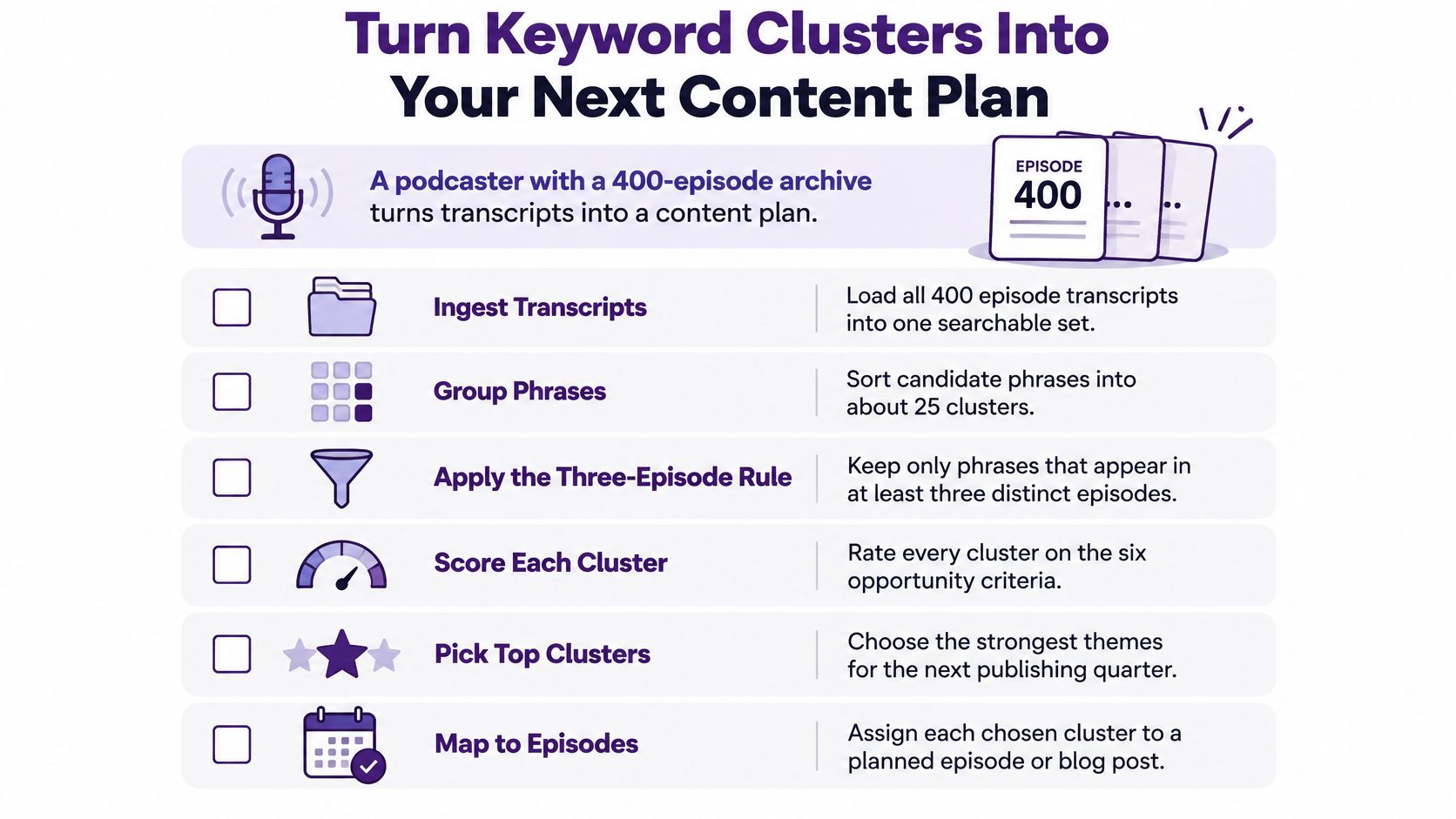
Turn Keyword Clusters Into Your Next Content Plan
Say a podcaster has a 400-episode archive and groups its transcripts into about 25 candidate clusters. In this hypothetical workflow, the team keeps clusters supported by at least three distinct episodes and clear audience demand, then assigns the strongest to publishing slots.
Contesimal is an option alongside a host dashboard and shared spreadsheet for managing this work at scale. Its programmatic uploads and fast ingestion bring files into a searchable library; its chat-based research interface lets collaborators ask which episodes discuss keyword research for small shows, while its taxonomy tools support a shared classification system.
Give each cluster a production assignment
For the hypothetical mic-setup cluster, build a coordinated batch rather than unrelated posts:
- Refresh an archive episode. Update its title and description after checking that the advice still holds.
- Record a follow-up. Answer the unresolved listener question instead of repeating the original conversation.
- Cut three short clips. Give each a distinct job, such as demonstrating placement, diagnosing echo, or correcting a misconception.
- Draft a written article. Use the transcript as evidence, then edit it into a direct answer with useful headings.
The goal is to make longform content easier to take across platforms and earn from, not to imply that a single click replaces editorial judgment. Sponsor packages, relevant product offers, and subscriber resources need audience fit and rights clearance.
Use this checklist to connect archive processing with actual publishing decisions.
Keep the archive usable for collaborators
The Library of Congress guidance on sustainable digital formats explains the role of descriptive, technical, administrative, contextual, fixity, and provenance metadata in managing digital objects. For a podcast library, translate that into fields editors can use:
- Identity and discovery: Episode title, speakers, topics, date, and transcript.
- Production and permissions: Format, source file, and rights status.
- History and reuse: Revisions and related clips, with links back to the original passage.
Give a named editor responsibility for approving cluster changes. Human collaborators and AI tools can propose relationships, but someone must check whether the source supports the new asset.
This week, choose a cluster and select three episodes to repackage. Put a review date four weeks out on the calendar, then assess whether the batch brought relevant listeners, useful engagement, or qualified actions.
Contesimal helps teams organize, search, and collaborate around existing content libraries so archive evidence can become new publishing opportunities. Visit Contesimal to explore how your podcast transcripts can support shared research, clearer keyword clusters, and a practical repurposing plan.