
The recording is still on someone's desktop, the transcript has a filename that tells you nothing, and a producer needs a useful clip before the next publishing deadline. Your team knows it has covered the topic before, but finding the right passage means searching folders, messages, and memory.
That's when an archive starts acting like a landfill instead of a creative asset. A practical document classification guide can help creators, publishers, and content teams find, understand, and reuse what they've already made, without pretending that every file needs a complicated system.
Why a Document Classification Guide Matters Now
Content libraries grow in every direction. A podcaster adds full recordings and transcripts; a publisher adds articles, drafts, and rights notes; a video team keeps footage, captions, edits, and thumbnails. Without consistent labels, even a useful archive can become hard to search when a deadline is close and nobody remembers which version is final.
Folders solve browsing, not retrieval. A folder can hold an interview, but it cannot record that the interview covers audience growth, carries restrictions on reuse, or was derived from a recording made by a contractor two years ago. Those details belong in layered metadata: topic, sensitivity, provenance, and handling, each answering a different question about the same asset.
From library shelves to living systems
The idea has a long history. The Dewey Decimal Classification was published in the United States in 1876. The Library of Congress decided to create its own classification scheme in 1897 as its collection outgrew its earlier arrangement, and the first outline appeared in 1904. Its schedules continued to develop over time, including the Law class, whose first schedule was published in 1969, with later development continuing into the 2000s. These milestones are documented in this history of major classification systems.
The lesson for modern content teams isn't that creators should copy a library's scheme. It's that classification must evolve with the collection. A label set that fit when you published mostly blog posts may fail once you add video, transcripts, AI summaries, or collaborative research.
The Library of Congress reports holdings exceeding 34.5 million books and 117 million non-book items, a scale that calls for explicit rules and revision procedures rather than informal tags alone. A creator's archive is smaller, but the practical principle still applies: agree on labels, explain what they mean, and make somebody responsible for maintaining them.
Practical rule: Label an asset so it remains understandable outside the folder where you found it.
I have run this kind of archive migration more than once, and the teams that stall are the ones who try to design every metadata layer before labeling a single file. Start with the labels that protect you: rights status and sensitivity. Topic refinements and provenance detail can wait until the archive is searchable.
Good classification helps teams organize. It also helps them recognize what can be reused, what needs review, and what should stay restricted. That is the difference between storing content and building a library that can support new ideas, audience discovery, and future publishing.
What Document Classification Actually Means
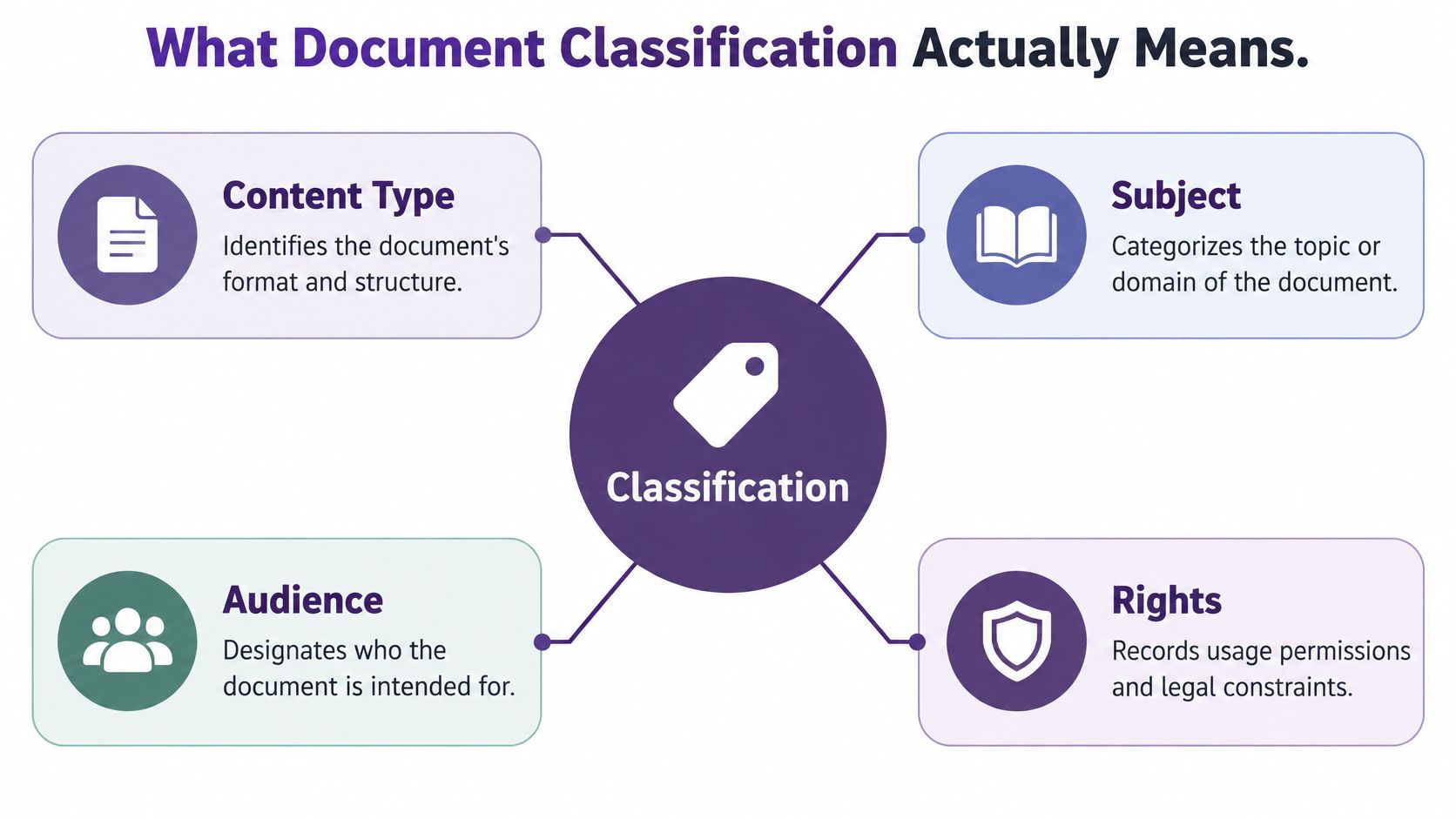
An editor pulls a transcript out of shared storage and asks two questions: what is this, and can I use it? A folder name answers neither. Document classification is the persistent assignment of labels to an asset, labels that stay attached as the file moves through storage, editing, search, and distribution. That transcript might carry a content-type label (transcript), a subject label (independent publishing), and a rights label (cleared for excerpting), each one answering a different question.
The mistake I see most often on teams without a taxonomist is treating classification as one big tag field. It holds up better as a layered architecture, where each layer handles a separate concern:
- Content type identifies the format or structure, such as article, transcript, video, or interview.
- Subject describes what the asset covers, using terms your team agrees on.
- Audience indicates who the material serves, such as first-time creators or experienced editors.
- Rights and sensitivity record permissions, restrictions, and handling needs.
- Lifecycle state distinguishes drafts, published work, and material awaiting review.
- Provenance records where the asset came from and how it was changed.
The layers matter because they fail independently. A label such as "interview" tells an editor nothing about whether a clip may be republished. A label such as "restricted" tells a researcher nothing about the topic. When a team collapses these into one field, the first person who searches by subject loses the handling rules, and the first person who filters by rights loses the content itself.
Labels and metadata work together
A classification label describes how an asset should be grouped or handled. Metadata fields supply the surrounding detail: title, creator, date, format, identifier, rights. Dublin Core is a useful reference point here. It began as a minimal framework for describing diverse resources, and its familiar set has 15 elements. A study of digital repositories reported that Qualified Dublin Core appeared in 40.6% of examined implementations, compared with 25.4% for unqualified Dublin Core (research on metadata schemas in digital repositories).
For creators, the practical version of this is: resist forcing every useful detail into a single category field. Keep the taxonomy small enough to apply consistently, then let metadata carry the descriptive context that supports search and exchange between systems.
A working record stores the human-readable label alongside a machine-readable code, plus a confidence score, classifier version, timestamp, and reviewer identity. NIST describes classification as a taxonomy of known data-asset types, with labels acting as metadata attributes that remain associated with assets across workflows (NIST guidance on data classification). That traceability is what lets you find out who labeled an item, how the decision was made, and whether a later correction is warranted.
Teams handling legally sensitive material face review requirements that differ from ordinary editorial discovery. A practical introduction to what is document review in PI law offers context on why handling rules in that setting are stricter than a typical archive's.
Designing a Taxonomy That Actually Fits Your Library
A taxonomy works when people can apply it consistently and still find what they need. The common failure is borrowing a complicated scheme before understanding the archive. Start with actual files, recurring editorial questions, and the decisions your team makes when it reuses content.
Begin with facets, not nested folders
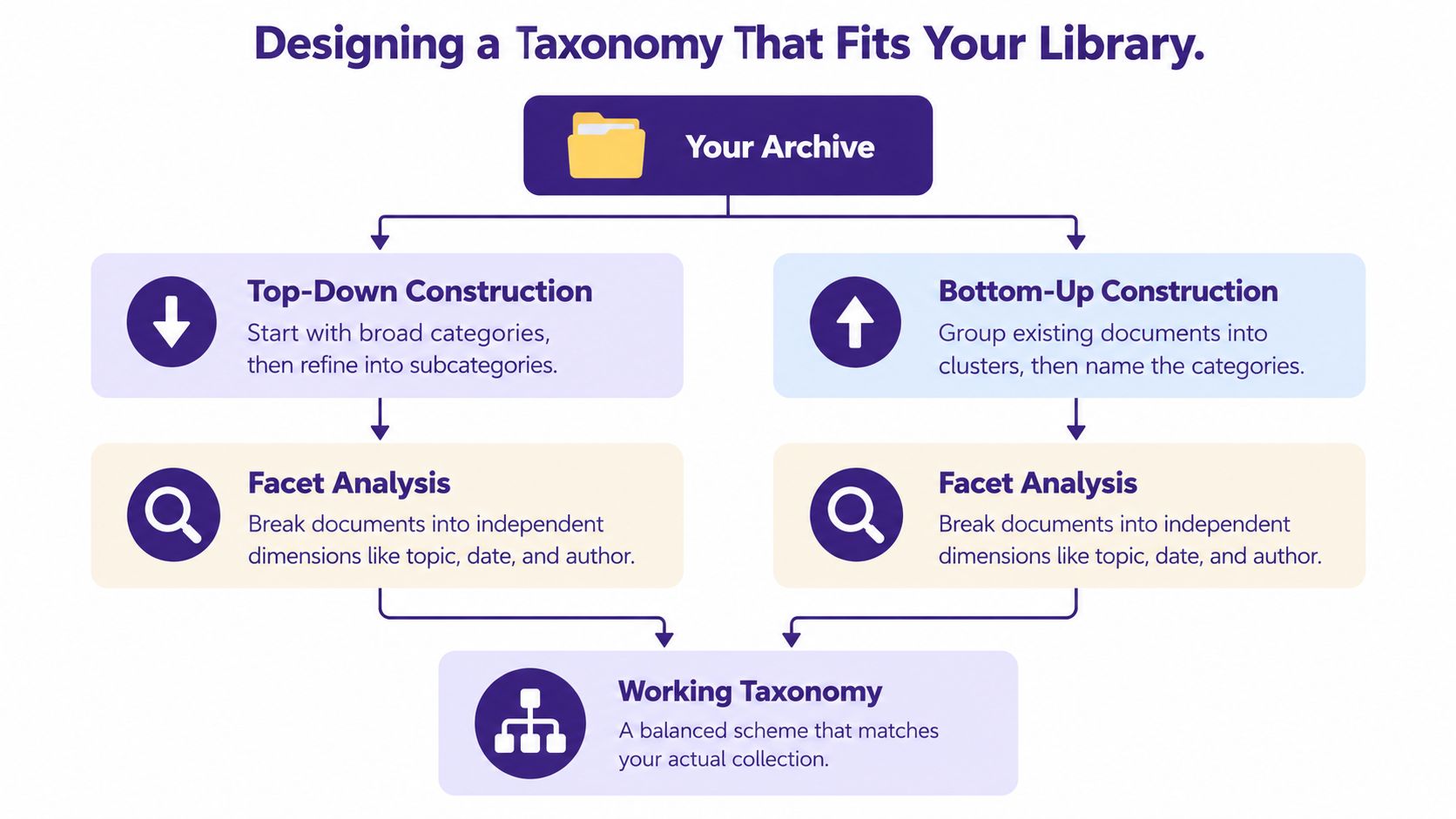
List the independent dimensions that matter. A podcast team might need format, season, theme, audience, rights, and lifecycle state. Those are facets: an episode can be a video and an interview, about audience growth, intended for new creators, and still awaiting rights review.
Next, inspect the language already in use. If one editor tags a topic “creator economy,” another uses “independent creators,” and a third writes “creator business,” search will fragment. Choose a preferred term, define it plainly, and record accepted synonyms so users can search naturally without multiplying categories.
Consider a network organizing 600 episodes. It could use format values such as interview and solo episode, season identifiers, themes such as audience development or production, and audience labels such as emerging creator or publisher. That example is a design exercise, not a claim about a real network. The useful point is that each label answers a different retrieval question.
Balance top-down and bottom-up design
A top-down approach starts with broad categories and refines them. It's useful when the team already knows its publishing model, but it can produce branches nobody uses. A bottom-up approach groups existing assets by recurring patterns, then names those groups. It reflects the actual archive, though it can preserve old inconsistencies unless someone consolidates near-duplicates.
Most small teams need both: set broad facets first, then test them against real files. Keep branches shallow enough for a person to choose a label without consulting a specialist. Document each label's definition, examples, exclusions, and owner. For practical habits that complement classification, this guide to mastering lab file organization can help teams make names and storage conventions more predictable.
For a deeper look at organizing labels themselves, see this guide to content tagging and taxonomy.
Before you roll out the scheme, check whether a new team member can choose the right label, whether two labels mean nearly the same thing, and whether each category supports a real search or handling need. Assign an owner who can approve changes and communicate them. Taxonomies need revision, but changing labels without managing the transition can break saved searches and disrupt familiar workflows.
Supervised, Unsupervised, and Hybrid Approaches
A small content team doesn't need to choose a powerful model before it understands the archive. The right approach depends on whether useful categories already exist, how consistent the assets are, and how much human review the team can maintain.
Supervised classification uses a defined taxonomy and examples that people have labeled. It's a sensible fit when categories are stable and the team can agree on what belongs in each one. For instance, a publisher with established sections might train or configure a classifier to suggest whether a draft belongs in its existing editorial categories. The trade-off is preparation: inconsistent examples teach inconsistent rules, and a model can force unfamiliar material into labels that don't fit.
Unsupervised clustering groups items by patterns in the content without requiring a finished taxonomy first. That can help when an archive has years of transcripts but no agreed subject labels. Reviewers can inspect clusters, name useful groupings, and merge duplicates. The catch is that a cluster isn't automatically a meaningful category. Similar wording can hide different editorial purposes, while the same subject may appear in very different language.
Hybrid classification combines an agreed label set with machine suggestions and human review. It's often the most practical choice for a growing archive: automate routine suggestions, then send uncertain or sensitive results to a person. The team still has to maintain definitions and review mistakes, but people don't need to hand-label every straightforward asset.
| Approach | Best fit | Cost to run | Main risk |
|---|---|---|---|
| Supervised | Stable categories and reviewed examples | Upfront labeling and ongoing checks | Inherited label inconsistencies |
| Unsupervised | Archives with little or no agreed taxonomy | Human time to interpret and consolidate clusters | Treating patterns as meaningful categories without review |
| Hybrid | A working taxonomy with uneven content or higher-risk labels | Setup plus targeted human review | Letting automation override an outdated taxonomy |
Choose for the archive you have
For a compact collection with clear sections, start with human-applied labels and a short written guide. If the archive is messy, use clustering to discover candidate themes, then have editors name and validate them. If the collection is already growing across formats, a hybrid workflow can balance speed with editorial judgment.
Whatever you choose, don't treat confidence as proof. A confident suggestion can still be wrong if the content is ambiguous or the categories are poorly defined. Keep a route for correction, capture reviewer feedback, and revisit whether the labels match how creators search for old episodes, articles, or clips.
Google's guidance on AI-generated content emphasizes that quality and usefulness matter regardless of whether AI assisted in producing an asset (Google guidance on AI-generated content). The same editorial discipline applies to classification: automation can suggest, but a team must still decide whether the label makes the asset more useful and trustworthy.
Metrics and the High-Water-Mark Rule
A classifier can produce labels without improving search or handling decisions. Track whether its labels help your team find the right material and protect restricted content. The cost of an error depends on the label: a misplaced topic tag can slow a search, while a missed sensitivity label can expose a source.
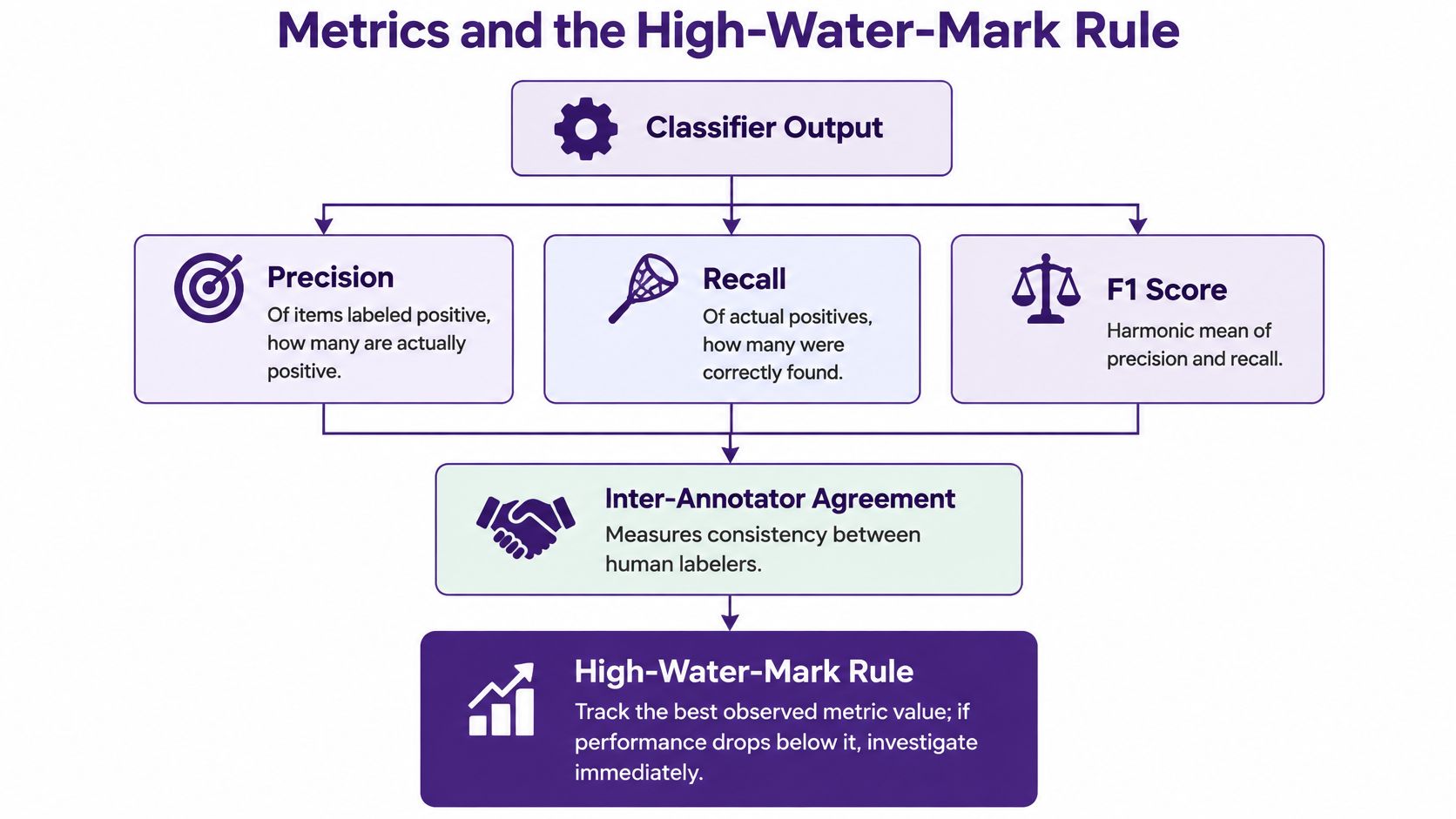
Precision measures how many items assigned to a category belong there. Recall measures how many items that belong in the category the classifier finds. F1 combines the two. Review these measures by category, since strong performance on common topics can hide misses in sensitive or less frequent categories.
Reviewers can disagree even when they follow the same guide. Inter-annotator agreement measures how consistently people apply labels to the same material. Persistent disagreement points to a vague definition, weak examples, or a category that combines concepts editors need to distinguish.
Apply the high-water mark to mixed content
For a mixed document, classify meaningful sections or data elements first, then apply the highest relevant protection level to the whole file. North Carolina's statewide data-classification policy requires the overall label to reflect the highest classification present, with accountability assigned to the data owner (North Carolina data classification and handling policy). NIST's impact methodology similarly determines an overall category from the highest relevant confidentiality, integrity, or availability impact, consistent with that policy.
For example, a research packet might contain a public summary and a passage identifying a source whose identity is embargoed. Topic labels can still help editors find the packet, but its sensitivity label must account for that passage. One restricted segment can change who may access or distribute the full file.
A topical tag helps people find the material. A sensitivity label determines how they may handle it.
Set clear review triggers for predictions involving mixed, sensitive, or ambiguous content. Keep sensitivity separate from topics such as politics, health, or episode theme, so discovery labels remain useful while access and distribution rules reflect risk. Teams assessing material before assigning labels can review content analysis tools as part of their workflow.
Operationalizing Classification for Large Archives
A taxonomy becomes useful when it changes what people can find and what they're allowed to do with it. Connect labels to search, permissions, review queues, redaction, retention, and export rules. A sensitivity label that doesn't affect handling is decoration; a rights label that editors can't find is just as ineffective.
Preserve the asset's provenance
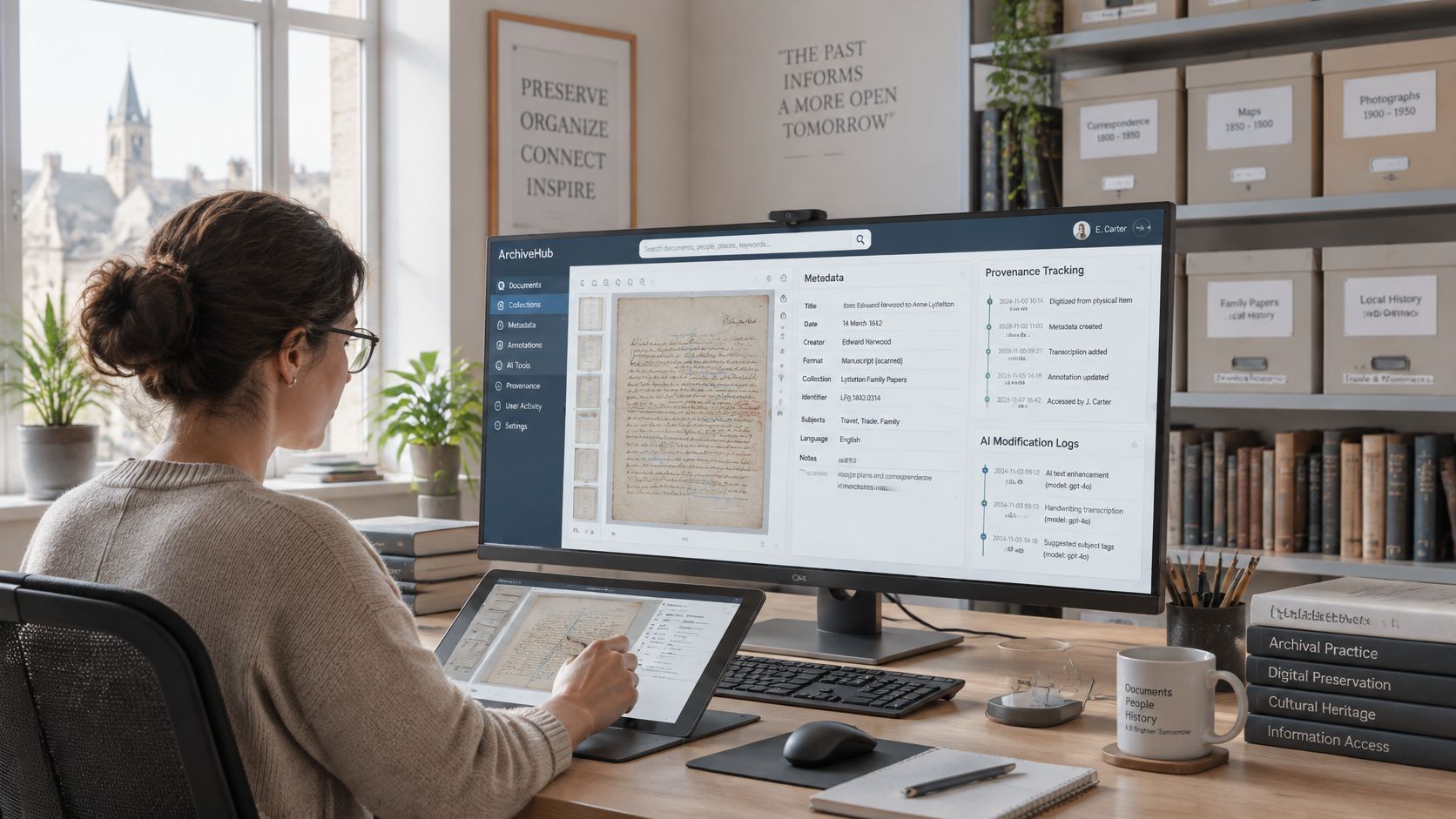
Subject labels alone don't explain how an asset came into being. Record whether a file is original, transformed, derivative, or synthetic, and keep its source identifier, version, timestamp, transformation history, and review status. That matters for a translated transcript, OCR output from a scan, an AI-generated summary, or a synthetic voice based on recorded material. NIST identifies metadata as a way to record digital-content origin and history, including whether content was AI-generated or modified, and recommends tracking dataset provenance and transformations in AI workflows (NIST guidance on AI content provenance).
This record helps editors understand what they're reusing and gives the team a trail to follow if someone questions an edit, attribution, or rights decision. Don't make the provenance label a substitute for topical metadata; each answers a different question.
Make accessibility searchable
Accessibility should describe what people can use, not reduce a resource to a single “accessible” label. Record features and limitations that matter in search: whether a video has captions and speaker labels, whether a full podcast transcript exists, whether an ebook supports reflow or text-to-speech, and whether visuals contain hazards or missing descriptions. Publishing guidance from the W3C community recommends explicit accessibility information for features, adjustments, conformance, and additional details (publishing accessibility guidance).
Those distinctions help an audience member filter for material that works for them. They also help a production team see which assets need captions, descriptions, transcript correction, or another accessibility review.
For guidance on keeping fields useful across tools and workflows, consult these metadata management best practices. If the team uses AI to adapt archived work, keep an editor responsible for checking accuracy, originality, and audience value. Google's people-first guidance recommends that publishers assess whether material serves an intended audience, shows relevant expertise, and leaves readers with a satisfying answer to their goal (Google's people-first content guidance. Clear titles and headings that use the language people search for can also support discovery, alongside thoughtful sharing in relevant communities (Google Search Essentials).
Your 90-Day Classification Rollout Plan
Keep the first rollout focused on a useful slice of the library, such as a show, publication, or recurring content series. The aim is a working system people can maintain, not a perfect taxonomy on paper.
- Week one: Inventory formats, storage locations, rights concerns, and the searches people make. Choose a practical pilot collection.
- Weeks two and three: Define the first facets, document label meanings, and apply them to a sample. Adjust labels that reviewers interpret differently.
- Weeks four through eight: Set up classification suggestions where useful, review uncertain results, and record corrections. Make sure sensitive labels connect to actual handling rules.
- Final month: Expand the workflow, monitor mislabels and missing metadata, and assign an owner for taxonomy changes.
At minimum, each asset should have a stable identifier, title, content type, subject, audience, rights status, lifecycle state, and provenance. Add sensitivity and accessibility fields where they affect handling or discovery. If labels keep multiplying, reviewers disagree, or people still can't find known assets, pause expansion and fix the definitions before processing more files.
Start with one collection this week: inventory it, agree on the labels that would make reuse safer and easier, then test those labels against real assets. Contesimal helps content teams classify, organize, and search existing documents, podcasts, videos, and articles with AI-assisted categorization and layered taxonomies, giving people a shared place to explore and build on their library. Visit Contesimal to see how it can support your archive workflow.