
You know the scene. Monday planning starts, the calendar has holes, and someone opens a keyword tool hoping a fresh idea falls out. Meanwhile your drive holds years of articles, episodes, and videos no one has properly searched. Good content marketing research starts there, with evidence only your audience could have given you.
Why Most Content Research Starts in the Wrong Place
The teams I work with don't have an idea shortage. They have a retrieval problem. A podcaster with a deep back catalog commissions a new episode on a question she answered twice, badly, three years ago. A publisher brainstorms from scratch while comments under older pieces ask the same unanswered question in slightly different words.
Outside research makes this worse when it's your only input. You sort keywords by volume, outline whatever already ranks, and produce a competent version of a competitor's post. It might get indexed. It rarely gives a loyal reader a reason to choose you, because it wasn't built from anything they told you.
What Your Archive Already Knows
Your library stores recurring audience questions, phrases people use when they're stuck, topics that held attention long after publication week, and promises your headlines made that the content didn't fully keep. That's proprietary material. A competitor can buy the same keyword subscription you use. They can't see which segment in your episode made listeners rewind, or which throwaway example in a newsletter drove replies.
This isn't a new insight dressed up for the AI era. John Deere's launch of The Furrow in 1895 and Michelin's 1900 guide show brands building useful publications long before search engines existed. The Furrow reportedly now reaches approximately 1.5 million readers in 40 countries and 12 languages, according to that same history, which tells you how a single editorial property compounds when you keep feeding it audience knowledge.
Treat your archive as field notes from years of audience contact, not as storage you're paying to ignore.
The Shift That Changes Your Backlog
Start research inside, then go outside to test what you found. Mine your own assets for durable themes first, check audience language second, and bring in keywords and competitors last to size and sharpen the opportunity.
- Pull before you pitch: Search transcripts, comments, and support tickets for repeated questions before approving a new topic.
- Flag unfinished business: Mark pieces where readers asked for a follow-up you never made.
- Note proven hooks: Save the exact titles and openings that earned saves, shares, and return visits.
You'll still need external signals. You'll just stop letting them write your calendar for you, and your backlog will start sounding like your audience instead of your category.
Defining Audience Research That Goes Beyond Demographics
Age, job title, and location tell you who someone is on paper. They don't tell you why she searched at midnight, what she's already tried, or what would make her forward your piece to a colleague. Useful audience research captures the job, the stage, and the trigger.
Start with the outcome your business needs, then work backward. That discipline matters because 42% of B2B marketers attribute ineffective content strategies to a lack of clear goals, and 56% report difficulty attributing ROI and tracking the customer journey, according to the Content Marketing Institute's 2025 B2B research. Treat self-reported figures as directional, not as census data, but the pattern is hard to miss.
Build a One Page Canvas You Will Actually Use
Interview five to eight readers or listeners with one prompt, "Walk me through the last time you ran into this problem." Don't pitch. Record their verbs. Then mine sales calls, podcast reviews, and YouTube comments for the same language. If you need a broader pass before interviews, these survey and social listening tactics help you collect signals at scale before you narrow in on individuals.
| Dimension | What to capture | Source | Confidence check |
|---|---|---|---|
| Job to be done | The outcome they're hiring content to achieve | Interviews, sales calls | Can you state it in their words without jargon |
| Awareness stage | Unaware, problem aware, solution aware, comparing | Search queries, entry pages | Does their language match the stage |
| Pain intensity | Annoying, costly, or blocking other work | Support tickets, reviews | Would they pay or switch tools to fix it |
| Trigger | The event that started the search today | Comments, community posts | Can you name a specific moment, not a trait |
Keep the Canvas Honest
Score each row high, medium, or low confidence. Low confidence doesn't block publishing, it tells you what to validate next with a poll, a reply prompt in your email, or a short post asking readers to pick between two angles.
For comparing listening tools, transcripts, and tagging options, our roundup of audience research tools worth testing breaks down what each does well. Pick one primary source per dimension. A canvas fed by twelve dashboards usually means no one updates it, and a stale persona is worse than a short, honest one.
Competitive Research That Surfaces Gaps Instead of Mirrors
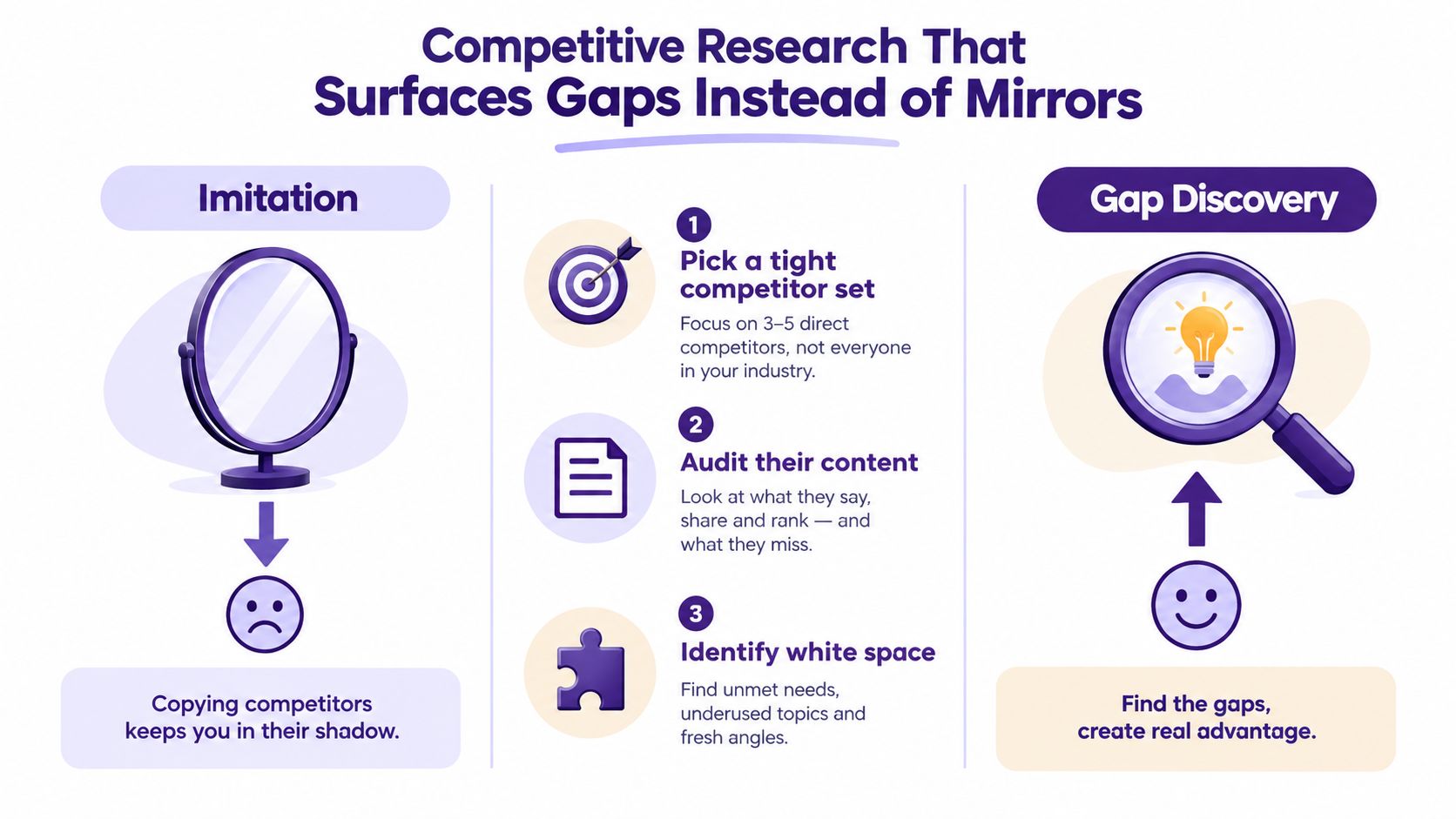
Competitive audits fail when they become shopping lists. You screenshot a rival's top posts, brief writers to do the same thing slightly longer, and wonder why buyers can't tell you apart. Gap discovery asks a different question, where is proven demand meeting weak, outdated, or missing coverage that fits your audience canvas?
Use the visual below as a quick gut check before you build anything.
Pick a Tight Set and Tag What They Publish
Choose direct competitors your audience names, plus one adjacent creator who wins attention you want. That's enough. Crawl their recent articles, episodes, and videos into a sheet and tag every item the same way.
- Topic cluster: Group by the problem solved, not by their menu labels.
- Intent and depth: Note whether the piece defines, compares, teaches steps, or sells, and whether it skims or shows real work.
- Hook style: Record the promise in the title, contrarian claim, teardown, template, personal story, or data roundup.
- Format and cadence: Track what they repeat weekly and what they tried once and abandoned.
Abandoned formats are signal, too. A rival who stopped doing expert roundups may have learned they don't retain, or they may have left a proven format undefended. Your own retention data helps you tell which.
Score Gaps Before You Brief Anyone
Build a simple matrix with topic clusters as rows and competitors as columns. Mark coverage as strong, thin, or absent. Then score each white space on audience fit from your canvas, demand from search and community questions, and difficulty given your expertise and assets. Prioritize high fit, real demand, and moderate difficulty. Ignore gaps that are empty because nobody cares.
Scoring shortcut: If a gap doesn't connect to a job on your audience canvas and an asset in your archive, it's trivia, not strategy.
Refresh the matrix monthly with new competitor posts rather than rebuilding it quarterly from memory. Our walkthrough of competitive content analysis in practice shows a lightweight version you can maintain in a spreadsheet. You'll know the process is working when your briefs cite what's missing in the market, not just what the top result already says.
Keyword and Intent Research Built Around Business Fit
A flat keyword list sorted by volume is how teams end up ranking for traffic that never subscribes, buys, or returns. Volume tells you a phrase is typed often. It doesn't tell you who's typing it, what they expect to find, or whether satisfying them helps your business.
Build a map in layers instead. If you're tying this work to a broader growth plan, this guide to SEO content strategy for growth-stage SaaS shows how clusters connect to pipeline goals. Apply the same logic whether you sell software, subscriptions, courses, or sponsorships.
Read the SERP as an Intent Brief
Search results reveal what Google believes searchers want right now. Video packs mean people want to watch a process. Comparison pages mean they're choosing. A wall of templates means they want to copy something and leave. Match the expectation or pick a different query.
| Intent | SERP signal | Reader expectation | Best-fit format |
|---|---|---|---|
| Informational | Guides, explainers, videos | Understand a concept or fix a problem | Tutorial article, walkthrough episode |
| Navigational | Brand pages, homepages, login links | Reach a specific destination fast | Clear landing page, series hub |
| Commercial | Comparisons, reviews, best-of lists | Evaluate options with evidence | Teardown, comparison table, tested review |
| Transactional | Pricing, product, trial pages | Act now with low friction | Offer page, demo, focused short video |
Add a Fit Score You Can Defend in the Room
Score each cluster on three things. Audience match asks whether the searcher resembles your canvas. Commercial proximity asks how close the topic sits to a subscription, lead, or sale. Existing authority asks whether your archive already covers adjacent ground you can link and update.
That last factor changes priorities fast. A modest-volume cluster where you own three aging but respected pieces often beats a huge term where you'd start from zero against entrenched publishers. Updating and interlinking proven assets is cheaper than outwriting the internet, and it gives new readers a path deeper into your library instead of a single page visit.
Watch for phrasing shifts in your search console and comments, too. When readers start adding words like template, example, or versus to an old topic, they're telling you intent has moved. Follow that movement, and your map stays a decision tool instead of a spreadsheet you re-sort every Monday.
Turning Your Content Library Into a Research Engine
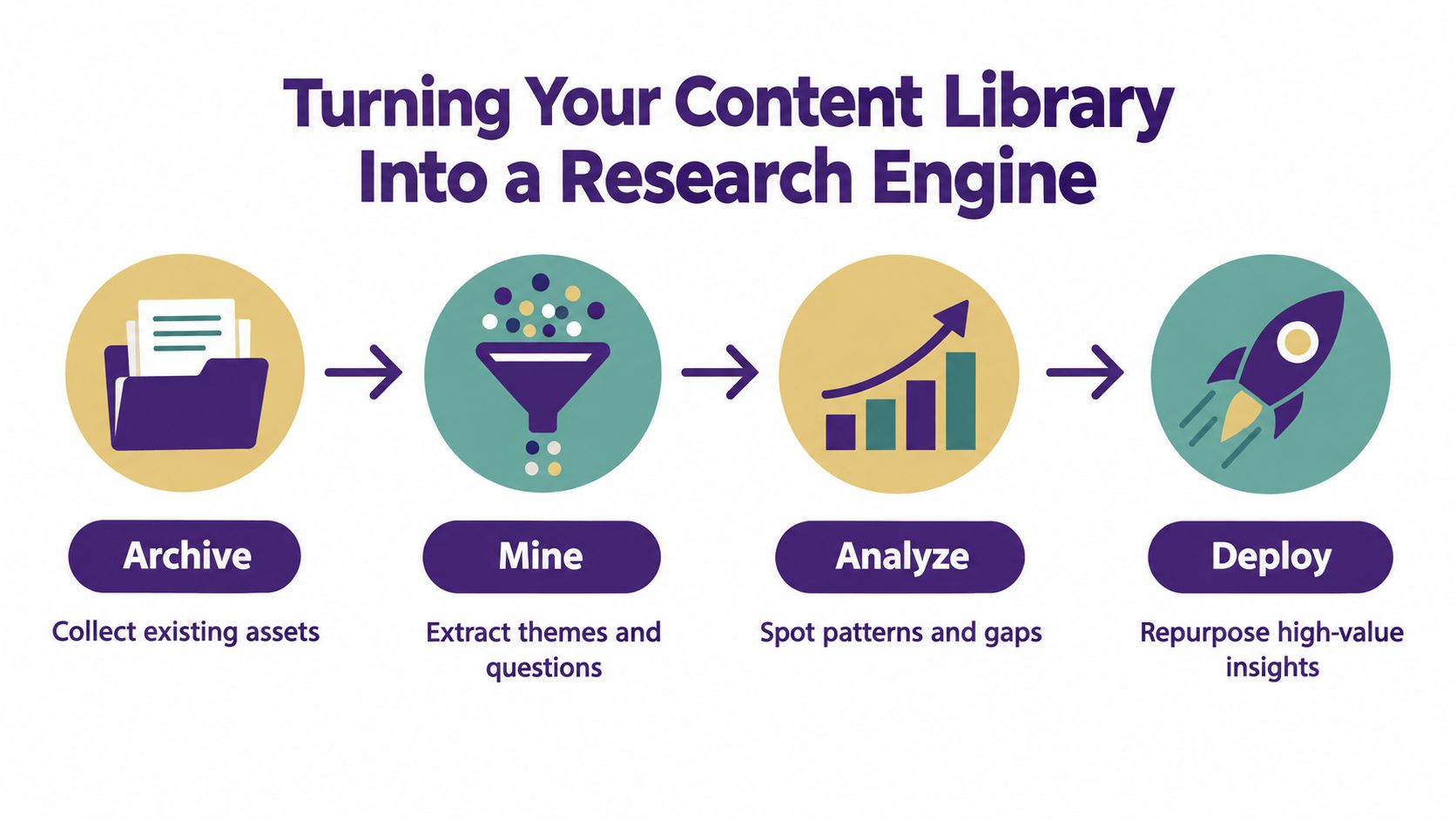
Here's where your unfair advantage compounds. Once your articles, transcripts, and videos carry consistent metadata, you can ask questions across years of work in minutes. Which topics do we return to every spring? Which guest themes produced episodes people finish? Which claims have we repeated without ever showing evidence?
The flow below shows the basic loop, collect, mine, analyze, and redeploy.
Normalize First, Query Second
Ingest what you have, then clean titles, dates, authors, and formats so the same show or column isn't spelled three ways. Apply a controlled taxonomy covering topic, audience stage, format, author, publication date, channel, and conversion objective. Free tagging feels flexible and destroys comparability, so keep the vocabulary short and governed.
A tool like Contesimal fits as one option for teams that want chat-based search across classified articles, podcasts, and videos without living in spreadsheets. Whatever stack you choose, the taxonomy does the heavy lifting. Software just makes asking questions faster.
Run Pattern Queries That Produce Briefs
Don't browse. Ask specific questions with an editorial decision attached.
- Recurring questions: Show audience questions we've answered in comments but never in a dedicated piece, grouped by topic.
- Durable themes: List topics with steady saves or completions across multiple years, not just launch-week spikes.
- Contradictions and updates: Find places where newer episodes update advice given in older articles that still get traffic.
- Repurposing candidates: Surface long pieces with strong mid-sections that were never cut into clips, emails, or social posts.
That last query matters operationally. In one survey, only 19% of marketers repurpose the same content across their platforms, while 34% create entirely new content from scratch for each platform and 47% share similar content across platforms, according to HubSpot's social media survey findings. A tagged library fixes that duplication by separating the reusable core idea from platform-specific execution.
Use AI to expand angles from archived material, then let humans select and fact-check. Research summarized by MIT Sloan on human and AI collaboration across 370 effect sizes from 106 experiments found combinations tended to do better on content-creation tasks, which represented 10% of the studies reviewed. Drafting help is real. Editorial judgment is still yours.
Run the loop monthly, ingest, tag, query, decide. Small, regular passes keep the library current and turn research into a habit instead of an annual archaeology project your team dreads.
Measuring Opportunity With Analytics and Cohorts
Raw pageviews punish podcasts, reward old posts with lucky backlinks, and tell you almost nothing about whether a research finding deserves production budget. Cohorts fix that by comparing like with like, episodes by topic within their first ninety days, or articles by intent against qualified conversions.
The chart below frames the metrics to validate before you spend.
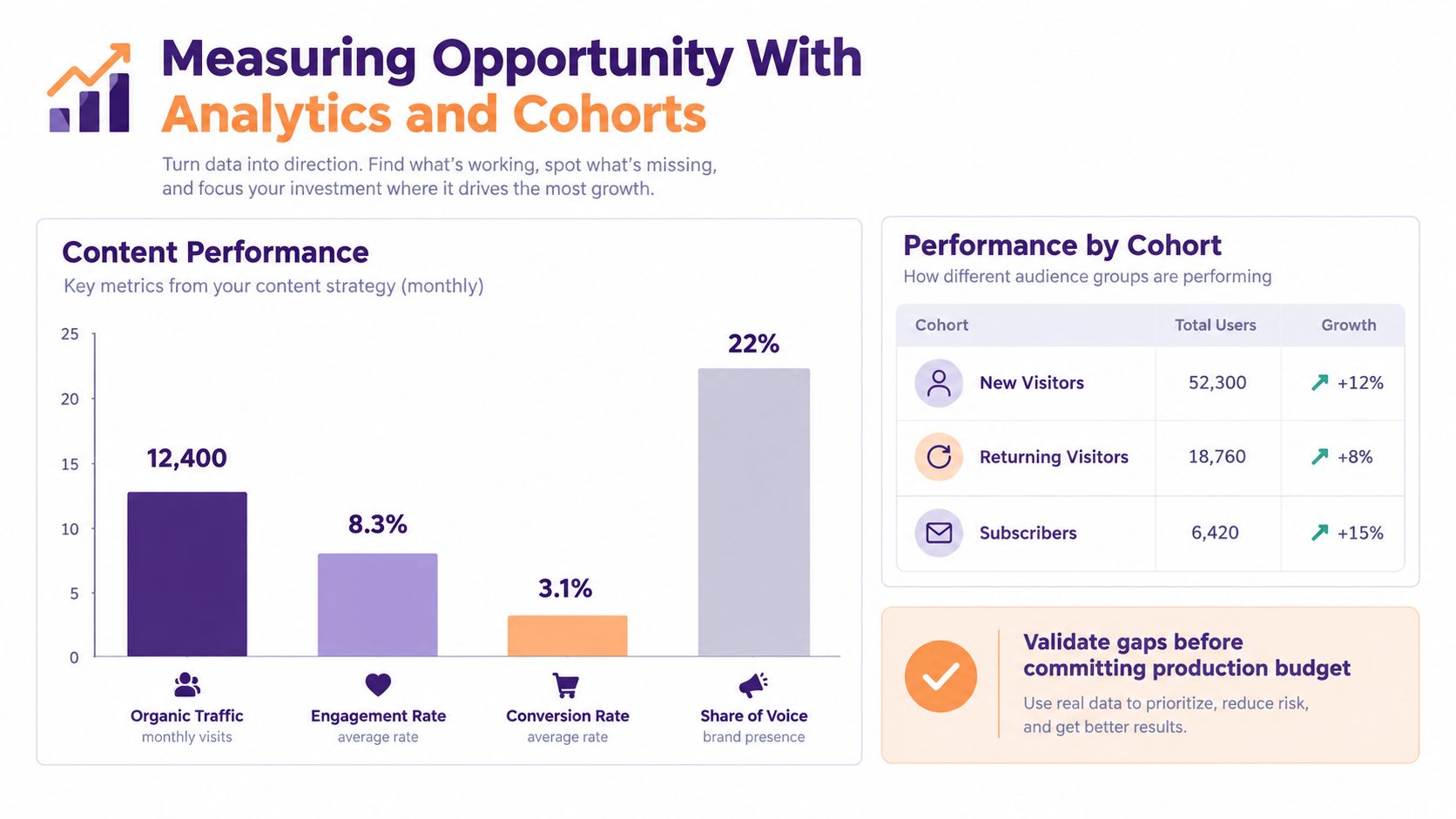
Set one attribution window and keep it. Separate leading indicators like completion rate, engaged time, and return visits from lagging outcomes like pipeline, subscriptions, and revenue. Leading signals tell you within weeks whether an angle resonates. Lagging outcomes confirm whether resonance pays. Confusing the two is how teams kill promising series too early or keep funding popular topics that never convert.
That measurement gap is widespread. Even though 96% of B2B marketers say they measure content performance, only 51% believe they do so effectively, a benchmark noted in the CMI research cited earlier. Dashboards aren't the bottleneck. Outcome alignment is. The same problem shows up with AI, where 74% of surveyed practitioners use AI in content workflows, yet only 19% have implemented AI-specific performance indicators and 81% continue using pre-AI KPIs, according to an analysis of AI-era content ROI measurement. Track research-time savings, reuse rate, and cost of low-performing output alongside audience metrics, or you'll miss where AI actually helps.
The short video below walks through reading cohort performance without drowning in dashboards.
Audit a sample of tagged items by hand each month and note confidence limits when a cohort is tiny. Three viral clips don't prove a format. For a step-by-step method, see our guide on how to analyze content performance with cohorts. Validate the gap, then commit budget with a clear leading indicator you'll check first.
A Practical Week-One Research Plan You Can Run Monday
You don't need perfect data to start. You need four small artifacts and one decision meeting. Here's a week-one pass sized for a busy creator or small team moving from hobbyist habits into a real revenue operation.
- Monday, audience canvas: Draft the one-page canvas from five reader conversations or a comment mining session. Decision made: who every brief this month is for.
- Tuesday, competitor matrix: Tag recent work from five competitors and mark strong, thin, or absent coverage. Decision made: which gaps you'll ignore on purpose.
- Wednesday, intent map: Score a short keyword list on audience match, commercial proximity, and existing authority. Decision made: which clusters earn production time.
- Thursday, archive audit: Tag a sample of your strongest older assets and run the recurring-question and repurposing queries. Decision made: what to update or cut into new formats before creating from scratch.
- Friday, cohort check: Group recent pieces by format and topic, compare leading indicators, and pick next week's briefs from validated gaps.
Keep trust visible as you reuse archive material. Label AI-assisted summaries, link back to the original episode or article, and let a human approve anything that reframes someone else's words. That transparency protects the credibility your archive earned in the first place.
Research is a cycle, not a project. Run this loop monthly, let your buckets and playlists build on proven concepts, and your library starts generating the next idea, the next format, and the next revenue stream. Organize what you own, understand what it proves, then take action.
Ready to organize your library, understand what your audience keeps asking for, and turn proven long-form work into new formats across platforms? Contesimal helps you classify, search, and collaborate across articles, podcasts, and videos so your archive becomes a research engine you can monetize. Start with your strongest assets this week and see how much value is already sitting in your catalog.