
Your archive probably started innocently. A video went into a folder, a podcast transcript became a document, and a few useful tags seemed enough. Later, someone asks which episodes discuss a product, which clips are cleared for commercial reuse, or which draft still needs editorial review. The answers are somewhere in the library, but nobody can reach them quickly.
Document classification types provide the structure behind those answers. Classification isn't just assigning a topic label. It connects an asset to its format, purpose, audience, lifecycle, rights, provenance, and confidence level. That structure helps creators, publishers, marketers, and research teams find existing material, reuse it safely, and turn one substantial asset into many useful outputs.
When a Growing Archive Stops Being Findable
The problem usually appears during a deadline. A creator wants to turn an old interview into a newsletter, a short video, and a research-backed article. The original recording exists, but the transcript has a different filename, the best quotation is buried in a PDF, and nobody knows whether the guest approved promotional reuse. The team searches by memory, opens unrelated files, and eventually recreates work that already exists.
A larger archive magnifies the cost. Content teams may hold videos, podcast episodes, scripts, articles, research notes, contracts, thumbnails, captions, and social posts in the same broad storage environment. A folder name can tell you where an asset was placed. It can't reliably tell you what the asset contains, who may use it, what stage it has reached, or which other assets belong with it.
Classification turns storage into an inventory
A useful classification record answers several practical questions:
- What is it? A transcript, episode, article, clip, report, or contract.
- What is it about? A subject, person, organization, product, or theme.
- Why does it exist? Research, editorial production, education, promotion, or legal use.
- Who can use it? A public audience, an internal team, a specific market, or a restricted group.
- What happens next? Review, publication, repurposing, archiving, or deletion.
That final layer matters because content isn't static. A draft becomes approved, a translation creates a related asset, and an AI-assisted summary may need its own provenance record. A thoughtful data governance compliance guide can help teams connect classification with responsible handling rather than treating organization as a purely editorial task.
The right classification type depends on the question your platform must answer. Binary labels can route items into a simple review decision. Multi-label schemes describe overlapping subjects. Hierarchies support browsing from broad themes to narrow topics. Metadata and controlled vocabularies keep those decisions consistent as the archive grows.
The result is more than tidy search. A classified library gives your team a way to identify reusable material, build content series, compare performance by theme, and create new value from work that would otherwise remain dormant.
Single-Label, Multi-Label, and Hierarchical Schemes
A documentary platform may need to answer different questions about the same asset. Is it cleared for reuse? What format is it? Which subjects does it cover? Classification works best when each question has an appropriate label structure, rather than forcing every decision into one field.
Four useful label shapes
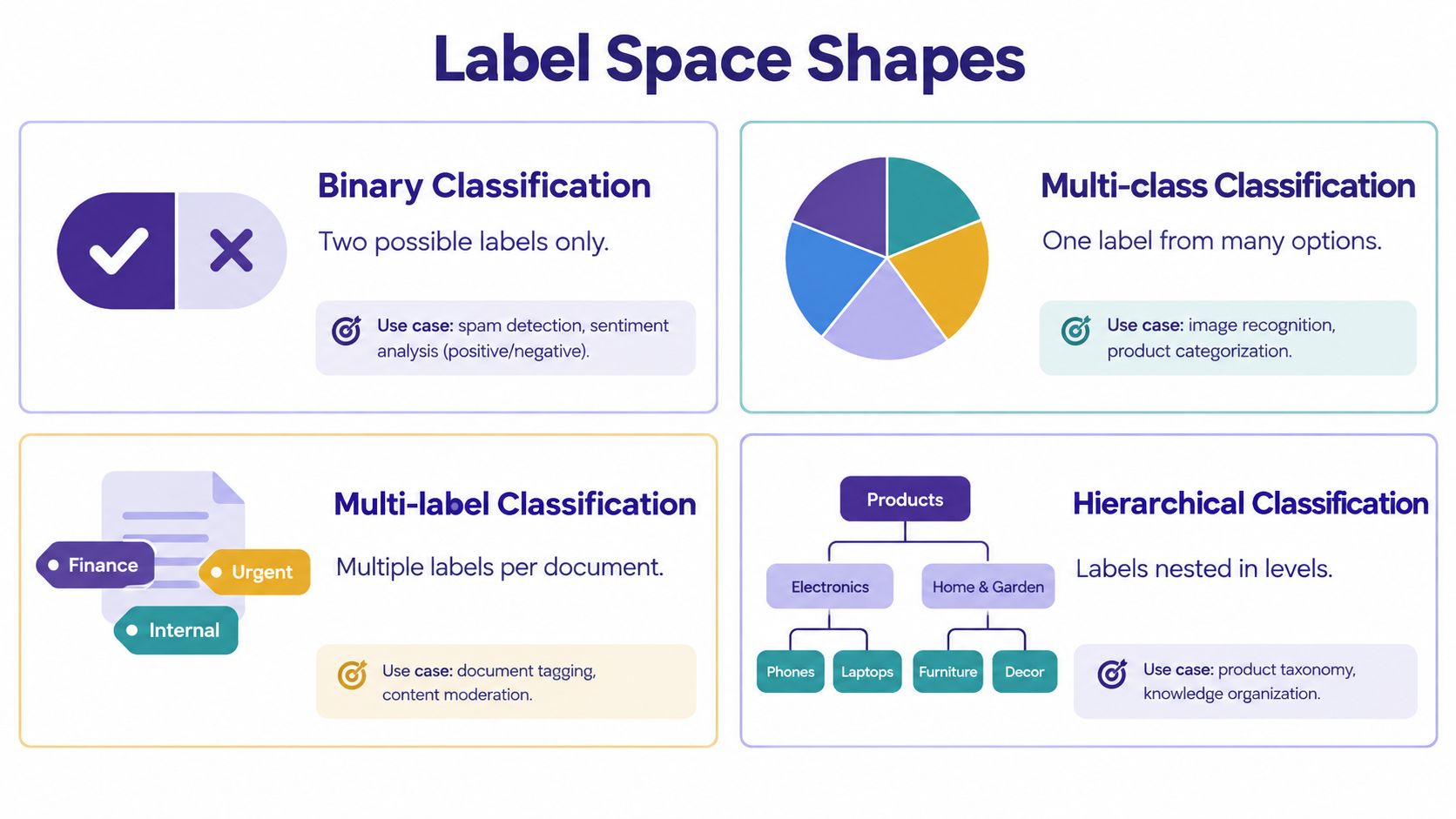
Binary classification answers a yes-or-no question. A podcast item might be marked “approved for public reuse” or “needs rights review.” This structure supports quick routing, but it cannot describe an episode's wider identity.
Multi-class classification assigns one label from several mutually exclusive choices. An asset might be an interview, tutorial, news analysis, or behind-the-scenes recording. Use it when a workflow needs one clear format or stage.
Multi-label classification allows several labels on one item. An episode could be an interview, a discussion of artificial intelligence, a beginner resource, and an evergreen reference. These labels preserve overlapping meaning instead of hiding it inside a single bucket.
Hierarchical classification organizes labels from broad categories to specific terms. A library might move from Technology to Artificial Intelligence to Generative AI to Prompt Design. The parent category supports broad browsing, while the narrower term improves precise retrieval.
The Reuters-21578 corpus illustrates why a governed inventory needs more than one classification pattern. It contains 21,578 newswire articles, covers 118 topic categories, and permits an article to receive several labels or none. Documents with at least one label average 1.24 classes. Its ModApte split includes 9,603 training documents and 3,299 test documents, with human-indexed records used for evaluation in Stanford's information-retrieval reference.
Match the scheme to the business question
Choose binary classification for a narrow decision, multi-class classification when options exclude one another, multi-label classification when subjects overlap, and hierarchical classification when users need broad browsing alongside specific retrieval. A mature content platform may apply all four at separate layers. Format can be multi-class, topics can be multi-label, and subject terms can follow a hierarchy.
The taxonomy should come before the algorithm. If an episode covers several subjects, a single-label model will discard information no matter how accurately it predicts. Add rights, provenance, and confidence as governed layers around those content labels, so the archive records not only what an item is, but how safely and reliably it can be reused.
Content-Based Label Categories
Content-based labels describe the material itself. They're useful, but they answer different questions, so they shouldn't be mixed into one undifferentiated tag field.
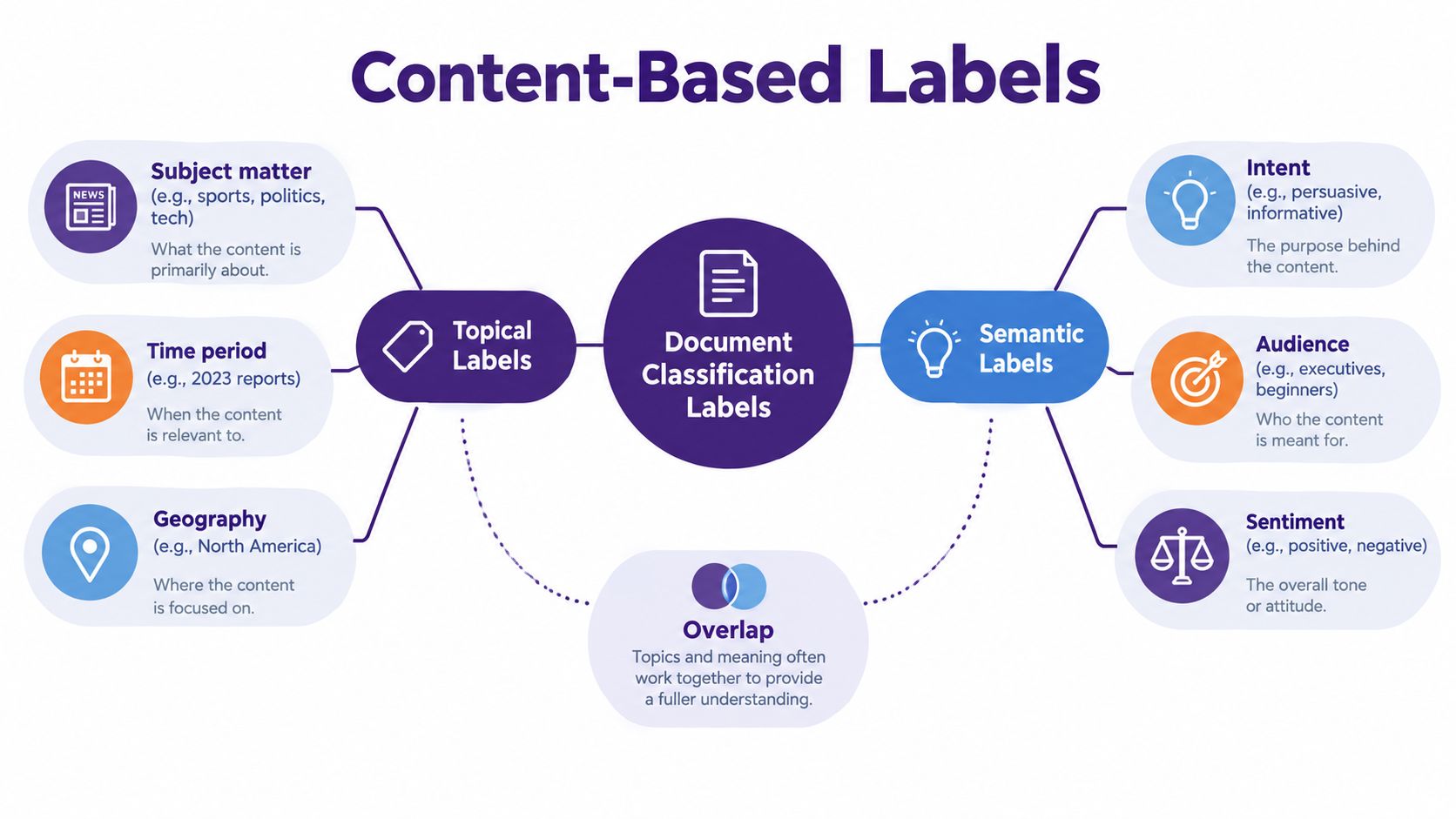
Topical classification identifies subject matter. An episode may concern creator economics, video production, publishing, or audience research. Add time period and geography when they affect discovery, such as an annual report or a regional market discussion.
Semantic classification looks beyond matching words and groups content by meaning. Two articles can use different vocabulary while addressing the same problem, such as turning a long interview into several shorter assets.
Genre classification describes the form of the content. Interview, tutorial, review, case study, opinion, explainer, and news update are useful genre labels because readers and viewers often seek a particular experience.
Sentiment classification identifies tone or attitude. A customer response may be positive, dissatisfied, cautious, or mixed. Sentiment can support editorial review and audience segmentation, but it shouldn't replace human judgment where context matters.
Intent classification asks what the content is trying to do. An asset may inform, persuade, educate, compare, entertain, or prompt an action. Intent helps teams match material to a campaign or stage in a reader's journey.
Named-entity classification identifies people, organizations, products, places, events, and other specific entities. If a transcript mentions a guest, a software product, and a publisher, entity tags can connect that episode to related content even when the main topic label differs.
These axes work together rather than compete. A single video can be a tutorial by genre, about search strategy by topic, intended for marketing executives by audience, informative by intent, and associated with several named entities.
Practical rule: Keep subject, genre, sentiment, intent, and entity fields separate. Combining them into one tag list makes search easier to build badly and harder to improve later.
Before creating labels, write the question each axis must answer. If a label doesn't support discovery, routing, personalization, measurement, or reuse, it may be decorative rather than operational.
Metadata-Driven and Controlled Vocabulary Models
A durable classification system needs more than labels. It needs a metadata record that explains the label's meaning and places it alongside other structured fields.
A practical asset record can include:
- Asset type: Article, transcript, video, report, contract, script, or audio episode.
- Subject: The topic or topics covered.
- Function: Research, editorial, legal, instructional, promotional, or commercial.
- Audience: Beginners, executives, subscribers, internal staff, or a defined market.
- Jurisdiction and language: Where the content applies and which language it uses.
- Lifecycle state: Draft, reviewed, published, archived, superseded, or under revision.
- Access and rights: Who may view, edit, distribute, transform, or commercially reuse it.
A flat tag list feels convenient at first. It becomes fragile when two editors create slightly different labels for the same idea, or when a term changes but historical search must continue working.
| Aspect | Flat Tags | Controlled Vocabulary |
|---|---|---|
| Meaning | A label with limited context | A concept with a definition and relationships |
| Consistency | Depends on each contributor | Uses preferred terms, synonyms, and rules |
| Structure | Usually one level | Supports broader, narrower, and related concepts |
| Migration | Renaming can break search | Persistent identifiers preserve continuity |
| Analytics | Similar terms may split results | Mapped concepts support aggregation |
| Governance | Ownership is often unclear | Each branch can have a steward and status |
SKOS, from the W3C vocabulary model, represents classification schemes, taxonomies, thesauri, and subject-heading systems as structured concepts. ISO 25964 provides guidance for thesaurus development, exchange, and interoperability with taxonomies, ontologies, authority lists, and related systems through its standards overview.
Each concept should have a persistent identifier, preferred label, alternative labels, definition, broader and narrower relationships, related concepts, language, status, and effective dates. A mapping should say whether one concept is equivalent to, broader than, narrower than, or related to another. Calling every relationship a synonym destroys useful meaning.
This structure also helps when teams test files, review AI-generated metadata, or inspect transformations. A resource on privacy-conscious video verification options provides relevant context for teams handling video provenance and metadata checks. For day-to-day implementation, document the naming rules, ownership, and migration process in metadata management best practices.
Hierarchical Paths and Faceted Modeling
A hierarchy gives people a route through the archive. Facets let them combine routes without creating a new category for every combination.
Consider a podcast episode about search strategy for publishers. Its subject path might be Marketing, Search, Content Discovery. Its format is Interview. Its audience is Publishers. Its lifecycle is Published. Those values belong to different facets, but they can live on the same record.
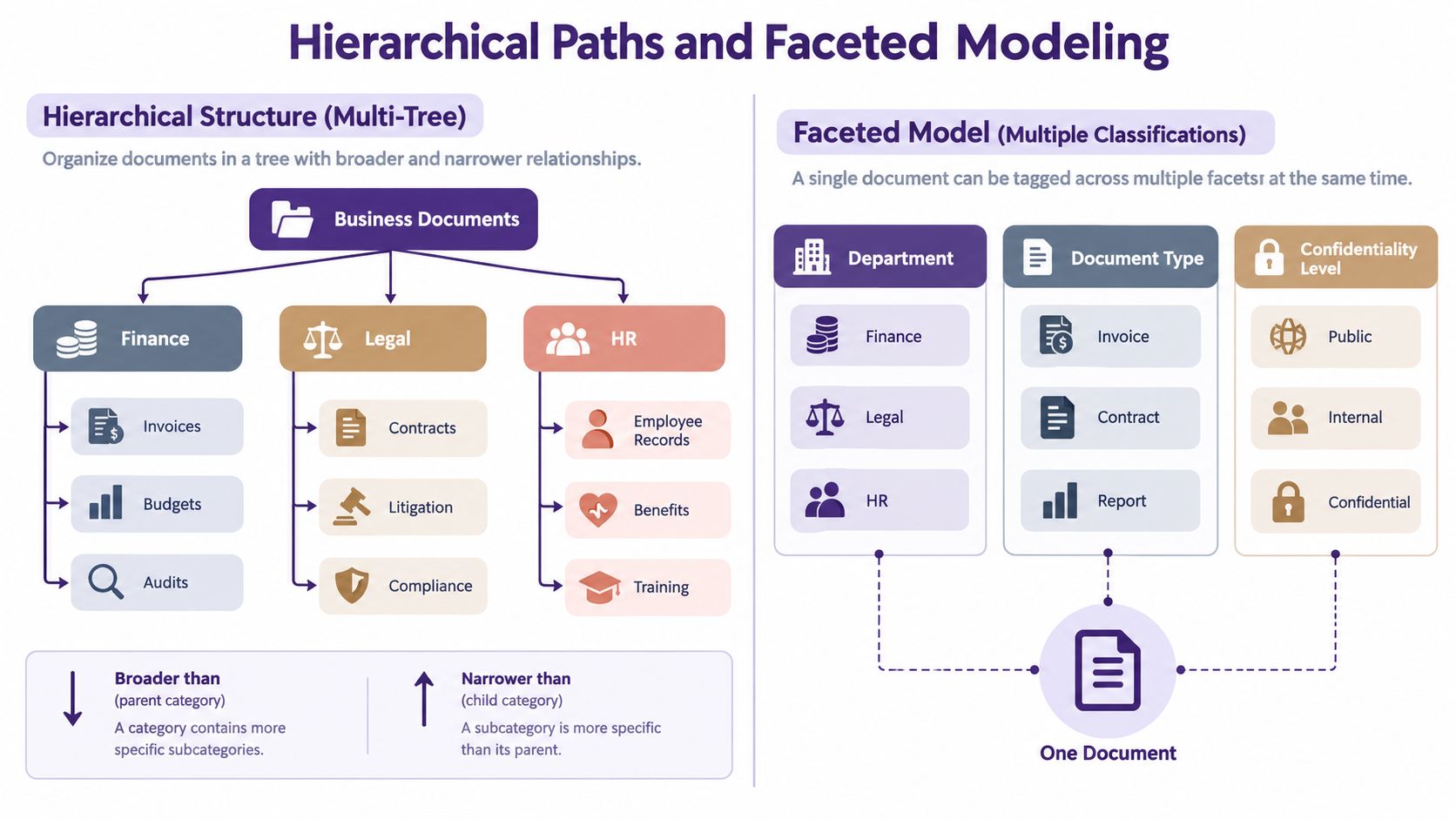
Within a hierarchy, broader and narrower relationships support navigation. A general subject contains more specific subjects. An associative relationship connects concepts that are related but not parent and child, such as Search Strategy and Editorial Planning.
Choose between pre-coordination and post-coordination
Pre-coordination joins facets into a compound class during indexing. You might create “Published Interviews for Publishers.” This can make a fixed browse page straightforward, but the number of combinations grows quickly.
Post-coordination keeps facets separate and combines them at query time. A searcher can select Published, Interview, and Publishers without your team creating a permanent compound term. This approach usually gives the archive more flexibility.
Keep hierarchies shallow enough for editors to maintain and specific enough for users to browse. Give every branch a definition, examples, exclusions, and an owner. A taxonomy guide such as types of taxonomies can help teams choose between trees, facets, and hybrid structures.
A document shouldn't need one path when its meaning spans several. Store multiple subject concepts, then expose the most useful paths in search and navigation.
Algorithms That Power Automated Classification
A taxonomy tells the classifier what labels exist. An algorithm determines how the system assigns them. Start with the least complex method that can meet your evidence and workflow needs.
Naive Bayes is a fast baseline for text. It estimates how likely a document is to belong to each class based on its features. It can work well for routing and early experiments, especially when the labels have recognizable vocabulary.
Logistic regression and support vector machines suit high-dimensional text represented with features such as word or phrase counts. They're useful for topic tagging, review queues, and format detection when the archive has labeled examples and latency matters.
Tree ensembles, including random forests and gradient-boosting methods, can combine text-derived signals with structured metadata. They're a sensible option when format, language, duration, workflow state, and other fields matter alongside words.
Transformer encoders capture richer context and semantic relationships. They can support similarity search, multilingual classification, and nuanced topic assignment, but they generally require more compute, careful evaluation, and stronger monitoring.
| Algorithm | Best Fit | Trade-off |
|---|---|---|
| Naive Bayes | Fast text triage and baseline experiments | Simplified feature assumptions |
| Logistic regression | Sparse text and clear routing classes | Needs labeled examples and feature preparation |
| SVM | High-dimensional text with distinct boundaries | Less convenient for complex multi-stage workflows |
| Tree ensembles | Mixed structured and derived features | Can require careful feature design |
| Transformers | Context-rich, semantic, and multilingual tasks | Higher operational complexity and compute needs |
Rules still have a place. A rights field marked “do not redistribute” can block a workflow regardless of a model's topic prediction. A practical system often combines deterministic rules, supervised models, semantic models, and human review.
A useful document classification methods reference can help your team compare approaches before committing to a production design.
Choose the algorithm according to the cost of error. A lightweight model may be appropriate for an internal suggestion, while a rights or compliance decision should require stronger evidence and a review path.
Evaluation Metrics for Real Archives
A classifier can look accurate while failing the labels your team needs. An archive dominated by common classes may produce a strong overall score while missing rare material with serious editorial, legal, or operational consequences.
Start with a confusion matrix, which places predicted labels beside the labels reviewers judge correct. Precision asks whether items carrying a label belong there. Recall asks how much relevant material the system found. F1 combines precision and recall, yet it cannot show whether a false positive or a missed document costs more to the business.
Macro averages give every label equal influence. Micro averages combine decisions across labels, allowing frequent categories to shape the result more strongly. Report both when class sizes differ, then inspect individual labels rather than relying on one headline score.
| Metric | Question Answered |
|---|---|
| Precision | Can we trust items carrying this label? |
| Recall | Did we find the relevant items? |
| F1 | How balanced are precision and recall? |
| Label coverage | How much of the archive receives useful labels? |
| Abstention rate | How often does the system correctly defer? |
| Inter-rater agreement | Do human reviewers interpret the labels consistently? |
| Taxonomy stability | Do results remain comparable after label changes? |
The Reuters evaluation example is useful because its ModApte records were assessed by a human indexer. Human-reviewed test data provides a more meaningful benchmark than treating automatically assigned labels as ground truth, a point reflected in the Reuters corpus evaluation literature.
A content lead can turn these measures into an operating dashboard: per-label precision and recall, coverage by format and language, review volume, abstentions, reviewer overrides, and changes after taxonomy revisions. Track provenance, rights, and confidence alongside topic labels so the archive remains useful for decisions, not merely searchable. A system that defers uncertain cases can produce cleaner inventory than one that assigns every document a confident-looking label.
When a Classifier Should Refuse to Label
A wrong label can be more damaging than an empty field. It can surface restricted material, hide a valuable episode, route a draft into publication, or distort analytics that guide future production.
Set uncertainty thresholds before deployment. High-confidence items may move automatically. Middle-confidence items can enter a review queue. Low-confidence items should remain unknown until a person or a stronger process resolves them.
Design the refusal record
Every abstention should explain enough for a reviewer to act:
- Prediction candidates: Which labels competed.
- Confidence or uncertainty: How strongly the system favored its suggestion.
- Evidence: Text spans, visual features, metadata, or rules that influenced the result.
- Failure context: Poor OCR, missing transcript, mixed language, or an unfamiliar format.
- Reviewer action: Accepted, changed, rejected, or left unresolved.
- Model identity: The classifier version and timestamp.
Multimodal archives create extra failure points. A scanned PDF may produce damaged OCR. A video transcript may omit information visible on screen. A multilingual collection can contain uneven training coverage. AI-modified material may have a different origin and transformation history. Prompt injection or deliberately misleading text can also manipulate a system that treats every passage as trustworthy instruction.
NIST's discussion of adversarial machine learning highlights why teams need to consider attacks and unexpected behavior in AI systems in its 2025 report. The practical response isn't to reject automation. It's to limit what automation may decide without review.
A confident prediction is not the same as a supported prediction.
Track disagreement between reviewers and the model, not only the model's headline score. If people routinely override one label, revise its definition, examples, training data, or threshold.
Provenance, Rights, and Reuse as Classification
A topical label tells you what a document discusses. It doesn't tell you whether your team may reuse it. Rights and provenance deserve their own classification axes.
Add fields for copyright status, consent status, personal-data sensitivity, jurisdiction, permitted audience, commercial reuse, transformation rights, and AI involvement. An interview might be approved for the original episode but restricted for advertising. A transcript might be suitable for internal research but not for public quotation.
The EU AI Act's data-governance requirements address design choices, collection processes, data origins, the original purpose of personal-data collection, bias detection, and representativeness across training, validation, and testing datasets in Article 10. Those concerns make provenance relevant even when a team uses classification for search rather than model training.
Attach the audit trail to the label
A classification record should preserve:
- Classifier version
- Confidence or uncertainty
- Assignment timestamp
- Evidence or source fields
- Human override
- Rights and consent status
- Transformation history
- Review owner and decision
NIST's 2025 standards initiative on AI datasets and models points toward more structured documentation of how data was created and managed. For publishers and content teams, that direction is practical: a future editor should be able to understand why an asset received a label and whether an AI transformation changed its reuse conditions.
Treating rights as metadata prevents a common operational mistake. Teams often find the perfect source asset first and ask about permission later. A rights-aware classification layer makes safe reuse visible during search, before someone builds a campaign around material they can't distribute.
Mapping the Taxonomy onto Contesimal
A layered model becomes useful when it appears inside the workflow rather than in a separate spreadsheet. Start by defining the fields your content team uses: asset type, subject, function, audience, language, lifecycle, rights, and provenance.
A platform such as Contesimal can support AI-assisted categorization at upload, layered taxonomies, custom tags, searchable collections, and programmatic ingestion for documents, podcasts, videos, articles, scripts, and transcripts. Use the taxonomy builder to establish parent concepts and facets, then let AI suggest candidate labels while people approve definitions, exceptions, and rights decisions.
Build the workflow in stages
- Define the schema. Create controlled concepts for format, subject, audience, function, and workflow state. Keep rights and provenance separate from topical tags.
- Ingest existing assets. Upload the archive in manageable batches so the team can inspect suggestions and identify gaps in the taxonomy.
- Mediate at interaction time. When a teammate searches or asks a research question, return assets together with their labels, confidence, status, and access conditions.
- Review exceptions. Send ambiguous, transformed, multilingual, or rights-sensitive items to a human queue.
- Version the vocabulary. Preserve old identifiers and record when concepts change, merge, split, or become inactive.
This structure makes repurposing more deliberate. A long-form episode can be found by subject, format, audience, and rights status. The team can then create a transcript excerpt, short video, article, newsletter, or research note without losing the connection to the source asset.
Human and AI contributors can also work on different parts of the same system. AI can propose related concepts or identify repeated themes. Editors can define inclusion rules, approve mappings, and decide whether a label supports publication or only internal discovery. Versioning keeps historical search and analytics interpretable after the taxonomy evolves.
Quick-Reference Checklist Before You Touch Your Archive
Use this checklist in your planning document:
- Choose the label shape: Binary, multi-class, multi-label, hierarchical, or a combination.
- Separate content axes: Topic, semantic meaning, genre, intent, sentiment, and named entities.
- Add operational facets: Asset type, function, audience, language, jurisdiction, and lifecycle.
- Create controlled concepts: Definitions, synonyms, relationships, identifiers, owners, and status.
- Model paths and facets: Let users browse broad subjects and combine independent filters.
- Select the algorithm: Start with a transparent baseline and add complexity where evidence justifies it.
- Set evaluation measures: Track precision, recall, F1, coverage, abstention, and reviewer agreement.
- Add refusal and provenance fields: Preserve uncertainty, evidence, version, timestamp, and overrides.
- Classify reuse conditions: Rights, consent, sensitivity, AI involvement, and permitted transformations.
- Connect the platform: Make upload, review, search, versioning, and repurposing part of one workflow.
Practical Questions After the Reference
How do we migrate a flat tag list without breaking search? Create persistent concepts, map old tags to preferred labels, preserve alternative labels, and keep the old identifiers as redirects or historical aliases. Test search before retiring any term.
How should we handle multiple languages? Store language as a facet and give each concept language-specific preferred and alternative labels. Map equivalent concepts rather than treating translated strings as unrelated tags.
How does a human review queue scale? Route only uncertain, high-risk, or novel items to reviewers. Record the reason for abstention and feed approved corrections into taxonomy and model maintenance.
Should a small team start with the schema, metrics, or platform? Start with the schema and the decisions it must support, define evaluation measures next, then configure the platform. A tool can't repair unclear labels, and metrics can't rescue a taxonomy nobody owns.
Use Contesimal to organize documents, transcripts, videos, and articles with layered taxonomies, AI-assisted suggestions, and human review points. Visit Contesimal to turn a searchable content library into a practical source for research, collaboration, and responsible repurposing.