
The popular advice about historical newspaper archives is simple: search a name, download the clipping, and turn it into a story. That workflow breaks quickly. Digitized pages are not automatically searchable, complete, reusable, or representative, and a creator who treats an archive like a clean database will miss the very details that make old newspapers valuable.
The better opportunity is to treat historical newspaper archives as a raw content library. They contain local scandals, forgotten businesses, unusual advertisements, political arguments, cultural shifts, and everyday details that can become videos, podcast episodes, newsletters, documentaries, educational products, and themed collections. The commercial advantage comes from building a repeatable system around discovery, verification, metadata, and repurposing.
The Hidden Flaws in Digitized Newspaper Collections
A scanned newspaper page is an image. Search works only after software attempts to interpret that image through Optical Character Recognition, or OCR. Historical OCR should be treated as a probabilistic retrieval layer rather than a faithful transcription. In a representative National Library of Australia sample, uncorrected character-level accuracy ranged from 71% to 98.02%, depending on paper condition, typography, and layout complexity (National Library of Australia OCR study).
That range matters to creators because a single damaged character can break a surname, place name, product name, or rare phrase. Faded ink, bleed-through, skewed pages, multi-column designs, decorative typefaces, ligatures, and advertisements all create opportunities for recognition errors. The page may look perfectly legible to a person while its searchable text remains incomplete or distorted.
Practical rule: A search result is evidence that the system found a match. It isn't evidence that the archive contains no other relevant pages.
Why exact searches fail
A keyword search often assumes that the digital text preserves the printed word exactly. Historical newspapers don't cooperate. A line may be split across columns, a word may be hyphenated at the margin, or an old typeface may cause two letters to merge. Advertisements are especially difficult because they combine unusual fonts, illustrations, dense layouts, and irregular spacing.
A cross-archive assessment reported an 18% average single-word error rate in newspaper body text, while a seven-word phrase search succeeded in less than half of test cases, despite interfaces that appeared functional (Digital Scholarship in the Humanities assessment). Exact quotation hunting is therefore a risky first move. Search for the surrounding concept, publication, date, and likely spelling variants before concluding that a passage is absent.
Access creates another blind spot. Some archives expose page images and downloadable text, while others allow individual browsing but restrict bulk download or programmatic access. Copyright can also limit later material, and online-only news may be missing from traditional newspaper collections. A creator needs to distinguish not found, not indexed, not accessible, and not preserved.
For a more detailed look at the preservation and search problems behind these collections, the guide to digitization of historical documents provides useful technical context. The operational lesson is straightforward: use OCR to generate leads, then inspect the original page image before quoting, scripting, or publishing.
Navigating Major Archive Types and Access Models
The archive you choose determines what you can do with the material. A public repository may offer open page images and structured metadata, while a commercial database may provide excellent browsing but restrict automated extraction. A library may give you access through a membership or physical terminal, and a government collection may combine public search with clearly defined rights information.
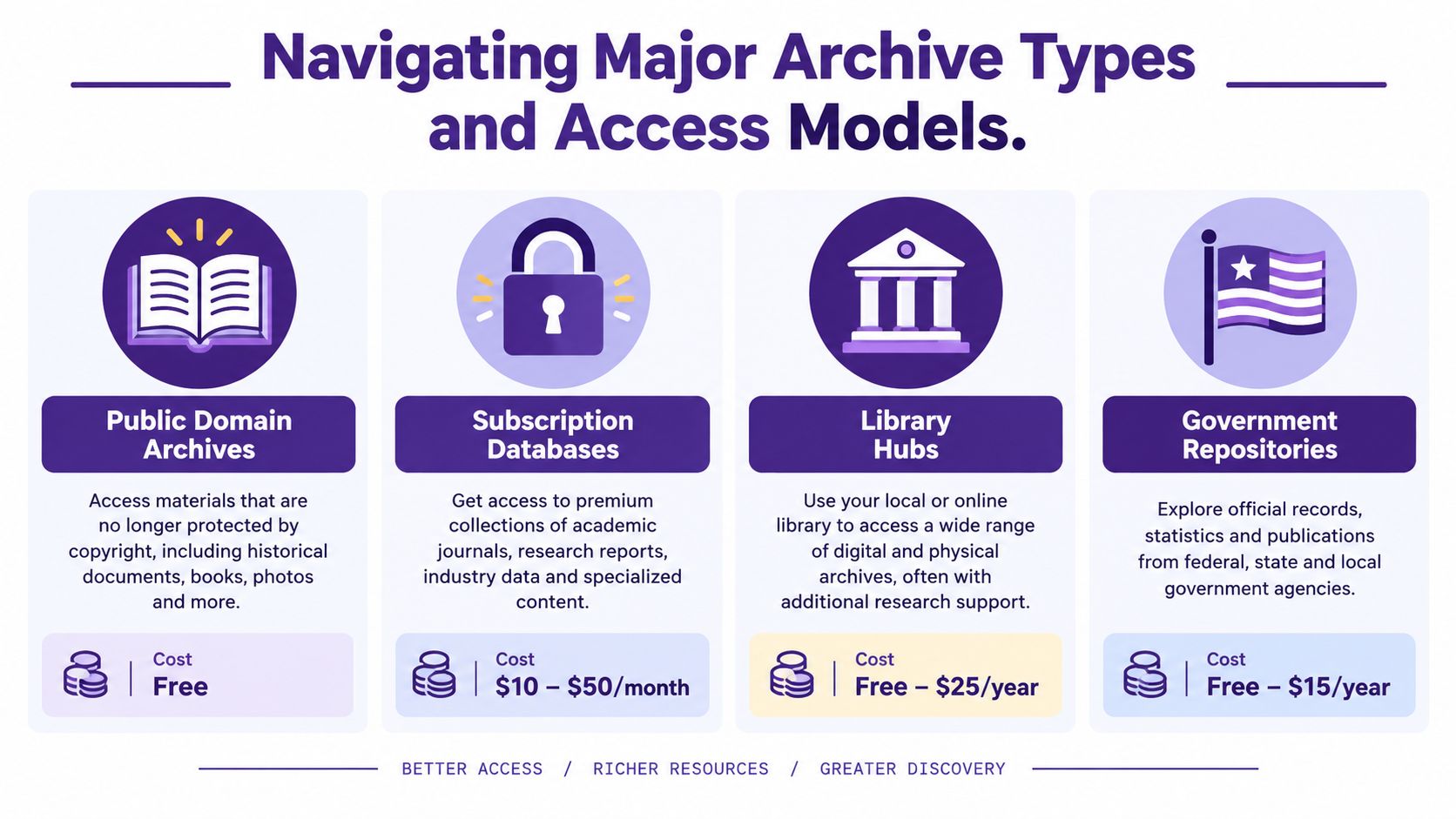
Four practical source categories
Public-domain archives are often the strongest foundation for repeatable content production. The United States' National Digital Newspaper Program created a long-term framework for preserving historically significant newspapers, with Chronicling America providing access to millions of digitized pages, primarily covering issues published between 1860 and 1922 (National Digital Newspaper Program overview). Public access doesn't remove the need to check image quality, attribution, and rights, but it can make research and reuse more manageable.
Subscription databases may offer broad coverage and polished interfaces, yet their terms can limit scraping, bulk downloads, redistribution, or commercial reuse. A creator should read the license before building a production pipeline around a platform. If the archive can disappear behind a subscription change, it shouldn't be the only copy of your research trail.
Library hubs often connect users to regional collections that are invisible in national searches. They can be particularly valuable for local reporting, neighborhood histories, community businesses, and specialized titles. The trade-off is that access may depend on a library card, in-person facilities, or manual browsing.
Government repositories can provide stable cataloging and clear institutional provenance. Their strengths usually include title, location, date, and collection-level organization. Their weaknesses may include uneven coverage, limited interfaces, or slow expansion into less represented communities.
Run an absence and access audit
Before researching a theme, record what the collection contains. Use a simple working table:
| Field | Question to answer |
|---|---|
| Publication | Which titles are available? |
| Geography | Which towns, regions, or communities are represented? |
| Time range | Which decades and individual dates can you search? |
| Format | Are page images, OCR, article views, and downloads available? |
| Rights | Can you quote, crop, publish, or commercially reuse the material? |
| Access | Is the collection open, subscription-based, library-mediated, or restricted? |
This audit prevents a common editorial mistake: treating a searchable collection as a complete record of the past. A large archive is useful, but its selection reflects institutional priorities, preservation conditions, funding, technical limits, and copyright. Sustainable creators document those boundaries before turning a clipping into a claim.
Advanced Search Strategies for Imperfect OCR Text
Search failure doesn't mean the story isn't there. It often means the query is too exact for the source. A solid workflow combines broad discovery, variant searches, visual verification, and structured notes.
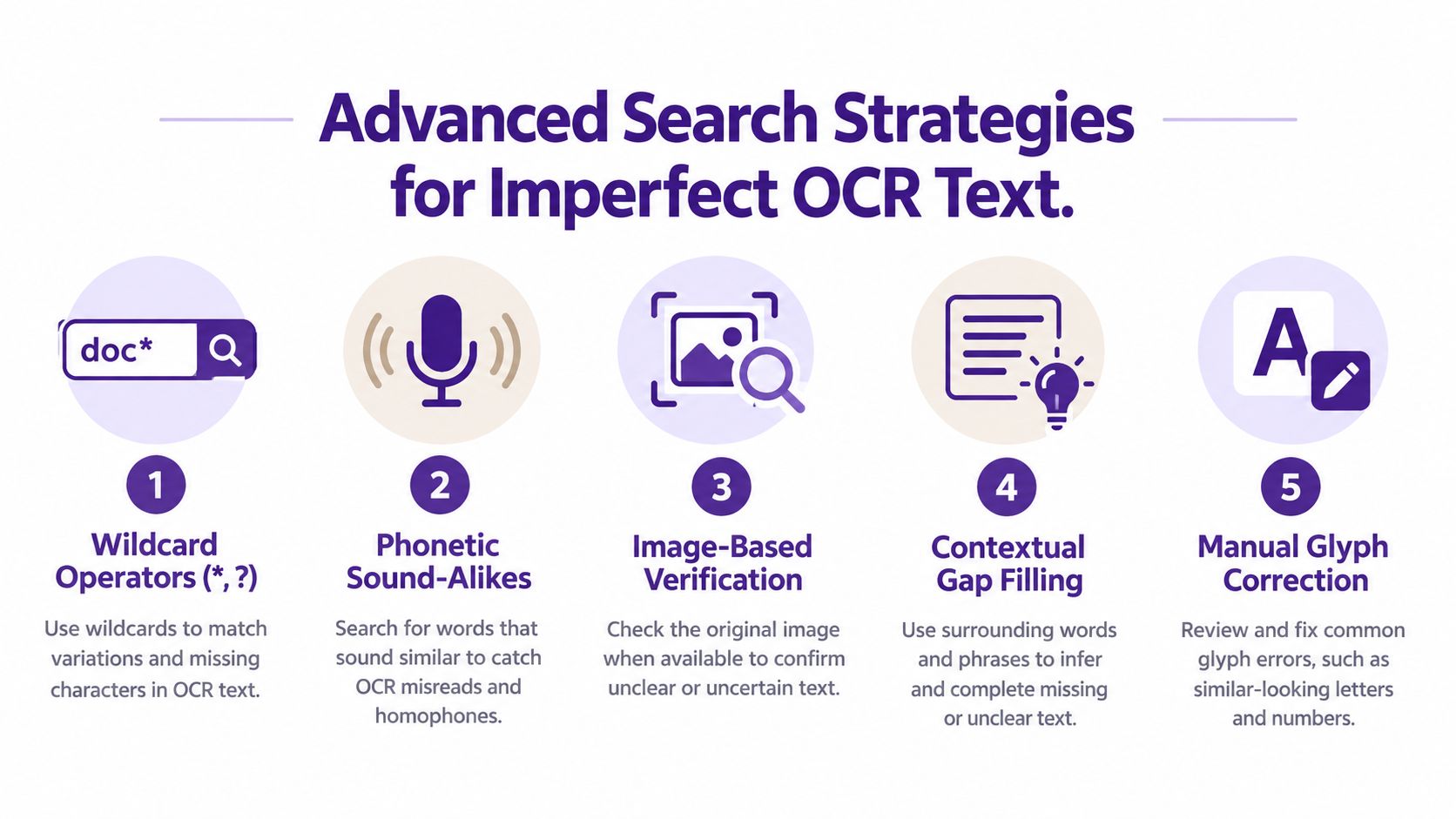
Start with the publication and date, then narrow by subject. For an event, try the town, organization, occupation, street, or related institution instead of only the person's name. Search spelling variants, abbreviations, phonetic alternatives, historical terminology, and likely OCR substitutions. A surname with one damaged character may remain discoverable through a neighboring place name or headline term.
Build a confidence-aware search loop
- Run the exact query. Save the result, including title, date, page, and the displayed OCR text.
- Relax the wording. Remove one word from a phrase, search a distinctive noun, and test alternate spellings.
- Use filters early. Date and title filters reduce irrelevant matches and make manual inspection realistic.
- Inspect the image. Confirm names, figures, quotations, and punctuation against the page rather than trusting OCR alone.
- Record uncertainty. Mark unclear characters, missing lines, column-order problems, and the confidence of your transcription.
A page image should remain part of the working evidence package. Preserve the scan, raw OCR, corrected text, metadata, source URL, and your editorial notes as separate layers. That separation lets another person reproduce the search and see where interpretation entered the process.
For teams building a repeatable research pipeline, these practical document analysis workflows offer useful ideas for separating extraction, review, and structured outputs. The same principle applies to historical newspapers: don't overwrite the raw layer when you create a cleaned script.
Search for patterns, not just words
If you control the indexing layer, character n-grams can help retrieve words with damaged letters. Fuzzy matching can catch near-duplicates, while phonetic search can surface names that OCR has distorted. Contextual searching also matters. A rare advertisement may be easier to find through its product category, address, slogan fragment, or neighboring business than through the brand name itself.
Semantic methods can help connect related concepts, but they don't eliminate verification. A semantic search optimization guide can help teams think beyond literal keyword matching while preserving the discipline of checking the original clipping. Search should surface candidates. Humans should decide what the page says.
Repurposing Historical Clippings into Modern Content Formats
The clipping is not the product. It is a source asset that can support several products when you organize it properly. A dramatic headline might become a short video, a podcast segment, a newsletter item, a documentary research note, and a themed collection. The return comes from developing one verified piece of archival material into a family of related outputs without pretending that every format needs identical wording.
The scale of the opportunity is substantial. By 2019, the Library of Congress reported that Chronicling America contained more than 15 million pages of searchable historical U.S. newspapers, creating a source base for timelines, local-history features, classroom resources, data projects, documentary research, and topic collections (Library of Congress visualizing Chronicling America data). Scale alone doesn't create revenue, though. Editorial structure does.
Turn one verified item into a content cluster
Begin with a source record containing the publication, date, page, location, headline, people, organizations, topic, rights status, image reference, and confidence notes. Then choose a central question, such as how a town reacted to a disaster, how an industry advertised itself, or how a public controversy developed across several issues.
From that record, create distinct formats:
- A video episode with the page image, a corrected transcript, contextual narration, and on-screen source details.
- A podcast segment built around the human conflict, unanswered question, or surprising local detail.
- A written feature that compares coverage across titles or dates and links every major assertion to a page.
- A short-form series that isolates one headline, advertisement, person, or phrase per post.
- A research bundle containing scans, transcriptions, metadata, and suggested follow-up questions for collaborators.
A practical cross-platform content repurposing reference can help teams adapt a central story without copying the same asset mechanically across every channel. Historical material rewards variation because each platform needs a different entry point.
Build recurring editorial buckets
Organize discoveries into durable themes rather than a loose folder of interesting scans. Possible buckets include vanished businesses, unusual inventions, neighborhood disputes, forgotten occupations, changing language, local entertainment, public warnings, and advertisements that reveal everyday priorities. Each bucket can support a recurring playlist, podcast season, newsletter column, or paid research product.
Clean OCR into a human-readable script, but retain the original text and image. Crop scans carefully for backgrounds or evidence panels, and label them with publication, date, page, and rights information. The content repurposing strategies workflow becomes much stronger when every asset carries enough context for another editor to use it safely.
Scaling Discovery with AI and Human Collaboration
Manual browsing works for a single story. It becomes a bottleneck when a team wants to compare titles, follow a theme across dates, or build a long-running content franchise. AI can classify documents, group similar subjects, surface names and places, suggest relationships, and identify promising clusters for human review. It cannot determine whether a damaged line says what a creator hopes it says.
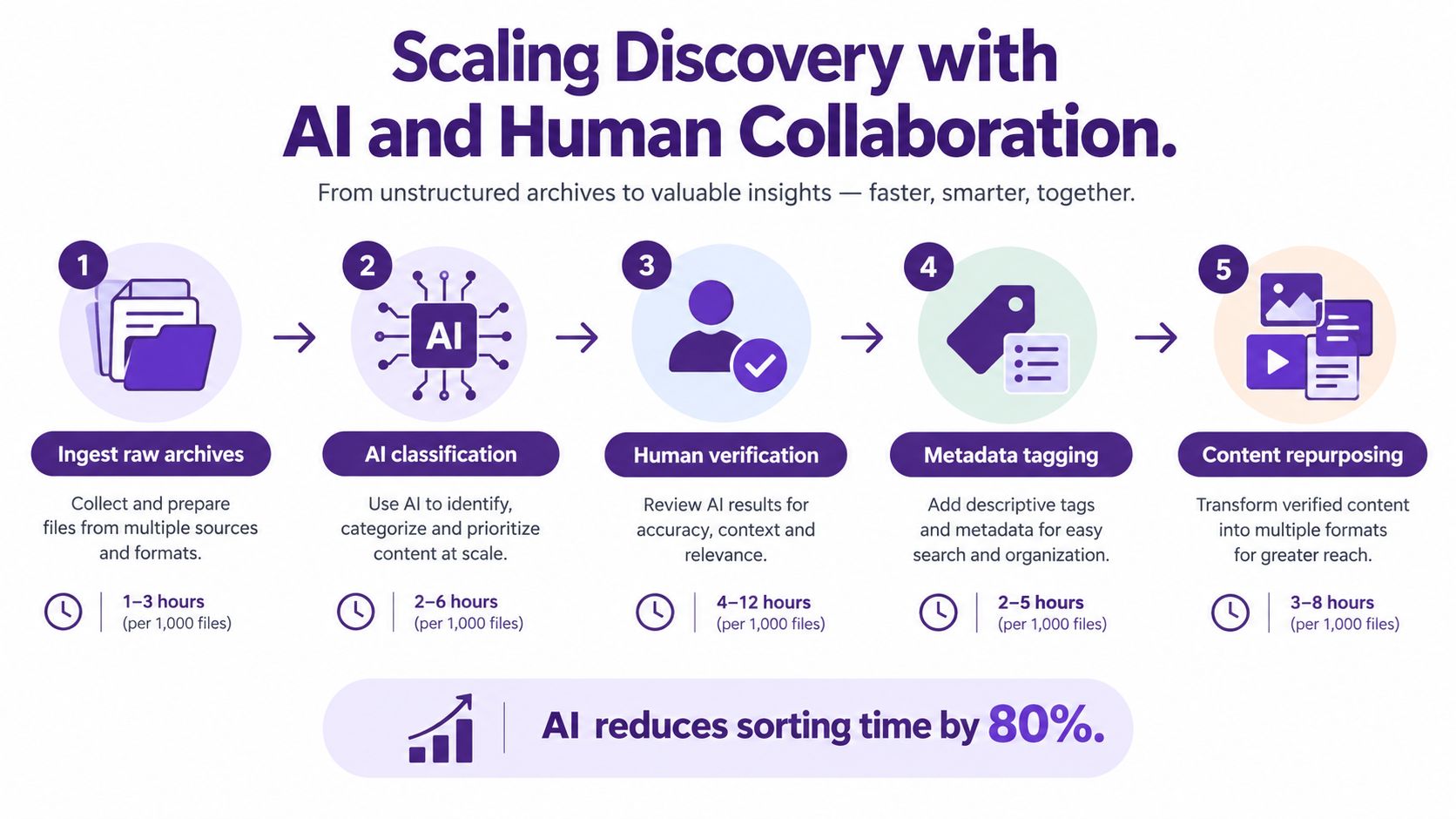
The strongest workflow divides responsibility. Machines handle repetitive organization across raw OCR, images, transcripts, and metadata. Humans define the editorial question, assess provenance, resolve ambiguity, and decide what deserves publication. That division also creates a useful audit trail because every correction can be connected to a source page and an editorial decision.
Use AI for discovery, not authority
A productive archive workflow might assign AI to:
- identify recurring people, places, organizations, products, and events;
- cluster clippings by theme, location, or narrative pattern;
- suggest related documents when wording differs;
- generate draft summaries that clearly remain unverified;
- flag OCR anomalies, missing text, and likely duplicate items;
- recommend metadata fields for future retrieval.
A human researcher then checks the image, confirms the date and title, compares related coverage, and records uncertainty. Editors decide whether a claim is suitable for a script, whether the source needs additional corroboration, and whether the intended use fits the rights status.
UNESCO's guidance on generative AI emphasizes human agency and responsible, pedagogically appropriate interaction with AI, supporting collaboration rather than unsupervised replacement of human judgment (UNESCO guidance on generative AI). For archive work, that means involving researchers, editors, subject specialists, and technical staff when the collection has difficult languages, sensitive topics, or uncertain provenance.
The embedded workflow below illustrates how a research team can think about collaborative discovery without treating automation as a final editorial step.
Give the system useful structure
AI performs better when the archive has consistent fields. Store the publication, issue date, page number, location, people, organizations, topic, format, rights status, OCR state, verification state, and related assets separately. Add controlled labels for themes, but allow free-text notes for unusual context.
A good taxonomy should answer practical production questions. Which stories belong in the next video series? Which clippings support a newsletter theme? Which items still need image verification? Which source pages can be reused commercially? The purpose isn't to create an impressive label system. It is to help a creator move from discovery to a defensible production decision.
Building a Monetizable Archive Content Library
A monetizable archive library starts with a clear unit of value. That unit might be a verified clipping, a historical event, a local character, a business profile, or a sequence of related reports. Each unit needs enough metadata that another person can find it, understand it, verify it, and turn it into a new format without repeating the original research.
The U.S. National Digital Newspaper Program offers a useful organizational model. Chronicling America preserved material within defined publication, geographic, and date frameworks rather than treating millions of pages as one undifferentiated mass (Library of Congress update on the National Digital Newspaper Program). Creators can apply the same logic to a smaller commercial library.
A practical production sequence
Ingest the source. Add the page image, raw OCR, publication details, archive URL, rights notes, and an internal identifier. Don't begin with a polished summary. Preserve the evidence first.
Normalize the record. Correct obvious OCR errors in a separate text layer. Keep uncertain readings marked, and retain the original wording for comparison. Add topic, geography, people, organizations, visual assets, and potential formats.
Create an editorial brief. Define the central question, audience, intended platform, supporting clippings, and unresolved issues. A podcaster may need a character arc, while a publisher may need a documented chronology.
Produce derivatives. Turn the verified record into a script, article, short video, newsletter item, research timeline, or educational handout. Reuse the research, not necessarily the exact sentences.
Measure library value. Track which themes generate repeatable formats, which assets need more verification, and which collections attract collaboration. The useful measure is not merely how many pages you stored. It is how easily your team can turn a source into trustworthy output.
This approach suits creators moving from hobby projects toward professional publishing. A YouTuber can build recurring playlists around one archive theme. A podcaster can develop a season from a regional collection. A magazine publisher can assemble a paid historical package. A screenwriter can use verified clippings as texture and leads, while keeping invention separate from documented fact.
Editorial standard: Every monetized derivative should make the boundary between archival evidence, interpretation, and creative reconstruction clear.
The commercial advantage compounds when your library becomes searchable by meaning, not just filename. Organize first, understand the relationships between assets, then act on the strongest clusters. Historical newspaper archives can supply the raw material, but a structured workflow turns that material into durable content value.
Contesimal helps creators and publishing teams organize historical sources, classify large content libraries, collaborate with AI and human contributors, and discover connections that support new formats. Visit Contesimal to turn your archive research into a searchable, reusable system for videos, podcasts, articles, and other revenue-generating content.