
The popular advice is to scan everything first and figure out the rest later. That approach produces impressive file counts and disappointing archives. A folder full of images, inconsistent filenames, weak text recognition, and missing rights information isn't a usable knowledge base. It's a backlog with a search box.
The digitization of historical documents works better as a lifecycle workflow. Selection, prioritization, physical handling, capture, OCR or handwriting recognition, metadata, quality control, preservation, rights management, and delivery all affect whether a document can support research, publishing, audience growth, or revenue. For creators and publishers, the payoff comes when a historical collection stops behaving like a storage problem and starts functioning as an organized content library.
Redefining the Digitization of Historical Documents
Digitization succeeds or fails before a scanner is switched on. The National Archives defines it as a workflow covering selection, prioritization, metadata creation, quality management, repository delivery, and evaluation, alongside image capture and OCR (National Archives digitization quality management guidance). That definition changes the opening decision from “Which scanner should we buy?” to “Which assets should become discoverable, reusable, and preservable?”
Selection criteria should reflect the intended use. A publisher may prioritize material supporting an upcoming book. A podcast team may choose letters, newspapers, and interviews for episode research. A museum may start with objects exposed to high handling risk. Each case produces a different queue, staffing plan, metadata model, and rights review, so the criteria need to be documented before production begins.
Treat the archive as a program
Historical collections rarely become manageable through one scanning sprint. The official ENUMERATE Core Survey, published in 2017, found that an average of 58% of heritage collections had been catalogued in a collection database, 22% had been digitally reproduced, and 54% still needed reproduction. The same European digitization analysis reported that only 9.4% of material was already digitized while 49% remained to be digitized, and noted that the Dutch National Archives set a long-term target to digitize 10% of its paper collection between 2015 and 2030 (European digitization survey analysis).
The figures point to a sustained operating model rather than a one-time technical project. Build a roadmap with a pilot collection, a production queue, and a preservation backlog. Review priorities as audience needs, funding, rights conditions, and recognition quality change.
Practical rule: Every digitized object should have a known user, a defined access purpose, and a named owner for the next stage.
Design for reuse from the beginning
A creator's archive needs relationships among the original document, image master, derivatives, transcription, rights status, subjects, people, places, and possible content uses. A newspaper page could support research, a video segment, a newsletter reference, or a thematic series. Reliable retrieval depends on recording those relationships rather than storing files in scanning order.
Organize the collection around meaning and future action. Browsing, full-text search, structured filters, and collaboration let editors reuse sources without repeatedly rediscovering them. Consistent identifiers also give OCR corrections, translations, summaries, and AI-assisted drafts a stable place in the workflow.
Governance keeps that system usable. Assign responsibility for selection, uncertain readings, rights checks, metadata changes, and derivative publication. Record those decisions as metadata and workflow rules. Otherwise, context remains in individual memory and disappears when the project changes hands. A well-governed archive can support research, publishing, audience development, and revenue without sacrificing preservation requirements.
Capture Standards and Physical Handling Protocols
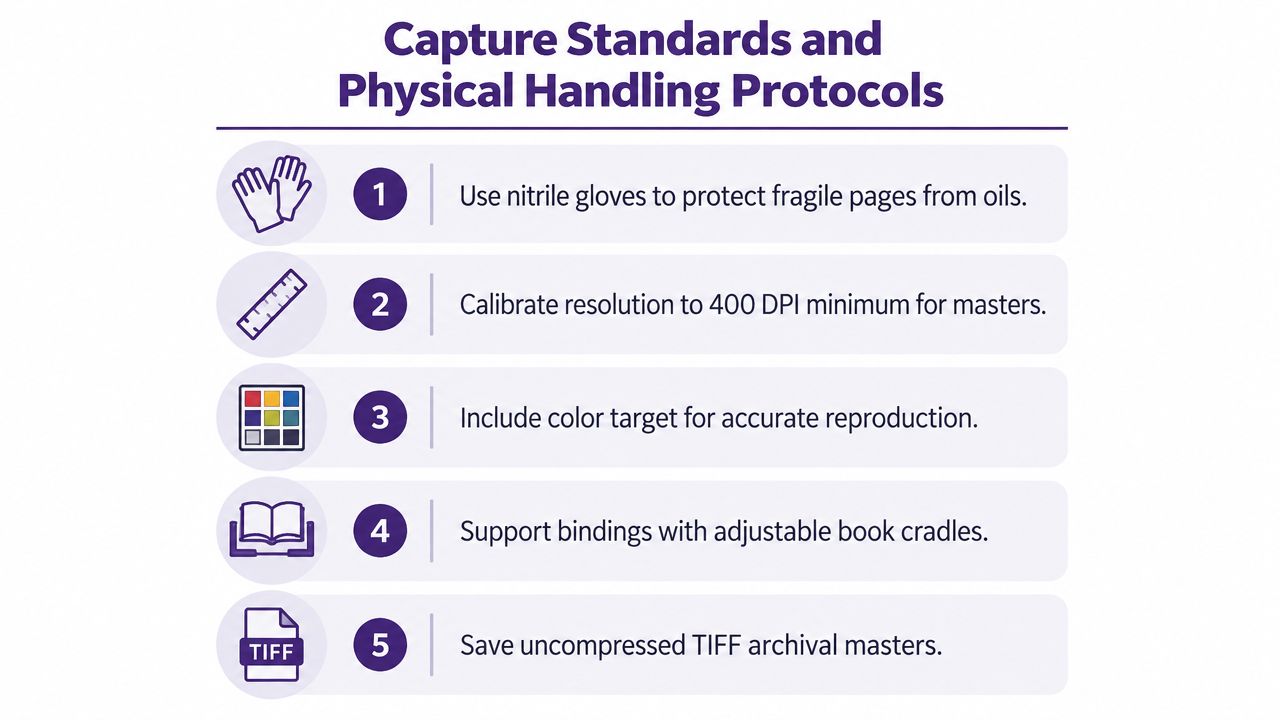
Preservation-grade capture begins with the object, not the software interface. Fragile paper, bound volumes, foldouts, photographs, maps, and oversized records each impose different risks. A fast feeder may work for stable modern pages, but it can damage brittle edges, distort bindings, or expose valuable material to unnecessary handling.
The National Archives specifies a minimum spatial resolution of 300 ppi for originals up to 34 by 55 inches. For larger originals, its guidance requires at least 3,000 pixels across the long dimension of the image area, with acceptable bit depths including 8-bit grayscale and 8-, 16-, or 24-bit color (NARA digitization specifications). These thresholds aren't decorative technicalities. Resolution determines whether small type, marginal notes, paper texture, and measurement details survive the digital capture.
Set master-image rules before production
Create a written capture specification and test it against representative originals. It should define resolution, bit depth, color management, cropping, file naming, derivatives, and acceptance criteria. A production operator shouldn't have to improvise when a page contains a foldout, a dark gutter, or handwritten marginalia.
Older NARA technical guidance specifies 300 dpi for originals 11 by 17 inches or smaller and 200 dpi for larger originals, and calls for uncompressed TIFF files with Intel byte order and TIFF header version 6 for master files (NARA archival digitization guidelines). Current project specifications may differ, but the underlying principle remains sound: keep a stable, high-quality master and generate access copies from it.
A JPEG or compressed PDF may be convenient for delivery, but it shouldn't replace the preservation master when the source requires faithful reproduction. Keep the master immutable, record technical metadata, and make derivative creation repeatable.
Handle the physical object conservatively
The Library of Congress advises that scanning equipment must not use a form feed for fragile, high-value, fine art, or archival materials, and it must control light and heat exposure. Oversized materials and books with foldouts require equipment with a bed at least as large as the object, while cradle support should be used when needed (Library of Congress scanning care guidance).
In practice, handling protocols should cover:
- Surface protection: Use clean, suitable handling methods and avoid transferring oils, dirt, or moisture to vulnerable pages.
- Binding support: Keep bound volumes open only as far as the structure allows, using an adjustable cradle when necessary.
- Lighting control: Limit heat and exposure, especially during repeated captures or reshoots.
- Page sequence: Record missing, blank, folded, or damaged pages rather than skipping them.
- Object identity: Keep the physical identifier connected to every digital record throughout transport, capture, and quality review.
The purpose isn't to create laboratory complexity. It's to prevent a cheap scan from becoming an expensive rescan, while protecting originals that may not tolerate repeated access.
Benchmarking OCR and Handwriting Recognition Engines
A scan is not searchable merely because it is clear. Historical pages expose the limits of default OCR through long s characters, ligatures, Gothic typefaces, faded ink, bleed-through, skew, columns, tables, and handwritten additions. Treat text recognition as a managed production stage, with outputs that can support discovery, editorial work, and later AI processing.
Build a ground-truth set from representative pages, run several engines against identical images, inspect their failure patterns, and fine-tune or adapt the selected system before scaling. The 2026 document-AI benchmark study linked below evaluated about 18,500 processed documents, including 322 English-language and 100 Arabic-language page scans replicated 43 times with synthetic noise. Cloud document-AI systems substantially outperformed plain Tesseract on noisy pages, while the strongest server-based processors handled degraded scans better than local OCR (document-AI benchmark).
Measure the errors that matter
Character Error Rate, or CER, records substitutions, deletions, and insertions at character level. Word Error Rate, or WER, better reflects whether a missed word affects search, indexing, or editorial meaning. Use both alongside human review. A low aggregate score can conceal failures in names, dates, headings, or table cells that matter more than ordinary prose.
A historical OCR survey reports that OCR4all achieved an 84% error reduction on 19th-century Gothic typefaces after fine-tuning on domain-specific ground truth. It also reports a direct extraction approach with 98.70% CER accuracy overall, compared with 89.06% for the strongest conventional Docling plus Tesseract pipeline (historical OCR survey). These findings support collection-specific adaptation, not automatic adoption of one model.
Document type changes the result. In the same survey, olmOCR 2 reached 82.3% on old math scans but 47.7% on general historical scans. A system can perform well on one document family and fail on another, so benchmark pages must resemble the material you will process.
Use a representative test set
Select pages that expose the archive's weaknesses: faint impressions, dense layouts, unusual type, marginal notes, columns, illustrations, tables, and multiple languages. Test handwriting text recognition separately whenever handwritten material appears. Printed-text OCR results do not reliably transfer to letters, annotations, or mixed pages.
Transformer-based systems, including approaches such as TrOCR, support layout-aware recognition and extraction. Evaluate whether they preserve relationships between headings and paragraphs, values and table columns, or marginal notes and their entries. Those relationships determine whether the result can feed search, structured datasets, or downstream content workflows.
Choose the engine by failure mode, not by brand familiarity. A clean-page demo says little about a damaged ledger or irregular handwritten letter.
Retain the original image, machine output, available confidence information, and corrected transcription as linked records. Editors can then repair high-value passages while preserving the machine-readable baseline, processing history, and evidence needed for later quality review.
Building Rich Metadata and Taxonomies for Discovery
A perfectly captured document can remain practically invisible if its context is missing. OCR may help someone find a phrase, but metadata tells the system what the document is, where it belongs, who created it, which rights apply, and how it relates to the rest of the collection.
UNESCO's recommendation on documentary heritage calls for long-term preservation and accessibility, including means of discovery such as cataloguing and metadata (UNESCO recommendation on documentary heritage). Metadata isn't a later enhancement. It's part of making the digitized object findable and usable.
Build from broad context to individual record
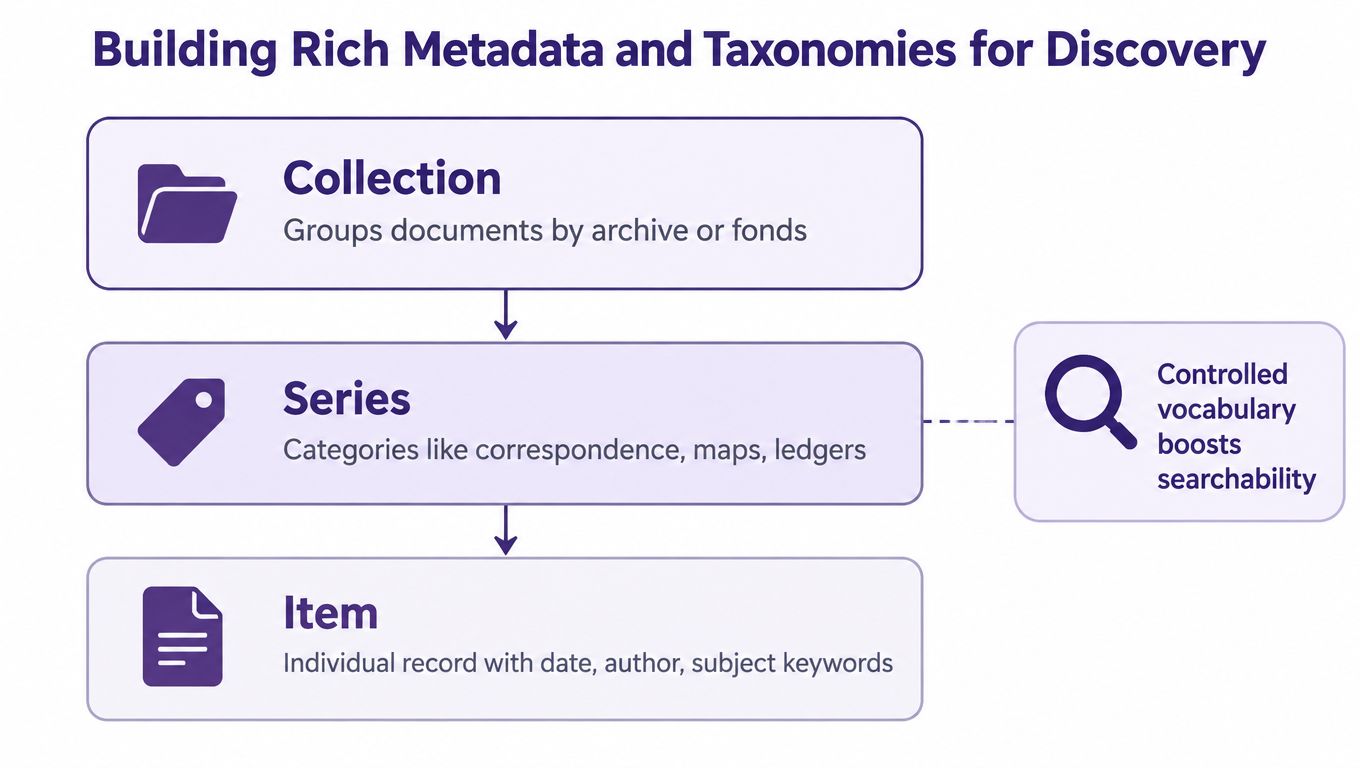
A useful schema separates levels of description instead of forcing every fact into one flat spreadsheet.
- Collection: Identify the archive, fonds, creator, provenance, scope, and broad rights context.
- Series: Group related material such as correspondence, maps, ledgers, newspapers, or production notes.
- Item: Describe the individual record with its date, author, title, subject keywords, language, physical characteristics, and digital file relationship.
- Page or segment: Add OCR, HTR, coordinates, confidence, annotations, and content warnings where needed.
Controlled vocabulary makes discovery more stable. One editor may call a document a “letter,” another may type “correspondence,” and a third may use a local abbreviation. A controlled term can connect those variations while preserving the original description.
Add editorial and commercial context
Archives become more valuable when metadata supports decisions, not just cataloguing. Add fields for potential audience, related topics, publication status, rights review, sensitivity, source reliability, and possible formats such as article, episode, short video, exhibit, or teaching resource. Keep these fields distinct from historical description so editorial interpretation doesn't overwrite provenance.
A practical reference for thinking about structured cataloguing is this guide by Colorado Art Services, which offers useful context on describing and organizing cultural objects. The same discipline applies to paper archives, even when the fields need to be adapted for manuscripts, periodicals, or institutional records.
Taxonomies should evolve carefully. Start with terms that support real searches, review failed queries, and add relationships only when they improve retrieval. A simple taxonomy used consistently will outperform an elaborate one nobody maintains. For a deeper operational framework, see metadata management best practices.
Quality Control and Long-Term Preservation Strategies
Quality assurance must operate at both batch and object level. A production team may process a large queue efficiently while repeating the same crop, color, focus, or sequencing error across every page. Inspecting every characteristic manually is impractical. Combine automated checks with targeted human review instead.
Sample each capture batch before release. Check focus, cropping, orientation, page order, color, scale, visible borders, foldouts, and gutter shadows. Compare derivative files with the preservation master, then confirm that metadata identifies the correct physical and digital object. Record exceptions so recurring defects can be corrected at the source.
Create a release gate
Use an acceptance record for every delivery:
- Image review: Confirm that each page is complete, legible, correctly oriented, and free of avoidable capture artifacts.
- Technical review: Verify resolution, bit depth, file format, naming, checksums, and relationships between masters and derivatives.
- Text review: Sample OCR or HTR output, inspect confidence patterns, and escalate pages with unusual error density.
- Metadata review: Check dates, names, subjects, hierarchy, rights, and links to the physical and digital object.
- Repository review: Confirm that files, metadata, thumbnails, searchable text, and access restrictions work correctly after ingest.
FADGI and Metamorfoze remain useful imaging benchmarks for historical and archival materials. Current quality guidance also stresses full-object scanning, accurate color references, and dimensional scale. For heritage work, “good enough for search” can fail when users need a trustworthy visual surrogate.
Preserve the masters, not just the website
Repository delivery is one stage in a longer lifecycle. Store preservation masters in managed systems, maintain fixity information, document formats and dependencies, and plan migration before a format or platform becomes unsuitable. Separate preservation copies from working derivatives, and restrict who can replace or overwrite each class.
Scale requires governance. The U.S. National Archives has committed to digitize 500 million pages by September 30, 2026, a target whose progress is worth tracking (National Archives digitization program). The National Archives Foundation says NARA manages more than 15 billion records across every era and medium. These figures illustrate why consistent quality rules, audit trails, and storage policies matter as much as capture speed.
Physical preservation remains part of the workflow. If housing needs replacing or expanding, Where can I buy cheap archive boxes? offers a practical starting point for evaluating archive boxes and related supplies. Digital files do not replace care for originals. Apply archival best practices to handling, environmental control, storage, and access planning so the collection remains usable after the initial project ends.
Integrating Archives into AI Workflows and Content Strategy
Digitization reaches its commercial and editorial value when people can do something with the collection. A static repository answers “Where is the file?” An active content system helps answer “Which sources support this episode, which themes recur across the archive, and what can we responsibly publish next?”
The distinction matters for every audience named here, from YouTubers and podcasters moving beyond hobby projects to magazine publishers, authors, screenwriters, and professional content marketers. They already have source material, but often lack a reliable way to organize it into repeatable research and production workflows.
Move from retrieval to orchestration
AI can classify documents, identify recurring entities, group related passages, summarize candidate sources, and surface connections across formats. It still needs boundaries. Keep provenance attached to every extracted claim, distinguish transcription from interpretation, and require human review for sensitive, ambiguous, or publication-critical material.
A useful workflow looks like this:
- Curate: Select a defined collection and confirm rights, provenance, and scope.
- Structure: Connect images, text, metadata, entities, topics, and editorial notes.
- Query: Search by phrase, person, place, period, theme, or document type.
- Collaborate: Let researchers, editors, and AI contributors work from the same evidence.
- Repurpose: Turn validated material into articles, scripts, newsletters, episodes, clips, or exhibits.
- Measure: Track which themes and formats earn attention, then feed those findings into the next selection cycle.
AI for knowledge management becomes relevant here. The system should mediate information at the moment of interaction, not merely dump a generated summary into a separate document. A strong research interface lets a human ask a question, inspect supporting pages, challenge the interpretation, and save the resulting insight back into the shared library.
The technology should serve the archive's structure rather than flatten it. Layout-aware extraction, searchable OCR, taxonomies, and rights fields allow teams to build playlists of related material, revisit successful concepts, and develop new angles without losing the historical record.
The following video adds a visual perspective on archival research and digital access:
Contesimal is one option for organizing and searching document sets, podcasts, videos, and articles, with a chat-based research interface and collaboration between human and AI contributors. It doesn't replace scanning, physical handling, imaging, or OCR. It becomes useful after those stages, when structured archival content needs to support ongoing research, creation, editing, and distribution.
A digitized archive can generate value through many paths: paid research products, premium newsletters, documentary development, educational resources, licensing, sponsored series, books, and audience-led programming. The commercial decision should come after preservation and rights decisions, not instead of them. Trust is part of the asset.
If you're turning historical documents into a searchable, reusable content library, visit Contesimal to organize archival material, connect sources with themes, and support human and AI collaboration. Start with one well-defined collection, preserve the evidence behind every insight, and build the workflow that lets your archive keep producing value.