
You've published consistently for years, but a listener still asks whether you've ever covered a topic that appeared in episode 37. A reader arrives through search, finds one excellent article, and leaves without discovering the related guide, newsletter, or interview that could have turned a visit into a relationship. Meanwhile, your archive keeps growing, and your team spends more time locating useful material than creating new value from it.
That's a customer experience design problem. For content creators, CX design isn't limited to a website layout or a polished podcast player. It covers the complete journey from discovery to consumption, understanding, return visits, and deeper participation. The strongest content organizations make that journey easier to start, easier to trust, and easier to continue.
What Customer Experience Design Actually Means for Content Teams
A podcaster with a 200-episode archive may have years of expertise, but a returning listener usually sees only the newest episode and a basic search box. If earlier conversations aren't organized around topics, questions, formats, or audience needs, the archive behaves like storage instead of a product.
Customer experience design means deliberately shaping every interaction a person has with your content operation. That includes a search result, a social post, a newsletter recommendation, an episode description, a transcript, a paywall, an AI assistant, and the follow-up message after someone subscribes. UX may improve one screen or player. CX coordinates the whole path between those screens and the teams, systems, and editorial decisions behind them.
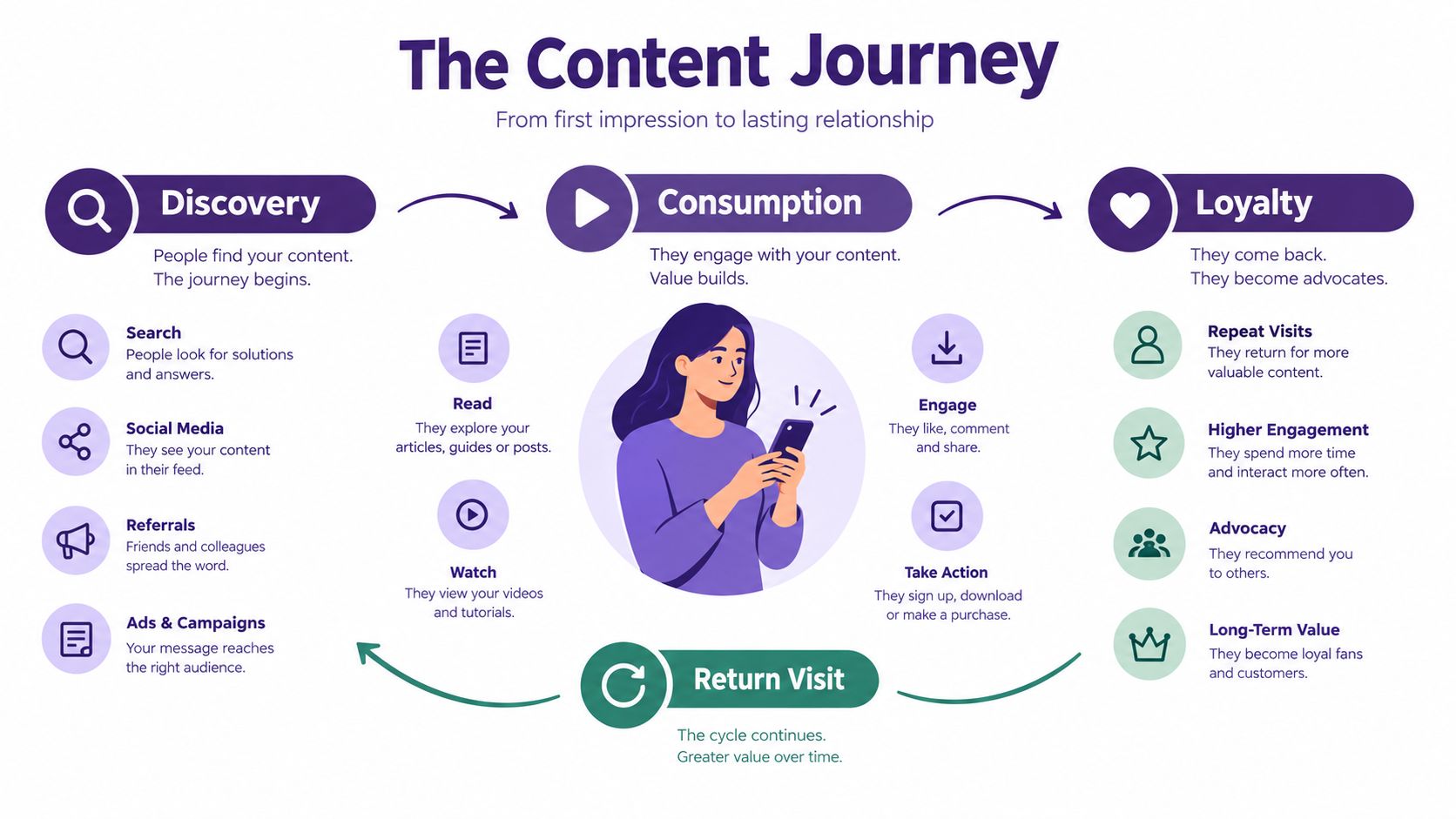
Start with the journey, not the interface
Audit the experience in sequence:
- Discovery: Can someone understand the promise of your content from a search result, social post, recommendation, or podcast-app listing?
- Selection: Can they tell which article, episode, video, or book best matches their question?
- Consumption: Is the content easy to read, hear, watch, save, quote, or revisit?
- Understanding: Can they verify key claims, find supporting material, and move to a related resource?
- Return: Does the next interaction recognize their interests without making the recommendation feel intrusive?
A beautiful landing page can't compensate for weak retrieval. A smart recommendation can't compensate for an unclear source boundary. A large archive creates value only when people can find the right material at the right moment.
Practical rule: Treat every content touchpoint as part of one experience, even when different teams own the website, newsletter, social channels, podcast feed, and archive.
To apply this immediately, choose one audience journey and follow it yourself. Search for a topic your organization has covered, open the result as a new visitor, try to find a related item, and subscribe or return later. Record every moment where you must guess, repeat information, or leave the current context. Those moments are your first CX design backlog.
How Experience Design Evolved into a Data and AI Discipline
Early digital publishing often treated experience as a matter of presentation. Teams focused on attractive pages, readable typography, smooth players, and clear navigation. Those details still matter, but they represent only the visible layer of the relationship.
As audiences moved between websites, email, mobile apps, social networks, video platforms, and podcast players, teams had to manage the journey across touchpoints. A person might discover a creator through a short video, read a detailed article, listen to an interview, and return through a newsletter. The design challenge shifted from making one interaction pleasant to preserving context between interactions.
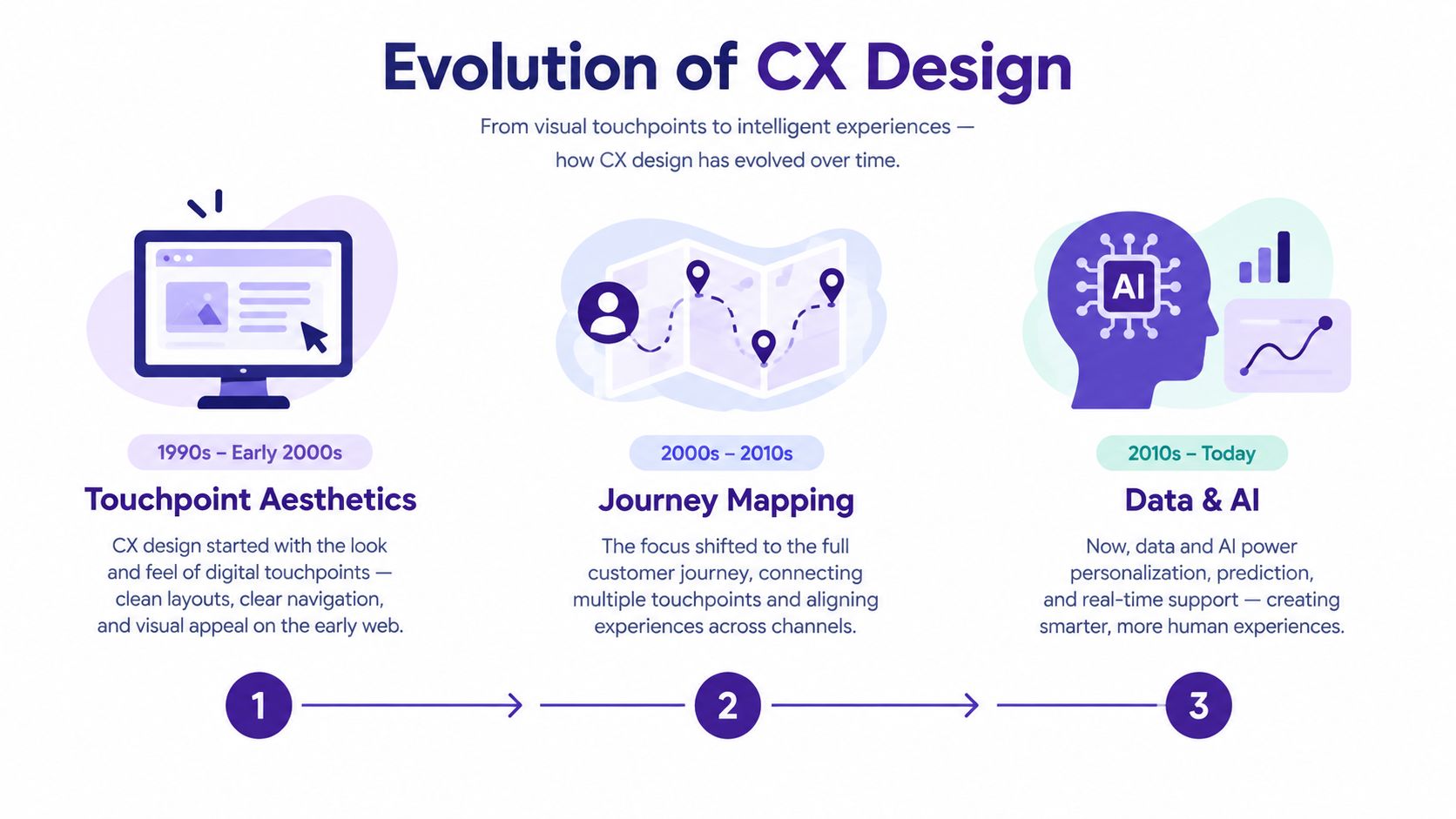
The archive became part of the experience
Taxonomies, metadata, behavioral signals, and search systems now influence what people see and what they can recover from an archive. A content team isn't only designing pages. It's designing the classification rules that connect a listener's question with an older episode, or a reader's interest with a relevant series.
That's why AI changes the discipline without replacing its foundations. AI can classify, summarize, recommend, transform, and retrieve, but it still needs boundaries. If you're evaluating possible tools, a practical overview of AI marketing tools that add value can help separate useful workflow support from technology added for appearance.
The present shift is from data-informed personalization toward AI-mediated journeys. A system may decide which archive item to surface, how to summarize it, or whether to answer a question directly. The design question is no longer whether the output is fast or convenient. It's whether the user knows what happened, can inspect the evidence, correct the result, and reach a person when the system gets it wrong.
AI adoption isn't the finish line. Trust is the differentiator. Content teams that earn trust make the system's role visible and keep meaningful editorial judgment with humans.
Core Principles That Hold Any CX Program Together
A content CX program becomes practical when you can inspect it against a small set of principles. These principles don't require a large department or a new platform. They require shared decisions about how people discover, use, and return to your work.
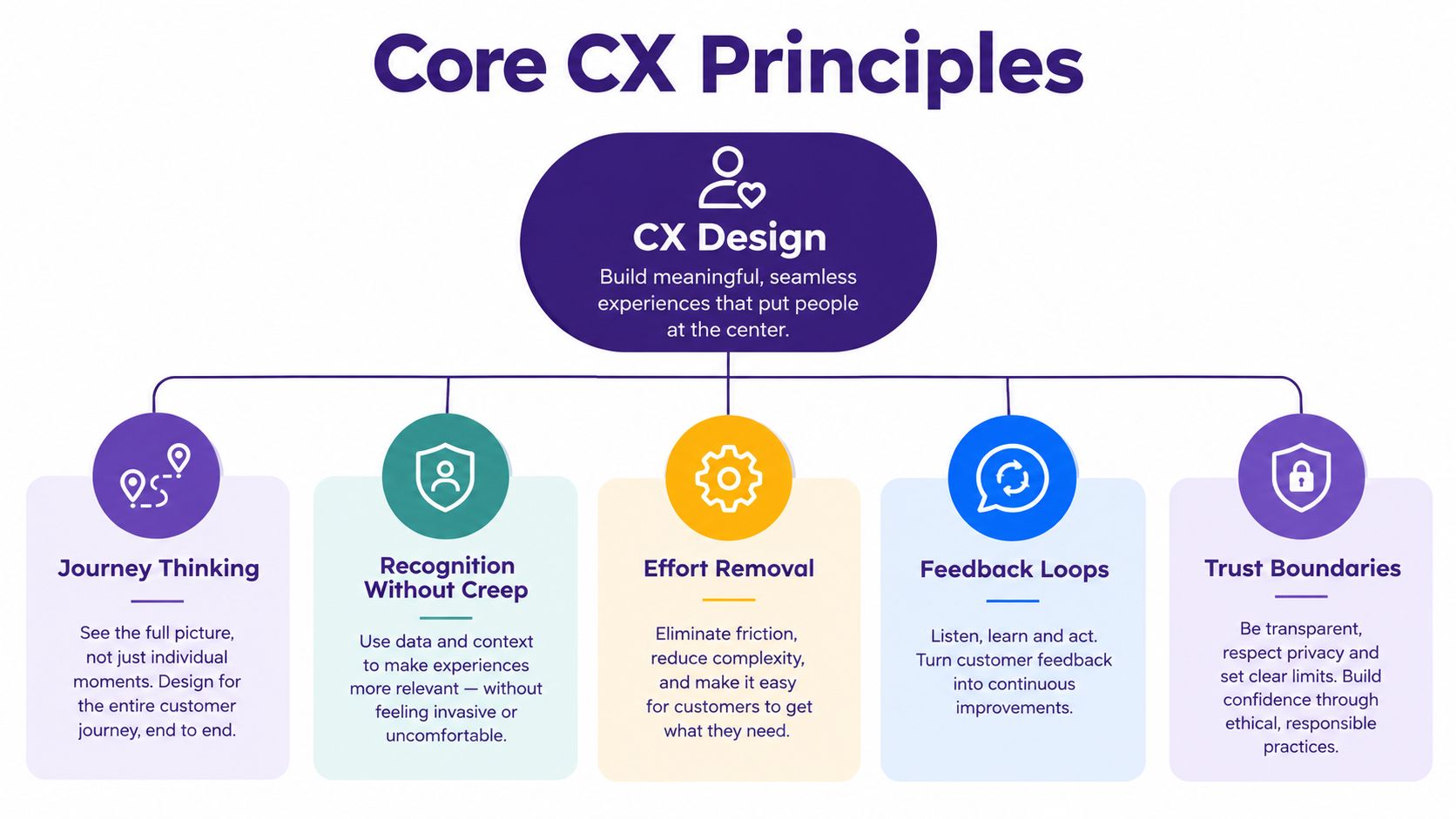
Journey thinking
Map the path around a real goal, not around your internal departments. A magazine publisher might map “find trustworthy background for a current topic,” while a podcaster might map “discover an earlier conversation that answers a follow-up question.” The map should include search, recommendations, transcripts, email, social posts, and the point where the audience decides whether to return.
Recognition without creep
Recognition helps when it preserves useful context. A newsletter that remembers a reader's chosen topic can reduce repetition. A podcast app that continues a series can make returning easier. Recognition becomes uncomfortable when people can't tell what data informed the recommendation or how to change it.
Give people visible controls. Let them broaden, narrow, reset, or dismiss recommendations. The audience should feel understood, not watched.
Effort removal
Remove work that doesn't contribute to understanding. Preserve search terms, keep a player's position, link claims to source material, provide transcripts, and make the next useful action obvious. If a reader must open several pages to discover whether an article covers their question, the organization has transferred its own indexing problem to the reader.
Feedback loops
Treat each release as a learning opportunity. Completion behavior, search refinements, unsubscribes, support questions, and direct survey responses can reveal different forms of friction. A short episode may have low completion because it's irrelevant, or because the audio experience fails. The signal needs context before it becomes a design decision.
Trust boundaries
Trust isn't a decorative value statement. It appears in source labels, correction paths, privacy controls, AI disclosures, and editorial review. For a publisher, that may mean separating reported facts from generated summaries. For a creator, it may mean showing whether an answer came from a transcript, a primary document, or an inferred topic match.
Use the hierarchy as a diagnostic:
- Recognition and continuity help people pick up where they left off.
- Effort removal makes the intended task feasible.
- Consistent voice reduces cognitive switching across channels.
- Feedback loops show what needs improvement.
- Trust boundaries define what the system may do and what humans must review.
A team doesn't need to fix every weakness at once. Score each principle qualitatively, then address the two areas that block the most valuable audience task.
Metrics and Research Methods That Make CX Measurable
A CX program becomes credible when it connects design changes to user tasks. Start by choosing 5 to 10 high-priority tasks, then measure those same tasks before and after a redesign using usability testing, analytics, and surveys. The exact task definitions matter. “Find something interesting” is too vague. “Locate an episode about audience growth, verify its date and guest, and save it for later” can be tested.
Organize measurement into three buckets:
- Effectiveness: Did the person complete the task? How often did errors or failed searches occur?
- Efficiency: How long did the task take? Where did the person hesitate, repeat a step, or abandon the attempt?
- Perceived experience: How easy, clear, trustworthy, or satisfying did the task feel?
Customer Effort Score can add useful context after a critical action. Research summarized from more than 75,000 customer interactions found that CES predicted loyalty 1.8 times better than satisfaction measures, while a separate benchmark reported that 96% of customers after high-effort interactions became disloyal, compared with 9% after low-effort interactions, as summarized in this customer-effort research source. Use those findings as directional evidence, not as a universal scorecard. Scales and benchmarks vary by industry and touchpoint.
Match the metric to the moment
| Journey Stage | Core Metric | What It Tells You | Watch Out For |
|---|---|---|---|
| Discovery | Selection and click behavior | Whether the promise matches the audience's intent | A click doesn't prove relevance |
| Ingestion | Completion and error rate | Whether a creator can add material successfully | A completed upload may still hide confusion |
| Retrieval | Task completion, time on task, and failed queries | Whether people can find useful archive material | Faster retrieval may produce weaker results |
| Validation | Source inspection and correction behavior | Whether users can assess an insight or summary | Silence doesn't equal trust |
| Return | Repeat use and task-level ease | Whether the experience supports another visit | Return behavior needs audience context |
Instrument the path, not only the endpoint. For a research workflow, capture file upload, taxonomy selection, search refinement, source tracing, collaboration, and export. Segment results by audience type and content format, because a researcher, a casual listener, and an editor may encounter different friction.
Measure the task your redesign is meant to improve, then keep the task definition stable.
A faster search flow that increases errors isn't necessarily an improvement. A higher survey score that coincides with fewer completed tasks may indicate that the wrong people answered. Good CX measurement combines behavioral evidence with direct feedback and examines trade-offs rather than celebrating one rising number.
Designing the Trust Boundary Around AI-Mediated Journeys
AI in CX is best understood as a trust-boundary design problem. The question isn't “Where can we add an assistant?” It's “What may the system do without approval, what evidence must it show, and when must a person take over?”
Low-risk discovery usually permits more automation. An AI system can suggest related episodes, group documents by topic, generate search variations, or offer several draft titles. The user should still be able to see that the result is a recommendation, reject it, and ask for a different angle.
Higher-risk tasks need stronger safeguards. Interpretation, rights-sensitive material, consequential recommendations, and personalized outbound messaging can affect reputation, consent, or editorial accuracy. These moments call for citations, uncertainty signals, confirmation before action, and a clear route to human review. A useful request workflow may begin with a request for information template that makes the desired evidence and decision context explicit.
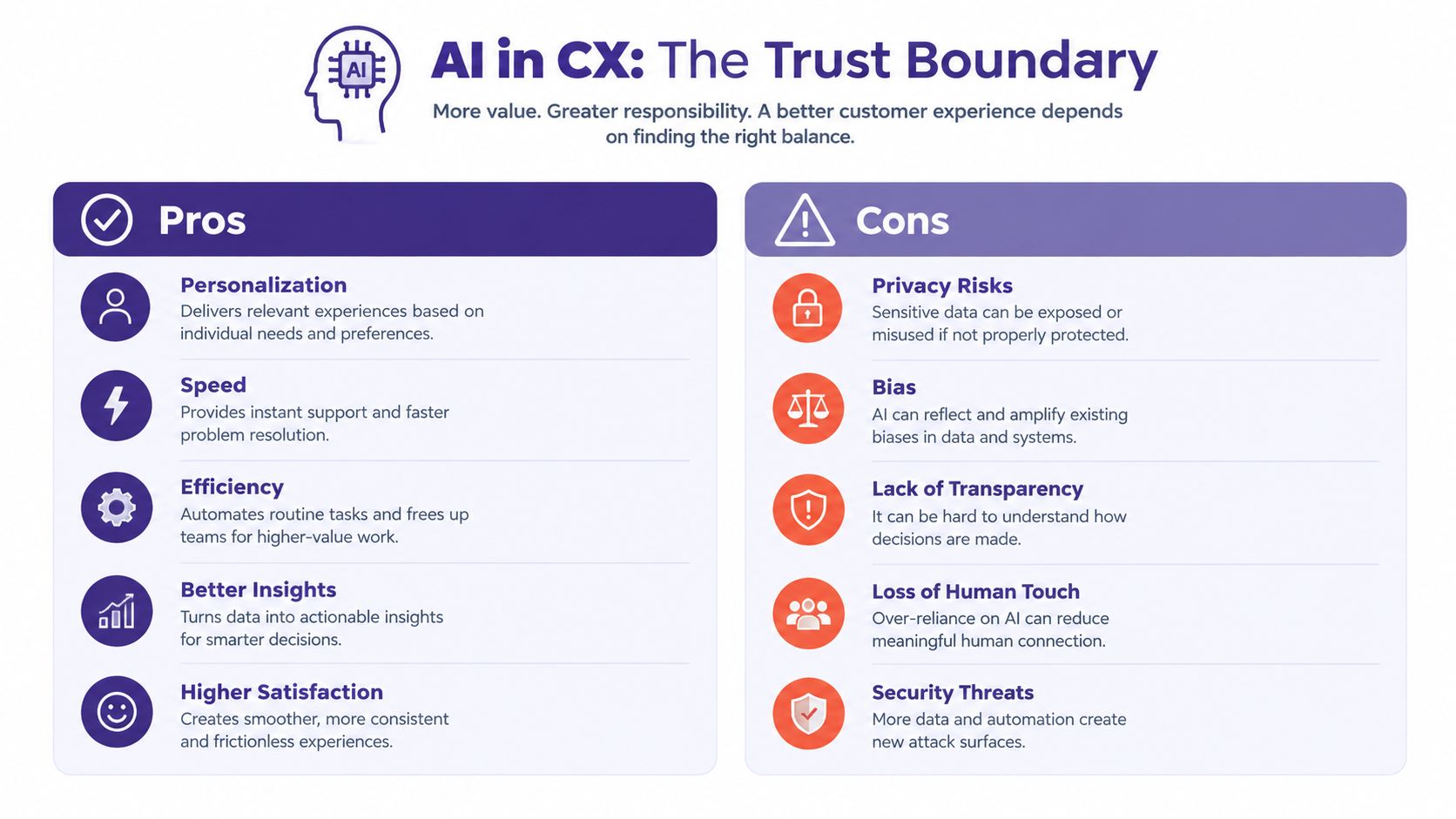
Compare the trust requirements
Low-risk discovery
- Agency: Let users accept, dismiss, refine, or broaden recommendations.
- Transparency: Label generated suggestions and show the relevant topic or source relationship.
- Reversibility: Make it easy to undo a classification or remove a preference.
- Escalation: Offer a way to report an obviously irrelevant or harmful result.
High-risk interpretation
- Agency: Require confirmation before publishing, sending, editing rights-sensitive material, or making a consequential recommendation.
- Transparency: Show citations, source boundaries, confidence signals, and any missing context.
- Reversibility: Keep the original content intact and preserve an audit trail of changes.
- Escalation: Route uncertain cases to an editor, researcher, rights specialist, or other qualified reviewer.
Consumer discomfort makes this boundary practical rather than theoretical. A 2025 PwC survey found that 58% of U.S. consumers were only somewhat or not at all comfortable using AI tools to engage with brands. Only 49% said they would likely use AI to track an order, and 29% would likely use it to make a payment, according to PwC's 2025 customer experience survey.
For content teams, a failed handoff is itself a CX failure. Don't make users repeat their question, restart the search, or explain what the AI already misunderstood. Pass the conversation, sources, rejected suggestions, and uncertainty signals to the human reviewer.
A Practical CX Workflow for Repurposing an Archive
A small editorial team can turn an archive into a working CX system by treating repurposing as a research workflow rather than a volume contest.
Start with ingestion. Gather transcripts, articles, show notes, videos, research documents, headlines, publication dates, authors, guests, and existing audience labels. Preserve the original files and their provenance. Your first objective isn't to generate posts. It's to create a reliable map of what you already know.
Build a layered taxonomy
Use several connected layers instead of one flat tag list:
- Topic: What subject does the item address?
- Question: What problem or decision does it help with?
- Format: Is it an interview, tutorial, opinion piece, case analysis, clip, or reference?
- Audience: Who benefits from it?
- Evidence: Does it contain firsthand reporting, expert interpretation, data, or commentary?
- Lifecycle: Is it current, evergreen, due for review, or dependent on an outdated context?
A podcaster might discover that ten episodes discuss audience growth, but only two explain measurement for beginners. That gap can become a new episode, newsletter sequence, video outline, or downloadable guide. A publisher might find a group of articles that share evidence but lack a navigable topic hub.
AI can accelerate clustering, extract themes, suggest transformations, and draft alternatives. It shouldn't decide whether a claim remains accurate, whether a guest's words are represented fairly, or whether the new format preserves the original meaning. Research on generative-AI content creation found that participants were expected to modify and refine outputs rather than submit them unchanged, while a participatory learning approach produced stronger creative problem-solving performance than the comparison group, as reported in this study of students creating digital content with generative AI.
Add human checkpoints
Create a review gate after ideation, another after drafting, and a final approval before distribution. At each gate, ask:
- Does the transformation serve a clear audience need?
- Can every important claim be traced to source material?
- Has the format changed the meaning or tone?
- Does the new piece point people toward a useful next step?
- Can the audience tell what was generated, edited, or verified?
A five-stage workflow of task definition, planning, ideation, generation, and finalization or testing offers a useful operating model. Marketing professionals in a qualitative study reported broader ideas, less routine work, and lower cognitive load from generative AI, but also identified weaknesses in emotional depth and authenticity, supporting this research on AI-assisted content workflows.
For a broader production sequence, this guide to repurposing video content can help your team compare format options. Keep feedback attached to each release. Track whether people complete the new piece, return to the source, refine their search, or report that the transformation missed the point. Then use those signals to improve the taxonomy and the next editorial brief. A human-AI collaboration model works best when the creator defines the transformation goal, evaluates alternatives, and remains accountable for the result, a conclusion supported by research on confidence in human-AI creative collaboration. Teams exploring the operational mechanics can also review AI content repurposing workflows.
Where Personalization Backfires and How to Avoid It
Personalization helps when it reduces search effort and increases relevance. It backfires when the audience can't understand why something was selected, can't correct the system, or feels trapped inside a narrow interpretation of their interests.
McKinsey's 2021 research found that 71% of consumers expected personalized interactions, while 72% expected businesses they purchased from to recognize them as individuals and understand their interests. The same research reported that 76% said personalized communications influenced brand consideration and 78% said personalized content made repurchase more likely, with personalization initiatives most commonly producing a 10% to 15% revenue lift, although company-specific results ranged from 5% to 25%, according to Deloitte Digital's summary of the research.
Relevance isn't enough. The same source of audience value can create discomfort when the system overreaches.
- Creepy recommendations: Explain the topic relationship and provide controls to dismiss or broaden results.
- Opaque data use: State what information shapes the experience and let people change or clear preferences.
- Flattened summaries: Show citations, preserve nuance, and distinguish source language from generated interpretation.
- Narrow content lanes: Add deliberate serendipity so a listener can encounter adjacent subjects rather than receiving the same theme forever.
- Unwanted outbound personalization: Require confirmation before sending customized messages, especially when the inference may be sensitive.
Trust remains fragile. A 2023 Twilio Segment survey of 3,001 adult online consumers across 12 countries found that 56% would become repeat buyers after a personalized experience, a 7-percentage-point increase from the previous year. Yet only 51% trusted brands to secure and responsibly use personal data, and 41% felt comfortable with AI personalizing experiences, as reported in the survey source. Personalization should therefore be adjustable, explainable, and restrained.
Putting It All Together With a 30-Day CX Starting Plan
Use the first week to audit discovery, selection, consumption, validation, and return. Pick 5 to 10 priority tasks, such as finding an archive item, tracing an insight to its source, or turning a transcript into a publishable brief.
During the second week, benchmark those tasks with completion, errors, time on task, and task-level effort. In the third, redesign one journey by removing repeated work, improving continuity, and adding clearer source signals. In the fourth, ship one AI-assisted workflow with explicit automation limits, review gates, correction paths, and human escalation. For broader planning, see AI for content marketing, and delegate suitable outreach work only when the process and handoff are clear, such as when you hire appointment setters.
Customer experience design for content organizations isn't about adding features everywhere. It's about making each step easier to start, easier to trust, and easier to return to.
Contesimal helps creators and publishing teams organize archives, search across documents and media, and collaborate with AI while humans retain editorial judgment. Visit Contesimal to turn your existing library into a clearer, more useful source of new content value.