
58% of U.S. adults in a Pew Research Center study conducted at least one Google search that produced an AI summary, and approximately 18% of observed Google searches generated one. That means your audience may encounter an answer assembled from several webpages before they ever see your article, episode, or video.
You can spend days producing a thoughtful interview, publishing a detailed guide, or building a video library, then wonder why your work doesn't appear in the answer people receive. The problem may not be poor quality or weak ideas. AI search results change how systems discover, interpret, combine, and cite content.
For creators, publishers, podcasters, and content marketers, the practical response isn't to abandon SEO. It's to make your library easier for both people and retrieval systems to understand. Metadata, semantic organization, clear provenance, and deliberate reuse can turn an archive from a pile of old files into a source of new visibility and revenue.
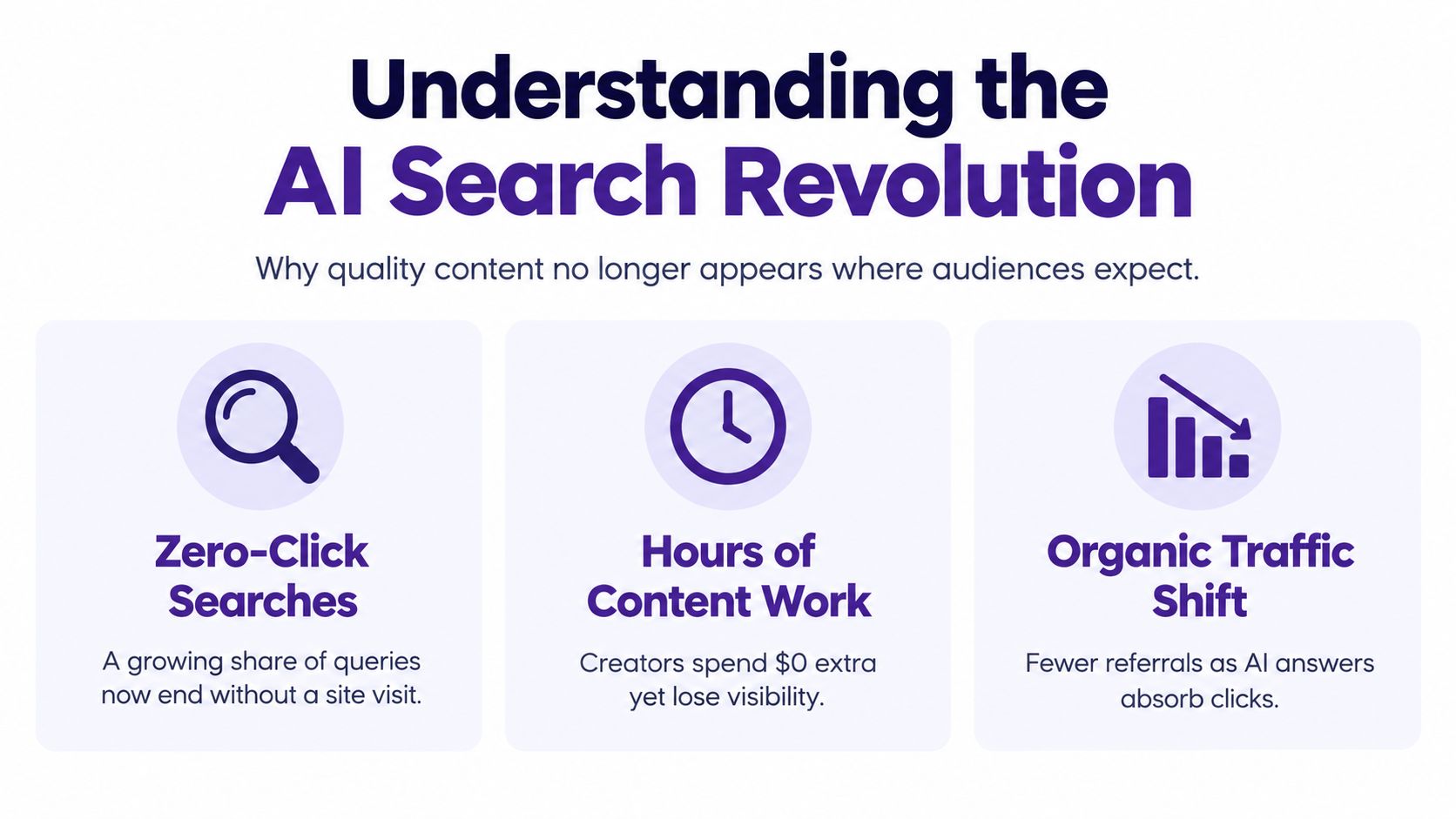
Understanding the AI Search Revolution
A creator publishes a strong podcast episode on sustainable fashion. Months later, a listener asks a search engine a layered question about fabric choices, ethical sourcing, and garment care. The answer they see may be a generated summary built from several sources, not a simple list of blue links. If that episode has a vague title, a thin description, or no clear topic signals in the archive, the system may never surface it, even if the explanation is excellent.
That is the practical shift. AI search changes discovery before it changes ranking.
Pew Research Center's analysis of Google searches with AI summaries found that 58% of U.S. adults in its study had conducted at least one Google search that produced an AI summary. Approximately 18% of observed Google searches produced one. For content teams, that means visibility can depend on whether a system can interpret and retrieve material from your existing library, not just whether a page targets a familiar phrase.
Why complex questions matter
Pew also found that only 8% of one- or two-word searches produced an AI summary, compared with 53% of searches containing 10 or more words. That pattern matters because long questions often sound like the buried value inside archival content. A transcript may answer a niche question clearly, but if the asset is stored like a box of unlabeled files, retrieval systems have little to work with.
Traditional SEO often centers on a target keyword. AI discovery asks for a more organized library. Systems look for topic labels, entities, relationships, format, dates, and passages that can answer a specific need. AI-powered SEO insights from Sprints & Sneakers offer useful context on this shift toward visibility inside generated answers.
The practical lesson is simple. Quality content needs descriptive structure to become retrievable content. Start with the archive you already have. Review titles, summaries, categories, transcripts, and naming conventions so older material can be found and cited when new questions appear. This overview of how AI search platforms can support content discovery is useful when your goal is to make a large content library easier for AI systems to interpret, not just to optimize one page.
How AI Search Results Differ from Traditional Search
A person searching “wireless headphones” and a person asking which pair stays comfortable through a long editing session in a noisy home office are not sending the same signal. Traditional search often treats those queries as a ranking problem. AI search treats them as a matching problem first, then a writing problem.
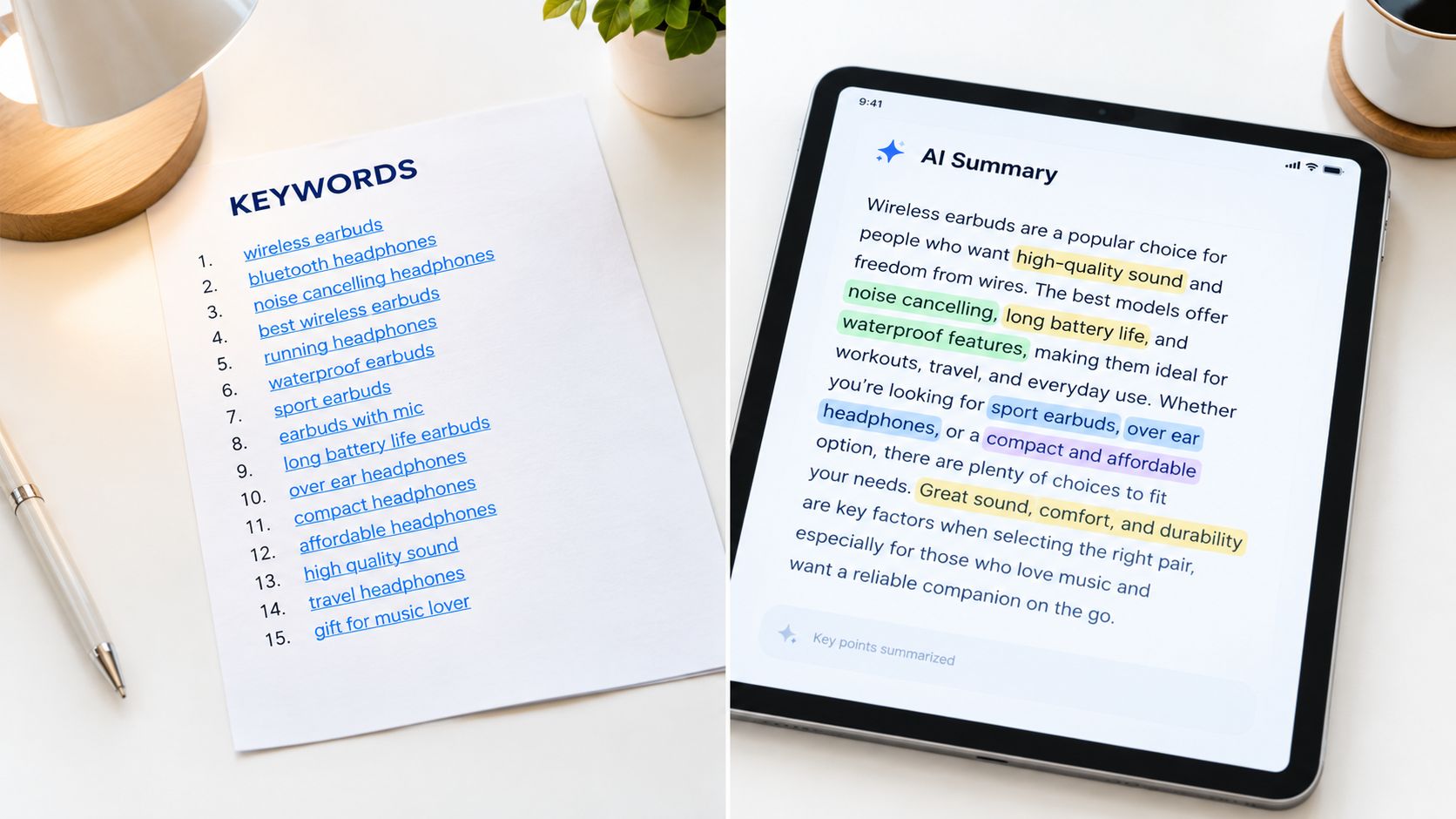
In a classic results page, the engine lists links, snippets, and pages to compare. The user does the synthesis after the click. In AI search, the system interprets the request, pulls passages from different sources, and assembles a direct answer that may include citations. That shift changes what makes old content discoverable. A page does not help much if the useful answer is buried in an unlabeled transcript, a vague file name, or a summary that never states the topic clearly.
Keywords still matter. They just work as one clue among several. Intent, entities, relationships, format, and context all help the system decide whether a piece of content belongs in the answer. That is the practical difference behind semantic search versus keyword search.
Retrieval comes before generation
Generation is the visible layer. Retrieval decides what the model can use.
A good way to picture it is a library request. If a visitor asks for “recording from home” but your archive labels the episode “remote audio production,” the answer may still be there, but only if the system can connect those expressions. Clear headings, accurate summaries, named speakers, dates, transcripts, and related topics give it more paths to the right passage.
This is why archival workflow matters. AI systems often assemble answers from multiple assets rather than one perfectly ranked page. A podcast episode, its transcript, a clipped quote, and a supporting article can each supply a different piece of evidence. Creators should ask a practical question: can the system identify the exact idea, speaker, date, and context that answer the query?
Watch the embedded overview for a visual explanation of how these systems change the search experience.
Creators exploring this field can also compare practical GEO AI tactics from IndieTool.
The Role of Metadata in AI Discovery
Metadata is the descriptive layer around your content. It tells a retrieval system what an asset is, who created it, when it was published, what it covers, and how its ideas connect to other material.
A useful metadata record for a podcast episode might include the episode title, hosts, guests, publication date, topic, subtopics, entities, audience, format, transcript location, related episodes, and rights status. A video record can add chapters, on-screen subjects, locations, and notable moments. An article can include author, content type, updated date, primary topic, supporting questions, and referenced organizations.
Build a governed description layer
A peer-reviewed evaluation across BioSample and GEO datasets found that retrieval from raw metadata produced average recall of approximately 17.65%, while augmenting GPT-4 with structured CEDAR metadata templates increased average recall to 62.87% and precision from 58% to 66%. The GigaScience evaluation of structured metadata also showed that enrichment can perform poorly when the schema or vocabulary doesn't fit the domain.
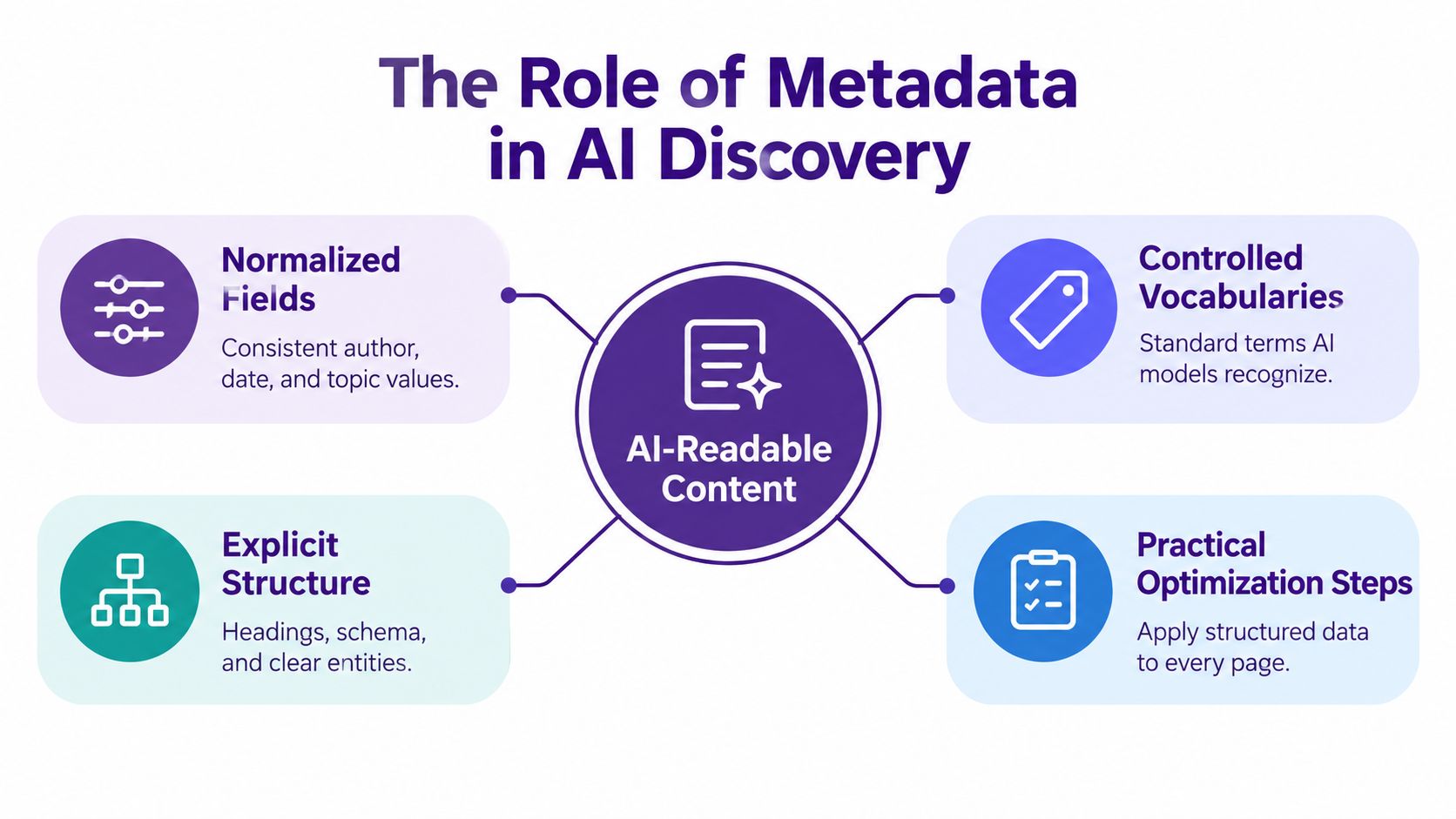
That finding gives content teams a practical warning. Adding random AI-generated tags isn't the same as building useful organization. Use stable fields and controlled terms that your team understands.
- Normalize the basics. Use one consistent format for creator names, dates, formats, and topics.
- Create controlled vocabularies. Decide whether your library calls a subject “artificial intelligence,” “AI,” or both, then define the relationship instead of using the terms randomly.
- Connect entities explicitly. Link a guest to their organization, an episode to its series, and a concept to related concepts.
- Describe audience and use. Mark whether an asset serves beginners, professionals, researchers, or a particular industry.
- Preserve the original asset. Keep the recording, transcript, article, and derivative versions connected rather than treating them as unrelated files.
This is the kind of operational discipline covered in metadata management best practices for content teams. The aim isn't to decorate a database. It's to expose meaning that would otherwise remain hidden inside filenames, folders, or unsearchable media.
Building an AI-Ready Content Library
An AI-ready library begins with a change in mindset. Your archive isn't merely storage for work you've already published. It can function as a structured knowledge base that helps your team answer new audience questions, identify related themes, and create fresh assets from material you already own.
A podcast episode, for example, can be represented as one connected record rather than one audio file. The record may include the full transcript, chapter headings, guest entities, claims, quotes, related episodes, short clips, newsletter references, and rights information. A video can connect its visual chapters to a written summary and the source interview. A magazine article can sit beside later updates, cited research, and related editorial packages.
Organize for people and machines
A web-archiving study from Utah State University's institutional repository links consistent metadata practice with better discoverability of archived websites. A separate archival-discovery paper describes metadata as central to organization, discovery, retrieval, access, and use. The practical implication is straightforward: publication date alone isn't enough.
Use a repeatable record for every asset:
- Identity: Title, creator, format, series, and original publication date.
- Meaning: Main topic, subtopics, entities, audience, and editorial purpose.
- Evidence: Transcript, references, source documents, quotations, and factual claims.
- Relationships: Related episodes, articles, clips, books, guests, and follow-up coverage.
- Reuse conditions: Rights status, update needs, sensitive material, and approved channels.
This organization supports more than AI retrieval. A human editor can find every interview about a topic. A producer can locate a prior explanation before commissioning another one. A marketer can identify a durable episode that deserves a newsletter, video excerpt, or social clip.
Podcast audiences move between formats. A SiriusXM Media and Edison Research survey of more than 2,000 U.S. monthly podcast consumers aged 13 and older found that 90% consumed an audio-first podcast during the previous month, 89% consumed a video podcast, and 70% used both formats. The same research found that 77% encountered podcast clips on social media, and two-thirds of those people later listened to or watched the full podcast. The survey reporting from Inside Radio supports a library model where one strong idea can travel through several connected formats.
Citation Reliability and Source Provenance
A citation can make an AI answer look trustworthy without proving that the answer is correct. That distinction matters to publishers whose work may be summarized, copied, syndicated, or attributed to a derivative page instead of the original source.
The Tow Center for Digital Journalism tested eight AI search tools and found that they collectively returned incorrect answers for more than 60% of queries. The tools also fabricated links and sometimes cited syndicated or copied versions instead of original articles, as documented in the Tow Center's testing of AI search citations.
Verify the claim, not just the link
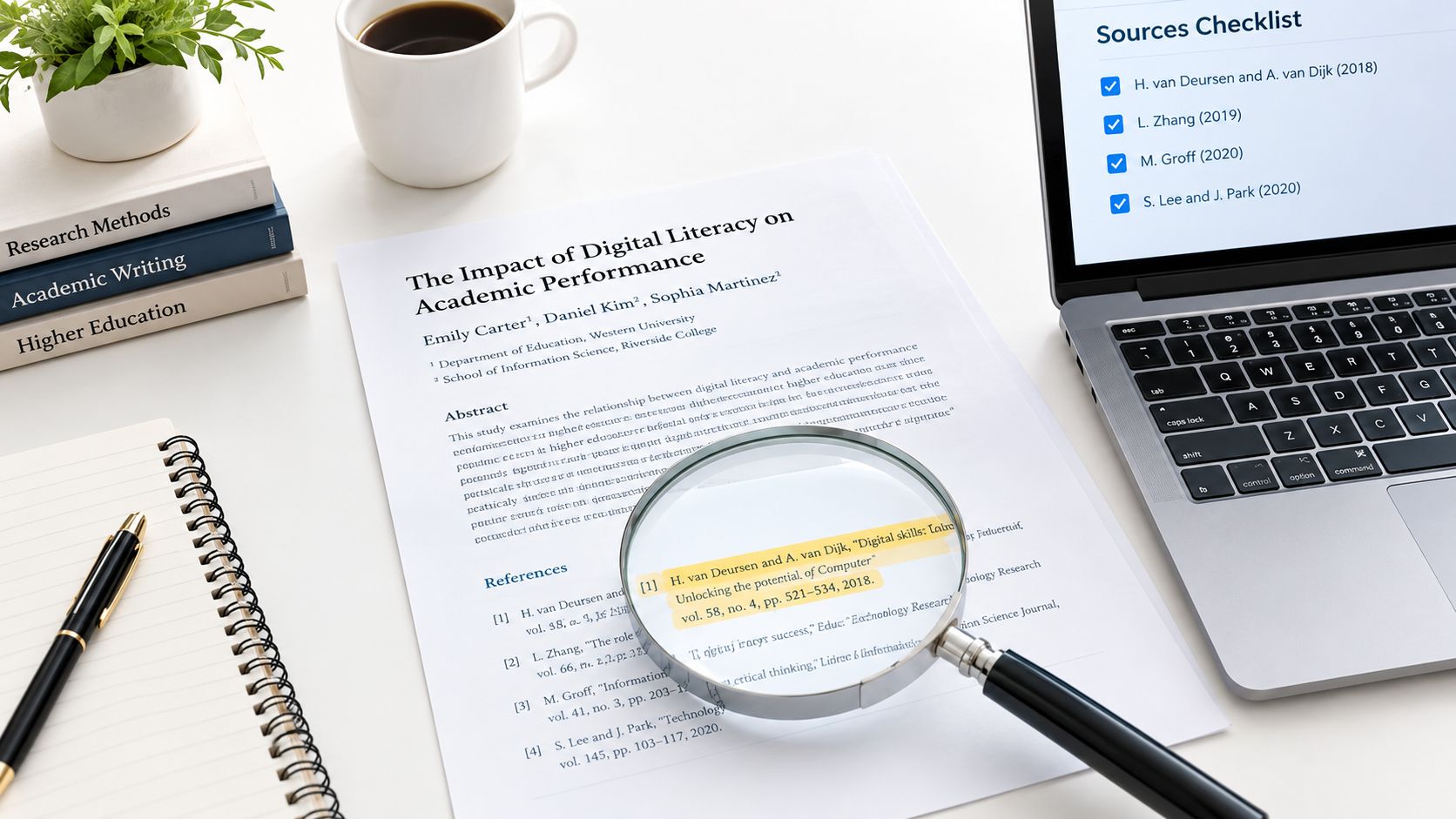
A content team should inspect each important citation at claim level. Ask whether the linked page is the original publisher, whether the date fits the claim, whether the cited passage supports the wording, and whether the system has combined separate facts into a conclusion no source makes.
A practical provenance check includes:
- Source identity: Is this the canonical article, episode, paper, or video?
- Excerpt fidelity: Does the cited passage mean what the answer says it means?
- Citation completeness: Does every important claim have support?
- Freshness: Is the material current enough for the question?
- Duplication: Has a copied version replaced the original in retrieval?
Practical rule: “Cited” and “verified” are different outcomes. Track both.
This is especially important for historical libraries. A derivative page may be easier for a system to retrieve, while the original interview contains the fuller context, correct attribution, or latest editorial correction. Clear canonical relationships, descriptive records, and connected source files give your team a better chance of detecting and correcting those mismatches.
Optimizing with Contesimal for AI Search Visibility
The workflow starts with inventory, not publishing. Gather your articles, transcripts, videos, research files, and derivative assets, then identify what each item contains. A useful system should let you search by phrase while also helping you discover related topics, entities, and recurring themes.
Contesimal is one option for this kind of organization. It combines a chat-based research interface with a tooling layer for classifying, organizing, and searching documents, podcasts, videos, and articles. Its searchable taxonomies, snippets, lists, dossiers, and research agents can help teams connect archival material to new editorial questions.
Use a practical operating sequence
First, define the taxonomy. Create topic groups, audience labels, formats, series, entities, and rights fields. Keep the terms stable enough that different collaborators classify similar assets in similar ways.
Next, ingest the source material. Preserve the relationship between a full episode and its transcript, clips, show notes, articles, and research. A system can only identify meaningful connections when the underlying assets remain linked.
Then, test real questions. Ask the library questions your audience might ask, such as which episodes explain a topic for beginners or where a guest discusses a particular challenge. Review both useful results and missing results.
Finally, create outputs from evidence. Build a dossier for an editor, a list of related episodes for a producer, or a research brief for a writer. Keep the source passage attached to each insight so a human can verify it before publication.
This workflow makes AI a research collaborator rather than an unchecked author. Humans define the taxonomy, review evidence, resolve ambiguity, and decide what deserves publication. The system reduces the time needed to locate and connect material.
Future Strategies for Content Visibility
The durable strategy for AI search isn't chasing every interface change. It's building a library that remains understandable when systems retrieve content through different questions, formats, and answer styles.
That requires three connected disciplines. Semantic organization makes the archive discoverable. Provenance controls help your team verify whether a generated answer represents the source accurately. Reuse workflows turn one well-understood asset into articles, clips, newsletters, videos, and new research directions.
The measurement model must also expand beyond rankings and visits. Authoritas reporting on UK news queries found a 47.5% desktop decline and a 37.7% mobile decline in per-query click-through rate when Google AI Overviews appeared, as reported by Press Gazette's coverage of the Authoritas findings. A separate 2025 study found that people using ChatGPT completed practical search tasks faster and were more likely to find correct solutions, but relied significantly less on primary web sources than Google users, according to the SPAR academic-search benchmark and evaluation.
Those findings create a measurement challenge for creators. A user may see your brand, claim, episode, or research in an answer without visiting your site. Track citation share, claim accuracy, source freshness, branded mention quality, direct traffic, and conversions among exposed audiences where your analytics allow it.
Design for distribution and reuse
A library organized around topics and entities can support platform-specific production without losing the original context. A long-form interview can become a video chapter, audio episode, short clip, written explanation, and source-backed answer. Tools such as an AI video generator may support the production of visual derivatives, but the editorial value still comes from selecting the right moment and preserving its meaning.
Marketers already use updating and repurposing because it extends the value of existing research and production. A report summarized by Quill cites SEMrush's State of Content Marketing research, stating that 94% of marketers repurpose content and that updating or repurposing existing content was the second-most-effective tactic for driving traffic and generating leads, as described in Quill's podcast content repurposing guidance.
Start with one content collection. Normalize its metadata, test retrieval with real questions, verify citations, and turn the strongest discoveries into new formats. That process gives your archive a role in future answers instead of leaving it trapped in yesterday's folders.
Contesimal helps content teams organize articles, podcasts, videos, and research into searchable taxonomies that support human review and AI-assisted discovery. Visit Contesimal to explore how your existing library can become a structured source for new ideas, reusable assets, and more visible content.