
Semantic search optimization helps a content library retrieve meaning, not just matching words. A strong production setup combines BM25 and embeddings, then reranks only the top 50 to 200 passages, because exact names and conceptual questions need different retrieval signals.
You know the frustration. You remember recording an episode about creator revenue, reading an article about turning expertise into products, or publishing a chapter on audience growth. You type a new question into your archive, and the search returns a handful of unrelated matches. The useful answer exists, but your system can't recognize the connection.
That gap matters for podcasters, YouTubers, publishers, bloggers, authors, researchers, and content marketers with a growing back catalogue. Your audience asks for ideas, comparisons, examples, and explanations. A basic search box looks for strings. A useful archive understands concepts, relationships, dates, people, formats, and evidence.
Semantic search optimization brings those needs together. It can make research faster, reduce duplicated editorial work, and help you decide which old assets deserve a new article, video, newsletter, or social adaptation. It won't make weak metadata disappear, and it won't guarantee rankings or accurate answers. It gives humans and software a better structure for finding what the library contains.
Why Content Libraries Fail Their Own Search
A creator searches for “ways to build recurring revenue from a podcast.” The archive contains an interview about memberships, an episode on premium communities, and a transcript discussing listener-supported media. Exact keyword search may miss all three because the original speakers never used the phrase “recurring revenue from a podcast.”
The archive hasn't lost the knowledge. It has lost the connection between the question and the language used in the source.
The string problem
Traditional keyword matching is useful when you know the exact title, guest, phrase, or identifier. It struggles when the user remembers an idea rather than a sentence. “That conversation about turning expertise into a course” is a meaningful request, but it doesn't tell a literal search engine which words must appear.
This problem grows as your library expands across formats. A podcast may hold the answer in spoken language, a video may contain it in a scene, and a book chapter may express it with entirely different terminology. The more assets you publish, the less reasonable it becomes to assume that one preferred keyword describes every relevant passage.
The historical roots of semantic retrieval reach back to Latent Semantic Indexing, developed at Bellcore in the late 1980s. Its foundational paper, “Indexing by Latent Semantic Analysis”, described representing documents and queries in a reduced semantic space so systems could connect related concepts even when the wording differed. The principle still applies to a modern archive: organize content around topics and relationships, not repeated terms.
Practical rule: If a person can describe the answer without remembering the source's wording, your archive needs a meaning-aware retrieval layer.
From frustration to repurposing
Better retrieval changes editorial decisions. Instead of commissioning another explainer because the team can't find an existing one, an editor can locate the relevant episode, transcript passage, supporting article, and related guest. That material can become a new video, a newsletter, a research brief, or a topic cluster without starting from a blank document.
Clear structure helps before search technology enters the picture. Teams that are still untangling headings, sections, and source relationships may benefit from mastering content structure with AIDictation. A well-organized source is easier for people to reuse and easier for retrieval systems to interpret.
Semantic search optimization isn't a synonym list pasted onto old content. It's an operating model for making an archive answer questions like a knowledgeable colleague. The quality depends on retrieval methods, item-level metadata, coherent chunks, evaluation, and the discipline to say “this library doesn't contain a reliable answer” when that is the truth.
How Semantic Search Actually Works
Think of a librarian serving a large media archive. One filing system shelves every item by exact title. Another records subjects, contributors, dates, formats, related works, and meaningful passages. The second librarian can still find an exact title, but can also answer a question expressed in unfamiliar language.
Semantic retrieval follows that second model.
The librarian's topic map
An embedding converts a passage or query into a numerical vector. You don't need to treat the vector as a mysterious “meaning score.” Think of it as a position in a large conceptual map. Passages that discuss related ideas tend to occupy nearby positions, even when they use different words.
A system commonly compares vectors with cosine similarity. If a user asks about “earning from an audience without relying on advertising,” a semantically related passage about memberships may be close on the map. That helps with paraphrases and exploratory questions, especially in transcripts where natural speech rarely follows the phrasing of search queries.
Embeddings have limits. A vector can recognize conceptual closeness while overlooking the exact details that make an archival result correct. A query for a guest's rare surname, episode identifier, publication date, or quoted phrase needs lexical matching and structured filters.
Why BM25 still matters
Sparse retrieval methods such as BM25 score term frequency, inverse document frequency, and document length. In plain language, BM25 rewards useful word matches while accounting for how common those words are and how much text the system searched.
That makes it valuable for:
- Rare names: A specific guest or author should remain easy to locate.
- Identifiers: Episode codes, product names, titles, and references need exact matching.
- Dates and numbers: A request involving a year, measurement, or numbered edition shouldn't depend only on semantic proximity.
- Technical language: Domain terminology may carry more precision than a broad embedding.
The strongest design uses both librarians. Retrieve candidates with BM25 and embeddings, merge or deduplicate the results, then apply a cross-encoder reranker to the most promising passages. A practical range is the top 50 to 200 passages, which keeps expensive reranking focused rather than applying it to the entire archive. The scientific-paper evaluation linked in this hybrid retrieval study reported BM25 enhancements improving MRR@5 by 8.4 percentage points and Precision@30 by 10.3 points over its official baseline. Adding a cross-encoder reached a development-set MRR@5 of 76.46%, a 9.3-point gain over the best individual retriever.
That result isn't a promise for your archive. It supports a design choice: use broad candidate generation to protect recall, preserve exact matching, and rerank only after the system has gathered plausible evidence.
For a practical overview of how meaning-based retrieval differs from related approaches, compare semantic search and vector search. Entity handling also deserves its own attention, particularly when a name, brand, place, or concept can have multiple meanings. These entity optimization tactics offer useful context for making those relationships clearer.
Designing Taxonomy and Metadata That Travel
Retrieval can't recover information your archive never described. If one editor labels an interview “creator monetization,” another uses “audience revenue,” and a third leaves the topic blank, the system receives three incompatible descriptions of related work.
Metadata creates the shared language.
Describe the item, not only the collection
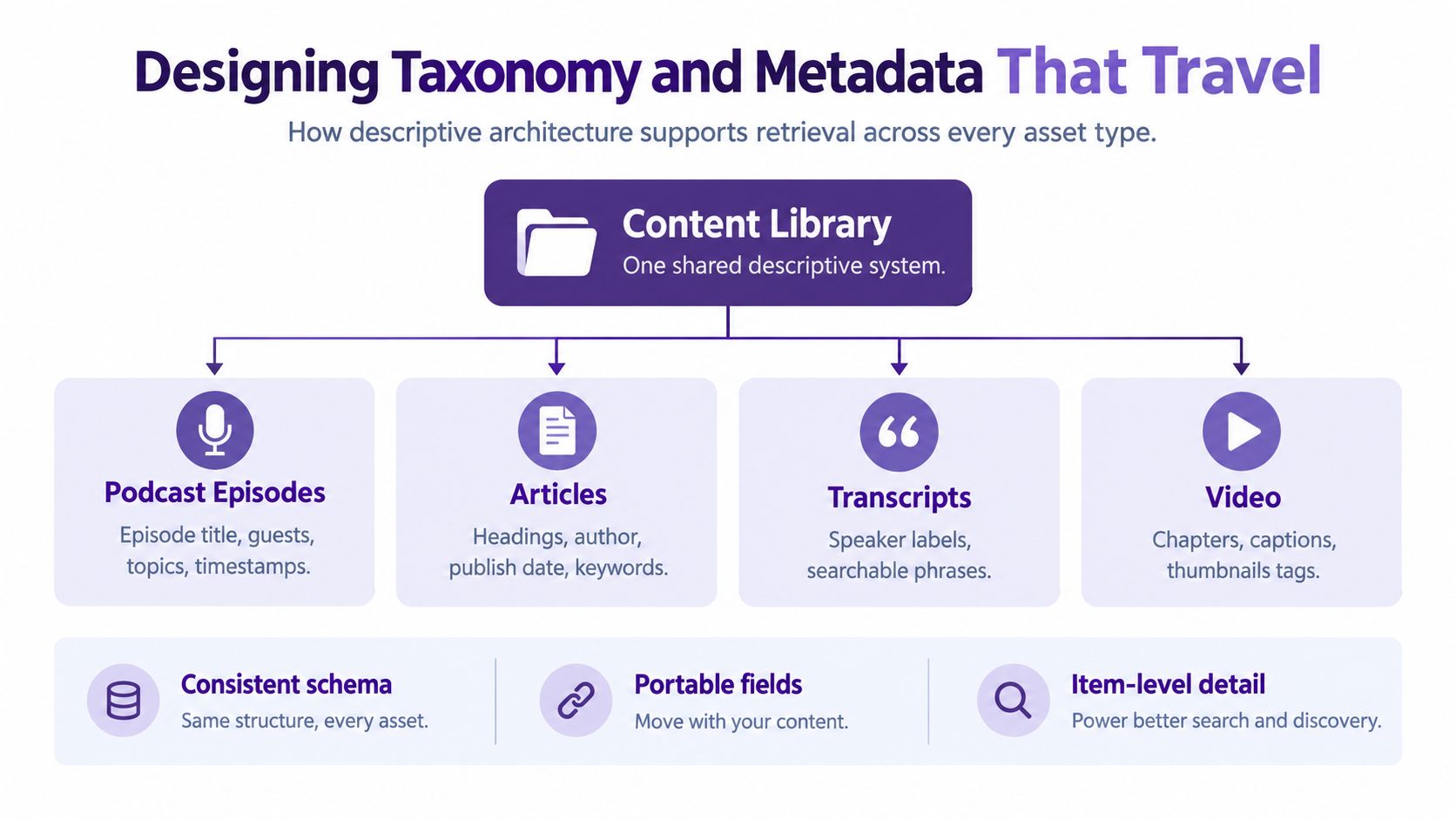
Digital archival practice generally describes primary resources at the individual-item level. For a content organization, that means each episode, article, video, transcript, image, or book chapter should have its own searchable record. A collection-level label such as “marketing archive” is too broad to guide retrieval or repurposing.
A useful item record might preserve:
- Identity: Title, creator, guest, parent publication, and stable identifier.
- Time: Publication date, recording date, update date, and relevant event dates.
- Content: Summary, topics, entities, key claims, format, and language.
- Structure: Transcript segments, chapter headings, timestamps, speaker labels, or page ranges.
- Rights and status: Usage permissions, editorial status, freshness, and whether the item has been superseded.
- Relationships: Related episodes, source articles, follow-up pieces, adaptations, and corrections.
The parent-document ID matters when you split a transcript or article into searchable passages. Without it, a result may look relevant but lack enough context for a human to judge whether it belongs to the full episode, a particular speaker, or a specific publication.
Make labels consistent enough to survive staff changes
A controlled vocabulary should cover topics, formats, contributors, audiences, rights, and status. It doesn't need to eliminate editorial judgment. It needs to help two editors classify comparable assets in comparable ways.
Use one canonical topic where possible, then preserve meaningful aliases for search. Keep “paid community,” “membership,” and “subscriber community” discoverable if your audience uses all three, but decide how those terms relate in the taxonomy. A controlled vocabulary can also support filters such as format, author, year, language, rights status, or audience sophistication.
Metadata isn't decoration. It's the interface between a creative archive and every future researcher, editor, or AI system that needs to use it.
The same principle applies to faceted navigation. Guidance on faceted search best practices can help teams design filters that narrow results without creating confusing or contradictory paths. For a deeper treatment of labels, hierarchies, and relationships, see content tagging and taxonomy.
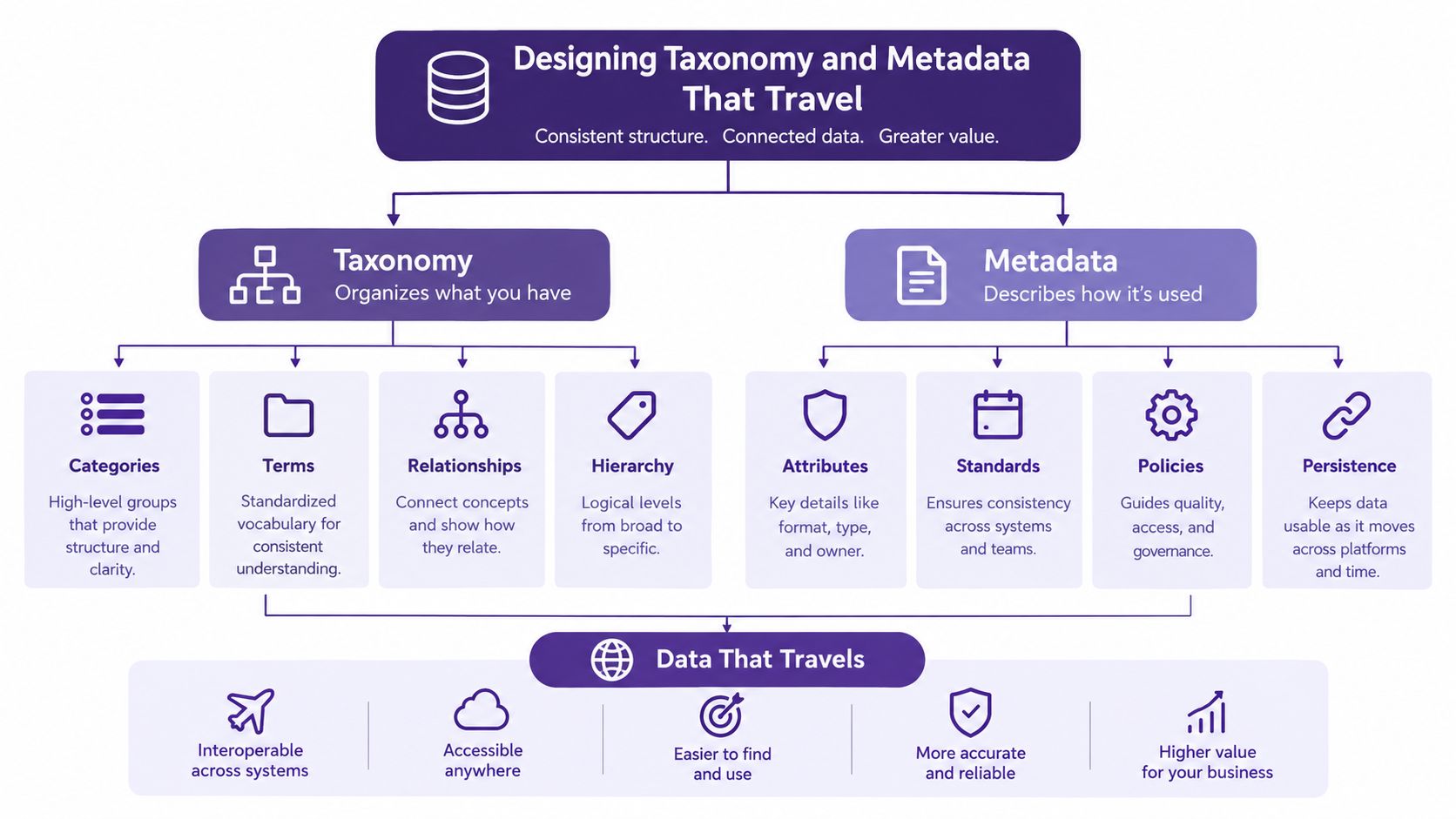
A portable schema is more valuable than a platform-specific naming habit. When podcast fields, article fields, and video fields share comparable concepts, you can search across formats and assemble a source package for the next production brief. That is how a passive folder system becomes an indexed knowledge base.
Chunking and Indexing Strategy
The unit you index determines the unit you retrieve. A full two-hour interview may contain several unrelated answers, while a single sentence may be too small to carry enough context. Neither extreme gives a semantic system a fair chance.
Split by meaning
Good chunks usually represent a coherent answer, section, scene, or argument. Examples include one podcast response, an article section, a video scene, or a book subsection. The precise boundary depends on the format and the questions your audience asks.
A chunk should retain enough surrounding context for a reader or reranker to understand the claim. It should also preserve a pointer to the parent asset, speaker or author, timestamp, publication date, and taxonomy labels. Store the raw text alongside normalized metadata so you can display the original passage while filtering with consistent values.
A dense-retrieval benchmark description reported model-dependent recall changes. One embedding configuration raised recall from 0.483 to 0.608, while another raised it from 0.673 to 0.718. Those figures aren't universal expectations. They demonstrate why teams should test their own models and query types rather than assume that one embedding setup works equally well everywhere. The benchmark description is available in this retrieval evaluation.
Match the index to the question
A conceptual question such as “how do creators build trust with a small audience?” should benefit from dense retrieval. A request for “the episode with Maria Santos published in 2023” should retain BM25 and field-level filters. A quotation hunt needs exact text. A numerical question needs reliable lexical and metadata signals.
Audit an indexing pipeline with these decisions:
- Chunk boundary: Does each passage contain one coherent idea?
- Parent link: Can the interface reconstruct the full source?
- Metadata fields: Can users filter by author, speaker, date, format, topic, language, and rights?
- Text preservation: Is the original wording available for verification?
- Query classes: Are conceptual, entity, date, quotation, and numerical searches tested separately?
- Evaluation set: Does the test collection resemble real archive questions?
Searchers shouldn't have to choose between semantic discovery and precise retrieval. The design should offer both. A clear explanation of how archives become searchable through document indexing can help teams audit the ingestion layer before tuning models.
Measuring Semantic Search Honestly
A single search score can hide a broken archive. Your system may retrieve broad conceptual matches while missing the exact episode a producer needs, or it may place a correct result so far down the list that nobody sees it.
Measure retrieval in stages.
Recall@K asks whether the relevant item appears anywhere in the first K results. It catches candidate-generation failures. Precision@K asks how many of those first results are relevant, which exposes noisy retrieval. MRR, or mean reciprocal rank, rewards systems that place the first correct result near the top. nDCG also considers ranking quality when several results have different levels of relevance.
Use Recall@K before reranking. This tells you whether BM25, embeddings, or their combined candidate set found the right material. Use MRR@K and nDCG after reranking, when you want to know whether the interface presents the best evidence first.
Your labeled set should include real archive questions, not only easy keyword lookups. Include a conceptual request, a named-entity search, a date-bounded question, a quotation hunt, and a request for information the archive doesn't contain. Label the ideal source and acceptable alternatives, then review errors by query type.
| Metric | What It Catches |
|---|---|
| Recall@K | The right asset never entered the candidate set |
| Precision@K | Too many loosely related passages crowd the results |
| MRR | The best result appears below less useful matches |
| nDCG | Several relevant results are ranked in the wrong order |
A representative evaluation matters because aggregate scores can conceal failures on rare names or structured requests. Search logs add another layer: repeated reformulations show where users are struggling, while abandoned searches reveal possible taxonomy gaps or missing content.
Feeding Optimization Back Into Content Production
Semantic search becomes more valuable when it influences what you publish next. Search logs aren't just technical diagnostics. They are a record of the questions your audience, editors, and researchers can't answer efficiently from the current library.
Look for recurring patterns:
- A conceptual query returns related passages but no complete answer.
- Users reformulate a question with different terms before finding a result.
- A named guest appears in transcripts but lacks a reliable contributor field.
- A follow-up question exposes a missing date, definition, comparison, or source.
- Editors repeatedly open the same group of assets while preparing a new production.
Those signals can become topic clusters, gap briefs, refreshed transcripts, or new episode outlines. A creator who sees repeated searches for “how to turn a newsletter into a paid product” might connect older interviews, identify missing guidance, and produce a new article that links back to the strongest source passages.
Distribution also changes the value of this loop. Content Marketing Institute survey data compiled by this content distribution overview reports that 89% of surveyed B2B marketers use organic social media, 84% use a corporate blog, and 71% use email newsletters. Those channels have different jobs. Social can introduce an idea, a blog can preserve searchable context, and email can bring the source directly to an existing audience.

A searchable archive should support the next production decision, not merely retrieve an old file. The loop is straightforward: publish, index, observe queries, improve metadata, identify gaps, and repurpose or create the next asset. Contesimal can support this kind of workflow by organizing documents, podcasts, videos, and articles through layered taxonomies and a chat-based research interface.
The difficult part isn't only finding more passages. It is knowing when a passage doesn't answer the question, showing where it came from, and preventing a plausible fragment from becoming a confident but unsupported summary.
The Honest Limits of Semantic Retrieval
Semantic similarity is not evidence. A passage can sit close to a query in vector space and still fail to answer it, use outdated information, or discuss the same topic from the wrong angle.
This matters most when an archive has partial coverage. A system may find three passages about subscription businesses for a specific pricing decision that none of those passages addresses. Returning them without a clear evidence boundary creates a false sense of completeness.
Build abstention into the archive
A retrieval evaluation found that standard RAG and GraphRAG returned false-positive passages for questions with no answer in the knowledge base roughly 19% to 28% of the time. The same evaluation found that cosine similarity correctly identified only 26.7% of entities, compared with approximately 55% to 57% for LLM-based and hybrid approaches, as reported in this retrieval evaluation.
The practical response is not to abandon embeddings. It is to add evidence quality and abstention:
- Provenance: Show the original asset, author or speaker, date, passage, and location.
- Freshness: Mark publication, event, update, and supersession dates.
- Scope: Record what an asset covers and what it doesn't cover.
- Negative metadata: Use labels such as “not covered,” “uncertain,” or “superseded” where appropriate.
- Contradiction handling: Surface conflicting claims instead of blending them.
- Confidence signals: Separate semantic proximity from verified answer quality.
Operating habits that protect trust
Review failed searches on a regular cadence. Add representative questions to the evaluation set, especially those involving rare names, exact figures, dates, and unavailable information. When editors correct a result, capture the correction in metadata or labeling rather than treating it as a one-off human workaround.
Track whether users reach a qualified source, whether the answer reflects the source accurately, and how often the system returns a confident result when the archive has no answer. These habits keep semantic visibility tied to usefulness rather than vanity rankings.
Contesimal helps creators, publishers, and content teams organize documents, podcasts, videos, and articles with layered taxonomies, metadata, and chat-based research across their existing libraries. If you want your archive to support reliable semantic search, smarter repurposing, and evidence-aware collaboration, visit Contesimal and explore how your content can create new value.