
Programmatic media is software that automatically buys and sells individual digital advertising impressions, and it accounted for 82.4% of digital ad spend in 2024. Global programmatic spending exceeded $650 billion that year, so this isn't a niche tactic reserved for large advertising teams.
You may already have the raw material programmatic buyers want. Your podcast has a deep archive of episodes, your video channel contains evergreen explainers, or your publication has years of articles that still attract the right audience. Yet those assets can sit unused while advertising budgets move through automated systems that can't understand their value unless the content is classified, packaged, and measured clearly.
Understanding what is programmatic media means learning more than the phrase “automated ad buying.” You need to know how the marketplace developed, how an impression moves through an auction, who controls each step, where fees can accumulate, and what measurement can still prove when individual tracking becomes less reliable. Then you can connect those mechanics to the library you already own and make better decisions about distribution and monetization.
The Plain-English Answer and Why It Matters Now
Programmatic media is an operating model in which software uses rules, data, and automated transactions to match advertising buyers with available digital inventory. Instead of a person manually negotiating every placement, the system can evaluate an individual impression and decide whether it fits a campaign.
That model now reaches far beyond banner ads. It can support display, online video, connected television, audio, mobile in-app advertising, and digital out-of-home media. The important distinction is that programmatic describes how media is bought and sold, not one specific format.
The scale explains why creators should care. Programmatic placements represented 82.4% of digital ad spend in 2024, compared with 75.9% in 2019, and global programmatic spending exceeded $650 billion, more than 12% higher than the previous year, according to DataReportal's global advertising trends data. The reported regional estimates included approximately $283.65 billion in North America, $214.7 billion in Asia, and $110.2 billion in Europe during 2024, all from the same source.
The practical shift: Buyers don't just purchase a publication or a show anymore. They can evaluate the value of an individual impression inside that environment.
That creates an opportunity for publishers, podcasters, filmmakers, bloggers, and professional creators with substantial archives. A useful media asset management approach can help you organize episodes, clips, transcripts, articles, and supporting research so those assets become easier to search, classify, package, and distribute.
Three questions will determine whether the opportunity is real for you. How did this system develop? How does the machinery work? What does it mean for the content you already own? The answers reveal why metadata, context, transaction control, and measurement deserve as much attention as the creative itself.
A Short History of How Programmatic Got Built
Programmatic didn't appear as a finished product. It developed as publishers, advertisers, and technology companies tried to solve practical problems, including fragmented inventory, slow negotiations, and inconsistent auction rules.
Right Media launched an ad exchange in 2005, creating a marketplace where digital inventory could be aggregated and traded more efficiently. The exchange model helped move advertising away from isolated publisher relationships toward connected systems that could bring supply and demand together.
In 2008, Google acquired DoubleClick for $3.1 billion, combining a major advertising technology asset with Google's broader advertising capabilities. The milestone reflected the industry's movement toward integrated infrastructure, where ad serving, inventory management, and buying decisions could operate within connected software environments. The historical milestone is documented in this programmatic media timeline.
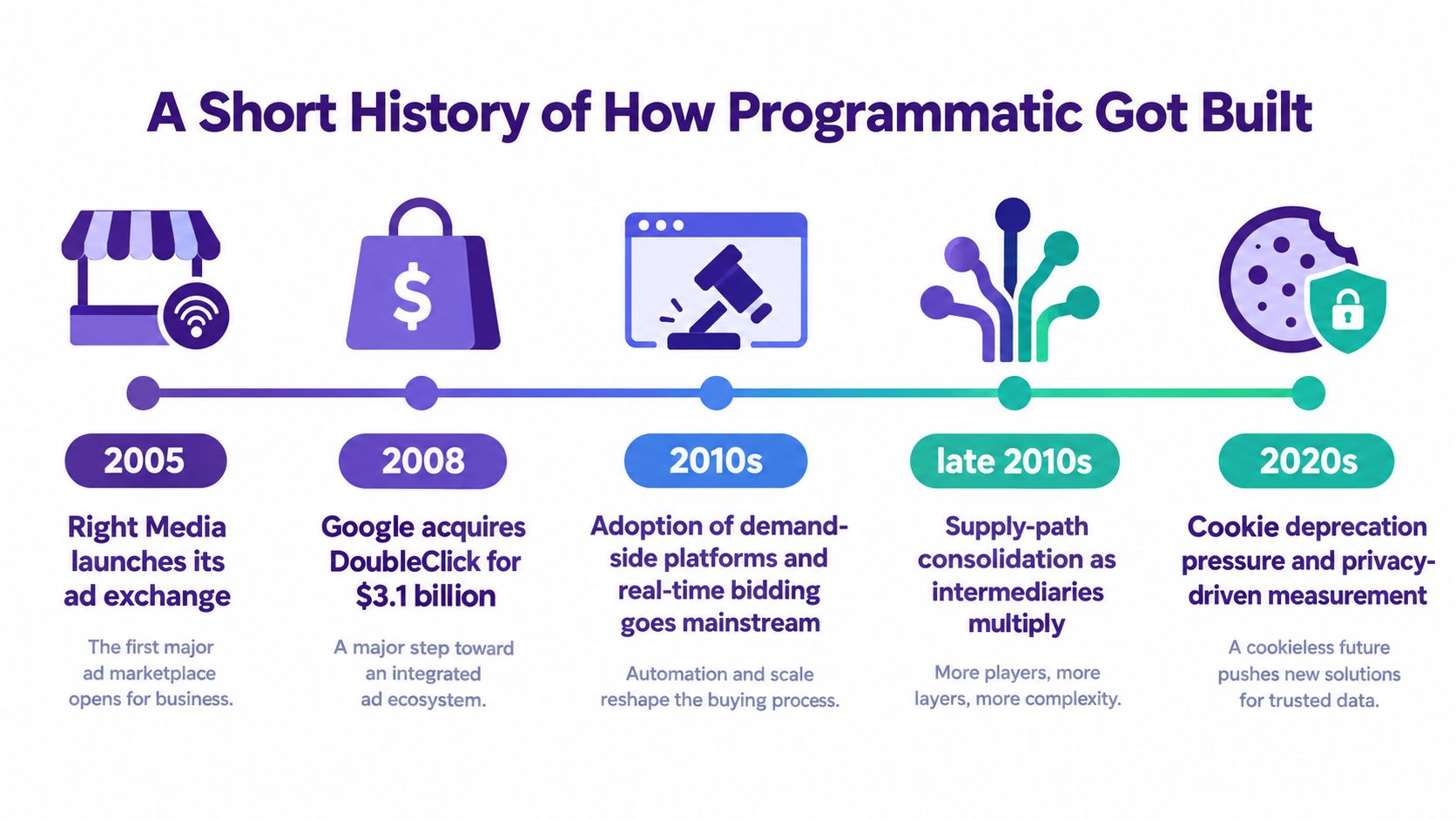
The next problem was interoperability. Different platforms needed a shared way to describe an impression, request a bid, and return a response. The IAB first published the OpenRTB specification in 2010, establishing a common technical language for bid requests and responses among publishers, supply-side platforms, demand-side platforms, and exchanges.
That standard mattered because it allowed systems to transmit information about placement, device, geography, context, and audience attributes while an ad opportunity was still available. It turned a collection of disconnected tools into something closer to a common marketplace.
Auction mechanics continued to change. Exchanges began testing first-price auctions in 2017, and Google completed its first-price rollout across Ad Manager on September 10, 2019. In a first-price structure, the winning buyer pays the bid it submitted, which makes bid valuation and supply-path clarity especially important.
The timeline tells a useful story. Programmatic grew from basic ad-server automation into interoperable, real-time marketplace infrastructure. Each milestone reduced one form of friction, but each also made the system more dependent on accurate signals and understandable controls.
The Four Ways Programmatic Inventory Actually Sells
A common mistake is treating programmatic as a synonym for real-time bidding. RTB is an auction mechanism. Programmatic is the broader automated operating model. A programmatic deal can use an auction, but it can also automate a fixed-price agreement or a guaranteed booking.
The IAB identifies four distinct transaction types: automated guaranteed, unreserved fixed-rate, invitation-only auction, and open auction. RTB can operate in both open and invitation-only auctions, as described in the IAB programmatic transaction framework.
Automated guaranteed
An automated guaranteed deal combines a negotiated agreement with software-based execution. The buyer and seller establish terms such as inventory, price, and delivery expectations, then platforms automate the booking, trafficking, and reporting.
This suits a publisher selling a defined sponsorship around a podcast series, video collection, or editorial environment. The buyer receives more predictable access, while the publisher keeps greater control over placement and delivery.
Unreserved fixed-rate
An unreserved fixed-rate arrangement uses an agreed price without the same delivery guarantee. The buyer may receive access to inventory at a fixed rate, but available supply can vary.
This can work when a buyer wants a known price and a publisher wants flexibility. It sits between a fully guaranteed agreement and a competitive auction.
Invitation-only auction
An invitation-only auction, often called a private marketplace, limits participation to selected buyers. The publisher or selling platform can set eligibility rules, invite preferred demand, and preserve more control over the environment than an open exchange provides.
RTB still happens here. The difference is who can participate and what conditions apply.
Open auction
An open auction makes eligible inventory available to a broad set of buyers. Software evaluates each impression, buyers submit bids, and the marketplace selects an eligible offer under the auction rules.
Open auctions can provide reach and liquidity, but they can also make it harder to understand the complete path from buyer to publisher. A low price doesn't automatically mean a good purchase, and a high bid doesn't automatically mean the best outcome.
| Transaction Type | Auction Style | Who Can Bid | Best For |
|---|---|---|---|
| Automated guaranteed | No open auction, automated reserved agreement | Selected buyer and seller | Predictable delivery and premium sponsorships |
| Unreserved fixed-rate | Fixed price without guaranteed delivery | Buyers with approved access | Price consistency with flexible supply |
| Invitation-only auction | Private RTB auction | Invited buyers | Controlled access and curated inventory |
| Open auction | Broad RTB auction | Eligible marketplace buyers | Scaled reach and impression-level buying |
When someone proposes a “programmatic campaign,” ask which row they mean. Ask whether delivery is guaranteed, whether the buyer is invited, whether the price is fixed, and whether the inventory is offered through an open auction. Those answers reveal more than the word programmatic does.
Inside the Real-Time Bidding Loop
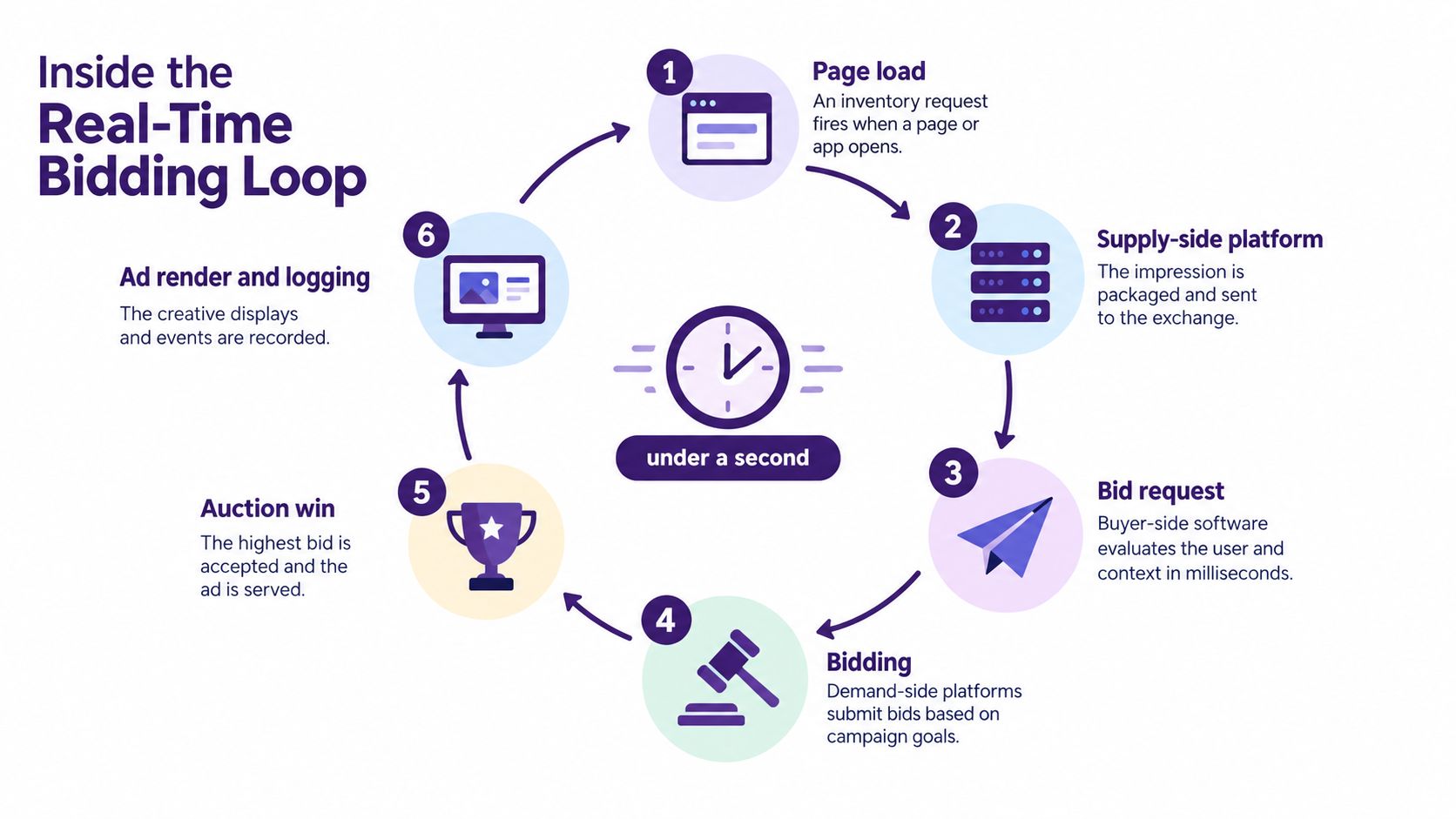
The bidding loop begins when a page or app creates an advertising opportunity. The publisher's supply-side technology packages details about that impression and sends a bid request into the marketplace. Buyer-side software then decides whether that specific opportunity fits a campaign. In real-time bidding, or RTB, this assessment happens quickly enough to support impression-level buying. An overview of real-time bidding infrastructure describes the technical systems that make these auctions possible. Industry estimates cited there put global programmatic infrastructure at roughly 650 billion bid requests per day, with peak traffic above 12 million requests per second and a typical bid-to-render time of under 200 milliseconds. Treat those figures as industry estimates, not an official market census.
The loop links six decisions:
- Inventory request: A page or app loads and signals that an ad space is available.
- Supply packaging: The supply-side platform describes the placement, publisher, format, and available signals.
- Bid evaluation: Demand-side software assesses context, device, geography, audience attributes, placement, and campaign goals.
- Valuation: The buyer estimates the impression's expected value and checks eligibility, budget, frequency, brand-safety, and measurement rules.
- Auction decision: Eligible bids compete under the marketplace's auction mechanics.
- Delivery and feedback: The winning creative renders, exposure events are logged, and conversion or outcome data informs later decisions.
Google describes automated bidding as setting a bid for every individual auction, with machine-learning strategies optimizing toward conversions or conversion value. The system can therefore redistribute a fixed budget impression by impression as performance signals accumulate, rather than changing one campaign setting only occasionally.
For content owners, metadata is not decoration. It is a decision signal. A clear taxonomy covering subjects, formats, audience context, content sensitivity, language, geography, and commercial suitability gives buyers and platforms information they can use.
Operational rule: If a buyer cannot understand what an episode, article, or video covers through structured fields, the marketplace may value it less accurately than a human editor would.
Messy ingestion makes automated classification harder. Inconsistent titles, missing transcripts, vague categories, and duplicated records obscure what is being sold. Creators do not need to expose every internal research note, but the sellable content environment should have reliable descriptions, clear content labels, and stable identifiers.
Publishers working across video, podcast, and editorial channels should also define brand-suitability rules. A practical guide to brand safety in programmatic can help turn broad concerns into inclusion, exclusion, verification, and placement settings.
The video below walks through the same six steps visually if you prefer to see the loop in motion.
Where the Money Actually Goes and Why It Disappears
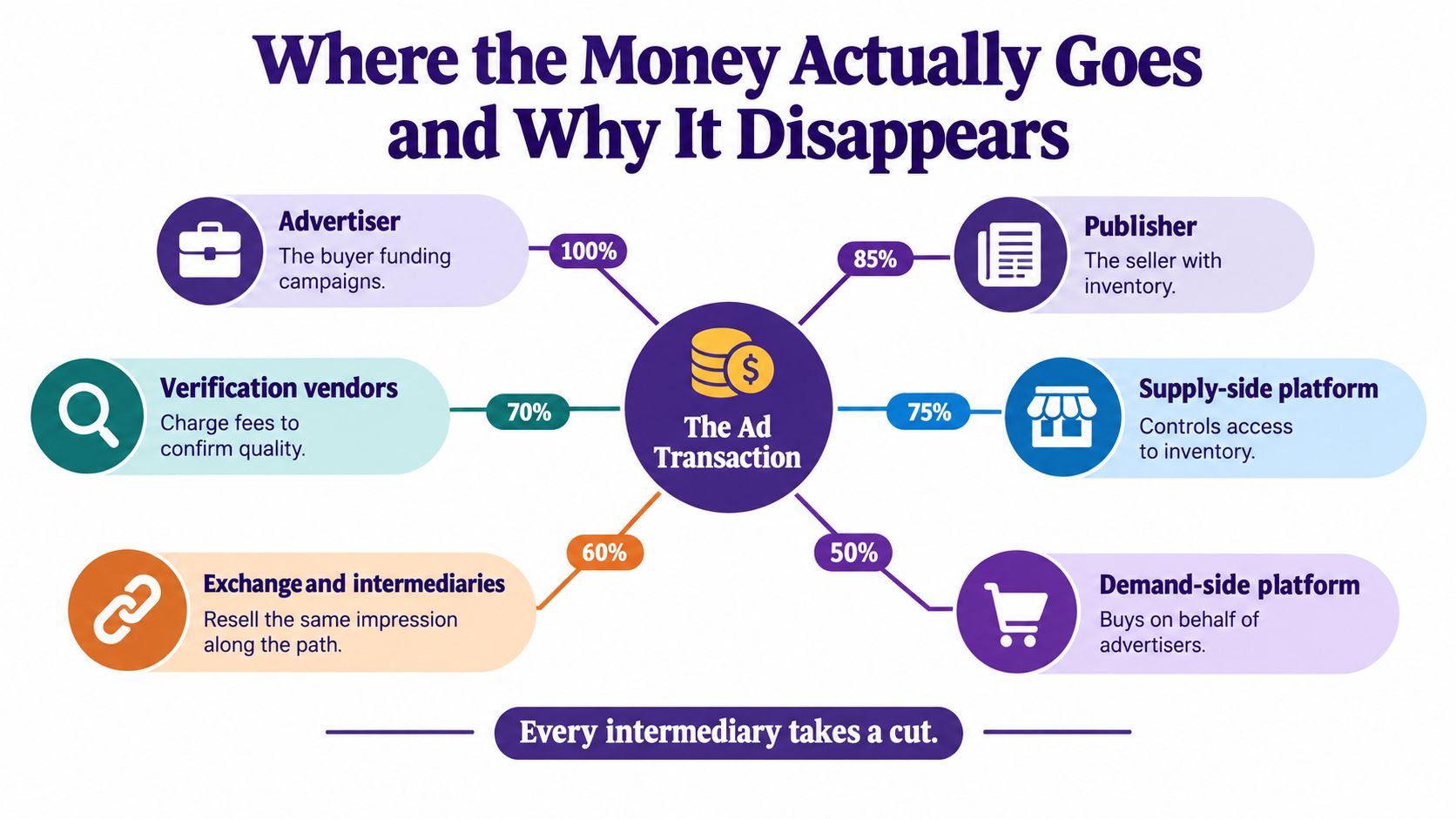
The ad transaction often involves more organizations than the simple story suggests. The publisher-owned sales channel controls the original inventory, the supply-side platform helps package and sell it, an exchange may connect supply and demand, the demand-side platform buys for the advertiser, and verification or measurement vendors may assess quality and outcomes.
Each participant can add useful functionality. The problem begins when a buyer or publisher can't see which companies are involved, whether the same impression is being offered through redundant paths, or how much value remains after technology and service costs.
One industry benchmark cited approximately $26.8 billion in annual global media value lost through supply-chain inefficiencies, including redundant intermediaries and poorly optimized paths, as reported in this analysis of programmatic supply-chain waste. The figure is an industry benchmark, not a universal accounting of every transaction.
Ask who is authorized to sell
Supply-path optimization starts with documentation and reconciliation. Publishers and buyers should examine:
- Authorized seller files: Check ads.txt relationships for web inventory and confirm that listed sellers are permitted to represent the publisher.
- Seller declarations: Use sellers.json relationships to understand which entities participate in the chain and whether an intermediary is direct or a reseller.
- Reseller restrictions: Limit unnecessary resale permissions, especially when a direct publisher relationship already exists.
- Bid-request duplication: Look for the same impression being offered through multiple routes, which can create competition without adding genuine value.
- Outcome verification: Compare the reported impression, viewability, invalid-traffic, and conversion records against the actual business objective.
A publisher can also compare open-exchange demand with private marketplace or programmatic guaranteed options. Premium contextual packages may give the seller more control over placement, audience description, editorial alignment, and buyer expectations.
A cheap CPM is not the same as a low-cost verified outcome.
The highest bid isn't automatically the best impression either. Brand safety, viewability, fraud risk, audience quality, editorial alignment, and carbon intensity can change the value of an opportunity. A buyer may rationally reject a higher bid if the placement creates reputational risk or produces weak attention. A publisher may prefer a controlled deal that pays less per impression but strengthens the relationship, preserves the audience experience, and produces more dependable demand.
For creators building revenue from an archive, the same logic applies. Don't send every asset into the broadest possible marketplace by default. Organize your library so you can identify which episodes, articles, and videos support a strong contextual package, then use revenue optimization practices to compare the value of different paths.
Measurement When the Old Tracking Stops Working
Programmatic buying can make a decision for an impression without proving that the impression caused a business result. That distinction becomes harder to ignore when platforms can't consistently recognize the same person across browsers, devices, publishers, and connected television environments.
One industry estimate placed authenticated open-web match rates at roughly 47%, below the cited cookie-era level of 68%, indicating that addressability and frequency control can weaken when identity signals fragment, according to this industry analysis of programmatic advertising data. These figures are estimates, but the underlying operational issue is clear. A buyer may not be able to identify, reach, and measure the same user consistently across every environment.
Separate delivery from causality
Delivery metrics tell you what the system served and what users did immediately around the exposure:
- Impressions show that an ad opportunity was recorded.
- Reach estimates how many people or devices received exposure.
- Frequency describes repeated exposure within the available measurement system.
- Viewability indicates whether the ad met the selected visibility standard.
- Clicks record an interaction, but not necessarily a valuable action.
Business outcomes require a different question. Did the campaign produce incremental conversions, lift, retention, qualified demand, or brand impact that wouldn't have happened otherwise? A click can be useful evidence, but it doesn't automatically establish causation.
That is why teams increasingly combine several methods. Modeled conversions estimate outcomes where direct event matching is incomplete. Incrementality tests compare exposed and controlled groups to estimate causal lift. Media-mix modeling evaluates relationships between media investment and broader business results. Attention metrics try to understand the quality of exposure rather than treating every served impression as equal.
Let context carry more of the work
When user-level identity weakens, contextual signals become more valuable. The subject of a podcast episode, the language of an article, the tone of a video, and the environment surrounding an ad can travel with the content even when a platform can't maintain a complete individual profile.
That changes the creator's priority. Instead of asking only, “How do I identify this person everywhere?” ask, “What does this piece of content reliably communicate to a suitable buyer?” A well-classified library can support contextual packages, curated sponsorships, and measurement based on content environments rather than an assumption of perfect user recognition.
The strongest measurement plan combines delivery reporting with controlled tests and clearly defined business outcomes. It also states what the data cannot prove. Honest uncertainty is more useful than a precise-looking attribution report built on broken identity links.
What Creators and Publishers Should Actually Do With It
A programmatic-ready library starts with organization, not a new campaign. Audit your existing episodes, videos, articles, newsletters, and research assets. Mark the subjects, formats, audience contexts, languages, commercial sensitivities, evergreen themes, and possible sponsor categories that a buyer could understand.
Build inventory from the archive
Start with a simple classification system. A podcast episode about home financing, a video explaining camera equipment, and an article about independent publishing may attract different commercial categories even if they live on the same channel. Add transcripts, summaries, topics, entities, content warnings, and rights information where relevant.
Then group assets into packages. An evergreen series may support a contextual sponsorship. A cluster of related articles may suit a private marketplace deal. Short clips can extend a longer video's reach, while an old interview can become a fresh audio, newsletter, or social placement when its subject remains relevant.
Match the deal to the asset
Not every asset belongs in an open auction. Use a controlled or guaranteed transaction when the environment, editorial relationship, and delivery expectation matter. Use broader auction access when reach and flexible demand matter more.
The decision should reflect the asset's strengths. A valuable archive with clear metadata gives you more choices because you can identify premium contexts instead of treating every impression as interchangeable.
Carry disclosures across formats
The FTC requires native advertising to be identifiable as advertising when its presentation could mislead consumers into believing it is independent, impartial, or editorial. The disclosure must be clear and prominent, use simple language, appear close to the advertisement, and remain readable through suitable design.
That obligation follows the asset. When a sponsored article becomes a newsletter item, social post, search placement, video, or audio promotion, the commercial disclosure must travel with the republished version. The FTC native advertising guidance explains why automated distribution doesn't remove the responsibility to label advertising clearly.
A content organization can reduce mistakes by storing disclosure requirements alongside the source asset. Keep the approved wording, placement rules, sponsor identity, and republishing constraints attached to the package rather than leaving them in a separate email thread.
Finally, use search and classification tools to find relationships that a folder structure hides. A platform such as Contesimal can help teams classify and search document, podcast, video, and article sets, build layered taxonomies, and surface patterns across a content library. That supports content monetization planning without requiring every opportunity to begin with a new piece of content.
The Three Things to Remember
First, programmatic is an operating model, not an ad format. RTB is one mechanism inside it, alongside fixed-rate, invitation-only, and guaranteed transactions.
Second, context may be more durable than a supposedly complete user profile. Content subjects, environments, and audience meaning can remain useful when identity signals fragment.
Third, your library metadata is part of the inventory. Clear classifications help buyers evaluate archival episodes, videos, posts, and stories instead of overlooking them. The next phase will combine contextual targeting, authenticated identity where available, privacy-aware measurement, and AI-assisted content classification.
Contesimal helps creators and publishers organize, classify, and search their existing documents, podcasts, videos, and articles so they can uncover contextual themes and monetization opportunities. Turn your archive into clearer, programmatic-ready content packages by exploring Contesimal.