
You've probably got a library problem disguised as a content problem. Your archive contains videos, podcast episodes, articles, newsletters, research notes, and campaign assets, yet every week still begins with the same question: What should we create next? Meanwhile, useful work sits in folders and platforms, generating little beyond occasional search traffic.
Revenue optimization changes that pattern. Instead of treating every new post as a standalone bet, you organize the library, understand which assets can create value, and take action across the channels that fit your audience. The aim isn't to squeeze more money from every file. It's to build a repeatable system that turns existing knowledge into relevant offers, stronger distribution, and sustainable income.
What Revenue Optimization Actually Means for Content Businesses
A video creator opens an analytics dashboard and sees respectable view counts. A podcaster has years of episodes. A publisher owns a deep archive of articles, interviews, and books. None of them can easily answer a more important question: Which assets are creating business value, and what should happen next?
That gap separates simple monetization from revenue optimization. Monetization adds a revenue mechanism, such as advertising, subscriptions, sponsorships, affiliate links, or a paid product. Revenue optimization looks across the entire system. It connects the content asset, the audience segment, the distribution channel, the offer, the cost of delivery, and the result.
A practical definition is maximizing the lifetime value of each content asset, not merely maximizing its immediate reach. One longform interview might attract search visitors, supply clips for social platforms, support a newsletter sequence, inform a paid report, and help a sales team explain a specialist service. The asset earns more because the organization gives it several purposeful jobs.
From viral chasing to library economics
The shift matters because content businesses often overinvest in creation while underinvesting in retrieval, packaging, and measurement. A creator may produce another episode before checking whether an older episode has strong audience retention, timely search demand, or a natural connection to an existing product.
Practical rule: Treat your archive as inventory with different levels of demand, relevance, cost, and commercial potential.
Revenue optimization has roots in airline revenue management. The field became established in airlines during the 1980s, then spread to hotels, car rentals, rail, advertising, and other capacity-constrained industries, as documented in this academic and industry review of revenue management. Content has different mechanics, but the underlying challenge is familiar. You have finite attention, limited production capacity, changing demand, and opportunities that can expire.
What the system should answer
A useful content revenue system helps you answer questions such as:
- Which older assets still solve a current audience problem?
- Which formats attract discovery, and which formats drive conversion?
- Which audience groups need education before they'll buy?
- Which channels create valuable customers rather than cheap activity?
- Which assets deserve an update, a new package, a paid promotion, or retirement?
That's why publishers, creators, marketers, editors, authors, filmmakers, and professional production teams should think beyond views and page views. Organize. Understand. Take action. Those three habits turn a content library from digital storage into an operating asset.
The Framework Behind Sustainable Content Revenue
A content library contains assets with different commercial lives. Some lose relevance quickly, while others regain demand through an update, a new format, better distribution, or a clearer offer. Revenue optimization gives teams a way to manage those differences deliberately.
Airlines helped establish the underlying discipline by matching limited inventory with changing demand. American Airlines introduced a widely cited revenue management system in 1986, developed to compete against People Express. Research also places the broader rise of analytical pricing in the early 1970s, when airlines experimented with differentiated fare products for the same seats. By the 1990s, improved computing and distribution supported origin-and-destination optimization across networks, rather than controls at the individual flight-leg level. The history is covered in this review of airline revenue management and analytical pricing.
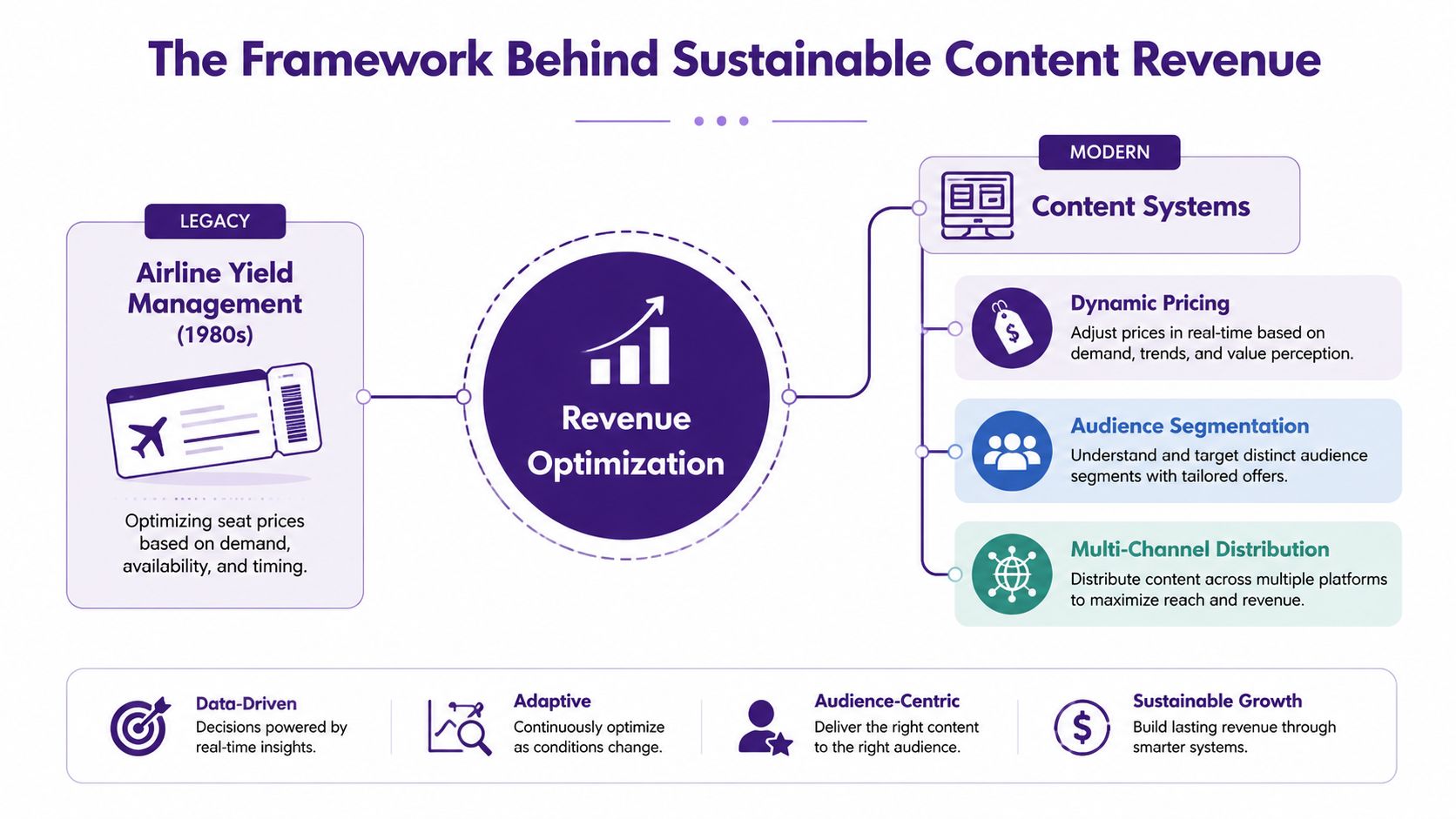
Four decisions content teams need to connect
Inventory intelligence establishes what the organization owns and can use. Tag episodes by topic, guest, audience, format, rights status, freshness, and commercial use. A publisher may also track author, subject, publication date, search intent, and related products. A video team can record transcript themes, footage, licensing restrictions, and performance history. These fields make dormant value easier to find.
Audience segmentation organizes people by observed behavior and needs. A casual viewer, repeat listener, paid subscriber, and professional buyer may consume the same subject in different ways. Someone who repeatedly studies advanced tutorials may respond to a premium workshop, while a new visitor may need a concise explainer first.
Channel and packaging optimization assigns each asset a useful role. A podcast episode might become a full audio experience, written summary, short video, or subscriber email. Each version should fit the channel and give the audience a clear next step. Reformatting without a distribution purpose adds work without necessarily creating value.
Offer and timing decisions connect audience intent with a suitable commercial action. An evergreen article might support a book, course, or membership. A timely interview might support sponsorship or a live event while interest remains high. The choice depends on trust, rights, fulfillment effort, demand, and margin.
The global customer revenue optimization software market was estimated at USD 8.6 billion in 2023 and projected to reach USD 20.3 billion by 2033, with a reported 9.3% CAGR, according to this customer revenue optimization software market estimate. A separate estimate values the market at USD 7.8 billion in 2025 and projects USD 15.5 billion by 2035, with a 7.1% CAGR, in the same market category. The estimates differ, but both point to a field extending beyond airline inventory into forecasting, segmentation, pricing, and monetization systems. For content organizations, the practical opportunity is systematic: find valuable archive assets, match them with the right audience and offer, then measure whether the effort produces profitable results.
Key Performance Indicators That Drive Decisions
Views and followers show reach, but they do not show whether a content business is getting healthier. A smaller audience that buys, renews, recommends, or licenses your work can create more value than a large audience that rarely takes a commercial action. For organizations with substantial archives, this distinction helps identify which older assets deserve renewed distribution, better packaging, or a clearer offer.
Start with a measurement map. Place each content asset at the center, then connect it to audience behavior, offers, costs, and outcomes. A perfect attribution model can wait. Consistent definitions cannot, especially when teams compare current content with historical library performance.
The operating scorecard
Track these indicators at both asset and channel level:
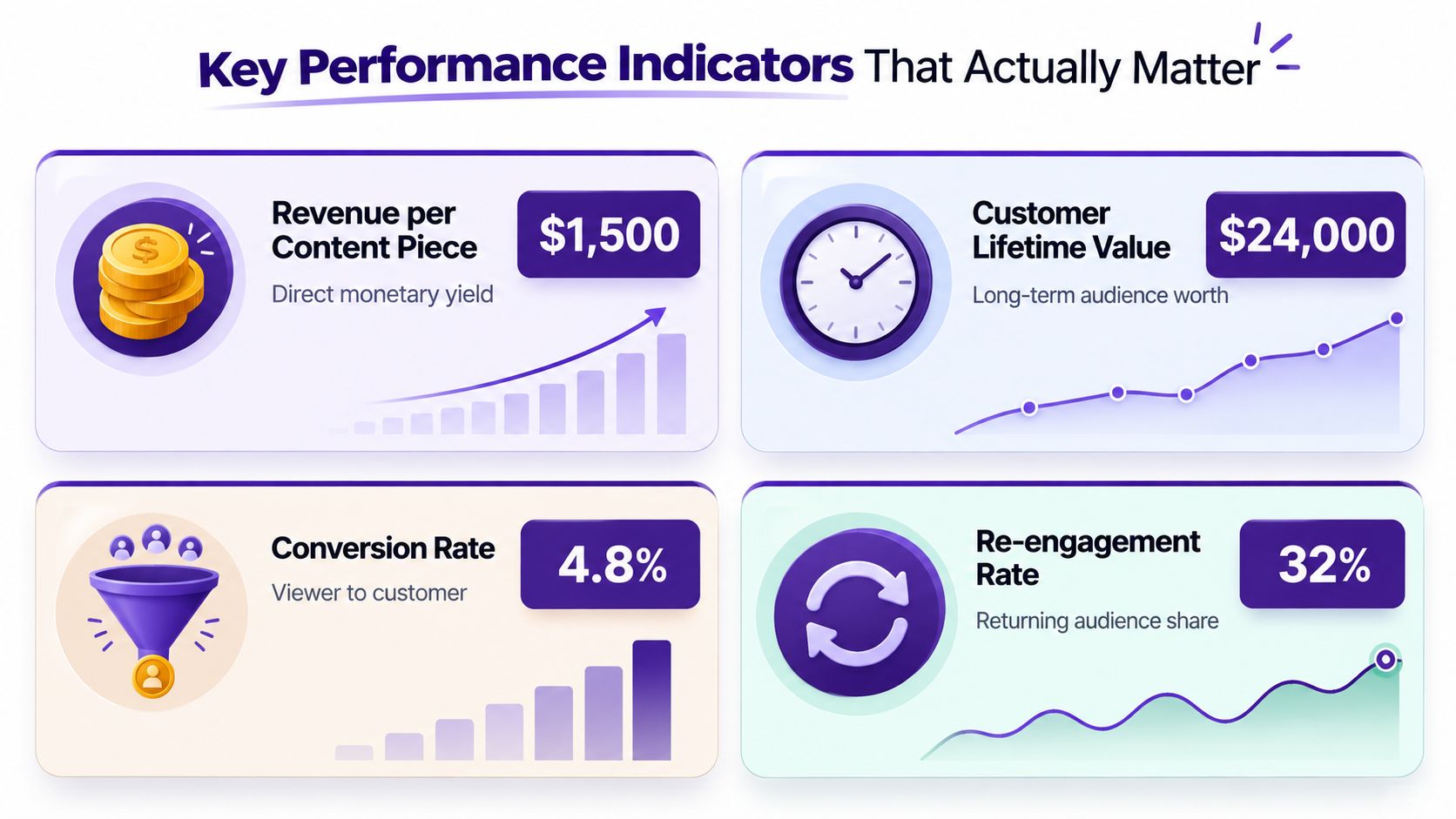
- Revenue per content piece: Divide attributable revenue by the asset or asset group that supported it. Apply a transparent allocation rule when several pieces influence one purchase.
- Customer lifetime value by content type: Compare the long-term value of customers who first encounter a tutorial, review, interview, newsletter, or product page.
- Conversion by format: Measure movement from viewer, reader, or listener to subscriber, lead, buyer, member, or license inquiry.
- Acquisition cost by channel: Include paid media, creator fees, sales effort, editing, platform charges, and other directly related costs.
- Contribution margin: Subtract the costs of producing, distributing, selling, and fulfilling the offer from attributable revenue.
The supplied visual uses illustrative KPI values, including $1,500 for revenue per content piece, $24,000 for customer lifetime value, 4.8% for conversion rate, and 32% for re-engagement rate. These figures are design examples, not universal benchmarks. Replace them with definitions and records that reflect your own content, audience, and commercial model.
A practical reporting rhythm
Review reach, engagement, click behavior, and conversions often enough to catch broken links, weak packaging, or sudden demand changes. Review customer value, acquisition cost, contribution margin, and portfolio performance less frequently. Those measures need enough completed customer journeys to support a useful conclusion.
Attribution requires restraint. Credit an asset for its role, whether discovery, education, conversion support, or retention. A last-click model can hide the contribution of articles, emails, and episodes that built buyer confidence over time, particularly when an archived asset introduces someone to the organization before a later purchase.
For a hands-on guide to connecting engagement signals with business outcomes, use our guide to analyzing content performance. A useful dashboard should make the next editorial or commercial decision clearer, not just display impressive numbers.
Revenue Channels and Which Ones Fit Your Content
No revenue channel works universally. Advertising can suit broad reach and frequent consumption, while subscriptions depend on recurring value and a dependable publishing promise. Licensing may fit specialist archives, but it requires rights management, packaging, sales work, and a buyer who needs the material.
Use the table as a starting point, not a guarantee. “Minimum audience size” is qualitative because a highly specialized audience can support a commercial offer with less reach than a general-interest channel.
| Channel Type | Min Audience Size | Revenue Potential | Setup Complexity | Best For |
|---|---|---|---|---|
| Advertising | Broad, engaged reach | Variable and volume-dependent | Medium | Video, podcasts, newsletters, and sites with consistent consumption |
| Subscriptions | Smaller audience can work when need and trust are strong | Recurring and potentially predictable | High | Premium analysis, memberships, paid newsletters, and specialist publications |
| Licensing and syndication | Focused audience or distinctive archive | High per deal, irregular | High | Publishers, filmmakers, authors, research libraries, and rights owners |
| Commerce and affiliate partnerships | Intent-rich audience | Variable, tied to purchase behavior | Medium | Reviews, tutorials, buying guides, and practical recommendations |
| Sponsored content | Clear audience identity and brand fit | Deal-based | Medium to high | Podcasts, video series, newsletters, and editorial franchises |
| Direct products and services | Audience with a defined problem | Potentially strong, with delivery obligations | High | Courses, books, consulting, workshops, and professional communities |
Match the channel to the content job
A product review can support affiliate revenue, sponsorship, or a commerce guide, but editorial independence must remain visible. A professional podcast may earn more from a focused membership or event than from general advertising if listeners value access and expertise. A magazine publisher may combine subscriptions with licensing, sponsored franchises, and books built from established editorial authority.
Channel mix also changes the work behind the scenes. Advertising requires inventory, brand suitability, reporting, and sales or ad technology. Subscriptions require billing, access control, retention programs, customer support, and a steady value proposition. Licensing requires contracts, rights records, delivery specifications, and a sales process.
Don't launch every channel at once. Choose the path that fits the audience's intent and your team's operational capacity. A revenue channel that creates administrative drag, weakens trust, or consumes more labor than it returns isn't optimized because it produces gross revenue.
Extracting Value from Your Content Archive
An archive can contain years of useful work while producing little revenue. The usual causes are practical: teams cannot find the material, its contents are unclear, or the original format no longer fits current discovery habits.
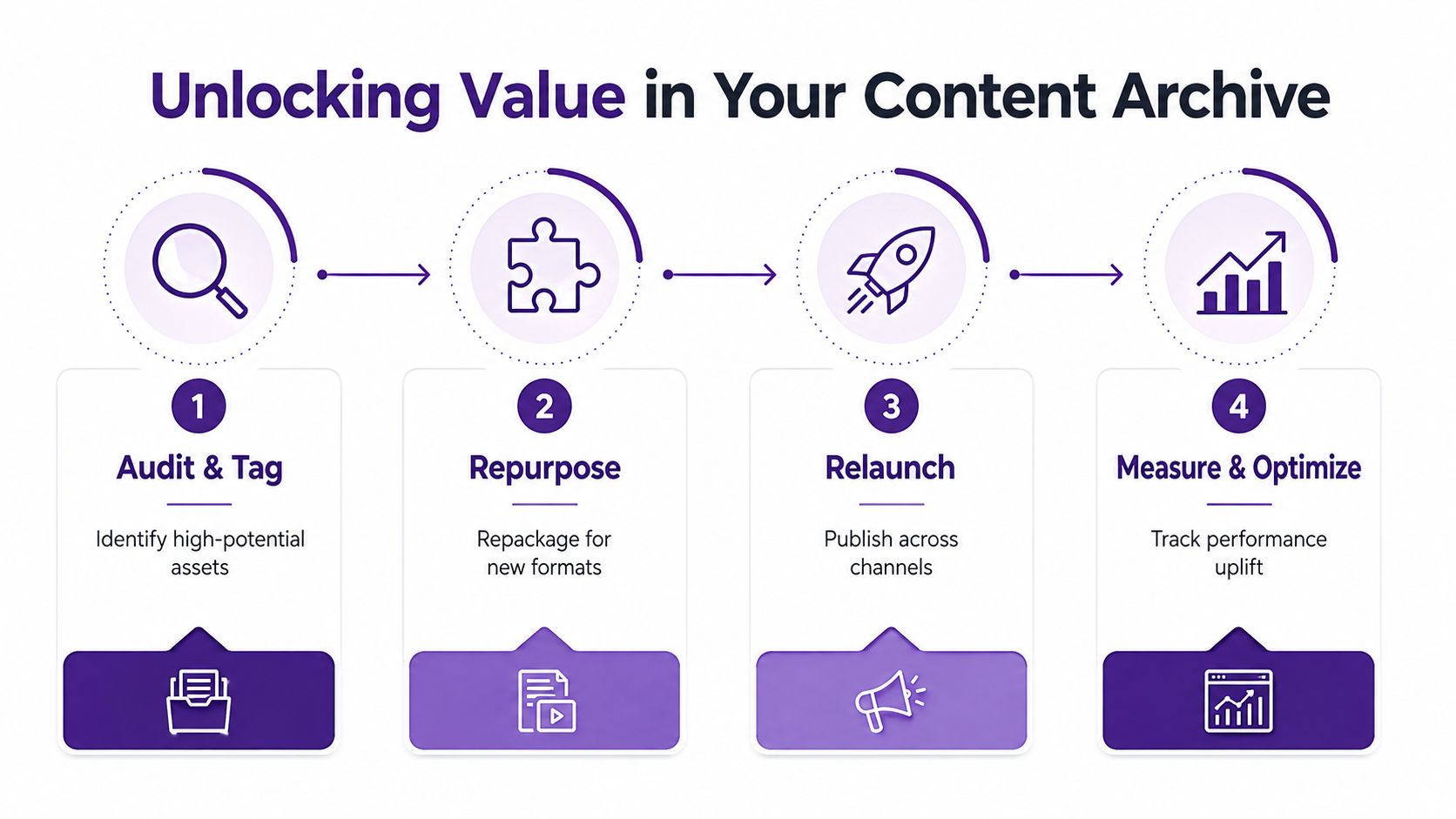
Start with a classification and audit workflow. Tag each asset by subject, audience problem, format, freshness, rights, dependencies, traffic history, conversion role, and possible next use. Then sort the library into clear actions: update and relaunch, adapt into new formats, package with related work, license, maintain as reference, or retire. For guidance on using AI in this process, see AI-supported content repurposing workflows.
Turn one source into a coordinated set
A longform interview can support a written feature, newsletter discussion, short video excerpts, quote-led social posts, a research summary, a sales enablement asset, and a companion resource. The commercial value comes from adaptation, not duplication. Preserve the underlying insight, then change the structure, opening, length, visual language, and call to action for each platform.
A 2026 marketing roundup reports that only 29% of marketers have a systematic content repurposing process, while it also reports that repurposed content generates 60% more engagement than single-format original content and can become 8-12 separate pieces across formats. Treat those figures as directional industry reporting rather than a forecast for every archive. The roundup of recent content repurposing research and ROI data includes its stated methodology.
A separate source reports that 48% of social media marketers share similar or repurposed content across platforms with minor adaptations, while 34% create unique content from scratch for each platform and 17% publish the same content without adaptation, as described in this report on content repurposing practices. The operational lesson is clear. Adaptation matters, and the workflow should preserve the original source while recording each change.
Contesimal can organize and search documents, podcasts, videos, and articles through layered taxonomies, chat-based research, AI-supported insights, and collaboration workflows. It can work alongside a content management system, analytics platform, transcription tool, or project workspace instead of replacing every system.
The archive becomes commercially useful when every derivative has an owner, audience purpose, channel, offer, rights status, and measurement plan. A 2026 article reports that repurposing can save 60-80% of creation time and that 94% of marketers repurpose content across channels, according to this content repurposing analysis. Those savings depend on clean source material and disciplined workflows, so establish the process before increasing volume.
Testing and Measurement Approaches That Work
A publisher may have a strong archive topic, a responsive audience, and several possible offers, yet still waste revenue by changing too many variables at once. Revenue optimization requires tests that isolate one decision, define success in advance, and preserve the learning for future campaigns.
Start with one meaningful variable. Compare one paid package with another, a subscription page with a revised version, one newsletter call to action with a different version, or a long video with a shorter cut. Keep the headline, price, offer, audience, channel, and landing page stable wherever possible. Otherwise, a result from an archive campaign cannot show which change caused the difference.
Build a useful experiment
Write a specific hypothesis:
If we package this archive topic for a specific audience need, then qualified conversions should improve without reducing customer value.
Set the primary outcome before publishing. Revenue may lead, while supporting measures include qualified clicks, trial starts, paid conversions, renewals, refunds, completion, or assisted conversions. Record the audience segment, channel, offer, start and end dates, creative version, and costs. This record makes later comparisons possible across old and new content.
Run the test long enough to capture normal variation in the publishing cycle. An early spike can reflect a small audience or a timely event rather than a durable improvement. If a formal statistical test is not practical, describe the result cautiously and repeat the experiment before changing the operating standard.
Keep an experiment archive
A testing calendar should cover commercial, editorial, and distribution questions. Document the outcome, decision, affected audience, and next change. A failed test still protects the archive from being packaged around the same unsupported assumption in a later campaign.
Use holdouts where practical. Giving every audience member the new offer may show a lift without providing a clean comparison. If holdouts are unavailable, compare results with a carefully chosen historical baseline and label that limitation clearly. Measurement discipline protects revenue and audience trust while showing which parts of a historical library deserve further investment.
Why Profitability Matters More Than Top-Line Revenue
A content business can increase revenue and become less healthy at the same time. A sponsorship may require extensive custom production. A paid campaign may generate sales while acquisition costs consume the contribution. A high-performing video may demand editing, rights clearance, moderation, and support that the dashboard doesn't show beside its gross return.
That's why revenue optimization should prioritize contribution margin, not top-line revenue alone. For each content type or channel, list attributable revenue, production labor, freelance work, editing, hosting, platform fees, sales time, promotion, fulfillment, customer service, and refunds. The result won't be perfect, but it will be more useful than treating every dollar as equal.
Make margin visible
Compare a standard episode with a sponsor-customized episode. The customized version may command a larger fee, but it can also require extra research, approvals, revisions, and delivery work. Compare a paid article with a membership offer. The article may convert fewer people but create more durable value if it serves acquisition and retention without substantial fulfillment cost.
Book publishers and authors face the same issue across formats, retailers, promotions, and rights. A practical resource on how to track your book sales effectively can help create a clearer view of sales activity before you compare a format or channel's commercial contribution.
Recent industry coverage describes a profitability-first shift as labor and inflation costs pressure margins, while also emphasizing that AI pricing and forecasting need human oversight, governance, and exception handling in revenue optimization trends and challenges for 2025. The lesson applies to creators. Automation can surface opportunities, but humans still need to decide whether the work is strategically and financially sensible.
A related content marketing return on investment framework helps connect content activity to business outcomes rather than treating engagement as the finish line. Invest in growth when the acquired audience has a credible path to profitable value. Otherwise, improve packaging, retention, reuse, and channel economics in the library you already own.
Contesimal helps content organizations classify, search, and collaborate across articles, videos, podcasts, documents, and research so they can identify high-potential archive assets and build repeatable repurposing workflows. Visit Contesimal to organize your library, uncover new content opportunities, and turn historical work into measurable revenue action.