
Figuring out your content marketing return on investment is the only way to know if your content is actually making a difference for your business. It forces you to look past flashy but shallow numbers, like likes and shares, and zero in on what really matters: the tangible value your content creates. We're talking leads, sales, and genuine brand authority—all weighed against what you paid to produce it in the first place.
This is the make-or-break step. It’s how you go from creating content as a hobby to running a real, revenue-generating operation.
Why Content Marketing ROI Is More Than Just a Number
Think of your content library like you're planting a fruit tree. Your first efforts—the cash and hours you pour into a video, podcast, or blog post—are like digging the hole and watering a tiny sapling. You won't see results overnight. But if you keep caring for it, that tree grows and starts producing a steady harvest, year after year. Measuring your content marketing ROI is just counting that harvest.
It’s the bridge connecting what you create to what your business earns. For YouTubers, podcasters, and publishers, finally understanding ROI gives you a solid answer to nagging questions like, "Was that expensive video series actually worth it?" or "Which of my blog posts are bringing in sales?"
The Core Components of ROI
At its core, the math is pretty simple. It all comes down to two key pieces, which we’ll unpack throughout this guide:
- Investment: This is everything you spent to get that content made and seen. Think software subscriptions, payments to freelance writers, ad spend, and even the dollar value of your own time.
- Return: This is the money your content brought back in. It could be direct revenue from sales, sure, but it also includes the value of new leads, better customer retention, or even money saved because organic traffic replaced your paid ads.
From Hobbyist to Professional
Getting a handle on this concept is what separates casual creators from professional content entrepreneurs. It fundamentally shifts your goal from just making more content to making smarter content. You'll start to see your old articles and videos not as a pile of finished projects, but as a vault of assets just waiting to be reignited.
By accurately tracking your content marketing return on investment, you can identify which topics, formats, and channels deliver the most value. This allows you to double down on what works and stop wasting resources on what doesn't.
This data-backed thinking is absolutely critical if you want to scale. When you can prove that every $1 you put into content brings back $5 in revenue, you can hire with confidence, expand to new platforms, and build a predictable growth engine. And when you apply smart content repurposing strategies, you stretch that investment even further, turning one killer asset into infinite new value.
The Metrics You Actually Need to Track for Success
To figure out your content marketing return on investment, you have to know what to measure in the first place. Too many creators get bogged down tracking vanity metrics—things like social media likes or page views. They feel good, but they don't tell you the whole story.
The real secret is to separate your inputs from your outputs. Get brutally honest about the two sides of the ROI coin: what your efforts are truly costing you, and the tangible value they’re bringing back. Only then can you stop guessing and start knowing what actually moves the needle.
Accounting for Every Dollar of Investment
The "Investment" side of the equation is easy to underestimate. It’s not just the price tag on a new piece of software. It’s the total, all-in cost of creating your content and getting it in front of the right people.
Think about it this way:
- Creation Costs: This bucket includes all your software subscriptions (think editing tools or design platforms), any equipment you bought (cameras, mics), and what you paid freelancers like writers, editors, or graphic designers.
- Promotional Spend: Did you run ads on social media to boost a video? Sponsor a newsletter? Every penny spent on paid distribution is part of your investment.
- Your Team's Time: This is the big one people forget. Calculate the hourly rate for your team members (and yes, that includes you!) and multiply it by the hours spent on content strategy, creation, and management. Time is money, plain and simple.
Tallying these up gives you a clear, honest picture of what you're actually spending. This isn’t about discouraging you from investing; it's about making every single dollar accountable for its results.
Focusing on the Returns That Matter
Now for the "Return" side. We have to look past the surface-level numbers. Sure, traffic is a nice starting point, but it's not the finish line. Real return is measured by actions that lead directly to revenue. To do this right, it's critical to learn how to measure content marketing ROI accurately and move beyond guesswork.
You can split these valuable return metrics into two main camps:
1. Leading Indicators (Signs of Growth)
These are the metrics that show your content is building momentum and setting you up for future returns. They prove you're on the right track.
- Organic Traffic Growth: Are more people finding you through search engines? This is a huge sign that your content is building long-term, sustainable value.
- Keyword Rankings: Nailing top spots on Google for important terms means you’re becoming a trusted authority in your space.
- Email Subscribers: An engaged email list is a direct line to your audience. It's one of the most powerful assets you can own for driving sales down the road.
2. Bottom-Line Metrics (Direct Revenue Impact)
These are the numbers that connect straight to your business’s financial health. No ambiguity here.
- Qualified Leads Generated: How many potential customers did a specific piece of content bring in? You can track this with contact forms, gated downloads, or demo requests.
- Conversion Rates: What percentage of people who read your blog post or watched your video took the action you wanted them to, like signing up for a trial or buying a product?
- Attributable Sales: With tools like Google Analytics and your CRM, you can draw a straight line from a specific piece of content all the way to a final sale.
This shift in focus—from vanity to value—is precisely why the global content marketing industry is exploding. The industry is on track to hit $107 billion in revenue by 2026 because businesses are finally seeing tangible, measurable results.
In fact, 82% of businesses now use content marketing, and an impressive 77% report being happy with their ROI. That’s a success rate that leaves most traditional marketing tactics in the dust. You can dig into more of these impressive content marketing statistics to see just how proven its value is.
The most successful creators and marketers measure what matters. They connect every piece of content to a business goal, whether it's generating a lead, closing a sale, or building an audience that will pay dividends for years to come.
To help you get started, it's useful to see both the investment and return metrics laid out side-by-side. This gives you a clear checklist for building your own ROI calculation.
Key Metrics for Your ROI Calculation
Here’s a breakdown of the essential metrics you’ll need to track. Think of this as your cheat sheet for plugging the right numbers into the ROI formula.
| Metric Category | Specific Metrics to Track | Why It Matters |
|---|---|---|
| Investment | Content Creation Costs: Freelancer fees, software subscriptions, stock photos/videos, equipment. | This captures the direct, out-of-pocket expenses required to produce your content. |
| Investment | Promotional & Distribution Costs: Ad spend, sponsored content fees, social media boosting. | This covers the cost of getting your content in front of your target audience. Great content is useless if no one sees it. |
| Investment | Team Salaries & Time: Hourly wages multiplied by hours spent on content strategy, creation, and management. | Often the largest hidden cost, this reflects the human resources invested in the entire content lifecycle. |
| Return | Lead Generation: New email subscribers, form submissions, demo requests, free trial sign-ups. | This is a primary indicator of how well your content is converting casual visitors into potential customers. |
| Return | Sales Revenue: Direct sales attributed to content via tracking links, promo codes, or CRM data. | The ultimate bottom-line metric. It directly ties content efforts to the money coming into the business. |
| Return | Organic Traffic & SEO Performance: Keyword rankings, organic sessions, backlinks acquired. | These are leading indicators that show your content is building a long-term, compounding asset for your brand. |
By systematically tracking the metrics in this table, you'll have all the data you need to calculate an accurate ROI. It removes the ambiguity and lets you prove the real business impact of your work.
A Practical Step-by-Step Guide to Calculating ROI
Alright, now that you know what numbers to watch, it’s time to actually crunch them. Figuring out your content marketing ROI doesn't require a Ph.D. in mathematics; it's really just about drawing a clear line from what you spent to what you earned. Think of it as turning a pile of abstract data into a real, actionable tool for making smarter decisions.
The classic formula is beautifully simple and gets right to the point. It spits out a percentage that tells you just how hard your investment is working for you.
((Return – Investment) / Investment) x 100 = ROI %
Let's make this real. Imagine you're a YouTuber who's decided to go pro and launch an online course. You sink $5,000 into a top-notch video series to promote it, covering things like gear rental, a freelance editor, and a few targeted social media ads.
Over the next three months, you keep a close eye on your course sales. You discover that the video series directly brought in $20,000.
Plugging that into our formula:
(($20,000 – $5,000) / $5,000) x 100 = 300% ROI
Boom. For every single $1 you put in, you got $4 back. All of a sudden, you have a solid number that proves your content's worth, making it a whole lot easier to justify putting more money into the next project.
Moving Beyond the Last Click
While that basic formula is a fantastic starting point, it doesn't always paint the full picture. The way people buy things online is rarely a straight line from A to B. Someone might find your brand through a blog post, watch one of your YouTube videos a week later, and then, finally, click a link in an email to make a purchase. So, which piece of content gets the gold star?
This is where attribution models come into play. They're just different frameworks for giving credit to the various touchpoints a customer interacts with before they convert.
- First-Touch Attribution: This one gives 100% of the credit to the very first piece of content a customer ever saw. It’s perfect for figuring out what initially pulls people into your orbit.
- Last-Touch Attribution: This is the most common and easiest to track. It gives all the credit to the final touchpoint right before the sale—like that email link in our example. The downside? It completely ignores everything that built trust and interest along the way.
- Multi-Touch Attribution: This is where things get really insightful. Instead of a winner-take-all approach, it spreads the credit across multiple touchpoints, acknowledging that each piece of content played its part. It gives you a much more holistic—and realistic—view of your content's performance.
The right model for you depends on your goals, but shifting toward a multi-touch approach will give you a far more accurate sense of what’s actually driving results. To get even sharper with your numbers, it helps to dig deeper into how to analyze content performance across that entire journey.
This diagram breaks down the basic flow of tracking your investment, measuring the impact, and calculating the final return.
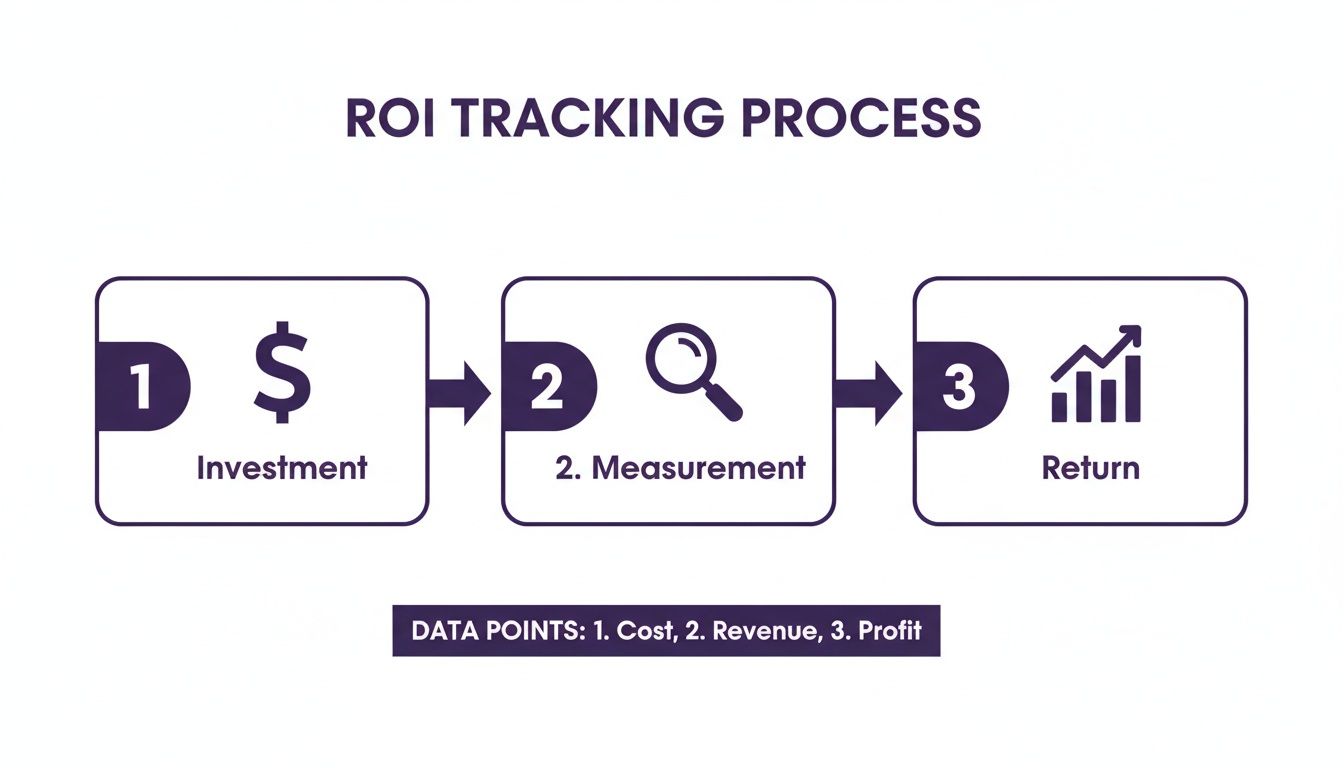
As you can see, calculating ROI isn't a one-and-done task. It’s a cycle where the returns from one campaign should directly inform the investments you make in the next one.
Using Tools to Simplify the Process
You don’t have to do all this math with a pencil and paper. Most analytics platforms, like Google Analytics, have attribution modeling features built right in to help you visualize these customer paths.
For an extra layer of clarity, an external ROI payback calculator can be a huge help. These tools don't just show you the return; they help you figure out how long it takes to get your initial investment back.
By taking a structured approach to your calculations and attribution, you’re not just tracking numbers. You're arming yourself with the insights needed to make data-driven decisions that will fuel real, sustainable growth.
Setting Realistic ROI Expectations and Benchmarks
One of the biggest hurdles in measuring content marketing ROI is good old-fashioned impatience. We live in a world that craves instant feedback, but great content marketing doesn't play by those rules. It's a marathon, not a sprint. Setting the right expectations from day one is the only way to get stakeholders on board and stay the course long enough to see the payoff.
Think of it like building a reputation in your industry. You don't just show up and become a trusted authority overnight. It takes a consistent, dedicated effort to publish valuable content that slowly builds an audience, earns its place in search engines, and establishes your credibility. The ROI you see in month three will look completely different from the ROI you see in year three.
The Compounding Effect of Content
Your content library isn't just a collection of articles and videos—it's a business asset. And like any solid investment, its value compounds over time. A single blog post published today might bring in a trickle of traffic at first. But as it picks up backlinks, climbs the search rankings, and gets shared, that trickle can turn into a steady stream of qualified leads for years to come. All without any extra investment.
This compounding nature is exactly why early ROI figures can feel a bit underwhelming. You're busy laying the foundation.
The real magic of content marketing kicks in when your library of assets hits a critical mass. Older posts continue to generate traffic and leads on their own, while new content adds fresh momentum, creating an exponential growth curve.
Understanding this timeline is everything. If you walk in expecting a 300% ROI in the first quarter, you're just setting yourself up for disappointment. A much more realistic goal is to aim for steady growth in leading indicators—like organic traffic and keyword rankings—in the first year. You can have confidence knowing those metrics will eventually translate into bottom-line returns.
Industry Benchmarks: A Multi-Year Game
So, what does a realistic timeline actually look like? While results will always vary by industry and how well you execute, the data shows a clear pattern: it's a multi-year game. Your early efforts build the momentum that pays off big time in the following years.
For instance, detailed industry analysis shows that high-performing campaigns deliver some seriously impressive returns that build year after year. A top-tier campaign might generate $984,000 in its first year. By Year 2, that number often jumps to $1.1 million (a 633% ROI), and it can peak in Year 3 at $1.6 million (a 656% ROI). That works out to a 3-year average of $1.1 million in new revenue at an incredible 844% return. You can dig into these long-term ROI statistics to see just how powerful this cumulative effect can be.
This data reinforces a critical lesson:
- Year 1 is for Foundation: This is where you focus on creating high-quality, evergreen content, building topical authority, and getting your foot in the door with search engines.
- Year 2 is for Acceleration: Your existing content library starts to mature and drive consistent traffic, while your new stuff builds on that success.
- Year 3 is for Domination: By this point, your content engine is firing on all cylinders. It's producing predictable and substantial returns that dwarf your initial investment.
Whether you're a YouTuber trying to grow a subscriber base or a B2B company building a pipeline, patience is your greatest strategic advantage. If you set realistic, long-term goals and consistently create value, you can turn your content library into one of your most profitable and reliable business assets.
Actionable Strategies to Dramatically Boost Your ROI
So, you understand your content marketing ROI. That’s the first step. Now for the fun part: making it better.
The secret isn’t always about grinding out more content. It’s about getting more mileage from what you’ve already created. Your library of videos, blog posts, and podcasts is a goldmine just waiting to be tapped. This is how creators and publishers really scale—they get off the content treadmill and start running a strategic, sustainable operation.
The goal is to upcycle your old content and create new value, turning sunk costs into assets that compound over time. Let’s walk through the proven strategies that can give your ROI a serious lift.
Unlock the Hidden Value in Your Content Library
The most powerful way to boost your ROI is to stop treating content like a disposable, one-and-done event. That hour-long podcast or in-depth YouTube video you produced six months ago? It isn't finished; it's just getting started. Think of it as a raw asset you can break down and reshape for different platforms and audiences.
This is the heart of content repurposing. Instead of constantly draining your creative and financial resources just to feed the machine, you strategically reignite your content library.
Think of a single piece of long-form content as a content "multitool." With the right approach, one video can be sliced into a dozen social media clips, transcribed into a blog post, summarized in a newsletter, and visualized as an infographic. This multiplies your reach and impact with minimal extra investment.
This strategy is a total game-changer, especially for creators and publishers moving from hobbyist to professional. To pull it off, you first need to organize your content library. Tools like Contesimal are built for exactly this, allowing humans and AI to collaborate and discover repurposing opportunities hiding in your archives. It helps you organize, understand, and take action to turn your old content into a moneymaker today.
Optimize Your Content for Long-Term SEO Gains
While repurposing multiplies your output, search engine optimization (SEO) extends its lifespan. The highest ROI often comes from content that drives organic traffic for years after you hit publish. This "evergreen" content answers real, long-term questions your audience has and consistently brings in new leads without you having to lift a finger.
To get there, you need to think beyond just basic keywords.
- Update and Refresh Old Content: Don't let your best-performing posts gather dust. Regularly update them with new stats, fresh examples, and current information to keep them relevant and at the top of the search rankings.
- Target High-Intent Keywords: Go after keywords that signal someone is close to making a decision. Answering these specific, bottom-of-the-funnel questions can dramatically improve your conversion rates.
- Improve On-Page Experience: Make sure your content is easy to read, looks good, and loads fast. When people stick around longer, it signals to search engines that your content is valuable, which can boost its ranking. You can even use AI for SEO to make this whole process way more efficient.
Integrate Content with a Clear Conversion Funnel
Great content informs and entertains. But high-ROI content moves people to take a specific action. A huge reason for poor content marketing return on investment is a disconnect between the content itself and what you want the user to do next. Every single piece you publish needs a purpose.
Just ask yourself: what’s the next logical step for someone who just finished this piece of content?
- Use Compelling Calls to Action (CTAs): Don't just end a blog post with a period. Guide readers to the next step with clear, actionable CTAs. This could be anything from signing up for a newsletter to downloading a checklist or scheduling a demo.
- Offer Valuable Lead Magnets: Give people something genuinely useful—a template, an ebook, an exclusive video—in exchange for their email address. This turns casual visitors into qualified leads you can build a relationship with over time.
- Link to Your Products or Services Naturally: Don't be afraid to weave relevant links to your landing pages, trial sign-ups, or product demos right into your content. This helps engaged readers move further down the funnel without feeling like they're being sold to.
When you align every asset with a clear goal, your content transforms from a simple storytelling tool into a powerful engine for sales and growth. That strategic alignment is the real cornerstone of maximizing your return.
Common Questions About Content Marketing ROI
Even with a clear formula, some questions always pop up when it's time to calculate your content marketing return on investment. The whole process can feel a bit murky, especially when you're dealing with content that doesn't point directly to a "buy now" button.
Let’s clear up the confusion with straightforward answers to the questions I hear most often from marketers and creators.
How Long Does It Take to See a Positive ROI?
Look, everyone loves a quick win, but a real, significant ROI from content marketing is a long game. Most brands start to feel meaningful traction and see a positive return after 6 to 12 months of consistent, high-quality work.
Think of that first year as laying the foundation. You're building assets, earning trust, and establishing authority. The real magic kicks in during years two and three. Your content library starts to compound, your SEO snowballs, and your brand becomes a go-to resource. That’s when you see traffic and leads start to grow exponentially.
What Is the Biggest Mistake When Measuring Content ROI?
The most common mistake, hands down, is getting fixated on last-touch attribution. This model gives 100% of the credit to the final piece of content someone saw before they converted. It’s simple, but it’s dead wrong.
This approach completely ignores all the articles, videos, or podcast episodes that introduced the person to your brand and nurtured them along the way. To get a real picture, you need a multi-touch attribution model that gives credit to every touchpoint in the journey. That’s how you get a holistic view of what’s actually driving results.
Relying only on last-touch attribution is like giving all the credit for a championship win to the player who scored the final point, ignoring the assists, defense, and coaching that made it possible.
Can I Calculate ROI for Top-of-Funnel Content?
Absolutely, but you have to get a little creative with your metrics for the "Return" part of the equation. A social media post or a blog article might not lead directly to a sale, but you can measure its value through proxy metrics like website clicks, lead magnet downloads, or even shifts in brand sentiment.
The trick is to assign a monetary value to these actions. For example, if you know from your data that 1 out of every 50 people who download your e-book eventually becomes a customer worth $500, then you can say each download is worth $10. This lets you quantify the return on content that’s designed to build awareness and fill your pipeline for future sales.
Unlocking the value of your content library is the fastest way to boost your ROI. Contesimal helps you and your team collaborate with AI to find hidden opportunities in your archives, turning past work into a powerful engine for new growth. Discover how to reignite your content library today.