
Large Language Models (LLMs) are no longer just a technological curiosity; they are powerful engines for content creation, research, and audience engagement. For podcasters, publishers, and video producers, integrating the right AI can transform a static content library into a dynamic, revenue-generating asset. The challenge isn't whether to use an LLM, but which one to choose from a crowded and complex field. Selecting from the ever-growing list of the best llm models can feel overwhelming, with each platform offering unique strengths, weaknesses, and cost structures.
This guide is designed for content creators, YouTubers, bloggers, and publishing professionals who are ready to move from hobbyist to revenue-generating entity. We provide a comprehensive, practical breakdown of the top LLM platforms and models available today. Whether you're a YouTuber looking to script your next viral hit, a publisher aiming to reignite your content library, or a marketing executive needing to align content across multiple platforms, this resource will help you make an informed decision.
We'll move beyond generic feature lists to offer a clear-eyed analysis of what truly matters: performance benchmarks for creative tasks, real-world use cases, and crucial implementation details like API costs and fine-tuning capabilities. Each entry includes direct links and key details to help you compare options like OpenAI's GPT-4, Anthropic's Claude 3, and open-source powerhouses like Llama and Mistral. Our goal is simple: to equip you with the knowledge to select the perfect LLM that not only enhances your workflow but also helps you organize, understand, and create new value from your content library.
1. OpenAI Platform
The OpenAI Platform serves as the primary gateway for developers and businesses to access some of the industry's best LLM models, including the powerful GPT-4o and its specialized variants. It’s not just a model repository; it's a comprehensive development environment designed for building sophisticated AI-powered applications. For content creators, this means direct access to tools that can brainstorm video scripts, generate blog post outlines, or even draft social media campaigns from a single prompt.
What sets the platform apart is its robust API, extensive documentation, and a suite of integrated tools like the Code Interpreter and File Search. This allows for complex workflows, such as analyzing audience feedback from a CSV file to inform your next podcast series or using function calling to pull real-time data for a research article. While the user-friendly web console (ChatGPT Plus) is great for experimentation, the platform API is where professional creators can build scalable, repeatable content systems. Exploring the potential of AI for content creation on this platform can significantly enhance production efficiency.
Key Details & Considerations
- Model Access: Features a tiered lineup from the flagship GPT-4o to more cost-effective models like GPT-4o-mini and specialized audio models (e.g., Whisper, TTS). Access is managed via API keys, with usage-based, per-million-token pricing.
- Use Cases for Creators: Ideal for drafting long-form articles, generating podcast transcripts with Whisper, creating marketing copy, and developing interactive content assistants for websites.
- Pros: SOTA performance in reasoning, coding, and creative generation; strong ecosystem and community support.
- Cons: Costs can escalate quickly with high-volume usage; access to the newest models may have initial rate limits or waitlists.
Website: https://platform.openai.com/
2. Anthropic (Claude)
Anthropic’s platform provides access to its family of Claude models, which have rapidly become a top choice for those prioritizing safety, deep reasoning, and exceptional long-context performance. For creators managing large volumes of text, such as authors, researchers, or screenwriters, Claude's ability to process and analyze entire documents in a single prompt is a game-changer. It offers a direct and powerful alternative to other leading systems, making it one of the best LLM models available today.
What distinguishes Anthropic is its "Constitutional AI" approach, ensuring outputs are helpful, harmless, and honest. This is particularly valuable for publishers and brands that need reliable, brand-safe content generation. While other platforms are powerful, user experiences sometimes reveal specific challenges; for instance, some Reddit users abandoning ChatGPT for novel translation highlight the need for models adept at handling novel-length content, a key strength of Claude. The platform offers both a clean web console for individual use and a robust API for integrating Claude into custom content workflows and applications.
Key Details & Considerations
- Model Access: Features the Claude 3.5 Sonnet model alongside the Opus (highest performance) and Haiku (fastest, most affordable) tiers. Access is available through the API with per-million-token pricing and via consumer or business subscriptions.
- Use Cases for Creators: Excellent for summarizing lengthy research papers, drafting and editing entire book chapters, analyzing complex scripts, and building sophisticated customer-facing chatbots that require nuanced understanding.
- Pros: Industry-leading context window (up to 200K tokens); strong performance in reasoning, coding, and creative writing; emphasized focus on AI safety and reliability.
- Cons: Pricing for the top-tier Opus model can be premium compared to competitors; the newest models or features may initially launch with limited access or in preview.
Website: https://www.anthropic.com/
3. Google AI Studio (Gemini API)
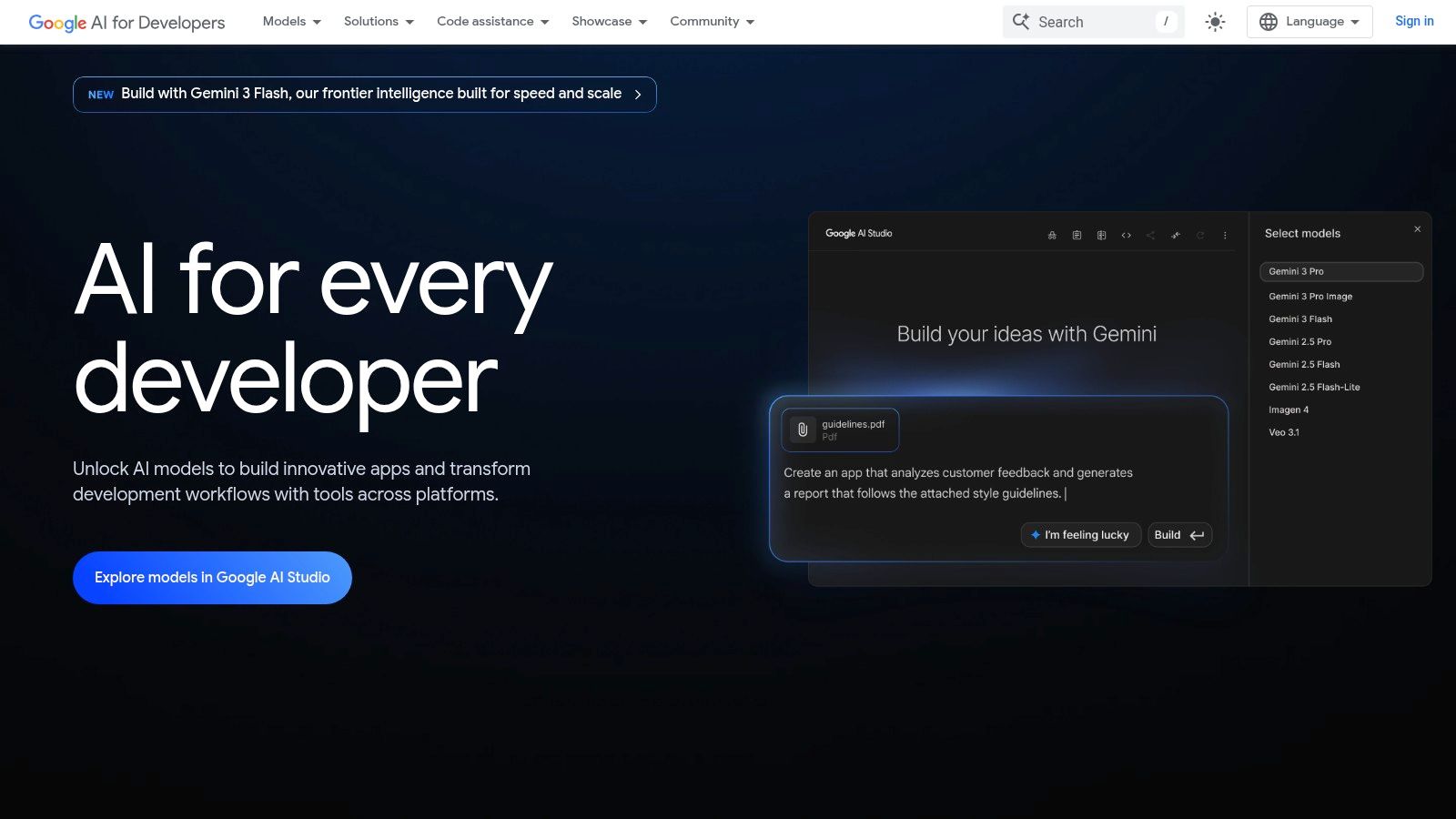
Google AI Studio is the developer-focused gateway to the Gemini family of models, Google's answer to the industry's best LLM models. It serves as an accessible workbench for experimenting with and integrating models like Gemini Pro and Gemini Flash into applications. For content creators, this platform provides a direct line to powerful multimodal capabilities, allowing them to process and generate text, images, and soon, audio and video, all through a unified API.
What makes Google AI Studio a compelling choice is its seamless integration with the broader Google ecosystem and its focus on practical, scalable tooling. Creators can leverage unique features like grounding with Google Search to generate factually consistent articles or research notes. The user-friendly web interface is excellent for quickly prototyping prompts for a new YouTube series or drafting email marketing campaigns, while the API provides the necessary power for building robust, automated content workflows that scale.
Key Details & Considerations
- Model Access: Provides API access to the Gemini family, including the balanced Gemini Pro and the speed-optimized Gemini Flash. Previews of next-generation models are often available here first. Access is usage-based with a generous free tier for initial development.
- Use Cases for Creators: Excellent for brainstorming video topics grounded with real-time search data, generating descriptive alt-text for images, drafting blog posts, and developing specialized research assistants for podcast preparation.
- Pros: Competitive pricing, especially for speed-optimized models; generous free usage tier for testing and low-volume projects; strong developer tooling and integration with Google Cloud for enterprise-level scaling.
- Cons: Some of the most advanced features remain in preview, meaning their capabilities and limits can change; grounding with Google Search is a powerful but separately billed feature that can increase costs.
Website: https://ai.google.dev/
4. Meta Llama (official model site)
Meta's official Llama site is the central hub for its family of powerful, source-available large language models. This platform provides direct access to model weights, essential documentation, and usage policies for models like Llama 3. For content teams with technical expertise, this site is the starting point for building custom, self-hosted AI solutions, offering a foundation to create unique tools for script generation, research analysis, or content summarization without relying on a third-party API.
What makes Meta's approach distinct is its focus on empowering developers to build on their own infrastructure. The platform links out to official repositories and a wide ecosystem of partners like Hugging Face, enabling creators to fine-tune Llama models on their proprietary data. This is a game-changer for publishers or filmmakers wanting to develop an AI assistant trained specifically on their content library's unique style and voice. It represents a significant step toward owning your AI stack, providing greater control and customization than many API-based services.
Key Details & Considerations
- Model Access: Offers various sizes of Llama models (e.g., 8B, 70B parameters) available for download after accepting the license agreement. These weights are designed for self-hosting on-premise or via cloud providers.
- Use Cases for Creators: Excellent for building bespoke content generation pipelines, developing internal research tools trained on a publisher’s archives, or creating specialized chatbots that reflect a specific brand identity.
- Pros: No per-token fees for self-hosted models, allowing for predictable costs at scale; a massive open-source community provides extensive tooling and support.
- Cons: The "Community License" has usage restrictions and is not a true open-source license; self-hosting requires significant technical infrastructure and MLOps expertise.
Website: https://ai.meta.com/llama/
5. Amazon Bedrock (AWS)
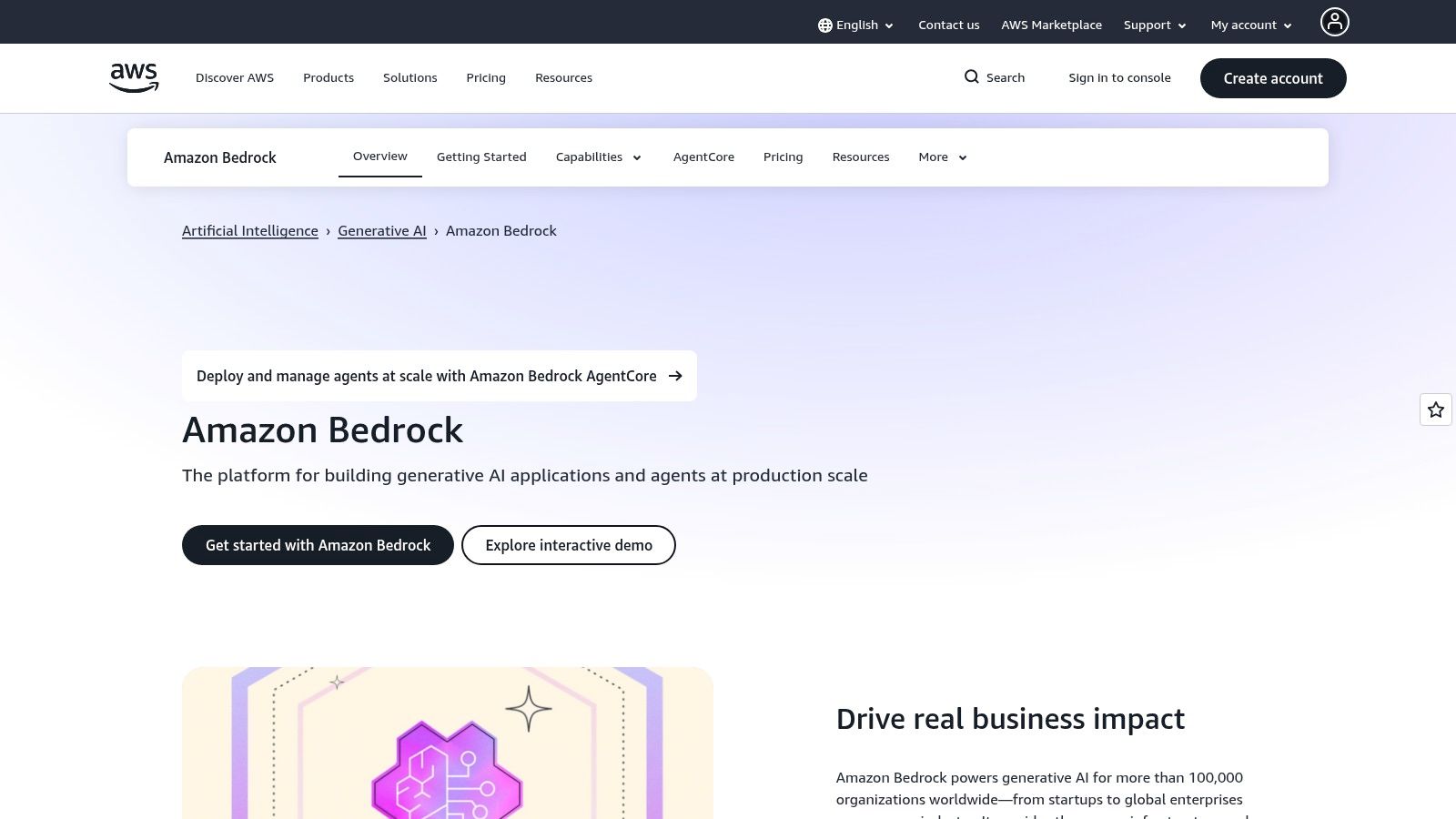
Amazon Bedrock provides a streamlined, serverless gateway for enterprises and content teams to leverage a diverse range of top-tier LLMs through a single, unified API. Instead of managing individual contracts and integrations with providers like Anthropic, Cohere, and Meta, AWS handles it all, simplifying procurement and security. For content marketers and publishers, this means you can experiment with different models for specific tasks, like using Claude 3 for nuanced article writing and Llama 3 for creative social media copy, all within the secure, scalable AWS ecosystem.
What makes Bedrock particularly powerful is its deep integration with the broader AWS suite. This allows for sophisticated, automated content workflows. For instance, a media organization could build a system that automatically transcribes new video uploads using a model on Bedrock, analyzes the transcript for key topics, and then generates a draft blog post and promotional tweets, all triggered within their existing AWS infrastructure. It moves beyond simple text generation to enable the creation of robust, enterprise-grade content production pipelines, making it one of the best LLM models access points for businesses already invested in AWS.
Key Details & Considerations
- Model Access: Offers a curated selection of foundation models from leading providers like Anthropic (Claude), Meta (Llama), Mistral AI, and Cohere through a unified API. Pricing is per-model and usage-based, with options for on-demand or provisioned throughput.
- Use Cases for Creators: Excellent for building automated content pipelines, powering internal research tools for writing teams, generating marketing materials at scale, and creating customized chatbots with proprietary data using Retrieval Augmented Generation (RAG).
- Pros: Single API and contract simplifies access to multiple providers; strong enterprise-grade security and governance controls; seamless integration with other AWS services.
- Cons: Per-token costs can be slightly higher than accessing models directly from providers; the sheer number of options and pricing tiers can be complex to navigate initially.
Website: https://aws.amazon.com/bedrock/
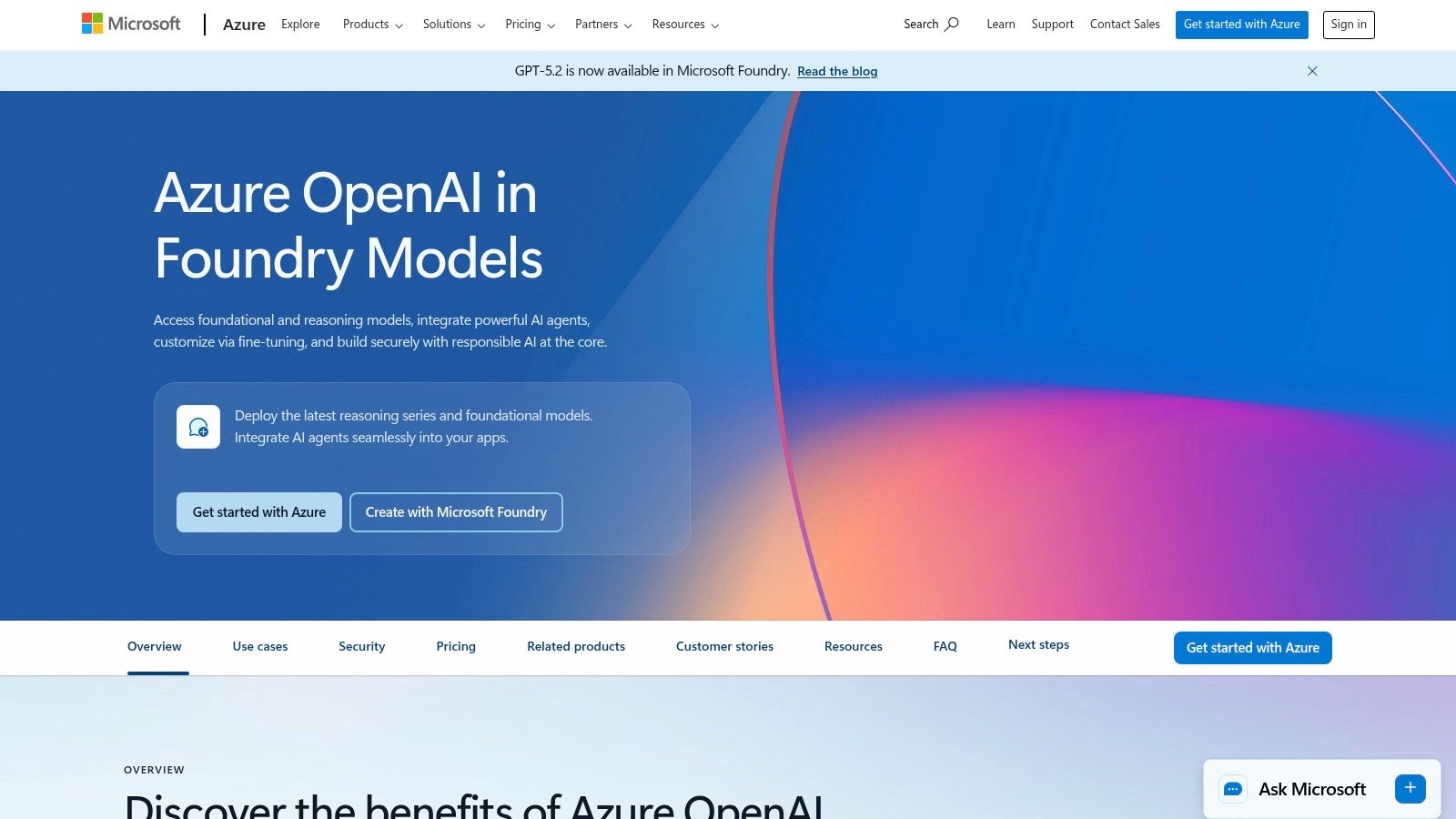
6. Microsoft Azure OpenAI Service
For organizations deeply integrated into the Microsoft ecosystem, the Azure OpenAI Service offers a powerful, enterprise-grade gateway to access OpenAI’s best LLM models. It packages the generative power of models like GPT-4o within Azure's robust cloud infrastructure, providing enhanced security, compliance, and networking capabilities. For content teams, this means leveraging top-tier AI for tasks like script generation or market research, all while adhering to strict corporate data governance and security policies.
What distinguishes this service is its focus on enterprise readiness, offering features like virtual private networks, managed identities, and guaranteed SLAs not typically available through public APIs. Creators can build scalable content workflows that benefit from Azure’s global data centers and provisioned throughput options for predictable performance. For instance, a publishing house could deploy a dedicated instance to analyze its entire content library for repurposing opportunities, a process that demands both high security and stable, high-throughput processing.
Key Details & Considerations
- Model Access: Provides access to a curated catalog of OpenAI models, including the GPT-4o family, DALL-E 3, and various embedding and fine-tuning models. It offers both pay-as-you-go and provisioned throughput pricing tiers.
- Use Cases for Creators: Excellent for large-scale content analysis, building internal knowledge base assistants, and automating content pipelines within corporate environments. The secure environment is also ideal for experimenting with advanced techniques in AI for SEO without exposing sensitive company data.
- Pros: Strong enterprise governance, security, and compliance; offers predictable performance with provisioned throughput and global deployment options.
- Cons: Configuration can be complex for those unfamiliar with the Azure portal; pricing can be less transparent upfront, requiring specific region and resource selection.
Website: https://azure.microsoft.com/en-us/products/ai-services/openai-service/
7. Hugging Face (Model Hub + Inference Endpoints)
Hugging Face stands as the definitive central hub for the open-source AI community, often described as the "GitHub for machine learning." It offers an unparalleled repository where developers, researchers, and creators can discover, compare, and download thousands of the best LLM models. For content teams, this translates into an incredible sandbox for experimentation, allowing them to test various models for tasks like text summarization, sentiment analysis, or creative writing without being locked into a single provider's ecosystem.
Beyond just a model library, Hugging Face provides robust tools for deployment, including its managed Inference Endpoints. This service simplifies the process of taking an open-source model and deploying it on scalable cloud infrastructure, complete with features like autoscaling to manage demand. Podcasters and YouTubers can leverage this to build custom AI tools, such as an internal research assistant fine-tuned on their content library or a specialized engine for generating niche marketing copy, all while maintaining control over the underlying infrastructure.
Key Details & Considerations
- Model Access: Provides access to a massive catalog of open-source models (like Llama 3, Mistral, and Phi-3) that can be downloaded freely or deployed on managed hardware. Inference Endpoints are priced per instance-hour, with costs varying by the selected cloud provider and hardware.
- Use Cases for Creators: Excellent for benchmarking different models for a specific task, fine-tuning a model on a proprietary dataset (e.g., a publisher's article archive), and deploying custom, cost-controlled AI microservices for content workflows.
- Pros: The fastest way to test and compare a wide array of open models; strong community support and resources; clear infrastructure pricing and autoscaling help manage costs effectively.
- Cons: Users are responsible for managing endpoint sizes and instance quotas; infrastructure costs are tied to hourly usage and can spike unexpectedly if not monitored.
Website: https://huggingface.co/
8. Mistral AI
Mistral AI provides a suite of high-performance, open, and optimized large language models accessible through a developer-focused platform. It stands out for its emphasis on efficiency, offering some of the best LLM models that balance cost and capability, making it a compelling European alternative to other major providers. For content teams, Mistral’s platform offers robust APIs for integrating powerful text and code generation directly into their workflows, enabling everything from automated blog post drafting to sophisticated data analysis for audience engagement strategies.
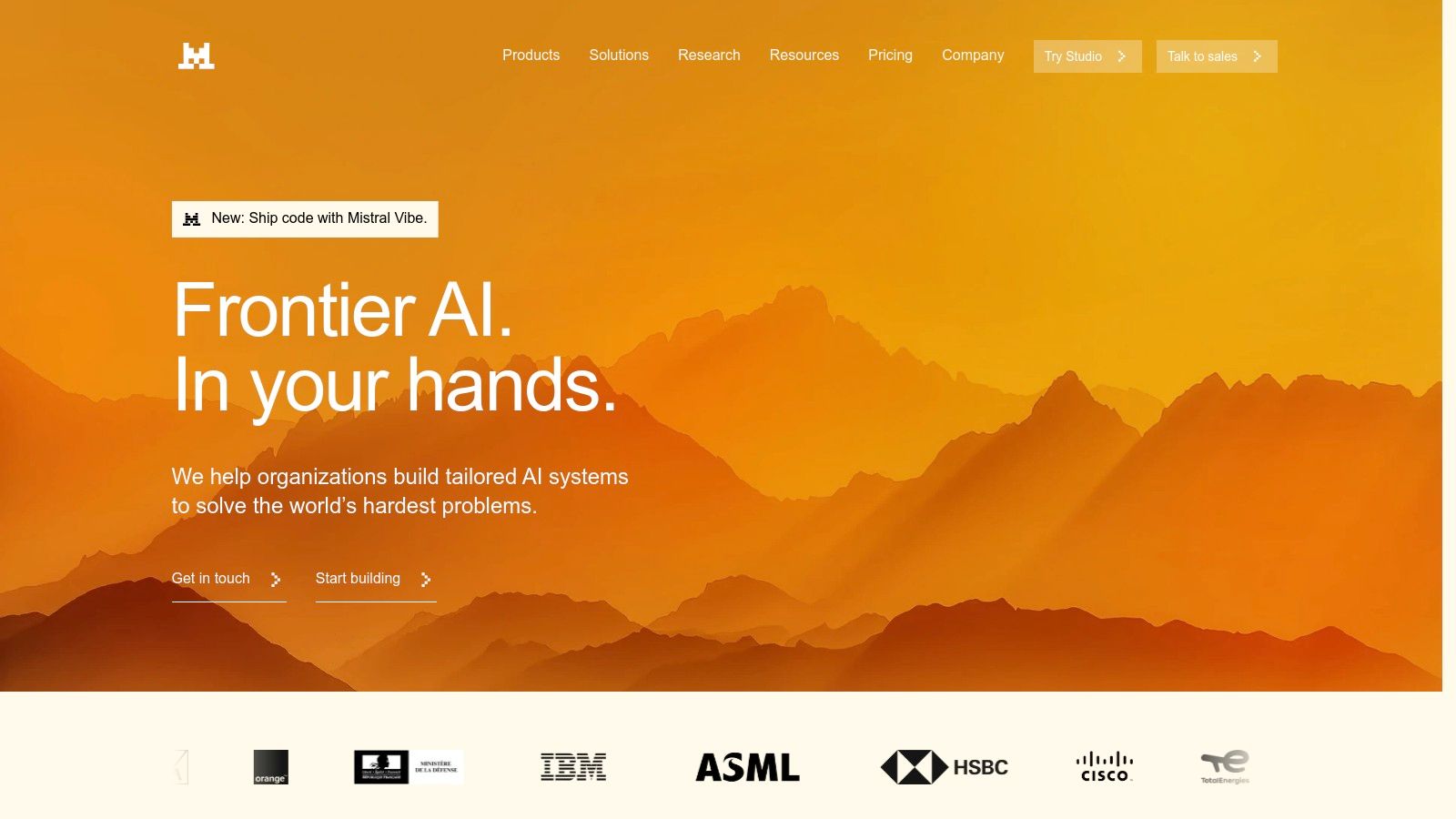
What makes Mistral a strategic choice is its strong price-performance ratio, particularly for high-volume tasks. Creators can leverage models like Mistral Large for complex reasoning or the faster Mistral Small for tasks like summarizing video transcripts or generating social media updates at scale without incurring excessive costs. The platform also offers specialized models like Codestral for development tasks and an active model refresh cadence, ensuring users have access to improving technology. This focus on practical, cost-effective deployment makes it ideal for publishers and creators looking to scale their AI-driven content operations sustainably.
Key Details & Considerations
- Model Access: Offers a range of models via its API platform ("La Plateforme"), including the flagship Mistral Large, the balanced Mistral Small, and specialized models like Codestral for coding. Pricing is competitive and usage-based per million tokens.
- Use Cases for Creators: Excellent for building cost-effective content generation pipelines, summarizing large volumes of text from a content library, creating marketing copy, and developing backend support for interactive content tools.
- Pros: Cost-effective for large-scale text and coding workloads; straightforward API and a strong European vendor option.
- Cons: Some models and features are in preview or beta stages; specialized models may have narrower functional scopes than general-purpose ones.
Website: https://mistral.ai/
9. Cohere
Cohere positions itself as an enterprise-grade AI platform, offering some of the best LLM models specifically engineered for business applications like Retrieval-Augmented Generation (RAG). While many platforms focus on broad creative generation, Cohere provides a powerful suite of tools for grounding AI responses in specific data. For content teams, this means building highly accurate research assistants that can query an entire content library to answer questions, summarize findings, or find relevant clips from podcast archives.
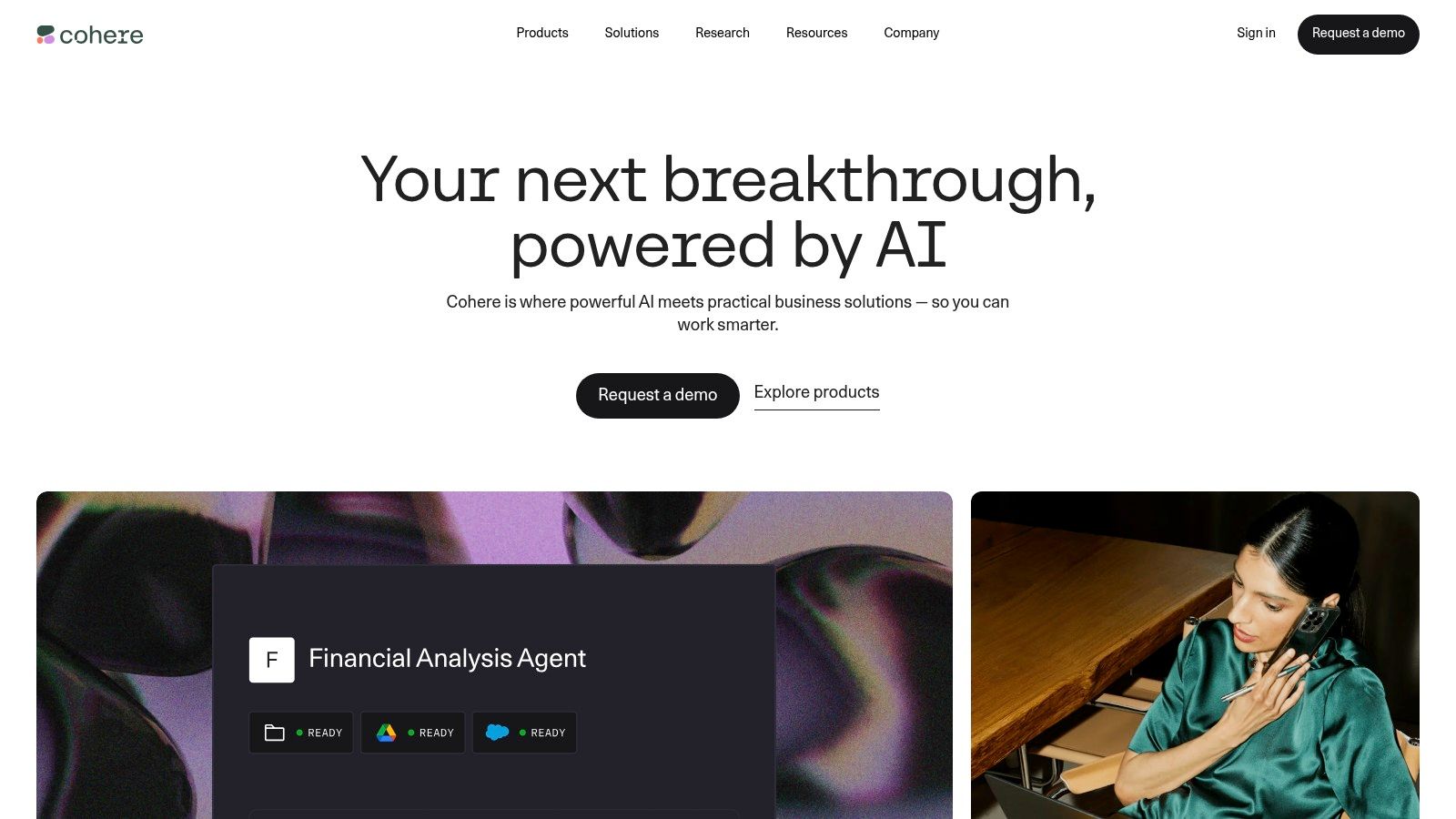
What truly distinguishes Cohere is its specialized stack for search and retrieval, featuring sophisticated embedding and reranking models. These tools allow creators to build systems that don't just generate text but understand and rank the relevance of source material with high precision. This is perfect for publishers or marketing teams needing to ensure brand voice consistency or factual accuracy by pulling only from approved documents. The platform’s focus on secure, private deployments also appeals to organizations that need to protect their proprietary content libraries while leveraging AI.
Key Details & Considerations
- Model Access: Offers a family of models including Command for text generation, Embed for creating vector embeddings, and Rerank for improving search result quality. Access is via API with clear per-million-token pricing for legacy models, while newer models may require a sales inquiry for enterprise use.
- Use Cases for Creators: Excellent for building internal knowledge bases from a content library, creating a chatbot to help users search a publisher's archives, or developing research tools that summarize and cite source materials for articles and whitepapers.
- Pros: SOTA performance in RAG-specific tasks (retrieval, reranking); strong options for data privacy and private deployments; clear documentation for building complex search systems.
- Cons: Enterprise focus means some of the latest models and pricing are not publicly listed; less oriented toward pure creative or artistic generation compared to competitors.
Website: https://cohere.com/
10. Together AI
Together AI positions itself as a comprehensive cloud platform for running, fine-tuning, and scaling both open-source and proprietary LLMs. It provides a multi-model API that grants access to a diverse array of models, making it a powerful hub for developers and content teams looking to experiment without being locked into a single ecosystem. For creators, this means the flexibility to choose the best LLM models for specific tasks, whether it's using a fast, low-cost model for summarizing comments or a high-performance one for generating a detailed video script.
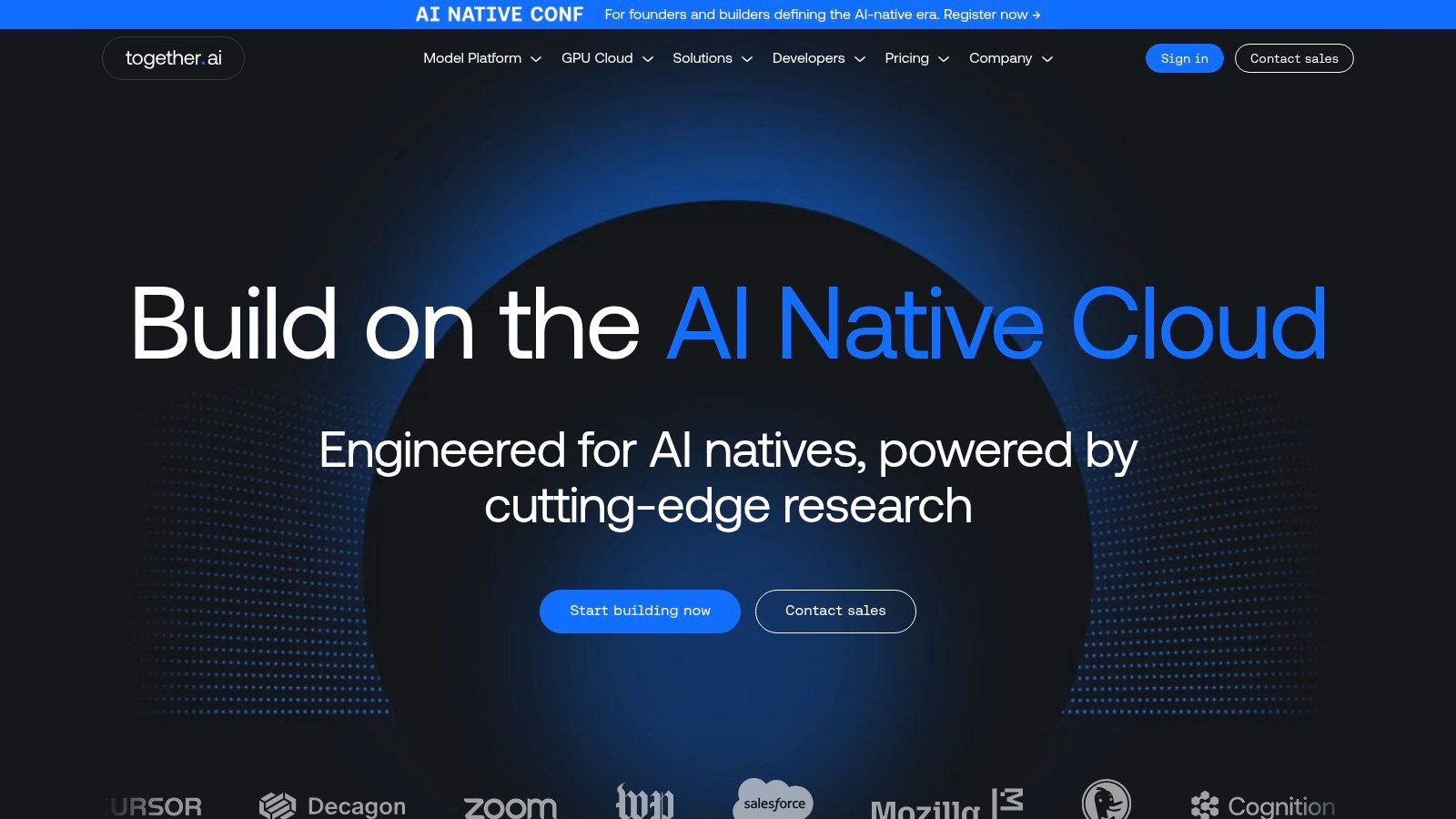
What makes Together AI stand out is its transparent, granular pricing and its focus on providing the underlying infrastructure for serious AI work. Beyond simple API calls, it offers dedicated GPU clusters and fine-tuning services, allowing creators to train custom models on their own content libraries. A publisher could fine-tune a model on their entire article archive to develop a unique brand voice, or a podcaster could build a specialized Q&A bot based on their episode transcripts. This level of control makes it a go-to for teams ready to move from simple generation to building scalable, custom AI systems.
Key Details & Considerations
- Model Access: Offers a vast library via a unified API, including models from Meta (Llama 3), Mistral, Google (Gemma), and more. Pricing is serverless and per-token, with clear tables for cost-performance comparison. Dedicated endpoints on powerful GPUs are available with hourly pricing.
- Use Cases for Creators: Excellent for A/B testing different models for marketing copy, fine-tuning a model on brand-specific data, or building high-throughput content analysis pipelines. Also suitable for running custom models for research and data discovery.
- Pros: Transparent pricing simplifies cost management; offers GPU clusters and dedicated infrastructure for scaling up; wide selection of models encourages experimentation.
- Cons: The sheer number of models and infrastructure options can be overwhelming for newcomers; premium models can have higher token rates compared to basic ones.
Website: https://www.together.ai/
11. Replicate
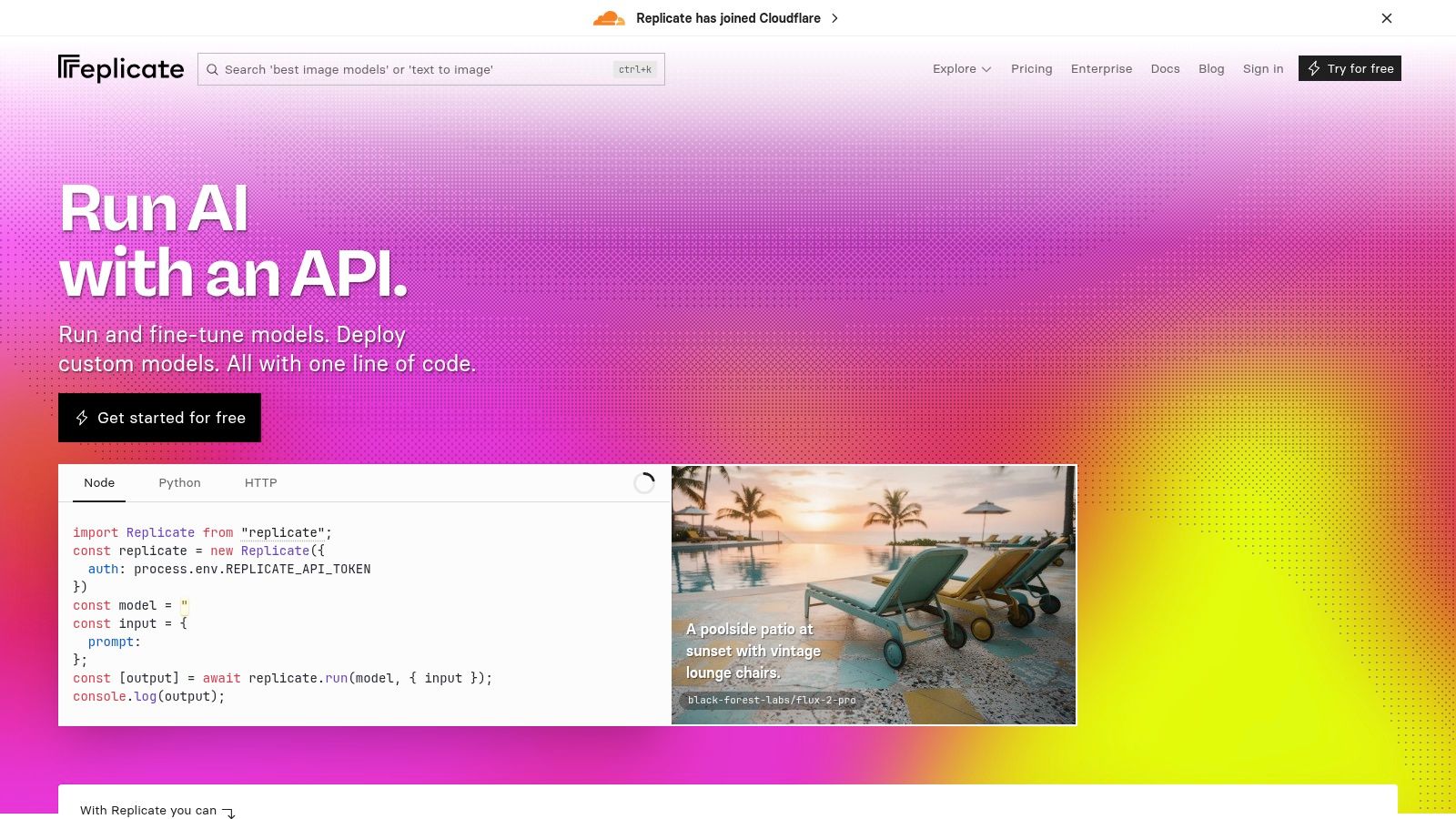
Replicate functions as a cloud-based marketplace and execution layer for running a vast array of open-source AI models, including many of the best LLM models available. Instead of managing complex GPU infrastructure, creators can run powerful models through a straightforward API. For content teams, this means rapid prototyping is extremely accessible; you can test a new text-to-image model for blog thumbnails or experiment with a specialized language model for summarizing research papers without any server setup.
What makes Replicate particularly valuable for creators is its focus on community-driven models and transparent, pay-as-you-go pricing. It abstracts away the hardware, allowing you to focus purely on the creative output. You can find and run models for tasks like audio transcription, video enhancement, or generating marketing slogans in minutes. Its per-second billing model, tied directly to the underlying hardware, makes it a cost-effective choice for intermittent or experimental projects where provisioning a dedicated server would be overkill.
Key Details & Considerations
- Model Access: Provides API access to thousands of public models from providers like Meta (Llama 3), Mistral, and Stability AI, as well as specialized models from the community. Pricing is primarily based on per-second runtime on specific hardware (e.g., NVIDIA A100).
- Use Cases for Creators: Excellent for running specialized open-source models for tasks like voice cloning, image generation, video upscaling, and advanced text analysis without infrastructure management.
- Pros: Extremely fast for prototyping and deploying models; transparent, per-second hardware pricing; huge library of cutting-edge community models.
- Cons: Cold starts can introduce latency and add to costs if not managed; some models use per-token pricing which can be less predictable than time-based billing.
Website: https://replicate.com/
12. NVIDIA API Catalog (NIM microservices + Foundation Models)
The NVIDIA API Catalog is an enterprise-focused gateway for deploying some of the best LLM models with peak performance. It provides access to NVIDIA NIM, a set of easy-to-use microservices designed for optimized AI inference. For content teams with demanding workflows, like processing large video libraries or running complex data analysis for audience insights, NIM offers a streamlined path to deploy models on NVIDIA-powered infrastructure, whether in the cloud or on-premises.
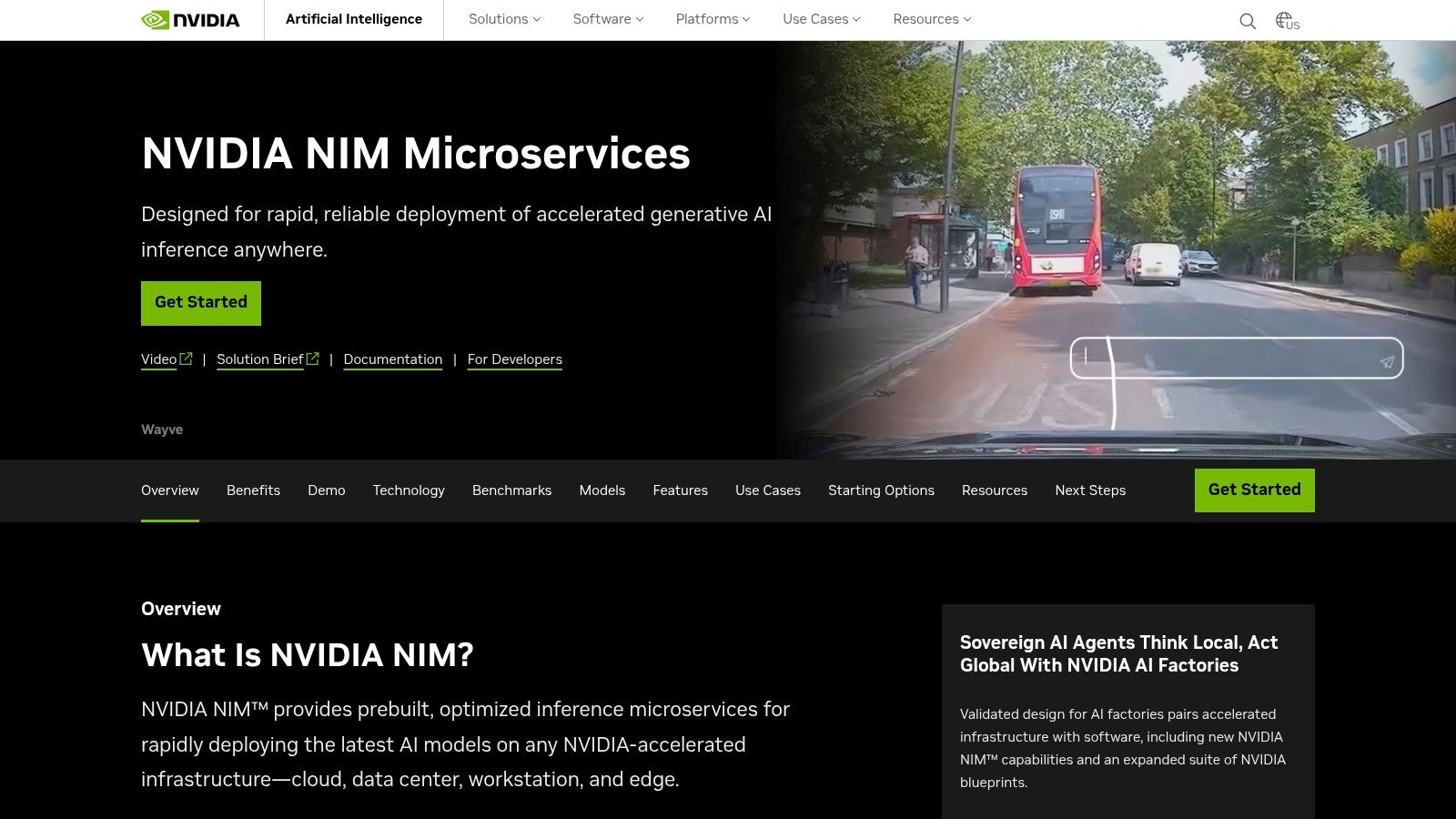
What makes this platform unique is its focus on production-grade, high-throughput inference. NVIDIA optimizes a curated selection of popular open-source models (like Llama and Mixtral) using its TensorRT-LLM library, packaging them into NIM microservices that can be deployed anywhere. This ensures consistent, low-latency performance, which is critical for real-time applications like interactive chatbots or automated content moderation systems. The catalog's free API endpoints allow for prototyping, giving creators a taste of the performance before committing to a full production deployment.
Key Details & Considerations
- Model Access: Offers a catalog of pre-built, optimized NIM microservices for leading open models. Access is provided via free trial API endpoints for experimentation, with a clear path to production through cloud marketplace subscriptions or NVIDIA AI Enterprise licensing.
- Use Cases for Creators: Excellent for high-volume content analysis, powering internal AI research tools, building custom AI-driven video editing plugins, and deploying specialized models for analyzing user engagement data at scale.
- Pros: Delivers SOTA performance and efficiency on NVIDIA GPUs; provides consistent runtimes across cloud and on-prem deployments; includes enterprise-level support and licensing options.
- Cons: Primarily geared toward production environments, requiring infrastructure knowledge; full deployment involves licensing costs through NVIDIA AI Enterprise or cloud providers.
Website: https://www.nvidia.com/en-us/ai-data-science/products/nim-microservices/
Best LLM Models — Top 12 Platform Comparison
| Provider | Core offering | Key capabilities | Integration & deployment | Best for | Pricing & value |
|---|---|---|---|---|---|
| OpenAI Platform | GPT & o-series APIs (text, multimodal, realtime) | Reasoning, code, fine‑tuning, retrieval, realtime/audio | API + web console, tools (code interpreter), enterprise controls | Devs & businesses needing high‑performance general models | Per‑million‑token pricing; can grow at scale |
| Anthropic (Claude) | Claude family (Sonnet/Opus) via API | Long‑context, safety‑oriented, strong reasoning/code | API, team/enterprise controls, spend guidance | Teams prioritizing safety and long context | Per‑million‑token; premium for top tiers |
| Google AI Studio (Gemini) | Gemini APIs (Pro/Flash) with multimodal support | Grounding (Search/Maps), image/voice, batch, long‑context | Google Cloud / Vertex AI integration, enterprise tooling | Google ecosystem & scalable deployments | Tiered model pricing; free tiers; grounding billed separately |
| Meta Llama | Source‑available Llama weights for download/self‑host | Self‑hosting, fine‑tuning, community models | Official repos + partner hosting (Hugging Face) | Organizations wanting self‑hosted experimentation | No per‑token fees self‑hosted; infra & license costs |
| Amazon Bedrock (AWS) | Unified API to many LLM providers | Multi‑provider access, caching, batch, enterprise security | Deep AWS integration (IAM, VPC, observability) | Enterprises wanting one contract for many models | Per‑model pricing; may be higher than direct providers |
| Microsoft Azure OpenAI Service | Azure‑hosted OpenAI model catalog | Provisioned throughput, SLAs, compliance, embeddings | Azure‑native RBAC/SSO, regional deployment, SLA options | Microsoft‑centric orgs needing governance & predictability | Enterprise pricing; region/spec dependent; SLA options |
| Hugging Face | Model Hub + managed Inference Endpoints | Discover, fine‑tune, autoscale endpoints, analytics | Cloud endpoints, team/org features, infra menus | Experimentation and multi‑model deployment | Clear infra pricing per instance; costs by infra hours |
| Mistral AI | Mistral model family (text, code, image variants) | High efficiency, text/code performance, variant SKUs | Hosted API, chat plans, connectors | Cost‑sensitive high‑volume text/code workloads | Competitive pricing; some SKUs in preview |
| Cohere | Models for generation, embeddings, rerank | Strong RAG stack, embeddings, private Model Vault | Private deployments, BYO connectors, enterprise options | RAG pipelines and controlled enterprise deployments | Published reference prices; sales for newest models |
| Together AI | Multi‑model API with fine‑tuning & dedicated infra | Per‑token pricing, SFT/DPO fine‑tuning, dedicated GPUs | Serverless + dedicated endpoints (H100/H200/A100) | Cost/perf comparisons, training & dedicated inference | Transparent granular pricing; hourly for dedicated GPUs |
| Replicate | Marketplace to run community & private models | Fast prototyping, runtime logs, autoscale deploys | Per‑runtime deployments, Cog for private autoscale | Rapid prototyping without infra management | Pay‑per‑second hardware pricing; some token‑priced models |
| NVIDIA API Catalog (NIM) | NIM microservices + optimized foundation models | TensorRT‑LLM optimizations, high GPU throughput | Cloud & on‑prem deploys, AI Enterprise licensing | Organizations needing max GPU performance & consistent runtimes | Licensing + infra costs; enterprise support options |
From Content Library to Content Goldmine: Making LLMs Work for You
Navigating the landscape of the best LLM models can feel like exploring a new continent. We've journeyed through the walled gardens of OpenAI, Anthropic, and Google, examined the powerful ecosystems of AWS and Azure, and delved into the vibrant, open-source communities fostered by Hugging Face, Meta, and Mistral AI. The sheer variety, from the creative prowess of GPT-4o to the analytical precision of Claude 3 Opus and the open-source flexibility of Llama 3, demonstrates one clear truth: the era of one-size-fits-all AI is over.
Your choice is no longer just about picking the "smartest" model. It's about aligning a model's specific strengths, costs, and implementation paths with your unique goals as a content creator. This guide aimed to move beyond benchmark scores and provide a strategic framework for that decision. We've seen how a podcaster might prioritize a model with superior audio-to-text capabilities, while a publishing house would focus on models with extensive context windows for analyzing manuscripts. The key is to see these LLMs not as magic wands, but as highly specialized power tools.
Key Takeaways for Content Creators
The most critical insight is that the "best" model is entirely contextual. Your ideal choice hinges on a careful evaluation of several factors:
- Task-Specific Performance: Don't just look at general intelligence. A model like Gemini 1.5 Pro excels at video analysis, making it a top contender for YouTubers. For complex research and summarization, Claude 3's large context window is a game-changer for academics and authors.
- Cost vs. Control: Proprietary models like those from OpenAI and Anthropic offer incredible power with ease of use via APIs, but at a per-token cost. Open-source models like Llama 3 or Mistral's offerings provide ultimate control and potential long-term cost savings, but demand more technical expertise for hosting and fine-tuning.
- Ecosystem Integration: Platforms like Amazon Bedrock and Microsoft Azure OpenAI Service are not just model providers; they are comprehensive ecosystems. They offer the security, scalability, and integration with other cloud services that larger media organizations and content teams require for building robust workflows.
Your Actionable Next Steps
Armed with this information, it's time to transition from learning to doing. The path forward involves strategic experimentation and implementation.
- Define a Pilot Project: Don't try to overhaul your entire workflow at once. Select a single, high-impact task. For a blogger, this could be generating 10 SEO-optimized article outlines from a single research paper. For a video producer, it might be creating social media scripts from a long-form interview transcript.
- Test Two Contenders: Based on our analysis, choose two different models that seem well-suited for your pilot project. Perhaps you'll pit a high-end proprietary model against a leading open-source one. Use their APIs or playground interfaces to run the same prompts and compare the quality, speed, and nuance of the outputs.
- Analyze and Iterate: Evaluate the results not just on quality, but on the entire process. How much prompt engineering was required? What were the associated costs? This hands-on experience is invaluable and will guide your larger strategy far more effectively than any benchmark chart.
Ultimately, these powerful models are catalysts, designed to augment your creativity and organizational intelligence, not replace them. They can transform a sprawling, dormant content library into a dynamic, interconnected asset ready for monetization and discovery. By choosing the right LLM and pairing it with the right operational framework, you can finally upcycle your old content, reignite your library, and turn it into a true money-maker.
Ready to turn your content library into a collaborative, intelligent asset? Contesimal is the platform that helps you and your team organize, understand, and take action on your content using the power of the best LLM models. It enables seamless collaboration between humans and AI, allowing you to discover new value across your existing assets. Discover a smarter way to collaborate at Contesimal.