
You're probably already doing the hard part. You publish videos, podcasts, newsletters, essays, clips, and posts. Then the distribution cycle starts, and the results feel uneven. A thoughtful post on your Facebook Page gets a few reactions. A strong promo link drifts by. Comments stay thin. You know the content is useful, but the format is fighting the environment.
That's where Facebook Group marketing starts to matter.
For creators and content teams, groups aren't just another social surface. They're one of the few places on a large platform where discussion can still become an asset. The right group gives you recurring attention, direct audience language, repeatable content prompts, and cleaner paths from conversation to conversion. It also gives you something most creators are missing: a body of audience insight you can reuse.
Beyond the Page The Case for Community-Led Growth
Most creators don't have a content problem. They have a context problem.
A Page is built for broadcasting. A group is built for interaction. That difference sounds obvious, but it changes everything about how content performs, how people respond, and whether your audience starts building momentum with you instead of just consuming what you publish.
According to this Facebook Group marketing guide, Facebook Groups engage approximately 1.8 billion users monthly as of 2026, and thriving groups can reach engagement rates between 200% and 400%, compared with 0.15% for standard Facebook Pages. The same source reports that brands with an active owned group see 47.3% higher customer retention and 2.6 times higher conversion rates from community traffic.

Why groups behave differently
The useful way to think about Facebook Group marketing is this: a group compresses the distance between audience, feedback, and trust.
When someone joins your group, they're not just following your brand at arm's length. They're opting into a room. That room has norms, familiar names, recurring topics, and memory. Over time, people don't only respond to you. They respond to each other. That's when a group stops being a channel and starts becoming infrastructure.
Three practical shifts happen inside strong groups:
- Attention gets deeper because people expect discussion, not just updates.
- Content gets better feedback because members tell you what they understand, resist, or want next.
- Offers feel more natural because trust builds through repeated interaction, not one-off promotion.
Practical rule: If your Facebook activity depends on people clicking cold links from a Page post, you're still playing a broadcast game.
What this means for creators
For YouTubers, podcasters, educators, consultants, and publishers, fb group marketing works best when you stop treating the group as a mini Page. It isn't a dumping ground for links. It's a place to develop themes before they become public content.
That matters if you're trying to turn a growing content library into revenue. A group can tell you which topic deserves the next longform video, which FAQ should become a lead magnet, which objection belongs on a sales page, and which audience segment wants a paid offer.
The strongest use case isn't reach alone. It's community-led growth. You publish less blindly, learn faster, and convert from a warmer starting point.
Designing Your Group Strategy Before You Create It
A weak Facebook group usually doesn't fail because of poor posting. It fails because the creator never made a strategic choice.
You can't build one group that serves every need at once. If you try, the value proposition gets blurry fast. Members won't know whether they're there to get support, network, learn, buy, or just watch. Once that confusion sets in, engagement drops and moderation gets harder.
Sprout Social frames the core question well in its guidance on which Facebook group type is worth building: the hard decision isn't just how to grow, but whether an owned brand community, customer-support group, or niche peer community is the right model when organic reach is constrained and authenticity matters.

Pick one primary job for the group
Before you touch settings, write one sentence that finishes this phrase: This group exists to help this specific kind of member achieve this specific outcome.
Then pressure-test it against these common models:
| Group model | Best use | Main advantage | Main risk |
|---|---|---|---|
| Owned brand community | Loyalty and education | Stronger relationship with your audience | Can become self-promotional if the mission is vague |
| Customer-support group | Product help and retention | Questions surface fast, and members often help each other | Support issues can dominate the feed |
| Lead-generation group | Warming prospects before an offer | Clear business intent | Feels transactional if value is thin |
| Niche peer group | Shared identity or topic | Members generate discussion without constant brand prompts | Harder to connect directly to revenue |
What works and what doesn't
What works is specificity. A group for “independent documentary filmmakers editing their first feature” is easier to run than a group for “creatives.” A group for “clients implementing our process” is cleaner than a general “community” with no shared stage.
What doesn't work is stacking goals too early. If your group is trying to be a customer forum, mastermind, local network, content feedback club, and promo engine, people won't know how to participate.
A simple strategic filter helps:
- Build an owned group if you can show up consistently and already have a defined audience problem.
- Join and contribute to existing groups if you're still testing message-market fit.
- Skip groups for now if your team can't moderate, reply, and create recurring prompts. An inactive group makes the brand look absent.
A group without a clear job becomes a storage bin for posts that didn't fit anywhere else.
Decide your North Star metric
Don't start with vanity. Start with behavior.
If the group exists for support, your North Star might be resolved questions and recurring peer-to-peer answers. If it exists for thought leadership, the metric may be quality discussion that leads to site visits or email signups. If it exists for retention, you should care about member activity among customers, not just member volume.
This is the same discipline you'd use in any strategic marketing plan template and process. A group deserves that level of planning because it creates ongoing operational work. Treat it like a product line, not a side project.
When Facebook Groups are the wrong fit
Some brands should not build a group yet.
If your audience wants quick answers but not community, a searchable help center may serve them better. If your offer is high-ticket and private, direct conversations might outperform public discussion. If your niche is broad but weakly motivated, your group may fill with passive members who never contribute.
Facebook Group marketing is powerful when people want shared context. Without that, you're building a room no one needs.
The First 100 Members A Tactical Launch Plan
The first stage of a group is fragile. New members don't judge the promise of the community. They judge the room they enter. If it feels empty, they leave. If it feels alive, they assume they should participate.
That's why the first 100 members matter more than the next 1,000.
Start with a staged launch, not a public opening
Don't create the group and immediately invite everyone. Build the interior first.
Seed the space with a handful of posts before anyone arrives. You want a new member to see movement, not potential. That usually means:
- A welcome post that tells people who the group is for, what belongs there, and how to introduce themselves.
- Two or three discussion starters tied to real problems, not generic prompts.
- One resource post that gives immediate utility, such as a checklist, short lesson, or process breakdown.
- Clear rules that make the room feel intentional.
Invite people in layers
Mass invites create a weak foundation. Personal invites create a core.
Start with people who already have some relationship to your work:
- Existing clients or customers who know the topic and can answer questions
- Loyal followers who comment often and tend to engage early
- Peers or collaborators who understand the tone you want to set
- A few “signal members” whose thoughtful replies tell newcomers this is a serious space
Ask them to do something specific when they join. Comment on the welcome thread. Answer an opening prompt. Share a lesson from experience. Don't leave engagement to chance.
Give people a reason to join now
Urgency doesn't need hype. It needs relevance.
A strong launch hook might be a live Q&A, a challenge week, a feedback thread, or a private discussion around a timely topic. If you're pairing the group with paid acquisition, review proven creative patterns like these Facebook ad examples for professional services. They're useful for seeing how positioning and audience pain can be framed without sounding generic.
The best early members aren't your biggest audience segment. They're the people most likely to speak.
Build a small distribution loop
You don't need a complicated launch campaign. You do need consistency across the channels you already control.
A simple launch loop looks like this:
- Email your warm audience with a clear reason the group exists
- Mention it inside your latest content with a direct call-in for a specific type of member
- Post short clips or text hooks on adjacent platforms
- Route interested people to one destination so the group becomes the focal point
If your broader publishing system is scattered, tighten that first. This guide to a content distribution strategy across channels is a good reference for making sure your group launch supports, rather than competes with, the rest of your content.
The point isn't speed. It's density. A small group with active conversation is easier to grow than a large silent one.
Fueling Engagement and Cultivating Community
The middle stage is where most groups flatten out.
The creator launches strong, members join, and then the feed slowly turns into a mix of announcements, dropped links, and uneven replies. Nothing is technically wrong, but nothing is sticky either. The fix usually isn't “post more.” It's to create recurring participation patterns that members can recognize and trust.
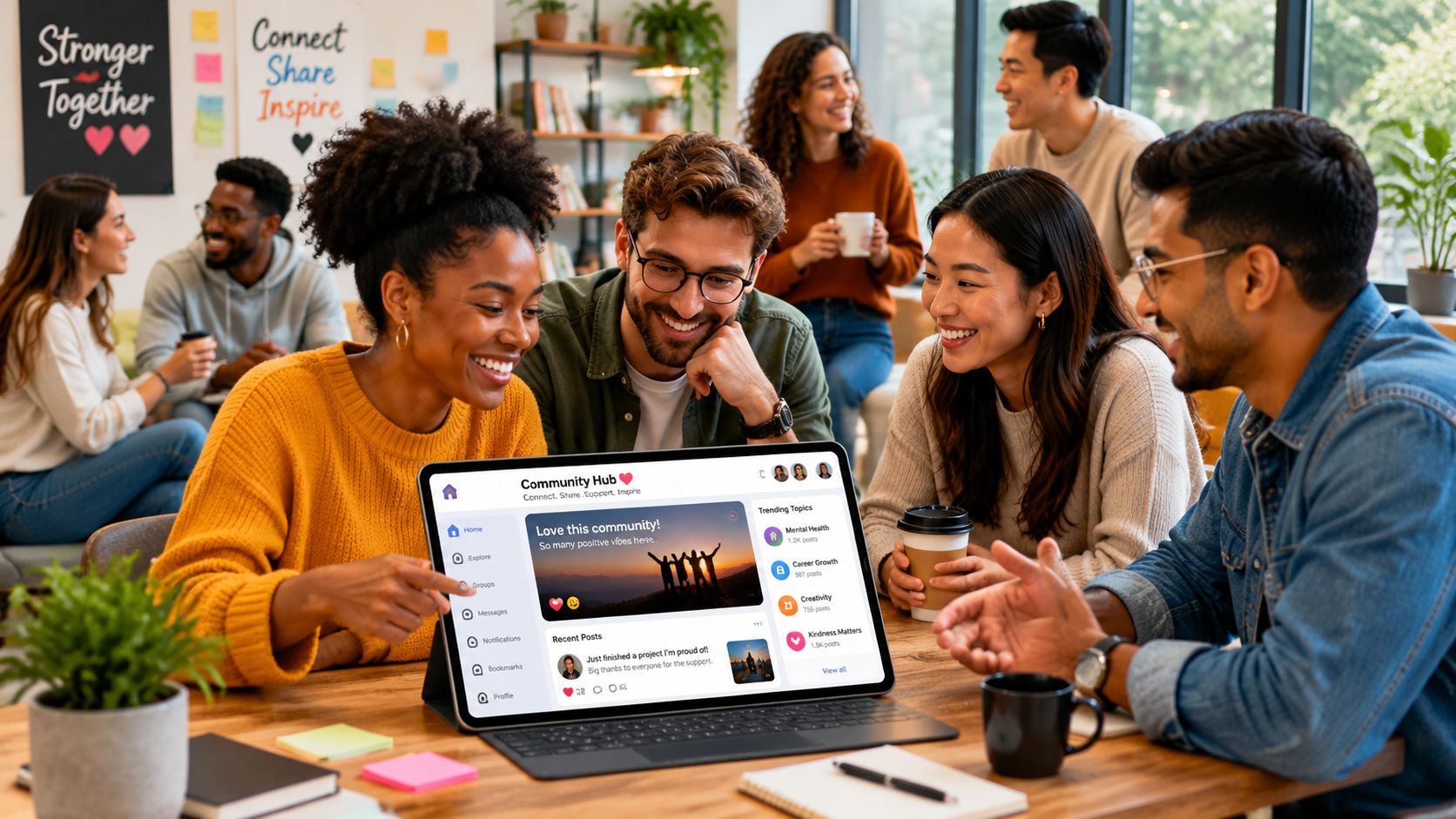
Build rituals, not random activity
Good Facebook Group marketing depends on rhythm. Members participate more when they understand what kinds of posts show up, what kinds of responses are welcome, and when their voice matters.
A practical weekly structure might include:
- Prompt threads that ask one focused question tied to a current challenge
- Member spotlights that reward thoughtful participation and surface examples others can learn from
- Office-hours posts where members can drop short questions in one place
- Behind-the-scenes lessons pulled from your recent content work, campaign, launch, or production process
These formats work because they reduce friction. People don't need to invent a reason to speak. The post gives them one.
Encourage member-to-member value
A lot of admins accidentally train dependence. They answer every thread, jump in first, and close discussion before the community can develop its own voice.
A healthier pattern is facilitation. Ask follow-up questions. Tag members who might have experience. Highlight thoughtful replies. Let the room breathe a little before turning every thread into a brand response.
That shift matters because member language is the raw material. Their phrasing reveals pain points, objections, vocabulary, and priorities. If you're making videos, courses, articles, or sales content, this is gold.
Your group becomes valuable when members feel the room still works even when you're not the only one talking.
Moderate like a host, not a cop
Moderation isn't just about removing spam. It's about protecting the quality of interaction.
Set a tone that makes smart people want to stay. That means removing obvious self-promotion when it breaks context, stopping repetitive low-value posting, and intervening early when a thread turns snarky or combative. The standard should be simple: does this make the community more useful?
A few practical moderation habits help:
- Approve with discernment if you run a private group. Not every member request improves the room.
- Redirect promos into designated threads if self-promotion has a place.
- Restate the purpose publicly when discussions drift.
- Message repeat offenders directly instead of performing moderation in comments unless needed.
For teams that want more ideas on sustaining conversation quality, this video has useful tactical prompts and examples for active group management:
Treat every thread as source material
The smartest admins don't just manage engagement. They archive insight.
A recurring question can become a blog post. A debate can become a newsletter essay. A member win can become a testimonial theme. A messy thread full of confusion can become the outline for your next explainer video.
That's the hidden edge in fb group marketing. Community activity isn't separate from content strategy. It is content strategy, just earlier in the cycle.
Building Natural Conversion Paths from Your Group
A group shouldn't feel like a funnel with better lighting.
People join because they want access, context, answers, and community. If every useful thread points too quickly toward a pitch, members will notice. Engagement drops first. Trust leaves right after.
The best offers solve a conversation already happening
Conversion inside groups works when the offer feels like the next logical step. Someone asks how to implement a method. You point them to a workshop. A member says they're stuck doing the same task manually. You mention the template, service, or product that removes that friction. The relationship stays intact because the recommendation fits the moment.
That's different from posting a sales link because it's Tuesday.
Three conversion paths tend to feel natural:
- Group-exclusive access such as early registration, private Q&A sessions, or limited office hours
- Contextual invitations based on visible need inside a discussion
- Offer validation through listening where the group shapes the wording, structure, or packaging before launch
What spammy promotion looks like
Most bad monetization in Facebook groups has the same smell. No conversation. No context. No timing. Just a link and a request.
That approach fails because it treats members as a list, not participants. It also creates a weird split in the room. The educational posts establish one tone, then the promotional posts break it.
A cleaner rule is this: if the post would still be useful to a member who never buys, it's probably safe.
If your monetization depends on interrupting the community, the strategy is wrong.
Match the group model to the revenue model
An owned educational community can support premium workshops, digital products, consulting, sponsorship-aligned content, or paid memberships. A support group can improve retention, reduce friction before renewal, and surface expansion opportunities. A niche peer community may convert more indirectly by strengthening authority and referral flow.
If you're exploring paid access or recurring revenue, these strategies for membership-based Facebook groups are a useful comparison point. The important filter is whether the paid layer increases value or just puts a gate in front of basic access.
Look for buy signals in plain language
You don't need manipulative scripts. You need pattern recognition.
Members often reveal buying intent through phrases like:
- “I've been trying to solve this for weeks.”
- “Is there a template for this?”
- “I wish someone had already built a system for this.”
- “How do you do this without wasting time?”
That's not a cue to pounce. It's a cue to help. Sometimes the right response is a public answer. Sometimes it's a relevant resource. Sometimes it's a gentle invitation to the offer that already exists.
The healthiest groups monetize because members trust the host's judgment. Keep earning that trust, and conversion becomes a byproduct of service rather than a break from it.
Measuring Group ROI Beyond Likes and Comments
Most fb group marketing advice gets vague right when the stakes get high.
It will tell you to watch engagement, nurture conversation, and stay consistent. Fine. But if you need to defend time, budget, or staff effort, “people are talking” isn't enough. You need a measurement system that connects group activity to site visits, leads, pipeline movement, retention signals, or revenue.
Evergreen Feed identifies this clearly in its discussion of measurement and attribution in Facebook Group marketing: most guidance focuses on engagement tactics and rarely shows how to tie group activity to revenue, leads, or site visits in a defensible way. That's exactly where the serious opportunity is.
Replace vanity metrics with a tracking stack
Member count is context, not proof. Reactions are signals, not outcomes.
A more defensible setup includes:
- UTM-tagged links for any traffic-driving post that sends members to your site, landing pages, webinars, or products
- Lead-source fields in your CRM so your team can tag whether a contact came from a group discussion, group link, or group referral
- Offer-specific landing pages when you want cleaner attribution for a launch or campaign
- Manual tagging for high-intent conversations when someone converts after visible discussion inside the group
This doesn't need enterprise software. It needs discipline.
Use simple attribution rules
Attribution gets messy when you expect perfect certainty. Don't.
Start with a practical model. Decide what counts as group-influenced and what counts as group-sourced. For example:
| Attribution level | What qualifies |
|---|---|
| Group-sourced | The user clicked a tagged link from the group and converted |
| Group-assisted | The user participated in the group, then converted through another channel |
| Group-informed | A conversation in the group shaped content or an offer that later produced results |
Groups often influence demand before they capture it directly. A member might learn from your discussions for weeks, then convert from email or branded search later. If your model only counts last-click traffic, the group will look weaker than it is.
Add incrementality, not just tracking
Tracking shows correlation. Incrementality helps test causation.
A simple version looks like this: publish a topic or offer with strong group support during one period, then compare it with a similar period where the group is not used as a promotion or discussion channel. Another version is message testing. One audience segment gets content seeded through the group first. Another doesn't. You then compare downstream quality signals.
You don't need to pretend the method is perfect. You do need to document the design and keep it consistent. That alone puts you ahead of many others.
The question isn't whether the group generated conversation. The question is whether the conversation changed behavior.
If you need a broader framework for tying content activity to business impact, this guide on content marketing return on investment pairs well with group attribution work.
Turn Conversations into Your Content Goldmine
The most underused benefit of Facebook Group marketing isn't engagement. It's content intelligence.
A strong group keeps telling you what to make next. Not abstractly. Directly. Through repeated questions, objections, examples, stories, frustrations, and language patterns. When you capture that well, the group becomes a renewable source of content ideas that are already pre-validated by the audience.

Use a repeatable repurposing workflow
Most creators lose value here because they rely on memory. They remember one smart thread, vaguely recall a recurring question, and then move on.
A better workflow is operational:
Capture
Save notable posts, comment chains, and recurring prompts every week.Classify
Sort them by intent, such as beginner question, purchase objection, tactical problem, success story, terminology confusion, or trend signal.Cluster
Group related discussions into themes. One cluster might become a podcast episode. Another might become an FAQ hub or a video series.Create
Turn the strongest themes into durable assets. Think tutorial article, YouTube script, webinar outline, case-based newsletter, or downloadable checklist.Redistribute to the group
Bring the finished content back into the community and invite response. That closes the loop and often starts the next idea cycle.
Match conversation types to content formats
Not every thread should become the same asset.
- Repeated beginner questions work well as glossary posts, onboarding emails, and short explainer videos.
- Detailed member stories often become case-led newsletters or testimonial-rich landing page material.
- Debates and strong opinions can shape podcast episodes, live sessions, or contrarian essays.
- Troubleshooting threads are perfect for checklists, templates, and support documentation.
One overlooked companion skill here is comment handling itself. If you want a stronger system for turning discussions into strategic signals, this guide on social media comment strategy is worth reviewing because comments often contain the clearest audience language.
Build an archive, not just a feed
The feed is temporary. The insight shouldn't be.
That's why creators moving from hobbyist mode into a real content business need a way to organize community input alongside their existing library of videos, podcasts, articles, transcripts, and notes. When group conversations are searchable and structured, they stop being scattered engagement and start becoming research.
The payoff is bigger than a fuller content calendar. You get sharper editorial planning, better product language, more relevant lead magnets, and a tighter loop between what your audience says and what your business publishes.
This is the promise of fb group marketing. Not more noise. More usable signal.
If you're sitting on a growing archive of posts, videos, transcripts, episodes, and community conversations, Contesimal can help you turn that library into something operational. It gives content teams a way to organize, search, classify, and collaborate across their existing assets so the next article, video, offer, or research thread comes from evidence instead of guesswork. For creators building revenue from a body of work, that's how old content starts creating new value.