
You know the feeling. A creator opens an old folder full of recordings, articles, clips, notes, and transcripts, then realizes the hard part isn't making more content, it's finding a useful way to reuse what already exists. That's where the features of the product matter most, because the job isn't just storing a library, it's turning that library into something searchable, collaborative, and worth acting on.
Contesimal is built for that shift. It helps creators move from “I have a lot of content” to “I can use this content again,” with tools for organizing, searching, collaborating, and operationalizing ideas across podcasts, videos, articles, and documents. The point is simple, organize. Understand. Take action.
When Your Content Library Becomes a Goldmine
A creator's archive usually doesn't feel like a goldmine at first. It feels like a pile of old exports, half-finished drafts, buried transcripts, and clips no one has touched in months. The irony is that the best future episodes, posts, and campaigns are often already inside that pile, they just haven't been indexed into something useful yet.
The problem is not a lack of content
Most creators don't need another blank page. They need a way to revisit what they've already made and see it with fresh eyes. A podcast host might have twenty interviews that all circle the same theme. A publisher might have hundreds of articles with recurring ideas, but no clean way to locate them fast. A video team might know the archive is rich, but still spend hours searching by memory instead of by structure.
That's why features of the product are more than a checklist. They're the bridge between old material and new output. In Contesimal's case, the system is meant to make that archive feel less like storage and more like a working asset.
Practical rule: if a creator can't retrieve a piece of content quickly, that content might as well not exist.
The shift matters because product analytics treats feature usage as something measurable, not anecdotal. One common benchmark is DAU/MAU, where a ratio of 0.2, or 20%, is often described as healthy engagement, and feature usage rate is defined as unique feature users divided by total unique product users, multiplied by 100, so a product with 5,000 monthly users and 1,000 users of one feature would have a 20% feature usage rate Quantum Metric.
What changes for creators
Contesimal's value starts when the library stops being passive. Instead of asking, “What did we make last year?”, creators can ask, “What can we reuse, remix, or reframe today?” That's a much better question for anyone trying to turn a hobby into a revenue stream.
For creators who want a deeper model for organizing that archive, metadata management best practices give a useful way to think about the structure behind discoverability. And for teams thinking about how search intent connects to content outcomes, content SEO services are a practical reminder that organization only matters if people can find what they need.
The benefit is momentum. Once the archive becomes searchable and structured, it stops acting like digital dust and starts acting like raw material for the next format, the next series, or the next revenue path.
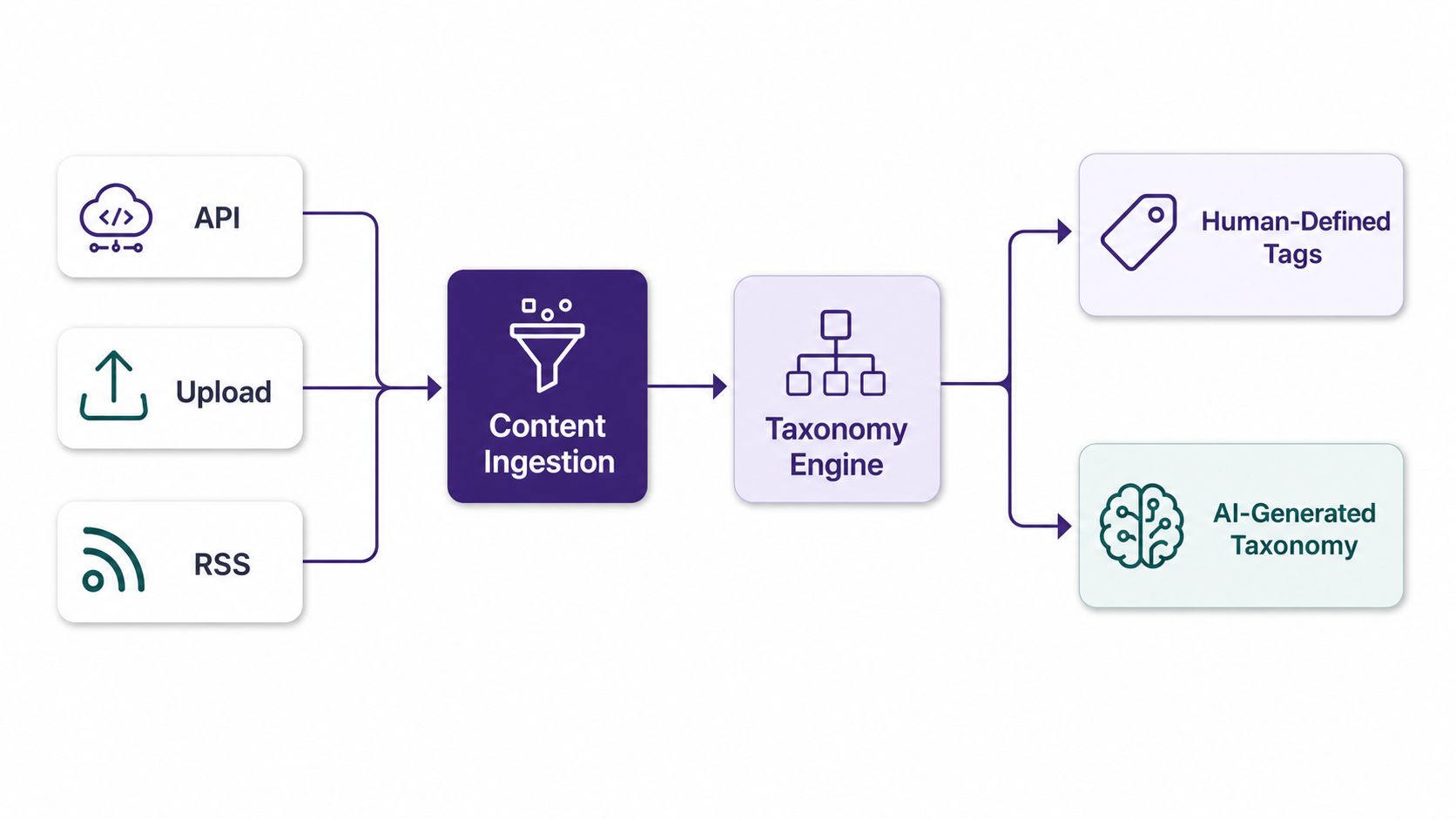
Ingestion and Taxonomy Building
Good organization starts before search, before chat, and before analytics. Content has to enter the system cleanly, and it has to be labeled in a way both people and machines can understand. Properly sorted and labeled storage is essential, as poor organization slows every subsequent step.
Start with a clean intake path
The first job is ingestion. Content needs a reliable route into the platform, whether it arrives through an upload, an API connection, or another feed-based workflow. Once it's in, the main work begins, because raw files alone don't help anyone find patterns or reuse material.
Taxonomy matters. The North American Product Classification System, or NAPCS, matters historically because Statistics Canada used it as an official standard for collecting, processing, and disseminating product statistics, which standardized classification across industries and helped analysts compare categories consistently over time Statistics Canada. The same logic applies here, because creators need a structure that keeps names from drifting and categories from becoming vague.
A useful taxonomy usually starts with the language the team already uses. Tags that already live in spreadsheets, editorial notes, or folder names can become the starting point, then the system can suggest refinements. That keeps the process practical instead of academic.
Build the structure around how the team actually works, then let the system sharpen it.
Why layered classification matters
A folder tree is often too shallow for a modern library. A single episode can belong to a host, a guest, a topic, a format, a campaign, and a reuse path. Rich taxonomy gives each item multiple addresses, which makes discovery and reporting much more precise.
Structured classification is what makes cross-market comparison possible. Just as standardized product categories support statistical reporting, a creator's taxonomy supports better discovery across podcasts, videos, articles, and research files. It also helps mixed-media libraries avoid the usual mess where one asset gets buried under a name no one remembers.
For teams working through messy archives, understanding content SEO services can be helpful context for how discovery systems think about structure and retrieval. The main idea is straightforward. If the intake path is clean and the taxonomy is disciplined, every other feature becomes easier to trust.
AI Search and Chat for Instant Discovery
Once content is indexed and labeled, search becomes the true test. Creators don't want to click through endless folders. They want to ask a question and get something usable back fast, whether that's a quote, a topic cluster, or a set of clips tied to one theme.
Search should behave like a conversation
Traditional search is still useful when a creator knows the exact term, guest name, or file title they're chasing. AI chat adds another layer, especially when the question is broader, like which episodes repeat a certain theme or which posts keep surfacing the same objection. That's why features of the product in this layer matter so much, they turn the archive into something closer to a working research partner.
A podcaster might ask which interviews mention audience growth in the same way. A blogger might look for every post that references repurposing. A publisher might search for underused archive topics that have strong connective tissue but have never been turned into a series. The value isn't just retrieval, it's pattern-finding.
For readers who want a broader explanation of this kind of interface, AI-powered search is a useful way to think about how conversational lookup can sit on top of structured content. The key is to use short, specific prompts when precision matters, and broader prompts when you're exploring themes.
Know when to use search versus chat
Both modes have a job. Search is best for exactness, chat is best for synthesis. A creator looking for a particular transcript clip should use search. A team trying to understand what topics keep recurring across a year of work should use chat.
The practical win is speed. Instead of manually opening ten files to find one useful detail, teams can ask the library directly and move faster from discovery to decision. That changes research from a slow scavenger hunt into a live conversation with the archive.
Collaboration Tools for Human and AI Teams
Content teams rarely work alone now. A podcaster might draft a concept, an editor might tighten the angle, and a researcher might pull supporting material, all before one episode is published. Contesimal treats that shared process as part of the product, not an extra layer bolted on later.

Shared knowledge works better than isolated notes
The strongest collaboration happens when everyone can work from the same set of information. One person can curate source material, another can refine the angle, and AI can help surface related ideas or draft starting points. That's especially useful when a team is trying to turn a backlog of content into something more reusable.
A practical example helps. A podcaster wants to build a new series around audience trust. The editor pulls prior episodes, a guest researcher adds references from the archive, and the AI surfaces other themes that already performed well. Instead of rebuilding the idea from scratch, the team works from a shared knowledge base.
This is also where understanding content discovery solutions becomes useful context, because discovery is not just a search problem. It's also a collaboration problem, since people need to agree on what matters before they can turn it into a deliverable.
Practical rule: if collaboration lives in email threads, the archive will stay fragmented.
Human judgment still leads
AI suggestions are useful, but humans still decide what gets published, what gets revised, and what gets retired. That balance matters. The best workflow is one where AI proposes, humans review, and the team keeps moving without bouncing between too many tools.
The benefit for creators is less friction. People spend less time reconciling scattered notes and more time shaping the actual content. The library becomes a working space, not just a storage room.
The Tooling Layer and Integrations
Most creators already juggle editing suites, publishing tools, file stores, and analytics dashboards. A new platform has to fit that stack, not force a rebuild. That's why the tooling layer matters, because it acts like connective tissue instead of another disconnected tab.
Compare the two setups
| Capability | Typical Setup | Contesimal Tooling Layer |
|---|---|---|
| Content intake | Manual exports and repeated uploads | Programmatic uploads and fast ingestion |
| Access to library assets | Separate folders and scattered searches | One place to classify, search, and reuse |
| Workflow continuity | Tools don't share context well | Embedded features mediate data at the moment of interaction |
| Team handoff | Notes, emails, and fragmented approvals | Shared access to content, context, and results |
| Output reuse | Recreating work from scratch | Reusing archive material with structure |
The difference is not cosmetic. In a disconnected stack, a creator has to move content around just to keep working. In a tooling layer that sits closer to the library, the content is already where the team needs it.
Contesimal fits as one option among several for creators who want to manage large libraries without breaking their existing flow. The point isn't to replace every tool. It's to reduce the amount of manual transferring between them.
Why integrations change freshness
When a system pulls from existing sources and pushes results back into the workflow, the library stays current. That matters because stale exports lead to stale decisions. If a team is working from old snapshots, the recommendations will be behind the actual state of the archive.
Programmatic connections also reduce the friction that usually slows adoption. Creators don't want a second job just to maintain the library. They want the system to sit close to the work, keep the data fresh, and stay out of the way when possible.
The result is less patchwork and more continuity. That's what makes the tooling layer feel like an operating system instead of another app.
Analytics and Operationalizing Insights
A well-organized library is useful, but an active library is better. Analytics tells creators what people use, what gets ignored, and what deserves to be repurposed next. Without that feedback loop, content strategy stays guesswork.

Start with a baseline, then watch the pattern
Feature usage, retention, conversion, NPS, and average session time all help teams understand whether a feature or a content path is doing its job Quantum Metric. The point isn't to worship dashboards. It's to make decisions with evidence.
A creator can start with a baseline for what gets used most, what gets reused most often, and which topic clusters keep attracting attention. Then the team can decide what to expand, what to refresh, and what to retire. That's the practical link between analytics and production.
For a broader framework on turning data into decisions, how to analyze content performance is a useful reference point. The main idea is simple. If you know which assets drive engagement, you can stop guessing where to invest the next hour.
Turn insight into action
Operationalizing insights means moving them into the workflows people already use. If a topic keeps showing up in search, that topic may deserve a follow-up episode. If a content format gets reused often, it may need a cleaner template. If an archive section gets ignored, it may need retagging or retirement.
Practical rule: review insight patterns on a regular schedule, then assign one clear action to each pattern.
That habit matters because analytics only creates value when it changes behavior. In Contesimal, the goal is to move from passive reporting to active reuse, so content teams can treat the archive as a living input into editing, scheduling, and distribution.
The result is a better feedback loop. Every published piece teaches the system a little more about what to surface next.
Turning Features into Measurable ROI
When the full workflow is connected, the payoff becomes easy to understand. Ingestion brings content in, taxonomy gives it structure, search makes it retrievable, collaboration turns it into shared work, and analytics shows what deserves another life. That's the path from archive to asset.
A creator doesn't need to squeeze every feature at once to see value. Start with one content format, then build the taxonomy around the language the team already uses. After that, let analytics show which topics keep resurfacing and which assets are worth turning into a new episode, article, or clip.
That is how features of the product translate into ROI in everyday terms. Research gets faster, repurposing gets easier, and the content library starts supporting new output instead of sitting on the sidelines. For founders and teams comparing how insight turns into distribution decisions, social media insights for founders is a useful reminder that strong content systems should lead to clearer actions, not just cleaner dashboards.
The bigger shift is psychological as much as operational. Creators moving from hobbyist to professional need a system that helps them organize, understand, and take action on what they already have. Contesimal is built around that idea, so the past doesn't stay buried and the next round of content starts from a stronger place.
If you're ready to turn your archive into something searchable, collaborative, and useful, take a closer look at Contesimal. It's built to help creators access the value already sitting in their libraries and turn that material into new work. Visit today and see how the same content can support your next idea.