
Most creators don't have a content problem. They have a retrieval problem.
You've already recorded the interviews, written the essays, published the newsletters, edited the videos, and shipped the episodes. Then the archive starts working against you. Good material disappears into folders, transcripts, old CMS entries, cloud drives, and half-remembered titles. Your team keeps asking for “something new,” while years of usable ideas sit one search away and still feel inaccessible.
That's where AI powered search becomes useful. Not as a shiny feature, and not as a developer toy. It works best as a practical system for turning buried knowledge into usable output. For publishers, podcasters, bloggers, and video teams, that changes the role of the archive. It stops being a storage bill and starts acting like a research assistant, story miner, repurposing engine, and editorial memory.
If you manage a library of longform content, the opportunity is simple. Organize it. Understand it. Take action on it. Old content can support new videos, thematic collections, book projects, sponsorship packages, episode spinoffs, and search-ready answers across platforms. The value was already there. AI powered search just helps you reach it before your competitors do.
Your Content Library Is a Goldmine You Forgot You Owned
A familiar pattern shows up in mature content businesses. The bigger the archive gets, the harder it becomes to use.
A YouTuber has hundreds of uploads and knows they've talked about a topic before, but can't remember which episode. A magazine publisher has decades of features, interviews, and essays but no fast way to group them by theme. A podcast team wants to build a paid collection around a recurring idea, yet the source material is scattered across transcripts, clips, show notes, and research docs.
The archive starts to feel like a digital attic. It's full of value, but pulling anything out takes so much effort that people default to making something from scratch.
Old content usually isn't obsolete. It's just hard to see, hard to connect, and hard to reuse.
That's why many teams keep overspending on creation while underspending on discovery. They commission another article instead of resurfacing five excellent passages from older work. They plan another video series without realizing the raw ingredients already exist across episodes, notes, and unpublished drafts. The cost isn't only wasted time. It's missed revenue from work you've already paid to produce.
When the archive becomes active again
AI powered search changes the interaction model. Instead of hunting by exact keywords, titles, or folder names, you can ask for ideas, themes, moments, claims, examples, or patterns. You can search by meaning.
That matters because creative work rarely gets reused through perfect file naming. It gets reused through recognition. You remember a concept, a tone, a guest insight, a recurring audience question. AI powered search is built for that kind of retrieval.
A dormant library can become useful again when a team can:
- Find by idea: Search for “every time we discussed creator burnout” instead of guessing exact phrases.
- Group by opportunity: Surface related assets for a newsletter series, a course module, or a sponsor package.
- Repurpose with intent: Turn one strong longform asset into multiple channel-ready versions.
- Monetize existing work: Package proven material into new formats instead of starting from zero every week.
For a publisher, that's not just operationally cleaner. It's a better business model.
What Is AI Powered Search Anyway
Traditional search is like a library clerk who can help if you know the exact title or the exact phrase on the page.
AI powered search is closer to a seasoned librarian who understands what you mean, even when your request is messy. You don't need the exact wording. You can describe the idea, the context, the audience, or the problem you're trying to solve, and the system works backward from meaning instead of matching literal terms.
That shift is why this category has grown so quickly. By 2026, the global AI search engines market reached USD 49.83 billion and is projected to reach USD 110.52 billion by 2033, with a 14.2% CAGR. The web search segment is expected to hold 62.7% of the global market share in 2026, according to Coherent Market Insights on the AI search engines market.
It understands intent, not just input
At the heart of AI powered search is semantic search. That means the system tries to understand what a person wants, not just what they typed.
If someone searches for “episodes where we talked about audience trust after an algorithm change,” a traditional search engine may only return items containing those exact words. An AI system can connect nearby ideas such as platform dependence, creator risk, traffic volatility, community loyalty, and distribution strategy.
That's a major difference for content archives because creators rarely remember the exact wording of their best material. They remember the point.
The role of vector embeddings
The technical layer underneath this often uses vector embeddings. You don't need to be a machine learning engineer to use them well. Think of embeddings as a way to translate content into the language of relationships.
A transcript, article, or chapter gets represented by meaning rather than only by text strings. Similar ideas end up closer together. That lets the system pull material that's conceptually relevant, even when the wording differs.
Here's the practical version:
| Search approach | What it needs | What it returns |
|---|---|---|
| Keyword search | Exact terms | Literal matches |
| AI powered search | Intent, context, related meaning | Conceptually relevant answers |
Why this matters for publishers
For publishers and creators, this turns search into a conversation with your own body of work. You can ask:
- Editorial questions: “What themes have we covered repeatedly but never turned into a series?”
- Commercial questions: “Which past pieces support a premium guide or sponsorship package?”
- Audience questions: “What old material still answers the questions people ask today?”
Practical rule: If your archive only works when someone remembers the exact title, you don't have a usable library. You have storage.
That's the line between having content and having a content asset.
The Core Components Powering Modern Search
The jump from “find me the file” to “help me think with my library” comes from a few core components working together.
One of the most important is the semantic layer described earlier. IBM explains that AI-powered search improves retrieval precision by using vector embeddings and semantic matching, converting unstructured text into high-dimensional vectors that encode conceptual relationships. That lets systems process large datasets and detect patterns that traditional indexing misses by interpreting intent and context, as outlined in IBM's explanation of AI search technology.
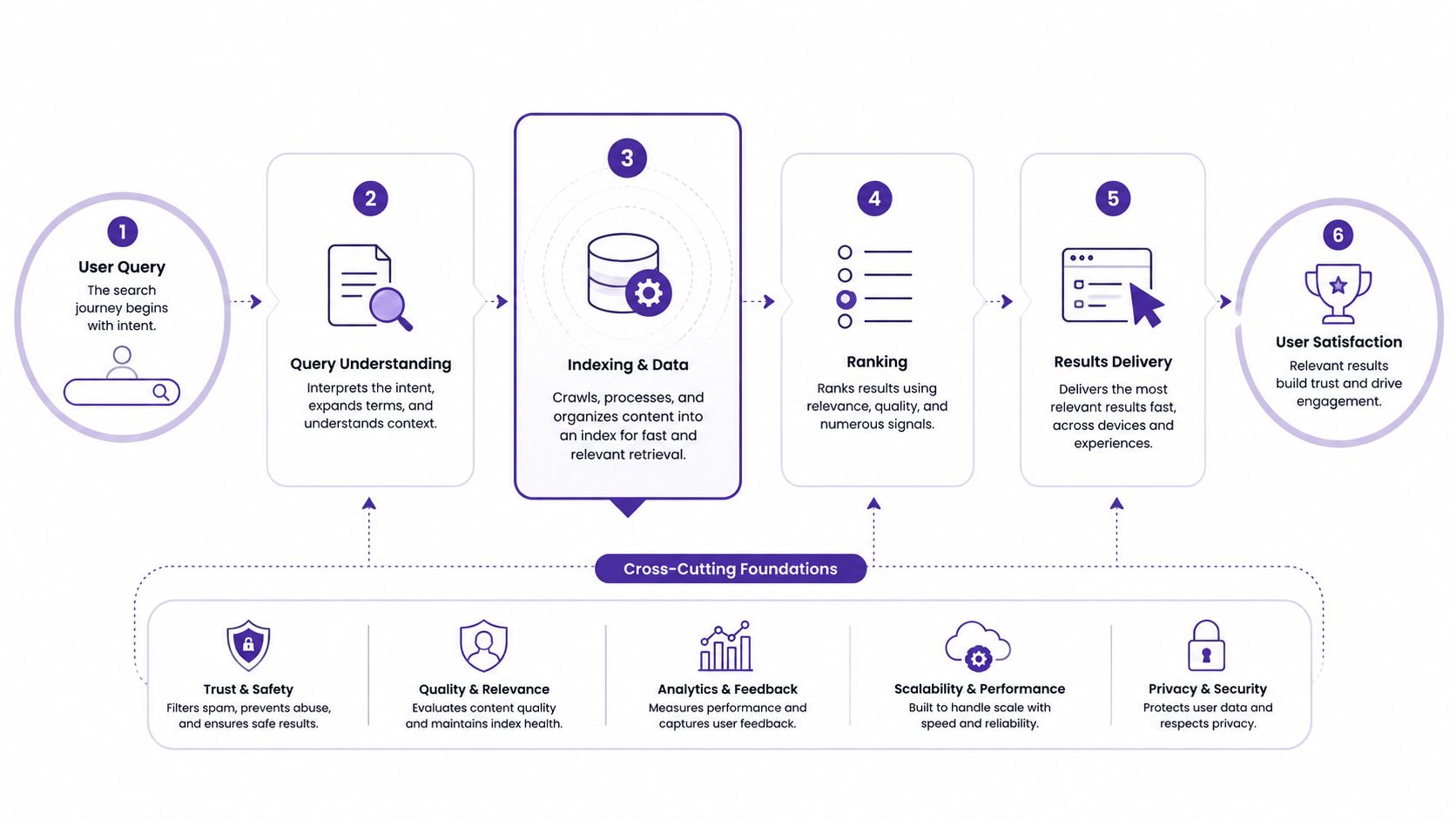
Retrieval-augmented generation in plain English
Retrieval-augmented generation, often shortened to RAG, is what makes AI powered search useful for serious editorial work.
A plain language model can generate polished text, but it may answer from general training rather than from your archive. RAG changes that. It first retrieves the most relevant source material from your documents, transcripts, or videos, then generates a response grounded in that material.
For creators, the difference is huge.
Without RAG, you ask, “What have we said about creator membership models?” and get a plausible summary that may or may not reflect your own published thinking. With RAG, the answer is built from your actual episodes, posts, interviews, and notes. That makes the response more useful for repurposing, editorial planning, and fact-checking.
A good implementation supports questions like:
- Synthesis tasks: “Summarize our strongest arguments on independent audience ownership.”
- Pattern spotting: “What concerns came up repeatedly across guest interviews?”
- Packaging work: “Which pieces belong together in a guide, playlist, or book concept?”
If you want a strong primer on the retrieval layer beneath this, semantic search versus keyword search is the distinction that matters most.
Taxonomy layering finds the hidden structure
The second component that matters for publishers is taxonomy layering.
This is less flashy than generative output, but often more valuable. A taxonomy is the system used to classify content by topic, format, audience, stage, tone, commercial intent, and other dimensions. Layering means you don't stop at one label. You build multiple ways of understanding the same asset.
A podcast episode might sit inside all of these at once:
- Topic layer: audience growth, platform risk, monetization
- Format layer: interview, clip-worthy, longform
- Business layer: sponsorship potential, evergreen, series candidate
- Audience layer: creators, marketers, publishers
That layered structure lets teams ask much better questions. Not just “find episodes about search,” but “show evergreen clips about search strategy for professional creators that can be repurposed into a sponsorship-ready package.”
Here's where the creative payoff appears. A publisher may discover that a 2018 interview, a 2021 column, and a 2023 panel transcript all support the same editorial thesis. That's not just search. That's product development.
A short explainer helps frame the flow from query to result:
The best AI search setups don't only retrieve content. They reveal relationships your team didn't have time to map manually.
That's why modern search works as a creative partner. It doesn't replace judgment. It expands what your editors can notice.
Real World Use Cases for Creators and Publishers
Theory gets interesting when it starts making money.
For creators and publishers, AI powered search becomes valuable the moment it helps turn old material into a new asset, a faster workflow, or a clearer offer. The most successful uses aren't abstract. They solve ordinary bottlenecks that block output.

Three practical scenarios
A YouTuber with years of back catalog wants to build a sponsor-friendly compilation around one product category. Instead of rewatching old uploads, they search the transcript archive for every meaningful mention, compare the tone and context, then cut a themed package from footage they already own. That lowers production friction and opens a path to new inventory from existing work.
A magazine publisher with a deep archive wants to create a premium anthology around one topic that has resurfaced in public conversation. AI powered search can cluster older essays, interviews, and reported features by concept, not just by issue date or keyword tag. Editorial staff still make the final selections, but the discovery stage stops being a manual excavation project.
A content marketing team asks its knowledge base a direct business question such as, “What are our strongest customer stories related to ROI?” The system returns relevant materials, summarizes the pattern, and points the team back to source assets. That's useful for sales enablement, campaign planning, and executive messaging.
If you're evaluating broader systems in this category, this guide to content intelligence platforms is a useful place to compare what “search” means across tools.
Repurposing gets easier when discovery gets better
Repurposing usually breaks down for one simple reason. Teams can't reliably find the right source material fast enough.
That's why AI-powered repurposing and AI-powered search work best together. AI content repurposing can automatically convert one approved asset into multiple channel-specific formats, enabling enterprise teams to achieve a 3 to 5x increase in content output per person per quarter, according to Typeface on AI content repurposing.
The hidden prerequisite is discoverability. Before a team can repurpose well, it needs to know what it has.
Here's what tends to work in practice:
- Clip extraction for video teams: Find moments by theme, objection, quote, or audience pain point.
- Series development for publishers: Group related archive pieces into fresh editorial packages.
- Channel adaptation for marketers: Pull one proven longform asset into email, social, blog, and sales formats.
What doesn't work is treating repurposing as a purely generative task. If the retrieval step is weak, the output will feel generic, repetitive, or disconnected from your best ideas.
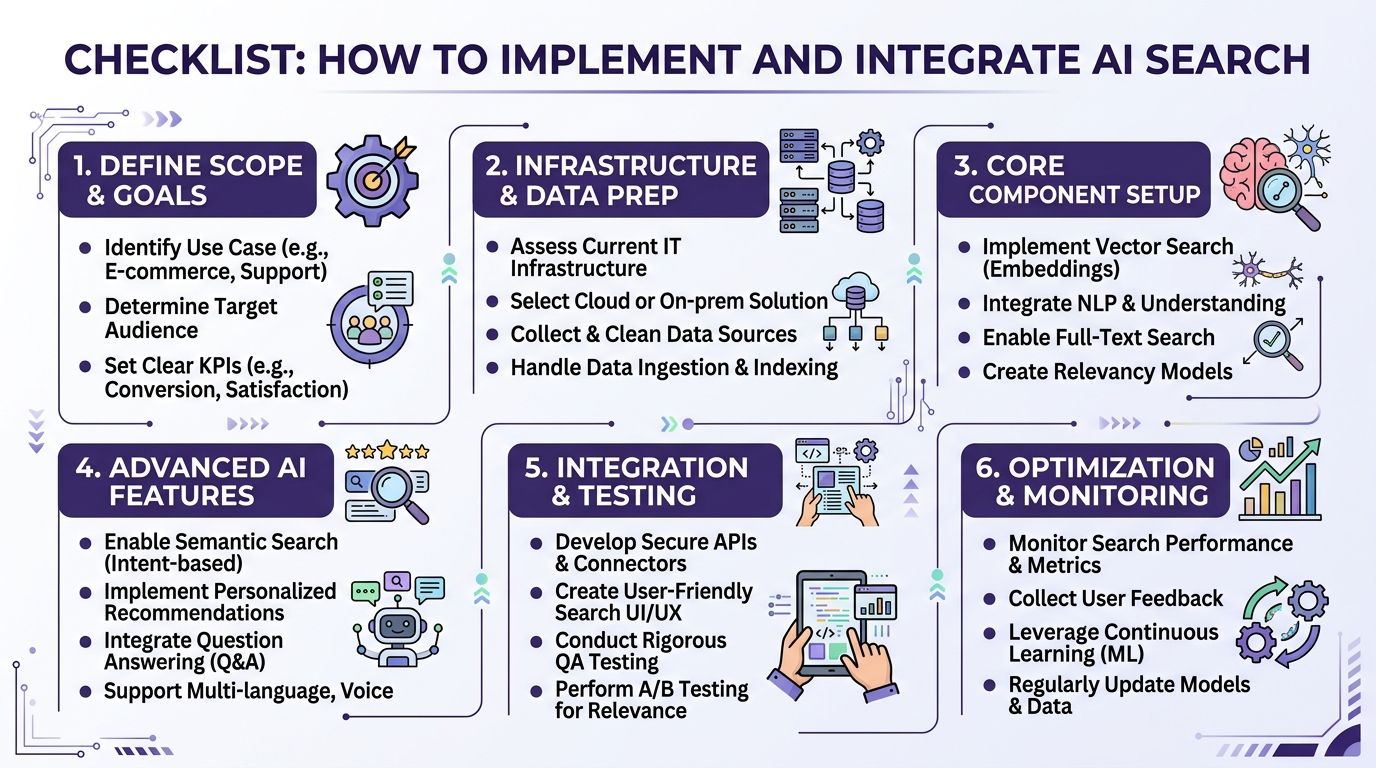
How to Implement and Integrate AI Search
Organizations often make AI search harder than it needs to be. They think the first step is tooling. It usually isn't.
The first step is choosing one business problem that's painful enough to matter and narrow enough to fix. Speeding up research for new videos is a good start. So is finding reusable archive material for newsletters, paid products, or sponsored packages. A vague goal like “use AI better” won't survive contact with a real workflow.
The timing matters. Gartner predicts traditional search engine volume will drop by 25% by 2026 because of the rise of AI chatbots. By Q1 2026, AI search visits had grown 42.8% year over year to more than 27.4 billion total visits, with ChatGPT accounting for 16.8 billion of those visits, according to Omnibound's roundup of AI search statistics.
A practical rollout checklist
Use a small operating model first, then expand.
Pick one retrieval job
Start with a repeatable need. Examples include surfacing old clips for shorts, finding all coverage on one topic, or summarizing archive material for a briefing doc.
Clean the inputs
AI search won't rescue chaotic source material. File names, transcripts, metadata, publication dates, and content types should be legible enough that the system can ingest them consistently.
Index the right assets first
Don't dump everything in on day one. Prioritize high-value materials such as flagship episodes, evergreen articles, interview transcripts, and research notes. If your team needs a primer, this overview of document indexing explains why indexing quality affects search quality.
Define answer standards
Decide what a useful answer looks like. Should responses link back to source material? Should they summarize only published assets? Should they separate drafts from final content?
What works and what usually fails
A strong implementation usually has a human editor in the loop. Search should speed up judgment, not replace it.
What tends to work:
- Focused pilots: One use case, one team, one library slice.
- Source-aware outputs: Answers that show where the material came from.
- Workflow fit: Search inside the tools and routines your team already uses.
What tends to fail:
- Messy libraries: If transcripts are missing and metadata is inconsistent, results become unreliable.
- No governance: Teams won't trust the system if published and unpublished material are mixed carelessly.
- Tool-first buying: A feature list won't fix an undefined workflow.
If your team is also thinking about discovery beyond owned archives, this piece on implementing AI for search optimization is a useful companion because it ties internal search habits to broader visibility strategy.
Start small enough that your team can feel the win quickly. Adoption follows usefulness, not announcements.
Measuring Success and Troubleshooting Common Hurdles
The wrong metric will make a good implementation look disappointing.
If you measure AI powered search only by page views or vanity engagement, you'll miss its real contribution. Search inside a content library is a production and monetization tool before it becomes a traffic story. The better questions are operational. Did research get faster? Did editors uncover more reusable material? Did the archive produce more ideas this month than last month?
Metrics that reflect business value
A simple scorecard works better than a giant dashboard. Look for movement in a few areas:
- Research speed: How quickly can someone assemble source material for a brief, episode, or article?
- Idea velocity: How many viable concepts came from the archive this month?
- Reuse rate: How often did teams repurpose older assets into new formats or packages?
- Editorial confidence: Do users trust the returned sources enough to build from them?
For answer quality, use a stricter lens. Benchmarking AI-powered search should evaluate the relevance of retrieved sources, the completeness of the final answer, and the faithful use of sources. Top-tier AI search agents can achieve up to 100% task completion on real-world queries by using criteria-grounded verification, as discussed in this benchmark-focused breakdown of AI search evaluation.
Strange answers are often useful signals
When an AI system gives a weak or odd answer, that's not always a failure. Sometimes it's a content diagnosis.
If the answer is incomplete, you may have gaps in transcripts, metadata, or taxonomy. If the answer misses certain communities, locations, or perspectives, your source library may not represent them well. That matters for multi-location brands, publishers with regional coverage, and teams serving underserved communities. AI systems can inherit those blind spots unless people actively audit and improve the source material.
A practical troubleshooting table helps:
| Problem | Likely cause | Best response |
|---|---|---|
| Irrelevant results | Weak indexing or vague prompts | Tighten metadata and ask more specific questions |
| Incomplete summaries | Missing source coverage | Add more archive material before judging output quality |
| Biased or uneven answers | Gaps in source diversity | Audit the library and broaden the dataset |
| Low team trust | No source transparency | Require answer citations back to the original assets |
Don't treat every bad result as proof the tool is broken. Treat it as feedback about your archive, your indexing, or your prompt.
That mindset turns troubleshooting into editorial improvement.
Your Contents Future Is Now
The biggest shift isn't technical. It's editorial.
When teams adopt AI powered search well, they stop treating the archive like a warehouse and start treating it like active infrastructure. Past work becomes searchable by meaning, connectable across formats, and reusable across channels. An old interview can support a new article. A buried transcript can become a short-form series. A scattered body of work can turn into a product, a package, or a sharper point of view.
That matters even more as search behavior keeps changing. Publishers and creators who own strong longform libraries have an advantage if they can structure and surface that material well. For audio teams especially, this perspective on podcast marketing for future AI search is worth reading because it connects durable longform content to discoverability in emerging AI-driven environments.
The practical takeaway is simple. Don't ask only, “What should we make next?” Ask, “What have we already made that deserves a second life?”
That's where new revenue often starts. Not with more output, but with better access to the insight you already own.
If you want a system built for that kind of work, Contesimal helps content teams organize, understand, and act on their libraries so old articles, podcasts, videos, and documents can become new research, new formats, and new revenue opportunities.