
You probably have more usable content than you think.
A YouTube channel with years of uploads. A podcast feed full of interviews. Blog posts that still rank for useful terms. Webinar recordings, newsletter archives, research docs, production notes, social clips, transcripts, drafts. From the inside, that library often feels less like an asset and more like a storage unit you keep paying for but rarely open.
That's where most creator-led businesses get stuck. They don't have a content problem. They have an organization problem, a retrieval problem, and a prioritization problem. The archive is full, but nobody can quickly tell what should be updated, repurposed, bundled, licensed, or turned into the next series.
A good digital transformation roadmap fixes that. Not with corporate theater. With a practical system that helps creators, publishers, and content teams organize what they already have, understand what matters, and take action that leads to revenue.
The timing matters. Global spending on digital transformation is projected to reach nearly $4 trillion by 2027 as organizations prioritize digital-first strategies, according to WalkMe's digital transformation statistics roundup. For content-heavy businesses, that matters because the same shift is reshaping the tools available for research, search, tagging, collaboration, and repurposing. If you run a content library well, you're no longer sitting on old files. You're sitting on future formats, future campaigns, and future products.
From Content Chaos to a Cohesive Strategy
Creators usually notice the problem in small moments.
A producer asks for a clip from an old interview, and nobody remembers the episode title. An editor wants to build a “best of” package, but the transcripts are inconsistent. A marketing lead needs three strong evergreen pieces for a campaign, and the team ends up making something new because searching the archive takes too long.
That's not a talent issue. It's an operating model issue.
What chaos looks like in a content business
In a factory, bad inventory control slows shipping. In a publisher or creator business, bad library control slows thinking. Your team spends time re-researching topics you already covered, recreating ideas you already tested, and overlooking strong material because it lives in disconnected folders, platforms, and formats.
A library without structure creates familiar symptoms:
- Discovery breaks down: You know the idea exists somewhere, but you can't locate the clip, quote, chapter, or segment fast enough to use it.
- Repurposing becomes random: Teams pull from whatever they can remember, not from what has the strongest business value.
- Revenue stays trapped in old work: The archive keeps gathering dust instead of feeding new videos, posts, newsletters, offers, or subscription value.
- Collaboration gets harder: Writers, editors, producers, and marketers work from different versions of the truth.
A content archive becomes valuable when the team can ask better questions of it and get usable answers back.
What a roadmap changes
A digital transformation roadmap for content creation is a plan for moving from scattered output to a working content system. It defines what you'll organize, what success looks like, which workflows need to change, and which tools support the work instead of complicating it.
For storytellers, this matters because your raw material isn't inventory on shelves. It's accumulated knowledge. Interviews. Themes. recurring audience questions. Evergreen explanations. Narrative patterns. Once your team can find and reuse those assets reliably, the library stops feeling heavy and starts behaving like a growth engine.
Assess Your Library and Uncover Hidden Value
Most content teams want better workflows, but they skip the boring part and go straight to tools. That usually backfires.
If your library is messy, a new platform won't magically produce clarity. It will just give your mess a nicer interface. The first job is to identify what you have, how it's stored, what performs, and what's still usable.
Start with your data legacy debt
Content organizations carry a specific kind of baggage. Old podcasts with no transcripts. Videos with weak metadata. Articles with broken categorization. Research files buried in drives. Historical content that exists, but can't be searched or connected.
That's data legacy debt. It blocks transformation because the archive can't support discovery, AI-assisted workflows, or efficient repurposing. As noted in the verified data above, 73% of firms cite data quality as their top barrier, and 60% of historical media output sits unused. For creator and publishing teams, that means the first serious move is operationalizing archival content into searchable, AI-ready assets.
Run the audit like an editor, not a bookkeeper
A useful library audit doesn't stop at counting files. It asks editorial questions.
Which assets still answer questions your audience asks today? Which series introduced ideas that could become playlists, guides, courses, or lead magnets? Which old interviews contain clips that would still work as shorts, carousels, or newsletter pull-quotes?
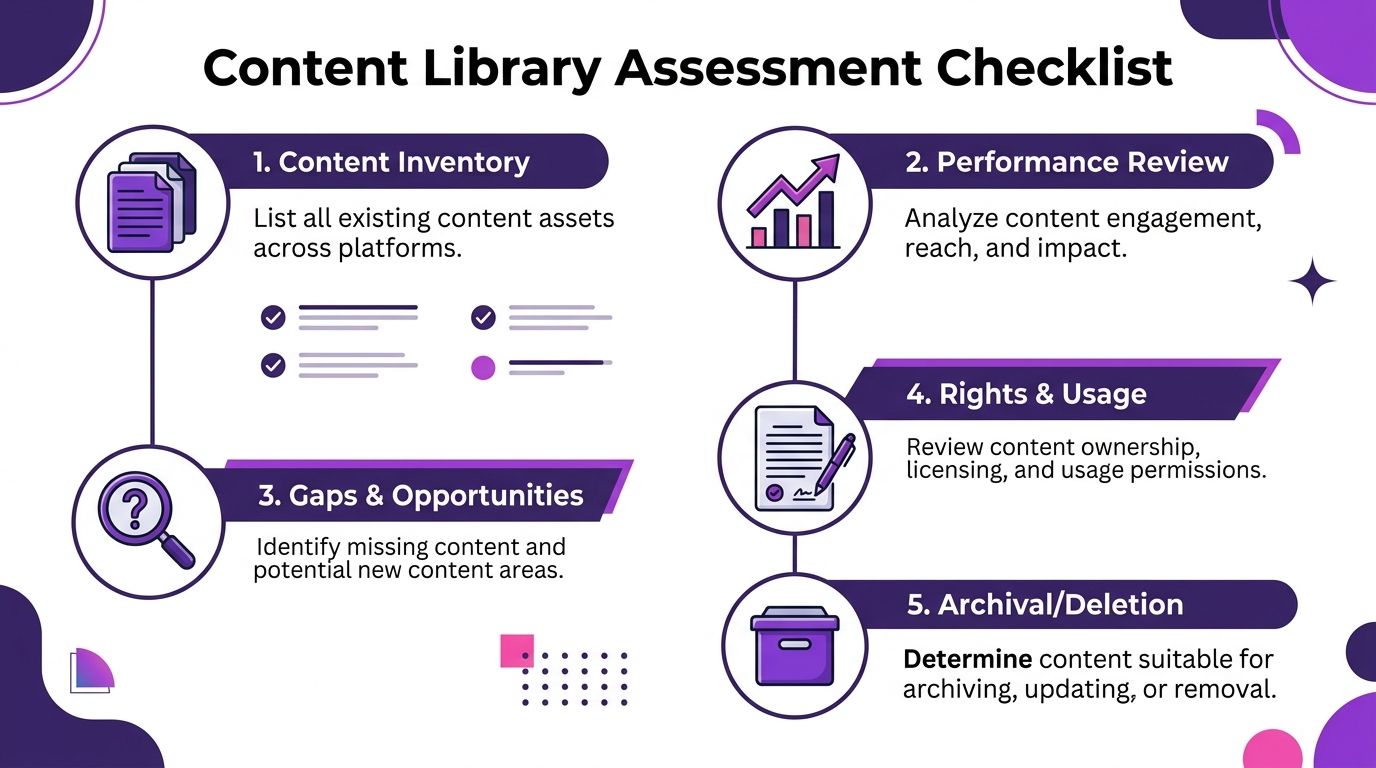
Use this five-part lens:
Inventory the formats
List your major asset types across platforms. Videos, podcasts, articles, newsletters, lead magnets, transcripts, research docs, and social derivatives all count.Review performance patterns
Look for content that earned durable attention, not just a quick spike. Evergreen assets often hide in plain sight.Identify gaps and adjacent opportunities
If one topic repeatedly performs, check whether you have enough supporting assets around it to build a cluster, playlist, or series.Check rights and usage
Some archive value is locked behind permissions, guest agreements, licensed media, or unclear ownership. Mark those early.Decide what to archive, refresh, or remove
Not everything deserves rescue. Some assets are “rockstars.” Some are “dust collectors.”
A simple maturity check
Here's a practical way to grade your current state.
| Area | Weak signal | Strong signal |
|---|---|---|
| Findability | Team relies on memory | Team can search by topic, format, guest, or theme |
| Metadata | Titles and folders do the work | Assets are tagged consistently and descriptively |
| Reuse | Repurposing is occasional | Repurposing is planned and repeatable |
| Performance insight | Metrics live in separate tools | Editorial and business signals are reviewed together |
| Collaboration | Research sits with individuals | Knowledge is shared across roles |
If most of your library sits on the left side of that table, start there. Don't jump to automation yet.
Practical rule: If your team can't find an old asset within minutes, you don't have a content library. You have content storage.
A structured worksheet helps. If you need a starting point, use this content inventory template for organizing existing assets. It's a good way to turn vague archive anxiety into an actual working list.
Find your hero content and your sleeping giants
Every mature library has two categories worth protecting.
- Hero content already proved itself. These are your strongest explainers, flagship interviews, cornerstone posts, or recurring episodes.
- Sleeping giants didn't become central assets, but they contain strong ideas, stories, or research that can be reframed for a different platform or audience entry point.
Publishers understand this instinctively. A deep feature from last year may not be homepage material now, but it can still become a new essay, a short audio segment, a thematic collection, or a premium resource if someone can surface it at the right moment.
That's the hidden value you're looking for.
Define Your North Star Goals and KPIs
A roadmap gets expensive when the destination is fuzzy. Teams stay busy, but the work becomes a pile of disconnected upgrades, experiments, and tool subscriptions.
For content businesses, a useful North Star ties transformation to business value. Not just visibility. Not just output. Not just “using AI.” Value.
Weak goals versus strong ones
A weak goal sounds modern but doesn't guide decisions.
- “Improve our content workflow”
- “Use AI better”
- “Grow across platforms”
- “Repurpose more content”
A strong goal changes behavior because it forces trade-offs.
- Increase revenue contribution from the back catalog
- Reduce research time for new episodes by making prior material searchable
- Improve the speed of turning long-form assets into multi-platform derivatives
- Increase conversion from evergreen content that already attracts qualified audience attention
The reason this matters is simple. Only 35% of digital transformation initiatives succeed, according to Mooncamp's digital transformation statistics roundup. But the same source notes that 59% of companies using technology to boost profits saw those profits grow by at least 11%. Clear goals don't guarantee success, but vague goals almost guarantee drift.
Pick KPIs that reflect a content business
Views still matter. So do subscribers, listens, and reach. But they shouldn't be your only compass.
Use a mix like this:
Operational KPIs
Time to locate reusable source material, time to brief a new piece, speed of repurposing workflow, editorial turnaround.Library KPIs
Share of archive that is searchable, tagged, transcript-ready, rights-cleared, or actively reused.Business KPIs
Revenue tied to evergreen assets, conversion from archive-driven campaigns, sponsorship support from packaged back-catalog themes.Audience KPIs
Engagement with refreshed content, return visits to evergreen clusters, cross-platform movement from one format to another.
One test for every KPI
Ask one question. “Will this metric help us choose what to do next?”
If the answer is no, it's probably a vanity metric or a lagging signal with no operational use.
Good KPIs don't just prove performance. They tell the team where to invest next.
For a YouTuber moving from hobbyist to business, that might mean tracking which old videos consistently generate qualified watch time and can support a new series. For a publisher, it might mean measuring how often older features drive newsletter signups after a refresh. For a podcast team, it could mean watching which archive episodes produce the best clips, quotes, or derivative written assets.
That's the shift. You stop asking, “How is this one piece performing?” and start asking, “How is the library helping us build a business?”
Prioritize Initiatives and Select Your Tech Stack
Once goals are set, organizations often encounter the same temptation. Buy a shiny tool and hope it creates momentum.
That's backwards. Sequence matters more than novelty.
Start with the work that makes later wins possible
A strong digital transformation roadmap for creators usually begins with foundational initiatives, then moves toward growth initiatives.
Here's the order that tends to work.
Foundation first
Before you chase expansion, tighten the base:
- Standardize metadata: Decide how you'll tag topics, guests, series, formats, audience stage, rights status, and performance markers.
- Clean up transcripts and source files: Search quality falls apart when transcripts are incomplete or inconsistent.
- Consolidate scattered knowledge: If research lives in docs, clips in editing tools, and strategy in someone's head, your system won't scale.
- Clarify ownership: Somebody has to own taxonomy, workflow rules, and naming conventions.
Without this layer, every later initiative gets slower.
Then build the revenue levers
After the library becomes findable, the growth work starts:
- Turn flagship assets into repeatable repurposing pipelines
- Build thematic clusters around proven topics
- Package archive material for newsletters, playlists, gated resources, or sponsor support
- Use searchable history to speed up ideation for new content
Content teams often experience the first real operational lift. According to Digital Applied's guide to turning one piece into ten formats, the benchmark is to generate at least 10 distinct content assets from every flagship piece, and active repurposing programs often report 10 to 20+ hours saved per week. That's not just efficiency. It's what turns one-off publishing into a system.
Don't buy tools that solve the wrong problem
A creator business doesn't need every tool on the market. It needs a stack that supports retrieval, analysis, collaboration, and action.
A simple decision table helps.
| Need | Wrong tool choice | Better tool choice |
|---|---|---|
| Find old insights fast | Another storage layer | Searchable content intelligence system |
| Repurpose consistently | Manual copying across apps | Workflow-friendly platform with reusable source context |
| Align writers, editors, marketers | Isolated AI assistants | Shared workspace for human and AI collaboration |
| Build topic clusters | Generic analytics alone | System that connects performance with archive content |
The trade-off is real. All-in-one tools can simplify handoff, but they may be weaker in a specialized area. Best-of-breed stacks can be powerful, but they often create more fragmentation. If your team is still early, choose fewer systems with clearer roles.
A useful evaluation framework includes:
Library fit
Can the platform handle articles, transcripts, audio, video, notes, and historical files without forcing awkward workarounds?Search depth
Can users retrieve information by theme, concept, guest, quote, or segment, not just by title?Collaboration design
Does the tool support shared research and editorial decision-making, or is it built for a solo prompt-and-response workflow?Operational speed
Can you upload, classify, and act quickly enough for an active production schedule?
One category worth understanding is content intelligence platforms built for modern teams. The best ones don't just store files. They help teams organize, understand, and act on the knowledge already inside the archive.
Human plus AI beats human versus AI
Creative teams often ask the wrong question. They ask whether AI should replace parts of the process. The better question is where AI can reduce friction while humans keep editorial judgment.
That usually means:
- AI helps classify and surface patterns
- Editors decide what deserves reuse
- Producers shape format and sequence
- Marketers choose packaging and distribution
- Writers protect tone, framing, and nuance
That model is especially useful for podcasters, YouTubers, and publishers with recurring series. A good system can surface previous treatment of a topic, reveal forgotten angles, and speed up derivative work. But a person still decides what belongs in the final cut.
A short walkthrough makes that clearer:
The practical takeaway is simple. Don't select a stack because it sounds advanced. Select it because it reduces search friction, supports collaboration, and helps your archive produce new value.
Build Your Roadmap and Champion Change
A roadmap should look less like a manifesto and more like a production schedule. Creative teams work better when the plan is visible, phased, and tied to real outputs.
That means quarters, owners, milestones, and a pilot that can prove the model before you ask everyone to change how they work.
Build the roadmap in practical phases
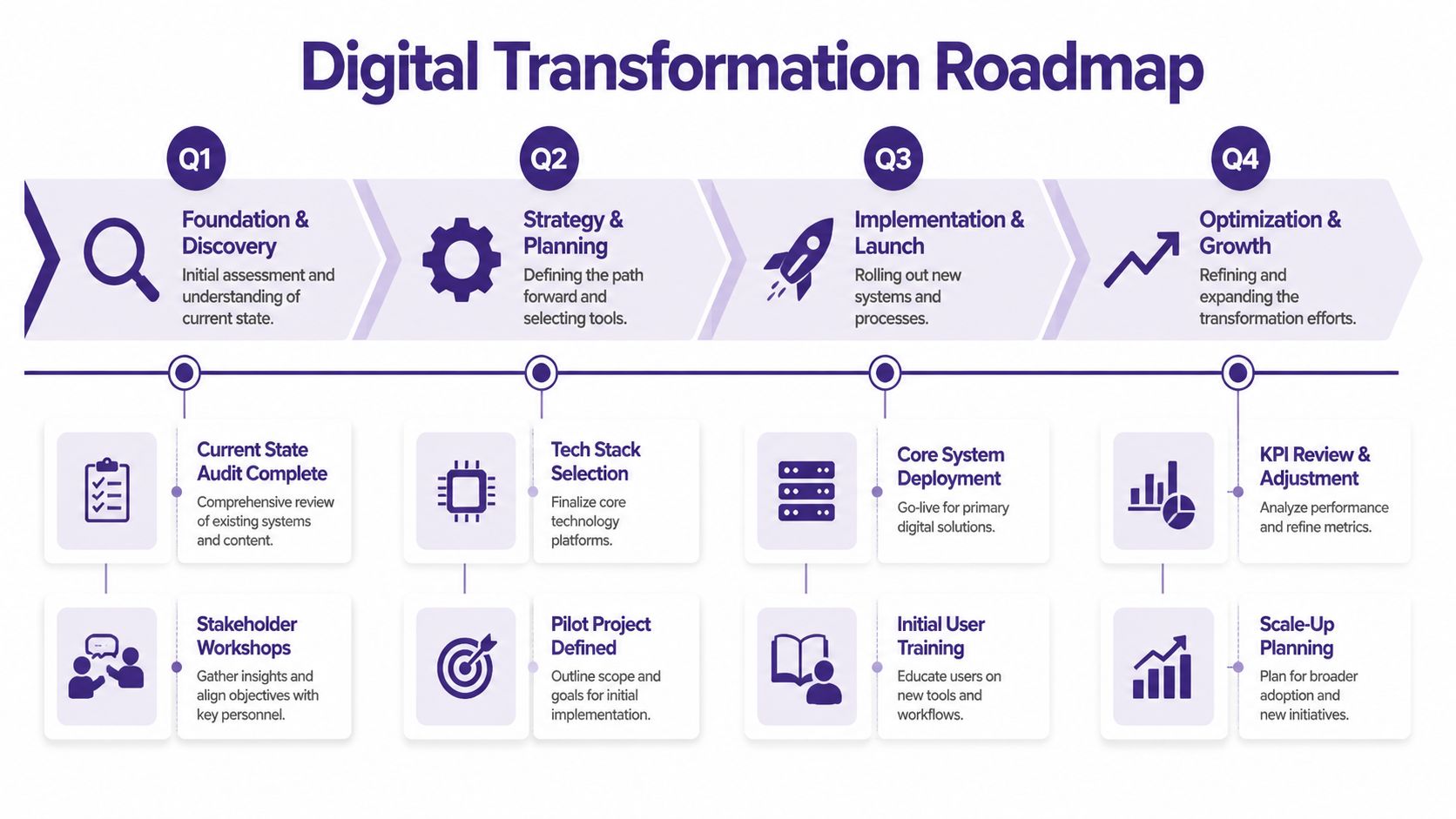
A simple four-phase model works well for content organizations.
Q1 foundation and discovery
Audit the library. Define taxonomy. Review current workflows. Identify the most reusable content families. Hold working sessions with the people who touch the content every week.
Q2 strategy and planning
Choose the core systems. Define the pilot. Set operating rules for naming, tagging, retrieval, and rights handling. Decide which team members own adoption.
Q3 implementation and launch
Ingest content. Train the pilot team. Run one live use case, such as turning archive podcast episodes into clips, articles, and newsletters. Watch where friction appears.
Q4 optimization and growth
Review KPI movement. Tighten the workflow. Expand to more content types, more contributors, or another department.
Change fails when creative teams feel managed instead of helped
Many roadmaps falter. The process looks sound, but the people doing the work don't buy it.
The verified data on the cultural governance paradox is blunt. 68% of digital initiatives fail due to poor cross-functional adoption, and 82% of standard roadmaps don't explain how to blend human creativity with AI insights. For publishers and creator teams, that gap is lethal. If writers think the new system will flatten their voice, or editors think it adds admin work, adoption stalls fast.
The best roadmap for a creative team removes friction from the craft. It doesn't try to replace the craft.
How to get buy-in from creators and editors
Don't roll this out as “AI transformation.” That phrase makes people defensive before they've seen a single useful workflow.
Try this instead:
Lead with a pain point they already feel
“We waste time finding old material” is persuasive. “We need advanced AI capability” usually isn't.Show one working use case
For example, take one strong interview and turn it into clips, social posts, article ideas, and a refreshed newsletter package.Protect editorial control
Make it explicit that machines can surface options, but humans approve framing, sequencing, and final output.Name workflow boundaries
Decide where automation starts and stops. Teams relax when they know what still requires a human decision.
If you want another perspective on roadmaps tied to operating performance, this guide on strategies for digital efficiency and growth is a useful companion read.
A roadmap needs owners, not just enthusiasm
Every phase should have named responsibility. Not “marketing.” Not “content.” A person.
Use a simple owner map:
- Editorial lead owns taxonomy standards and content selection
- Operations lead owns workflows and system hygiene
- Producer or managing editor owns adoption in day-to-day production
- Leadership sponsor removes blockers and keeps priorities stable
That structure matters because transformation drifts when everyone supports it in theory but nobody owns it in practice.
Measure Success and Create Your Content Flywheel
The first version of your roadmap won't be the final version. That's normal. A content business changes too fast for a static plan.
What matters is building a review rhythm that turns performance data into editorial decisions. That's how a transformation effort becomes a flywheel instead of a one-time clean-up project.
Review the library on a fixed cadence
Top-performing content organizations conduct quarterly reviews using hard metrics such as page views, conversion rates, and time-on-page to identify the best assets for repurposing, according to Cloud Present's guide to content repurposing. That cadence works because it's frequent enough to catch opportunities and slow enough to reveal patterns.
A quarterly review should answer questions like:
- Which older assets still attract meaningful attention?
- Which topics convert better after an update or repackaging?
- Which formats create the strongest downstream action?
- Which archive materials support the next content series?
- Which assets should be retired, merged, refreshed, or promoted?
Build the flywheel from one asset to the next
The flywheel is simple in principle.
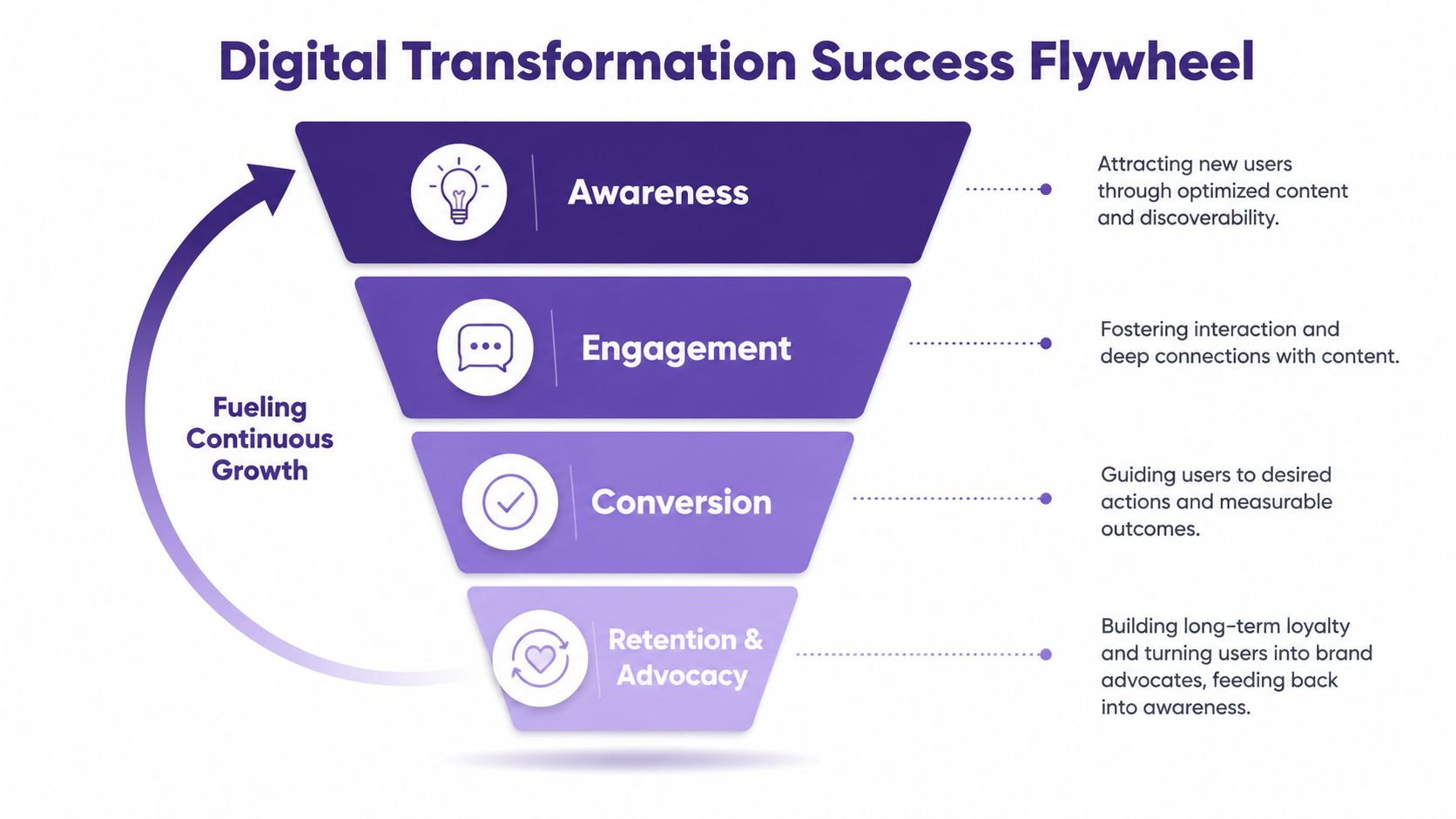
A strong library asset gets resurfaced. That repurposed asset reaches people on another platform. Their engagement reveals what angle, format, or question matters most right now. That insight shapes a new flagship piece. The new flagship piece enters the library in a better-organized form, ready for future reuse.
That loop compounds.
What the flywheel looks like in practice
| Stage | What the team does | What the library gains |
|---|---|---|
| Awareness | Refresh and distribute proven archive assets | More entry points into evergreen ideas |
| Engagement | Watch what people read, click, save, or share | Better topic and format signals |
| Conversion | Package the best ideas into offers or next steps | Stronger link between content and revenue |
| Retention and advocacy | Build recurring series and useful follow-ups | Deeper audience trust and more reusable assets |
Editorial discipline beats volume. A smaller set of well-tagged, well-reviewed assets will outperform a larger archive nobody can interpret.
Don't measure only the new stuff
Teams naturally obsess over fresh content because it's visible. But in a transformed content operation, older assets should earn scrutiny too.
An archive article that drives conversion after a refresh may deserve more budget than a new piece that spikes and disappears. A two-year-old interview may contain the strongest clips for a current theme. A past newsletter thread may be the seed for a lead magnet or premium collection.
That's why performance analysis has to connect current signals with historical assets. A toolset can help, but the habit matters first. This practical guide on how to analyze content performance is useful if your metrics are still scattered across dashboards and platforms.
What success looks like after the shift
Success doesn't mean your team publishes more for the sake of it.
It means your archive becomes easier to search, stronger at generating ideas, and more reliable as a source of revenue-supporting work. It means your next video, article, episode, or campaign starts with context instead of guesswork. It means the library gets more valuable every time you use it.
That's the fundamental promise of a digital transformation roadmap for content creators and publishers. Not abstract modernization. A working system that helps you organize, understand, and take action on the content you've already earned.
If your team is ready to turn a scattered archive into a searchable, collaborative content system, Contesimal is built for that job. It helps creators, publishers, and content teams organize large libraries, surface hidden insights, and turn past work into new value across research, production, and repurposing.