
The most popular advice about competitive content analysis is also the least useful: make a spreadsheet of rival keywords, check who ranks, and publish a longer version. That approach can reveal what competitors cover, but it often misses the questions their pages leave unanswered, the formats their audiences prefer, and the places where AI systems, reviewers, social platforms, and third-party publishers shape discovery.
A stronger process treats competitor research as content intelligence. You examine owned pages, external mentions, search features, engagement patterns, intent, and AI citations, then connect those findings to the library you already own. The payoff isn't another oversized content calendar. It's a practical system for turning existing articles, episodes, interviews, videos, and research into work that answers a clearer need and travels further.
Redefining Competitor Tracking for Modern Search
Checking only the top organic results gives you a narrow view of competition. A brand can rank well on its own website yet remain absent from review sites, social conversations, publisher coverage, and AI-generated answers. Conversely, a competitor may have modest owned-channel output but appear repeatedly in the summaries and citations that audiences now use to discover information.
A foundational shift in competitive content analysis is the move from simple competitor listing to multi-surface benchmarking. Modern analysis evaluates what a brand publishes, what third parties say about it, and what AI search platforms surface, including the frequency and sentiment of brand mentions. Semrush's competitive analysis guidance describes this broader view of visibility across owned, external, and AI-mediated discovery.
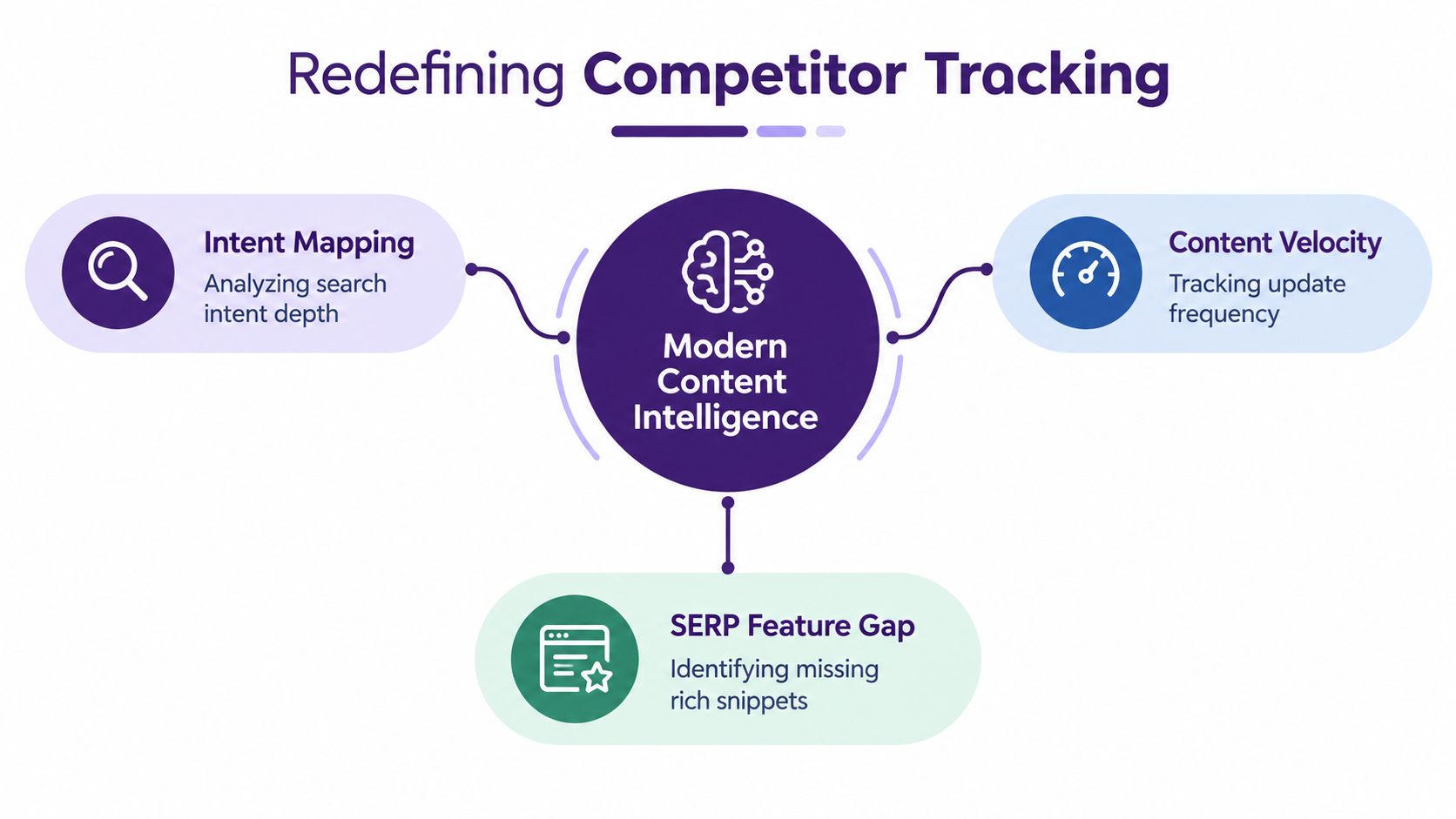
Track the surfaces that influence decisions
For a creator, publisher, or marketing team, the relevant question isn't just, “Who outranks us?” Ask instead:
- Owned visibility: Which pages, episodes, videos, and guides attract search demand?
- Third-party visibility: Which reviews, interviews, roundups, communities, and publications mention each competitor?
- AI visibility: Which brands are summarized, cited, or recommended when people ask systems for comparisons, explanations, or buying guidance?
- Sentiment and framing: Are external sources describing a competitor as authoritative, affordable, difficult to use, or something else?
- Format presence: Does the competitor appear through articles, video, podcasts, social posts, newsletters, or reference material?
This matters especially for publishers and media organizations with substantial archives. Owned-channel volume is only one part of portfolio performance. Discovery may happen through a search result, a quoted passage in an AI answer, a review, a social clip, or an external article that introduces a reader to the brand.
Practical rule: Track where your audience forms an opinion, not only where your domain owns a URL.
A useful review starts with a manageable competitor set. Data Hunters Agency's guide to outranking rivals offers practical context for examining competitor tactics, but the analysis should go beyond rankings. Record whether a page earns a rich result, whether a third party reinforces its message, and whether AI systems retrieve its material when the query becomes conversational.
The strategic change is significant. A static spreadsheet answers what competitors did at a moment in time. A multi-surface workflow asks what audiences can currently find, which sources they trust, and what your library could contribute that the market hasn't explained well.
Building a Repeatable Benchmarking Workflow
Subjective reviews produce subjective decisions. One person calls a competitor page “thorough,” while another sees a bloated introduction and weak evidence. A repeatable benchmark replaces impressions with comparable observations.
Start with 5–10 core keywords, inspect the top 5 ranking pages per keyword, and record word count, heading structure, multimedia usage, featured-snippet ownership, and average domain authority. This practical workflow is outlined in HubSpot's competitive analysis kit. The value isn't the spreadsheet itself. The value is making every reviewer inspect the same signals.
Set up the comparison model
Create a row for each ranking page and keep the fields consistent. Don't judge quality before recording the underlying characteristics. A page with fewer words may answer a narrow task better than a longer page, while a visually rich guide may serve a different intent from a definition page.
| Metric Category | Specific Data Points to Record | Strategic Purpose |
|---|---|---|
| Search alignment | Keyword, query wording, apparent intent, answer type | Shows whether the page matches the task behind the query |
| Page structure | Word count, heading hierarchy, summaries, tables, lists | Reveals how competitors make information scannable |
| SERP presence | Featured-snippet ownership, rich-result format, visible page elements | Identifies format opportunities beyond standard rankings |
| Media mix | Images, video, audio, diagrams, downloadable assets | Helps match content packaging to audience expectations |
| Authority context | Average domain authority, referring-page context, brand strength | Separates a content weakness from a distribution advantage |
| Conversion path | Calls to action, related links, forms, product references | Connects informational coverage to business outcomes |
| Freshness | Publication date, update signals, evidence of maintenance | Indicates whether competitors invest in ongoing relevance |
Add a performance layer
Search rankings show visibility, not necessarily audience response. For a competitor with a visible content archive, export recent posts, sort them by an engagement metric, and isolate approximately the top 10–15% as an A+ tier. Compare those posts with D-tier material. Look for recurring traits in the opening, format, point of view, pacing, examples, calls to action, and distribution pattern.
Treat the result as a hypothesis, not proof of causation. A repeated hook may coincide with a strong topic, timely promotion, or an established audience. Your next step is to test the pattern in your own voice, not to copy the post.
A useful audit produces decisions such as:
- Keep: Elements that fit your audience and existing production strengths.
- Improve: Formats or topics competitors use, but explain poorly.
- Differentiate: Unanswered questions, underserved audiences, or distinct viewpoints.
- Retire: Repeated formats that consume resources without a clear strategic role.
Tag every finding with a source page and an intended action. A note that says “competitor uses video” is weak. “Turn the troubleshooting section of our guide into a demonstration video because competing pages provide only text” can enter a production queue.
For teams working across articles, videos, podcasts, and research files, this content analysis workflow from Contesimal provides a useful internal reference point for organizing material before turning observations into briefs.
Identifying Intent Gaps and Originality Flaws
A crowded topic can still contain a valuable opportunity. Competitors may rank for the same subject while serving the wrong job, such as defining a concept when readers need to compare options, troubleshoot a problem, or make a decision. That intent gap often matters more than a missing keyword.
Searchers arrive with tasks, not abstract topics. A beginner may need a definition, an experienced buyer may need trade-offs, and a frustrated user may need a diagnostic sequence. One broad article rarely handles all three with equal clarity. The same distinction now applies across search results, social feeds, video platforms, and AI-generated answers. Check whether competitors are being cited for the questions your audience asks, not only whether they rank for familiar terms.
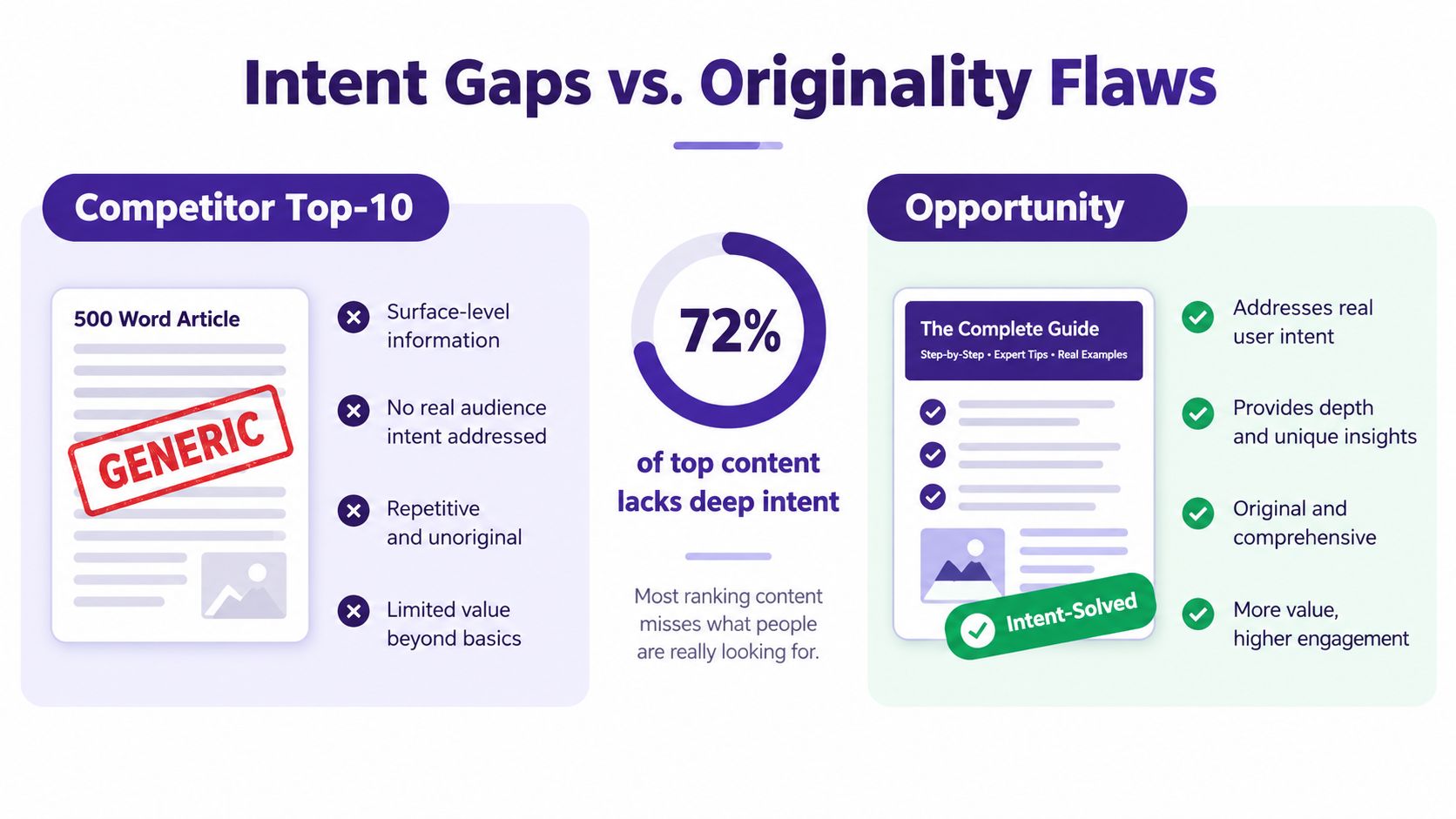
Start by asking whether the market is missing the subject entirely, covering it for the wrong task, covering it badly, or covering it with recycled phrasing. Those are the topic gap, intent gap, quality gap, and originality gap. A quality problem appears in confusing explanations, incomplete coverage, weak structure, or unsupported recommendations. An originality problem remains even when an article is polished if it repeats the same advice without a distinct perspective, example, method, or interpretation.
Judge both gaps by the reader's next action. Can the page help someone choose, fix, compare, plan, or apply something? An unconventional article can be useful with a modest production budget, while a polished article can offer little that readers have not already seen.
Semrush's content gap analysis guidance reinforces the broader point: competitor research should examine missing tasks, quality weaknesses, and distinctive opportunities, not only uncovered topics.
Write briefs around the neglected task
Take a shared topic and list the jobs a reader might be trying to complete. Compare each competitor page against those jobs, then record the missing evidence, format, or workflow. A group of “content repurposing” articles may explain the concept while avoiding workflow design, editorial approvals, platform adaptation, and archive selection. The subject is crowded. The practical task remains underserved.
Examine the introduction, headings, process, decision framework, examples, troubleshooting, audience assumptions, objections, and format. This prevents the usual response to weak competition: producing a longer imitation. A clearer decision tree, better demonstration, honest trade-off, or more actionable format can create the advantage.
A useful brief should name the neglected job in plain language. The Contesimal content gap analysis template provides a ready structure for recording those jobs alongside competitor pages. “Help an established podcaster turn one research-heavy episode into platform-specific assets while preserving the original argument” gives a production team a usable direction. “Target the repurposing keyword” does not. Capture the source gap, the intended audience, the required format, and the internal asset that could supply the missing evidence.
Connecting Insights to Your Content Library
Competitive content analysis creates waste when every insight becomes a brand-new assignment. Your archive may already contain the evidence, stories, explanations, and raw material needed to answer the gap. The missing step is mapping market opportunities to internal assets.

Begin with an asset-to-intent map. For each competitor weakness, search your library for material that already addresses the underlying task. An old interview may contain the comparison criteria a new article needs. A podcast episode may include a troubleshooting sequence. A longform video may provide demonstrations that competing text pages lack.
Turn one source into a deliberate asset family
Repurposing isn't copying the same paragraph into every channel. It means preserving the central insight while changing the shape, opening, level of detail, and call to action for each audience.
A practical transformation chain might look like this:
- Source asset: An in-depth article, interview, episode, or recorded presentation.
- Intent extraction: Pull out questions, objections, examples, processes, and decisions.
- Primary update: Refresh the source so it directly addresses the newly identified intent gap.
- Video adaptation: Create a concise explanation, walkthrough, or response to one specific question.
- Audio adaptation: Build a short discussion or narrated version for listeners who prefer episodic learning.
- Social adaptations: Extract strong claims, contrasting viewpoints, checklists, and audience prompts.
- Conversion asset: Offer a worksheet, consultation path, subscription, product demonstration, or related resource.
The sequence should follow the gap, not a rigid channel quota. If competitors fail to demonstrate a process, prioritize video. If they bury comparison criteria in dense prose, create a table and a decision guide. If external discussions contain recurring objections, produce short responses that link back to the authoritative source.
An independent industry roundup states that one source piece repurposed across 6–8 platforms can reach roughly 4–7x the unique audience of single-platform publishing for most niches, based on operator audits rather than a single benchmark study. The roundup's methodology and qualification matter here because the figures aren't presented as a universal controlled benchmark. Use the finding as a planning signal, then measure your own audience overlap and actual response.
Make the library searchable by meaning
A large archive becomes useful when teams can find more than titles. Tag assets by topic, intent, format, audience stage, evidence type, freshness, rights status, and potential reuse. Store transcripts and editorial notes alongside videos and audio so researchers can locate a relevant passage without replaying an entire episode.
This approach helps creators move from “What should we publish next?” to “Which existing asset can answer this market gap, and what transformation does it need?” That shift reduces duplicate research and gives old work a clear route back into circulation.
Avoiding Common Measurement and SEO Pitfalls
The fastest way to damage a competitive content program is to confuse activity with progress. Teams often respond to a competitor by inserting the target phrase repeatedly, extending an article without improving its answer, or celebrating a short-lived traffic spike. None of those actions establishes that the strategy works.
Keyword relevance still matters, but it should support intent rather than replace it. One industry source reports that 39% of marketers struggle with keyword stuffing, and that 61% of Google penalties tied to over-optimization were linked to that behavior. The source's SEO statistics and context provide the figures, but the practical lesson is straightforward: write for the task first, then make the language clear enough for search systems to understand.
Stop treating noise as a signal
Small metric changes can result from seasonality, distribution, rank volatility, audience composition, or tracking problems. Before calling a change meaningful, ask whether the sample is large enough for statistical confidence. A single page, one keyword, or one unusual post isn't a reliable basis for changing an editorial system.
Use repeated sampling across pages, topics, and time windows. Compare stable indicators such as ranking position, engagement rate, and content depth, while keeping the comparison conditions consistent.
A disciplined review separates:
- Observation: A competitor page owns a featured snippet for a query.
- Hypothesis: Its concise definition and ordered structure may fit that SERP format.
- Test: Publish a practical version with a comparable answer structure.
- Evaluation: Monitor visibility and engagement over an appropriate period.
- Decision: Keep, revise, or discard the format based on repeated evidence.
Protect the reader from optimization theatre
Keyword stuffing often appears when teams treat a page as a container for terms rather than a response to a person. Read the draft aloud. Remove repeated phrases that add no meaning. Replace generic introductions with the answer, use headings that reflect real questions, and include supporting detail where the reader needs to make a decision.
This guide to analyzing content performance can support a more grounded review of page-level results. Pair performance data with editorial judgment. A page with fewer visits may serve a valuable conversion or retention role, while a high-traffic page may create little business value if it sends visitors away confused.
Measurement principle: Don't optimize the metric you can access most easily. Optimize the reader action your content is supposed to support.
Operationalizing Your Analysis for Continuous Growth
A useful analysis becomes an operating rhythm, not a document that disappears after a planning meeting. Assign ownership, define the fields everyone records, and create a visible route from competitor observation to library asset to published adaptation.
A lightweight cycle can run like this:
- Review signals: Monitor priority queries, competitor updates, third-party mentions, AI citations, and recurring audience questions.
- Classify opportunities: Label each finding as topic, intent, quality, originality, format, or distribution.
- Search the archive: Match the opportunity with existing articles, transcripts, videos, episodes, research, and editorial notes.
- Choose the transformation: Refresh, expand, excerpt, translate into video, turn into audio, or build a new decision aid.
- Assign a responsible owner: Give the brief to an editor, creator, researcher, or AI-assisted production partner.
- Record outcomes: Connect the published asset to its source, target intent, format, and chosen measurement signals.
- Review and recycle: Keep strong assets in a refresh queue and retire adaptations that no longer serve a clear purpose.
The workflow should support human and AI collaboration without handing strategic judgment to an automated system. Humans define audience needs, editorial standards, rights boundaries, and the point of view. AI can help classify material, find related passages, surface patterns, generate adaptation options, and prepare drafts for editorial review.
A 2026 marketing statistics roundup reports that 48% of B2B marketers identified insufficient content repurposing as a primary barrier to scaling content production, compared with 40% for communication silos and 31% for the absence of structured production processes. The roundup's operational context positions repurposing as a workflow constraint, not merely a creative preference.
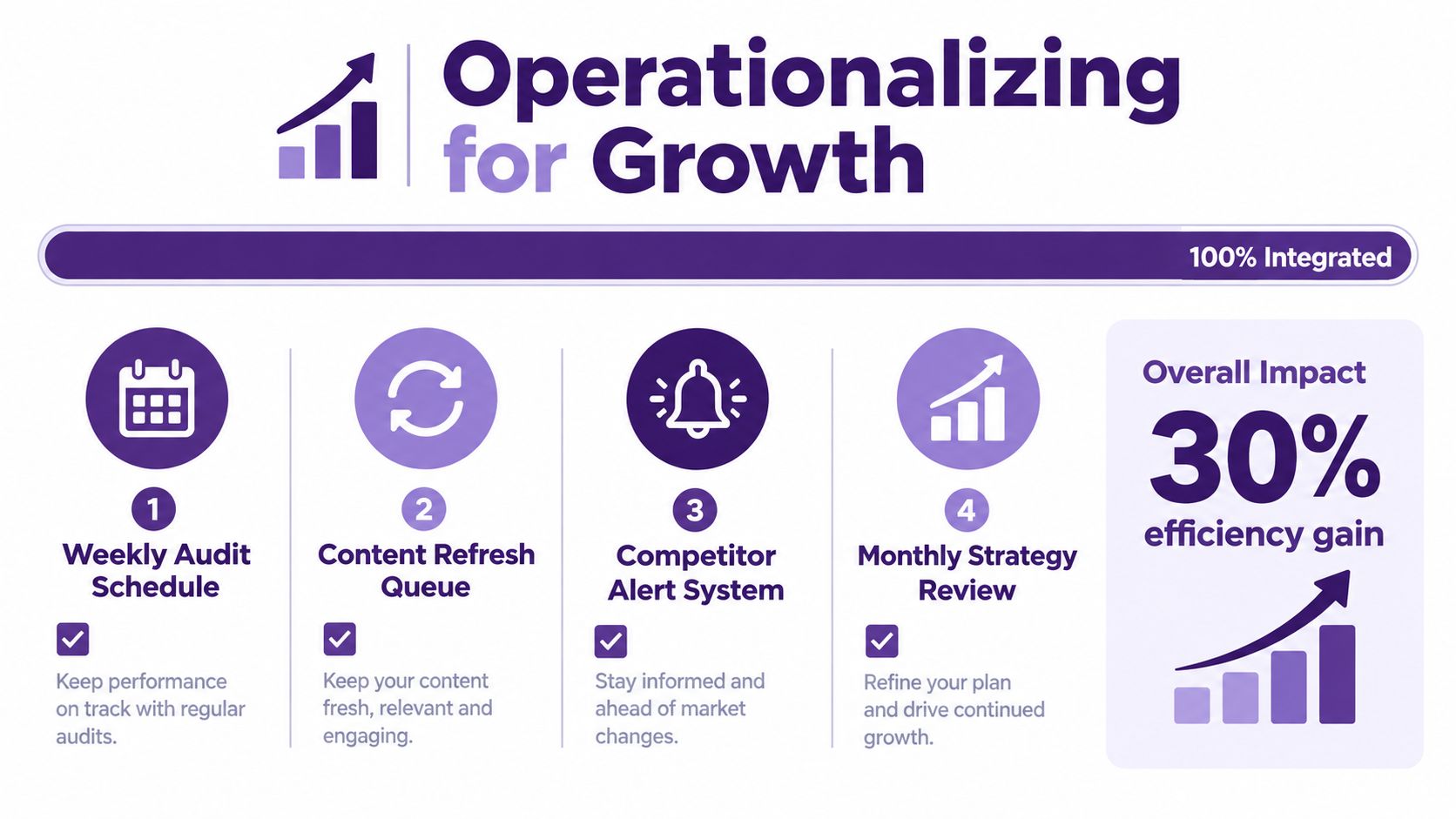
Use a simple control sheet with these fields:
- Finding: What did the competitor or external surface reveal?
- Reader task: What does the audience need to do?
- Library match: Which existing asset contains useful material?
- Adaptation: What must change for the new format or intent?
- Owner and status: Who is responsible, and where is the work?
- Evidence of success: Which stable signals will determine the next decision?
That structure helps creators, publishers, and content executives build value from what they already know. It also gives hobbyist YouTubers, podcasters, bloggers, and video makers a more practical path toward professional operations, because growth doesn't require starting every idea from an empty page.
Contesimal helps creators and publishing teams organize articles, podcasts, videos, and research so competitive insights can become targeted updates and repurposed assets. Visit Contesimal to connect your content library with AI-assisted discovery, collaboration, and production workflows that turn existing work into new opportunities.