
You've published for years, but your archive still behaves like a storage room. A podcast episode sits apart from the article it inspired, a useful interview remains buried in a video folder, and old posts contain ideas you've already researched but haven't reused. You know there's value in the library. You just can't see its shape clearly enough to act on it.
Content analysis turns that clutter into an operating system for your content. It helps creators, publishers, marketers, editors, authors, and production teams identify themes, classify assets, find gaps, and decide which existing ideas deserve a new format, a new audience, or a new distribution channel. The practical question isn't only what your content says. It's how your library can create its next useful output.
Unlocking Value from Your Content Library
A content library becomes valuable when you can retrieve knowledge from it quickly. Without analysis, your archive is a collection of files. With analysis, it becomes a map of recurring questions, strong narratives, audience interests, unused research, and formats that can support future production.
That shift matters for anyone moving beyond one-off publishing. A YouTuber may have a long interview that can become short clips, a newsletter, a searchable article, and a topic cluster. A publisher may have years of reporting that can support a new series. A podcaster may discover that several conversations point toward a coherent playlist or a paid resource. Content analysis makes those connections visible before your team spends time creating from scratch.

Start with an inventory, not an idea
Begin by collecting the assets you own or control:
- Longform sources: Articles, books, reports, interviews, webinars, podcast episodes, and video transcripts.
- Contextual metadata: Dates, authors, guests, formats, channels, audience segments, topics, and publication status.
- Performance signals: Views, page views, comments, saves, shares, completion patterns, or other indicators available to your team.
- Reuse possibilities: Quotes, explanations, stories, examples, visuals, unanswered questions, and evergreen sections.
A content inventory template can help you establish a consistent record before you start interpreting patterns. The inventory isn't the analysis itself. It's the evidence base that keeps your decisions connected to real assets rather than memory.
Practical rule: Don't ask, “What should we publish next?” until you've asked, “What do we already know, and where is that knowledge stored?”
Organizing old work also gives repurposing a stronger foundation. If you need a practical overview of how to repurpose content, use it alongside your inventory, then add an analytical layer. Identify which ideas recur, which formats are underused, and which assets can serve different stages of the audience journey.
The operating rhythm is simple: organize, understand, take action. Organizing reveals the archive. Understanding reveals patterns. Action turns those patterns into episodes, posts, videos, products, collaborations, and clearer editorial priorities. That's how you reignite a library instead of continually abandoning it for the next blank page.
Defining Goals and Choosing Your Sampling Strategy
The first decision in content analysis is not which software to use. It's the question your analysis must answer.
A useful research question connects the library to a decision. “What topics appear most often?” may produce an interesting chart, but “Which recurring themes can support a new video series?” gives the team something to do with the result. Other practical questions include:
- Which subjects are covered thoroughly but distributed poorly?
- Which audience questions appear across formats?
- Which episodes or articles contain material worth updating?
- Where do competitors or true search competitors answer questions we haven't addressed?
- Which assets can be combined into a coherent playlist, guide, or paid resource?
The standard quantitative workflow starts by defining the research question, selecting a sample, deciding the level of analysis, choosing whether to code existence or frequency, then coding and interpreting the material. Columbia's content-analysis guide lays out this sequence and also distinguishes possible units such as words, phrases, sentences, and themes.
Match the sample to the decision
A complete archive review makes sense when the library is manageable and each asset may contain important context. Large organizations usually need a deliberate sample. A decade of podcast transcripts shouldn't be reduced to a convenient handful of recent episodes if the goal is to understand long-term themes. Older material may contain the strongest explanations, while newer material may reflect current audience language.
Use a sampling plan that preserves variation:
- Time coverage: Include early, middle, and recent material when historical change matters.
- Format coverage: Separate or compare audio, video, articles, books, newsletters, and social posts.
- Editorial coverage: Include different hosts, writers, guests, series, and subject areas.
- Performance coverage: Compare highly engaged assets with quiet ones, but don't let performance alone define value.
- Audience coverage: Mark beginner, advanced, professional, and general-interest content where those distinctions exist.
For mixed-media libraries, sample by asset and by meaningful unit. An entire video might be the asset-level unit, while a segment, answer, story, or chapter may be the coding unit. Keep those levels distinct. Otherwise, a long interview can appear more important because it contains more words or more time.
Write the inclusion and exclusion rules before reviewing the sample. Decide whether trailers, duplicate uploads, transcripts with missing sections, promotional clips, and user comments belong in the corpus. Clear boundaries prevent the analysis from changing halfway through because one unusual asset is difficult to classify.
Qualitative versus Quantitative Methods
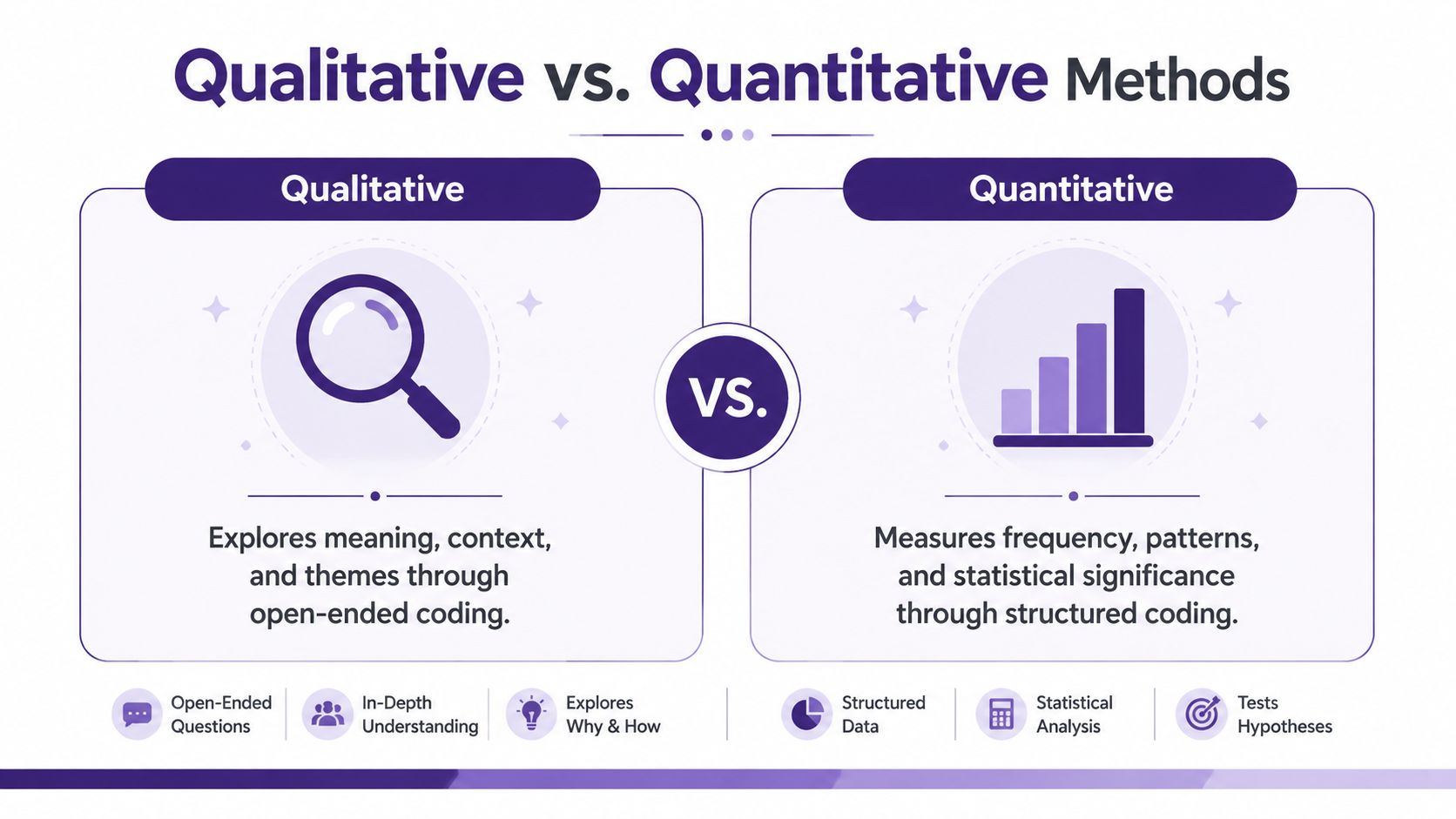
Qualitative and quantitative analysis answer different questions, even when they use the same archive.
Quantitative content analysis measures patterns through structured categories. It can tell you how often a topic appears, whether an idea exists in an asset, which formats carry a theme, or how categories are distributed across a library. This approach works well when a publisher needs an inventory of coverage, a creator wants to compare content buckets, or a marketing team needs a repeatable classification system.
Qualitative content analysis examines meaning, context, tone, narrative structure, and the way an idea is expressed. It's the better fit when you need to understand why a story resonates, how guests frame a problem, or whether two episodes discuss the same subject from different perspectives. Counts may support the interpretation, but they don't replace it.
Choose based on the decision
| Approach | Best for | Main risk |
|---|---|---|
| Qualitative | Exploring themes, meaning, tone, stories, and audience language | Interpretations can drift without clear rules |
| Quantitative | Measuring coverage, frequency, distribution, and category presence | Counts can flatten context |
| Mixed method | Finding broad patterns, then explaining why they matter | Requires more planning and documentation |
A creator looking for the next content bucket might begin quantitatively by tagging every episode for subject, audience, format, and recurring question. The creator can then review representative episodes qualitatively to understand the narrative angle that makes a bucket useful. That combination is more informative than choosing a topic solely because its keyword appears frequently.
Let the media shape the method
Text is comparatively easy to search, but audio and video require an intermediate layer, usually a reliable transcript, chapter structure, or time-coded summary. Don't treat a transcript as a perfect substitute for the original recording. Delivery, pauses, visuals, demonstrations, and audience interaction can change meaning.
For each asset, record both what is present and how it functions. A video may contain a useful definition, a personal story, a demonstration, and a call to action. A quantitative tag can capture those elements. A qualitative memo can explain which segment is suitable for a short clip, which needs context, and which might support a deeper article.
A hybrid workflow often works best for content organizations. Use structured codes to make a large archive searchable, then use human review to interpret the patterns and select assets for production. The numbers organize attention. The interpretation makes the decision.
Building Your Coding Scheme and Taxonomy
A coding scheme gives your analysis a shared language. Without one, each reviewer searches for whatever catches their eye, and an AI system may group material according to broad semantic similarity rather than your editorial needs.
The field has a long history. A 2026 academic summary of content analysis.pdf) traces the method's use to at least 1743, when the Swedish state church reportedly evaluated 90 hymns in Songs of Zion for blasphemy or doctrinal compliance. Formal academic content analysis is often dated to Max Weber's 1910 address to German sociologists. The term appeared in English by 1941, and Bernard Berelson's 1952 book later codified the field.
The lesson for creators is practical. Classification becomes useful when categories are explicit enough for another person, or another system, to apply them consistently.
Define the unit before the label
Choose what receives a code:
- A full article or episode
- A chapter or section
- A sentence or paragraph
- A spoken answer or story
- A theme, claim, entity, or audience need
Then define the category itself. “Business” is too broad for a production workflow. “Pricing strategy,” “customer acquisition,” “team operations,” and “founder story” may be more useful, depending on the decisions your team makes.
A working codebook should include:
- Code name: A short, stable label.
- Definition: What the code means in operational terms.
- Include rules: What qualifies.
- Exclude rules: What looks similar but doesn't qualify.
- Examples: Real excerpts or asset references from your library.
- Parent category: The broader topic or function.
- Output use: The formats, audiences, or decisions the code can support.
Build for retrieval and reuse
A good taxonomy describes content from several angles instead of forcing one label to carry every meaning. Separate topic, audience, format, intent, stage, entity, and reuse potential. An interview can be about audience growth, aimed at professional creators, structured as a personal story, and suitable for a newsletter or short video. Those are different attributes, not competing categories.
Metadata management best practices can help teams think beyond filenames and folders. Consistent metadata lets a publisher retrieve every asset about a theme, guest, audience problem, or format opportunity without relying on the person who originally created it.
Start with a narrow pilot. Code a small, varied portion of the archive, note where categories overlap, then merge, split, or rename them. Don't build a perfect taxonomy in isolation. Build one that survives contact with real episodes, messy transcripts, duplicate ideas, and assets that serve more than one purpose.
Leveraging Tools for Analysis and Validation
Spreadsheets remain useful for inventories, especially when a team needs a simple record of titles, dates, formats, owners, and status. They become less effective when the library includes thousands of transcripts, long videos, scanned documents, multiple taxonomies, and relationships between assets.
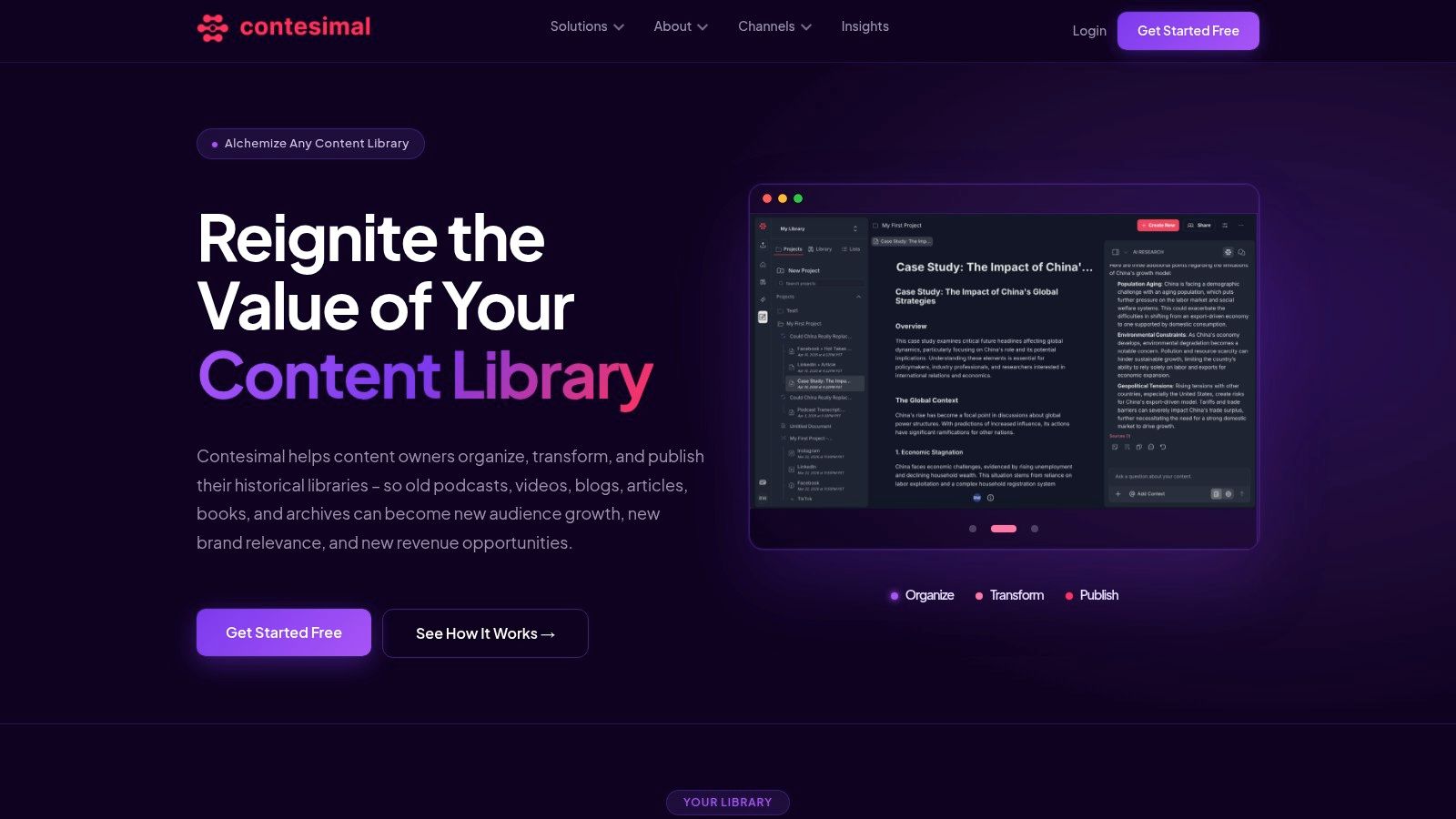
Specialized platforms can reduce the manual work of locating themes and connecting related material. Contesimal, for example, combines document, podcast, video, and article search with AI-assisted classification and research across an uploaded library. It can help teams surface recurring keywords, themes, audiences, and potential connections, while people still decide whether a pattern is editorially meaningful.
Use automation for discovery, not permission
AI-assisted clustering is valuable for creating a first pass. It can group semantically related assets, suggest tags, identify repeated entities, and retrieve passages that contain a concept even when the exact keyword differs. It can't decide on its own whether a repeated idea is distinctive enough for your brand, accurate enough to republish, or appropriate for a particular audience.
Keep a human review layer for:
- Ambiguous language: Sarcasm, metaphor, irony, and specialist terminology.
- Editorial context: Whether an old claim needs updating or qualification.
- Rights and privacy: Whether an interview, image, quote, or user contribution can be reused.
- Strategic value: Whether a pattern supports a meaningful product, series, or audience need.
- Search visibility: Whether the archive is structured clearly enough to surface through traditional search and AI-mediated discovery.
For a separate checklist on how teams find content gaps, focus on the difference between missing topics and missing answers. A library may mention a subject repeatedly while failing to provide a clear definition, comparison, example, or next step. Search visibility analysis should include true SERP competitors, not only direct business rivals, because audiences may encounter your subject through answer engines and blended search results.
A content analysis tools guide can help you compare software by ingestion, search, coding, collaboration, export, and validation needs. Tool choice matters, but the codebook matters more. A fast system with vague categories produces fast confusion.
Validate the coding before trusting the pattern
Reliability has three useful forms: stability, consistency across time on the same data; reproducibility, agreement between coders using the same rules; and accuracy, correspondence with a known standard. The distinction is described in methodological guidance on reliability in content analysis.
Pilot-code a subset, compare decisions, discuss disagreements, and revise the codebook. Krippendorff's alpha accounts for expected disagreement using the form α = 1 − (observed disagreement / expected disagreement), and it can accommodate different numbers of coders, measurement levels, sample sizes, and missing data, as explained in this methodological overview of Krippendorff's alpha.
A commonly cited benchmark treats α ≥ .70 as acceptable for reliable coding, while percent agreement of ≥ .90 may be used when alpha isn't available or doesn't meet the threshold, according to guidance on intercoder reliability. Other guidance describes Krippendorff's alpha of 0.80 or higher as satisfactory, 0.67 to 0.79 as tentative, and values below 0.67 as weak for drawing conclusions, while ICC values below .40 are poor, .40 to .59 fair, .60 to .74 good, and .75 to 1.0 excellent in the relevant measurement context, as summarized by k-alpha methodological notes.
Don't report a polished theme map without recording how the team reached it. Preserve codebook versions, disagreement notes, sample definitions, and decisions about excluded assets. That audit trail protects the analysis from becoming an attractive but unrepeatable opinion.
From Insights to Actionable Use Cases
Analysis earns its place when it changes what the team does next.
A publisher might discover that its archive contains strong explanations of a subject but few beginner-friendly introductions. The response isn't automatically to produce another advanced article. The team can select existing explanations, identify missing context, create an introductory guide, and connect the assets through a clearer series structure.
A podcaster may code episodes by theme, guest expertise, story type, audience level, and reusable segments. The resulting map can reveal a group of conversations that belongs in a dedicated playlist. The producer can then extract a focused clip, write a supporting article, create a newsletter summary, and invite a relevant guest for a follow-up. The analysis doesn't guarantee audience growth or revenue. It gives the production team a defensible reason to prioritize the work.
Turn categories into production decisions
Use each pattern to create an explicit action:
- Repeated theme: Build a series, playlist, guide, or recurring editorial bucket.
- Strong source, weak distribution: Repurpose the asset across formats and channels.
- Audience question without a clear answer: Produce a focused explainer or update.
- Several related assets: Combine them into a research package, course foundation, or premium resource.
- Distinctive expertise: Develop a collaboration, sponsorship context, or branded content opportunity.
- Outdated but valuable material: Review claims, refresh the framing, and preserve the original insight where appropriate.
For AI-search visibility, inspect whether your archive has clear titles, consistent metadata, direct answers, descriptive transcripts, and links between related assets. AI-mediated discovery depends on more than repeating keywords. It also depends on whether your knowledge is structured well enough for systems and people to understand what each asset contains.

The strongest teams treat analysis as a recurring editorial practice, not a one-time audit. They review new material against the same taxonomy, update categories when the business changes, and keep a visible queue of reuse opportunities. That process helps hobbyist creators professionalize their operations, gives publishers more value from historical work, and lets cross-functional teams collaborate around shared evidence instead of scattered intuition.
Contesimal helps creators and content organizations classify, organize, and search mixed-media libraries so recurring themes and reuse opportunities are easier to find. Visit Contesimal to explore how your archive can support more focused research, repurposing, and production decisions.