
You've probably reached the point where publishing more content no longer feels like progress by itself.
There's a backlog of blog posts, podcast episodes, YouTube videos, interview clips, notes, transcripts, and half-finished ideas sitting across drives, folders, and platforms. Some pieces performed well. Some disappeared. Some still have value, but nobody on the team can quickly tell whether they should be updated, repurposed, split into a series, or left alone.
That's where a Content Gap Analysis Template becomes useful. Not as an SEO checkbox, and not as a spreadsheet you create once and forget. Used properly, it becomes the operating system for a growing content library. It helps you decide what's missing, what's weak, what deserves a second life in another format, and what can move audience growth or revenue.
For creators moving from hobbyist output to a professional content business, this shift matters. Guessing drains energy. A repeatable gap analysis gives your archive a job.
Stop Guessing and Start Growing with a Content Gap Analysis
A strong content operation doesn't just publish. It audits, compares, prioritizes, and reuses.
That's why a content gap analysis template usually follows a repeatable workflow of content inventory, goal setting, competitor analysis, keyword research, a gap-analysis sheet, and a monitoring or review sheet, as outlined in Attrock's content gap analysis template guide. That sequence mirrors how experienced teams operate. First they assess what exists, then they identify what's missing, then they connect those gaps to audience intent and business value.
What a gap really looks like
Most creators hear “content gap” and think “keywords I forgot to target.” That's part of it, but it's too narrow.
A gap might be:
- A missing topic that your audience keeps searching for
- A weak angle on a topic you already covered too generally
- A missing format where a strong article should also exist as a video, carousel, or podcast clip
- A funnel problem where you have top-of-funnel discovery content but nothing that helps people take the next step
- An archive problem where old content still has useful ideas but isn't organized well enough to be reused
If you've built a meaningful library, your issue usually isn't a lack of raw material. It's a lack of visibility into what that library can do next.
Practical rule: If your next content decision depends on memory, instinct, or whoever shouts the loudest in a planning meeting, you don't have a strategy. You have a queue.
Why creators need this more than ever
Creators with large archives often get trapped between two bad habits. One is chasing new ideas every week without using past work. The other is endlessly “repurposing” without checking whether the source material still matches audience demand.
A content gap analysis template fixes both problems. It shows where your library already has authority, where competitors have left openings, and where an old asset could become a fresh one with a better format or clearer intent.
That's the difference between making more content and building a content asset base. One fills your calendar. The other compounds.
Laying the Groundwork for Your Content Audit
Before you can find valuable gaps, you need a clean picture of what you already own. Many skip this because inventory work feels administrative. It isn't. It's strategy disguised as cleanup.
A technically sound content gap analysis template starts with a deterministic workflow. That means defining SMART goals and scope, inventorying assets with metadata such as URL, publication date, primary and secondary keywords, format, audience, and business objective, then mapping assets to funnel stage, performance metrics, and duplication or cannibalization flags before prioritizing missing topics by opportunity and relevance, as described in HubSpot's content gap analysis guidance.

Start with a real business goal
“Find content opportunities” isn't a goal. It's an activity.
A useful goal is specific enough to shape decisions. Examples include improving discoverability for a topic cluster, increasing the usefulness of an underperforming category, building a stronger bridge between educational content and offers, or creating a repurposing pipeline from longform source material into platform-native assets.
If you're a publisher, your goal may be broader coverage and stronger archive usability. If you're a YouTuber or podcaster, it may be turning successful episodes into a repeatable multi-format system. If you're leading a marketing team, you may need tighter alignment between search intent and conversion paths.
Build an inventory people can actually use
Your inventory should be more than a dump of URLs. It should work like a searchable map.
Include fields such as:
- Asset location with URL, platform, or file reference
- Core identity with title, format, publication date, and owner
- Audience fit with target persona or segment
- Search signals with primary topic and any known keywords
- Business role with objective, funnel stage, and call to action
- Performance notes with whichever metrics matter to your team
- Risk flags including overlap, outdated information, or competing assets
If you need a cleaner starting point, a dedicated content inventory template can save a lot of friction.
The teams that get value from a content gap analysis aren't always the ones with the best ideas first. They're usually the ones with the cleanest content records.
Don't ignore non-obvious assets
Many audits go off track when teams inventory polished published pieces and ignore the material that could become future assets.
That means you should also consider:
- Transcripts and interviews that contain reusable expert commentary
- Webinars and live sessions that can be broken into smaller themes
- Email sequences that reveal recurring pain points
- Sales or support insights that expose unanswered questions
- Research notes that never became public content
Those hidden assets often contain your best future topics because they come from real conversations, not just brainstorms.
Add a few fields that prevent expensive mistakes
The most useful templates include fields people resist adding because they force clarity.
A few worth keeping:
| Field | Why it matters |
|---|---|
| Funnel stage | Prevents overproduction at one stage and neglect at another |
| Duplication flag | Helps catch overlap before you create another near-identical asset |
| Update candidate | Separates refresh opportunities from net-new work |
| Repurpose candidate | Identifies pieces that should become video, audio, or shortform |
| Business objective | Keeps “interesting” content from crowding out useful content |
Once this groundwork is done, the rest of the analysis becomes far more reliable. Without it, competitor data and keyword exports just create noise.
Mapping Your Universe with Keyword and Competitor Data
Once your library is organized, the next job is external orientation. You're no longer asking only, “What do we have?” You're asking, “Where does our current coverage fall short in the market?”
This is the stage where good operators separate signal from vanity. Raw keyword exports can look impressive. They can also waste days if you don't filter them aggressively.
How experienced teams run the comparison
For SEO-focused gap discovery, a practical workflow is to enter 1 to 4 competitor domains into a keyword-gap tool, filter to “Missing” and “Untapped” terms, remove brand mentions and irrelevant topics, and export to CSV for spreadsheet analysis, according to Semrush's content gap analysis workflow. The same guidance notes that if the list exceeds 30,000 entries, you'll need a minimum search-volume threshold or a custom report to make the dataset workable.
That last part matters more than people think. Big exports don't make you smarter. They just make your spreadsheet slower.
What to look for in competitor data
The fastest mistake here is treating all competitor keywords as opportunities. They aren't.
Some terms are irrelevant. Some belong to a different business model. Some only matter because a competitor has brand demand you don't. Others point to topic areas that look adjacent but would pull your content into weak territory.
A better review process asks:
- Is this topic relevant to our audience?
- Do we already cover this and cover it poorly?
- Is the intent informational, commercial, comparative, or navigational?
- Could we produce something meaningfully more useful than what already ranks?
- Does the topic deserve a new asset, or should it be merged into an existing one?
That's why spreadsheet review still matters even when tools do the collection. Tools gather. Strategists judge.
Don't stop at broad keywords
Creators often overfocus on big head terms because they look strategic. In practice, some of the best opportunities come from narrower phrases, recurring audience questions, and conversational wording that reveals stronger intent.
A YouTuber might find that a broad topic like “podcast editing” is too crowded to tackle directly, while narrower needs such as workflow comparisons, beginner mistakes, or format-specific setup questions reveal better entry points. A publisher may discover that a category appears “covered” at the top level, but misses practical decision-stage content underneath.
If you're reviewing your stack of research tools, this roundup of content analysis tools for creators is a useful place to compare options and workflows.
Good gap analysis doesn't reward the biggest list. It rewards the cleanest shortlist.
Clean the export before you trust it
A raw gap report is not a content plan. It's an ingredients list.
Try this review sequence:
- Remove branded terms that only matter because they include competitor names
- Cut irrelevant intent if the query doesn't connect to your audience's actual needs
- Group near-duplicates so one topic doesn't appear ten different ways
- Cluster by theme rather than evaluating every line item separately
- Mark obvious matches where an existing asset could be improved instead of replaced
This filtering stage is where professionals save time. Without it, teams create bloated topic lists and then wonder why production gets messy.
Use competitors as mirrors, not masters
Competitor analysis works best when it exposes blind spots, not when it dictates your calendar.
If three competing sites rank around a theme you've ignored, that's worth attention. If every competitor publishes the same generic how-to article, that may be a sign to approach the topic differently with a clearer point of view, stronger examples, or a better format.
The goal isn't to clone market behavior. It's to understand where demand exists, where your coverage is thin, and where your archive gives you an unfair advantage.
Finding the Gold by Identifying True Content Gaps
At this point, the template stops being an audit log and starts becoming a decision tool.
A weak process produces a pile of possible topics. A strong process labels each opportunity by type of gap, evidence of demand, and best next action. That's how you turn research into a working content roadmap.
The gap isn't always the topic
A content gap analysis template shouldn't be limited to keyword or competitor gaps. A gap can also be a missing angle, format, audience segment, example, workflow, update, comparison, or proof, as noted in Overseeros' discussion of content gap analysis. The best opportunities tend to appear where audience demand is clear but current coverage is weak.
That changes how you interpret your own library.
You may already “cover” a topic, but only in one of these incomplete ways:
- The angle is too broad and doesn't answer the specific problem people care about
- The format is wrong for how the audience wants to consume it
- The audience target is vague so the piece doesn't feel written for anyone in particular
- The proof is weak because the content lacks examples, comparisons, or process detail
- The asset is outdated even though the underlying topic still matters
A practical way to tag opportunities
Once you combine your inventory, audience input, and competitor review, start tagging each opportunity with a simple label:
| Keyword/Topic | Search Volume | Your Content URL | Competitor URL | Gap Type | Action |
|---|---|---|---|---|---|
| Podcast episode repurposing workflow | Qualitative opportunity | Existing article on clipping strategy | Competitor guide on full workflow | Format gap | Expand article and create video tutorial |
| Content audit for YouTube library | Qualitative opportunity | None | Competitor article exists | Topic gap | Create new pillar page |
| Refreshing old blog content | Qualitative opportunity | Older post exists | Updated competitor post | Update gap | Revise and relaunch |
| Creator content planning system | Qualitative opportunity | Broad newsletter mention | Competitor comparison page | Angle gap | Create detailed comparison article |
The exact metrics you include will depend on your tools, but the structure matters. You need one row per opportunity and one clear action attached to it.
Three decisions that keep the template useful
Most opportunities fall into one of three action buckets:
New content
Create something net-new when there's clear demand and your library has no credible asset covering the topic.
This usually applies when you find a missing cluster, an underserved audience segment, or a repeated question showing up across search, comments, community spaces, or support conversations.
Update existing content
Choose this route when the topic already exists in your library but the asset is stale, thin, unfocused, or poorly aligned with current intent.
This is often the fastest path to better performance because the base material already exists. The mistake is creating a second similar asset when the first one should have been improved.
Repurpose into a stronger format
Creators with large archives often realize the most value. A strong podcast episode might need a written guide. A strong article might work better as a tutorial video. A webinar might contain a dozen short-form pieces and one high-value evergreen resource.
If a topic worked once in one format, don't assume it's fully exploited. Assume it may be underdistributed.
What doesn't work
Several habits make gap analysis noisy instead of useful:
- Treating every missing keyword as a content brief
- Ignoring archive assets because they're harder to find
- Creating duplicates instead of improving weak but relevant pages
- Confusing competitor presence with audience demand
- Focusing on search language while missing user questions and objections
True value is rarely in the biggest list. It's in the clean overlap between demand, weakness in current coverage, and a practical path to execution.
Prioritizing Your Next Move From Analysis to Action
A full content gap analysis template usually leaves you with more opportunities than your team can execute. That's normal. The problem isn't abundance. The problem is acting as if every opportunity deserves equal urgency.

Use an impact versus effort lens
A simple prioritization model works better than a complicated scoring system nobody maintains.
Sort each opportunity by two questions:
- How much impact could this create?
- How much effort will this require?
Impact might include audience growth, revenue relevance, strategic authority, or the ability to support multiple formats. Effort includes research time, production complexity, editing, subject matter review, and distribution demands.
That gives you four practical groups:
| Priority type | What to do with it |
|---|---|
| High impact, low effort | Do these first |
| High impact, high effort | Plan as strategic projects |
| Low impact, low effort | Use as filler only if they support a larger cluster |
| Low impact, high effort | Usually defer or reject |
Quick wins are useful, but they're not the whole strategy
Teams often overcorrect here. They discover quick wins and turn the whole plan into a list of easy tasks. That creates motion, not momentum.
A better mix includes:
- Fast upgrades such as improving an existing piece with clearer structure or stronger examples
- Repurposing plays where one strong source asset can feed several formats
- Strategic cornerstone work that takes longer but gives your library a stronger center of gravity
- Support content that strengthens internal pathways around an important topic
If you want a better framework for turning those choices into an editorial rhythm, this guide to effective content scheduling is a useful companion.
Assign actions, owners, and timing
A prioritized spreadsheet still isn't a plan until every selected opportunity has an owner and a deadline.
That means each approved row should answer:
- What exactly are we making or updating?
- Why now instead of later?
- Who owns the asset?
- What source material will they use?
- How will success be reviewed after publication?
Many analyses frequently stall. The research is done, but nobody converts the findings into accountable work. If you need a better method for judging what's worth acting on, this guide on how to analyze content performance helps connect analysis to decisions.
A short walkthrough can help teams operationalize the handoff from analysis to planning:
Protect your calendar from random idea drift
The biggest practical benefit of prioritization isn't efficiency. It's restraint.
When a new idea appears, you can compare it against the current list instead of treating it like an emergency. That's how professional content teams keep creative energy aligned with outcomes instead of losing weeks to impulse publishing.
Future-Proofing Your Content Strategy
A lot of gap analysis advice still assumes the finish line is a traditional search ranking. That assumption is already too limited.
Recent guidance argues that teams now need to assess semantic, intent, format, and value gaps because AI Overviews and other generative answer surfaces reward well-structured, information-rich pages. Yotpo's 2026 guidance specifically recommends analyzing zero-result queries on-site and presenting data in HTML tables because AI systems extract structured information more effectively, as explained in Yotpo's modern content gap analysis article.
What changes in the AI search era
Keyword coverage still matters. It just isn't enough on its own.
Now you also need to ask:
- Does this piece answer the question directly and clearly?
- Is the structure easy to extract from?
- Does the page add unique value, not just paraphrased basics?
- Have we included comparisons, workflows, examples, and tables where useful?
- Are there unanswered queries inside our own site search or audience channels?
That last one is especially underrated. Zero-result searches on your own site often reveal exactly where your library is failing users.
Strong content in this environment doesn't just mention the topic. It organizes the answer in a way both people and machines can use.
Adapt the template for different formats
This matters beyond blogs.
For YouTubers, a gap may be a missing explainer video, a better title angle, or a topic that deserves both longform and clips. For podcasters, it may be a recurring question that needs a solo episode, transcript-derived article, or curated resource page. For publishers, it could be a missing series, updated comparison format, or archive topic cluster that hasn't been reorganized into a stronger collection.
A B2B team may also need to connect educational content more tightly to pipeline goals. If that's your world, this step-by-step B2B marketing guide is a practical reference for aligning strategy work with business outcomes.
Future-proofing means structuring value, not just producing more
The old mindset was volume. Publish enough and something will stick.
The better mindset is structured usefulness. Build assets that can be discovered, updated, recombined, cited, repackaged, and surfaced in more than one environment. That means cleaner taxonomy, stronger formatting, clearer intent, better metadata, and more deliberate reuse of archive material.
A modern content gap analysis template helps you spot what's missing today. A mature content operation uses it to keep the whole library legible and profitable tomorrow.
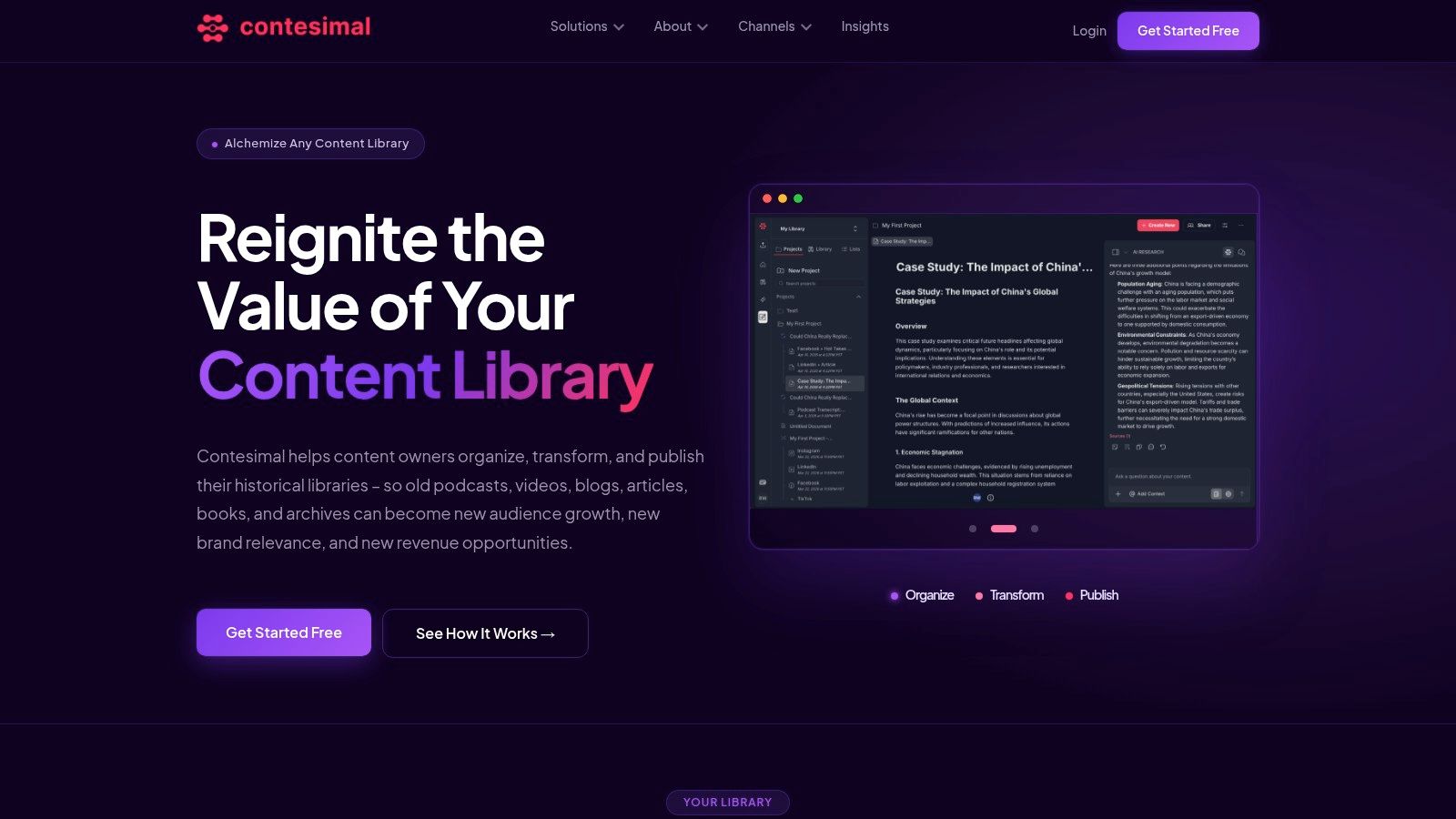
If your archive is getting bigger but not getting easier to use, Contesimal helps you organize, search, classify, and activate your content library so old assets can become new ideas, new formats, and new revenue opportunities. It's built for creators, publishers, and teams who want to turn scattered content into a system.