
Your channel is growing. Brand emails are landing in your inbox. You're paying an editor some months, a thumbnail designer on rush weeks, maybe a researcher when you can justify it. Money is finally moving through the business, yet the answer to a basic question still feels fuzzy: which projects are making you money, and which ones just look successful from the outside?
That's the point where a creator stops needing “better hustle” and starts needing a system. Not a corporate system. A practical one. The kind that tells you whether a documentary-style YouTube series deserves another season, whether your podcast ad package covers the actual labor behind it, and whether your back catalog is funding your next creative swing or draining it.
From Passion Project to Profitable Business
A lot of creators hit the same wall.
The work starts as a passion project. You film on weekends, edit at night, publish when you can, and treat every dollar as part of the experiment. Then something changes. Maybe one format starts pulling in steady sponsorship interest. Maybe your archive begins driving search traffic. Maybe clients or advertisers want packages, not one-off posts.

Suddenly, the messy approach stops being charming.
The creator problem nobody talks about enough
A successful-looking content business can still be financially disorganized. Revenue comes in from different directions. Costs show up in uneven bursts. You might know what a project earned in a rough sense, but not what it truly cost once you include editing time, freelance help, travel, music, revisions, and the hours spent repackaging it across platforms.
That's where project financial management matters. For creators, it's the business side of creativity. It's the discipline that lets you say, with confidence, “This series deserves more investment,” or “This content looks popular, but it's too expensive for the return.”
Practical rule: If you can't explain where the money went on your last project, you're guessing on your next one.
Bigger opportunities need cleaner financial thinking
Financial clarity isn't about becoming boring. It's how creators earn the right to make bolder bets.
When you understand project costs and cash flow, you can do things hobbyists struggle to do consistently:
- Hire with confidence because you know whether a producer, editor, or researcher fits the economics of the project.
- Price smarter when a sponsor asks for custom deliverables, usage rights, or multi-platform packages.
- Reuse your library profitably because you can see which old assets are worth refreshing and redistributing.
- Protect your runway when a big creative idea needs upfront spending before revenue arrives.
Musicians run into the same shift when they move from making songs to building a business around a catalog. This guide for musicians to earn more is useful because it shows the same underlying truth. Creative ambition grows faster when the business side stops being an afterthought.
The creators who last usually aren't the ones with the most chaotic energy. They're the ones who treat money like production infrastructure. Quiet, organized, and always working in the background.
What Is Project Financial Management Really
Think of a content project like a flight.
You have a destination, a route, fuel limits, timing constraints, and a crew. If you only focus on takeoff, the trip can still fail long before landing. Project financial management is the financial flight plan. It tells you what the trip should cost, what it is costing right now, what risks could throw it off course, and whether the destination is worth reaching in the first place.
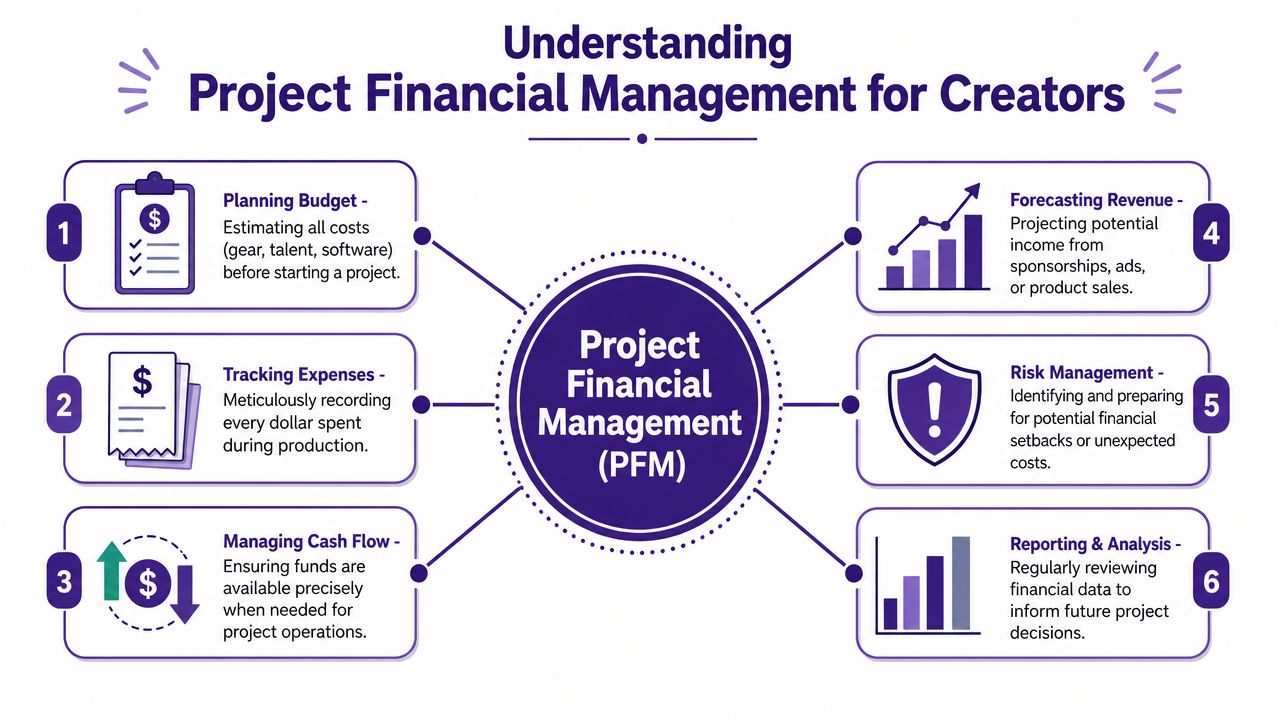
Industry guidance ties project success closely to disciplined budget control and defines the field broadly. It includes budgeting, cost estimation, cost control, forecasting, financial reporting, risk management, profitability analysis, and cash-flow management, with managers expected to compare actual spend against budget and track KPIs such as cost variance and budget adherence throughout the project lifecycle, as outlined in Harvest's explanation of project financial management.
What it means in creator language
For a creator or publisher, this isn't accounting for accounting's sake. It's a practical operating system with four jobs.
Plan the cost before you hit record
Don't just price the obvious items like camera rental or freelance editing. Include approvals, revisions, asset prep, transcripts, artwork, music, platform formatting, and your own time.Set a budget that behaves like a boundary
A budget isn't a wish. It's a decision. If a series has a defined spending limit, you can make creative trade-offs early instead of acting shocked later.Track actuals while the project is alive
Most creators often make this error. They review costs after launch, when the money is already gone. Good project financial management watches spending during production.Judge the outcome against business value
A project can perform well creatively and still miss financially. It can also underperform on launch week and become valuable later through licensing, search traffic, audience conversion, or repurposing.
The difference between bookkeeping and control
Bookkeeping tells you what happened. Project financial management helps you steer what happens next.
That distinction matters. Financial management is forward-looking. It uses live tracking, periodic review, and updated forecasts to catch overruns before they become painful. The strongest setups treat budgets as a control system, not a historical archive.
A good budget doesn't limit a creator. It protects the project from drifting into expensive improvisation.
If you want a simpler grounding in the documents that sit underneath this process, Allied Tax Advisors has a solid primer on how to prepare financial statements. You don't need to become a tax specialist, but you do need to know how the numbers roll up.
The Financial Workflow for Every Content Project
Take a YouTube documentary episode. Not a giant studio production. Just a serious creator-led project with research, interviews, editing, design, and distribution.
The financial workflow starts before production. It doesn't start when you open your banking app and wonder what happened.
Stage one with the idea still on paper
At concept stage, estimate the project in layers.
First, list the direct production costs. That might include editing, motion graphics, travel, archive footage, music licenses, transcription, and thumbnail design. Then add the hidden labor that creators often forget, like pre-interviews, script revisions, sponsor approvals, and cutdowns for shorts, newsletters, or social clips.
This estimate becomes your first reality check. If the concept only works when everyone donates time, it may still be artistically worthwhile, but it isn't yet a reliable business model.
Stage two with a working budget
Before kickoff, convert the estimate into a budget with categories you can monitor. In this context, a cost performance baseline matters.
Tempo's guidance on project financial management makes an important point. The discipline isn't just cost tracking. It manages profitability, revenue, costs, and forecasting across the full project lifecycle, and it depends on establishing a cost performance baseline so actual spending can be compared against it before overspend becomes unrecoverable.
For creators, that baseline might look like this:
| Budget area | What belongs here | Common mistake |
|---|---|---|
| Pre-production | Research, scripting, planning, outreach | Ignoring planning time because it feels invisible |
| Production | Filming, location costs, talent, gear | Treating owned gear as “free” even when usage affects other projects |
| Post-production | Editing, sound, graphics, captions | Forgetting revision rounds |
| Distribution | Paid promotion, asset resizing, repurposing | Spending after launch without tying it to a goal |
| Contingency | Extra edits, delays, replacement assets | Not reserving anything for surprises |
Stage three while the project is moving
Now track actuals as the episode unfolds.
That means logging invoices, time, contractor costs, and approved extras against the budget. If the edit expands, the budget has to reflect that. If a sponsor requests additional cutdowns, that change should be visible immediately, not buried in a chat thread.
A useful discipline here is to review the project at defined moments:
- Mid-production check to see whether labor is already drifting
- Rough-cut review to catch revision-heavy problems before final delivery
- Pre-launch review to confirm total cost and expected revenue path
- Post-launch review to assess what the project is likely to earn over time
If you're packaging content with sponsorships or creator partnerships, it helps to understand how those deals are structured in the market. This explainer on understanding influencer brand deals is useful context when you're building revenue assumptions around deliverables.
If you only count production expenses and ignore revision labor, your budget is fiction.
Stage four after launch
The final review isn't about blame. It's about pattern recognition.
Ask simple questions. Did the project stay inside budget? Which cost category drifted? Did the content justify the spend through direct revenue, audience growth quality, repurposing value, or advertiser interest? Would you greenlight the same format again at the same cost?
That last question is where mature creators separate from busy ones. Busy creators keep producing. Mature creators learn which formats deserve repetition.
Metrics That Matter More Than Just Views
Views matter. So do subscribers, downloads, shares, and watch time. But none of them answers the question a growing content business eventually has to ask: did this project strengthen the business?
That's why financial metrics matter. They turn performance into decision-making.
The questions behind the numbers
Instead of treating finance like a separate department in your head, translate each metric into a creator question.
- Cost per acquisition becomes, “What did it cost to earn one paying member, customer, client, or patron?”
- Return on investment becomes, “Did this series produce enough value to justify the spend?”
- Gross profit margin becomes, “After direct production costs, how much room is left?”
- Burn rate becomes, “How fast is the operation consuming available cash while projects are in motion?”
- Customer lifetime value becomes, “If this content brings in the right audience, what is that audience worth over time?”

A strong finance setup doesn't stop at historical numbers. It uses current delivery signals to inform future choices. If you want a broader business lens on content returns, this piece on the ROI of content marketing complements that thinking well.
What to watch when you have a content library
Creators with a growing archive need metrics that work at both project and library level.
A single video might break even slowly while driving newsletter signups, product awareness, or long-tail discovery. A podcast episode might underperform on launch week but become useful later in sales outreach or as source material for articles, clips, and paid products.
That's why I like grouping content into three buckets:
| Content type | Financial lens | Decision it supports |
|---|---|---|
| Evergreen library content | Long-term asset value | Should we refresh and redistribute it? |
| Fast-turn content | Cost efficiency | Can we produce this consistently without strain? |
| Premium flagship content | Strategic upside | Is the higher spend creating a bigger business opportunity? |
Forward-looking metrics beat vanity metrics
A technically mature project financial management stack connects work structure, time logs, resource capacity, and milestone status to one financial control layer so teams can estimate before kickoff, track burn rate during execution, and forecast 30/60/90-day outcomes from live delivery data rather than waiting for spreadsheet updates, according to Rocketlane's guide to project financial management tools.
For a creator, that means you shouldn't wait until month-end to realize the “important” series is eating too much labor.
Here's a useful breakdown if you want a quick visual reference before going deeper:
The best metric is the one that changes your next decision.
Smarter Workflows and Tools to Manage Your Money
Most creators don't fail at project financial management because they reject the idea. They fail because their workflow makes it too annoying to maintain.
A notes app holds the initial budget. Invoices sit in email. Time lives in memory. Contractor costs are in one spreadsheet, sponsorship details in another, and nobody updates the “master” tracker until the project is already finished.
Start simple, but don't stay fragmented
A spreadsheet is fine at the beginning. It's often the right first step.
Use one tab for project estimates, one for approved budget categories, one for actual expenses, and one for post-project review notes. Pair that with a folder structure that keeps contracts, invoices, receipts, statements of work, and asset approvals tied to the same project.
That setup works until project volume rises. Then the gaps show up fast.
- Manual entry slips because someone forgets to log a rush edit or stock asset purchase.
- Time gets lost because nobody tracks internal labor consistently.
- Forecasting stays weak because spreadsheets show the past better than they show what's about to happen.
- Library value stays hidden because finished content and financial performance live in separate systems.
What better tooling actually does
Good tooling doesn't just store numbers. It connects production activity to financial consequence.
If your team uses Notion, Airtable, Asana, Trello, ClickUp, Monday.com, QuickBooks, Xero, Harvest, Toggl Track, or a mix of them, integration is the goal. Financial discipline improves when the project board, time tracking, and cost records talk to each other.
That matters because a mature stack should connect the work breakdown structure, time logs, resource capacity, and milestone status to one financial layer. Then you can estimate before kickoff, track burn rate while work is underway, and forecast near-term outcomes from live delivery data instead of relying on occasional spreadsheet cleanup. In practice, that kind of integration gives you earlier warning when actuals diverge from plan.
A practical maturity ladder for creator teams
Here's the progression I've seen work best:
Solo creator stage
One budget template. One expense tracker. One monthly review habit.Small team stage
Shared project board, recurring budget categories, and time tracking for contractors and internal staff.Operator stage
Revenue assumptions tied to content formats, approval rules for extra spending, and project post-mortems.Library stage
Financial data connected to the content archive, so you can evaluate not just what a project cost, but what it keeps producing later through repurposing, licensing, packaging, and search discovery.
Tools don't create discipline. They make disciplined behavior easier to repeat.
For publishers and creator businesses with deep archives, the full potential is realized when financial visibility isn't limited to a single production cycle. It extends into the life of the asset.
How a Podcast Grew by Mastering Its Finances
Consider a fictional podcast called Creative Currency.
It started the way many good shows do. Smart host, loyal listeners, strong conversations, and a lot of improvisation behind the scenes. Episodes went out regularly enough. Sponsorship conversations started to appear. The team felt busy in a promising way.
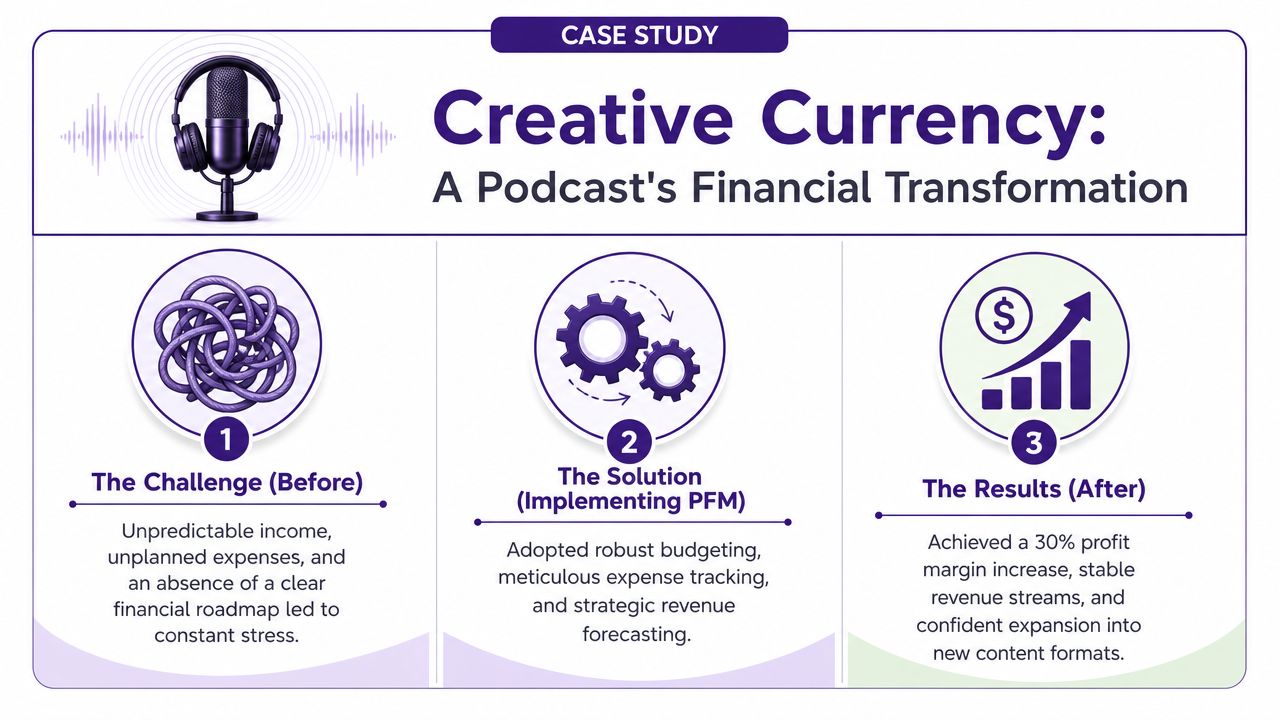
The problem was that nobody could say which episodes were good business.
Before the cleanup
The host paid freelancers as needed. Some episodes got extra editing. Some got custom social packages. Travel costs showed up unpredictably. Sponsor income arrived on a different rhythm than production expenses. The team knew revenue existed, but they didn't know how stable it really was.
That's a classic old-model problem. Project finance used to sit closer to basic project accounting. Contemporary guidance describes a more strategic approach, where forecasting, risk reserves, cash-flow control, revenue recognition, and stakeholder reporting all work together as one operating model supporting decision-making and business value, as discussed by PMI in its article on why finance matters for project managers.
What changed
Creative Currency didn't become “corporate.” It got specific.
The team introduced a per-episode budget. They separated core production costs from optional promotional spend. They tracked freelancer time by episode instead of by vague monthly totals. They also reviewed sponsor packages based on the actual work required to deliver them.
Three habits made the difference:
- Per-episode baselines gave every release a financial starting point.
- Cash timing checks reduced stress around when money was due versus when it arrived.
- Post-episode reviews helped the team decide which formats were worth repeating.
The show also got sharper about monetization strategy. If you're building audio-first revenue, this guide on making money with a podcast adds useful context on where that upside can come from.
After the discipline took hold
The biggest change wasn't in the spreadsheet. It was in confidence.
The team could see which recurring segments were efficient, which guest formats created hidden production drag, and when a sponsor package needed better pricing. With that clarity, hiring a producer no longer felt reckless. It felt timed.
That's what good project financial management does for creative businesses. It moves finance out of the panic category and into the planning category.
Your Content Is an Asset Treat It That Way
Every serious creator says they want to build a body of work. That phrase only means something if the work is managed like an asset, not just published and forgotten.
A content asset has a lifecycle. It costs money to develop. It can produce value directly or indirectly. It can be repackaged, licensed, updated, bundled, clipped, translated, or used to attract a better audience and stronger business relationships. But none of that value is easy to see when the financial side stays foggy.
A better way to think about creative discipline
Project financial management isn't the enemy of creative freedom. It's what lets you protect your best ideas from sloppy execution and weak planning.
If you want a more durable content business, start small:
- Choose one upcoming project and write down its true cost categories.
- Set a baseline before work begins.
- Track actual spending while it's live instead of reviewing it too late.
- Judge the outcome beyond views by asking what business value the asset created.
That mindset changes how you treat your archive too. Old work stops looking like dead inventory and starts looking like under-managed value. This perspective connects well with the idea of content libraries creating new revenue and brand relationships.
The creator economy rewards imagination. Sustainable creative businesses add financial memory to that imagination.
Contesimal helps creators, publishers, and content teams turn scattered archives into usable business assets. If you're trying to organize your library, surface what's worth repurposing, and connect past work to new revenue opportunities, explore Contesimal.