
Your next episode needs an angle, your newsletter needs a lead, and someone has asked whether that old interview could become a useful article. The material exists, somewhere between a transcript folder, a publishing calendar, and a video archive nobody wants to search manually.
A useful AI content creation workflow connects those assets to editorial decisions and audience outcomes. It doesn't just produce more drafts. It helps your team find what's worth reusing, establish permission, preserve evidence, and decide whether the result deserves publication.
Why Your Content Library Is Already an AI Workflow
Consider a podcaster planning an episode about a recurring audience question. Previous guests have addressed it from different perspectives, but their answers sit in separate recordings. The opportunity isn't another summary. It's a new argument built from those perspectives, with accurate attribution and a clear reason for listeners to care.
A publisher faces a similar choice when revisiting longform reporting. An older article might support a newsletter, an updated explainer, or a fresh interview. But the editor first needs to know which claims remain current, what rights apply, and where new reporting is necessary.
The archive becomes useful when people can make decisions with it. Uploading files is only the beginning.
Your content library isn't a pile of prompts waiting to happen. It's a body of evidence your team can use to create something worth publishing.
From individual experiments to shared production
Stanford's 2025 AI Index reports that organizational AI use in at least one business function rose from 55% in 2023 to 78% in 2024, while generative AI use more than doubled from 33% to 71% over the same period (Stanford AI Index).
For an editorial team, that shift changes the operating question. Instead of asking whether a writer can generate an outline, ask whether colleagues can retrieve the same evidence, understand its restrictions, and continue the work without reconstructing the research.
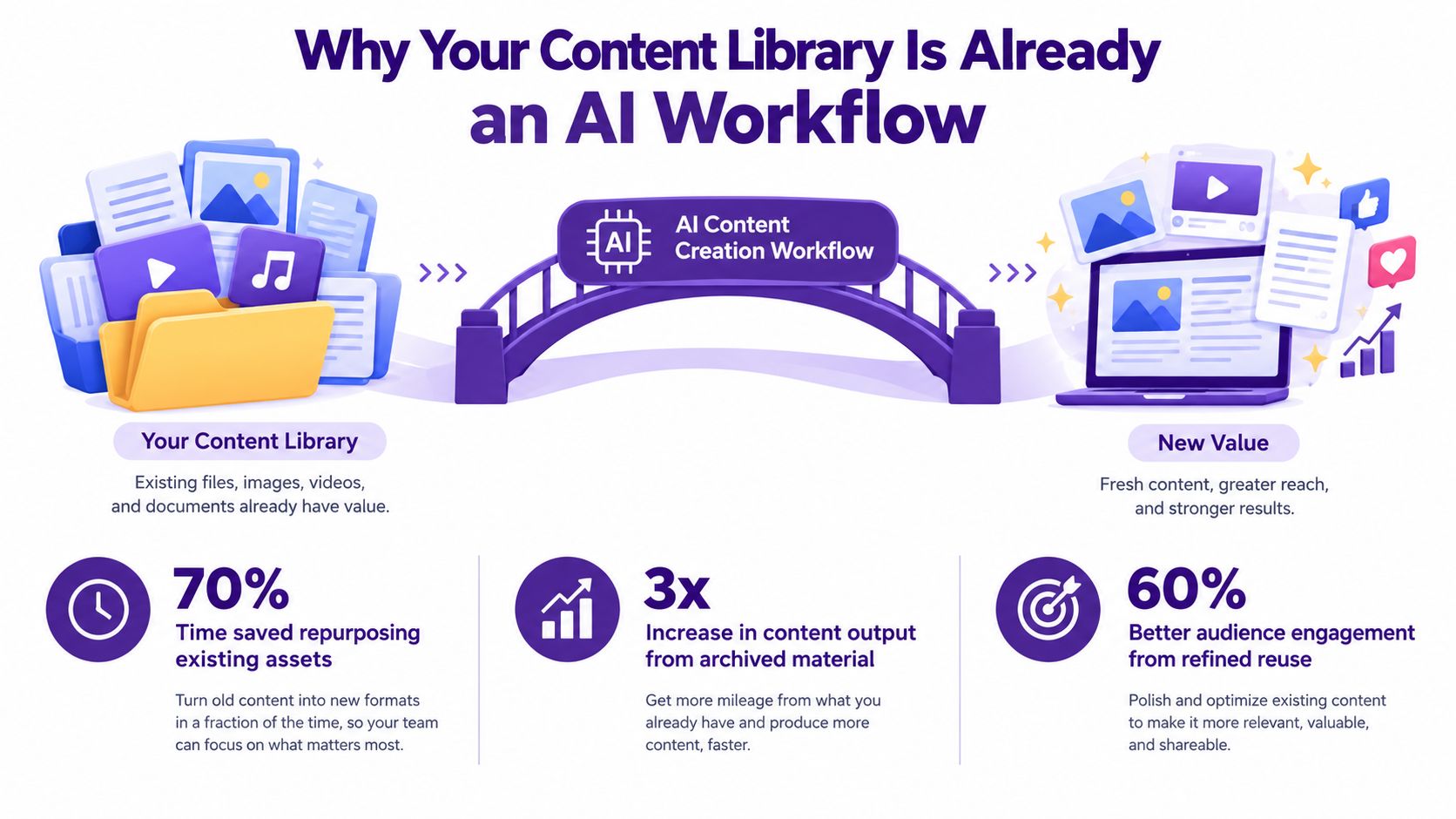
The illustration below shows the connection between an organized archive and purposeful reuse.
Give every asset an operating record
A practical library needs more than folders named by publication date. Start with:
- Identity and provenance: Preserve the original file, author or speaker, publication date, and stable source reference.
- Permission boundaries: Record whether an asset may be searched, quoted, transformed, or republished.
- Editorial status: Distinguish current material from superseded reporting, unverified notes, and restricted drafts.
- Audience purpose: Connect assets to recurring questions, themes, playlists, and intended reader needs.
That's the useful lens for evaluating content intelligence platforms: can your team understand and act on the collection, not merely retrieve a passage?
For creators moving from hobby projects to revenue-generating operations, this groundwork also makes collaboration possible. An editor shouldn't need access to the creator's memory to understand why a source matters. Organize. Understand. Take action. The archive can stay nostalgic; the workflow needs to be operational.
The Core Stages Every Hybrid Pipeline Needs
Build the pipeline around decision gates, not a chain of generation commands. Each handoff should leave behind an artifact another person can inspect.
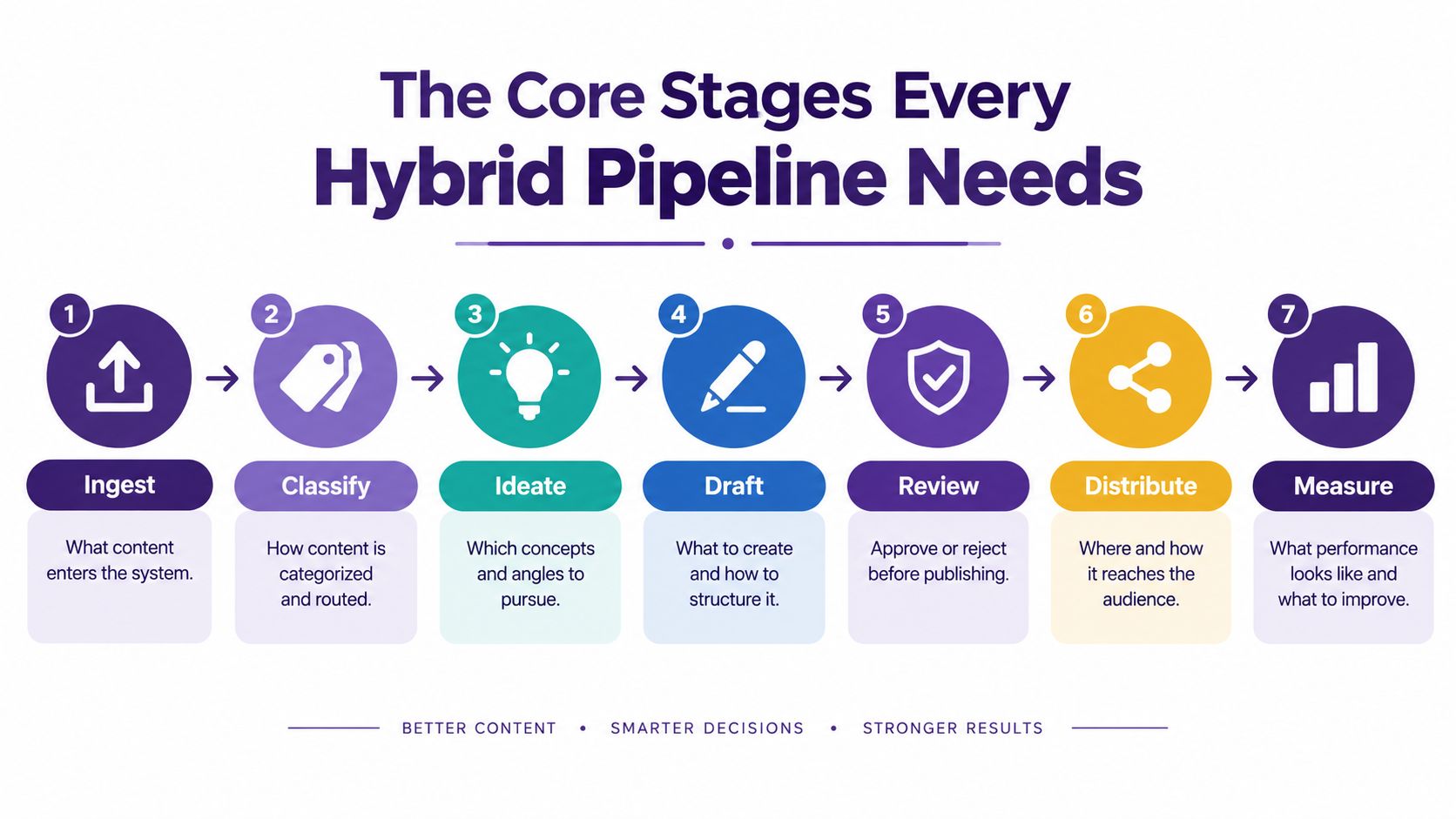
Use this diagram to map where material enters, changes form, receives approval, and produces feedback.
Move work through explicit gates
Ingest. The library owner admits an approved recording, transcript, or article. The handoff is a source package with identity, permissions, and a readable file. Missing permissions should hold the asset here.
Classify. AI proposes topics, speakers, formats, and audience questions. An editor checks ambiguous labels before accepting the asset into the searchable taxonomy. Preserve uncertainty rather than forcing every passage into a category.
Ideate. A producer asks which audience need the material can serve. For a podcast, that might mean a Short built around a surprising explanation and a blog answering the broader question. Advance only when the proposed derivative has a distinct purpose.
Draft. AI works from an approved brief and selected passages. Require source references alongside factual claims so the writer receives an inspectable draft, not polished prose with invisible dependencies.
Review. Editors resolve evidence, attribution, context, and suitability. The artifact is an approved version or a specific revision request. “Needs work” isn't an actionable handoff.
Distribute. The channel owner prepares titles, captions, links, accessibility elements, and scheduling. Approval of an article doesn't automatically approve every promotional claim.
Measure. The analyst or creator records audience response and production effort against the asset's purpose. Feed that assessment into future topic selection rather than leaving it in a reporting dashboard.
For a second perspective while documenting handoffs, consult Outrank's content workflow playbook. Use it alongside your own approval requirements rather than treating any template as a finished operating procedure.
Adapt the gates to the format
A publisher turning longform journalism into a newsletter may need an update from the reporter before drafting. A podcast team creating Shorts may instead need to inspect the surrounding audio so an isolated answer doesn't imply something the guest never meant.
The stages stay consistent; the evidence required to pass them changes. A transcript can support text drafting, but a video editor still needs to check the actual footage.
Use the video below as a discussion prompt while mapping your own production process.
Don't automate every gate immediately. First identify where your current process loses information or leaves decisions unowned.
Roles and Human Oversight That Keep Quality in Control
A derivative post can be grammatically immaculate and still credit the wrong person. Consider a hypothetical interview where the host paraphrases a guest's argument. AI turns that paraphrase into a direct quotation, and the publishing editor assumes someone else checked it.
The failure isn't a weak prompt. Nobody owned the distinction between speaker attribution, paraphrase, and quotation.
The NIST AI Risk Management Framework's guidance on human-AI interaction calls for human roles and responsibilities to be clearly defined and differentiated, with oversight processes defined, assessed, and documented. Applied to content operations, that means naming decision-makers rather than adding a vague “human review” box.
Assign responsibilities without inflating headcount
| Responsibility | Accountable person | Evidence of completion |
|---|---|---|
| Source selection | Research editor or producer | Approved source package |
| Prompt configuration | Workflow owner | Versioned prompt and input requirements |
| Rights and privacy | Designated rights lead | Recorded permissions and restrictions |
| Factual verification | Editorial reviewer | Claim checks and resolved discrepancies |
| Brand or specialist approval | Appropriate editor | Approval of wording and interpretation |
| Publication | Distribution owner | Approved version and destination record |
These are responsibilities, not mandatory job titles. A small podcast operation might assign several to the producer, while a publisher separates them across editorial, legal, and audience teams.
The person configuring the prompt doesn't automatically become the authority on the subject. Likewise, a distribution owner shouldn't have to infer whether an unresolved rights note blocks publication.
Make escalation part of the job
In the hypothetical quotation failure, the reviewer should compare the proposed quote with the original recording. If the words aren't there, the reviewer either restores an accurate paraphrase or removes the passage. If the speaker's meaning remains ambiguous, the responsible editor decides whether clarification is needed.
Document that decision beside the asset. Otherwise, another colleague can unknowingly regenerate the same problem from the same source.
- AI may propose: Categories, candidate excerpts, summaries, and discrepancies for inspection.
- Humans must resolve: Permission disputes, uncertain interpretations, sensitive disclosures, and consequential editorial judgments.
- Publishers must retain: The approved version, its supporting material, and the identity of the approver.
Good human and AI collaboration doesn't require a meeting for every sentence. It requires clear authority at the points where a mistake would matter, plus a route for stopping work when nobody has enough evidence.
Prompt Templates That Survive Real Production
Production prompts need an input contract, an output specification, and an instruction for missing evidence. “Make this engaging” supplies none of those.
Treat the following as reusable working patterns. Replace the bracketed fields before running them, and keep each prompt version attached to its resulting draft.
Classification without invented certainty
Expected input: An asset, its existing metadata, and an approved taxonomy.
Classify [asset] using [approved taxonomy]. Return a table containing proposed topic, audience question, speaker or author, source location, permission status from supplied metadata, and uncertainty notes. Separate observed information from inferred labels. Mark missing information as unknown. Don't infer permission from public availability.
The library owner checks speaker identity and restrictions before accepting the record. If a taxonomy label changes later, preserve the original asset identity so colleagues can still trace earlier work.
Transformation with evidence attached
Expected input: An approved transcript, source markers, audience brief, reuse permissions, and format requirements.
Using only [approved source package], prepare [requested formats] for [audience and purpose]. For each format, state its distinct angle and proposed hook. Preserve source markers beside factual claims. Reproduce quotations exactly, label paraphrases, and flag material requiring fresh research. Don't strengthen claims or imply the speaker endorsed a new conclusion.
For example, a 45-minute podcast could be assigned a blog draft, a newsletter teaser, and three Shorts scripts. Those are illustrative production specifications, not promised output or performance benchmarks.
Give the blog an explanatory hook, the newsletter an unresolved question, and each Short a self-contained idea. The editor then checks that the formats offer different entry points rather than repeating the same introduction.
Editorial review that produces a repair list
Expected input: The draft, its source package, editorial standards, and channel brief.
Compare [draft] against [sources and standards]. Return an issue table with passage, issue type, supporting source location, severity, and proposed action. Check unsupported claims, altered quotations, missing context, stale information, repetitive material, and brand mismatches. State what you couldn't verify. Don't certify publication readiness or silently replace unsupported claims with new ones.
Prompt Templates by Workflow Stage
| Stage | Prompt Goal | Required Input | Human Checkpoint |
|---|---|---|---|
| Classification | Propose useful, bounded metadata | Asset, metadata, taxonomy | Confirm identity and permissions |
| Transformation | Create distinct derivatives | Approved sources and format brief | Verify meaning and audience value |
| Editorial review | Produce an actionable issue list | Draft, evidence, standards | Resolve issues and authorize publication |
An AI review is a triage aid, not independent proof. The editor should open the cited material, not approve a draft because another generated response says it looks accurate.
Measuring Whether AI Content Actually Works
A faster first draft isn't a business outcome. If an editor spends longer repairing unsupported passages, the team has shifted work rather than removed it.
The Adobe 2025 global creator survey figures cited in AirOps' State of Content Teams report capture that distinction: 88% said AI helps them produce faster, while 45% of creative professionals didn't expect to fully trust it to create final assets. Speed and readiness for publication aren't interchangeable.
Practical rule: Measure the whole route to an approved, useful asset, including rejected drafts, corrections, and review time.
Build a scorecard around the content's job
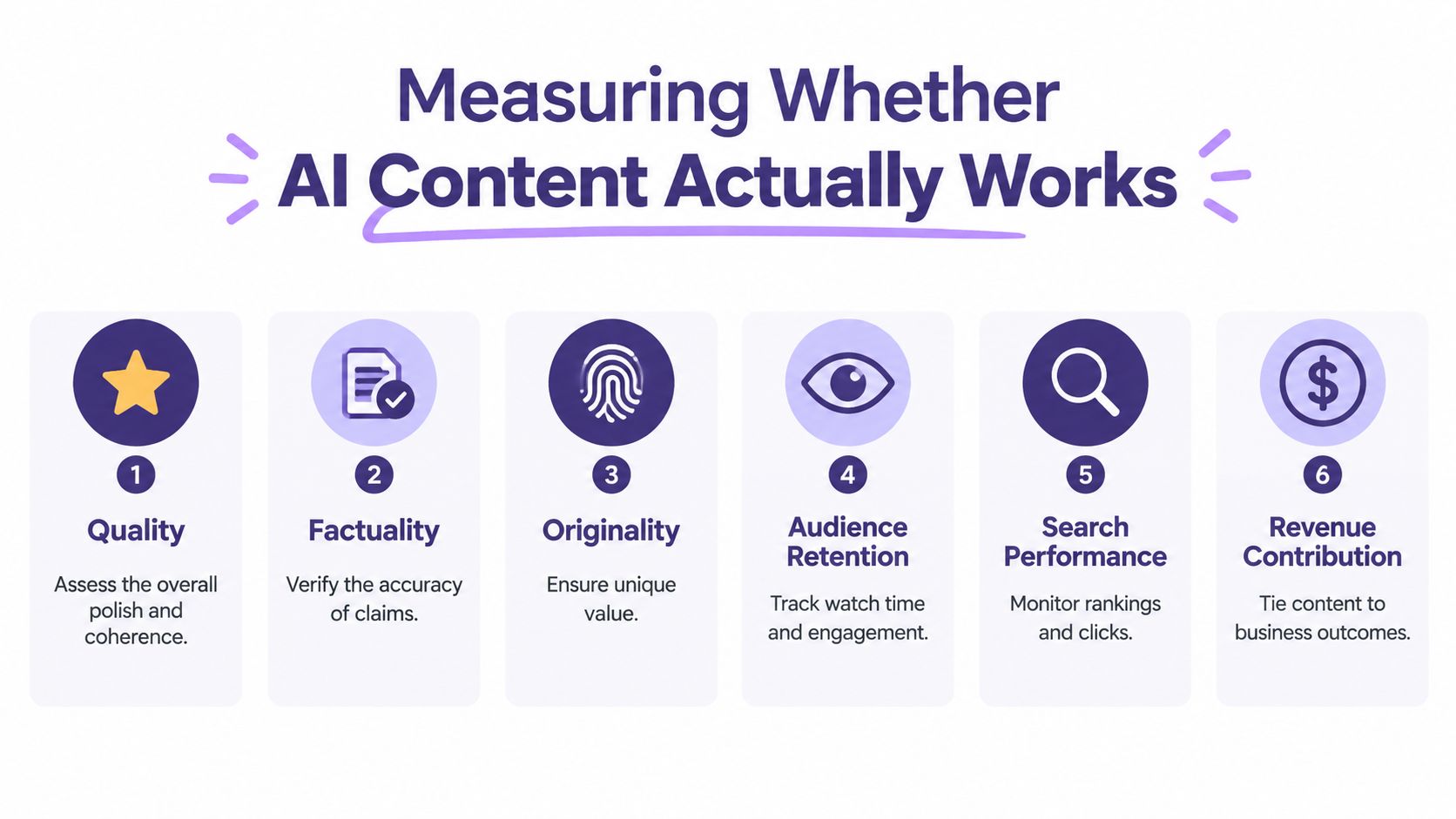
Use the categories below to organize evaluation, then choose observable evidence for each format.
| Dimension | What the team records |
|---|---|
| Quality and brand fit | Coherence, usefulness, voice, and editing required |
| Factuality | Unsupported statements, attribution errors, and corrections |
| Originality | The new explanation, interpretation, or audience benefit |
| Audience retention | Viewing or reading behavior appropriate to the format |
| Search performance | Relevant queries, impressions, clicks, and reader intent |
| Revenue contribution | Qualified inquiries, subscriptions, purchases, or assisted outcomes |
Don't collapse these into a single flattering score. An article that attracts readers but misstates the source needs a different response from an accurate article with weak packaging.
For podcasters, inspect whether the clip delivers its promised answer and encourages relevant next steps. For publishers, assess whether the derivative stands on its own without losing the reporting's qualifications.
Test a bounded workflow before expanding
Choose a content type and establish its pre-AI baseline from comparable work. Run AI-assisted and human-only production tracks for a month, using similar topics, distribution conditions, and editorial standards.
Record preparation, generation, review, and correction effort. Where feasible, let reviewers evaluate drafts without knowing which production method created them, and document differences that make comparisons imperfect.
Set your stop/go rules before seeing results:
- Stop: Unresolved factual or permission issues prevent publication.
- Revise: Review effort outweighs drafting savings, or the derivative adds little value.
- Expand cautiously: Quality holds, audience outcomes meet your existing standards, and total effort improves.
Use content performance analysis to connect editorial evaluation with audience behavior. Don't declare success from an isolated traffic spike or claim revenue attribution your tracking can't support. A modest, repeatable improvement is more useful than a spectacular dashboard with no defensible explanation.
Automating the Workflow Without Losing the Plot
Automate the mechanical handoffs first: file arrival, processing status, classification suggestions, draft routing, and measurement collection. Keep approval authority separate from the machinery that moves work.
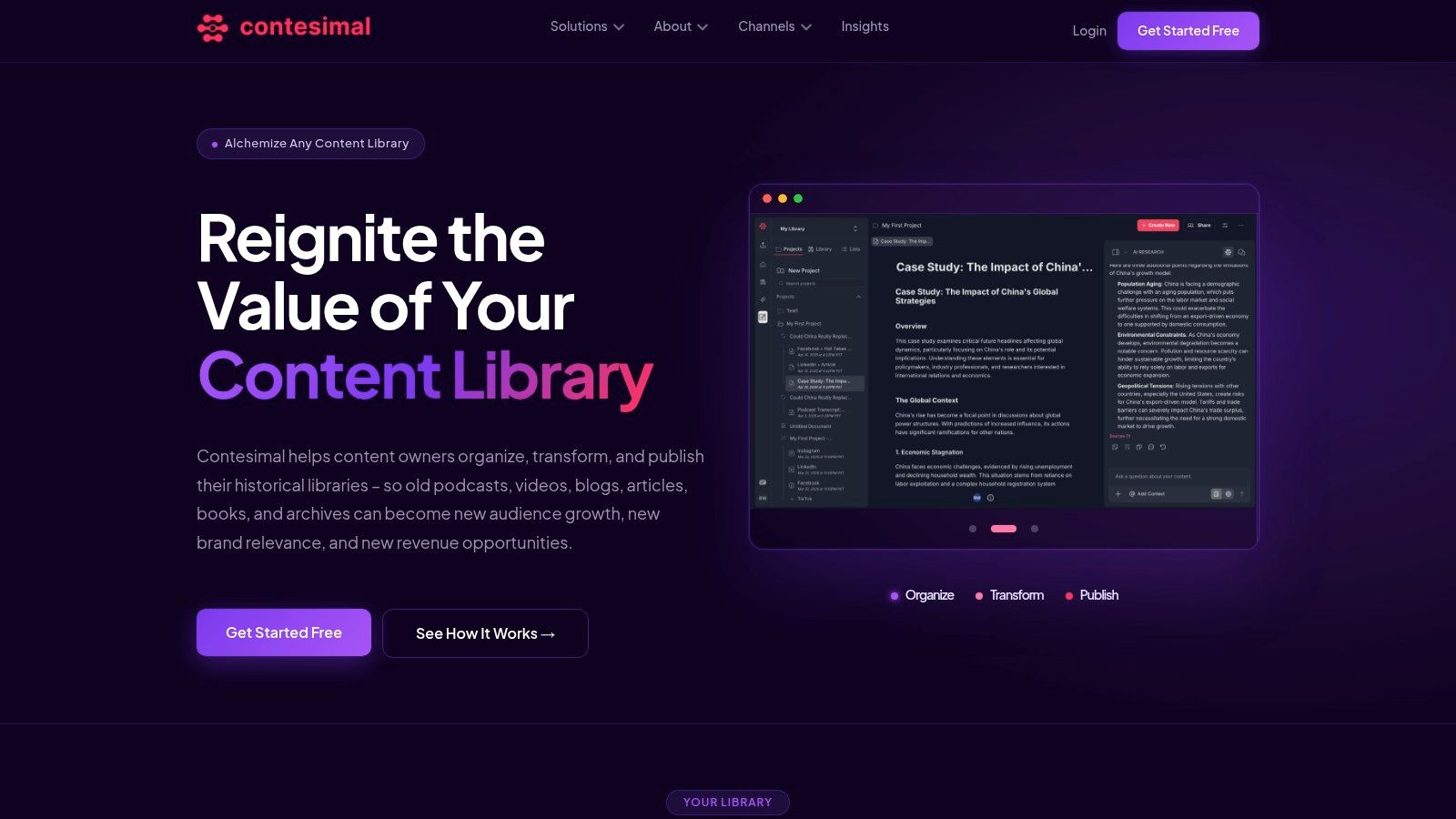
Contesimal is one option for connecting an archive to research and generation. Its chat-based research interface and tooling layer let teams classify, organize, and search documents, podcasts, videos, and articles, using layered taxonomies and AI-driven insights during interaction.
The platform view below illustrates the workspace supporting that archive-centered approach.
Connect ingestion to an editorial queue
Programmatic uploads and fast file ingestion can bring ongoing output into the collection. Configure the surrounding workflow so a processed file doesn't automatically become an approved source.
Use layered classification to distinguish the asset's subject from its editorial status. A recording can belong to a successful playlist while containing an outdated claim or a restricted guest contribution.
For a video team planning its next episode, the sequence might look like this:
- Retrieve relevant material: Search earlier episodes for the audience question, not just an exact keyword.
- Inspect the evidence: Compare explanations, disagreements, and unanswered questions.
- Prepare an opportunity brief: Identify what the next episode could add and what new research it needs.
- Route for commissioning: Let the producer approve the angle before generating scripts or promotional assets.
This is research-led reuse rather than an archive-sized photocopier. The same approach can help authors revisit research notes or magazine editors develop follow-up coverage.
Keep automation inside publishing policy
Google Search Central's guidance on generative AI content says AI can support research and structure, warns that publishing many generated pages without added value may violate scaled-content-abuse policy, and advises manual fact-checking and review before publication.
The practical boundary is added editorial value, not whether a machine touched the draft. Reformatting an old article into near-duplicate pages isn't a useful content strategy.
When documenting the automation surrounding production, content workflow tips from idea to publish from Humantext.pro offer another resource to consult. Keep your implementation specific: define retry behavior, quarantine incomplete processing, preserve version history, and send failures to a named owner. A failed upload should create a visible task, not an empty draft that enters the publishing queue.
Your First 30-Day Workflow Rollout
Keep the pilot narrow enough to diagnose. Start with an archive segment you understand and a derivative format with a clear audience purpose.
A practical weekly sequence
- Week one, map the library: Identify usable sources, record restrictions, and select the pilot format. Capture comparable production effort and audience outcomes before changing the process.
- Week two, assign ownership: Name the people responsible for source admission, rights, review, and distribution. Adapt the prompts to your material and agree on rejection criteria.
- Week three, run the batch: Produce AI-assisted work, retain the evidence trail, and record every intervention. Include rejected outputs in the evaluation.
- Week four, decide: Compare quality, total effort, and audience response. Expand the useful parts, repair weak handoffs, and remove automation that creates more work than it saves.
Tie the pilot to a revenue path
For YouTube, the published eligibility thresholds distinguish early monetization features from advertising revenue. Access to memberships, Shopping, Super Chat, Super Stickers, and Super Thanks requires 500 subscribers, three public uploads in the previous 90 days, and either 3,000 qualified long-form watch hours in the previous 365 days or 3 million qualified Shorts views in the previous 90 days; advertising and YouTube Premium revenue require 1,000 subscribers plus either 4,000 qualified long-form watch hours in the previous 365 days or 10 million qualified Shorts views in the previous 90 days (YouTube Partner Program eligibility).
Treat these as planning milestones, not guaranteed acceptance or earnings. Choose whether a derivative supports discovery, deeper viewing, or a commercial next step, then measure that purpose.
Build a system your next collaborator can understand, not a setup only its creator can operate.
Contesimal helps teams organize and research their content libraries, collaborate around shared knowledge, and develop new ideas from existing assets. Visit Contesimal to explore an archive-centered AI content creation workflow, starting with a focused collection and a clear editorial purpose.