
Users shown an AI summary clicked a traditional result only 8% of the time, compared with 15% when they saw standard results. That gap tells you the difference in AI Search vs Traditional Search: one system resolves the question in place, the other sends you to a source to resolve it yourself.
That isn't a feature difference. It's a decision about trust, traffic, and workflow. If you run a podcast archive, a magazine library, or a YouTube back catalog, you now live inside both systems at once. Pick the wrong one for the wrong job and you'll get fast answers you can't verify, or precise results nobody can find by theme.
The Real Stakes of Choosing AI Search or Traditional Search
Stop treating this as a search box upgrade. It's an economics and workflow choice, and the behavioral data proves users already treat the two systems differently.
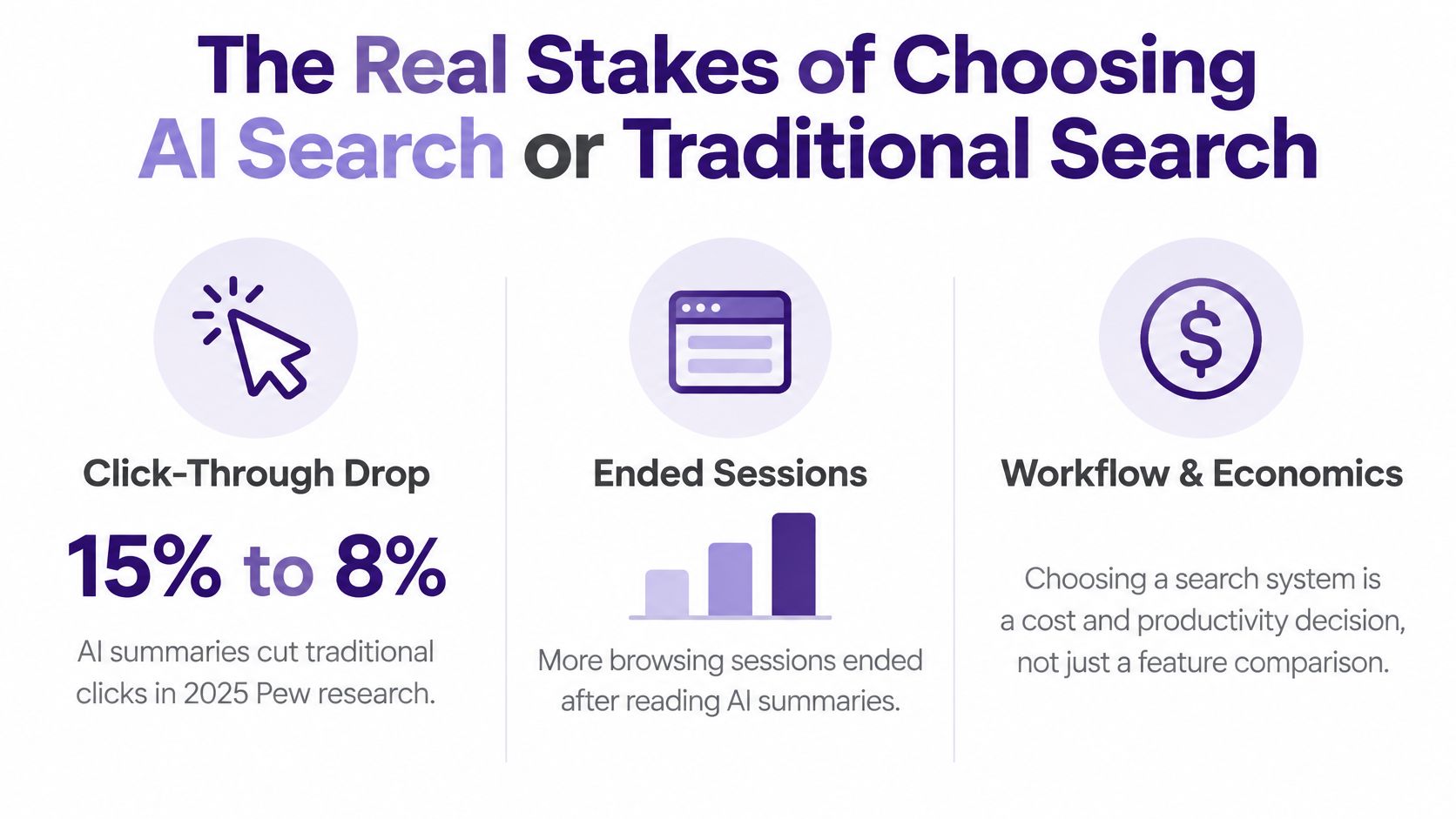
Pew Research Center analyzed 68,879 Google searches from 900 U.S. adults in March 2025 and found that users clicked a traditional result 8% of the time when an AI summary was present, versus 15% when results were conventional, a relative reduction of roughly 47%. About 58% of participants encountered at least one AI summary, and summaries appeared in approximately 18% of all searches examined in that same research.
Sessions End Where Answers Appear
Users also stopped sooner. Pew found 26% of visits involving an AI summary ended the browsing session, versus 16% of visits without one, in the analysis linked above.
That pattern matters for creators and publishers. Traditional search primarily directs people toward external pages. AI search increasingly tries to finish the job inside the results interface, so visibility now depends on being selected, summarized, and cited, not only on ranking for a click.
Practical rule: Optimize for two outcomes, not one. Win the click where you can, and win the citation where the click never happens.
Every content organization now operates in both retrieval systems, whether it planned to or not. Your archive can be ranked, quoted, paraphrased, or ignored before anyone reaches your site. The rules differ by system, so a feature checklist won't save you.
The question to ask in 2026 isn't which system is better. It's which system you should trust for discovery, which for verification, and how you structure your library so both can find the right passage, episode moment, or article without stripping away attribution.
How Each Search System Actually Works
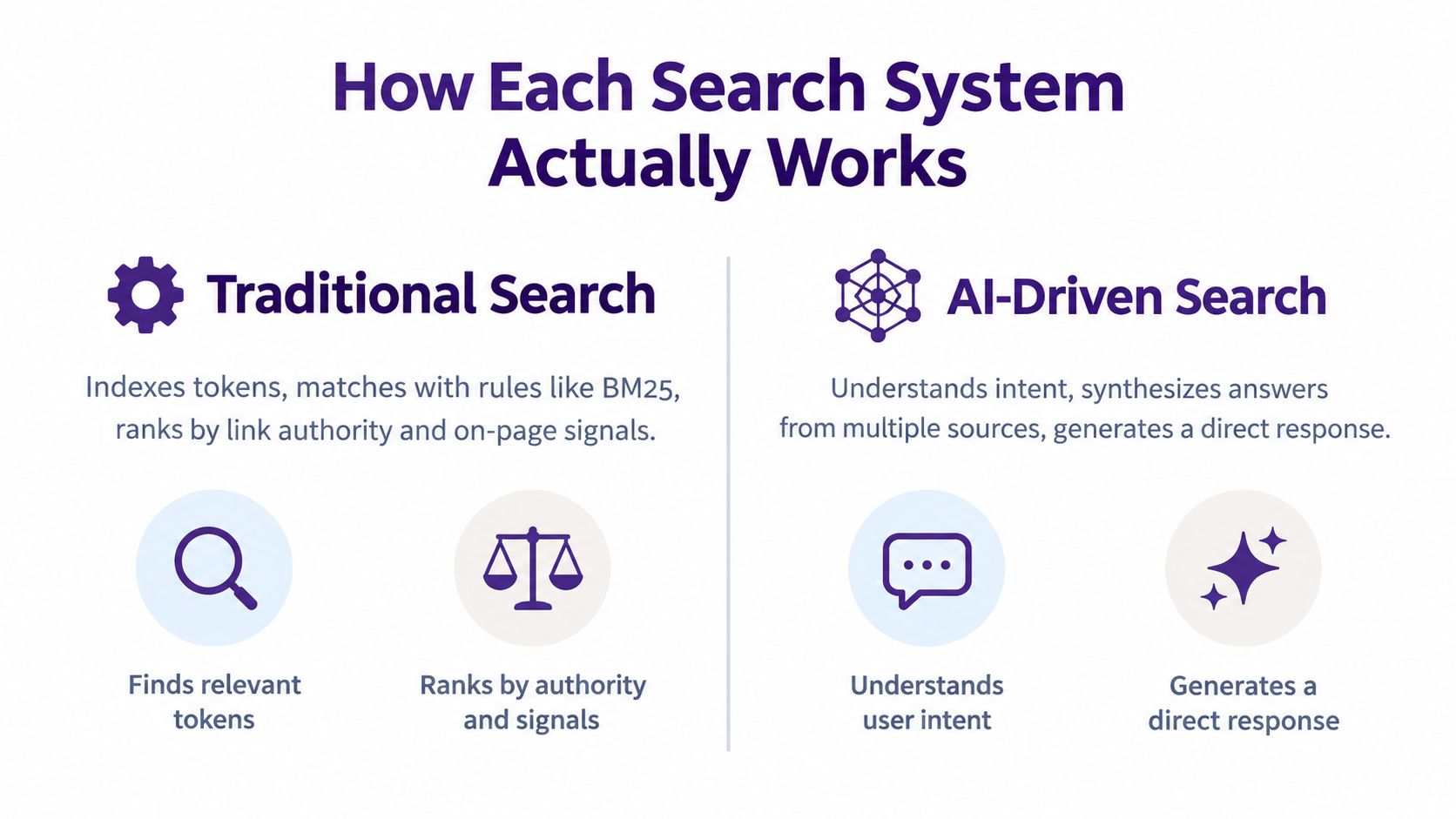
Traditional search breaks content into words and indexes them. When you type a query, it looks for matching words, weighs how distinctive they are with rules like BM25, then ranks pages using link authority and on-page signals. It's literal, predictable, and excellent when you know the exact words.
AI search works differently. It converts your question and your content into representations of meaning, retrieves passages that are close in meaning even when the words differ, then often writes a synthesized answer on top. That's why it handles paraphrases well and why it can sound confident while hiding which source said what.
One Query, Two Paths
Take a podcaster searching a back catalog for moments about audience churn. Traditional search finds episodes where someone said churn, retention, or the exact title you typed. It'll miss a segment called losing listeners if that phrase never appears.
AI search can surface that segment because the meaning matches, then summarize what three guests said across episodes. Useful for brainstorming. Dangerous if you publish the summary without checking the tape.
- Traditional path: Match words, rank documents, let the reader judge.
- AI path: Match meaning, retrieve passages, generate an answer for the reader.
- Hybrid path: Retrieve both ways, then show the source passage alongside any summary.
If you want the mechanics without the jargon, start with how information retrieval systems organize and rank content, then compare that foundation against current trends in AI-powered search. Don't let anyone sell you a system they can't explain in plain sentences. If a vendor can't tell you how candidates are found, how they're ranked, and how a user reaches the original passage, don't buy it.
Relevance and Latency Trade-offs You Can Actually Measure
Opinions about relevance are cheap. Benchmarks and latency budgets aren't, so use them.
On the heterogeneous BEIR benchmark, BM25 trailed neural approaches by 7 to 18 percentage points on the in-domain MS MARCO dataset. Semantic retrieval handles paraphrases and related concepts better than exact-token matching. But BEIR was built to test zero-shot generalization across domains, and lexical methods stay competitive when queries contain distinctive names, identifiers, or exact terminology.
Speed changes the design. Dense retrievers operate below 20 ms in the tested setup and are approximately 20 to 30 times faster than cross-encoder reranking models, while BM25 plus cross-encoder pipelines reach roughly 450 ms to 6,100 ms depending on configuration, according to that same source.
Retrieval Method Trade-offs
| Method | Best at | Relative latency | Best role |
|---|---|---|---|
| BM25 lexical | Exact titles, names, quotes, product strings | Very fast for candidate search | Broad, cheap first pass |
| Dense semantic | Paraphrases and thematic questions | Below 20 ms in tested setup | Exploratory retrieval |
| Cross-encoder reranker | Fine-grained ordering of top candidates | Much slower, up to 6,100 ms in tested pipelines | Rerank a small top set only |
| Hybrid fusion | Balancing exact and conceptual matches | Depends on top set size | Default for large archives |
Build in tiers. Use inexpensive lexical and vector retrieval for broad candidate generation, apply an expensive reranker only to a small top set, and cache frequent queries.
A system that improves semantic relevance but misses your latency target isn't better. Users abandon slow search before they praise its nuance.
Measure three things separately. Track nDCG or recall for relevance, p95 latency for user experience, and indexing and storage cost for operations. For a podcast network or publisher archive, hybrid isn't a compromise. It's the only design that respects both exact lookup and thematic discovery.
Side-by-Side Comparison Across Decision Criteria
Run the same archive query through both systems and the trade-offs get blunt fast. Traditional search is transparent and cheap. AI search is flexible and synthesizing. Neither dominates on every criterion, so decide by job, not by hype.
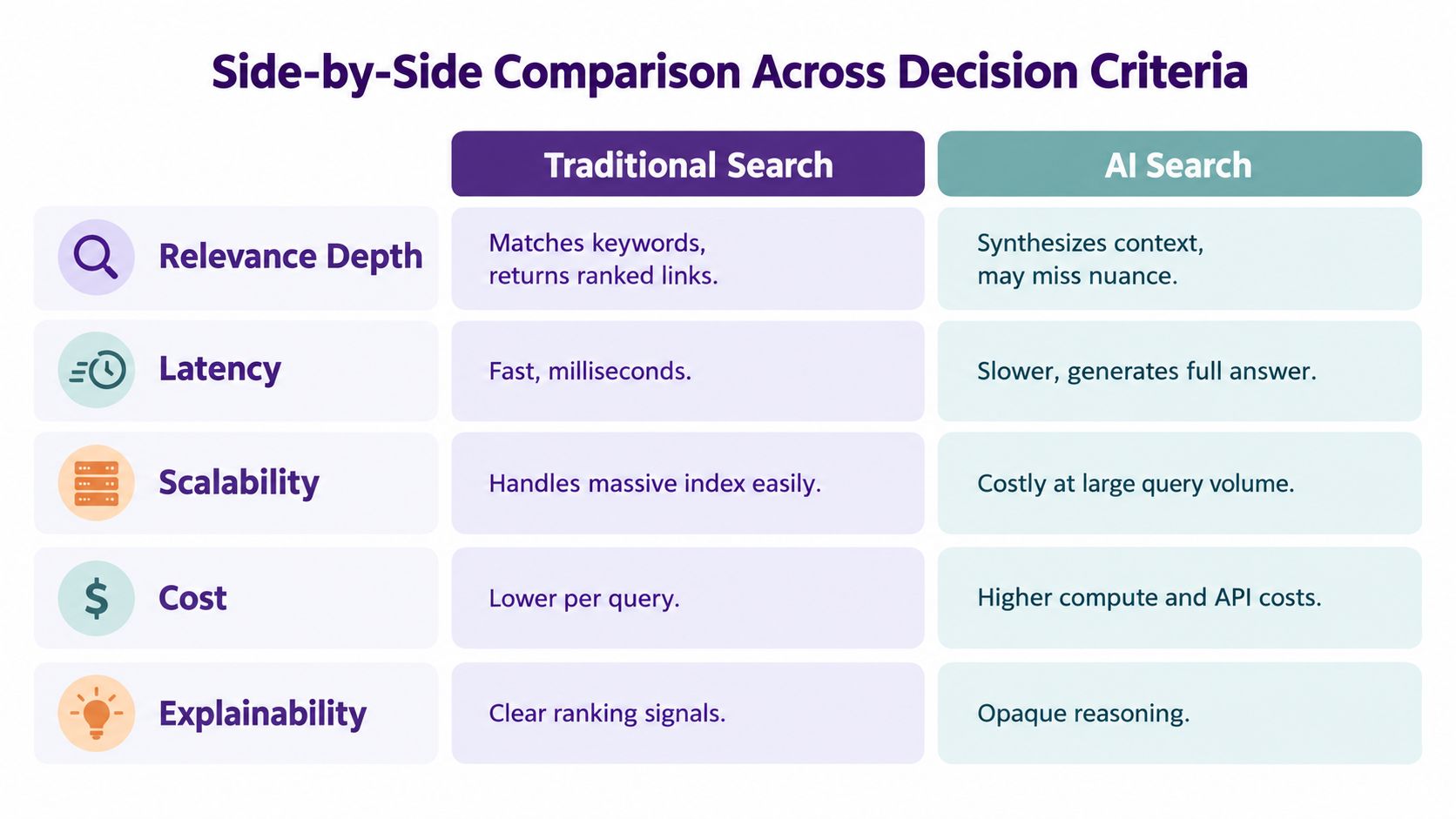
Relevance depth favors AI for vague, thematic questions because it retrieves by meaning and connects related passages. It favors traditional search when the query contains an exact quote, episode title, or technical string that must match exactly. Latency favors traditional and dense retrieval for instant candidate lists, while generated answers and heavy reranking add waiting time users feel.
AI Search vs Traditional Search Decision Matrix
| Criterion | Traditional Search | AI Search | Who Wins |
|---|---|---|---|
| Relevance depth | Strong on exact terms, weak on paraphrase | Strong on themes, can blur nuance | Depends on query type |
| Latency | Fast candidate retrieval | Slower when generating answers | Traditional for speed |
| Scalability | Predictable at large index scale | Reranking and generation raise load | Traditional at volume |
| Cost | Lower compute per query | Higher compute and model cost | Traditional |
| Explainability | Clearer matching and ranking signals | Reasoning often opaque | Traditional |
Scalability and cost usually decide the architecture. Lexical indexes handle massive libraries predictably. AI generation and reranking cost more per query, so you shouldn't run them across an entire archive when a small candidate set will do.
Explainability decides trust. With traditional results, an editor can see why a page matched and open the exact passage. With AI answers, the reasoning path is often opaque, which is a problem for anything you'll publish, license, or defend.
The decision comes down to two questions. Can you afford the cost per query at your volume, and can a user cite the original passage in one click? If the answer to either is no, you don't have a finished system. You have a demo.
Three Real Workflows That Expose the Differences
Abstract comparisons hide the point. These three jobs show where each system earns its keep and where you should hand off to the other.
Resurfacing a Magazine Archive Into Themed Bundles
A publisher wants to turn years of articles into bundles on topics like creator burnout or audience growth. Writers used different vocabulary across years, so keyword search misses relevant pieces.
AI search wins the first pass because it groups by theme and surfaces related work across eras. Then editors should switch to traditional search to confirm titles, dates, authors, and exact sections before packaging anything for sale. The handoff is the workflow.
Answering a Fan Question Across a Podcast Catalog
A listener asks what your guests have said about pricing a first product. No single episode answers it cleanly. AI search can retrieve moments across many episodes and draft a synthesis for a newsletter, community post, or new episode outline.
Don't publish that draft as a quote. Open each transcript moment, check context, and link back to the episode timestamp. AI found the thread. Your team verifies the evidence.
Use AI to find the pattern across the archive. Use the source to prove it.
Verifying a Specific Quotation
A researcher needs to confirm a guest's exact words before a book goes to print. Traditional search wins outright. Search the distinctive phrase, open the transcript, check the surrounding sentences, and cite the primary source.
Source selection also shifts by system. Pew also reported that AI summaries and standard search results cite overlapping but distinct source mixes, with Wikipedia appearing more often in AI summaries and YouTube featuring more prominently in traditional results. Together, Wikipedia, Reddit, and YouTube represented 15% of sources cited in AI summaries versus 17% of links in standard results, according to that reporting. Format and perceived authority shape what each system surfaces, so creators should organize archives into clear, topic-specific, evidence-rich assets rather than dumping undifferentiated files into a folder.
When AI Answers Create an Illusion of Understanding
A fluent summary feels like learning. It isn't always learning, and creators who mistake the two will publish shallow work with confident formatting.
A 2026 user experiment found that generative-AI search increased both search depth and search breadth compared with traditional search, yet did not produce more complex learning. Users covered more ground and didn't understand it more thoroughly. That should change how your team works.

Citations make the problem worse when nobody checks them. Evidence discussed in the verified research for this topic shows citations can increase trust even when they're incorrect or hallucinated. Visible sourcing is not verification. A footnote is a claim, not proof.
Separate Discovery From Verification
Use four modes and don't blur them:
- Discovery: Use AI search to map themes, names, and related questions across a large library.
- Comprehension: Use AI summaries to get oriented, then read the strongest primary sources in full.
- Verification: Use traditional search to find exact passages, quotes, dates, and identifiers.
- Archival research: Work from the original asset, its metadata, and its context, not from a generated paraphrase.
Before you trust an answer, check source diversity, reasoning transparency, and whether you can reproduce the result from the original passage. If you need a performance reference point for your public content, browse pre-AI performance baseline material to understand what your pages did before summaries absorbed demand, then judge new results against that history instead of against vibes. If an answer can't survive a source open, it doesn't go in the script, article, or course.
The Traffic and Attribution Problem Most Comparisons Skip
Convenience for the searcher can starve the source. That's the economic issue most comparisons politely avoid, and it's the one that determines whether original work keeps getting funded.
Separate publisher analysis reported AI bots generated 95.7% less referral traffic than traditional Google search on average, while AI Overviews were associated with a 34.5% lower click-through rate for the top-ranking page. Combined with the Pew click and session-end behavior covered earlier, the direction is clear. Fewer people reach the original work.
Measure Value Beyond the Click
Traffic loss is the wrong frame by itself. Attribution is the right one. If an AI answer uses your reporting, podcast, or video, you need measurable paths back:
- Citations: Track when and where your assets are cited, not just ranked.
- Qualified discovery: Measure downstream listens, reads, and subscriptions after citation exposure.
- Conversion paths: Connect search visibility to calls and signups, using resources like an SEO call tracking guide where phone enquiries matter.
- Reuse and licensing: Log when archive material supports new products, bundles, or licensed use.
Structure your library to survive as a citation source. Give every asset a clear title, topic, author or guest, date, transcript or full text, and stable link. Break long work into citable sections with descriptive headings, as explored in how AI search results select and present sources.
Don't surrender context to become machine-readable. Machine-readable and human-attributable are compatible if you keep provenance attached to every passage. Lose provenance and you've donated your archive to an answer layer that may never send anyone back.
A Five-Step Migration Path for Creators and Publishers
Don't rip out keyword search. Build hybrid on top of it, in this order.
First, audit what AI systems cite today. Run your highest-value questions through AI and traditional results. Record which of your assets appear, which competitors appear instead, and whether citations point to the right passage. Done means you have a written baseline for your priority topics, not a screenshot folder.
Second, fix metadata before you buy models. Tag episodes, articles, and videos with consistent topics, people, products, dates, and section-level descriptions. Add transcripts and full text where rights allow. Done means a new team member can understand an asset without opening three other files, and a machine can cite a specific section.
Build the Hybrid Layer
Third, stand up semantic search beside your existing keyword index. Tools in this category include Contesimal, which lets teams classify, organize, and search large sets of articles, podcasts, and videos with a chat-based interface alongside structured library organization. Done means exploratory questions return thematically relevant passages while exact title and quote searches still work.
Fourth, add a reranker only where your latency budget allows. Rerank a small top candidate set, cache frequent queries, and set a p95 target before launch. Done means relevance improved on your test questions without breaking the response-time budget you wrote down.
Fifth, measure clicks, citations, and downstream value together. Track sessions, citation presence, newsletter signups, bundle sales, licensing enquiries, and reuse in new content. Done means your dashboard can show value when nobody clicks. For the public-facing side of this work, align it with optimizing content for search engines so your pages serve ranking systems and citation systems at the same time.
Decision rule: Use AI search to discover across meaning, traditional search to verify against sources, and hybrid retrieval as your default architecture.
Quick Answers to the Questions That Remain
What if an AI answer cites your own content incorrectly? Open the cited passage, document the error, tighten the source page headings and metadata, and publish a clear canonical version that's harder to misread. Don't argue with the summary. Fix the source it feeds on.
Does a small archive need semantic search? If your team knows every asset by heart, no. The moment collaborators can't recall titles, guests, or themes reliably, yes. Scale is about human memory, not file count alone.
What should you do about hallucinated citations? Treat every generated citation as unverified until the passage is opened. Require source links in drafts, reject quotes without timestamps or page anchors, and keep a human verification step before publication. AI drafts the map. People check the territory.
Organize your library, understand what it contains, then take action with both systems working for you. That's how old longform content becomes new value instead of storage cost.
Turn your archive into a searchable, citable asset that both people and AI systems can use without losing provenance, with tools to organize libraries, surface themes across episodes and articles, and build new products from existing work. Visit Contesimal to see how your catalog can support hybrid discovery, verification, and reuse across platforms.