
The real goal of research is to stop you from just wandering around the internet and start a targeted hunt for gold. It’s the "why" that gives your work a backbone, making sure every video you shoot or article you write has a clear, strategic point—whether you're looking for your next hit topic or figuring out how to monetize your entire back catalog.
Finding Your True North in Research
Before you even think about opening your analytics or brainstorming your next project, you have to ask one simple question: “Why am I doing this?”
Without a clear answer, you’re not really doing research. You’re just gathering information—clicking through articles, scrolling through comments, and staring at dashboards. It feels productive, but it usually leads nowhere. Defining your purpose is like plugging a destination into your GPS before you start driving. It turns a random road trip into a direct route to where you want to go.
This "why" is what separates busy work from work that actually moves the needle. It's the difference between a podcaster making another generic interview episode and one who finds a tiny, underserved niche their listeners are desperate to hear more about. It’s what helps a YouTuber stop chasing fleeting trends and start building a real content strategy based on what their audience has proven they love.
For creators and publishers, a sharp research purpose isn't some stuffy academic exercise. It's the absolute foundation of a successful content business. It makes sure your time, energy, and creativity are all pointed directly at your goals, whether that’s growing your audience, boosting engagement, or making more money.
Think about all that content you’ve already made—the videos, the blog posts, the podcast episodes sitting in your archive. Without a purpose, it’s just a digital attic full of old stuff. But with a clear research objective, that attic becomes a goldmine.
- For a Publisher: The purpose might be to figure out which articles from the last 5 years drove the most affiliate sales, which then shapes a whole new monetization plan.
- For a Content Marketer: The goal could be to find the most common questions in your blog comments so you can create a killer FAQ series that prints SEO traffic.
- For a Video Creator: Your mission might be to see which video formats have the highest audience retention, telling you exactly what kind of video to make next.
See how that works? The purpose guides everything. It tells you what questions to ask, what data to look for, and how you’ll know if you’ve succeeded.
It’s the difference between saying, "Let's look at some data," and, "Let's find out which topics our most engaged subscribers actually want more of." That one shift in focus is everything. To get a clearer picture of what this looks like in practice, you can explore our detailed guide on the fundamentals of what research truly is and how it applies to modern creators. When you lock in your 'why' from the start, you guarantee that every move you make is based on solid insight, not just a hunch.
The Six Core Objectives Driving Meaningful Research
Knowing your "why" is a great start, but the purpose of research isn't some monolithic idea. It’s more like a toolbox, with different tools built for different jobs. Each specific objective is designed to answer a unique kind of question. After all, you wouldn't bring a hammer to a job that needs a saw.
For content creators, podcasters, and publishers, picking the right objective is what separates a focused, strategic project from a wild goose chase. Get this right, and every bit of effort pays off, delivering insights that directly fuel your goals—whether that's audience growth, monetization, or just making better stuff.
Let's walk through the six core objectives, ditching the textbook definitions for how they actually work in the real world of content.
1. Exploratory Research: Charting New Territory
Think of exploratory research as sending a scout into an uncharted wilderness. The whole point is to get the lay of the land on a topic that’s fuzzy, new, or not well understood. You aren’t marching in with a firm hypothesis to test; you're just looking for initial patterns, glimmers of insight, and fresh ideas.
For a YouTuber, this might look like trying out a totally new video format just to see how the audience reacts. A publisher might dive into reader comments and social media chatter, trying to spot the next big trend before it blows up. It’s all about asking open-ended questions like, “What are the possibilities here?” or “What are people really talking about in this niche?”
Exploratory research doesn’t give you a final answer. What it does give you is a much better set of questions and a clearer path for what to investigate next.
2. Descriptive Research: Painting a Detailed Picture
Okay, so your scout has returned from the wilderness. Now you need to create a detailed map of what they found. That’s where descriptive research comes in. Its job is to accurately and systematically describe a situation, a group of people, or a phenomenon. It’s all about the "what," "where," "when," and "how"—but it stops short of explaining the "why."
This is the bread and butter of most content operations. If you run a blog, descriptive research is analyzing your audience demographics—who they are, where they live, what they like. It’s tracking your page views, time on page, and bounce rates on your top articles. For a podcaster, it might be as simple as documenting the average listen time for your episodes.
Descriptive research gives you the hard data for a crystal-clear snapshot of your current reality. It’s the difference between guessing who your audience is and knowing, with numbers to prove it.
3. Explanatory Research: Connecting the Dots
If descriptive research tells you what's happening, explanatory research is all about figuring out why. This objective dives deep into cause-and-effect relationships. It moves past just observing things to actually testing ideas and understanding the links between different factors.
This is an incredibly powerful tool for any creator trying to fine-tune their work. A YouTuber might use it to determine if shorter video intros directly cause higher audience retention. A publisher could analyze data to see if articles with a certain number of images correlate with more social shares.
Explanatory research is the detective work that uncovers the hidden mechanics behind your content’s performance. It’s what lets you say, “When we do A, B is much more likely to happen.”
This is how you move from just gathering random information to making targeted discoveries.
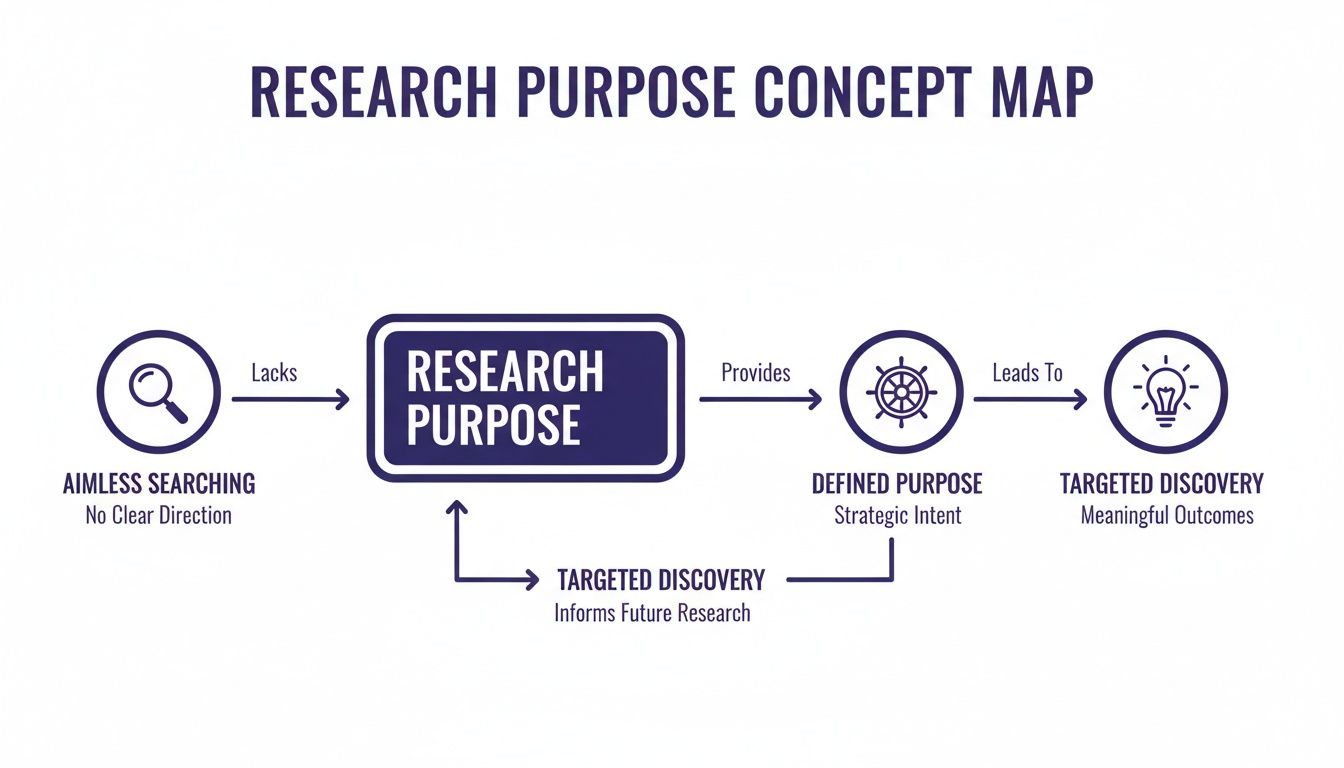
A clear objective acts as a rudder for your project, steering you away from aimless wandering and toward insights you can actually use.
4. Evaluative Research: Measuring the Impact
Evaluative research is all about judgment. It assesses whether a program, a strategy, or a specific piece of content actually worked. Did it hit its goals? For anyone running their creative work like a business, this is how you measure your return on investment (ROI).
Here are a few places where evaluative research shines:
- A Content Marketer: Did our new email campaign actually boost leads by the 15% we projected?
- A Book Publisher: Did that big social media ad spend for a new author's launch successfully drive book sales?
- A Podcaster: After we switched to a new hosting platform, did our downloads see a measurable jump?
This objective is all about accountability. It gives you the data to make smart decisions about where to put your time, money, and energy for the biggest payoff.
5. Applied Research: Solving a Real-World Problem
While other types of research might be about understanding, applied research is about doing. It’s laser-focused on solving a specific, practical problem and finding a solution that works right now. For most creators, almost all research has an applied angle.
A YouTuber who sees a sudden drop in viewership isn't just curious about the "why" (that's explanatory research); they need a fix. Applied research is the process of testing different thumbnail designs, video titles, or content styles to find a concrete strategy to reverse the trend. It's problem-focused, solution-oriented, and directly tied to making things better.
6. Theoretical Research: Expanding the Frontiers
Finally, there’s theoretical research, sometimes called basic or pure research. This is driven by pure curiosity and the desire to expand what we know about a subject, often without any immediate practical use in mind. While it’s less common for the day-to-day work of a podcaster or publisher, its findings often become the bedrock for the applied research of tomorrow.
Understanding these six objectives helps you get your mission straight from the start. When you pinpoint the right purpose for your research, you ensure every ounce of effort contributes directly to a meaningful goal. You start turning your creative energy and your content library into a well-oiled machine for growth.
How Purpose Shapes Your Research Method and Metrics

Figuring out the purpose of your research isn't just a box to check. It's the one decision that steers everything else you do. Your "why" determines your "how"—it’s that simple. Get the objective right, and it becomes your compass, pointing you to the right way to gather information and the right way to measure if you've succeeded.
Picking a method that doesn’t match your purpose is like trying to measure the temperature with a ruler. It just doesn't work. If your goal is to explore new video ideas, a rigid survey with multiple-choice questions is useless. You need conversations, open-ended questions, and brainstorming. But if you're trying to prove a new intro format boosts retention, you need cold, hard data from an A/B test, not just a handful of opinions.
Getting this alignment right from the start saves you from chasing dead ends. It’s the difference between producing a report that gets buried in a folder somewhere and finding an insight that completely changes your content game.
From Purpose to Practice: A Podcaster's Journey
Let’s get specific. Picture a podcaster who’s built a huge back catalog of episodes, but their audience growth has completely stalled. They aren't sure what to do next. Their first move shouldn't be to randomly try new topics or guests. It’s to define a sharp, clear research purpose.
Problem: Audience growth is flat, and people seem to be bailing on new episodes early.
Research Purpose: Explanatory—to figure out why and where listeners are dropping off.
That specific goal immediately tells them what to do. They don't need to poll strangers on Twitter. They need to dig into their own content and audience behavior.
Method:
- Analyze listener data, zeroing in on the retention graphs for each episode.
- Find the top 5 episodes with the biggest drop-offs in the first 20% of the show.
- Compare the intros, topics, and formats of these bottom-performers against the episodes that keep listeners hooked.
The purpose dictates the method. Because the goal is to explain drop-off, the method becomes a forensic analysis of existing episode data. The podcaster is now a detective, with their content library as the crime scene.
Once the method is clear, the success metric is just as obvious. The goal isn’t a fuzzy wish for "more downloads." It's tied directly to the problem they identified.
Success Metric: Increase average listener retention at the 20% mark from 65% to 75% over the next three months.
The whole journey, from a vague problem to a concrete, measurable goal, flows from that initial purpose. This is the same thinking that drives growth everywhere. The core aim of research is to turn ideas into results, whether you’re a solo creator or a massive company.
The Right Tools for the Right Job
This logic works for every creator. A blogger who wants to describe their audience will live inside Google Analytics. One who needs to evaluate a new article format will be tracking things like time on page and conversion rates. A publisher looking to explore new ways to make money from their archives needs a way to find hidden gems in their back catalog.
This is where a tool like Contesimal comes in. If you have hundreds of hours of video or audio, analyzing it all by hand is next to impossible. Contesimal helps you organize your content library, enabling humans and AI to collaborate and discover value in your existing assets. That podcaster, for instance, could just ask, "What are the common traits of episodes with the highest listener retention?" and get an actionable summary in minutes.
By connecting your purpose to your methods and your metrics, you create a repeatable system for growth. Each project becomes a focused effort, not just a shot in the dark. For a closer look at how to organize your own projects, check out our guide on creating a sample research plan that actually works. This is how you turn your creative hunches into a strategy that gets real results.
Research in Action for Creators and Publishers

It’s one thing to know the different types of research, but the real magic happens when you see how a clear purpose of research solves the day-to-day problems creators and publishers face. This is where theory gets its hands dirty.
Let’s ditch the textbook definitions and see how a sharp objective leads to real-world wins. By looking at a simple "Problem, Purpose, Action, and Result" flow, you can see how this structured thinking works for different creators—and how you can steal the framework for your own projects.
These examples show how a focused mission stops you from wasting time and directly ties your creative work to your business goals.
The YouTuber Boosting Click-Through Rates
A YouTuber pours her heart into high-quality documentary videos, but she’s hit a wall. People who click through love her work and watch to the end, but her click-through rate (CTR) is a painful 2.5%. The content is great, but nobody’s clicking.
- Problem: Amazing videos aren't getting viewed because the thumbnails fail to grab attention.
- Research Purpose: Descriptive. The goal here is to systematically break down the visual patterns of top-performing thumbnails from her direct competitors.
- Action: She zeroes in on the top 10 channels in her niche and analyzes their 50 most-viewed videos. She starts documenting what she finds: high-contrast colors, big text overlays (three words or less), and human faces showing intense emotion. Armed with this data, she redesigns her next five thumbnails to match these patterns.
- Result: The average CTR on her new videos jumps to 6%. Her descriptive research gave her a clear, data-backed blueprint for what works, allowing her to fix the exact problem holding her back.
The Publisher Measuring Repurposing ROI
A digital magazine has a massive archive of fantastic long-form articles. They recently invested a chunk of time and money to repurpose their top 20 articles into short-form videos for social media. Now, the leadership team is asking the big question: Was it worth it?
This is where evaluative research shines. It’s not about finding new ideas; it’s about judging whether a strategy you already tried actually worked.
- Problem: The team has no idea if their content repurposing project is delivering a positive return on investment (ROI).
- Research Purpose: Evaluative. The objective is to measure the video series' impact against specific goals, like referral traffic and new subscribers.
- Action: The marketing team tracks referral traffic from social media for the 30 days after the video campaign launched, comparing it to the month before. They also tally how many new email subscribers signed up from landing pages linked directly in the videos.
- Result: The video series drove a 40% increase in referral traffic and pulled in 500 new subscribers. Based on their customer lifetime value, this return blew past the production costs. The evaluative research proved the project’s success and secured the budget to do it again, but bigger.
The Podcaster Discovering Untapped Niches
A podcaster with a popular business strategy show feels like he’s running out of steam. His topics are starting to feel a bit generic. He needs a fresh, specific angle to fire up his audience and attract new listeners, but he’s drawing a blank. For any creator, understanding your market is everything. This even includes learning how to research comparable titles for your book easily to see what clicks with your audience.
- Problem: Content is getting stale, and the creator needs a new, super-engaging niche to explore.
- Research Purpose: Exploratory. The goal is to dive headfirst into audience feedback and online chatter to find unmet needs and hidden interests.
- Action: The host uses a tool to sift through comments on his last 50 episodes and in his community forum. He’s looking for patterns—recurring questions, keywords, and frustrations. He strikes gold. Dozens of listeners are asking for advice on one specific thing: "how to transition from a side hustle to a full-time business."
- Result: The podcaster launches a five-part mini-series on that exact topic. It becomes his most-downloaded content of the year. The exploratory research didn't just give him an idea; it unearthed a topic his audience was practically begging for.
Common Mistakes That Wreck Good Research
Even the best research plan can completely fall apart. Knowing what not to do is just as critical as knowing the right steps. These mistakes aren’t just bumps in the road; they’re deep potholes that can swallow your project whole.
Spotting these traps is key. For creators, publishers, and marketers, it's the only way to protect the work and make sure your research actually delivers insights you can use. Many of these blunders are subtle, but they have the power to completely invalidate your findings.
Let's walk through the most common ones and how you can steer clear of them.
Starting with a Solution Instead of a Question
This is the classic one. You’ve already decided on a great video idea, and you’re just doing "research" to find proof that you’re right. This isn’t research—it’s confirmation bias in action. You're just looking for an echo, not an answer.
-
A Familiar Story: A blogger decides their audience must want a deep dive into 19th-century philosophy. They hunt for evidence and find three positive comments, all while ignoring a mountain of data showing their readers love short, practical marketing tips. The series bombs, of course.
-
The Fix: Don’t start with an answer. Start with an honest, open-ended question like, "What topics get the most shares from our audience?" Let the data point you toward the solution.
Using the Wrong Method for Your Goal
This mistake pops up when you mix up your research objectives. You might try running a numbers-based survey (descriptive research) to figure out the deep "why" behind audience behavior (explanatory research). You’re using a hammer to turn a screw.
-
A Familiar Story: A podcaster sends out a multiple-choice survey to figure out why their listenership is tanking. The results come back showing 70% of listeners think the content is "good," but it offers zero clues as to why they all bail after five minutes.
-
The Fix: Match your method to your goal. If you're asking "why," you need qualitative tools. Think one-on-one interviews or a deep, manual analysis of comment sections.
Confusing Correlation with Causation
Just because two things happen at the same time doesn't mean one caused the other. This is a huge mistake that leads to terrible decisions. For instance, your views might spike after you start wearing a blue shirt in your videos, but let's be real—the shirt probably isn't the reason.
A core purpose of research is to close these kinds of knowledge gaps. On a global scale, you can see this in how nations approach R&D. The US saw business R&D spending hit $692 billion in 2022, with 80% of that going toward development—turning raw knowledge into real-world applications. This same principle—analyzing past data to find what actually drives future success—is what helps creators find real, causal links in their content performance. To see more on these investment trends, you can check out the 2025 Global R&D Funding Forecast.
Unlock Your Archives with Purposeful Research

Most creators have a digital attic. It’s that ever-growing library of past videos, articles, and podcast episodes—full of incredible assets, but so disorganized it’s almost impossible to search. What if you could flip a switch and turn that static archive into an active, intelligent partner for your work?
This is where the real purpose of research comes alive. It’s not about dusty textbooks; it's about turning your own work into a goldmine. The problem is, who has the time to manually sift through hundreds of hours of video or thousands of blog posts? This is exactly why we built Contesimal. It lets you organize your content library, upcycle old assets, and create infinite new value from what you already own.
Ask Your Content Library a Question
With the right tools, you can run focused research on your own material without spending weeks buried in spreadsheets. Instead of just guessing what worked, you can ask your content directly.
Think about it this way:
- YouTubers: You could ask, "What are the common threads in our top-performing videos from last year?" That’s descriptive research in action, giving you a data-backed blueprint for what your audience truly loves.
- Podcasters: Try querying your transcripts with, "What new ideas can we pull from our series on digital marketing?" This is exploratory research, and it’s perfect for uncovering fresh angles you might have missed the first time around.
- Publishers: Ask, "Which topics in our archive got tons of engagement but haven't been updated in over a year?" Suddenly, you have a list of proven winners just waiting for a refresh.
From Static Archive to Active Partner
This simple shift changes everything. Your content library stops being a passive storage unit and becomes an active collaborator in your creative process. It helps you understand what connects with your audience, see the patterns in your best work, and generate new ideas that are already backed by your own history.
By mining your content library for fresh ideas, you build a sustainable engine for creativity that’s completely unique to you.
It's the same principle driving massive innovation worldwide. Global R&D spending has tripled since 2000 and is expected to hit $2.87 trillion by 2026. Why? To find hidden opportunities in huge piles of data. Just as Contesimal sifts through your archive, this huge investment uncovers patterns that fuel entire industries. In fact, as WIPO's analysis of global innovation trends shows, without this kind of purposeful research, the AI tools revolutionizing our work today wouldn't even exist.
Common Questions (and Answers) About Research
Jumping into research can feel a little like you’re trying to assemble furniture with the instructions in another language. You know what you want to build, but the steps feel confusing. This is especially true for creators and marketers who just need practical, clear answers.
Let’s clear up a few of the most common questions people have when figuring out the purpose of their research.
How Do I Choose the Right Research Purpose for My Project?
This is the big one. The best way to answer it is to ask yourself another question: What decision will this research help me make? Your answer is your compass.
Think of it this way:
- Feel like you’re in a new, unexplored territory? You need Exploratory research. This is your map-making phase, where you’re just trying to get the lay of the land for a new content idea or topic.
- Need a snapshot of your audience right now? That’s where Descriptive research comes in. It gives you the "who, what, and where" so you can understand your current situation with real numbers.
- Trying to figure out why something is happening? You're looking for Explanatory research. This is for when you need to connect the dots, like testing if a new video thumbnail actually causes a spike in clicks.
If you’re stuck, just keep coming back to the final decision you need to make. That single point of focus will always guide you to the right purpose.
Can I Use Multiple Research Purposes in One Project?
You can, but it's usually a bad idea to try and do it all at once. Trying to explore, describe, and explain in one go often leads to a muddled mess where nothing gets answered clearly.
A much better approach is to see research as a journey. One type of research naturally sets the stage for the next.
For example, a publisher might start with exploratory research by digging through social media chatter to find a few promising article topics. Then, they’ll follow up with a descriptive research survey to see which of their top three ideas the audience is most excited about.
Think of it as a step-by-step process. Each phase builds on the last, giving you focused insights that you can actually trust and act on.
What Is the Difference Between Market Research and the Purpose of Research?
This is a great question, and it's a common point of confusion. It’s actually simpler than it sounds.
The "purpose of research" is the fundamental why behind your project—are you exploring, describing, or explaining something? Market research is just what we call it when you apply those purposes to a business problem.
In other words, you’re doing market research when you use these core principles to understand customers, check out the competition, or test a new product. You might run an exploratory market research project to find a new audience segment, or an explanatory one to figure out why sales dipped last quarter.
Ready to turn your content archive into an active research partner? With Contesimal, you can ask your library questions, discover hidden patterns, and generate new ideas backed by your own data. Stop guessing and start knowing. Explore how you can unlock the value in your content today at https://contesimal.ai.