
Your archive is probably full of useful material that nobody can find.
A podcaster has years of thoughtful interviews buried in episode folders. A publisher has articles that once performed well but now sit untouched in an aging CMS. A video creator remembers a brilliant explanation from an old recording, yet can't locate the right minute, transcript, or supporting clip quickly enough to reuse it.
That gap between having content and activating content is where a content automation platform earns its place. The right system turns a static library into searchable knowledge, repeatable workflows, and new formats for new audiences. It helps creators organize what they already own, understand what can be reused, and take action without asking an editor to rebuild every asset from scratch.
Why Your Content Library Is Sitting on Untapped Revenue
Maya runs a successful interview channel. Her library contains longform conversations, behind-the-scenes recordings, written notes, and transcripts. She knows the strongest ideas are still relevant, but every new campaign starts with the same exhausting ritual: open old folders, skim files, search vague filenames, copy fragments into documents, and ask a contractor to turn them into social posts.
By the time she finds the material, the moment has passed. Her team produces the next episode instead.
This is the familiar transition from hobbyist to professional. A hobbyist can remember where everything lives. A revenue-generating creator needs a system that can classify, retrieve, transform, review, and distribute content while several people work on it. Manual organization breaks down because the library grows faster than anyone can maintain its labels, versions, rights information, and relationships.

The archive needs a working memory
A folder can store a recording. It can't reliably answer, “Which episodes discuss sustainable design, include a useful founder story, and could become a newsletter for senior marketers?”
A content automation platform can connect the answer to classification, taxonomy, search, workflow state, and output format. That makes old content available for editorial decisions instead of leaving it as an expensive memory bank.
The opportunity isn't limited to independent creators. Major studios such as Disney and Marvel have long understood how characters, stories, scenes, and themes can move across films, series, books, merchandise, and fan experiences. Independent publishers and professional creators now have access to tools that bring a more manageable version of that reuse model to their own libraries.
A practical guide to transforming a content library can help teams make the shift from storage to activation. The central principle is simple: one strong source can support many carefully edited experiences, provided the underlying content is organized well enough to retrieve and adapt.
Production speed isn't the whole point
Automation matters because it removes repetitive work, but speed alone doesn't create durable value. A fast workflow that produces poorly labeled clips, loses provenance, or publishes unreviewed claims only creates a faster mess.
The stronger model separates machine-friendly tasks from human judgment. Software can identify themes, suggest related assets, prepare drafts, and route approvals. Creators still decide what deserves emphasis, what fits the brand, and what should reach an audience.
That combination lets a library become a living asset. Old interviews can support new explainers. A research archive can inform a current campaign. A back catalog can feed playlists, newsletters, clips, and member experiences. Organize. Understand. Take action. That's how a dusty archive starts behaving like a revenue engine.
What a Content Automation Platform Actually Does
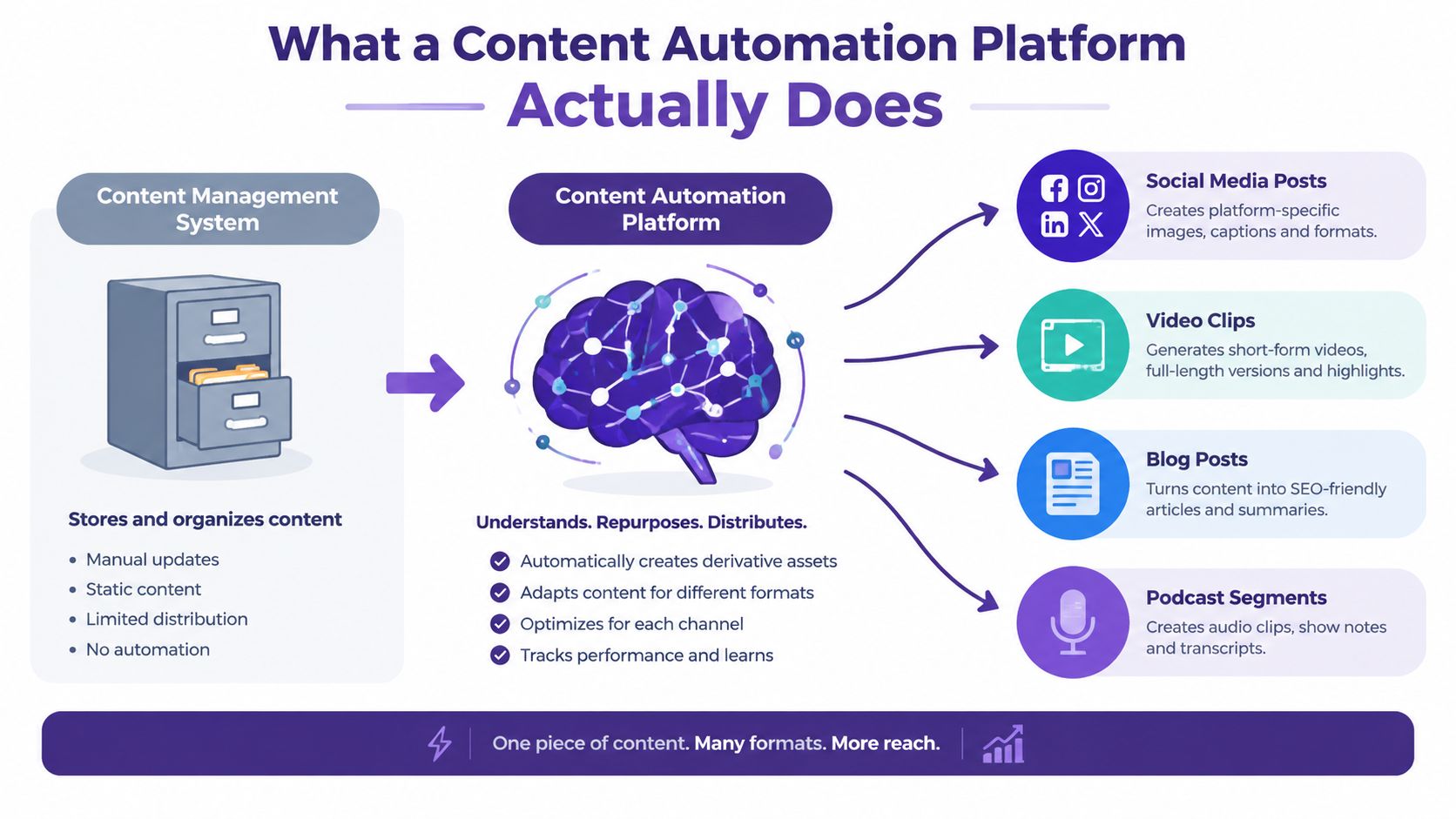
A traditional CMS is like a library with shelves, labels, and a checkout desk. It stores content and helps people publish it, but the user often has to know what to search for and where the item belongs.
A content automation platform adds a research assistant, archivist, production coordinator, and distribution desk to that library. It examines incoming material, applies structured meaning, connects related items, moves work through defined stages, and helps people decide what to do next.
Start with the content model
The first layer is ingestion. The system needs to accept the formats your organization uses, such as articles, transcripts, audio, video metadata, research documents, and supporting files. It then applies labels that describe subjects, people, formats, audience groups, rights, status, and relationships.
Those labels form a taxonomy, not merely a collection of keywords. A useful taxonomy can distinguish a topic from a format, a finished asset from a draft, and a licensed recording from material cleared for unrestricted reuse.
The next layer is search. Functional search finds a title, phrase, author, or date. AI-assisted search can help a researcher explore themes and connections across a heterogeneous collection, although every generated suggestion still needs appropriate editorial checking.
Move from rules to orchestration
CMS technology began changing digital content creation, management, and distribution at scale in the 1990s. The newer architectural direction moves beyond deterministic routing toward multi-agent orchestration and human-in-the-loop assistants, a progression discussed in background on content management and Namirial.
In practical terms, one specialized process might classify an incoming transcript, another might identify reusable passages, and another might prepare a draft for approval. A policy engine determines what can happen automatically, while a state model records whether an item is new, under review, approved, published, archived, or restricted.
Practical rule: Automate predictable movement, not unreviewed judgment.
That distinction protects editorial control. A human-in-the-loop copilot can handle repetitive tagging or routing while escalating low-confidence decisions, rights questions, sensitive topics, and brand-sensitive edits to a person.
For teams comparing systems, the difference between a storage tool and a true content intelligence platform is the decision layer. The platform should explain where an asset came from, what happened to it, who approved it, and how a new derivative relates to the original.
Watch the workflow in action before you assess the interface.
Teams that want a broader technical view can also explore how to automate content workflows with AI, especially when a process combines generation, review, and distribution.
How Different Teams Use Content Automation
A single interview can behave very differently depending on who owns it.
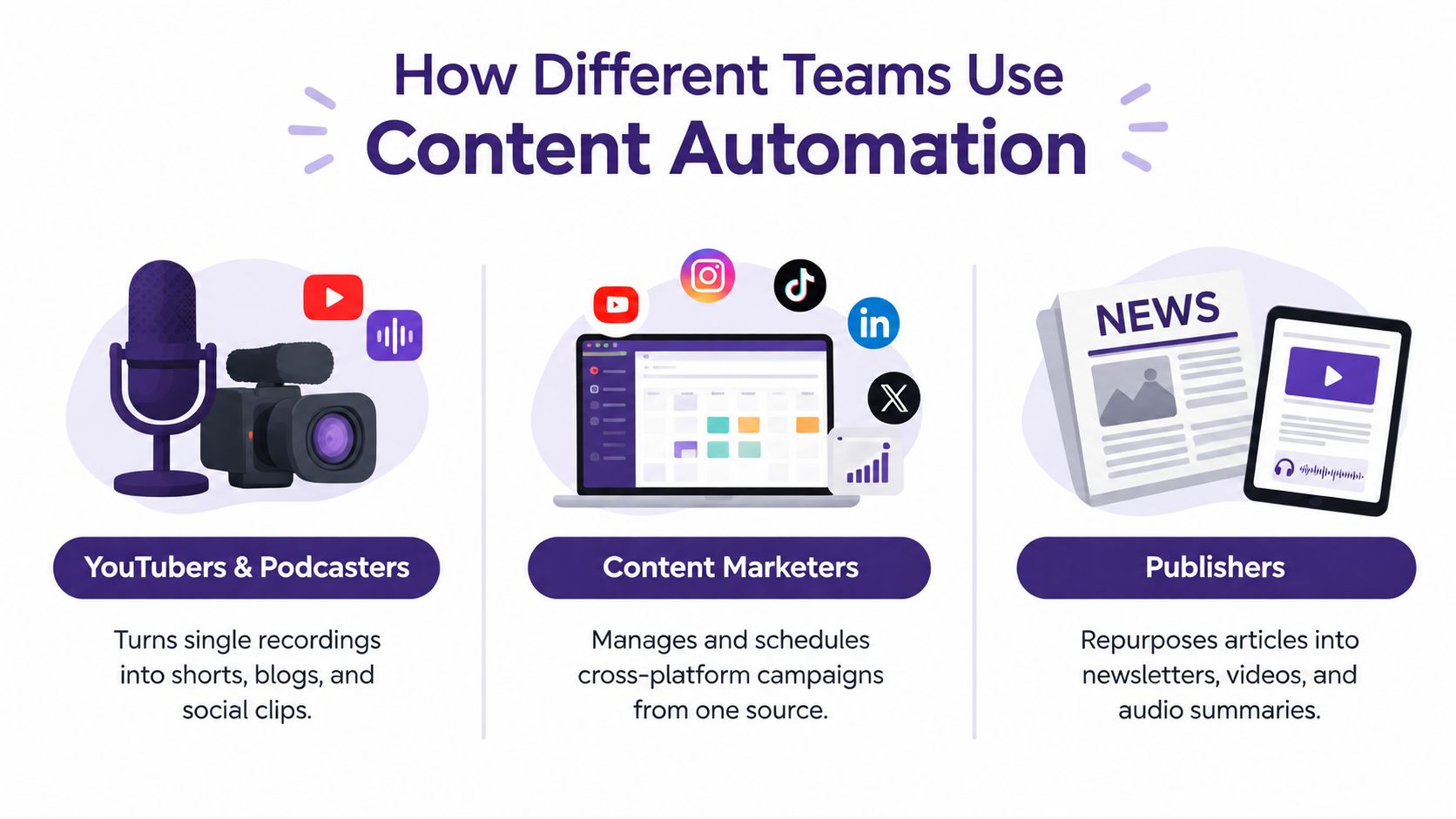
For a YouTuber, the recording is a video episode. For a marketer, it may be a customer insight, a campaign theme, or a sales enablement asset. For a publisher, it can become part of a searchable archive that gains relevance when a new event brings the subject back into public conversation.
YouTubers and podcasters
A podcaster records an hour-long conversation with a climate researcher. After approval, the workflow can identify sections by topic, connect them to the episode transcript, suggest a blog structure, and prepare short-form clip candidates. The producer still chooses the hook, checks context, and rejects anything that distorts the guest's meaning.
This matters when a hobby project becomes a professional operation. The creator needs more people, more dependable handoffs, and a way to keep successful concepts discoverable. A platform can support playlists and recurring content buckets without forcing the team to rediscover the same source material each week.
Content marketers
A marketing team starts with one approved source brief. The platform can route versions for a blog, newsletter, social channel, customer presentation, and internal review. Shared metadata keeps the campaign aligned while channel-specific editors adjust length, tone, and calls to action.
The benefit isn't just publishing from one button. It's maintaining a reliable relationship between the source and its derivatives, so an updated claim or changed approval status doesn't leave outdated versions circulating unnoticed.
When a campaign needs structured comparison content, a DTC listicle template tool can help shape the format, while the automation platform manages source selection, review, and reuse.
Publishers and researchers
A magazine publisher may own years of articles about a recurring subject. AI-assisted search can surface older reporting when editors plan a new package, then connect related interviews, images, audio, and follow-up coverage. The editor decides which material is still accurate, which rights remain valid, and what deserves a new treatment.
That human-AI partnership expands experimentation without flattening editorial identity. Teams can test a newsletter angle, audio summary, or explainer while preserving the original source and its context.
Research on marketing content automation found that teams using automation technology saw a 29% greater revenue impact from content marketing and were 24% more likely to meet content demand than peers not using automation, as reported in coverage of the Aragon Research findings. The implication is operational: structured reuse gives teams more ways to activate existing work without treating every output as a brand-new assignment.
How to Evaluate a Content Automation Platform
A vendor demo often looks impressive because every platform can show a polished dashboard. The harder test is whether the system can understand your archive, preserve context, support approval, and make useful material discoverable beyond ordinary keyword search.
Start with the content model. Ask the vendor to import a representative sample containing different formats, incomplete metadata, duplicate files, and restricted assets. Then test whether your team can adjust the taxonomy without rebuilding the entire system.
Use the evaluation matrix
| Evaluation Criteria | What to Look For | Why It Matters |
|---|---|---|
| Taxonomy flexibility | Layered categories, custom fields, relationships, and controlled vocabularies | Your archive will evolve, and rigid labels quickly become misleading |
| Multi-format ingestion | Support for articles, transcripts, audio, video metadata, and documents | Valuable context often sits outside the primary CMS |
| AI-search discoverability | Semantic retrieval, source references, structured metadata, and clear indexing controls | Content must be findable and understandable in AI-mediated discovery |
| Workflow orchestration | Routing, approvals, exception handling, status tracking, and event logs | Teams need automation without losing accountability |
| Governance and compliance | Rights fields, retention rules, permissions, audit history, and human review gates | High-volume reuse can amplify policy and provenance errors |
| Integrations | APIs, import tools, export options, and connections to existing publishing systems | A platform should fit the operating environment rather than create another silo |
| Reporting | Reuse tracking, workflow visibility, search behavior, and output performance | Leaders need evidence that the library is becoming more useful |
Test discovery, not just publishing
A platform that publishes quickly may still leave your archive invisible to AI-powered search tools. Adobe reports that 48% of organizations are already optimizing content for interpretation and surfacing by AI-powered discovery tools in its content management and digital trends report.
Ask vendors to demonstrate how the system handles entities, source relationships, ambiguity, citations, updates, and content freshness. Ask whether an editor can inspect the evidence behind an AI-generated recommendation. Ask how the platform signals uncertainty instead of presenting every match as equally reliable.
Governance deserves the same scrutiny. For a practical way to think about review standards, use a content quality assurance framework alongside vendor testing. Your trial should include rights checks, sensitive subjects, duplicate sources, and an approval chain that reflects real editorial work.
Implementation Roadmap and Common Pitfalls
A content automation platform works best when the organization starts with a narrow, valuable problem. Importing an entire archive before defining what its labels mean usually creates noise at scale.
Phase one, audit and taxonomy
Map how content enters, changes, gets approved, and reaches an audience. Review a representative sample of your library and identify the fields people need to answer practical questions, such as topic, format, contributor, audience, rights, publication status, and derivative relationship.
The output is a shared taxonomy and a short list of pilot assets. Measure baseline retrieval effort, reuse activity, approval delays, and the time required to prepare a derivative. These baselines let you judge progress without relying on vague enthusiasm.
Phase two, configure and ingest
Set up roles, permissions, naming conventions, required metadata, and connections to existing systems. Ingest a controlled collection first, then inspect classification quality and duplicate handling before expanding.
Don't treat ingestion as a clerical task. It determines whether later search and automation can distinguish a source interview from a short clip, or an approved article from an outdated draft.
Phase three, automate one workflow
Choose a repeatable path, such as turning approved podcast episodes into newsletter drafts and social candidates. Define where the system may act automatically and where a person must approve, edit, or escalate.
Track practical indicators:
- Reuse rate: How often teams activate existing assets in new outputs.
- Production efficiency: How much manual effort the pilot removes from preparation, routing, and formatting.
- Approval quality: How often reviewers find missing context, incorrect labels, or rights problems.
- Business contribution: Which reused assets support audience engagement, leads, subscriptions, or other defined revenue goals.
Phase four, optimize and scale
Review search failures, rejected suggestions, stalled handoffs, and derivative performance. Expand only after the team understands why the pilot works.
The common pitfalls are predictable:
- Over-automation: Letting software make editorial or rights decisions without review.
- Weak metadata: Treating tagging as optional, which makes search unreliable.
- No governance: Scaling ingestion before permissions, provenance, and retention rules exist.
- Measuring activity only: Counting outputs while ignoring reuse quality and commercial relevance.
A small pilot gives creators room to learn. It also gives editors a defensible way to shape the system before the archive becomes dependent on it.
Real Outcomes and How Contesimal Fits the Picture
The practical outcome isn't a larger pile of generated assets. It's a library that helps a team make better decisions.
A producer searches for a theme and finds the original interview, related episodes, transcript passages, approved quotes, and previous derivatives. An editor sees which assets are cleared for reuse. A marketer turns a validated idea into a campaign without asking three departments to reconstruct its history. A researcher can collaborate with colleagues around a shared body of knowledge instead of passing disconnected files through email.
Research on repurposing reports that reuse can increase results by 75% without a proportional increase in investment, according to repurposing statistics from SHNO. Another report says a structured workflow can save 60% to 80% of creation time compared with producing each asset anew, while reporting that AI-supported repurposing may boost output by 40% and reduce production costs by up to 65%, as detailed in 2026 content repurposing research.
Those figures don't remove the need for judgment. They show why organizations are investing in the infrastructure that makes reuse repeatable. Survey coverage also reports that 94% of a marketer sample repurposes content, while 65% identified repurposing as the most cost-effective workflow, according to content repurposing data from TapVid.
Contesimal fits this model as an AI-powered platform for organizing and activating historical libraries. Its chat-based research interface, layered taxonomy building, programmatic uploads, fast file ingestion, and embedded customer experience features are designed to help teams classify, search, research, transform, and collaborate across documents, podcasts, videos, and articles.
The important detail is the working relationship. Humans curate knowledge, interpret meaning, and make editorial choices. AI helps discover connections, prepare transformations, and move approved work through production. Research on human-AI co-creation finds that co-created marketing content can outperform purely human-made or purely AI-made content by combining emotional authenticity with efficiency and scalability, as discussed in research on human-AI co-creation.
Learn more about Contesimal's product features when you're ready to compare those capabilities with your own archive and workflows.
Your Next Steps to Content Library Transformation
Your next valuable asset may already exist. It may be an overlooked episode, a strong article from an earlier editorial cycle, or a research document that contains the exact insight a new audience needs.
Start with a focused pilot:
- Audit your library: Identify formats, gaps, duplicates, rights information, and high-value themes.
- Select reusable assets: Choose a small collection with clear editorial potential.
- Define the taxonomy: Create labels that support search, collaboration, governance, and distribution.
- Test the workflow: Move one source through discovery, transformation, review, and publication.
- Measure useful change: Track reuse, production effort, approval quality, discoverability, and revenue contribution.
- Set governance first: Establish permissions, provenance, human review, and escalation rules before scaling.
The goal isn't to replace the people who make your work meaningful. It's to give them a reliable way to find what they've already made, build on it intelligently, and create infinite content value from a library that keeps growing.
Contesimal helps content organizations classify, search, research, and transform historical libraries into coordinated outputs across articles, podcasts, videos, blogs, and newsletters. Visit Contesimal to explore a practical way to organize your archive, support human-AI collaboration, and turn existing content into new audience and revenue opportunities.