
You ask an AI tool to research a topic, and a few minutes later it gives you a clean summary, a tidy list of sources, and prose that sounds ready to publish. The problem starts when nobody checks whether those sources exist, whether the papers support the claims, or whether the model filled gaps with plausible invention.
That's the central challenge in learning how to use AI for research. AI can speed up framing, triage, extraction, drafting, and synthesis, but it shouldn't own the research process. The reliable approach separates retrieval, extraction, synthesis, and verification, then gives each stage its own tools, reviewer, and failure checks.
When AI Almost Shipped the Wrong Answer
A research project nearly shipped with an elegant literature review that depended on citations nobody had verified. The language was confident, the themes were coherent, and the references looked academic enough to pass a quick editorial glance. Two days before launch, a peer reviewer checked one quoted paper and found that it didn't exist.
That discovery triggered a full rewrite. The team had to retrace the model's claims, locate legitimate supporting sources, remove unsupported conclusions, and rebuild the draft against primary material. The deadline survived, but only because someone challenged the output before publication.
The failure wasn't “the AI hallucinated.” The workflow invited the mistake.
- Retrieval and drafting were mixed together: The model was asked to find evidence and write from it in the same conversational pass.
- No verification stage existed: Nobody had a formal checkpoint for DOI resolution, author matching, or claim-level support.
- No domain reviewer owned the judgment: The team treated fluent prose as evidence that the underlying work was sound.
- The source boundary was vague: The prompt named a topic, not an approved corpus, inclusion rule, or exclusion rule.
Practical rule: Treat every uncited AI-generated claim as a lead, not as research.
Controlled workplace experiments help explain why teams are tempted to move quickly. A 2023 study in Science found that ChatGPT reduced average task time by 40% while improving writing-related output quality by 18% in the published experiment. A review of workplace experiments found that many AI-assisted tasks saw completion-time reductions from 15% to more than 50%, with less-experienced users often receiving the largest gains. An NBER field study also reported a 14% average productivity increase, including a 34% improvement for novice and low-skilled workers.
Those results support using AI for summarization, drafting, synthesis, and routine analysis. They don't make an AI-generated bibliography trustworthy by default. The same speed that helps a researcher clear a backlog can also help an invented reference travel from prompt to publication before anyone stops it.
The answer is a layered workflow. Define the question before searching. Separate retrieval from extraction. Draft only from structured notes. Verify every citation mechanically. Keep a named human responsible for the final claims.
Defining the Question and Picking the Right Stack
A vague question creates a vague research process. “Research the future of remote work” gives an AI system too much room to choose the population, evidence, timeframe, terminology, and definition of success. Start by turning the topic into something another researcher could apply consistently.
For a health or intervention question, use a PICO-style frame:
- Population: Who or what is being studied?
- Intervention: What action, exposure, or condition matters?
- Comparison: What baseline or alternative should be considered?
- Outcome: What measurable result will count as relevant?
For a content or market question, write a working hypothesis instead. State the audience, mechanism, evidence boundary, and disconfirming result. Then define inclusion criteria before a search result has a chance to influence your judgment.
A useful scoping prompt looks like this:
“Turn this research topic into a structured question. Propose inclusion and exclusion criteria, relevant synonyms, source types to prioritize, likely confounders, and questions that remain outside scope. Do not cite studies or claim that evidence exists.”
That prompt asks the model to organize thinking, not manufacture evidence. A planning prompt can then decompose the question:
“Break this question into search sub-queries. Group them by population, intervention, outcome, methodology, and opposing terminology. Return query variations only, with no conclusions.”
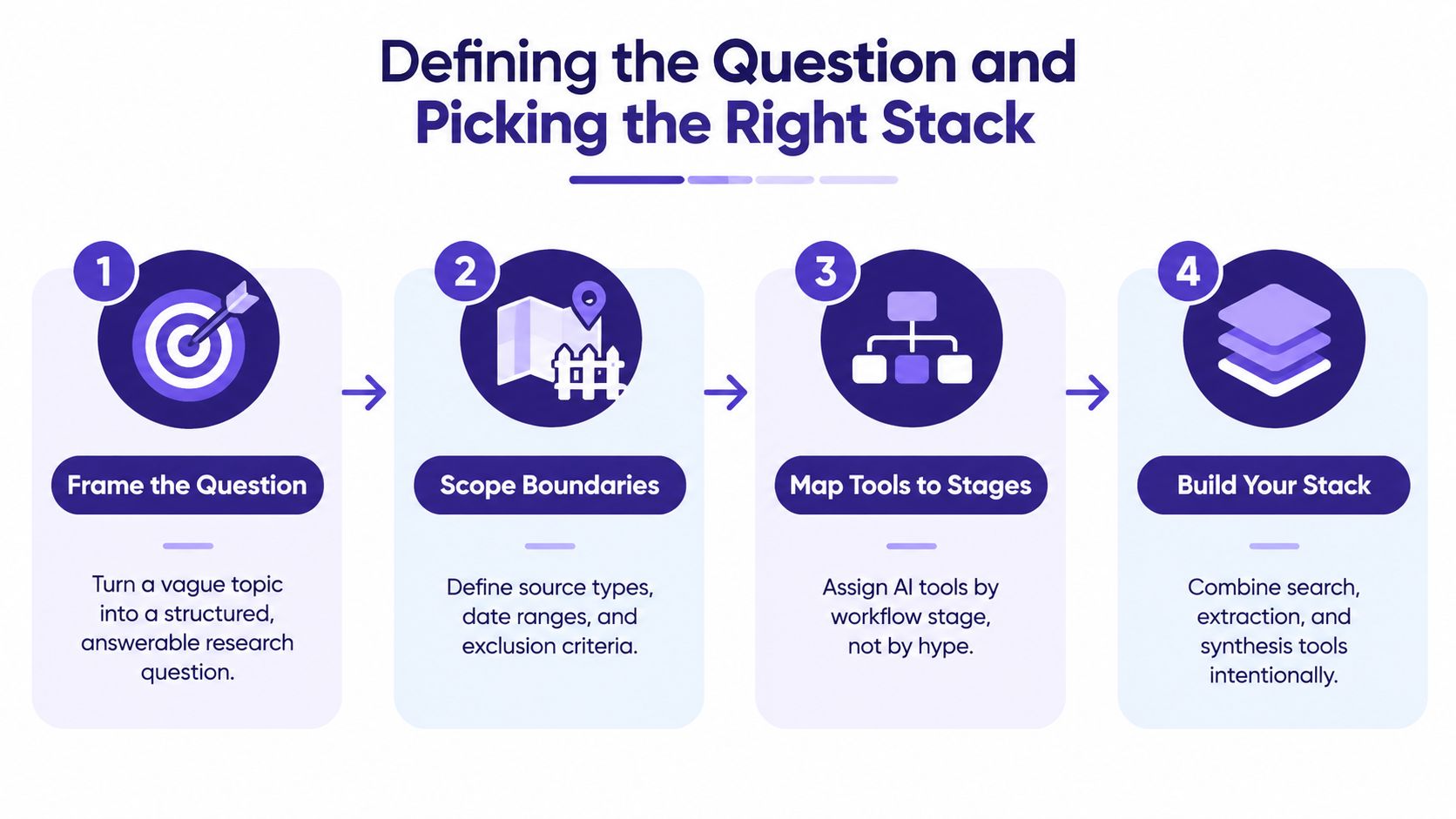
Assign tools to jobs
A single chatbot isn't a research stack. Retrieval needs a source-aware search system or database interface. Screening needs a consistent classifier with logged decisions. Extraction needs structured fields and constrained output. Synthesis needs a model that can work from supplied notes. Verification needs source records, DOI resolution, and human review.
| Stage | Suitable tool class | Main failure to watch |
|---|---|---|
| Question framing | General-purpose language model | Flattening nuance or inventing assumptions |
| Retrieval | Scholarly databases and transparent search interfaces | Missing sources or returning irrelevant material |
| Screening | Rules-based or LLM-assisted triage | False positives and inconsistent decisions |
| Extraction | Schema-based extraction workflow | Misreading numbers or shifting field definitions |
| Synthesis | Model grounded in approved notes | Blending unrelated findings |
| Citation checking | DOI and database verification | Fabricated, swapped, or mismatched references |
The AI tools for literature review is broad, but tool selection should follow this map rather than a feature list. If your team already owns a large archive of articles, transcripts, videos, or podcasts, a library-search layer such as Contesimal can help organize that internal corpus and surface recurring themes. It still doesn't replace external source verification.
Write the stack down before the first search. Record which system retrieves, which model extracts, who reviews borderline items, and where the evidence ledger lives. That small act prevents the common mistake of asking one tool to be search engine, statistician, editor, and fact checker at the same time.
Sourcing, Screening, and Pulling the Data Out
Retrieval should be transparent enough that another person can reproduce the search. Use databases such as PubMed, Scopus, or arXiv where they fit the subject, record the exact queries, and preserve the dates and filters used. AI can help expand synonyms and identify related terminology, but it shouldn't decide what counts as the literature.
Screening is where speed and judgment collide. AI can triage titles and abstracts against predefined criteria, assign a provisional include or exclude decision, and flag uncertainty for a human reviewer. It shouldn't make borderline decisions disappear inside an automated queue.
Evidence from systematic-review work shows why this distinction matters. LLMs reached 97% sensitivity for full-text screening with Claude, while top-performing systems reached 86% overall screening accuracy and an 87% F1-score in the USDA Forest Service evaluation materials. Agreement on risk of bias with experts ranged from 55% to 90%, so strong recall didn't remove the need for expert adjudication.
The extraction stage works best when every paper must produce the same fields. A USDA Forest Service evaluation found that a model extracted relevant data more than 50 times faster than a human reviewer and achieved over 90% accuracy for discrete and categorical fields, while performing poorly on some quantitative data in the same evaluation. That pattern argues for schemas, constraints, and manual review of numbers.
Use a constrained extraction record
A practical schema might include population, setting, study design, intervention, comparator, outcome definition, effect-size field, sample description, limitations, and direct supporting passage. Don't let the model return a polished paragraph as the primary record. Paragraphs hide omissions. Fields expose them.
Use a prompt such as:
“Extract only the fields in this schema. If a field isn't present, return ‘not reported.’ Copy quantitative values exactly, include the surrounding sentence, and flag any ambiguous unit, denominator, subgroup, or outcome definition for manual review. Do not infer missing values.”
| Dimension | AI-Assisted Screening | Human Screening |
|---|---|---|
| Speed | Rapid triage across a large result set | Slower, especially during full-text review |
| Consistency | Consistent when criteria and examples are explicit | Can drift across reviewers without calibration |
| Recall | Useful for high-recall discovery | Strong judgment, but fatigue can affect coverage |
| Precision | May include many irrelevant studies | Better suited to nuanced exclusions |
| Numeric interpretation | Risky without constrained fields | Better for ambiguous measures |
| Accountability | Supports a provisional decision | Owns the final inclusion decision |
Log confidence, rationale, and reviewer outcome for every uncertain record. The AI research assistant workflow should make the evidence trail easier to inspect, not bury it behind an impressive summary.
Synthesis, Drafting, and Catching Hallucinated Citations
Synthesis should begin after extraction, not during the search conversation. Group findings by theme, population, method, or outcome, then identify where studies agree, conflict, or leave important uncertainty. The model can help cluster supplied records, but the records must remain visible beside the proposed interpretation.
Draft claim by claim. For each paragraph, attach a source note that contains the paper identifier, the relevant passage, and the limits of what that passage supports. This prevents a common drift where a cautious finding becomes a broad conclusion after several rounds of paraphrasing.
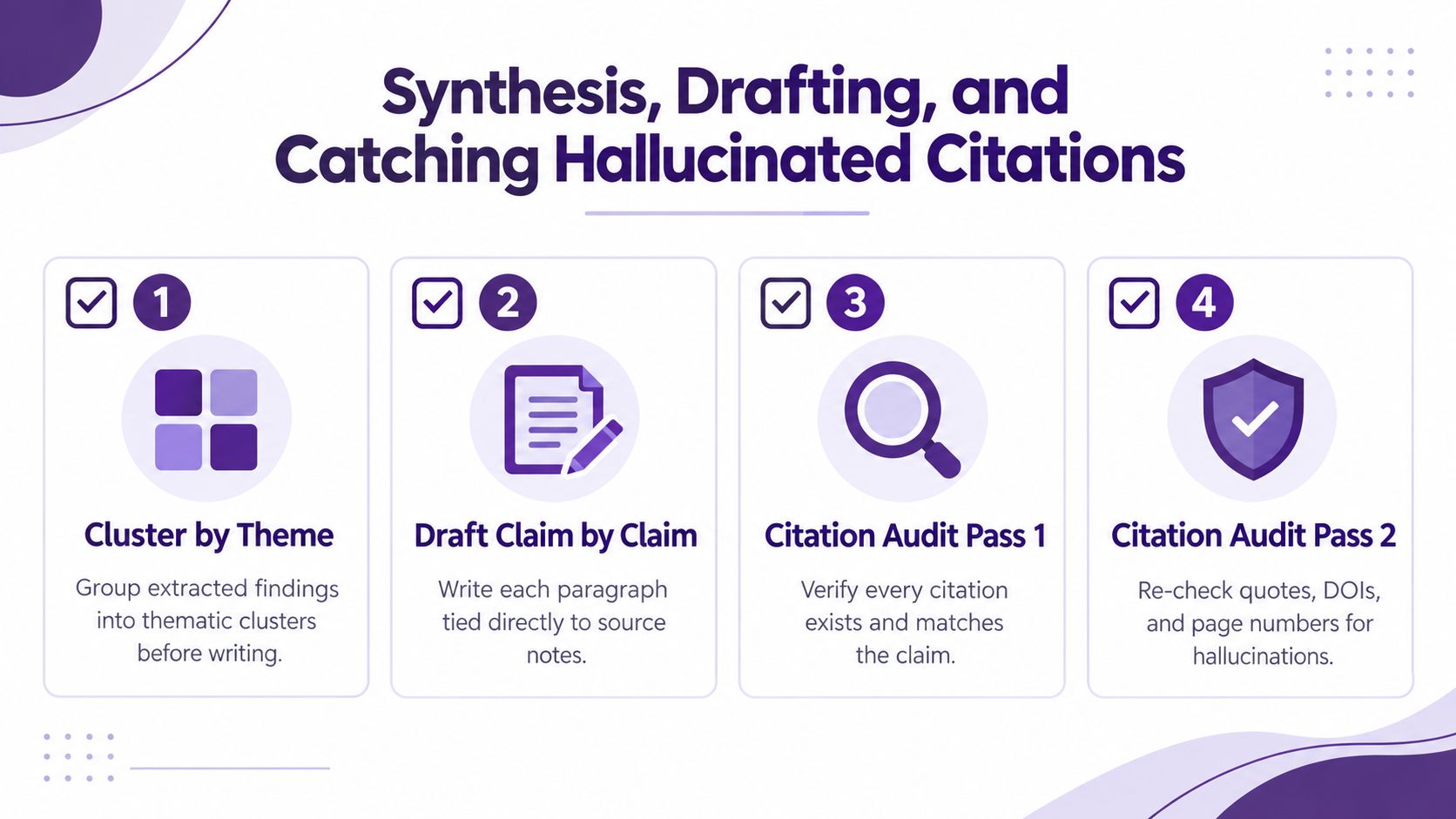
Run a mechanical citation audit
Never ask the model whether a citation is real. A confident “yes” proves nothing. Use a mechanical process that resolves the DOI, matches the resolved title and authors, confirms the record in a trusted database, and checks that the paper supports the sentence attached to it. Guidance on AI-assisted literature review citation verification recommends this kind of direct checking rather than trusting the model's confirmation.
A simple audit sheet can include:
| Audit field | What to record |
|---|---|
| Citation ID | A unique internal label |
| DOI status | Resolved, unresolved, or not assigned |
| Retrieval date | When the source was accessed |
| Title and authors | Exact match against the source |
| Verbatim quote | The passage supporting the claim |
| Page number | Location in the document where available |
| Claim scope | What the source supports, and what it doesn't |
| Reviewer sign-off | Name or initials of the person who checked it |
Search the exact title and author string when a citation looks unusual. That catches author swaps and near-match papers that an automated DOI check might miss. Apply the rule “cite the quote, not the citation.” If you can't point to the passage that supports the claim, rewrite or remove the claim.
Ask the model to expose weakness rather than perform certainty:
“Review this draft against the supplied evidence table. Identify the weakest claim, the broadest unsupported inference, every citation that doesn't directly support its sentence, and any wording that implies causation where the source only shows association. Do not repair the text yet.”
The prompt improves triage, but a person still makes the final call. For teams dealing with discovery errors, the practical discussion of fixing AI search problems is useful because search failure often enters the draft long before the writing stage.
Use the embedded walkthrough as a reminder that citation work is a process, not a final spellcheck.
Where AI Should Stay Out of the Loop
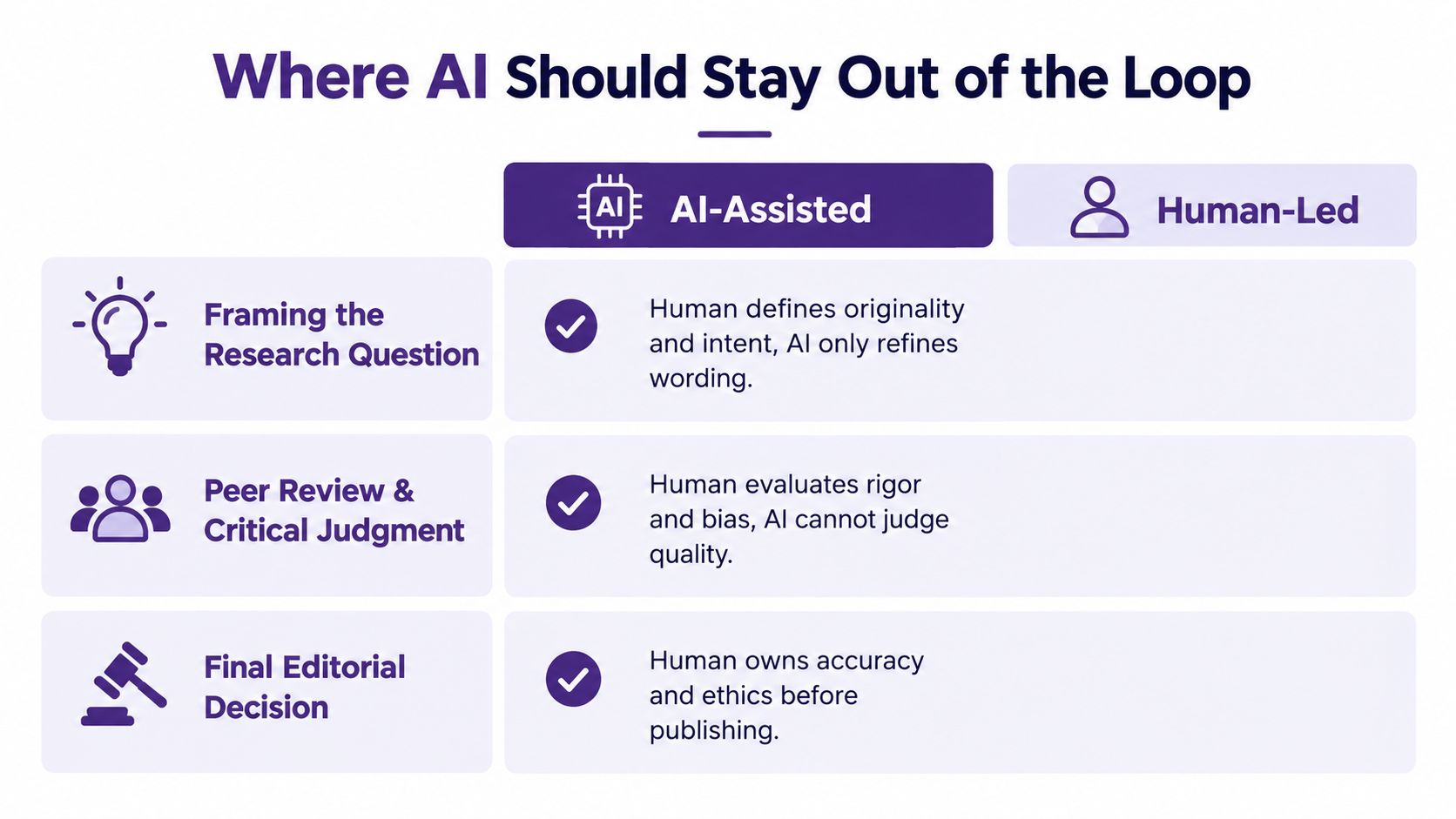
AI shouldn't drive every stage because it can produce an answer at every stage. Recent evidence says generative AI can help frame review questions and extract data, but it isn't recommended for literature search and study selection when reliability is inconsistent and irrelevant articles are common in the evidence review.
The first boundary is the original research question. A model can refine wording, suggest synonyms, and expose assumptions, but the researcher must decide what is original, meaningful, and worth investigating. Models tend to reproduce familiar framings. That can make a question sound polished while removing the unusual population, neglected setting, or uncomfortable counterargument that gives the work value.
The researcher owns the question. The model can help sharpen it, but it can't supply intellectual intent.
The second boundary is borderline screening. A model may mark a paper as irrelevant because its terminology differs from the prompt, or include a paper because the abstract contains familiar keywords without satisfying the actual design criteria. Human adjudication matters most where a decision depends on context, methodological quality, or a distinction that the inclusion rule didn't fully anticipate.
The third boundary is final editorial judgment. A named human must own factual claims, authorship decisions, conflict-of-interest statements, ethical disclosures, and publication approval. “The model generated it” isn't an accountability mechanism.
Defend the boundary in plain language
Stakeholders often respond to safeguards with a request for speed. A useful answer is: “AI will prepare candidates, organize evidence, and identify uncertainty. A qualified reviewer will decide what counts, verify what gets cited, and approve what ships.” That framing protects throughput without pretending that accountability can be delegated.
Human-led review also applies to recorded conversations and sensitive material. Teams evaluating on-device meeting capture tools 2026 should consider where transcripts are processed, who can access them, and whether the capture method fits the sensitivity of the research.
For creators and publishers, the same principle applies when turning an archive into new work. An AI layer can surface repeated themes across episodes, articles, or manuscripts, but an editor still decides whether a pattern is real, respectful, relevant, and worth developing. The practical distinction between assistance and ownership is also central to whether using ChatGPT counts as plagiarism.
Collaboration, Reproducibility, and Keeping Your Workflow Audit-Ready
Governance works best when it's built into the workflow before a dispute arrives. Store prompts in a shared document or repository with version history. Log the model name, temperature, retrieval date, source set, and output for every meaningful run. Test new workflows in a sandbox before they touch production data or sensitive research material, following the staged approach recommended in the Department of Energy's Generative AI Reference Guide.
NIST's generative AI risk profile highlights governance, content provenance, pre-deployment testing, and incident disclosure as primary risk-management considerations in its AI risk guidance. Those categories translate into ordinary operational tasks:
- Version prompts: Preserve the exact instruction that produced each extraction or synthesis run.
- Log sources: Link every output to the source list and retrieval date.
- Record reviewers: Capture who approved exclusions, numeric fields, claims, and final copy.
- Archive decisions: Keep rejected sources and disputed interpretations where they can be revisited.
Write a one-page methodology note that explains the question, source boundaries, tool assignments, review rules, and known limitations. A new teammate should be able to follow the path from source to claim without asking the original operator to reconstruct it from memory. If your team keeps losing context between experiments, guidance on how to fix gaps in experiment logging offers a practical starting point.
The cheapest audit is the one you prepare before launch. Keep prompts, source files, model configuration, retrieval dates, extracted records, reviewer sign-offs, and final citations linked in one archive. That documentation also makes collaboration easier when researchers, editors, producers, and content marketers need to turn verified findings into articles, videos, episodes, or new products.
Contesimal helps teams organize and interrogate existing articles, podcasts, videos, and other library assets so human researchers and AI can discover themes, keywords, and reusable research leads together. If you're ready to turn your archive into a documented, collaborative research workflow, visit Contesimal and start building new value from the work you've already created.