
You publish the blog post, ship the podcast episode, or upload the YouTube video. Then the calendar moves on, and that carefully researched idea sits in an archive while you start from zero on the next topic. The problem usually isn't a lack of creativity. It's that production ends where distribution should begin.
Content repurposing turns one finished asset into a working system. You audit what you already own, identify the ideas with remaining value, decide where adaptation is necessary, and create a feedback loop that informs the next piece. For creators, publishers, podcasters, bloggers, and content teams, that means the library becomes more than storage. It becomes raw material for audience growth, collaboration, and revenue.
A widely cited 2023 HubSpot State of Marketing finding reported that 48% of social media marketers publish similar or repurposed content across platforms with minor changes, while 34% create unique content from scratch for each platform and 17% publish the exact same content without adaptation. The reported distribution makes one point clear: repurposing is already a mainstream operating model, not a clever trick reserved for large teams.
Why Most Creators Stop at One Format
A creator records a thoughtful podcast episode, edits the audio, writes show notes, creates a cover image, and publishes. A blogger researches a substantial article, formats it, adds links, and presses publish. A YouTuber spends days scripting, filming, editing, and exporting. In each case, the work often ends at the first native format.
That happens because creators fall into three traps.
The identity trap
People attach their professional identity to a channel. “I'm a podcaster” can become “I don't write.” “I'm a video creator” can become “my audience doesn't read.” The original idea gets locked inside the medium that first carried it, even though the audience may want the same insight in a different form.
The format gravity trap
Every platform pulls an idea toward its own structure. A podcast encourages conversational development. A blog favors headings, context, and searchable answers. Short-form video needs a quick entry point and visual movement. If you copy the original structure instead of extracting the underlying idea, the derivative feels awkward before it even reaches an audience.
The time illusion trap
Repurposing seems slower than starting fresh because the work is visible. You have to find the useful section, make an editorial decision, rewrite the hook, and package the result. Starting a new post can feel cleaner, but it often repeats research and strategic thinking you've already completed.
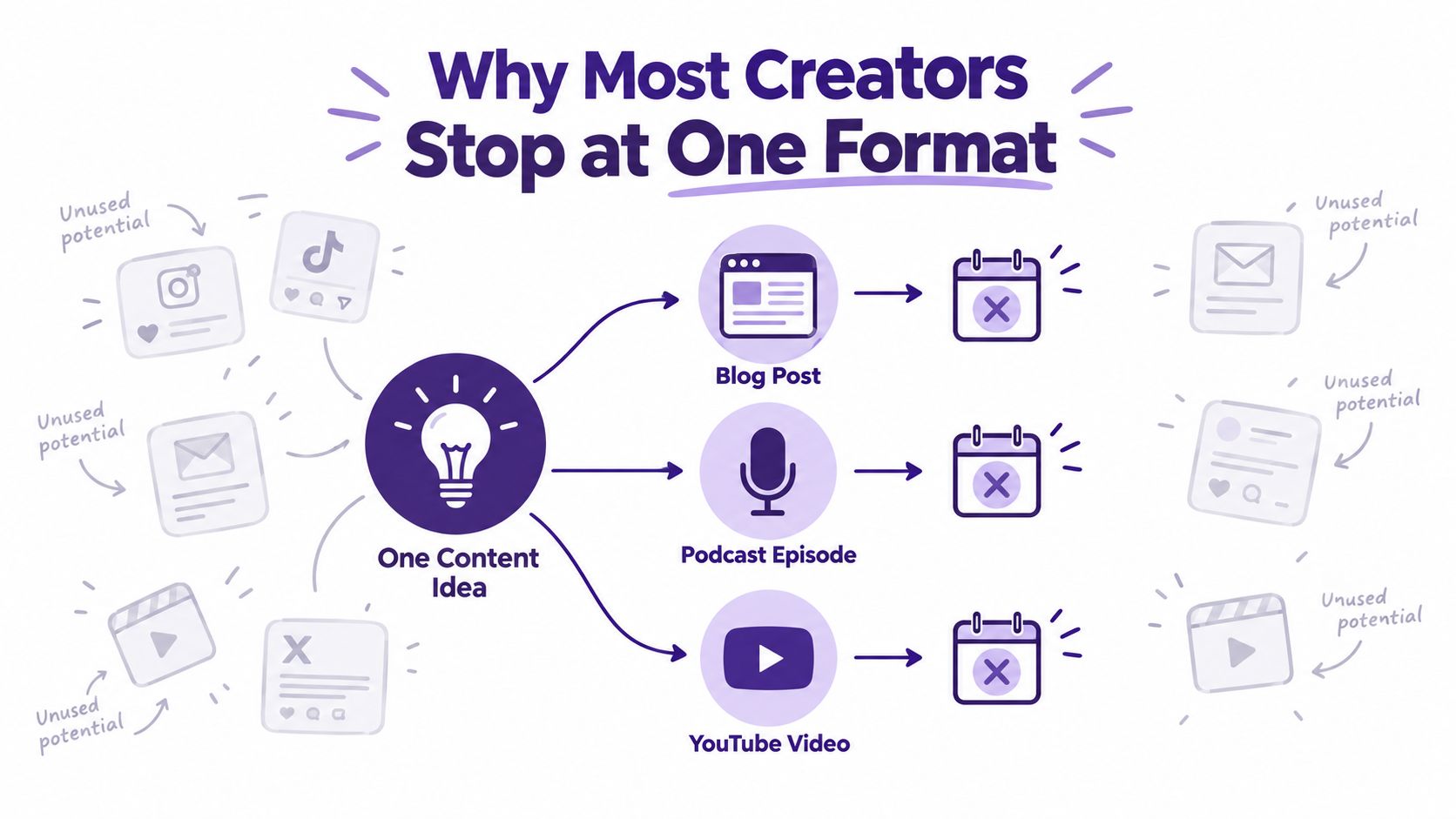
The practical shift is to treat a pillar asset as raw material, not a finished product. One idea shaped into eight useful derivatives can reach eight surfaces, but only if each derivative earns its format instead of receiving a lazy copy and paste.
The candid takeaway: Shipping isn't the same as distributing. Your first upload is the source, not the full output.
The operating system is straightforward. Audit the library, decide what to tailor and what to syndicate, map ideas into specific assets, then measure which angles deserve another round. That approach also explains why 46% of respondents in a Referral Rock marketer survey identified content repurposing as their best-performing content marketing strategy, according to the reported repurposing findings. The value isn't merely making more files. It's making better use of decisions you've already paid for with time and attention.
Auditing Your Existing Content Library
Don't begin with the asset you published most recently. Begin with the library. A useful audit shows which pieces still attract attention, which contain a durable idea, and which can feed multiple formats without creating editorial debt.
Run the audit in four focused passes.
Pass one, build the inventory
Put every published asset in one spreadsheet. Include:
- URL: The canonical location or file path.
- Format: Blog, podcast, video, newsletter, book chapter, webinar, or social post.
- Publish date: Useful for spotting outdated claims and seasonal material.
- Primary topic: Use a consistent label, not a new description for every row.
- Target persona: Identify the audience the asset was meant to serve.
- Current destination: Record the channel where it lives.
- Owner: Name the person responsible for the next decision.
- Refresh notes: Flag broken links, stale examples, or missing context.
This inventory makes blind spots visible. It can also help you uncover content gaps in your strategy, particularly when several assets address one topic while an important audience question has no clear answer. For a more detailed operational checklist, use the Contesimal content audit checklist.
Pass two, score the useful material
Score each asset from one to three on traffic arriving in the last 90 days, depth of the original idea, and reuse potential. The scoring doesn't need false precision. It creates a shared decision language for a team.
| Asset | Traffic (last 90 days) | Idea Depth | Reuse Potential | Total / 9 | Decision |
|---|---|---|---|---|---|
| Pricing podcast | 3 | 3 | 3 | 9 | Pillar |
| Evergreen tutorial | 2 | 3 | 2 | 7 | Pillar |
| Short announcement | 1 | 1 | 1 | 3 | Retire |
| Narrow social post | 2 | 1 | 1 | 4 | Retire |
Pass three, assign a status
Tag each row as pillar, derivative, or retire. Retire anything below a combined score of five out of nine. A low score doesn't mean the idea was bad. It means the asset isn't a sensible source for another production cycle without substantial rewriting.
Pass four, form topic clusters
Group the survivors into clusters such as pricing, audience research, editing, or creator operations. Each cluster becomes one repurposing sprint. Set a deadline for the audit, complete it in one focused afternoon, and move into production. An audit without a deadline becomes a recurring project that produces tidy rows and no new assets.
Decide What to Tailor and What to Syndicate
Repurposing fails when creators confuse adaptation with redistribution. Tailoring changes the structure, hook, length, examples, and visual language for a destination. Syndication distributes the same asset through a feed, embed, directory, or accepted reposting workflow.
The correct choice depends on the platform's role in your strategy. A destination that already serves your audience can tolerate a direct feed. A discovery platform needs a native entry point that earns attention from people who don't know the source.
| Platform | Primary Role | Recommendation | Why | Required Effort |
|---|---|---|---|---|
| Professional discovery and discussion | Tailor | Readers respond to a native argument, clear point of view, and useful context | Moderate rewrite | |
| YouTube | Search and video discovery | Tailor | Titles, openings, chapters, thumbnails, and pacing shape how viewers enter the idea | Full production pass |
| RSS-driven blog | Owned distribution | Syndicate or lightly edit | Subscribers expect a reliable feed and can consume the original structure | Low |
| Podcast directory | Audio distribution | Syndicate | The directory distributes the episode rather than requiring a new editorial format | Low |
| X | Conversation and discovery | Tailor | A copied caption rarely creates a native conversation | Moderate rewrite |
| Community discovery | Tailor heavily or skip | Communities expect context, participation, and a contribution that stands alone | High |
A simple rule keeps the decision practical.
- Syndicate when the platform is a distribution layer for an audience you already serve.
- Tailor when the platform is a discovery layer for an audience you want to earn.
- Skip when neither condition holds. More destinations don't automatically create more value.
For example, a long-form article can become a LinkedIn argument with a sharper thesis, while the original article can remain the canonical destination. A podcast episode may be syndicated to directories, then reworked into a vertical script with a cold open in the first three seconds for short-form video.
The shortcut that wastes time is identical cross-posting. Copying the same caption, hashtags, opening, and call to action into every channel isn't a repurposing strategy. It tells each platform that you haven't considered its audience or behavior, and it gives followers no reason to encounter the idea again.
Decision rule: Preserve the insight. Rebuild the entry point.
Mapping One Idea Into Many Assets
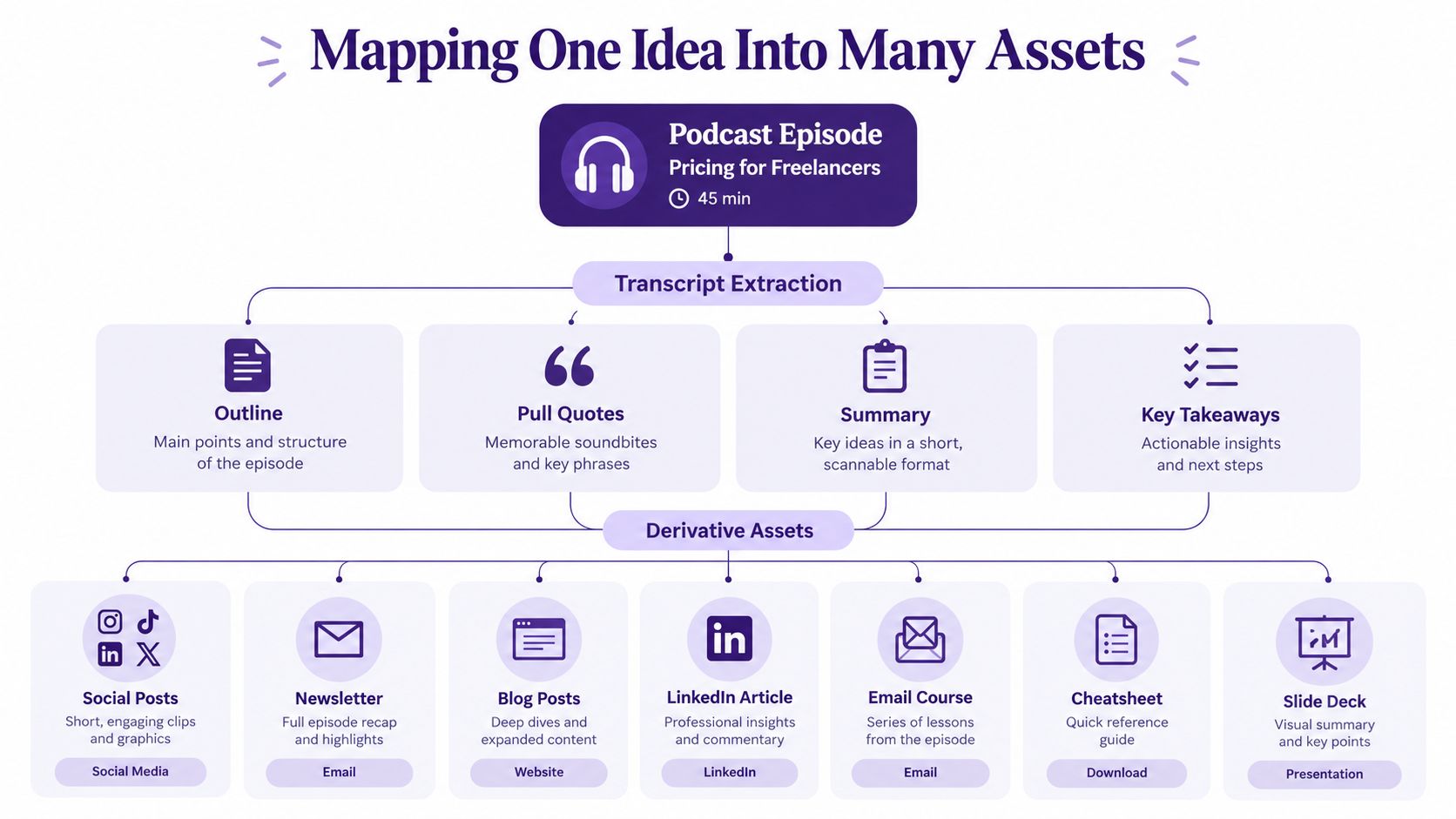
Start with a single pillar: a 45-minute podcast episode about pricing for freelancers. Don't ask an AI tool to “make content from this” and accept whatever it returns. First extract the atoms that give the episode shape.
Create a working sheet with the transcript, timestamps, and source paragraphs. Mark three to five quotable lines, one contrarian take, one story moment, the core framework, and the questions the host answered. Temporal boundaries matter. The Repurpose-10K benchmark contains over 10,000 videos and more than 120,000 annotated clips for long-to-short repurposing, which reflects the importance of selecting salient moments and defining useful clip boundaries rather than relying on generic summaries. The benchmark details are a useful reminder that extraction is an editorial task, not simple format conversion.
Build from the source atoms
Map each derivative to a specific source location:
- Long-form blog post: Use the complete argument, the episode outline, and the clearest examples. This deserves a full editorial pass because spoken language needs structure, search intent, and supporting links.
- Newsletter issue: Pull the central tension and one practical lesson. Keep it conversational, then point readers toward the episode or a related resource.
- Three short-form video scripts: Use the contrarian take, the story moment, and one step-by-step explanation. Each needs its own opening, visual direction, and ending.
- X thread: Convert the framework into a sequence of connected claims. Each post should advance the argument rather than repeat the episode summary.
- Ten LinkedIn posts: Separate the episode into distinct lessons, objections, examples, and questions. Don't publish ten versions of the same caption.
- Two carousel decks: Turn long quotes into slide-sized claims, then use the following slides to explain the reasoning.
- YouTube Short: Select one complete idea with a clean beginning and conclusion. A clipped sentence without context isn't a useful derivative.
- Quote graphic: Choose the line that can stand alone without the speaker's surrounding explanation.
- 90-second audio teaser: Combine the story moment with the promise of the full episode, then direct listeners to the podcast feed.
Match transformations to information type
Long quotes become carousels because readers can absorb the argument one claim at a time. Step-by-step explanations become threads. Analogies become visual hooks. Q&A moments become newsletter prompts because a question gives the email a natural subject and structure.
Transcript cleanup and initial quote selection can take under 30 minutes when the source is well organized. A blog, carousel, or short video needs a fuller production pass because editing for clarity, pacing, accessibility, and platform conventions creates the value.
For additional workflows, review these content repurposing tools and tips. If your archive includes mixed formats, the Contesimal content repurposing strategies can help frame the source material before you transform it.
This walkthrough shows the mapping process in action:
Distribution Playbook for Every Channel
A derivative needs a destination and a job. Posting every output everywhere creates activity, but it doesn't create a coherent journey. The pillar should anchor the topic, while adaptations create entry points for different audience behaviors.
| Asset Type | Primary Channel | Cadence | Tailor or Syndicate |
|---|---|---|---|
| Pillar blog | Website and search | Publish first | Tailor |
| Long LinkedIn post | Several drops across the cycle | Tailor | |
| X thread | X | Early or mid-cycle | Tailor |
| Carousel | Instagram or LinkedIn | Mid-cycle | Tailor |
| Short video | YouTube Shorts, Reels | Spaced throughout the cycle | Tailor |
| Newsletter version | Email list | After the pillar is live | Tailor |
| Audio teaser | Podcast feed and social | Near the episode release | Tailor |
| RSS episode | Podcast directories | Release schedule | Syndicate |
Give each channel a distinct role
The pillar blog earns durable website attention and gives every derivative a stable destination. The LinkedIn post should lead with a professional tension or practical decision. An X thread can unpack the argument claim by claim and invite conversation. A carousel should make the idea saveable, with one clear lesson per slide.
Shorts and Reels serve cold discovery, so open with the problem or surprising conclusion rather than a long introduction. The newsletter should build list depth by adding context that isn't available in the social version. The audio teaser should create curiosity and loop people back to the complete episode.
Don't dump the whole cascade inside 48 hours. Space the drops across two to three weeks so each format has room to generate discussion and so the audience doesn't experience the topic as repetitive. Publish the pillar first, then release the strongest discovery adaptation, then use the newsletter and community conversation to deepen the idea.
For platform-specific examples, SupaBird's repurposing tips offer useful guidance on adapting X posts for other destinations. Keep the principle broader than any single tool: an adaptation should sound native even when it points back to the same source.
A practical sequencing rule protects the pillar from its own derivatives. Let the original asset establish the complete argument before short posts reveal every conclusion. Each adaptation should offer enough value to stand alone, while leaving a natural reason to continue to the source.
For a broader channel framework, use this content distribution strategy as a planning reference.
Measurement, Iteration, and the Feedback Loop
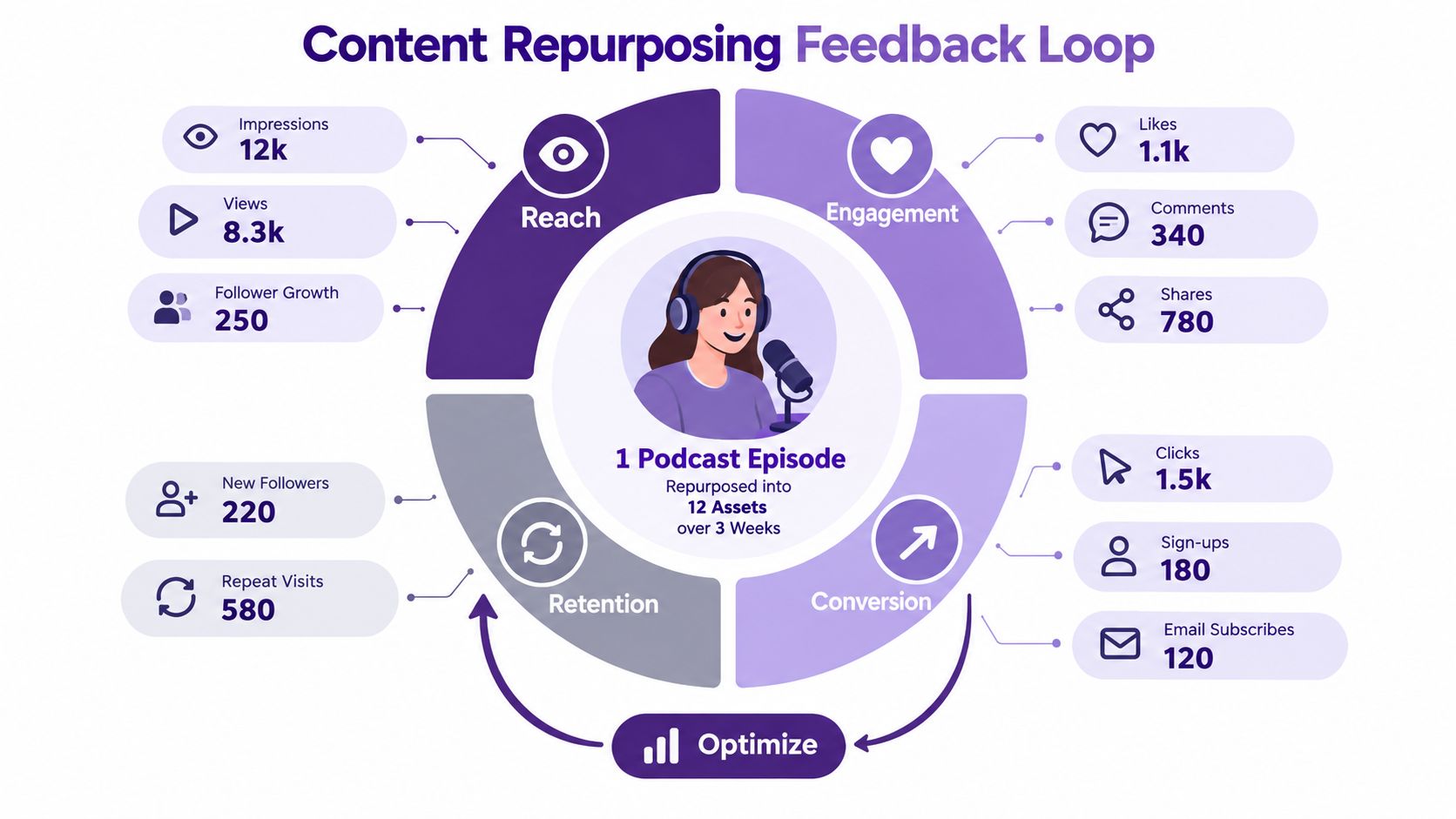
A podcaster publishes one episode and turns it into 12 assets over three weeks. That number belongs to the workflow, not the outcome. The useful question is which assets attracted the right people, held their attention, and moved them toward the next action.
Track four metric families for every derivative:
- Reach: Impressions, views, and follower change show whether the asset entered circulation.
- Engagement: Saves, comment depth, and watch time reveal whether the idea held attention.
- Conversion: Newsletter signups, podcast downloads attributed through UTM links, and product clicks connect distribution with action.
- SEO: Ranking movement on the pillar URL and internal link clicks show whether the surrounding content supports the owned asset.
The exact thresholds in a scorecard should reflect your baseline, but explicit triggers prevent vague postmortems. A LinkedIn post below 2% engagement rate signals a hook rewrite, while a blog post below 500 organic sessions in 30 days triggers a refresh. Both thresholds come from the stated operating scenario, not a universal benchmark, so use them as decision rules for that workflow rather than promises about performance.
Read signals instead of chasing vanity metrics
A Short with high views but low saves may have won the opening while failing to deliver a useful takeaway. Rewrite the conclusion, add a concrete next step, or select a more complete moment from the source. A post with modest reach but thoughtful comments may be a stronger seed for a follow-up episode than a widely viewed clip that produced no meaningful response.
Use the results to decide what happens next:
- Keep strong angles: Turn recurring questions and high-quality responses into the next pillar brief.
- Reformat weak assets: Change the hook, pacing, visual treatment, or destination before abandoning the idea.
- Retire exhausted material: Remove derivatives that no longer serve the audience or the current offer.
- Update the source: Refresh the pillar when links, examples, or recommendations have changed.
The review can fit into a weekly 30-minute ritual. Look at the four metric families, mark one winner and one problem, record the likely reason, and assign the next test. Over time, the archive becomes a source of editorial evidence. Your next topic comes from what the audience responded to, not from a blank page and a stressful content meeting.
Your Sustainable Repurposing Workflow
Sustainable repurposing is a rhythm, not a quarterly rescue mission. The workflow starts before the source is published and continues after the last derivative goes live.
Review
At the beginning of the week, flag one new pillar and inspect the strongest signals from the previous cycle. Reserve one unfinished draft, recording, or research thread. That unfinished material matters because it preserves an idea that can be developed without forcing a brand-new concept into production.
Mine
Pull hooks, clips, questions, examples, and calls to action from the source. Choose the audience and destination for each asset before anyone starts editing. A simple board should include source, format, audience, channel, status, URL, and owner.
Repurpose
Batch by stage. Collect hooks and clips first, draft the written assets second, edit video and audio third, and schedule last. This keeps the team from repeatedly switching between research, writing, design, editing, and publishing decisions.
Assign every derivative a job. The pillar should support durable search visibility. Adaptations can support email, social conversation, community participation, or sales discussions. Raw footage and unused transcript sections should remain archived, clearly labeled for later use rather than mixed into the active queue.
Measure
Run a Friday distribution check, then compare results after seven and 30 days. Feed winning hooks, angles, formats, and calls to action into the next brief. A podcaster can review episode audio every Monday. Bloggers can schedule a monthly library audit. Video teams can batch clips immediately after export, while publishers can align derivatives with their editorial calendar.
A structured cascade can materially change the amount of output a pillar produces. A 2026 UK guide citing HubSpot benchmark data reports an average of 12.7 unique content pieces from each pillar asset for businesses using a three-tier cascade, compared with 3.2 pieces for businesses without a structured approach. The guide's benchmark summary supports the operational point, but volume still needs editorial judgment.
The objective isn't maximum output. It's a reliable system that lets one strong idea travel through the places your audience already pays attention to. Contesimal helps creators and content organizations classify, search, and transform libraries containing documents, podcasts, videos, and articles, with workflows for collaboration between people and AI. Visit Contesimal to organize your existing library, find reusable source material, and turn overlooked work into a practical repurposing pipeline.