
You open a draft, type a title, and then stall on the first real sentence. Not because you don’t know your topic, but because you’re not sure what your piece is arguing.
That problem shows up everywhere. In essays. In YouTube scripts. In whitepapers. In video essays. In podcast outlines. A fuzzy beginning usually means a fuzzy middle.
A thesis statement solves that. Think of it as the GPS for your content. It tells your audience where you’re going, and it keeps you from taking scenic detours that waste time and dilute the message.
If you’ve ever wondered how long is a thesis statement, the short answer is simple. The useful answer is more strategic. Length depends on scope, discipline, and purpose. A lab report, a literary analysis, and a marketing article may all need a central claim, but they won’t frame that claim the same way.
Nailing Your Core Argument Before You Write
The blank-page struggle usually isn’t a writing problem. It’s a decision problem.
A student opens a research paper and keeps rewriting the introduction. A YouTuber outlines a video and ends up with six competing angles. A marketer drafts a blog post that sounds polished but doesn’t really land anywhere. In each case, the missing piece is the same. The core argument hasn’t been nailed down yet.

A thesis statement isn’t just an academic formality. It’s the sentence, or pair of sentences, that tells you what belongs in the piece and what doesn’t.
If your essay argues that remote learning improves flexibility but weakens peer interaction, every body paragraph should serve that claim. If your video argues that a creator should repurpose one long podcast into many short assets, every scene should help prove it. The format changes. The job stays the same.
A strong thesis gives your content direction before you start decorating it.
That’s why I tell writers to find the claim before they chase the wording. Don’t ask, “How do I make this sound smart?” Ask, “What is the one idea I’m prepared to defend?”
If you’re still building your opening, this guide on how to begin a paper can help you move from topic to argument: https://contesimal.ai/blog/how-do-you-start-a-research-paper/
How Long Should a Thesis Statement Be?
Here’s the direct answer.
Most thesis statements should be 1 to 2 sentences long, typically 20 to 50 words. That standard reflects a strong consensus among top educational resources, with common ranges of 15 to 25 words for high school, 25 to 40 for undergraduate work, and 30 to 50 for graduate work according to Paperguide’s thesis length guidance.
That range works because it forces discipline. You have enough space to make a real claim, but not enough space to ramble.
What that looks like in practice
Too short
“Climate change matters.”
This names a topic, not an argument.About right
“City governments should invest in heat-resilient infrastructure because rising temperatures strain public health systems, energy grids, and low-income neighborhoods first.”
This makes a claim and points to support.Too long
A thesis that tries to include every example, counterargument, and sub-point from the paper.
That starts reading like a summary, not a thesis.
Why the rule helps
Writers often confuse clarity with simplicity. They’re not the same.
A good thesis can be nuanced. It just can’t be bloated. If a reader reaches the end of your thesis and still can’t tell what you believe, it’s not doing its job.
For most creators, this is a good default: write one sentence first. Only move to two if the idea needs more room.
Factors That Change the Ideal Thesis Length
The basic rule is useful, but it isn’t universal. The better question is not just how long is a thesis statement. It’s how long should this thesis be for this kind of project.
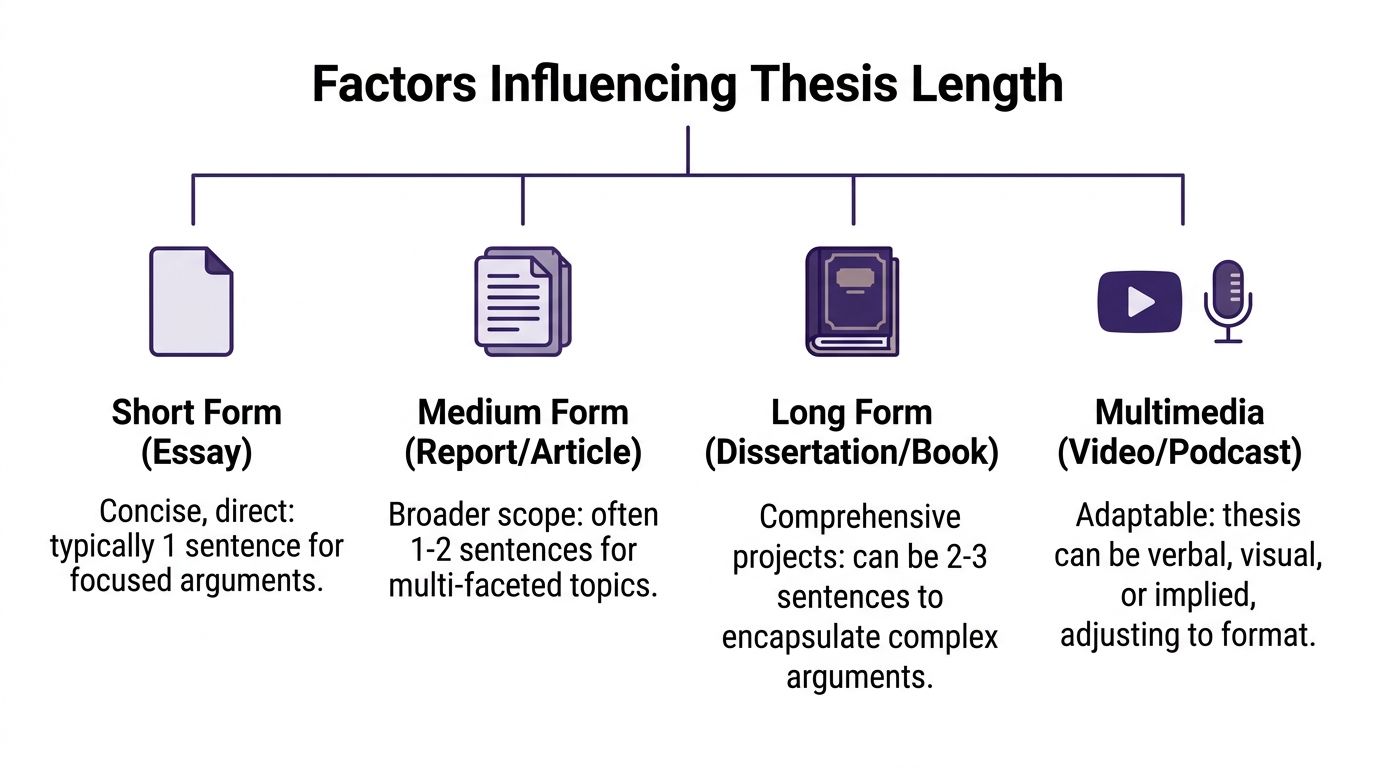
According to Paperpile’s guidance on thesis length by paper size, the relationship follows a scalable model. A 5-page paper typically needs a single sentence of 20 to 30 words, while an 8 to 13 page paper often expands to 2 to 3 sentences. The reason is straightforward. Larger projects need a thesis with more room for scope and structure.
Academic level changes the amount of nuance
A high school essay usually asks for a direct, manageable argument. The thesis can be short because the assignment is narrow.
Graduate writing often asks for qualification, context, and multiple moving parts. That doesn’t mean the thesis should become a mini-essay. It means the claim may need more framing. Consider production briefs as an analogy. A short creator brief can say, “This video explains three lighting mistakes.” A full documentary treatment needs more than that because the creative and evidentiary load is heavier.
Discipline changes the shape of the claim
Many guides become too generic at this point.
Some disciplines reward compression. Others need interpretation. In practice, STEM writing often leans toward concise, hypothesis-driven theses, while humanities and some social science writing often uses more layered, interpretive theses.
A biology report may need a compact sentence that states a relationship or result. A philosophy or literature paper may need space to define terms or set up a conceptual lens. That’s not bad writing. That’s fit-for-purpose writing.
The right thesis length isn’t a style preference. It’s a match between argument complexity and reader needs.
Purpose matters as much as page count
A persuasive essay, research paper, YouTube essay, and marketing article all make claims. But they don’t carry the same burden.
Here’s a practical breakdown:
Persuasive essay
Lead with a debatable position. Keep it tight.Research paper
Include the claim and a hint of the evidence path.Video script
Your “thesis” may sound more conversational, but it still needs a clear stance.Marketing blog
The core argument should be obvious early, even if it’s framed as a promise or lesson.
A creator-friendly way to decide
Ask these three questions before locking your thesis:
- How much ground does the piece need to cover?
- Does the field reward direct claims or nuanced interpretation?
- Will the audience need a clean headline-style argument or a more developed frame?
If you answer those questions, thesis length becomes less mysterious. It becomes a strategic choice.
Examples of Strong and Weak Thesis Statements
A thesis usually fails in one of two directions. It’s either too thin to guide the piece, or too crowded to stay readable.
Ryne’s breakdown of thesis length and structure notes that thesis statements under 8 words often lack arguability, while those over 70 words can overwhelm readers. It also identifies a 25 to 50 word sweet spot for combining a clear claim with a supporting framework.
That’s why revision matters. A weak thesis often contains the seed of a good one. It just needs sharper framing.
Transforming Weak Thesis Statements Into Strong Ones
| Weak Thesis (The Problem) | Strong Thesis (The Fix) | Why It Works |
|---|---|---|
| Social media is bad for teens. | Social media platforms can harm teenagers by intensifying social comparison, disrupting sleep, and replacing more reflective forms of interaction. | The revised version makes a debatable claim and previews support. |
| Shakespeare uses revenge in Hamlet. | In Hamlet, Shakespeare shows that revenge destroys moral judgment, turning the avenger into another source of corruption. | This shifts from topic to argument. |
| Remote work has changed business. | Remote work has improved scheduling flexibility for many teams, but it also exposes weak management systems that depend on constant physical oversight. | The claim is specific and balanced without becoming vague. |
| AI affects content creation in many ways. | AI tools help creators speed up ideation and drafting, but they also increase the need for sharper editorial judgment and clearer brand voice. | The thesis narrows the topic and gives the reader a clear direction. |
What weak theses usually have in common
- They state a topic, not a position
- They sound factual instead of arguable
- They try to cover an entire universe
- They hide the core point behind vague words like “affects” or “changes”
A quick editing test
Read your thesis and ask:
- Could someone reasonably disagree with this?
- Does it tell me what kind of support is coming?
- Can I hold the whole idea in my head after one read?
If the answer is no, revise.
For extra inspiration, review these powerful thesis statement examples from Natural Write. They’re useful because you can see how specific claims feel on the page, not just how they’re defined.
If your thesis sounds like a broad topic label, it probably isn’t finished yet.
Where to Place Your Thesis and Templates to Start
Placement matters because readers need orientation before they enter the body of the piece.
In a traditional essay, the thesis usually works best as the final sentence or two of the introduction. That placement lets you set context first, then plant your flag. Your reader finishes the introduction knowing exactly what the paper will argue.
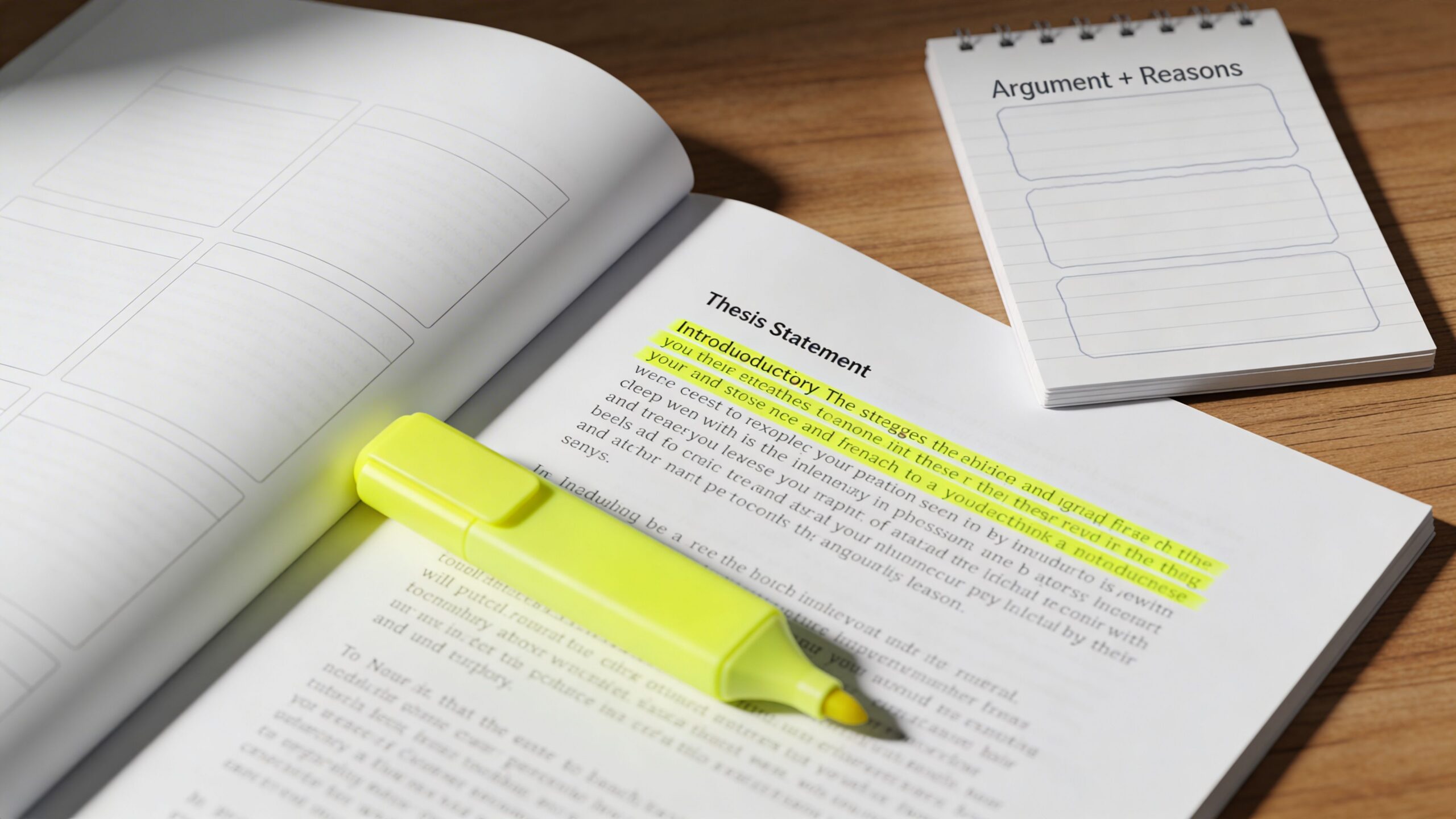
For creators, the same principle applies even when the format changes.
A YouTube script may place the core claim right after the hook. A podcast intro may spread the thesis across a few spoken lines. A marketing article may state the promise in the opening and sharpen it by the end of the introduction. Different packaging, same function. The audience still wants to know what they’re getting.
If you’re trying to sharpen the opening before the thesis lands, these examples of strong essay hooks are helpful: https://contesimal.ai/blog/good-hook-examples-for-essays/
Simple templates that help
You don’t need a magical first sentence. You need a usable frame.
Try these:
Argument template
[Topic] should be understood as [claim] because [reason 1], [reason 2], and [reason 3].Analytical template
[Author, text, or subject] reveals [interpretation] through [method or pattern].Compare-and-contrast template
Although [common view], [your subject] is better understood as [your claim].Research-focused template
This paper argues that [claim], with emphasis on [key variables or dimensions].
A planning worksheet can help if your ideas are still loose. This University Essay Plan Template is a practical starting point because it helps you connect topic, evidence, and argument before you start drafting paragraphs.
A short video walkthrough can also help if you think better by listening than by reading.
One placement mistake to avoid
Don’t bury your thesis halfway down the paper.
When readers have to hunt for your argument, they stop trusting the structure. The same thing happens in videos and blog posts. If the core point shows up too late, the audience feels drift before they feel clarity.
Your Thesis Is Your Content's North Star
The best thesis statements do more than satisfy a teacher or tidy up an introduction. They create alignment.
When rhetoric guides gave broad advice decades ago, thesis writing was often treated more loosely. The shift toward a clearer 1 to 2 sentence standard reflects a larger preference for precision and readability. The source material collected in UMary’s research paper thesis guide describes that move toward data-driven clarity, and notes that content organizations apply the same principle to significantly improve audience engagement.
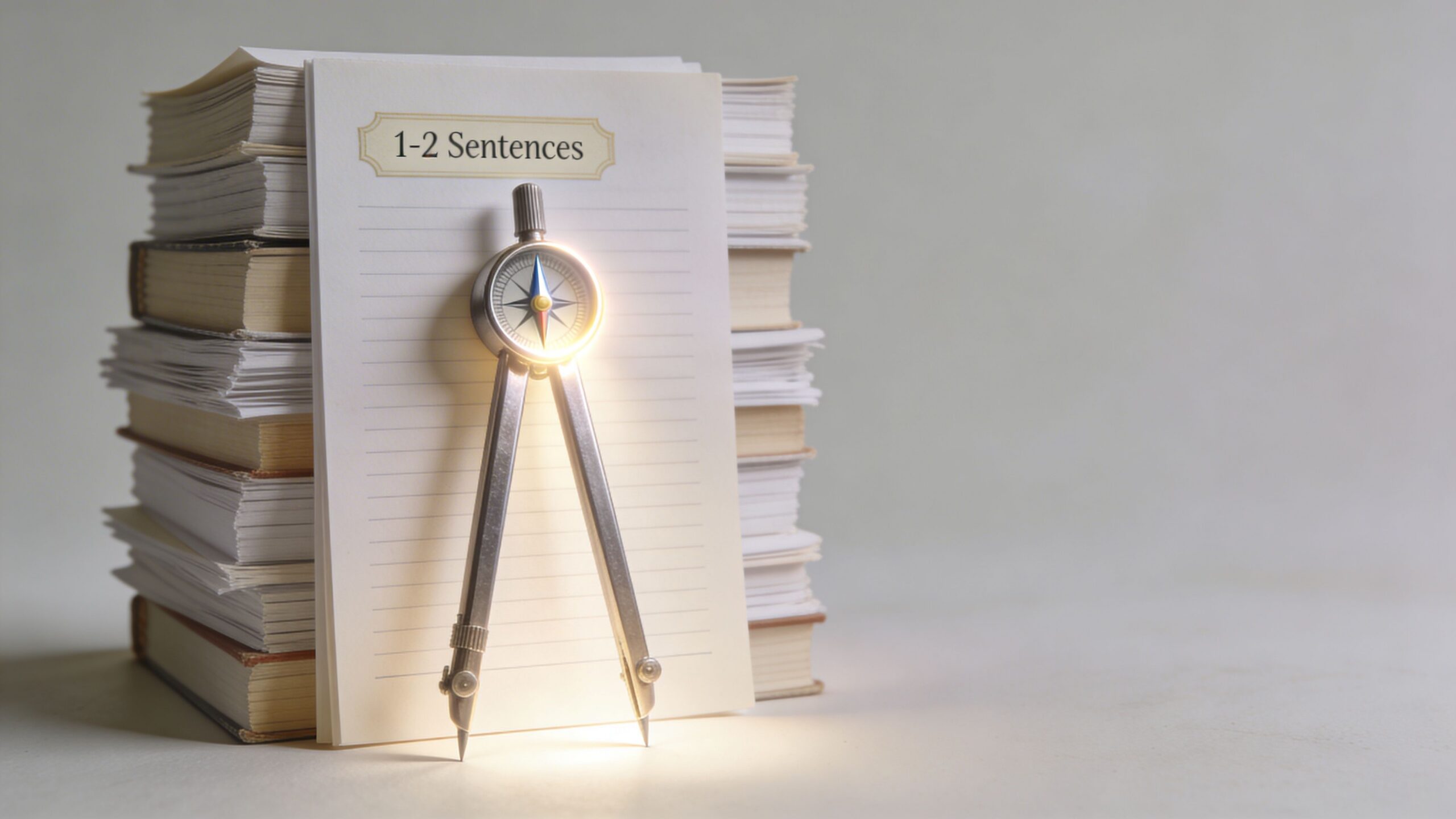
That makes sense. Audiences respond when creators know what they’re saying.
A sharp thesis helps a student stay focused through a paper. It helps a YouTuber keep the script from wandering. It helps a marketer unify a campaign message across blog posts, videos, emails, and downloadable assets. It helps an editor decide what belongs and what gets cut.
The practical takeaway
Keep these ideas in mind:
Start with the common rule
Most thesis statements work best at 1 to 2 sentences.Adjust for context
Length changes with scope, discipline, and purpose.Aim for a real claim
Your thesis should be specific, arguable, and useful as a guide.Place it where readers can find it
Usually that means the end of the introduction, or the early moment after the hook in creator formats.
Your thesis is the promise your content makes, and the standard the rest of the piece must meet.
That idea scales beyond a single assignment. When you identify the core claims inside your articles, videos, interviews, and research notes, you start seeing your whole content library more clearly. Patterns appear. Themes repeat. Strong concepts become easier to repurpose.
If you also need to support those claims properly, this guide on adding citations is a solid next step: https://contesimal.ai/blog/how-to-add-citation/
If you’re sitting on a library of articles, videos, podcasts, or research and want to turn those core ideas into fresh assets, Contesimal can help you organize, search, and reuse your content with much more intention. A clear thesis strengthens one piece. A clear view of your whole library helps you create value from all of them.