
That blank page can feel like a final boss. Staring you down. Daring you to write something brilliant. It's the biggest hurdle for most people, leading to a nasty cycle of indecision and overwhelm.
But what if I told you there's a proven strategy that successful researchers, creators, and storytellers use to break through that barrier?
It’s not about finding a perfect, fully-formed idea on day one. Instead, it’s a system designed to build momentum. Think of it as your roadmap—a way to turn that vague cloud of interest into a focused, researchable project with a clear path forward, whether you're writing for a class or creating the foundation for your next great video.
Conquering the Blank Page From Idea to Action
Let's walk through the process of turning that intimidating blank page into a solid, actionable plan.
From Vague Interest to Focused Inquiry
First things first: just brainstorm. Don't censor yourself. What topics from your coursework actually made you sit up and pay attention? What debates in your field seem like they’re missing a key piece of the puzzle? Jot down everything, no matter how broad or messy it seems. The goal here is just to get ideas on paper.
Next, you'll do some light, preliminary reading. You’re not diving deep just yet—think of it as reconnaissance. You're just getting the lay of the land to see where the current academic conversations are happening. This helps you spot gaps and see where your own unique perspective might fit in.
This step is more critical than ever. The world of academic publishing is exploding, with peer-reviewed articles growing by about 4% annually in recent years, jumping from 1.8 million to 2.6 million. With that much noise, your work needs a rock-solid foundation to stand out.
This entire journey, from a fuzzy idea to a sharp thesis, follows a logical flow. Each step builds on the last one.
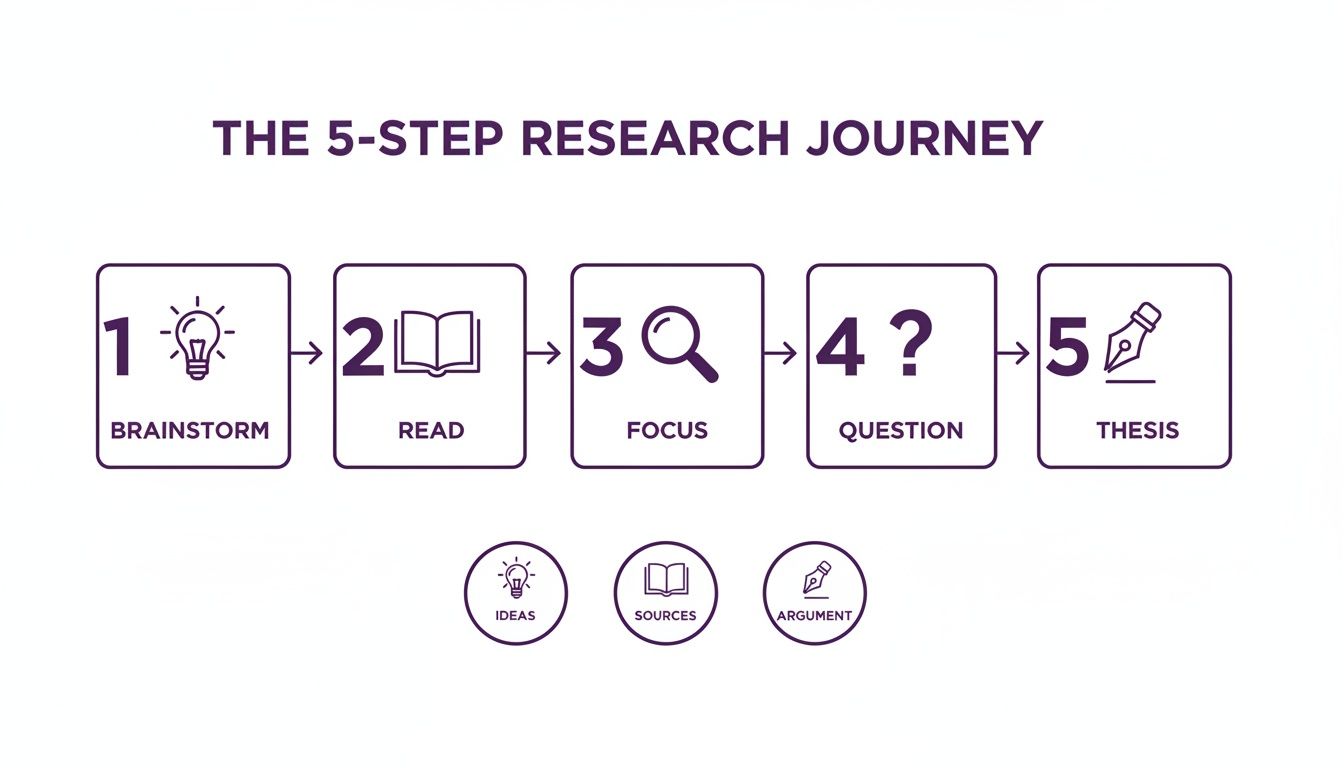
As you can see, this isn't just a random checklist. It's a progression designed to take you from overwhelmed to organized.
Building Your Research Foundation
Once you’ve done some initial reading, you can start to narrow things down. A topic like "social media's impact" is just way too big to tackle. You have to get specific.
Drill down until you have something concrete, like "the effect of Instagram's algorithm on the purchasing decisions of Gen Z consumers." See the difference? Now you have a manageable slice of a huge topic.
That kind of specificity is what allows you to form a sharp, compelling research question—the central inquiry that will drive your entire paper. If you're struggling to get those initial thoughts down, modern tools offering AI-powered writing support can be a great way to get unstuck and organize your ideas.
A well-defined research question is the single most important part of a successful paper. It gives you direction, sets clear boundaries for your research, and keeps you laser-focused on solving one specific problem.
Finally, you're ready to draft a working thesis. This isn't your final, set-in-stone argument. It's a preliminary statement that proposes an answer to your research question. It will almost certainly change as you dig deeper, but it gives you a clear direction right from the start.
Here's a quick checklist to keep you on track during this crucial pre-writing phase.
Your 5-Step Pre-Writing Checklist
This table breaks down the essential stages to get your research paper started on the right foot.
| Stage | Objective | Key Action |
|---|---|---|
| 1. Brainstorm | Generate a wide range of potential topics. | List all ideas without judgment, focusing on genuine interests. |
| 2. Preliminary Reading | Understand the current academic conversation. | Skim articles and journals to identify key themes and debates. |
| 3. Narrow Focus | Move from a broad subject to a specific niche. | Drill down from "climate change" to a specific regional impact. |
| 4. Formulate Question | Create a clear, focused inquiry for your paper. | Turn your niche into a question your research will answer. |
| 5. Draft Thesis | Propose a preliminary, arguable answer. | Write a one-sentence statement that outlines your main argument. |
Following these steps methodically will transform that daunting blank page into a structured and manageable project, setting you up for success before you even write your first full paragraph.
Developing a Powerful Research Question and Thesis
Once you’ve wrestled your broad topic into a manageable scope, the next real hurdle is forging a precise research question. This isn't just academic busywork; it's the engine that will drive your entire project.
Think of it this way: a vague question leads to a rambling, unfocused paper. You’ll spend pages chasing tangents. But a sharp, incisive question gives you a clear destination from day one. It's the difference between wandering into a library with no plan and going in to find a specific book on a specific shelf. One is a nice stroll; the other is a mission.
From Broad Topic to Sharp Question
So, how do you get from a general idea to a question that actually works? It’s all about refinement. You need to start asking "how," "why," and "to what extent" instead of just settling for "what." This is where a simple idea starts to take the shape of a real academic paper.
A great litmus test for any potential question is the FINER criteria. I've seen countless creators and marketers save themselves from dead-end projects by running their ideas through this simple framework. It ensures your project is built on solid ground.
- Feasible: Can you actually answer this question with the time, resources, and access you have? Be honest with yourself.
- Interesting: Does this question genuinely intrigue you? If you’re bored by it, your audience definitely will be.
- Novel: Are you exploring a new angle, challenging an old assumption, or filling a gap in the conversation? You don't have to reinvent the wheel, but you do need to add something new.
- Ethical: Can you investigate this question without causing harm or violating anyone's privacy?
- Relevant: Does the answer matter? Who cares? The best questions contribute to your field, your community, or a broader academic debate.
A question that ticks all these boxes is one worth chasing. It’s not just researchable—it’s meaningful.
Crafting Your Working Thesis Statement
With a strong question in hand, you can start sketching out a working thesis statement. Notice the word "working." This isn't a final, set-in-stone declaration. It's your initial proposed answer to your research question—a flexible, guiding argument that you'll test, challenge, and probably change as you dig into your research.
A weak thesis is usually just a fact ("Social media is popular with teens") or a super broad opinion ("Social media is bad"). A powerful thesis, on the other hand, is specific, arguable, and gives the reader a clear roadmap for your paper.
Let's walk through a real-world transformation. A lot of creators and marketers start with a general feeling or observation.
Before: "Social media is bad for teens."
This is a common sentiment, but it’s not a thesis. It's too big, it's not provable, and it gives you no direction. Now, let’s get specific.
After: "This paper argues that the gamified reward systems on platforms like TikTok foster addictive behaviors that directly correlate with increased anxiety in adolescents aged 14-18."
See the difference? This version is a game-changer. It’s specific (gamified rewards, TikTok, anxiety, ages 14-18), arguable (it proposes a direct link that has to be proven with evidence), and it sets a clear agenda. Your paper now has a purpose: to find and present the evidence supporting this very precise claim.

This is your blank canvas—the place where vague ideas get hammered into a structured argument. Your working thesis becomes your North Star, keeping you focused as you navigate all the information you're about to uncover.
Navigating the Literature Review Strategically
Let's be honest: the literature review often feels like a chore. It's that long, tedious summary you have to grind through before the real research begins. But that’s a rookie mistake.
A smart literature review isn't about summarizing what everyone else said. Think of it more like a recon mission. You’re mapping the existing conversation to find the perfect opening to make your own unique contribution and join the ongoing dialogue in your field. This is how you discover the concepts for your next viral video or find the data to back up a killer marketing campaign.
Instead of getting lost in an endless sea of articles, your goal is to read with purpose. You're not just collecting facts; you're hunting for arguments, methodologies, and—most importantly—gaps. Where does the current research fall short? What questions are still hanging in the air? Nailing these openings is the key to making your paper truly matter.
Mastering the Art of the Academic Search
Your first stop is going to be academic databases. Platforms like JSTOR, PubMed, and Google Scholar are your best friends, but just typing in a few keywords is like fishing with a tiny net in the ocean. To find the essential papers efficiently, you need to think like a search pro.
This means getting comfortable with advanced search operators. These are just simple commands that tell the database exactly what you’re looking for, saving you from drowning in thousands of irrelevant results.
- Quotation Marks (""): Use these to lock in an exact phrase.
"Social media addiction"will only show you results with that specific phrase, not articles that happen to contain all three words scattered around. - Boolean Operators (AND, OR, NOT): These are your best friends for combining or excluding terms. A search for
"mental health" AND adolescents NOT adultsinstantly sharpens your focus. - Asterisks (*): The asterisk is your wildcard. Searching for
neuro*will pull up "neuroscience," "neurology," and "neurobiology" all at once.
Getting these simple tools down transforms your search from a random hunt into a precise, targeted operation. You’ll find the core literature in your field way faster, which means more time for the important stuff: reading and thinking.
Reading With a Critical Eye
Once you have a stack of promising articles, the next hurdle is reading them without getting bogged down. Here's a secret: you don't need to read every single word of every paper. The trick is to read strategically.
Start with the abstract, introduction, and conclusion. These sections give you the bird's-eye view: the author's main argument, their evidence, and what they found. If a paper still seems relevant after this quick scan, then you can dive deeper into the methodology and results.
Your goal isn't to become an expert on every paper you find. It's to understand how each piece fits into the larger puzzle and how it connects back to your own research question.
This critical approach is more vital than ever. Academic publishing is facing a serious credibility crisis. In 2023 alone, a record-smashing over 10,000 research papers were retracted for issues like fraud and plagiarism. This means you have to rigorously vet every source you use, making sure your own work is built on a foundation of solid, trustworthy research.
How to Organize Your Findings
As you start gathering sources, you absolutely need a system to keep everything straight. A folder full of random PDFs is a recipe for chaos down the line. This is where tools like annotated bibliographies or concept maps come in. For a professional creator or publisher, think of this as building your own private, searchable content library.
An annotated bibliography sounds fancy, but it's just a list of your sources with a twist. For each one, you write a short paragraph summarizing its main argument, sizing up its strengths and weaknesses, and noting how it connects to your project. This forces you to engage critically with each source from the get-go.
A concept map is a more visual way to do it. You put your central research question in the middle of a page and then start branching out, connecting different authors and ideas by theme. This can be a game-changer for spotting how different arguments relate to each other and pinpointing where your own work can fit in.
Building these organizational habits early is a lifesaver. It doesn't just help you make sense of the literature; it lays the groundwork for a tight, cohesive argument. When you can clearly see the conversation, you can confidently find your place in it. Before you go any further, it’s worth reviewing our complete guide on what makes a source credible to ensure your selections are rock-solid.
Creating a Dynamic Outline to Guide Your Writing
Think of an outline as the architectural blueprint for your research paper. A good one is the difference between a solid, logical argument and a rambling mess. Let's ditch the rigid, static formats you might remember from high school. We're talking about a dynamic outline—a powerful tool for thinking, not just organizing.

This structure isn't just a list of topics you need to cover. It’s your chance to stress-test your logic before you sink hours into writing. This is where you spot the weak points, find the gaps in your research, and make sure every single paragraph serves your central thesis.
Once you’ve locked in your research question and have a working thesis, it’s time to start arranging your thoughts. Getting a handle on crafting a perfect outline format can be a game-changer, helping you build your argument piece by piece for a smooth flow from start to finish.
Finding the Right Structure for Your Project
Not all outlines are created equal. The best one for you really depends on your field of study and how you work best. The classic hierarchical outline—you know, with the Roman numerals and letters—is fantastic for linear, argument-driven papers common in the humanities. It forces you to think about which ideas are the main pillars and which are just supporting details.
But if you’re working on a more exploratory or scientific project, a rigid structure can feel confining. A mind map, for example, lets you visually connect ideas in a more free-flowing way. It’s perfect for brainstorming how different pieces of your research fit together. The goal here isn't to follow a rulebook; it's to find a method that helps you think clearly.
Whatever style you pick, the job is the same: create a logical path for your argument to follow.
Understanding the IMRaD Framework
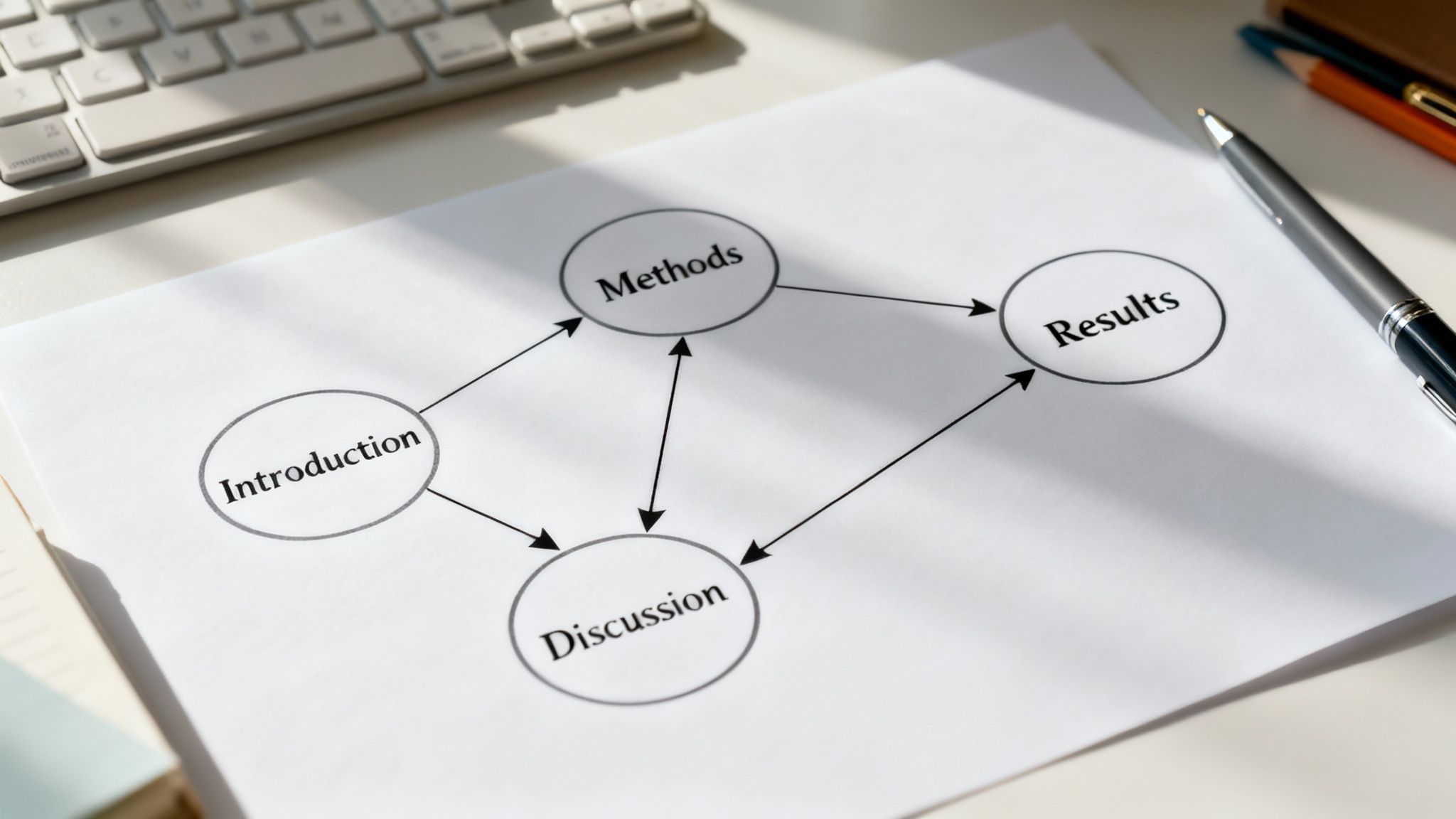
For anyone in the sciences and social sciences, the IMRaD format is the gold standard. It’s a time-tested structure that makes your paper instantly understandable to other researchers. Knowing what each section is for is the key to building a solid paper.
- Introduction: This is where you set the stage. You’ll introduce the problem, explain why anyone should care (the "so what?" factor), and clearly state your research question and thesis.
- Methods: Here’s where you explain how you did what you did. You need to detail the exact steps you took so someone else could replicate your study. This section is the bedrock of your paper's credibility.
- Results: This part is all about presenting your findings—no interpretation yet. You just state what you discovered, often using tables, charts, and figures to show the data.
- Discussion: Now you get to interpret everything. You'll explain what your findings actually mean, connect them back to the literature, point out any limitations, and suggest what could be researched next.
Even if you're not writing a scientific paper, the logic of IMRaD is incredibly useful. It provides a clear path: introduce the problem, explain your approach, show your evidence, and then interpret its significance.
Using Your Outline to Test Your Logic
Your outline’s real power is as a diagnostic tool. After you’ve sketched it out, take a step back and be your own toughest critic. Does the flow make sense? Does every single point directly support your thesis? Are there any weird jumps in logic where a reader might get lost?
For instance, if your thesis argues for a specific cause-and-effect relationship, your outline has to show that link being built, step by step. If a section doesn't actively help prove your thesis, it needs to be revised or cut.
Making these tough calls at the outline stage saves an incredible amount of time and frustration later. It turns writing from a messy, confusing exploration into the focused execution of a well-laid plan.
Bake Academic Integrity In From Day One
So many writers treat citations like a chore they have to rush through right before the deadline. This is a huge mistake. Don’t think of citations as a final step—think of them as the foundation of your paper’s integrity, something you build into your process from the moment you find your first source.
Starting early saves you from that frantic, late-night scramble trying to remember where you found a specific quote or statistic. More importantly, it helps you build a habit of intellectual honesty from the get-go and makes the final stretch of writing so much smoother.
Choosing the Right Citation Style
First things first: you need to figure out which citation "language" your field speaks. Different disciplines have their own rules for how to credit sources, and using the right one is non-negotiable.
- APA (American Psychological Association): This is the go-to for social sciences like psychology, education, and communications. It puts a heavy emphasis on the date of publication because, in these fields, the timeliness of research is critical.
- MLA (Modern Language Association): If you're writing for the humanities—think literature, philosophy, or the arts—you'll almost certainly use MLA. This style focuses on authorship and uses simple parenthetical citations that link to a "Works Cited" page.
- Chicago (The Chicago Manual of Style): A really flexible style popular in history and some other humanities fields. It actually gives you two options: a "notes and bibliography" system (using footnotes/endnotes) or an "author-date" system. Your professor will tell you which one they expect.
Always, always double-check your assignment guidelines or just ask your instructor which style to use. Handing in a paper with the wrong formatting can cost you points, even if the actual content is brilliant. These standards aren't just local, either. A global analysis of academic writing publications between 2020 and 2025 showed China leading with 159 publications on the topic, followed by the US and the UK, highlighting just how much focus is placed on research standards worldwide.
You Absolutely Need a Citation Management Tool
Trying to manually format every single citation is a one-way ticket to frustration and errors. This is where citation management tools come in—they are complete game-changers. Think of them as a personal digital library for every source you ever find.
These apps plug right into your web browser and word processor. You can save a source with a single click, and then the tool will automatically generate your citations and bibliography in whatever style you need. For a deeper dive, check out our guide on how to add citations.
By using a citation manager from the very beginning, you're not just saving time—you're creating an organized, searchable database of your research. It becomes a personal knowledge library you can draw on for future projects.
Top Tools to Organize Your Research
Getting started with a citation manager is easy, and some of the best ones are completely free. They don’t just store your sources; they help you actively manage them.
Here are a few of the most popular options out there:
- Zotero: A free, open-source workhorse. It’s incredibly powerful, working as both a desktop app and a browser extension that lets you grab sources from anywhere on the web.
- Mendeley: Well-known for its slick PDF organization features and social networking capabilities, Mendeley actually lets you connect with other researchers who are studying the same topics.
- EndNote: This is a more robust, professional-grade tool that many universities provide for their students and faculty. It's built to handle massive research libraries and is perfect for long-term, serious projects.
Picking one of these tools and making it part of your workflow from day one is one of the smartest things you can do. It turns citations from a painful chore into a seamless part of your research process, keeping you organized and your work academically sound.
Common Questions on Starting a Research Paper
Even with a solid plan, the first few steps of a research paper can feel like a minefield. Let's walk through some of the most common questions that trip up writers, creators, and researchers right out of the gate.
Getting these fundamentals right saves you a world of hurt later on. This is where you move from theory to practice, turning potential roadblocks into simple course corrections.
How Do I Choose a Research Topic if I Have Too Many Ideas
It's a great problem to have, but a flood of ideas can lead to paralysis. The trick isn't to just pick one at random, but to filter them like a pro.
Take your top three or four ideas and run them through the FINER criteria we talked about earlier (Feasible, Interesting, Novel, Ethical, Relevant). Be brutally honest with yourself. Which topic can you actually pull off with the time and tools you have? Which one genuinely makes you curious enough to spend late nights on it?
Next, do a quick "gap check." Spend an hour digging through academic databases for each of your top contenders. Where does the existing conversation feel a little thin? Where do you see a perspective that’s clearly missing? This is how you experiment to find your next viral concept. Finally, think about your own goals. Which project fits best with where you want to go in your career or studies? This process usually makes a clear winner emerge from the noise.
A great research topic isn't just about what you can write about; it's about what you want to spend dozens of hours thinking about. Passion fuels persistence.
By narrowing your options this way, you're not just picking a topic—you're choosing one that's viable, interesting, and meaningful to you.
What Is the Difference Between a Research Question and a Thesis Statement
This is one of the most critical distinctions, and it trips up a lot of people. Think of it as the difference between a question and the proposed answer.
Your research question is the open-ended problem you're trying to solve. It's the "what if" or "how does" that guides your entire investigation.
- Example: "How does the use of AI-powered repurposing tools affect the audience engagement of professional YouTubers?"
Your thesis statement, on the other hand, is your specific, arguable answer to that question. It's the claim you'll spend the rest of the paper proving with evidence. You find it after you've done some initial research.
- Example: "This paper argues that YouTubers who use AI-powered tools to repurpose long-form video into social media clips see a significant increase in audience engagement by reaching new demographic segments on platforms like TikTok and Instagram Reels."
You start with the broad question, and through your research, you arrive at a specific, defensible thesis. The question opens the door; the thesis is your confident walk through it.
How Much Research Should I Do Before I Start Writing
There's no magic number of articles to read, but there is a feeling you're aiming for: the "saturation point." This is that moment in your literature review when you start seeing the same names, the same studies, and the same theories popping up over and over again.
When you hit this stage, you should be able to do three things confidently:
- Explain the main arguments and schools of thought in your topic area.
- Name the key scholars whose work everyone else seems to build on.
- Pinpoint the specific gap your own research is stepping in to fill.
You don't need to read every single thing ever published. Once you have a firm handle on the conversation and a solid working thesis, you've got more than enough to start outlining and writing. The act of writing is a form of thinking, and starting to draft will actually show you where you need to research more.
What Are the Most Common Mistakes to Avoid When Starting
Three major pitfalls derail promising projects right from the start. Side-step these, and you'll already be ahead of the game.
First, choosing a topic that's way too broad. An idea like "The Effects of Climate Change" isn't a paper; it's an entire library. You have to shrink it down to something you can actually handle, like "The Impact of Rising Sea Levels on Saltwater Intrusion in Vietnamese Rice Paddies." Specificity is your best friend.
The second huge mistake is skipping the literature review. If you write in a vacuum, you're almost guaranteed to produce something unoriginal or just reinvent the wheel. You must understand the existing conversation to add something new to it.
Finally, don't wait until all your research feels "done" before you start writing. Writing is a tool for discovery. Drafting sections early—even if they're messy—will expose holes in your logic and gaps in your research. It makes your final argument so much stronger.
Transforming your existing research into new, valuable content is the next step in maximizing your effort. For creators and publishers looking to organize, search, and repurpose their entire content library, Contesimal provides the tools to turn archival assets into new opportunities. Discover how you can collaborate with AI to find new insights and create infinite value from your work at https://contesimal.ai.