
You post a Short. It jumps fast, then stalls. The first spike feels promising, but the flatline makes the whole format seem random.
It isn't random. The youtube shorts algorithm is one of the clearest examples of a system that rewards audience satisfaction over creator intention. If people stop, watch, and rewatch, the system keeps testing. If they swipe, distribution slows down.
That shift matters even more if you're sitting on a growing back catalog. Most creators still treat Shorts like lottery tickets. Publish, hope, move on. A better approach is to treat your Shorts library like an asset you can audit, reorganize, and revive. That's where the durable upside is, especially for creators and publishers trying to turn an archive into ongoing discovery.
Why the YouTube Shorts Algorithm Is Your New Growth Engine
A lot of creators still think of Shorts as a side format. That made sense early on. It doesn't now.
YouTube Shorts records over 70 billion daily views, and 74% of those views come from non-subscribers, which makes Shorts YouTube's primary discovery mechanism, according to Hootsuite's summary of YouTube algorithm data. For anyone trying to grow beyond an existing audience, that one fact changes the strategy. Shorts isn't just a way to serve current fans. It's how new people meet your channel.
Discovery now starts before loyalty
In long-form YouTube, creators often think in terms of subscribers, browse traffic, thumbnails, and session time. Shorts changes the opening move. The platform can place your video in front of viewers who have never heard of you, and most of that traffic does come from people who weren't already following the channel.
That creates a practical trade-off. Shorts is better at opening the door. It's worse at forgiving weak openings. In long-form, a good title and thumbnail can buy you a chance. In Shorts, the content itself has to earn the next second immediately.
Practical rule: Treat every Short like an audition with strangers, not a message to loyal viewers.
Why this matters for creators with libraries
For creators transitioning from hobbyist to professional, the economics of attention shift. A back catalog of podcasts, interviews, webinars, essays, live streams, and old Shorts isn't dead weight. It's raw material for new discovery.
A lot of teams waste time asking, "What should we create next?" when the sharper question is, "What in our archive already contains a strong hook, clean payoff, or replayable moment?" Shorts gives those moments a distribution path that doesn't depend on existing subscriber behavior.
Three groups benefit the most:
- Creators with long-form archives: Old episodes often contain punchy moments that work better as Shorts than they ever did buried inside a full video.
- Publishers with topic clusters: A strong archive lets you build repeated themes instead of one-off clips.
- Teams trying to professionalize: A library-first workflow is easier to scale than inventing every Short from scratch.
The important mindset shift is simple. The youtube shorts algorithm isn't only a publishing system. It's a discovery engine for repackaged knowledge. Once you understand that, your old content starts looking a lot less old.
How the Shorts Algorithm Actually Distributes Your Content
The easiest way to understand distribution is to think like a movie studio.
A studio doesn't release every film to every screen at once. It starts with a test audience, watches the response, and expands only if the reaction is strong. The youtube shorts algorithm works in a very similar way.
During the "explore" phase, YouTube tests a new Short with a small seed audience. If the "Viewed vs. Swiped Away" ratio is high and engagement is strong, the video moves into the "exploit" phase for broader distribution. If not, views plateau, as described in vidIQ's breakdown of the YouTube Shorts algorithm.
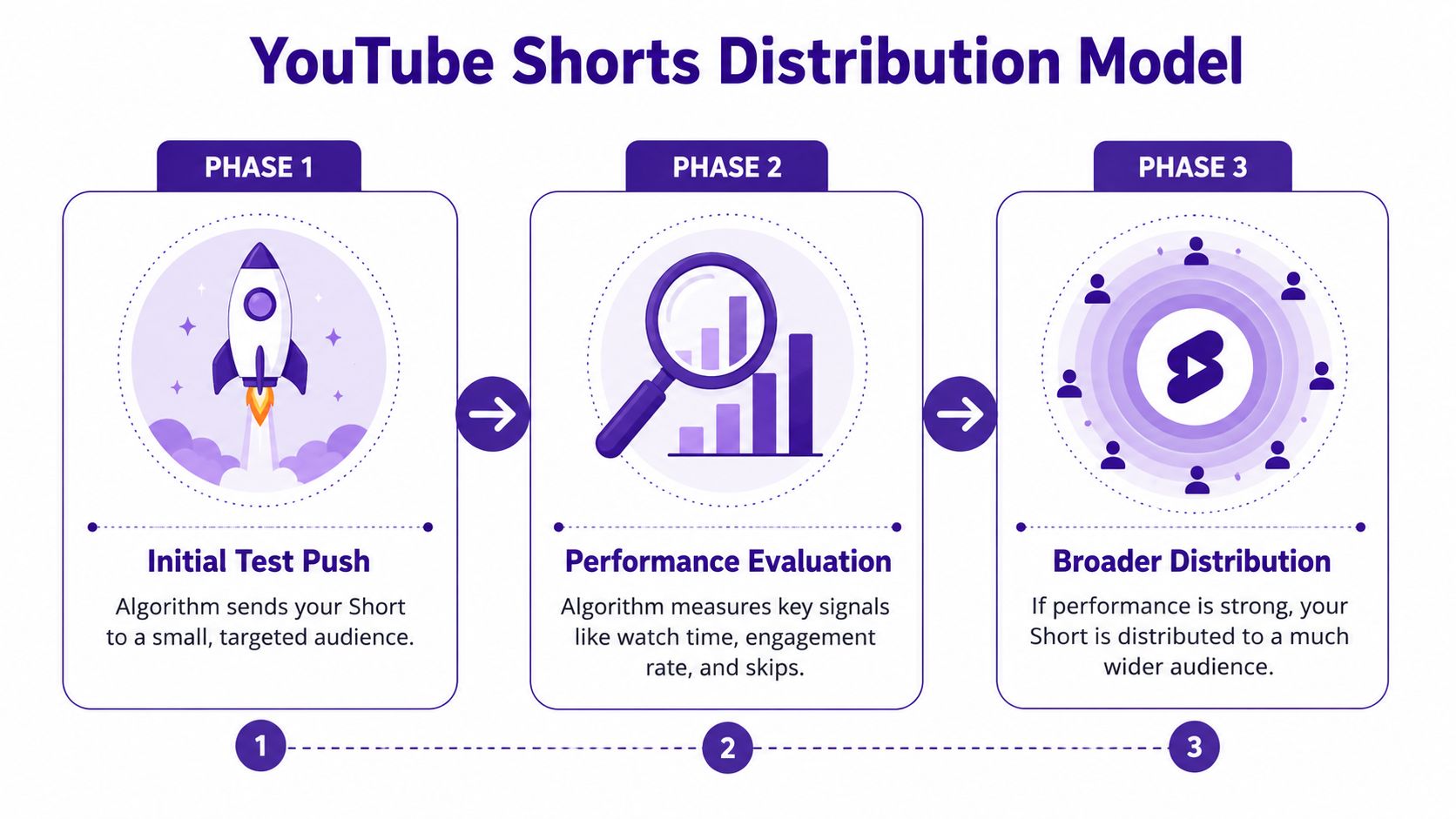
Phase one is a test screening
The seed audience isn't just a random pile of viewers. It's YouTube's first attempt to find people who might care. The system is checking whether the match is working.
That first push is where many creators misread the signal. They see early views and assume momentum is guaranteed. It isn't. Early reach is often a test, not a reward.
Here's the practical sequence:
- Initial placement: The Short lands in front of a small group.
- Behavior tracking: YouTube watches whether viewers stay or swipe.
- Decision point: Strong response leads to wider distribution. Weak response leads to stagnation.
If you've ever had a Short hit quickly and then freeze, that's usually what happened. The test audience didn't give the algorithm enough confidence to keep expanding the reach.
The gatekeeper metric is brutally simple
The "Viewed vs. Swiped Away" ratio is a harsh but useful signal because it measures the first instinctive reaction. People in the feed don't need to click. They only need to keep watching or swipe away.
That means weak openings get exposed fast. Intro branding, context-heavy setup, and slow scene building can work in long videos. In Shorts, they often die in the test phase.
If viewers need a few seconds to understand why they should care, the algorithm usually won't wait for them.
A lot of creators also get distracted by the public view count without understanding what that number represents. If you need a cleaner explanation of what counts and how YouTube measures activity, this guide on how YouTube counts views is a useful companion.
What works during distribution testing
Creators usually improve faster when they stop asking, "Why didn't YouTube push this?" and start asking, "What did the seed audience tell YouTube?"
The strongest adjustments tend to be structural:
- Open with the payoff: Show the result, tension, or surprise first.
- Cut setup language: Remove any sentence that delays the point.
- Match promise to content: If the first frame suggests one thing and the video delivers another, swipes rise.
- Design for silent comprehension: Many viewers decide before fully listening.
The biggest trade-off is creative ego versus feed behavior. You may prefer a slow build. The feed prefers immediate clarity. If growth matters, clarity usually wins.
The Key Signals That Determine a Short's Success
Most creators obsess over views because views are visible. The algorithm cares more about what happens after the view begins.
Watch time percentage and completion rates are the primary quality signals for the Shorts algorithm, and they matter more than raw view counts. High completion and re-watches carry more weight than passive views or initial impressions, based on Versa Creative's explanation of the Shorts ranking system.

Retention is the first truth signal
If someone watches most of your Short, the algorithm gets a strong message: this video kept attention. If they replay it, that signal gets even stronger.
That's why a modestly viewed Short with excellent completion can be more promising than a widely shown Short that people abandon early. One proves satisfaction. The other may only prove distribution.
For creators, this changes the edit. You stop asking whether every shot is "good" and start asking whether every shot is "necessary."
A few practical checks help:
- Look for drop points: If viewers leave at the same moment, something in the structure broke.
- Trim explanation before action: The feed rewards momentum.
- Earn the ending: A complete thought or satisfying reveal improves completion.
- Build replayability: Dense tips, visual reveals, and loops can encourage re-watches.
Swipe resistance is your hook score
Viewed vs. Swiped Away tells you whether the opening frame and first beat did their job. This is less about production value than about immediate relevance.
A cinematic intro can lose to a rough clip with a crystal-clear premise. In Shorts, clarity often beats polish.
The fastest way to improve this signal is to rewrite the first line and rethink the first visual. Don't start with "So today I want to talk about…" Start with the tension, claim, result, or mistake.
Editing lens: The first moment has one job. Prevent the swipe.
This walkthrough adds a useful visual perspective on how creators think about those first moments:
Engagement still matters, but it comes after retention
Comments, shares, and remixes matter because they show active interest. They just aren't the first hurdle. A Short usually needs to hold attention before it earns meaningful interaction.
That creates a common mistake. Creators add forced calls to comment before they've delivered enough value to deserve one. The result is extra friction in the exact moment the audience is deciding whether to stay.
A better order is:
| Signal | What it tells YouTube | What creators should do |
|---|---|---|
| Completion | People stayed through the full idea | Tighten structure and pacing |
| Rewatching | The Short had replay value | Use loops, reveals, and dense takeaways |
| Viewed vs. Swiped Away | The opening matched audience interest | Improve first frame and first line |
| Comments and shares | Viewers cared enough to act | Add CTA only after the value lands |
If you only remember one thing, remember the hierarchy. Retention first. Engagement second. Vanity metrics last.
Shorts vs Long-Form How the Rules Have Changed
A lot of frustration with Shorts comes from using long-form instincts in the wrong environment. The two systems live on the same platform, but they don't reward the same behavior.
Long-form YouTube gives you more room to persuade the click. Shorts gives you almost no room at all. Long-form often depends on packaging before the watch. Shorts depends on the watch itself.
Different feed, different physics
In long-form, the viewer usually chooses. They see a thumbnail, read a title, compare options, then click. In Shorts, the system places the video in the feed and the viewer makes a split-second stay-or-swipe decision.
That difference changes nearly everything: pacing, openings, narrative structure, and even what counts as a successful edit.
| Factor | YouTube Shorts Algorithm | Main YouTube Algorithm (Long-Form) |
|---|---|---|
| Discovery path | Feed-driven discovery inside the Shorts environment | Search, browse, suggested, homepage, subscriptions |
| Opening demand | Immediate hook has to stop the swipe | Title, thumbnail, and intro work together |
| Core success signal | Retention percentage, completion, replay behavior | Broader satisfaction signals across a longer session |
| Audience relationship | Often reaches new viewers first | Often builds through recurring viewer habits |
| Content pacing | Fast, compressed, low-friction | More room for setup, context, and development |
| Library strategy | Strong candidates can be revived and reframed | Evergreen strategy often centers on search and browse relevance |
Old habits that hurt Shorts
The most common long-form habits that backfire in Shorts are easy to spot:
- Slow intros: Helpful in documentaries, damaging in a swipe feed.
- Too much context: Viewers need the point before the background.
- Thumbnail thinking: Packaging matters less once the video is already playing in-feed.
- Subscriber assumptions: Shorts often reaches people who don't know you yet.
This is also why cross-platform learning helps. If you're studying short-form more broadly, the tactical differences in mastering TikTok for business can sharpen your sense of how fast feed-native storytelling needs to be, even though the platforms aren't identical.
Shorts rewards immediacy. Long-form rewards commitment. The mistake is trying to make one behave like the other.
Once you accept that split, your edits get cleaner. You stop defending long setups inside short videos and start shaping each format for the environment where it lives.
Actionable Tactics for Creating Algorithm-Friendly Shorts
The cleanest way to build a Short is to think in three parts: hook, story, loop.
Not every Short needs to feel flashy. But every Short does need to move. If the opening stalls, the middle wanders, or the ending feels terminal, the algorithm reads that loss of attention before you do.
Hook that stops the swipe
The hook isn't your topic. It's the fastest expression of why the viewer should care right now.
Do this:
- Lead with consequence: "This is why your Shorts flatline after the first push."
- Open with a visible change: before/after, wrong/right, messy/clean.
- Use language with tension: mistake, fix, myth, result, difference.
Not that:
- Channel-brand intros: viewers don't owe you a warm-up.
- Broad framing: "Let's talk about YouTube Shorts today."
- Delayed relevance: if the point arrives late, many viewers won't.
A good hook makes a promise. A bad hook asks for patience.
Story that keeps momentum
The middle is where many promising Shorts collapse. The creator wins the first second, then loses the next few by explaining too much, repeating the point, or adding side notes.
Try a structure that naturally compresses thought:
- State the problem quickly
- Show the mechanism
- Give the usable takeaway
That sequence works especially well for educational creators, podcasters, marketers, and publishers because it turns expertise into a feed-native shape. If your audience includes community organizations or faith-based media teams, this piece on boosting ministry reach with Shorts offers practical context on adapting short-form tactics to mission-driven content.
For a more focused internal checklist, these tips on getting more views on YouTube Shorts are worth reviewing alongside your next batch.
Loop that earns the rewatch
The ending should feel complete, but not dead. That's the art.
Some of the strongest Shorts end in a way that naturally throws the viewer back to the beginning without friction. That can happen through mirrored language, a visual callback, or an ending frame that reconnects to the first beat.
Examples of stronger endings:
- Return to the opening claim: resolve it cleanly
- Reveal the final piece late: make the viewer want to verify what they just saw
- End on motion, not drag: don't tack on outro clutter
A strong Short doesn't simply finish. It closes the thought and invites another pass.
A practical recording checklist
Before you publish, ask:
- Would the first frame make sense with no context?
- Can I cut the first sentence in half?
- Is there any section where the viewer gets the idea before I stop talking?
- Does the ending reward staying to the end?
Creators often look for hidden tricks in the youtube shorts algorithm. Most of the time, the fix is more direct. Better opening. Tighter sequence. Cleaner finish.
Unlocking Hidden Value in Your Entire Shorts Library
The biggest strategic mistake with Shorts is treating every upload like a disposable event.
That mindset makes sense if you believe every video has one brief chance to succeed. But that isn't how the format behaves. Research notes that "Plenty of Shorts go viral days or even months after upload," which is why True Future Media's guide argues for auditing older Shorts instead of focusing only on posting-time optimization.

Your archive is a testing ground
A Short that underperformed at upload isn't always a bad Short. Sometimes it had the wrong hook. Sometimes the framing was weak. Sometimes the system didn't find the right audience on the first wave.
That changes how you should review your back catalog. Instead of asking only "Did this get views?", ask more diagnostic questions:
- Did viewers who saw it stay with it?
- Did the clip have a strong payoff buried behind a weak opening?
- Did the topic fit a repeatable theme on the channel?
- Could the same insight be cut tighter or titled more clearly?
When you do that across dozens or hundreds of Shorts, patterns appear. Some creators have a hook problem. Others have a pacing problem. Others have strong retention on niche topics they haven't doubled down on.
Revive, don't just repost
Blindly re-uploading old clips is a weak strategy. Auditing and reframing is better.
The goal is to identify assets worth rebuilding. A creator with a podcast archive might find a moment that had strong viewer hold but an unclear opening line. A publisher might discover that one editorial theme consistently produces replayable clips. A marketing team might notice that expert reaction clips hold better than polished promos.
Tools transition from theoretical concepts to practical application. Spreadsheet review works for a while, but large libraries get messy fast. For teams managing many videos, audio files, transcripts, and topic clusters, Contesimal is one option that helps classify and search historical content so editors can find reusable moments, group patterns, and spot repurposing opportunities inside the archive. If you're doing this work manually now, the true upgrade isn't automation for its own sake. It's being able to diagnose a library instead of guessing.
A simple operating model works well:
- Sort old Shorts by retention behavior
- Flag clips with solid substance but weak openings
- Group by topic so winners become repeatable series
- Rebuild and republish with a different framing angle
If you want a better process for that review step, this guide to analyzing content performance is a useful starting point.
Older Shorts aren't dead inventory. They're unfinished signals waiting for a better read.
The creators who keep growing with Shorts usually don't just publish more. They learn faster from what already exists.
Your Shorts strategy gets stronger when your library becomes searchable, diagnosable, and reusable. Contesimal helps creators and content teams organize archives, surface reusable moments, and turn past videos, podcasts, and documents into new publishing opportunities without treating old content like dead content.