
Every creator, from seasoned YouTubers to busy publishers, has a secret weapon gathering dust: their archive. A content discovery platform is the key that unlocks this hidden goldmine, turning years of videos, articles, and podcasts into a fresh source of value. It's time to stop thinking of your old work as a library and start seeing it as a monetizable asset you can upcycle to create infinite content value.
Your Content Library Is a Hidden Goldmine

If you've been creating for a while, you’re probably sitting on a mountain of material. Think about it. Every video, blog post, and podcast episode represents hours of research, creativity, and hard work. But what happens after you hit "publish"?
For most creators, that content falls into a digital graveyard. Your best ideas and most engaging stories get buried under new uploads, lost somewhere in a messy, disorganized archive. It's like owning a library with no card catalog—you know the good stuff is in there, but you have no earthly way of finding it when you need to figure out your next viral video or build on a successful concept.
The Cost of a Forgotten Archive
This isn't just a small headache; it's a massive missed opportunity. When your best work gets forgotten, you're leaving engagement, revenue, and audience growth on the table. Creators transitioning from hobbyists to professionals and marketers juggling multiple channels feel this pain every single day. They’re focused on views and page views, but they’re constantly forced to start from scratch.
Think of the grind that goes into every piece of content. Without a system to find and reuse that work, you're forced to constantly start from scratch, leaving a treasure trove of valuable assets untapped and forgotten.
The market for this tech is exploding for a reason, projected to surge from $7.1 billion in 2025 to $16.53 billion by 2030. Without a discovery tool, an estimated 80% of a company's data sits there, completely unused. With one, you can turn those dusty archives into fresh clips, articles, and posts that actually drive revenue.
Reignite Your Library with a Content Discovery Platform
A content discovery platform brings order to this chaos. Think of it as an intelligent system that organizes your entire content library, making every piece of your work instantly findable. Your archive stops being a graveyard and becomes a living, breathing resource you can pull from again and again.
Imagine if you could:
- Instantly find every clip where you talked about a specific topic to stitch together a new compilation video.
- Pull from all your past articles to build a definitive guide that attracts thousands of new readers.
- Pinpoint the concepts from your old work that actually went viral so you can build on that success.
This is what happens when you get your creative assets organized. To really unlock this potential, you need to master some smart content repurposing strategies. It’s time to reignite your content library, upcycle your old work, and start turning your long-form content into a money-maker today.
What Is a Content Discovery Platform
Think of a content discovery platform as a brilliant research assistant—one who has memorized every single word, scene, and idea across your entire content library. It’s so much more than a simple search bar. It's a powerful system designed to pull in, analyze, and make every piece of your work—videos, audio files, and articles—intelligently searchable. It basically gives you the power to have a conversation with your own creative archive.
Imagine asking your work questions like, "show me every clip where I discussed productivity hacks under two minutes," or "find every time I mentioned a specific brand in my podcast episodes." A content discovery platform doesn't just hunt for keywords; it gets the context. This allows it to surface the exact moments and ideas buried deep within hours of footage or thousands of words.
More Than Just a Search Tool
While a standard search bar might find a file with the right title, a content discovery platform dives much, much deeper. It essentially creates a detailed map of your entire creative universe. For YouTubers, podcasters, and publishers, this means you can finally understand your own work on a granular level and spot connections you never even knew were there.
This screenshot of the Contesimal homepage shows you how a platform can help you ask detailed questions of your content library.
The interface shows how you can interact with your archive in a conversational way, turning a static library into a dynamic source of answers.
This is a complete game-changer for creators looking to move from hobbyist to professional. Instead of manually scrubbing through hours of video, you can instantly pinpoint the exact clips you need for a new compilation or social media post. This saves a massive amount of time and unlocks the hidden value in content that would otherwise just sit there, forgotten.
A content discovery platform transforms your archive from a passive storage unit into an active, strategic asset. It’s the engine that powers content repurposing, allowing you to create new value and ultimately make money from the work you’ve already done.
For content marketers and publishers, this kind of tool is indispensable for aligning content across many platforms. A recent report found that 84% of consumers feel like they have to put in a high amount of effort just to find information online. By using a platform to organize your internal assets, you can answer questions faster, keep messaging aligned across all your channels, and build new products—like comprehensive guides or online courses—by weaving together your best existing material. If you're curious how this is different from other tools, you might want to read our guide on what a content intelligence platform is.
At the end of the day, this technology gives you the power to organize, understand, and take action. It helps you reignite your content library, giving you the tools to collaborate with your team, find your next big idea, and make sure that every piece of content you’ve ever created continues to work for you.
How Modern Content Discovery Platforms Work
So, how does a modern content discovery platform actually pull this off? It’s not some single, magical piece of software. Think of it more like an automated factory for your content—a system where all your raw videos, articles, and podcasts go in one end and come out the other as perfectly organized, searchable assets.
The core process itself is pretty straightforward. This chart maps out how these platforms ingest, analyze, and finally unlock everything you’ve ever made.
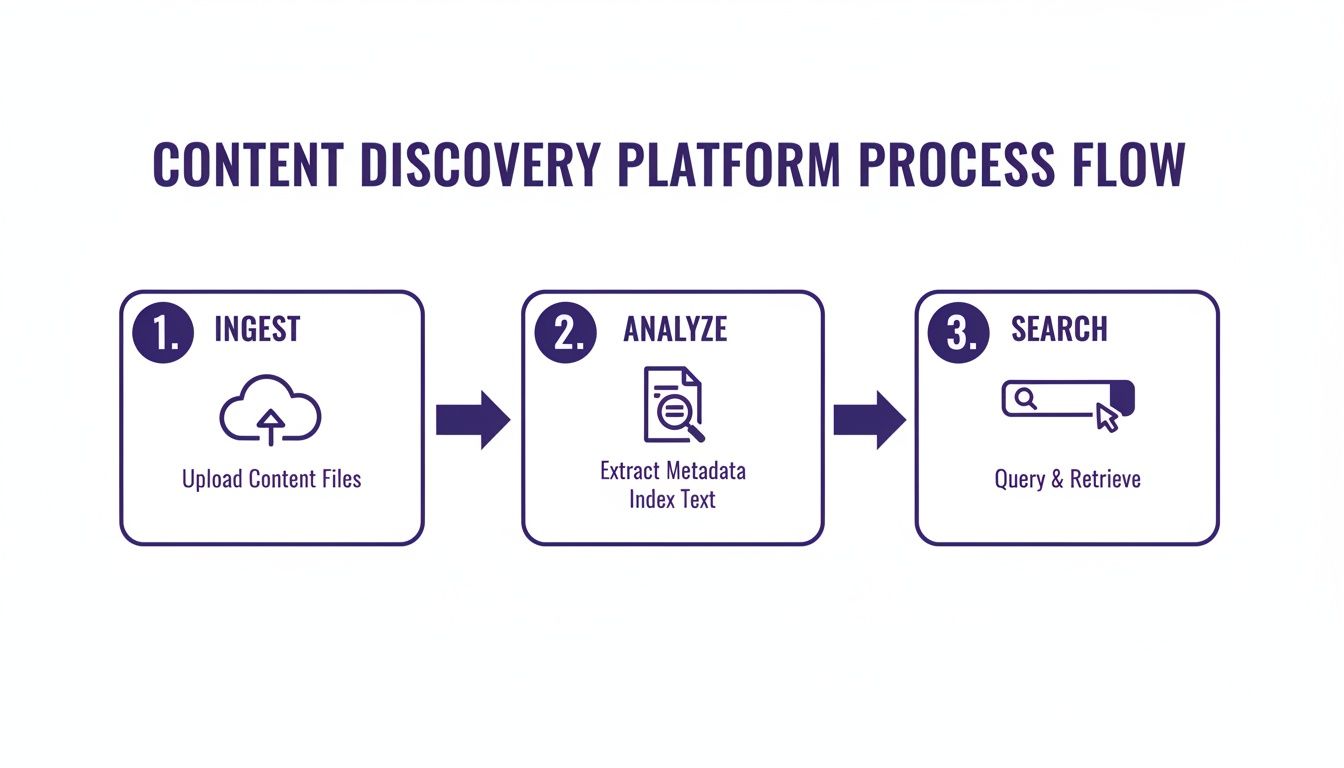
It all starts with getting your content into the system. From there, it’s all about deep analysis, which is what powers the smart, intuitive search you’ll use to find exactly what you need.
From Manual Work to Intelligent Automation
For creators and publishers, this system turns a mountain of tedious manual tasks into efficient, automated workflows. The shift is massive.
| Manual Task | Automated Solution with a Discovery Platform | Key Benefit |
|---|---|---|
| Scrubbing through hours of video/audio to find one clip. | Automatic transcription creates a time-stamped, searchable text of every word spoken. | Instantly find any moment in your entire media library. |
| Guessing which old content could be relevant for a new project. | Semantic search understands concepts and finds related content, even without exact keywords. | Uncover hidden connections and valuable assets you forgot you had. |
| Manually tracking topics and audience engagement across hundreds of assets. | AI-driven insights analyze your whole library to spot themes, patterns, and engagement trends. | Make data-backed decisions on what content to create next. |
| Sifting through folders and drives to gather research materials. | A centralized, searchable library brings all your content into one place. | Drastically cut down on research time and find inspiration faster. |
This isn't about replacing your team; it's about giving them superpowers to work faster, smarter, and more collaboratively.
The Core Components That Make It Possible
1. Content Ingestion and Transcription
The first job is content ingestion. The platform connects to all the places your content lives—your YouTube channel, podcast feed, blog, even those messy internal folders—and pulls it all into one central hub. No more hunting through a dozen different systems.
Once inside, the real work begins with automatic transcription. The platform’s AI listens to every second of your audio and video files, turning all that spoken content into searchable, time-stamped text. Your media library stops being a black box and becomes a fully readable database.
For anyone working with video or audio, this is a total game-changer. You can find the exact moment you mentioned a specific topic without manually scrubbing through hours of footage.
2. Semantic Search and AI-Driven Insights
This is what really separates a true discovery platform from a simple search bar. It doesn’t just match keywords; it uses semantic search. This means the AI understands the intent and context behind what you're asking.
You can ask it questions like a human, such as "find clips about our product launch last year," and the system gets what you mean. It connects concepts, not just words. This is a far more powerful and intuitive way to explore your archive, and you can learn more about how this works by understanding what enterprise search is.
But it goes beyond just finding things. These platforms also deliver AI-driven insights by analyzing your entire library to spot patterns and themes you might have otherwise missed.
The platform essentially becomes a collaborator. It will highlight which topics consistently drive the most engagement or which video formats get the most shares, helping you make smart, data-informed decisions instead of just guessing what your audience wants.
3. Human-AI Collaboration for Maximum Value
The point isn’t to have AI replace human creativity. It’s to give it a massive boost. Platforms like Contesimal are built on the idea of human-AI collaboration, where the AI handles the heavy lifting of organizing and analyzing. This frees you and your team up to do what you do best: create.
You can curate information surfaced by the AI to build a knowledge base for a new project. A group of people can then gather around that knowledge to create meaning, and as they collaborate, they generate new value from it.
These platforms are also built to make your content more visible externally. Many are leveraging Indexnow for faster content discovery by search engines and other AI models.
The market for these tools is growing fast, projected to jump from $5.15 billion in 2025 to $9.40 billion by 2034. Why? Because the results are clear. AI integrations are shown to boost engagement by up to 40% and help publishers accelerate research cycles by 20-30%. By pairing smart technology with your team’s expertise, you can pull every last drop of value from the content you’ve worked so hard to produce.
Practical Use Cases for Every Content Creator

Understanding the "how" of a content discovery platform is one thing, but seeing it in action is where the lightbulb really goes on. The magic isn't just in the technology; it’s in how it completely changes your day-to-day creative grind. It helps you finally organize your content library, spot new angles you missed, and make smart decisions that actually grow your audience and revenue.
Let's walk through a few real-world scenarios. This is how different creators—from vloggers and podcasters to authors and publishers—can use a tool like this to turn their dusty archive into their next big idea. Think of it as the jump from a creative hobby to a professional, revenue-generating operation.
For YouTubers and Video Creators
Imagine you're a YouTuber who reviews tech. A hot new smartphone just dropped, and you want to make a retrospective video comparing it to every model you've reviewed over the last five years. The old way? Manually scrubbing through dozens of old videos, hunting for the exact moments you talked about battery life or camera specs. It's a total slog.
With a content discovery platform, you just ask your archive a simple question: "Show me all clips under 90 seconds where I talked about camera performance in flagship phones."
Seconds later, you get a clean, curated list of time-stamped video segments. Now, the real fun begins. You can easily:
- Create Powerful Compilations: Stitch those clips together for a comparison video that flexes your long-term expertise on the subject.
- Feed Your Socials: Pull short, punchy clips to hype up your big video on TikTok, Instagram Reels, or YouTube Shorts, taking your long-form content across platforms in one click.
- Validate Your Next Move: See which of your past phone reviews got the most engagement and use that data to shape what you focus on in your new video.
You're no longer just working on one video at a time. You're building an entire content engine, running playlists to build on successful concepts, and squeezing new value out of the work you’ve already done.
For Podcasters and Audio Creators
Okay, now let's say you're a podcaster with over 200 episodes in your back catalog. You've noticed the theme of "imposter syndrome" keeps popping up in your interviews. You have a hunch there’s enough gold there for a special episode, or maybe even a spin-off series, but you need proof.
Instead of re-listening to hundreds of hours of your own voice, you use the platform to search your episode transcripts.
A podcaster can instantly search their entire audio library to identify every single mention of a key theme. This transforms a massive archive of conversations into a structured, searchable knowledge base, ready for new content creation.
You search for "imposter syndrome," "self-doubt," and a few related terms. The platform doesn't just find every mention; it shows you which guests said what and in what context. This lets you mine your own content to build something new, like a "Best Of" episode on the topic or an entirely new mini-series.
For Publishers and Content Marketers
For a publisher or a brand's content marketer, keeping messaging consistent across hundreds of articles, white papers, and blog posts is a constant headache. You're launching an update to a key product feature, and you need to make sure every single piece of customer-facing content is accurate and up-to-date.
Using a content discovery platform, a content lead can search the entire company archive for every mention of that feature. This isn't just a simple keyword search; the platform gets the context, finding direct mentions, customer quotes, and even outdated descriptions that need a refresh. This empowers your team to:
- Align All Messaging: Quickly find and update every relevant piece of content to reflect the new feature.
- Build Cornerstone Guides: Gather all articles, case studies, and webinar snippets about a topic to create an "ultimate guide" that becomes a lead-generating machine.
- Supercharge Collaboration: Create a curated knowledge set about a product that the entire marketing and sales team can tap into for campaigns and customer questions.
These AI-powered platforms are fundamentally changing how we work with content. The market is projected to hit $3.31 billion by 2026, and it's not hard to see why. Giants like Netflix use AI to achieve a 75% content discovery rate through recommendations. For individual creators, the same logic applies—you can analyze your past work to see which podcast topics led to a 40% spike in shares or which video thumbnails doubled your click-through rate, as detailed in these market growth insights.
How to Choose the Right Platform for You
Okay, so you get what a content discovery platform can do. The next question is obvious: how do you pick the right one? The market is getting crowded, and every option promises to be the key that unlocks your entire archive.
Making the right choice here is huge. You’re looking for a tool that doesn’t just add another complicated app to your workflow. You need a powerful collaborator that feels like a natural extension of your team, whether you're a YouTuber going pro or a publisher wanting to grow the value of their content library.
Core Capabilities to Evaluate
Before you sign any contracts, you need to dig into four key areas. These will be the difference between a tool you can't live without and an expensive, frustrating experiment.
- Ease of Use and a Brain-Dead Simple Interface
The best tool is the one your team actually uses. Period. If a platform feels clunky or has a learning curve like a sheer cliff, people will find every excuse to avoid it.
Look for a clean, intuitive design. Searching your own content should feel as natural as asking a research assistant for help. Can you ask it plain-English questions, or are you stuck trying to guess the exact right keywords?
- Real Collaboration Features
Content creation is almost never a solo mission, especially when you're moving beyond working on research alone. As you grow, you’re working with editors, writers, and social media managers. A good platform needs to be a digital roundtable where your team can gather, share what they’ve found, and build new projects together.
Does it let you create and share collections of clips or documents for your team to use? That’s the kind of feature that turns a solo tool into a team-wide asset.
- Powerful AI-Driven Insights
A decent content discovery platform will find what you ask for. A great one will show you things you didn’t even know to look for. The quality of the AI is a massive differentiator here.
It shouldn't just transcribe your audio and video. It should be smart enough to spot trends in your own work, analyze common themes, and connect the dots on what makes your audience tick. This is how you go from just finding old stuff to making smart, data-driven decisions about what to create next.
- Flexible Integration with Your Stack
Your content is probably scattered everywhere—YouTube, your podcast host, your website, Google Drive, Dropbox. A platform is only useful if it can connect to all those sources without giving your tech team a migraine.
Check to see if it can easily pull from all your existing channels. The goal is to create one single, unified library you can search in seconds.
The ultimate goal is to find a solution that helps humans and AI collaborate in a healthy, seamless way. The technology should handle the heavy lifting of organizing and analysis, freeing up your creative team to do what they do best: create, strategize, and connect with your audience.
Choosing the right platform is all about finding the one that generates the most useful information for you. As you evaluate, pay close attention to the kind of metadata the system creates. Does it make your content easier to find and understand? For a deeper dive into this, it’s worth reviewing some established metadata management best practices to help guide your decision.
The right platform won’t just organize your files—it will revolutionize your research and enable you to expand value across your existing assets. To help you compare your options, we’ve put together a simple checklist.
Evaluation Checklist for a Content Discovery Platform
This table is designed to help you methodically assess different platforms. Use it to compare how each one stacks up against the features that matter most for your specific workflow.
| Feature/Capability | Why It Matters | What to Look For |
|---|---|---|
| User Interface (UI) | A clunky UI kills adoption. Your team won't use a tool they hate. | Clean design, intuitive navigation, minimal clicks to get things done. Does it feel natural? |
| Search Functionality | The core of the platform. Weak search makes everything else useless. | Natural language search (asking questions), filters, semantic search (concept-based). |
| AI-Powered Insights | This is what separates a simple search tool from a strategic partner. | Automatic transcription, topic/theme detection, sentiment analysis, trend identification. |
| Collaboration Tools | Content is a team sport. The tool should support that. | Shared collections, user permissions, commenting, project-based workspaces. |
| Integration Support | Your content lives everywhere. The platform needs to connect to it. | Pre-built connectors for YouTube, Google Drive, Dropbox, podcast hosts, etc. API access is a plus. |
| Metadata Generation | Good metadata makes content findable and valuable for years. | Automatic tagging, speaker identification, chapter/topic generation, custom metadata fields. |
| Exporting & Sharing | You need to get content out of the platform easily to repurpose it. | Clip creation tools, easy export of video/audio/text, shareable links, social media integration. |
| Scalability & Performance | The platform must grow with you without slowing down. | Fast processing times for new content, ability to handle thousands of assets smoothly. |
Ultimately, this checklist is a starting point. The best "test" is to get your hands on the software with your own content. See which one feels less like a tool and more like a brilliant research assistant you can’t believe you ever lived without.
Putting It All Together: From Archive to Action
Let's be real. Every creator, publisher, and marketer eventually hits a wall. You've got this massive pile of old content—videos, podcasts, articles—and it just sits there. We’ve seen how a content discovery platform can be the engine that turns that forgotten content graveyard into a living, breathing asset. It’s the difference between hoarding your work and actually making it work for you.
The path forward is simple: Organize. Understand. Take Action. When you pull your entire library into one smart system, you suddenly see everything you've ever made. That's the first step. It's the moment your archive stops feeling like a burden and starts looking like your biggest advantage.
From Passive Pile to Active Asset
Next up is understanding what you actually have. With tools like automatic transcription and AI-powered analysis, you can finally have a real conversation with your own content. You can ask it tough questions, find themes you never knew were there, and spot the exact patterns that made your best stuff pop. This isn't just about finding an old clip; it's about figuring out what makes your audience tick.
Finally, you have to do something with it. All those insights are worthless until you turn them into new value. This is where you bring your library back to life by slicing up your best material into new formats. A single long-form video can easily become a dozen social media clips, a string of blog posts, or a killer compilation that hits a completely new audience.
Your past content isn't a sunk cost; it's the raw material for your future growth. Every video, podcast, and article is both a data point and a creative asset just waiting for a second chance.
The Next Move on Your Content Journey
For way too long, creators have been stuck on a hamster wheel, forced to constantly come up with brand new ideas while leaving a trail of perfectly good work behind them. A content discovery platform snaps you out of that cycle. It lets you build on what worked, learn from your entire body of work, and turn your library into a machine for growing your audience and making money.
If you're a YouTuber, podcaster, or publisher who's ready to go from a hobby to a real, revenue-generating business, you have to get serious about your archive. It’s time to stop letting your best ideas collect dust and start putting them back to work.
Platforms like Contesimal were built for exactly this—to help humans and AI team up to squeeze every last drop of potential out of your content. By getting your library in order, you can create fresh value, make smarter creative bets, and finally turn all that old long-form content into the money-maker it was always meant to be. Don't let your archive be a graveyard—bring it back to life.
A Few Questions We Hear All the Time
Jumping into any new piece of tech stirs up questions. It's only natural. Here are a few of the most common ones we get from creators, publishers, and marketers trying to figure out what a content discovery platform is and if it’s really for them.
Are These Platforms Only for Big Media Companies?
Not a chance. While massive publishers get a huge lift from them, these platforms are built to work for everyone. They're especially powerful for individual YouTubers, podcasters, and bloggers who are making the leap from hobby to full-time business.
Think about it. If you're a solo creator or have a tiny team, having an AI assistant to sort through years of your own work is a lifesaver. It can save you hundreds of hours of grunt work and find money-making ideas that are just sitting there, gathering dust in your archive.
How Long Until I See a Payoff?
The best platforms are built to get you up and running fast. The first step is pulling in all your existing content, and how long that takes just depends on how much stuff you’ve made. But you can start to see the value almost right away.
As soon as your first few pieces are in the system, you can start searching, asking questions, and spotting connections. The real magic happens over time as you make it part of your daily creative process, turning old content into new projects without breaking a sweat.
This isn't some long, drawn-out tech project. The whole point is to get you from a messy, disorganized archive to real, usable insights as fast as possible. It’s about turning yesterday's work into tomorrow's paycheck.
Is AI Going to Replace My Creative Team?
This is the big one, right? But the goal here is teamwork, not replacement. The AI is there to do the heavy lifting—the transcribing, the organizing, the pattern-finding—so your creative people can do what humans are best at: coming up with killer strategies, making amazing content, and connecting with an audience.
Think of it as the ultimate research assistant. It surfaces ideas and pulls data that helps your team make smarter, more creative choices, faster. It’s here to boost creativity, not get rid of it. The best tools help humans and AI work together in a way that makes everyone’s job better.
Can It Handle All My Content from Different Places?
Absolutely. A key job of any solid content discovery platform is to pull in content from all over the place. The top platforms can connect to your YouTube channel, grab your podcast’s RSS feed, and crawl your entire website.
This brings all your video, audio, and text into one central, searchable spot. That unified view is what unlocks the most powerful ideas, letting you see which themes pop off across all your channels and build a strategy that actually works everywhere. It's how you finally get your arms around your entire creative universe and start making smart moves.
Ready to stop letting your best content collect dust? Contesimal is an AI-powered platform built to help creators and publishers organize their libraries, discover hidden value, and turn their archives into revenue. See how it works by visiting https://contesimal.ai.