
Let's be real—the term "content marketing automation" used to be corporate-speak for scheduling a few social media posts. Yawn. But times have changed, and if you’re a creator, publisher, or storyteller, you need to pay attention.
We’re not just talking about basic scheduling anymore. This is about building an intelligent system that does the heavy lifting, freeing you up to do what you do best: create and connect with your audience.
The Shift To A Smarter Content System
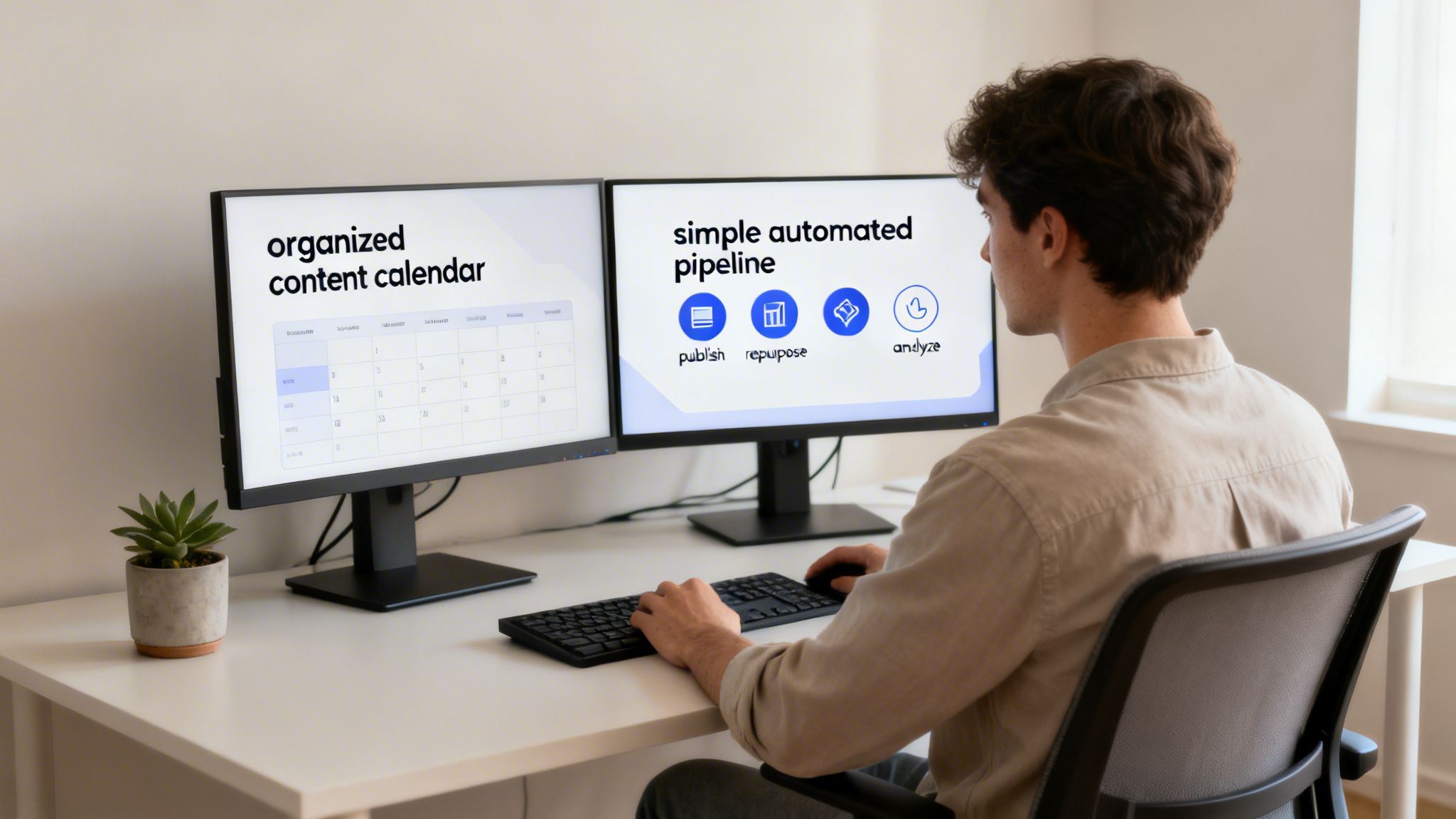
Welcome to the new playbook for content creators. We're moving from working harder to working smarter. And it all starts with your content library.
Think about it. Every video, podcast, or article you've ever published is sitting in a digital archive. For most, it's a chaotic mess. But with the right automation, that messy archive transforms into your most valuable, monetizable asset. It’s time to upcycle your old content, reignite your library, and create infinite content value.
Moving Beyond The Manual Grind
The days of frantically digging through old folders for a specific clip are over. So is the headache of trying to remember which themes you covered two years ago. This isn't just about getting organized; it's about reigniting dormant content, spotting your next viral hit, and finally getting your workflow under control.
The goal is simple: stop drowning in admin and start focusing on your creative genius and audience growth.
This shift isn't just a niche trend; it's a massive market movement. The marketing automation industry was valued at $6.65 billion in 2024 and is on track to explode to $15.58 billion by 2030. That’s because what was once a nice-to-have is now a must-have. With 68% of marketers planning to pump more money into their automation budgets, if you're not on board, you're already behind.
Let the machine handle the logistics. When you automate the repetitive grunt work, you give your creativity and strategic brain the space to breathe. You get to focus on the "why" and "what's next," while the system handles the "how."
The Old Way vs. The New Way
To really drive this home, look at the difference between the old, manual grind and a modern, automated system. One is a recipe for burnout; the other is a growth engine for YouTubers, podcasters, and publishers alike.
Manual vs Automated Content Workflows
| Activity | Manual Approach (The Grind) | Automated Approach (The Growth Engine) |
|---|---|---|
| Content Discovery | Manually searching folders and spreadsheets. | Instantly query your entire library by topic, theme, or keyword. |
| Repurposing | A time-consuming, one-off project. | Automatically suggests clips, quotes, and ideas for new formats. |
| Ideation | Brainstorming from a blank slate. | Surfaces patterns and past wins to inspire new content. |
| Distribution | Posting the same link everywhere. | Tailors content for each platform and schedules it intelligently. |
| Collaboration | Endless email chains and lost files. | A central hub where humans and AI can work together seamlessly. |
The difference is night and day. One path leads to spinning your wheels, while the other builds a sustainable, scalable content business.
What This Means For You
If you're a creator trying to go from hobbyist to pro, a content marketer needing to align content across platforms, or a publisher looking to grow the value of your library, this is for you. It’s about building the infrastructure to scale. The core ideas share a lot with traditional marketing automation for B2B, but tailored for the unique chaos of creative work.
A smart automation system tackles the biggest headaches modern creators face:
- Taming your massive content library so you can actually find and reuse things.
- Collaborating with your team (whether human or AI) without losing your mind.
- Driving real engagement by getting the right content in front of the right people.
- Finding your next big idea by understanding what’s already worked for you.
Ultimately, this is about making your content work for you, not the other way around. It’s a system to Organize, Understand, and Take Action. This guide will show you exactly how to build it.
How To Audit and Organize Your Content Goldmine
If you've been creating content for any length of time—whether you're a YouTuber, podcaster, or blogger—you’re sitting on a mountain of digital assets. The problem? Most of that good stuff is collecting dust in a chaotic mess of old folders and forgotten hard drives. It’s time to find that buried treasure and organize your content library to create new value.
This isn’t just about a weekend spring cleaning session. Think of it as a strategic mission to map out what you already have. You're looking for what’s still valuable, what’s evergreen, and what could be brought back to life to pull in new traffic. This audit is the bedrock for any real content marketing automation system. If you skip it, you’re just automating chaos.
Find Your Hidden Gems First
The thought of auditing your entire library is probably enough to make you want to close this tab. Don't do it. That's a surefire way to get overwhelmed and quit before you even start.
Instead, let’s focus on your proven winners from the last 12-18 months. These are the pieces that already have an audience and have shown they can perform. Hunt for:
- Highest Traffic/Views: The videos, articles, or episodes that consistently bring in new eyeballs.
- Most Engagement: The content that sparks conversation with the most comments, shares, and likes.
- Evergreen Topics: Posts that are just as useful today as they were when you first published them.
This small batch of A-list content is your low-hanging fruit. It gives you immediate material to play with and shows you the power of this process before you commit to the whole shebang.
The point of a content audit isn't just to tidy up; it’s to spot opportunities. You're searching for resonant themes, successful formats, and obvious gaps in your content. Your past hits are a literal roadmap for what to create next.
Build Your Content Taxonomy
Once you've rounded up your best stuff, it's time to give it some structure. A taxonomy sounds complicated, but it's just a smart way to categorize and tag your work. This is what transforms that messy digital garage into a searchable, high-powered database.
A good taxonomy doesn't need to be complex. Start with a few basic layers. If you're a podcaster or YouTuber, it might look something like this:
- Primary Topic: The big-picture subject (e.g., "Productivity," "Filmmaking Gear").
- Sub-Topic: A more focused theme inside that topic (e.g., "Time Blocking," "Lighting Setups").
- Content Format: What kind of asset it is (e.g., "Interview," "Tutorial," "Review").
- Key Concepts: Specific nouns or ideas you talked about (e.g., "Pomodoro Technique," "Aperture," "Sony FX3").
With this system in place, finding what you need later becomes ridiculously easy. Imagine you need a quick 30-second clip where you explained the "Pomodoro Technique." With a taxonomy, you can pull up every single instance in seconds. Without it? You’re stuck scrubbing through hours of footage, hoping you get lucky.
Automate The Ingestion Process
Let's be honest, manually tagging hundreds of old videos or blog posts is a soul-crushing job. This is where platforms like Contesimal completely change the game. Instead of doing all that grunt work yourself, you can let technology handle the heavy lifting.
Modern tools can automatically pull in your entire back catalog from places like YouTube or a folder of MP3s. As they process everything, they can:
- Transcribe Everything: Your entire video and audio library gets a word-for-word text version, making every single word you've ever said searchable.
- Apply Initial Tags: AI can analyze the transcripts to identify key topics, themes, and names, then suggest tags that fit right into your new taxonomy.
- Create a Central Hub: All your content—videos, transcripts, and metadata—gets organized into one unified, intelligent knowledge base.
This kind of automated ingestion is what makes a true content engine possible for creators ready to scale up. It takes care of the most mind-numbing part of the process, turning a chaotic archive into a powerful asset. For a deeper dive, our complete content audit checklist offers a step-by-step guide to get you rolling.
By auditing your best work and setting up a smart organizational system, you're laying the foundation for everything else. You’re no longer just sitting on a pile of disconnected posts and videos—you're building an interconnected web of value, ready to be repurposed for years to come.
Alright, you’ve dug through your archives and gotten everything sorted. Now for the fun part: building a system that does the grunt work for you, day and night. This is where you move from just having content to putting it to work automatically.
The whole point is to build a content lifecycle that runs itself. You're setting up simple rules that will completely change how you create. Imagine uploading a podcast and having a dozen social media clips magically appear, ready to go. Or picture writing a new blog post and instantly finding every related video you’ve ever made to embed within it. This is how you take your longform content across platforms in one click.
Blueprint For An Automated Workflow
You can't just stumble into a system like this. It starts with a clear plan that connects your content to specific, automated jobs. Think of it as a series of "if this happens, then do that" rules that hum along in the background, freeing you up to be more creative.
This simple visual breaks down the core idea: you evaluate what you have, organize it into a system, and then automate the work that follows.

This loop—from evaluation to automation—is what turns your one-off projects into assets that keep delivering value long after you’ve hit publish.
Setting Up Your Triggers And Actions
The best way to think about your automation engine is in terms of triggers (the "if") and actions (the "then"). A trigger is just an event that kicks off a task, and an action is what the system does for you automatically.
Here’s what this looks like in the real world for different creators:
For Podcasters:
- Trigger: You upload a new MP3 file.
- Automated Actions: The system gets to work transcribing the episode, figuring out who was speaking, and pulling 5-10 killer quotes under 60 seconds—perfect for social clips.
For YouTubers:
- Trigger: A new video goes live on your channel.
- Automated Actions: The platform ingests the video, transcribes it, and identifies 3-5 core sub-topics. It then digs through your archives to find older videos on those same topics and suggests you link them in your new video's description. Boom, more session watch time.
For Bloggers and Publishers:
- Trigger: A writer changes a draft’s status to "Ready for Review."
- Automated Actions: The system instantly scans the article against your brand voice guidelines and SEO checklist. It flags any problems and pings the editor, letting them know it’s ready for a human touch.
Workflows like these eliminate the tedious, manual tasks that kill creativity and slow you down. It’s no surprise that teams who get this right often slash their content production time by 50-70%, letting them focus on big-picture strategy instead of soul-crushing repetition.
The real magic happens when you blend human creativity with AI-powered discovery. A smart system doesn't just do what you tell it; it shows you connections in your own content you never would have found, sparking brand new ideas.
The Role of an Intelligent Platform
Let's be honest, trying to string all these complex rules together by hand would be a complete nightmare. This is where a dedicated platform is a non-negotiable. Tools like Contesimal are built to act as the central nervous system for your entire content operation, giving you a place to build and manage all these automated workflows. It's software designed to help humans and AI collaborate seamlessly, revolutionizing research and enabling you to expand value across your existing assets.
You can start interacting with your library in a totally new way, asking it direct questions to find specific moments or ideas buried in your archives.
This takes you way beyond a simple keyword search. It’s more like having a collaborative chat with your own archive, letting you "interview" your past work to pull out exactly what you need. When you design an engine that supports both creation and discovery, you give yourself the freedom to build on what you already know works. Your content starts compounding, creating value that grows over time.
Supercharging Your Workflow With AI Integration

Let's be real—AI is the rocket fuel for any serious content marketing automation strategy in 2026. And no, this isn't about letting robots write your next masterpiece. It's about giving your team superpowers.
True AI integration goes way beyond just scheduling posts. It brings a new layer of intelligence to your analysis, personalization, and even your creative brainstorming.
Think of AI as an incredibly sharp research assistant that’s read every word you’ve ever published. It’s the tool that finally lets you spot the hidden patterns in your work, predict what your audience actually wants to see, and pull data-driven topics out of thin air. This is how you stop guessing and start knowing.
It’s Not Just About Writing Content
Most people hear "AI" and immediately think of a robot writing a blog post. While that’s part of the picture, its real value in an automation system comes from analysis and discovery. The shift has been massive.
Right now, a staggering 89% of marketers are using AI for content creation, and 87% of them say it’s boosted their productivity. You can see more data on how AI is changing content marketing statistics on DesignRush. Just a few years ago, those numbers were practically zero.
This means AI isn't some fringe experiment anymore. It's a standard part of a modern creator's toolkit, helping you work faster and with more confidence.
Chat With Your Own Content Library
Here’s where it gets really interesting. One of the most powerful things you can do with AI is turn your entire archive into a conversational partner. Imagine asking your content library direct questions, like:
- "Show me every time I mentioned 'imposter syndrome' in a podcast."
- "What were the top three themes from my most-viewed videos last quarter?"
- "Create a summary of my blog posts about building an audience."
This is exactly what platforms like Contesimal are built to do. By making your content library "chat-able," you can pull out insights you never knew were there. You can instantly find that perfect clip, quote, or data point without having to scrub through hours of old material. Users can curate information to create a set of knowledge, gather people around that knowledge to create meaning, and then collaborate to generate value from it.
This isn't about replacing your creativity; it's about amplifying it. AI handles the data-crunching and grunt work, freeing your brain to focus on storytelling, strategy, and connecting with your audience.
AI-Assisted Ideation and Optimization
This is where you close the loop. An integrated AI system fuels your ability to plan and refine content by analyzing your entire library and comparing it against real audience engagement.
Here’s how AI fuels that creative cycle:
It finds your content gaps. The AI can analyze all the topics you've covered, compare them to what your audience is searching for, and show you exactly where the opportunities are.
It suggests new repurposing angles. It might spot a killer 30-second segment in an hour-long video and suggest you turn it into a short-form video, a blog post, or a series of social graphics.
It helps you optimize before you hit publish. The system can analyze a draft for tone, readability, and SEO opportunities, giving you practical tweaks to make it perform better from day one.
This collaborative approach—mixing your human intuition with AI-driven insights—is the whole idea behind modern content intelligence platforms. It’s a partnership where technology helps you make smarter, faster, and more creative decisions. The result is a workflow that’s not just automated, but truly intelligent.
Measuring Success and Scaling Your Strategy
Look, a fancy automation system is nothing more than a shiny new toy if it doesn’t actually deliver results. The real magic of content marketing automation happens when you can point to the numbers and see its impact on your bottom line. It's time to stop chasing vanity metrics like total views and start focusing on the numbers that signal real growth.
Success isn't just about doing things faster; it's about making your content work smarter and harder. This means tracking KPIs that tie your automation efforts directly to business goals. Are you actually generating more leads? Is your audience growing on other platforms? Are you finally turning your old longform content into a money-maker today?
You can’t improve what you don’t measure. A solid performance dashboard is your roadmap. It shows you what’s working, where the hang-ups are, and how to make data-backed decisions instead of just guessing.
Key Metrics For Automation ROI
To really see the return on your investment, you have to track the right stuff. The table below outlines the KPIs that go beyond surface-level stats and measure the real impact on your entire content operation.
| Metric | What It Measures | Why It Matters | Example Tool/Method |
|---|---|---|---|
| Content Velocity | The increase in content output (repurposed clips, articles, social posts) over a set period. | Shows how automation is boosting your production capacity without adding headcount. | Track assets created per month in a project management tool. |
| Time-to-Market | The time from content ideation to publication. | A shorter cycle means you can react faster to trends and publish more frequently. | Use workflow management timestamps to measure stage duration. |
| Content-Driven Leads | Leads generated from repurposed or resurfaced content. | Directly proves that your old content is now a revenue-generating asset. | Google Analytics goal tracking on CTAs within older content. |
| Audience Growth on New Platforms | Follower or subscriber growth on secondary channels fed by repurposed content. | Quantifies how automation is expanding your reach beyond your primary platform. | Channel-specific analytics (e.g., TikTok, Instagram). |
These numbers tell a powerful story. For instance, if you can prove automation helped you produce 3x more content, which then led to a 20% jump in leads from your archives, the value becomes impossible to ignore. That's a conversation worth having.
Creating A Roadmap For Growth
What you need from automation will definitely change as you grow. The system that works for a solo YouTuber is worlds apart from what a small media company needs. The secret is to build a strategy that can scale right alongside you.
My advice? Start by automating the most painful, mind-numbing tasks first. For a lot of creators moving from hobbyist to professional, this is usually creating social media clips or transcribing audio. Nail that down, and you’ll feel the relief immediately.
As your team gets bigger and your library expands, your automation can become more sophisticated. You can start building out workflows for multi-stage approvals, collaborating across departments, and even integrating with your sales or customer support systems.
- Solo Creator: Focus on the basics of repurposing. Turn one long video into 10 social clips. Simple.
- Small Team (2-5 people): Bring in automated approval workflows and a central dashboard so everyone knows what’s going on.
- Growing Media Brand: This is where you implement deep integrations with other business tools, like your CRM or email platform, to create a fully connected machine. For a full rundown of software that can level up your content marketing, check out this guide on the best AI tools for business in 2026.
This phased approach makes sure your system evolves with your business. If you want to dive deeper into measurement, we've got a whole guide on how to analyze content performance.
Ultimately, scaling your automation is about turning your content operation from a purely creative habit into a predictable, powerful engine for growth.
Your Questions About Content Marketing Automation Answered
Let's be real, the phrase "content automation" can sound a little scary. It probably brings up images of soulless robots churning out generic articles. I get it.
When you're first exploring a new way to manage your creative work, a lot of questions come up. Most creators and marketers I talk to have the exact same concerns. So, let's tackle the big ones head-on. This educational blog is here to help you learn best practices for content repurposing, and while the info is universal, we are big fans of Contesimal.
Will Automation Make My Content Feel Robotic?
This is the number one fear, and it's totally understandable. But here’s the good news: great automation does the exact opposite.
This isn't about having an AI write your next heartfelt script or viral video. It's about automating the mind-numbing, tedious tasks so you have more time and brainpower for the human, creative parts of your job.
Think about all the hours you've lost to tasks like:
- Scrubbing through a two-hour podcast recording just to find that one perfect clip.
- Transcribing endless audio files so you can pull a few quotes for social media.
- Manually scheduling dozens of posts across all your different platforms.
That’s grunt work, plain and simple. A well-designed automation system handles that stuff for you. This frees you up to focus on what actually matters: telling great stories, connecting with your audience, and dreaming up your next big idea. You end up creating more human-centric content, not less.
How Do I Start With A Huge, Unorganized Content Library?
The idea of trying to organize a massive, messy archive is enough to make anyone want to just close the laptop and walk away. It feels paralyzing.
So don't. Please, don't try to boil the ocean. You don't need to organize your entire back catalog in a single weekend.
Start small. Start smart. Just audit your top-performing content from the last year or so—the videos, episodes, and posts that got the most love from your audience. This is your low-hanging fruit.
From there, you can use a platform like Contesimal to ingest just that small, high-value batch of content. Let the system do the heavy lifting of transcribing and tagging it automatically. This gives you an immediate win and actionable insights from a totally manageable starting point.
You'll quickly see the power of having your best content organized and searchable. Once you experience that first win, you can progressively add more of your archive over time, turning a daunting project into a phased, strategic victory.
This approach builds momentum, not burnout.
How Much Technical Skill Do I Need For This?
Back in the day, you practically needed a software engineering degree to make automation work. Thankfully, those days are long gone. In 2026, you need way less technical skill than you think.
Modern platforms are built for people like us—creators, marketers, and publishers—not for developers. If you’ve ever used a social media scheduler, built a simple email sequence, or even just organized your files in Google Drive, you have all the skills you need.
Today's tools are all about:
- Intuitive, visual interfaces where you can literally see what you’re building.
- Simple one-click integrations that connect to the tools you already use, like YouTube or your podcast host.
- AI-powered suggestions that do most of the analytical heavy lifting for you.
The focus has completely shifted. It's no longer about how the tech works, but what you want to do with it. Your creative vision is the most important part. The platform is just there to help you bring it to life faster.
Can I Actually Measure The ROI Of Automation?
Absolutely. In fact, you have to. If you can't prove the value of a new system, it's just an expensive hobby. To get buy-in from your team—or even just to justify it to yourself—you need to track the metrics that really move the needle.
Here are the most important KPIs to prove the return on your investment:
- Time Saved: This is the easiest one. Calculate the hours your team gets back each week from no longer doing manual tasks. Multiply those hours by an hourly rate, and you've got a direct dollar value.
- Increased Content Velocity: How much more content are you getting out the door? If you were struggling to repurpose 2 clips a week and now you're easily publishing 10, that’s a 5x increase in output with the same team.
- New Revenue From Old Content: This is the holy grail. Start tracking leads, affiliate sales, or direct purchases that come from evergreen content your system automatically resurfaced.
When you track these things before and after, the conversation changes from "I think this is working" to "This system generated a 25% increase in leads from our existing library." That's a language everyone understands.
Ready to stop working harder and start working smarter? It’s time to transform your content library from a chaotic archive into your most valuable asset. Contesimal is the AI-powered platform that helps you organize, understand, and take action on your content. Discover hidden value, supercharge your collaboration, and make your old content a money-maker today. Learn more and get started at Contesimal.ai.