
The AIDA model is a classic marketing blueprint that maps out the four stages people move through before they decide to buy something: Attention, Interest, Desire, and Action. Think of it as a strategic roadmap for your content, guiding your audience from the very first glance all the way to a final, decisive click. For any content creator, podcaster, or YouTuber looking to turn a content library into a revenue-generating machine, mastering AIDA is non-negotiable.
What Is The AIDA Model And Why It Matters
Imagine you’re a filmmaker. You wouldn't just drop the movie’s climax on the audience in the first five minutes, right? Of course not. You’d start with an explosive opening scene to grab their Attention. Then, you'd build suspense and character connections to create Interest.
From there, you'd make the audience root for the hero, building a powerful Desire for them to succeed. Finally, the resolution gives them the cathartic Action they've been waiting for—the big payoff.
The AIDA model works the exact same way for your content, whether it's a blog post, a podcast, or a video script. It’s a psychological framework that helps you structure your story to move people along a predictable journey, turning old content into new value and reigniting your entire content library.
A Timeless Framework for Modern Creators
First developed way back in the early 1900s, AIDA has stuck around for over a century for one simple reason: it works. The psychology behind how people make decisions hasn't really changed, and this model taps directly into that process. You can discover more about its lasting impact on Media Plus.
This isn't just some dusty old theory; it’s a practical tool every creator should be using today. Why? Because it forces you to think about what your content is actually supposed to do at every single stage.
- You stop creating content just to fill a slot. Instead, every piece has a clear job, helping you organize your content library for maximum impact.
- You connect with your audience on a much deeper level. You’re meeting them exactly where they are in their decision-making process.
- You create a clear path toward your goals. Whether you want more subscribers, downloads, or sales, AIDA provides the steps to get you there, turning your creative assets into money-makers.
This simple table breaks down how to think about each stage.
The AIDA Model At A Glance
| Stage | Primary Goal | Key Content Question |
|---|---|---|
| Attention | Interrupt their scrolling and make them look. | What will stop them in their tracks? |
| Interest | Hold their focus with compelling information. | What will make them want to learn more? |
| Desire | Shift their mindset from "that's interesting" to "I need that." | How can I show them this solves their problem? |
| Action | Give them a clear, simple next step to take. | What do I want them to do right now? |
With this structure, you’re not just throwing content out there and hoping for the best. You’re building a system to upcycle your old content and create infinite value.
This infographic visualizes that simple, four-step flow from initial awareness to the final conversion.
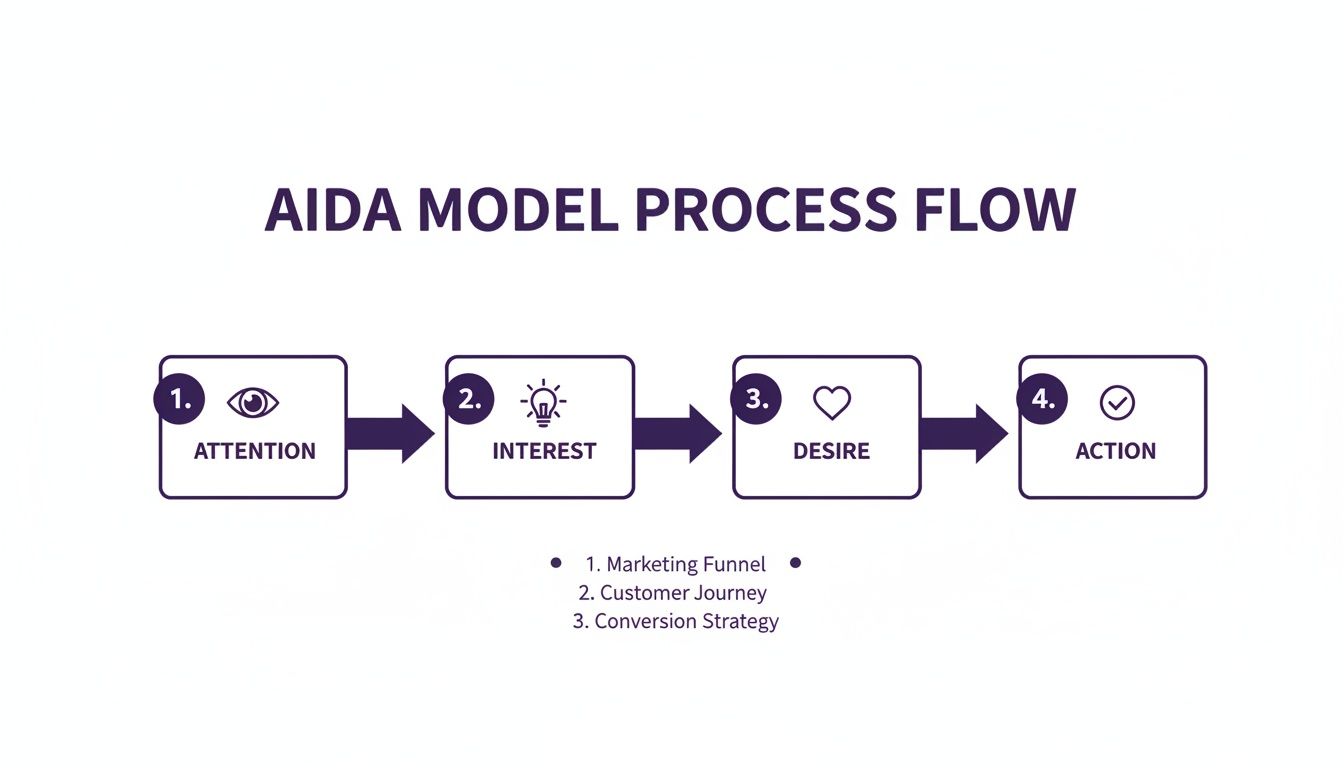
As you can see, each stage builds on the one before it, creating a natural momentum that guides your audience forward. For creators who want to grow beyond a hobby, mastering this flow is non-negotiable. It’s how you turn casual viewers into a loyal community and organize your creative work into a system that actually generates revenue.
Attention: How to Stop the Scroll and Earn That First Click
This is the first, and maybe the most important, fight you’ll have. In the AIDA model, the Attention stage is where you go to war against the endless scroll. You’re fighting for the first three seconds of a video, the headline of an article, or the opening line of a podcast.
Think of it like a pattern interrupt. People are zombies, mindlessly swiping and clicking through their feeds on autopilot. Your job is to jolt them awake. You need something unexpected, something that hits an emotional nerve, or something that makes them intensely curious. This isn't just about a clever title; it's about knowing what makes a person stop and look up.
Your content's first impression is a split-second audition. If your hook misses, the rest of your message—no matter how brilliant—might as well not exist.
Crafting Hooks That Actually Work
To win the fight for attention every single time, you need a solid set of tools. These aren't cheap tricks; they're psychological triggers that cut through the noise by tapping into how people think.
- The Curiosity Gap: Show them a fascinating result but hide the "how." A YouTube title like, "I Doubled My Subscribers With One Simple Change" makes people itch to know what that change was. You create a void, and they feel a pull to fill it.
- Emotional Triggers: Hit them with core emotions—hope, fear, surprise, a need for validation. A blog post titled "Are You Making These 3 Common Podcasting Mistakes?" triggers a fear of missing out and a quiet desire to check if they're doing it wrong.
- Bold or Contrarian Takes: Challenge something everyone believes. An intro like, "Everyone says you need a niche. They're wrong, and here's why," instantly grabs attention. It frames your content as a fresh, maybe even rebellious, perspective.
For any serious creator, building a library of what works is non-negotiable. When you organize your old content, you can dig into the data and see which hooks—curiosity, emotion, or controversy—really connect with your audience. You stop guessing and start replicating what you know is successful, giving every new piece of content the best possible chance from the moment it drops.
Mastering the hook is a vital first step. If you're hunting for more ideas, you can find several good hook examples for essays that translate perfectly to videos, posts, and podcasts.
By systematically testing and refining your openings, you turn grabbing attention from a game of luck into a reliable skill. It ensures all the valuable insights you have to share don't just get lost in the digital static.
Interest: Turning a Momentary Glance Into Genuine Engagement
You’ve stopped the scroll. Nice work. But now comes the real challenge: turning that quick glance into genuine engagement. This is the Interest stage, where you pivot from a flashy hook to delivering real substance.
It’s all about making your audience feel like you’ve read their minds. That this piece of content was made just for them.

Think of it this way: Attention is the knock on the door. Interest is being invited inside. You’ve earned a few more seconds of their time, and now it’s your job to prove that time is well-spent.
You do this by immediately making good on the promise from your hook, delivering information that hits on their specific problems or curiosities. If you can't explain aida model principles in a way that builds interest, your audience is gone. They'll click away, and the rest of your message evaporates.
Making Them Feel Understood
The fastest way to build interest is to show your audience you get them. You're not just talking at them; you're talking with them about a problem they're actively trying to solve right now.
For example, a podcaster might open with, "You've got a hard drive full of amazing interviews, but they're just sitting there collecting digital dust. What if you could turn those old clips into a week’s worth of new social content?" This immediately connects with creators drowning in their own content archives.
The goal of the Interest stage is to transition your audience from thinking "What is this?" to "This is for me." It's about establishing relevance and building a connection that makes them want to lean in and learn more.
This is where a well-organized content archive becomes a creator's secret weapon. Imagine needing a specific anecdote or data point to make a story pop. With a system like Contesimal, you can instantly search your entire library of videos, articles, and podcast transcripts to find the perfect detail, weaving it into your narrative to build a richer, more captivating experience. It helps you collaborate with your team and discover new value in your existing assets.
How to Sustain Interest Across Formats
Holding someone’s focus requires more than just good information—it demands smart presentation. You have to keep the momentum going.
- For Bloggers and Writers: Break up your text. Use short paragraphs, bullet points, subheadings, and blockquotes. Drop a surprising statistic to make a point, like the fact that nearly 95% of shoppers read online reviews before buying. Smart formatting isn't just about looks; it respects the reader’s time and makes your content way easier to digest.
- For YouTubers and Video Creators: Keep your visuals dynamic. Use b-roll footage, on-screen text, and quick cuts to illustrate what you're saying. If you're explaining a concept, show it in action. If you mention a past video, splice in a quick clip. This visual variety stops the viewer's attention from drifting off.
By mastering the art of sustaining interest, you build a bridge from your initial hook to the deeper emotional connection needed for the Desire stage. You prove your content is worth their time, making sure they stick around for the big payoff.
Desire: Forging an Unshakeable Need for Your Solution
Alright, you've snagged their attention and held their interest. Now comes the pivot. This is the Desire stage, where you shift your audience from simply nodding along to actively wanting what you have.
Think of it this way: if the Interest stage was about showing them you understand their problem, the Desire stage is about convincing them you hold the key to solving it. You’re moving them from, “Huh, that’s an interesting point,” to, “I think I need this.”

For a creator, this is where you start connecting the dots. You’re showing exactly how your course, your community, or your premium content is the bridge from where they are now to where they want to be. It’s all about painting a vivid picture of their successful "after" state—an outcome they can only get with your help. This is how you take your content library and make it a money-maker.
From Features to Feelings
Here’s the biggest trap I see creators fall into: they just list features. But let’s be honest, nobody’s heart races at the thought of “10 video modules.” What they really want is the confidence, the career boost, or the freedom that mastering that skill will bring.
You have to sell the transformation, not the transaction.
- Feature: "Our course includes 10 hours of video lessons."
- Desire (Benefit): "Go from novice to pro in one weekend, and start charging the rates you deserve by next week."
- Feature: "You get access to a private community."
- Desire (Benefit): "Stop feeling stuck. Get instant feedback on your projects from a network of peers and experts who are already where you want to be."
See the difference? This reframes the conversation. Suddenly, it’s not a purchase; it’s an investment in a better version of themselves.
Build Your Case with Proof
To crank up that desire until it’s undeniable, you need proof. This is where social proof isn’t just a nice-to-have; it’s your most powerful tool. It’s no secret that 95% of people read online reviews before buying something, and that behavior is hardwired into how we consume content, too.
Desire isn't sparked in a vacuum; it's fanned into a flame by the validation of others. When your audience sees people just like them succeeding with your help, their want quickly becomes a need.
So, roll out the testimonials, the case studies, and the success stories. Don’t just say your course gets results—show a clip of a student who landed a dream client. Don't just mention your community—share a screenshot of a genuinely helpful and supportive conversation happening right now.
This kind of real-world evidence dissolves doubt. It turns a hopeful prospect into a confident buyer who’s more than ready for that final, crucial step: Action.
Action: Guiding Your Audience to the Final Step
This is it. The finish line. The Action stage is where all that hard work—grabbing attention, building interest, and sparking desire—finally pays off. It’s the moment of truth where a passive viewer or reader turns into an active subscriber, customer, or fan.
And yet, this is precisely where so many creators drop the ball.
Why? They make the final step confusing, difficult, or just plain uninspiring. The trick to this stage is simple: make the next step you want them to take not just obvious, but easy and irresistible.

This final instruction is your Call to Action (CTA), and it has to be crystal clear. Weak endings like, "Let me know what you think," just don't cut it. You need direct, compelling language that leaves zero doubt about what to do next.
Crafting CTAs That Actually Convert
A great CTA removes any friction and dials up the motivation. It’s that final nudge that gets someone to commit. Psychology is your best friend here, especially the timeless principles of urgency and exclusivity. There's a reason you still see "limited-time offer" and "only 3 spots left"—these tactics tap into our natural desire to act now. As you explain aida model concepts to your team, hammering home the power of a strong CTA is non-negotiable. You can see how AIDA fits into different marketing efforts in this guide to the AIDA model from LogRocket.
Here are a few concrete examples of CTAs that get the job done:
- For a Video: "Click the first link in the description to download the free project template I used in this video."
- For a Blog Post: "Ready to transform your content workflow? Start your free Contesimal trial today."
- For a Podcast: "Join the conversation in our private community. Head to YourCommunityURL.com and sign up now."
The best CTAs do more than just beg for a click; they complete the story you just told. They provide a tangible, immediate way for your audience to fulfill the desire you worked so hard to build.
Getting the CTA right is fundamental to seeing real results from your content. If you want to make sure your website’s CTAs are pulling their weight, you might want to brush up on our tips for copywriting for a website.
By making your call to action specific, urgent, and valuable, you convert all that potential energy into measurable results. You prove the impact of your content strategy and set the stage for the next critical phase—keeping them around.
How To Measure And Optimize Your AIDA Strategy
The AIDA model is more than just a creative blueprint; it’s a powerful analytical tool. If you want to make it work, you have to map real-world performance metrics to each stage. This is how you turn a good theory into a data-driven strategy you can actually measure, test, and improve.
This is what separates the amateurs from the pros. When you can connect each stage of the funnel to a specific number, you stop guessing and start building a predictable growth engine.
AIDA without analytics is just guesswork. By assigning metrics to each stage, you transform your content funnel from a vague concept into a measurable, optimizable machine.
Key Metrics For Each AIDA Stage
By tracking the right data, you can pinpoint exactly where your strategy is working and where it's falling apart. This lets you stop throwing content at the wall and start making smart decisions that actually move the needle.
- Attention: Your only goal here is to get seen. The big metrics are impressions, click-through rate (CTR), and video views. These numbers tell you if your hooks are strong enough to stop the scroll.
- Interest: Okay, you got their attention. Now what? You need to measure engagement. Look at session duration, bounce rate, and audience retention on your videos. Are people actually sticking around after that initial click?
- Desire: This is where you see motivation building. Track things like lead magnet downloads, email sign-ups, or clicks on "learn more" links. These actions show your audience is starting to feel a real need for what you offer.
- Action: This is the bottom line—the final conversion. Your most important metric is your conversion rate. This could be a sale, a free trial, or just a filled-out contact form. It’s the payoff.
The Power Of A Data-Driven Approach
Measuring your AIDA strategy well means using the right tools. To get a real feel for how people are interacting with your content, tools like heatmap analytics can give you invaluable insights into what they’re actually clicking on and looking at.
And it’s not just a hunch—the data backs this up. Research has shown a direct link between using the AIDA framework and leaning on data analytics. These studies confirm a strong positive connection between AIDA and strategic planning, with data acting as the critical factor that makes the whole thing work. You can discover more about these findings from the research here.
An organized content library is the backbone of this whole process. When your content is tagged by AIDA stage, you get a bird's-eye view of your entire funnel. You can spot the weak links and know exactly where to focus your energy. To go deeper on this, check out our complete guide on how to analyze content performance.
Frequently Asked Questions About The AIDA Model
Getting your head around the AIDA model is the first step. But when you start actually using it, a whole new set of questions pops up. Here are some real-world answers to the common hang-ups creators and marketers face.
Is The AIDA Model Too Linear For Today's Customer Journey?
Think of AIDA less like a straight line and more like a flexible checklist. We all know the modern customer journey is a tangled mess. Someone might see your ad (Attention), disappear for a week to do their own research (Interest), see a friend rave about the product (Desire), and then finally buy it weeks later (Action).
AIDA’s real power is making sure you have content ready for each of those moments. It's about meeting your audience with the right message, no matter where they are in that messy, non-linear path.
How Can I Apply AIDA To My Existing Content Library?
Start with an AIDA audit. It's simpler than it sounds. Just go through your existing videos, blog posts, and podcasts and tag each one based on the main job it does.
- Attention: This is your content with great hooks and high initial views.
- Interest: Look for pieces with long watch times or session durations.
- Desire: This is content that drives clicks to product pages or brings in qualified leads.
- Action: These are your top converters—landing pages, dedicated sales videos, and the like.
This audit will immediately show you where the holes are. You might find you're a rockstar at grabbing "Attention" but have almost nothing that builds "Desire" or pushes for "Action." From there, you can either create new content to fill those gaps or even repurpose what you already have. Nailing this process means getting good at measurement, and a key part of that is knowing how to build an effective social media analytics report.
What Comes After The Action Stage?
Smart marketers today add a fifth stage: Retention or Loyalty. Getting that first "Action" is just the start of the relationship. The real goal for professional creators is turning a one-time viewer or customer into a true fan for life.
This means you keep the conversation going with newsletters, a thriving community, and consistent value long after they've clicked "buy."
Ready to turn your content history into content gold? Contesimal helps you organize, search, and repurpose your entire content library, making it easy to apply the AIDA model and unlock new value from the work you've already done. Discover what Contesimal can do for you.