
You probably already have enough material to write an ebook.
Not in the romantic sense. In the practical, files-everywhere, half-finished-notes, published-posts, podcast transcripts, workshop decks, and voice memos sense. Most creators who are moving from “I make content” to “I sell intellectual property” don't have an idea problem. They have a packaging problem.
That distinction matters. Writing an ebook isn't just a creative milestone anymore. It's a way to turn scattered expertise into a product, sharpen your positioning, and create an asset you can sell, bundle, gate, license, or use to pull readers deeper into your ecosystem. In a market projected to grow from about $14.9 billion in 2025 to $15.7 billion by 2029, with more than 1.1 billion readers expected by 2029 according to ebook market projections, the opportunity is real. So is the competition.
The mistake I see most often is treating the ebook like a side project. It gets written in leftover hours, built from vague inspiration, then published with no real product strategy behind it. That approach usually creates a document. It rarely creates an asset.
Finding an Ebook Idea Worth Writing and Selling
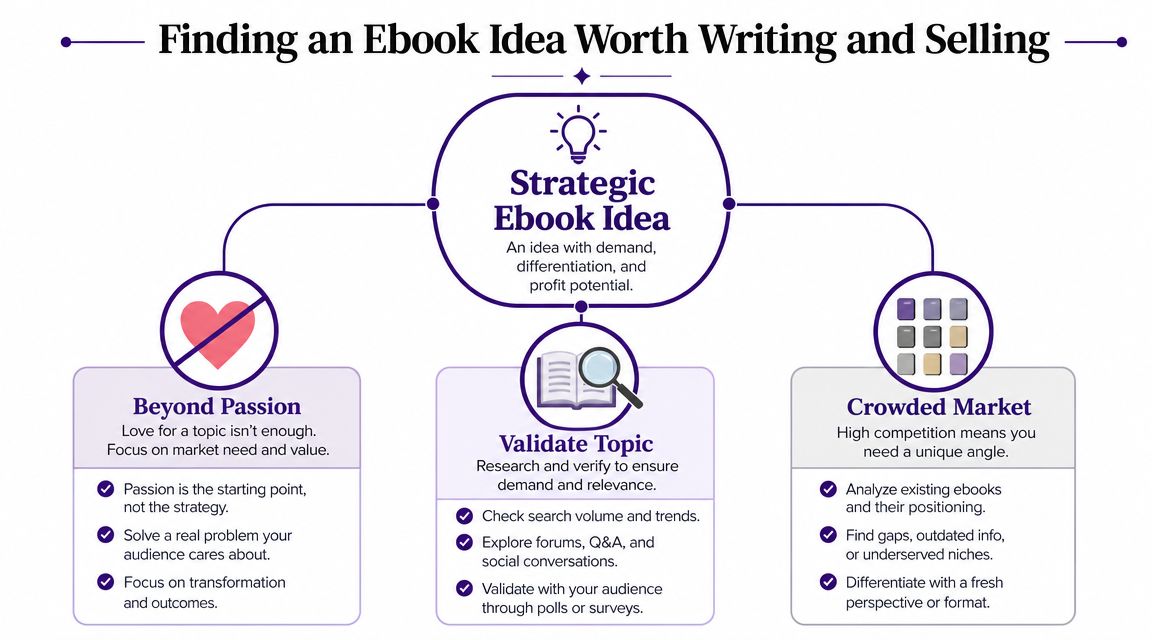
“Write what you know” is incomplete advice.
It works if your only goal is expression. It fails if your goal is to create a book people will buy, finish, and recommend. A better filter is this: write where your expertise, audience demand, and AI-resistance intersect.
That last part matters more than it did a few years ago. Existing writing guides still emphasize broad keyword research, but recent data indicates that AI-generated answers are increasingly satisfying informational intent directly in search. That shifts topic selection away from broad, popular subjects and toward depth, specificity, and first-hand insight that AI summaries can't easily replace, as discussed in this piece on low-competition ebook niches and discoverability shifts.
Pick a problem, not a theme
Weak ebook ideas sound like categories:
- Marketing
- Productivity
- Podcast growth
- Personal branding
Strong ebook ideas sound like costly, annoying problems:
- How a small podcast team turns one interview into a month of usable content
- How a creator with a large archive can organize it for sponsorship sales
- How a YouTuber turns tutorials into a paid educational product without rewriting everything
The narrower idea usually wins because it gives the buyer a clearer reason to care. It also gives you sharper positioning on the sales page, in the title, and in your launch content.
Practical rule: If an AI summary could answer the central question in one decent response, the topic is still too broad.
Test for defensibility
A defensible ebook usually has at least one of these qualities:
First-hand workflow
You're showing how you do the work, including decisions, trade-offs, and order of operations.Curated synthesis
You're combining ideas from a wide body of content into a framework readers can use immediately.Audience-specific application
The advice is designed for a niche with distinct constraints, such as publishers, podcasters, or creators with a deep back catalog.Usable assets
The book includes templates, checklists, prompts, examples, or decision tools.
If your topic has none of those, it's vulnerable to being skimmed instead of bought.
Validate with evidence from your own library
Your archive is a demand signal. Look at what already pulled comments, replies, saves, rewatching, reposts, or follow-up questions. For creators, topic validation often starts with content performance, not bookstore trends.
A useful way to pressure-test the concept is to review different forms of research for content planning and combine audience evidence with competitive judgment. Then compare your idea against a stronger validation checklist, like this guide to validating book ideas, which is useful when you need to move from “interesting” to “commercially viable.”
Ask blunt questions:
- Would someone pay for this, or just nod at it?
- Does the topic solve a painful problem or merely describe one?
- Can you explain why you are the right person to write this?
- Does the idea have enough depth for a book, but a tight enough scope to stay useful?
That combination is what gives an ebook a real market position. Not passion alone. Not trend-chasing alone. A sharp problem, solved with credible expertise, for a reader who knows exactly why this book exists.
Building Your Ebook's Foundation with Research and Outlining
Most bad ebook drafts start too early.
The writer gets excited, opens a blank doc, writes an introduction, rewrites that introduction, changes the promise, adds random sections, then discovers halfway through that the book has no spine. Expert guidance on methodology makes the fix plain: treat the project as a staged production pipeline, because ebook projects fail most often when writers draft before scope and structure are fixed, as explained in this methodology planning guide.
For creators with a real content library, outlining isn't busywork. It's assembly.

Treat your archive like source material
If you've published for any length of time, your best raw material is probably already sitting in:
- Blog posts that tackled one slice of the problem
- Podcast transcripts where you explained ideas naturally
- Video scripts with strong examples and teaching moments
- Newsletters that tested framing and tone
- Client decks or workshops where your ideas were already organized for action
The job is not to dump all of that into a manuscript. The job is to mine it.
I think of this as content archaeology. You're not collecting everything. You're brushing away the dirt to find the pieces worth preserving.
Build the outline in layers
A clean outline usually comes together in four passes.
Pass one pulls the material
Create one working document and paste in links, snippets, transcript sections, and notes that clearly relate to the book's promise. Don't organize extensively yet. Just gather.
Pass two groups by reader journey
Now sort the material by what the reader needs in order:
| Reader need | What belongs here |
|---|---|
| Orientation | Problem definition, stakes, common mistakes |
| Framework | Your core model, process, or philosophy |
| Execution | Step-by-step actions, examples, tools |
| Application | Templates, edge cases, advanced usage |
A strong sense of structure in writing pays off. Readers don't experience your archive the way you created it. They experience it in the order that helps them understand and use it.
Pass three cuts overlap
Your library will repeat itself. That's normal. Repetition often signals your strongest idea, but in an ebook it can also bloat chapters fast.
Cut aggressively when two assets teach the same lesson. Keep the clearer one, or merge both into a stronger section.
The outline should prove that the book works before the prose tries to make it feel elegant.
Use chapter prompts instead of chapter titles alone
A title like “Content Repurposing” isn't enough. A chapter prompt is better:
- What does the reader believe before this chapter starts?
- What should they understand by the end?
- What action should they be ready to take next?
That approach turns the outline into a production blueprint. It also helps if you're repurposing older material, because it tells you whether an existing asset belongs in the book or only belonged in the moment it was originally published.
A good outline makes drafting feel less like inventing and more like joining prepared parts together. This offers a significant benefit for creators with years of useful content behind them.
Mastering the Ebook Drafting Process
A busy creator rarely has ideal writing conditions.
They have a recording schedule, client work, edits to review, an inbox full of “quick questions,” and exactly one hour that was supposed to be free before something moved into it. If they wait for a perfect writing day, the ebook stays in outline form forever.
That's why the drafting process needs to work under imperfect conditions.
Write in modules, not in order
The cleanest way to maintain momentum is modular drafting. Instead of writing front to back, draft the sections with the highest clarity first.
A creator writing an ebook from an existing library might do this:
- Draft the chapter based on a workshop they've already taught live.
- Skip the intro because the promise still feels fuzzy.
- Write the checklist section next because the material already exists in notes.
- Return to the transitional chapter after the core framework is on the page.
This works because not every part of the book demands the same kind of energy. Some sections need synthesis. Others need explanation. Others need tightening. You don't need to force all of them through the same session.
Use sprint writing with a defined output
A sprint only works when the target is concrete.
Bad sprint goal: write for a while.
Better sprint goal: draft the example in chapter three and the takeaway box at the end.
Try a simple rhythm:
- Pick one small unit, such as a subsection, checklist, or example.
- Set a short writing block.
- Draft without editing sentences line by line.
- Leave a note where research, proof, or polish is still missing.
- Stop at the end of the unit, not in the middle of confusion.
That last point matters. Ending a session with a visible next step makes it much easier to restart.
Don't turn the book into project notes
One of the most common technical mistakes in writing an ebook is getting the level of detail wrong. Methods guidance recommends including the minimum detail needed for accurate interpretation while avoiding procedural clutter that belongs elsewhere, as outlined in this guide to writing a methods section clearly.
That lesson applies directly to creator books.
A reader wants:
- What you did
- Why you chose that path
- What to watch out for
- How they can apply it
A reader usually does not want the entire backstage log of every idea you discarded, every app you tested, or every tangent that crossed your mind while building the workflow.
Write the part that helps the reader act. Cut the part that only proves you spent time thinking.
For creators who want to sharpen the prose itself, this article on how you become a great writer is useful because it focuses on improving the writing habit and decision-making, not just grammar cleanup.
Keep a two-track draft
I like a split approach for practical books:
- Reader draft for clean prose
- Maker notes for reminders, source checks, missing examples, or formatting issues
That separation keeps the manuscript readable while preserving your thinking. It also reduces the urge to over-explain inside the chapter itself.
The first draft does not need to be pretty. It needs to be complete enough to edit intelligently. That's a different standard, and a much more productive one.
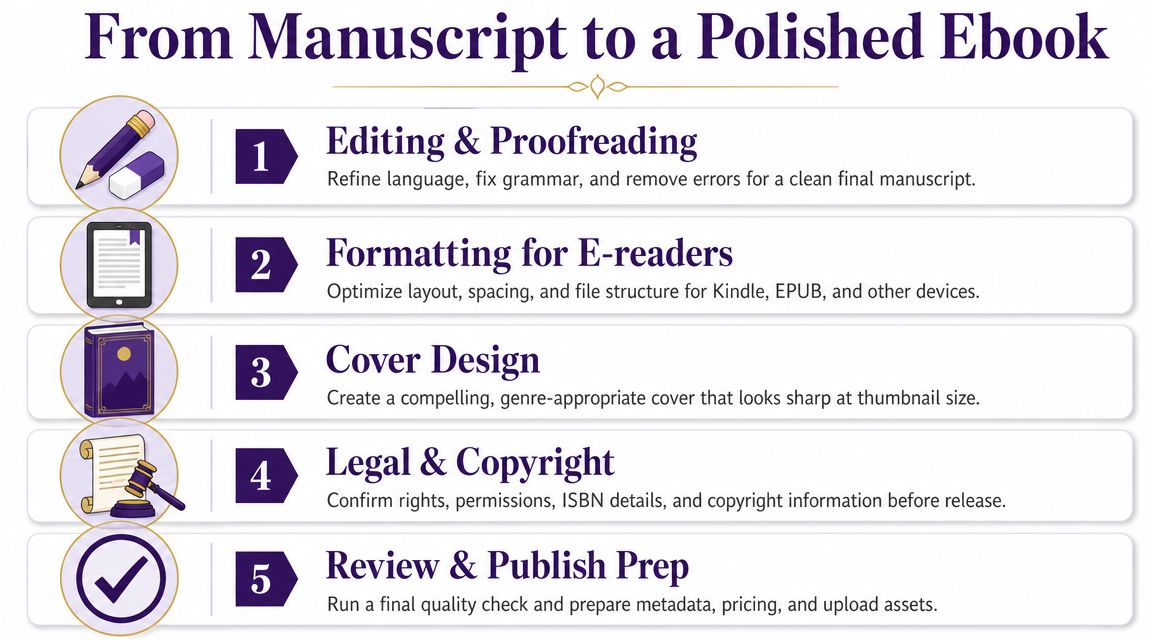
From Manuscript to a Polished Ebook
A strong ebook can still fail at the reading experience.
That happens when the writing is solid but the package is tiring. Dense paragraphs. weak headings. no visual rhythm. no sense of progress. Readers don't complain in technical terms. They just stop.
A 2024 study on digital reading behavior found that shorter, highly structured formats with clear headings, summaries, and checklists were associated with better completion and perceived usefulness than long, undifferentiated text blocks, as summarized in this discussion of ebook outlining and finishable structure. That's why polish is not cosmetic. It's functional.
Edit in distinct passes
Trying to fix everything at once leads to shallow edits. Separate the work.
Developmental pass
Check the argument, chapter order, repetition, missing examples, and whether the promise made at the start is fulfilled.
Copy pass
Tighten sentences, remove filler, standardize terminology, and fix clunky transitions.
Proof pass
Catch spelling, punctuation, formatting inconsistencies, and small visual errors before export.
If you can afford help, get outside eyes on at least one of those stages. If you can't, create distance between passes so you stop reading what you meant and start seeing what's on the page.
Design for completion
A finishable ebook feels easy to follow. That doesn't mean shallow. It means the reader can keep moving.
Use elements that reduce friction:
- Short sections that deliver one idea at a time
- Clear subheads that work like signposts
- Chapter-end summaries for retention
- Checklists and pullouts for action
- Whitespace and hierarchy so the page breathes
Here's a useful mindset: your job isn't to display all your knowledge at once. Your job is to help the reader make progress without fatigue.
Before you think about export settings, it helps to see the production process in motion:
Know where DIY breaks down
There's no shame in using Google Docs, Word, Canva, Apple Pages, Atticus, Vellum, or a simple PDF workflow if the book is structurally sound and visually clean. DIY becomes a problem when it creates obvious reader friction.
Use this quick decision table:
| If your ebook needs | DIY may work | Bring in help |
|---|---|---|
| Simple lead magnet PDF | Yes | Maybe not |
| Branded paid product | Sometimes | Often worth it |
| Complex layout with charts or callouts | Risky | Safer |
| Multi-format export for several retailers | Possible | Helpful |
Good design doesn't decorate the manuscript. It removes excuses for quitting.
A polished ebook signals respect. Respect for the reader's time, for your own expertise, and for the fact that this product represents your brand long after launch week.
Choosing Your Ebook Publishing and Distribution Path
A creator finishes an ebook, uploads it to the first platform that looks easy, and gets sales. Then the second question hits. Who keeps the customer. The store, or the business behind the book?
That choice shapes far more than delivery. It affects margin, audience data, upsell opportunities, pricing freedom, and how useful the ebook becomes after launch. If the book comes from a strong content library, the smartest distribution plan treats it as a business asset with a long shelf life, not a one-off digital product.
Analysts expect the global ebook market to keep growing through 2029, with revenue and readership both rising over that period, as noted in these global ebook market projections. A growing market helps, but channel strategy still determines whether your ebook builds your business or merely rents attention from someone else's platform.

Direct sales gives you more control and more responsibility
Selling from your own site, or through tools like Gumroad, Lemon Squeezy, or Shopify, works well when the ebook supports a broader offer stack.
You control the full buying experience, which usually means better options for:
- Pricing and discounting
- Bundles with templates, workshops, or memberships
- Email capture and post-purchase follow-up
- Brand presentation from sales page to download
This path tends to produce higher value per customer. It also makes the ebook easier to reuse. A chapter can become a bonus for a course. A checklist can support a workshop. Reader questions can shape the next product.
The downside is workload. You have to generate traffic, write the sales page, handle delivery, and own customer support.
Marketplaces reduce friction, but they limit what you own
Amazon KDP and other retailer platforms are useful when your main goal is distribution reach or built-in purchase intent. Readers already trust the checkout flow. That matters, especially for a first product with no established storefront.
What you give up is control.
| Decision factor | Direct sales | Marketplaces |
|---|---|---|
| Customer ownership | Strong | Limited |
| Pricing flexibility | High | Constrained by platform norms |
| Audience access | Must be built | Built into the platform |
| Brand control | High | Partial |
| Operational complexity | Higher | Lower |
Retail platforms also push you toward platform-friendly behavior. Lower prices often perform better. Product pages follow fixed formats. Cross-selling is narrower. For some creators, that trade-off is fine. For others, it caps the true value of the ebook.
If you need a broader walkthrough of retail and self-publishing mechanics, this guide on publishing a book is a useful companion.
Choose based on the job the ebook needs to do
Direct sales usually makes sense if the ebook should:
- support consulting, coaching, community, or premium offers
- turn readers into subscribers or buyers you can reach again
- act as core IP you can repackage over time
Marketplaces usually make sense if the ebook should:
- reach colder readers who are already shopping
- benefit from retailer search and platform credibility
- stand alone as a publishing product without much backend infrastructure
Some creators use both. I usually recommend sequence over simultaneity.
Launch direct first if you already have an audience and want proof of positioning, customer data, and stronger margins. Expand to marketplaces later if the ebook has clear demand and a message that converts outside your own ecosystem.
Start with one priority. More revenue per buyer, broader reach, simpler operations, or stronger audience ownership. The right distribution path gets much easier once that priority is clear.
Marketing Your Ebook for Maximum Reach and Impact
Publishing the ebook is the handoff, not the finish.
The strongest launches treat the ebook as both a product and a source. A source of excerpts, clips, frameworks, emails, posts, carousels, live sessions, FAQ answers, and follow-up content. That's where creators with a deep archive have an advantage, because they already understand how one good idea can feed multiple formats.
Build the launch from the manuscript itself
Most ebook marketing underperforms because it relies on generic promotion.
“New ebook out now” is weak because it asks for attention without creating interest. A better approach is to mine the book for assets before release. Pull out the most arguable point, the most useful checklist, the sharpest contrarian statement, and the most relatable mistake.
Those become:
- Email teasers that focus on one problem each
- Short-form posts built around chapter takeaways
- Video explainers that teach one narrow lesson from the book
- Lead magnets or sample pages that reduce purchase hesitation
- Sales content that frames the before-and-after clearly
Launch content works best when it teaches enough to prove value, but leaves enough depth that the ebook still feels worth buying.
Use a simple campaign rhythm
An ebook launch doesn't need to be loud. It needs to be coordinated.
A practical rhythm looks like this:
Pre-launch
Share the problem, not the product. Talk about reader pain points, recurring mistakes, and why existing advice falls short.Launch week
Publish excerpts, answer objections, show what's inside, and make the transformation concrete.Post-launch
Keep repurposing the best parts of the ebook into fresh content. The book should continue feeding distribution long after the first announcement.
AI offers a valuable role in assisting without replacing judgment. It can help you generate derivative formats, remix hooks, and adapt material for channels. If you're working that angle, this piece on integrating AI into marketing is a useful reference for thinking through where automation supports strategy instead of flattening it.
Turn one ebook into an ongoing content engine
A serious ebook should create a second wave of output.
A single chapter can become a newsletter issue. A framework can become a webinar. A checklist can become a carousel. A case example can become a short video. The conclusion can become a sales email sequence. That is the business value of writing an ebook from a content library in the first place. You're not creating one isolated artifact. You're concentrating your best thinking into a form that can keep producing.
For creators, publishers, and media teams, that's the key advantage. The ebook becomes a monetizable product and a reusable strategic asset. It earns once when someone buys it. It keeps earning when it sharpens your message, supports your offers, and gives your content machine better raw material.
If you're sitting on years of posts, transcripts, recordings, and research, Contesimal can help you turn that archive into something usable. It gives creators and content teams a way to organize their library, surface the strongest material, and collaborate with AI to transform old assets into new products, including the kind of ebook readers will find useful.