
Lots of creators listen to podcasts for inspiration, but very few have a real system to capture and learn from them. The secret is to stop just hearing and start actively learning. It’s a mindset shift. Before you hit play, set a specific goal, like finding three contrarian takes on a topic.
This simple habit turns every episode from background noise into a goldmine of reusable knowledge, helping you reignite your content library and create new value from your existing work.
Move From Passive Listening To Active Learning
For most of us in the content game—creators, podcasters, marketers—listening to podcasts feels like productive multitasking. We do it while driving, working out, or clearing our inbox. And sure, it keeps you in the loop, but it's a passive act. Information just washes over you, and only a tiny fraction actually sticks.
To really get an edge, you have to treat podcast listening as a core part of your content workflow. This is how you take your existing content and turn it into a money-maker.
The podcasting world is absolutely massive and it's not slowing down. As of 2026, over 584 million people are tuning in worldwide, and that number is expected to hit 619 million by 2027. Young audiences are especially hooked—a whopping 67% of people aged 18 to 29 listen regularly. These aren't just casual listeners; they're educated, attentive, and ready to learn.
To really understand the power of this audience, it helps to see how engaged listening differs from just having a podcast on in the background.
Active vs Passive Podcast Listening
| Characteristic | Passive Listening (Standard Approach) | Active Learning (Creator's Approach) |
|---|---|---|
| Mindset | Entertainment or background noise | A focused research mission |
| Goal | Pass the time, stay generally informed | Find specific ideas, quotes, or data |
| Activity | Multitasking (driving, chores, exercise) | Focused listening with a way to take notes |
| Outcome | A few vague takeaways, if any | A collection of organized, reusable assets |
| Retention | Very low; ideas are forgotten quickly | High; insights are captured and stored |
The difference is clear. One approach is consumption, the other is creation. For a creator, every minute spent listening should be an investment in future content.
Set Your Learning Intention
Active learning starts before you even press play. Don't just pick a random episode. First, define exactly what you're trying to find.
Are you hunting for:
- Specific data points to back up an argument in your next article?
- A powerful quote from an expert to use in a social media graphic?
- Fresh perspectives on a topic you've already covered to death?
- A great story or analogy that makes a complex idea feel simple?
When you have a goal, your brain automatically starts filtering. You stop just listening and start listening for something specific. That's the first step to pulling signal from all the noise.
"Passive listening is entertainment. Active learning is an investment. The difference determines whether an hour spent listening generates a week's worth of content or just passes the time."
Develop Your Capture System
An intention is totally useless if you don't have a way to capture what you find. Trusting your memory is a recipe for disaster—great ideas are fleeting. The goal here is to build a simple, repeatable process for funneling insights from the audio into a format you can actually use.
Start with timestamped notes. It’s low-tech but effective. Most podcast apps let you bookmark or share a specific moment. When you hear a killer quote or a surprising stat, just jot down the timestamp with a quick note. Something like: 14:32 - Guest explains the 'flywheel effect' for audience growth.
This tiny habit saves you from ever having to scrub through an entire episode again.
As you get more serious, you can explore how to get a Spotify podcast transcript. This turns an audio file into a fully searchable text document, essentially transforming your entire listening history into a personal database you can query for ideas, quotes, and data. This is the foundation of a real content engine, allowing you to organize your content library to create new value.
Build Your Personal Podcast Knowledge Base
Jotting down ideas from a podcast is a good start. But if your notes are scattered across a dozen apps and notebooks, you've created a bunch of disconnected fact islands. The real magic happens when you organize those insights into a single, structured system.
Think of it as moving from a collector of random thoughts to an architect of intelligence. You need a central hub—a personal knowledge base—where every idea connects. The goal? To instantly find every mention of a key concept, like "audience growth strategies," across hundreds of hours of audio you've listened to.
This is how you turn passive listening into a powerful asset. Organize. Understand. Take Action.

It’s an evolution. You start as a casual consumer and end up with a structured system that fuels all your future content.
Turn Audio into Searchable Text
Let's be honest: audio files are black boxes. You can't search them, which makes finding a specific quote or statistic nearly impossible. That's why the absolute foundation of any modern podcast knowledge base is the transcript.
Converting your audio to text is the single most important thing you can do to unlock its value. You can use a dedicated podcast transcription service to automate this, turning hours of talk into a fully indexed document.
Suddenly, you've got a searchable foundation. A simple Ctrl+F can now pinpoint quotes, data points, or expert advice in seconds. This is the first, most critical layer of organization.
Apply a Consistent Tagging System
Once you have a library of transcripts, the next move is to add layers of context. This is where a solid tagging system, or taxonomy, comes in. A good system lets you classify information by the ideas within the episodes, not just the episodes themselves.
Imagine being able to filter your entire podcast library by:
- Topics:
#marketing,#founder-story,#productivity-hacks - Guests:
#seth-godin,#tim-ferriss - Concepts:
#flywheel-effect,#mental-models,#content-repurposing - Asset Type:
#quote,#statistic,#case-study
This is when your knowledge base starts to feel like an intelligent partner. Writing an article on productivity? Just pull up every resource you've tagged with #productivity-hacks. This consistency is what separates a messy folder of files from a true knowledge engine.
A knowledge base is more than a digital filing cabinet; it's a collaborative space where ideas connect and grow. It’s where your team can gather around a set of knowledge, create meaning, and generate new value from it.
Use Technology to Automate and Collaborate
Manually transcribing and tagging hundreds of episodes just isn't realistic for a busy creator or a growing team. This is where you bring in platforms built specifically for this workflow.
Tools like Contesimal can handle the entire process. It can pull in your audio, use AI to create accurate transcripts, generate summaries of the key takeaways, and even suggest the right tags.
A central platform makes your content library a shared brain for the whole operation, a place where human and AI collaboration can thrive.
This creates an interconnected web of information that everyone on your team can access. Need to find data to support a blog post or pull clips for a social campaign? Instead of digging through files, your team can just query the entire knowledge base. It makes collaboration feel seamless. To see how this works in practice, check out our guide on how to create a collaborative wiki for your team.
When you build this system, you’re not just learning from podcasts anymore. You’re building an infinite source of new content.
How AI Can Accelerate Your Podcast Workflow
Let's be honest, manually sifting through hours of audio is a creative killer. It’s slow, mind-numbingly tedious, and the biggest thing standing between your raw podcast recording and a library of valuable content. If you're still doing this by hand, it’s time to bring in AI to seriously upgrade your workflow for learning from podcasts.
Think of AI as more than just a transcriber. It's your new research assistant, one that can listen, make sense of conversations, and organize insights at a speed no human could ever match. This is the secret to moving faster and squeezing more value out of every single episode you produce.
Go Beyond Basic Transcription
For most creators, the first step is just getting the audio into text. AI-driven tools, like a good podcast transcription tool, blow manual transcription out of the water, making it far easier to pull out and sort key information. But that’s just the starting line.
Today's AI can dive much deeper, analyzing the actual substance and structure of a conversation.
- Speaker Diarization: The AI automatically figures out who is speaking and when. This feature alone saves hours of manual labeling, letting you grab perfect quotes from your host or a specific guest in seconds.
- Topic Segmentation: It can break a long, rambling conversation into clean, logical chapters based on the topics discussed. This helps you jump straight to the most important parts of an episode without scrubbing back and forth.
- Action Item Detection: Some tools can even spot when speakers mention specific tasks, recommendations, or concrete next steps. This is gold for pulling out actionable advice that you can repurpose for your audience.
With these tools, a 90-minute interview isn't just a wall of sound anymore. It becomes a structured, searchable document packed with tagged and categorized insights, ready for you to use.
Find Themes and Patterns Across Your Entire Library
This is where things get really interesting for content creators. Instead of looking at one episode at a time, you can use AI to analyze your entire podcast library at once. Your archive stops being a simple list of past episodes and transforms into an intelligent, interconnected database.
Imagine you want to create a roundup article on the best books your guests have recommended over the past year. A few years ago, that meant re-listening to dozens of hours of audio or hoping your notes were good. Today, you can just ask your content library a direct question.
With a platform like Contesimal, you can ask your content library things like, "What were the top book recommendations from guests last year?" Your archive becomes a responsive research partner.
This works for any theme you can dream of. You can instantly find every single time a guest talked about "bootstrapping a business" or "overcoming creative block." The AI connects the dots across episodes, revealing recurring patterns you might have completely missed. It’s an incredible way to create deep, authoritative content that draws from a wide range of expert opinions—all sourced directly from your own library.
Generate First Drafts and Outlines
One of the toughest parts of creating is staring at a blank page. AI can help you clear that hurdle by generating the initial building blocks for your content. The goal isn't to let AI write for you, but to have it assemble all the raw materials for you.
Here's how a creator might put this into practice:
- Start with a high-value podcast interview. Feed the episode transcript into an AI tool.
- Ask for a summary of the core arguments. Have the AI distill the episode's main points and the guest's key takeaways.
- Generate a blog post outline from those points. Use the key arguments as the main sections for a new article.
- Pull quotes to back it up. Ask the AI to find the most powerful quotes from the episode that support each point in your new outline.
In just a few minutes, you have a solid, structured outline complete with perfectly sourced quotes. This first draft gets you 80% of the way there, freeing you up to do what humans do best: add your unique voice, expert analysis, and compelling stories. You shift from being a manual processor to an editor and strategist, directing the AI to build the foundation for your next great piece.
Turn Podcast Insights Into Content Gold
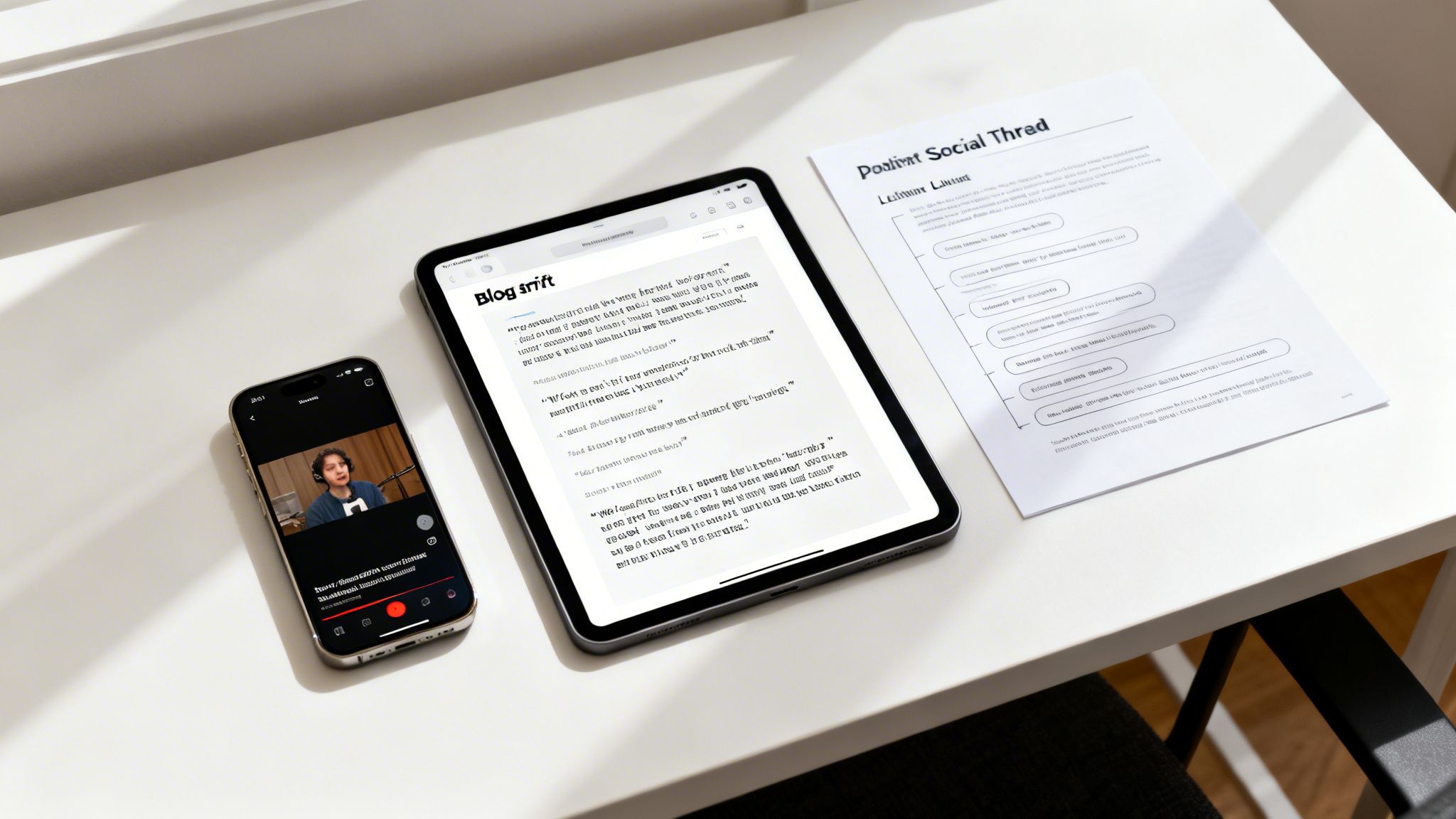
Okay, you've done the hard work of listening, extracting, and organizing. Now for the fun part: turning all those insights into a steady flow of killer content. An organized knowledge base isn't just a digital filing cabinet; it's a launchpad. This is where your system starts to pay real dividends, letting you upcycle your old content and reignite your content library to create infinite value.
Stop thinking about a podcast interview as one piece of content. It’s the seed for a dozen more.
The One-to-Many Repurposing Model
The whole game is about taking one long-form piece—your podcast episode—and smashing it into smaller, platform-native assets. This isn't just a time-saver. It's about meeting your audience where they hang out, with content that fits how they scroll, watch, and listen.
Here’s what that looks like for a single one-hour interview with a marketing expert:
- Five short-form videos: Pull the most potent 60-second stories, hot takes, or practical tips. These are your bread and butter for TikTok, Reels, and YouTube Shorts.
- A deep-dive blog post: Use the episode transcript as your skeleton. Flesh out the key topics, add your own commentary, and embed the full audio player.
- A Twitter/X thread: Boil down the top 10 takeaways into a punchy, skimmable thread.
- An infographic: Did the guest explain a unique framework or process? Visualize it.
- A newsletter exclusive: Share a personal reflection on the most surprising thing you learned from the chat, then link back to the full episode and post.
One hour of recording just became a week's worth of content across multiple platforms. If you want to go even deeper, you can find more content repurposing strategies in our detailed guide. A platform like Contesimal makes this ridiculously easy, letting you take your longform content across platforms in one click.
Video Podcasts Aren't a Trend, They're the Norm
The days of podcasts being an audio-only affair are over. The audience has moved on. Research shows that as of October 2026, a staggering 53% of new weekly U.S. podcast listeners now prefer podcasts they can actually watch. That’s a massive leap from just 30% in April 2023.
This 77% increase is a huge signal for creators. If you’re still not recording video, you're willingly ignoring half of your potential new audience.
And these aren't passive listeners. The same research from EGTA.com found that 88% of podcast listeners have taken action after hearing an ad—everything from researching a product to hitting "buy." This audience is paying attention. By giving them both audio and video, you're tapping directly into that focused engagement.
Assemble Thematic Deep Dives and Compilations
This is where your organized library truly becomes a superpower. By tagging every insight as you process it, you can instantly pull together material from dozens of different episodes to build authoritative, "cornerstone" content.
Let's say you want to create the ultimate guide to "starting a creative business." With a tagged-up knowledge base, your workflow looks like this:
- Search your library for the tag
#founder-story. - Filter for clips where guests talked about their biggest early-stage struggles.
- Pull all quotes tagged with
#bootstrappingor#first-hire. - Weave these assets together into a new "best of" compilation episode or a monster blog post.
This process turns your archive from a static, chronological list into a dynamic, queryable database. You can remix, mash up, and reignite old content to create something entirely new. A great idea never has to expire.
This method lets you build incredibly valuable resources for your audience without booking a single new guest. It positions you as the expert curator in your niche—the one who can connect the dots between what all the other experts are saying. It’s the most powerful form of learning from podcasts because you’re not just learning for yourself; you’re organizing that knowledge to teach your audience at scale.
Measure The Real Impact Of Your Learning

So, you've set up a system for active listening, started organizing your insights, and maybe even begun repurposing your best ideas. But here's the real question: how do you know if any of it is actually working?
If you want to make learning from podcasts a real part of your growth strategy, you have to measure what matters. And I’ll tell you right now, it’s not your download count.
Downloads can be a total trap. The real impact is in the engagement, the retention, and how your audience actually uses the knowledge you share. This is all about building a feedback loop driven by data, one that helps you make smarter choices about what to create next.
Move Beyond Vanity Metrics
The number one metric most podcasters get hung up on is downloads. It feels great to watch that number go up, but it tells you almost nothing about whether anyone is actually learning or paying attention.
The gap between downloads and actual listening is huge. One study found that roughly 31% of automated downloads on Apple Podcasts are never even played. Think about that. If you get 2,000 downloads, that could mean over 600 of them were just bots or background syncs, not human ears. You can read more about how to measure podcast learning effectiveness on elearningindustry.com.
Forget downloads. It's time to focus on metrics that show real human behavior. These are the numbers that tell you if your content is truly landing.
Here’s what you should be tracking instead:
- Listener Retention Rate: What percentage of your audience makes it to the end of an episode? If people are dropping off in the first few minutes, your intro might be the problem. A slow, steady decline could mean the middle of your show isn't holding their interest.
- Average Listening Time: Are people tuning in for five minutes or forty-five? This is a direct signal of how engaging your content is.
- Follower Growth: This one’s simple. Is your show good enough to make someone hit "subscribe" so they don't miss what's next?
These numbers paint a much clearer picture. They show you if your podcast is providing genuine value, not just racking up empty stats.
Measure Cross-Platform Engagement
Your podcast isn't just an audio file anymore. It’s the raw material for a whole universe of content. A single insight can spin off into a blog post, a handful of social media updates, and a video clip. To measure the true impact of your learning, you need to track how all these repurposed assets perform everywhere.
Let’s say you pull a great quote from an episode. You share it as a text post on X (formerly Twitter), turn it into a nice graphic for Instagram, and create a short talking-head video for TikTok. By tracking the engagement on each of those, you start to see which formats your audience loves most.
When you measure cross-platform performance, you're not just evaluating a single piece of content. You're testing the power of an idea itself, discovering which formats give it the most reach and impact.
This is where having a central system is a game-changer. A platform like Contesimal lets you organize your entire content library, making it dead simple to see which ideas and themes are getting traction across all your channels. You can finally connect the dots and see if a concept that blew up on TikTok also sent a wave of traffic to your blog. That’s the kind of feedback loop that tells you what to double down on.
Uncover Value in Your Content Archive
Your back catalog is a goldmine of data just waiting to be dug up. When you analyze the performance of your entire library, you can spot trends and see which older episodes are still pulling in new listeners. Are certain topics still driving search traffic months—or even years—after you hit publish?
These "evergreen" episodes are your most valuable assets. They point directly to the core problems and deep interests of your audience.
When you find an old episode that’s still getting love, it’s a clear signal to:
- Re-promote it to your current audience who may have missed it.
- Repurpose its key insights into fresh formats for today.
- Create a follow-up episode that goes even deeper on the topic.
This data-first approach transforms your content archive from a dusty shelf of old files into a source of real strategic intelligence. It helps you understand what your audience truly wants to learn, making every new thing you create that much more likely to succeed. This is how you turn learning from podcasts into a repeatable engine for growth.
Your Top Questions, Answered
Jumping into a structured system for your podcast library can feel like a huge undertaking. I get it. A lot of creators and marketers get tangled up in the "how" and never actually start.
Let's cut through the noise. Here are the most common questions we get, with straight-up, actionable answers to get you moving today.
How Much Time Does This Really Take?
This is always the first question, and it's a fair one. The honest answer? It depends on how you go about it.
If you’re trying to manually transcribe, tag, and organize every single episode by hand, you’re basically signing up for a second job. But that's not the smart way to do it. The goal is to build a system that leans on clever tools and focused effort.
At the beginning, you might spend an extra 15-20 minutes per episode getting your notes and tags in order. But as your system matures and you bring AI into the mix, that time drops off a cliff. Think of it as an upfront investment that pays you back every time you need to find a quote, stat, or story idea in seconds, saving you hours of frantic searching later on.
You're not adding more work to your plate. You're making the time you already spend listening infinitely more valuable.
Is This Only for Solo Creators?
Heck no. While a solo creator can get a massive leg up with a personal knowledge base, this kind of system is a total game-changer for teams. When your whole team works from a single, organized library, you kill content silos and stop wasting time on duplicated work.
Picture this: your writer, social media manager, and video editor all dipping into the same well of curated insights.
- The writer instantly finds expert quotes and data for a new blog post.
- The social media manager pulls a perfect audiogram and a handful of key takeaways for a promo campaign.
- The video editor sources B-roll ideas and thematic clips for a new YouTube compilation.
This isn't just about efficiency; it's about consistency. It transforms a bunch of scattered notes into a shared brain for your entire operation, where everyone builds on the same solid foundation.
People often think AI is here to replace human creativity. The reality is, the best workflows use AI to crush the tedious stuff. This frees up your team to focus on what humans do best: strategy, storytelling, and bringing their unique spark to the work.
What if My Podcast Library Is a Total Mess?
First off, you're in good company. Most creators are sitting on a chaotic archive of old audio files. Just looking at it can be paralyzing. The secret is that you don’t have to clean the whole house at once.
Start small. You don’t need to process your entire back catalog overnight.
- Start with new episodes. Just apply your new learning and organizing process to everything you publish from this day forward. Build the habit.
- Tackle your greatest hits. Go find your top 5-10 most downloaded or most referenced "evergreen" episodes. Processing those first will give you the biggest bang for your buck.
- Work backward in batches. When you have a spare hour, chip away at the older stuff. Even getting one or two old episodes done a week builds incredible momentum.
The key is to just start. Over time, that messy archive will morph into a structured, searchable, and incredibly valuable asset. One insight at a time.
Ready to turn your messy content library into an intelligent research partner? With Contesimal, you can organize, search, and collaborate on your entire archive of podcasts, videos, and documents. Stop letting great ideas die in your archive and start building your content engine today. Discover how at contesimal.ai.