AI for SEO is all about using artificial intelligence to supercharge your search engine optimization efforts. Think of it as a smart assistant that automates and improves everything from keyword research and content creation to nitty-gritty technical analysis. For content creators, podcasters, and publishers, it's a way to unlock the hidden value in your existing content library and create new assets that drive growth.
The goal is to shift from manual guesswork toward sharp, data-driven strategies. This approach helps you make better decisions, faster, by truly understanding what your audience is looking for and how to leverage your past work to meet their needs.
How AI For SEO Is Reshaping Content Strategy
Welcome to the new world of search optimization. For years, SEO was a game of keywords and backlinks. Not anymore. Now, it’s about aligning your content with the AI that sits at the very heart of search engines like Google. This isn't just a minor update; it's a fundamental change from the old playbook to a smarter, more predictive game.

Think of traditional SEO like using a paper map. Sure, it got the job done in its day, but it’s static and pretty limited. Using AI for SEO is like switching to a live GPS. It doesn't just show you the destination; it predicts traffic jams, finds faster routes, and helps you understand the terrain in real-time. For content makers, it’s the key to navigating the ever-changing digital landscape.
The Shift From Keywords To Context
In the old days, SEO success often meant stuffing a page with specific keywords. Today, search engine algorithms are way more sophisticated. They use AI to figure out the context, nuance, and true intent behind what someone types into the search bar.
This is exactly why a deep, well-researched article on "filmmaking techniques for beginners" can rank for hundreds of related searches without obsessively repeating every single keyword variation.
For content creators, publishers, and marketers, this change is everything. It means your existing content library—every blog post, podcast, and video you've ever made—is a goldmine of contextual authority waiting to be reignited. AI gives you the tools to organize, understand, and take action on this library to create new value and ultimately make money with it. For a deeper dive, it's worth exploring the core principles of artificial intelligence search optimization.
The core idea is simple: instead of just matching words, AI helps search engines match meaning. This rewards content that is genuinely helpful, comprehensive, and demonstrates true expertise on a topic.
To really see how much has changed, let's compare the old way with the new way.
Traditional SEO vs AI-Powered SEO
The table below breaks down the key differences between old-school SEO tactics and the modern, AI-enhanced approach. It highlights how the focus has moved from rigid rules to a more dynamic, user-centric strategy.
| Aspect | Traditional SEO | AI-Powered SEO |
|---|---|---|
| Core Focus | Keyword density and backlink volume. | User intent, topical authority, and contextual relevance. |
| Research Method | Manual keyword research, spreadsheet-heavy. | Automated topic clustering, intent analysis, predictive data. |
| Content Creation | Writing for keywords, often repetitive. | Crafting comprehensive content that answers user questions. |
| Optimization | On-page tweaks and technical checklist. | Real-time optimization, content gap analysis, link building. |
| Measurement | Ranking for specific, pre-defined keywords. | Overall topic visibility, user engagement, and conversions. |
| Adaptability | Slow to react to algorithm changes. | Proactively adapts to search engine trends and user behavior. |
As you can see, AI isn't just a new tool—it represents a complete evolution in how we approach search.
An Unmistakable Trend In Search Results
The move toward AI-driven search isn't just theoretical; you can see it in the data. Between 2019 and 2025, AI went from a fringe experiment to a core component of global search.
Back in 2019, AI-assisted content showed up in just 2.27% of top Google results. Fast forward to 2025, and that number rocketed to 17.31%. That means nearly one in five top-ranking pages shows AI's influence. This boom happened right as AI search interfaces like ChatGPT exploded, now hitting over 5 billion visits per month.
This trend points to a huge opportunity for anyone sitting on a library of content. Your archive isn't just a collection of old work; it's a rich dataset that can be organized, analyzed, and repurposed to meet the demands of today's AI-powered search engines.
Getting a Grip on the Four Pillars of AI-Driven SEO
If you really want to see how AI is shaking things up, you have to look past the buzzwords and get into the nuts and bolts. Using AI for SEO isn't about hitting some magic button and watching the rankings pour in. It’s about being smart and applying the right tools to the parts of your strategy that actually move the needle.
Think of it like building a house—you need a rock-solid foundation with strong supports holding everything up.

For an AI-powered SEO strategy, that foundation is built on four pillars: predictive keyword research, intelligent content creation, automated technical optimization, and insightful performance analytics. By getting these four areas right, everyone from YouTubers to professional publishers can build a repeatable process for organic growth that's both efficient and seriously effective.
Let's break them down one by one.
Predictive Keyword Research
Old-school keyword research is all about looking in the rearview mirror. You check to see what people have searched for in the past. AI flips the script entirely. It digs through trends, social media chatter, and search patterns to predict what your audience will be searching for next.
So, instead of just chasing a huge-volume keyword like "video editing software," an AI tool might spot a new cluster of searches bubbling up around "AI video editing for TikTok." This lets you get ahead of the wave and create content for topics before they’re completely saturated. You stop following trends and start setting them.
Intelligent Content Creation
This is where AI goes from being just a research assistant to a full-on creative partner. Let’s be clear: this isn’t about letting a robot write your articles. It’s about empowering your team with tools that speed up the entire content workflow, especially for those transitioning from hobbyist to professional.
Here’s what that looks like in the real world:
- AI-Generated Briefs: An AI can scan the top-ranking articles for your keyword and spit out a perfect content brief in seconds. It’ll tell you the ideal word count, key subtopics to hit, common questions people are asking, and even a list of related terms to include.
- Content Optimization: While your team is writing, AI tools can give real-time feedback on SEO, readability, and tone. This makes sure every piece of content is dialed in for both search engines and actual humans from the first draft.
- Content Repurposing: Got a massive library of content? An AI can tear through a long video or blog post and automatically chop it up into dozens of smaller assets—social media snippets, email copy, or even scripts for short-form videos. This is how you upcycle old content and generate more audience across platforms.
This whole approach lets your team focus on what they do best—storytelling and sharing their expertise—while the AI handles the tedious, data-crunching grunt work. If you want to go deeper, check out a solid list of the best AI tools for content creators to find more specialized gear.
Key Takeaway: Intelligent content creation isn’t about replacing people. It’s about building a workflow where your creators are armed with data, helping them make better content, faster.
Automated Technical Optimization
Technical SEO is the foundation your entire site is built on, but man, it can be a complex and boring slog. This is where AI automation is an absolute lifesaver. AI-powered tools can keep a constant eye on your website, flagging issues that are tanking your rankings before you even know they exist.
It's like having a technical SEO expert working for you 24/7. These tools can:
- Automatically find and flag broken links.
- Spot pages with slow load times.
- Hunt down and fix crawl errors that stop Google from indexing your content.
- Optimize your internal linking to spread link juice where it needs to go.
By putting these routine checks on autopilot, you free up your team to work on more important stuff and ensure your site is always technically perfect. It gives your awesome content the best shot it has at ranking.
Insightful Performance Analytics
Finally, AI completely changes how we measure what's working. Instead of getting lost in a sea of dashboards and spreadsheets, AI-driven analytics can bubble up the insights that you actually care about.
For instance, an AI analytics platform can connect a jump in organic traffic not just to one article, but to a whole "topic cluster" you've been building out. It can pinpoint which blog posts are driving the most conversions or which videos are bringing in the most subscribers. This gets you away from chasing vanity metrics like views and page views, helping you understand the real business impact so you can double down on what’s working and fix what isn’t.
Turn Your Content Library Into an SEO Powerhouse
Your single greatest SEO asset might not be your next brilliant idea. It could be the content you’ve already published.
For years, the playbook for creators, publishers, and marketers was all about the relentless pursuit of new. But what about the mountain of value sitting in your archive of blog posts, podcast episodes, or videos? This is where a modern AI for SEO strategy really shines. It's all about turning that passive archive into a highly organized, AI-ready engine for growth.
The first step is a mental shift. Stop seeing your library as a simple collection of individual files and start treating it as an interconnected ecosystem. This is where a Content Intelligence Platform comes into play—think of it as a central brain for all your published work.
Tools like Contesimal are built to ingest your entire library, making every single piece of content instantly searchable and analyzable. This isn't just about finding old files faster; it's about helping humans and AI collaborate to discover new value from existing assets.
From Passive Archive to Active Asset
Once your content is centralized, the AI gets to work. It automatically scans every video, article, and podcast episode to tag, categorize, and build rich connections across your entire library. This process uncovers hidden patterns that would be completely impossible for a human to spot manually.
For instance, an AI can identify:
- Hidden Topic Clusters: You might discover you've unknowingly created a dozen pieces of content around a specific niche. Suddenly, you have the perfect ingredients for a powerful pillar page or a new playlist to build on successful concepts.
- Critical Content Gaps: By mapping out everything you've covered, the AI instantly shows you what's missing. This points you directly to your next high-impact content idea, helping you figure out what to create next.
- Cornerstone Content: The system can pinpoint your most authoritative and comprehensive pieces—the ones that should be the foundation of your entire SEO strategy.
This automated analysis transforms a static, dusty archive into a dynamic strategic tool. Instead of guessing what to create next, you can make data-driven decisions based on the assets you already own.
Building Authority With Your Existing Content
With your library organized and analyzed, you can start building that web of authority that search engines absolutely love. It all starts by identifying your strongest "cornerstone" content and then strategically using your other assets to support it.
Imagine you're a podcaster with a deep-dive episode on "Starting a YouTube Channel." An AI can sift through your archive and instantly find five other episodes where you touched on related topics like "video lighting," "audio gear," or "scriptwriting." You can then jump into those old show notes, add internal links pointing back to your main episode, and just like that, you've created a powerful topic cluster.
This approach shifts the focus from chasing one-off articles to building a powerful content ecosystem. You’re no longer just publishing; you're building a network of interconnected ideas that reinforces your expertise on a subject, signaling to search engines that you are a true authority.
This strategy is becoming non-negotiable. For content-heavy organizations—publishers, podcasters, and video networks—archives are now being surfaced not just as blue links but as snippets, citations, and ideas inside AI answers. Platforms like Contesimal, which can rapidly classify and enrich huge content libraries, become strategically vital. Structured, well-understood archives are far more likely to be used by AI systems as authoritative evidence.
The new era of AI for SEO rewards depth and internal consistency across an entire catalog. That's a value that's only unlocked when your library is organized and queryable. To see the full picture, you can dive into more research on these emerging AI and SEO trends.
How to Build an AI-Powered Content Workflow
A killer strategy is just a theory without a solid plan for execution. Knowing AI can reshape your SEO is one thing, but actually putting it to work is something else entirely. Let's walk through a practical, step-by-step workflow for weaving AI for SEO into your content process, from that first spark of an idea all the way to getting it in front of your audience.
For creators and publishers, this isn't about letting a robot take over. It’s about building a smarter, collaborative system where you and your AI assistant team up to produce higher-quality content, faster. A platform like Contesimal acts as the bridge, connecting your unique human creativity with AI’s raw analytical horsepower.
Think of it as a modern content powerhouse that ingests your library, analyzes it for gold, and then helps you build new assets from it.
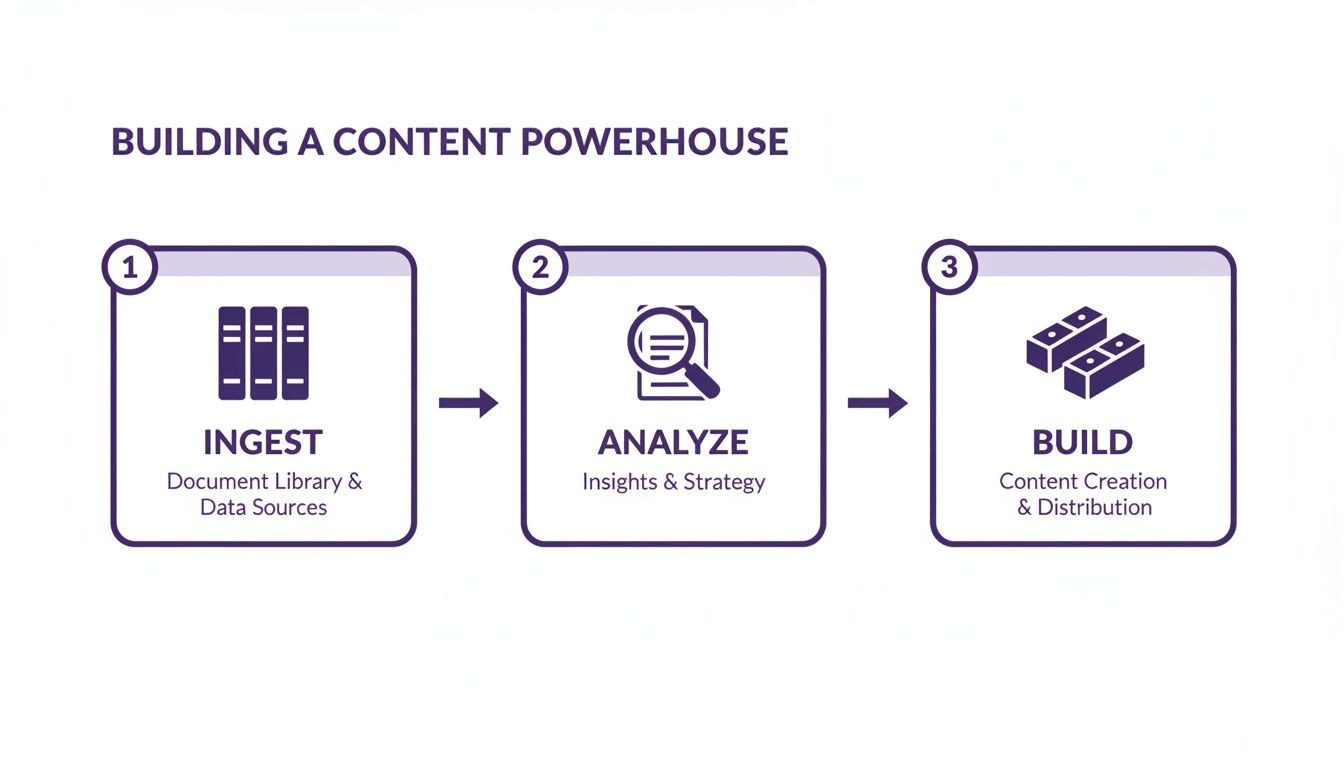
This workflow turns a passive archive of old content into an active, intelligent asset for creating your next big hit.
Stage 1: Ideation Powered by Your Own Library
Your best new ideas are probably hiding in plain sight—right inside your most successful past work. Instead of staring at a blank page and a keyword tool, an AI-powered workflow starts by looking inward.
By organizing and analyzing your entire back catalog, an AI system can spot engagement patterns, identify popular themes, and show you what really clicks with your audience.
- Discover Hidden Series: AI is brilliant at connecting the dots. It might notice you’ve talked about "filmmaking lighting techniques" in five separate videos, flagging a golden opportunity for a dedicated deep-dive series that you might have missed.
- Brainstorm Fresh Angles: You can literally ask the AI questions about your own content. "What are the three biggest challenges my audience faces, based on my last 50 blog posts?" The answers give you instant, data-backed ideas for what to create next.
This approach means every new piece of content is built on a foundation of proven success, making your ideation process way more strategic and a lot less about guesswork.
Stage 2: Research with an AI Assistant
Once you’ve got a solid idea, it’s time to dig in. Here, AI acts as your dedicated research assistant, but with a critical twist: its main source is your own verified, authoritative content library. This is a core feature of modern content intelligence platforms, which turn your archive into a searchable knowledge base.
Instead of sending you into the wild west of the open internet, the AI pulls key data points, powerful quotes, and relevant stats directly from your past work. This saves an insane amount of time and also keeps your messaging consistent, reinforcing your brand’s unique point of view.
You can ask it to "pull all statistics about audience growth from my podcast transcripts" or "find three compelling client stories from last year's case studies." The AI fetches the information in seconds, complete with sources from your library, handing you the building blocks for your new article or script.
Stage 3: Creation and Real-Time Optimization
With your research done, AI shifts into the role of a collaborative partner during the actual creation process. It can help you draft detailed outlines, generate initial sections of text, and—most importantly—optimize the content for SEO in real time as you write.
This isn't just an experimental tactic anymore; it's becoming standard practice. Surveys show that nearly 70% of companies using AI in their SEO workflows report a higher ROI. It’s also been found that about two out of three SEO specialists see real performance gains in traffic, conversions, and production speed after adding generative AI to their toolkit.
To get the most out of this stage, you can plug in specialized tools like Dooza's Rank tool, which is designed specifically to fine-tune content for search engine performance.
Key AI Integrations in the Content Lifecycle
To bring this all together, here’s a quick summary of how AI tools can plug into each stage of your content lifecycle, boosting both efficiency and SEO impact.
| Content Stage | AI Application | Primary Benefit |
|---|---|---|
| Ideation | Analyzing your library for hidden themes and topic gaps. | Data-backed ideas with a higher chance of success. |
| Research | Querying your own content archive for stats and insights. | Faster research with brand-consistent information. |
| Creation | Drafting outlines, generating text, and writing copy. | Increased production speed and overcoming writer's block. |
| Optimization | Real-time SEO suggestions for keywords and structure. | Higher search rankings and improved organic traffic. |
| Distribution | Repurposing long-form content into social posts and clips. | Maximized reach and engagement across multiple platforms. |
As you can see, AI isn't just a single tool for one job; it's a versatile assistant that can add value from start to finish.
Stage 4: Distribution and Intelligent Repurposing
Hitting "publish" used to be the end of the line. Not anymore. A modern workflow uses AI to intelligently take your longform content across platforms, turning your old work into a money maker today.
For example, an AI can take one comprehensive YouTube video and instantly generate:
- A handful of short-form video scripts for TikTok and Instagram Reels.
- A multi-part email newsletter series.
- Several engaging social media posts with pull quotes and key takeaways.
- A concise blog post that summarizes the main points for readers.
This final stage is what turns your content operation into a well-oiled machine. It multiplies the value of every single thing you create, guaranteeing you get maximum reach and impact with minimal extra effort.
Measuring the ROI of Your AI SEO Efforts
Putting an AI for SEO strategy in motion costs time and money, no doubt about it. So, how do you prove it’s actually paying off? To make the investment worthwhile, you need to connect your AI-powered work directly to results the business actually cares about—not just vanity metrics like page views.
It's all about showing a real return on investment (ROI) that stakeholders can look at and say, "Okay, this makes sense." That means tracking the key performance indicators (KPIs) that really matter. You want to show you're not just pulling in more clicks, but building real authority, keeping your audience hooked, and ultimately, making money.
Shifting Focus to Business-Centric KPIs
The first step in proving ROI is to track the right things. A jump in traffic is great, but it doesn't paint the whole picture. A solid AI SEO program influences the entire journey a customer takes, and your metrics need to show that.
Start by zeroing in on these key areas:
- Organic Traffic to Key Topic Clusters: Don't just look at overall traffic. Measure the growth for the specific, strategic topic clusters your AI helped you map out. This proves you're becoming the go-to source in your most important subjects.
- Ranking Improvements for Strategic Terms: Keep an eye on your position for high-intent keywords and those longer, more specific phrases. When you see a steady climb for terms that lead to sales or sign-ups, you know you're on the right track.
- Higher User Engagement: Content that's been optimized with AI should connect better with your audience. Look for an increase in average time on page and a lower bounce rate. These are clear signals that people are finding what you've created genuinely useful.
- Increased Conversions: This is the big one. Track how many people coming from organic search are doing what you want them to do—signing up for a newsletter, downloading a whitepaper, or buying something.
Building the Business Case for AI Tools
To make a strong argument for investing in a platform like Contesimal, you have to tie these KPIs directly to the bottom line. You need to show how organizing your content and using AI workflows leads straight to business growth.
This is where you can bring in the bigger picture. In the marketing world, spending on AI is set to blow past $107 billion by 2028, and a whopping 88% of marketers are already using AI tools every day. There’s a good reason for it, too. 93% of marketers using AI say they create content faster, and 81% report better brand awareness and sales. By tracking your own wins in these areas, you can show a clear ROI that makes the investment in AI a no-brainer. You can dig into more stats on how AI is boosting SEO and content marketing effectiveness.
The trick is to draw a straight line from what you did to what happened. For example: "By using AI to find gaps in our content library, we built a new topic cluster that boosted organic traffic by 45% and brought in 15% more qualified leads last quarter."
Connecting Content Organization to Revenue
At the end of the day, the goal is to show how a well-organized, AI-powered content library becomes an asset that predictably generates revenue. When you use a system like Contesimal to map out all your content, you can start attributing conversions to specific articles, videos, or podcasts with much more accuracy.
This lets you stop guessing what’s working and start knowing. You’ll get a much sharper picture of your content's financial impact and can make smarter, data-backed decisions about where to put your creative energy next. To really get this right, you have to learn how to analyze content performance with business goals—not just traffic—in mind.
The Future Is Human-AI Collaboration
Let’s be clear: the future of content isn't about AI replacing talented creators, publishers, and marketers. Not even close. It's about empowering them with tools that finally handle the grunt work—the heavy lifting of data analysis, research, and optimization that eats up so much time.
This isn't just a passing trend; it's a fundamental shift in how we work. AI becomes the tireless research assistant, the data cruncher that never sleeps. This frees up your team to focus on what humans do best: storytelling, critical thinking, and building real connections with your audience. The goal is to fuse human ingenuity with AI's analytical power, creating a partnership where each side makes the other better.
Building a Centralized Content Hub
A huge piece of this puzzle is building a centralized, intelligent content hub. Think of it as your organization's single source of truth—a living library of your brand’s knowledge, accessible to everyone. This isn’t just about improving your AI for SEO strategy; it’s about preserving institutional memory and creating a content operation that actually scales and grows more valuable over time.
When your entire content history is organized and easy to tap into, it stops being a dusty archive and becomes an active asset. Every new article or video benefits from the insights and authority of everything that came before it. This creates a powerful flywheel effect, where your content ecosystem gets stronger and more authoritative with each new piece you publish.
The future of content belongs to teams that successfully merge human creativity with AI’s analytical horsepower. It’s a partnership that unlocks new levels of efficiency and strategic insight, turning your content library into a predictable engine for growth.
A system like Contesimal fits perfectly into this new reality. It helps humans and AI collaborate seamlessly to revolutionize research and expand value across existing assets. It ingests your entire content archive, automatically applies smart taxonomies, and gives your team a chat-like interface to research your own material. Instead of starting from a blank page, you can train AI workflows on your own back catalog, systematically turning that intellectual property into search-optimized series, topic clusters, and multimedia. You can find more data on how AI is transforming SEO strategies and its impact. It's an approach that ensures your content strategy is not only efficient but also deeply rooted in your own established expertise.
Still Have Questions About AI for SEO?
Diving into the world of AI for SEO can feel like learning a new language. For creators, marketers, and publishers trying to figure out how these powerful tools fit into their world, getting straight answers is everything. Let's tackle some of the most common questions we hear all the time.
Can AI Completely Replace My SEO Team?
Not a chance. Think of AI as an incredibly powerful assistant, not a replacement for human instinct and expertise. It's brilliant at chewing through mind-numbing, data-heavy tasks—think keyword research, technical audits, and content analysis at a scale no human could manage.
But here's what it can't do: it can't replicate the strategic thinking, the creative spark, or the gut feeling a real SEO pro has about what an audience truly wants. The magic happens when you pair them up. AI automates the grunt work, freeing up your team to focus on big-picture strategy, compelling storytelling, and building real connections with your audience. This is especially true for creators moving from hobbyist to professional who need to bring in more people to grow.
Is AI-Generated Content Bad for SEO?
This is a big one. AI-generated content isn't inherently bad, but low-quality, unhelpful content is—and always will be. Google's main goal is to reward content that shows real expertise, authority, and trustworthiness. If you use AI to just pump out generic, spammy articles that add no value, your rankings are going to take a nosedive.
However, when you use AI as a collaborator—a tool to help you create well-researched, original, and genuinely useful content—it can be a game-changer. The secret is simple: every single piece needs to be thoroughly reviewed, edited, and infused with your unique human perspective before it ever sees the light of day. It's your brain, amplified by a machine.
How Do I Choose the Right AI for SEO Tools?
It’s easy to get lost in a sea of options. Instead of searching for one single "best" tool, shift your mindset. Think about your biggest headaches and find the tools that make them disappear.
Ask yourself these questions when you're looking at different platforms:
- What's my main goal right now? Are you trying to nail your keyword research, speed up content creation, fix technical issues, or breathe new life into your existing content library?
- Does it play nicely with how we already work? The best tools slide right into your current workflow, not force you to change everything you're doing.
- Can it actually understand my existing content? For creators sitting on a goldmine of old posts and videos, tools that can analyze that archive to find hidden gems are incredibly powerful.
At the end of the day, the best AI for SEO tool is the one that feels like a natural extension of your team's skills and helps you hit your goals faster.
Ready to turn your content library into an SEO powerhouse? Contesimal is an AI-powered platform that helps you organize, analyze, and create new value from your existing content. Discover hidden opportunities and build a smarter content strategy today. Learn more about how Contesimal can help.