You finish a strong essay, white paper, long-form post, or manuscript chapter. The argument holds. The prose moves. The examples are sharp.
Then you hit the part many professional creators still treat as clerical cleanup. You need to prove where the book-based claims came from, show readers where a quotation lives on the page, and make your sourcing usable by an editor, a fact-checker, a client, or a skeptical reader.
That is where citing a book in footnotes stops being an academic ritual and becomes part of professional publishing craft.
A footnote does more than satisfy a style guide. It tells readers you can be trusted with borrowed ideas. It lets another writer retrace your thinking. It gives your content a paper trail that survives repurposing, adaptation, and collaboration. If your article later becomes a video script, podcast segment, newsletter, sales asset, or chapter draft, the citation trail becomes part of the asset itself.
Why Your Footnotes Are More Than Just Footnotes
The weak version of a footnote says, “I had a source somewhere.”
The strong version says, “I know exactly where this idea came from, and you can verify it.”
That difference matters more than most creators realize. A publisher sees it. A client sees it. A smart audience definitely sees it.
When creators move from hobby work into professional output, the same shift almost always happens. They stop asking, “Do I really need a footnote for this?” and start asking, “Can someone else verify this claim without chasing me down in Slack?”
That is the useful standard.
Figures and numbers in academic writing almost always require footnotes, and citation guidance makes the reason plain. Statistics and precise numerical claims need source documentation across MLA, APA, and Chicago because credibility depends on verifiability, not confidence alone (Ranger College Library guidance on when to use footnotes).
That principle applies well beyond academia. If you publish essays, scripts, newsletters, educational threads, documentaries, or research-backed marketing, your citations are part of your brand’s quality control.
Footnotes create reusable value
A clean footnote system helps with more than one document.
When you cite books properly, you create reusable metadata for your content library. The author name, title, edition, year, and page reference become a retrieval layer. Later, when your team wants to reuse a quote, verify an argument, or spin an article into another format, the citation does half the organizational work for you.
That is one reason source discipline overlaps with broader editorial judgment about what makes a source credible. Good footnotes do not just point outward. They improve what you own.
A footnote is not decoration. It is evidence attached to a sentence.
What does not work
A few habits erode trust:
- Vague references such as “from a book by Foucault” or “as one historian notes”
- Missing page numbers when quoting directly
- Inconsistent style across a document
- Half-complete publication details that force the reader to do detective work
Professional readers do not interpret those as harmless shortcuts. They interpret them as editorial looseness.
If your work is meant to last, circulate, and be repurposed, the footnote is part of the product.
Mastering Book Citations with Chicago Style Footnotes
An editor is closing a manuscript, the fact-check pass starts, and one line stops the room: a strong quote from a book with no usable note behind it. At that point, citation is no longer a classroom exercise. It becomes production work.
Chicago notes-bibliography remains the working standard for publishing, history, criticism, biography, and serious nonfiction because it keeps evidence attached to the sentence that uses it. That matters for readers, but it also matters for your own archive. A clean Chicago footnote gives your team source metadata you can reuse later in articles, scripts, decks, rights reviews, and derivative content. If you need help with the mechanics inside your document, this guide on how to add citations in a working draft covers the insertion side.
The core format for a first footnote
The standard first Chicago footnote for a book is:
First name Last name, Title of Book (Place of publication: Publisher, Year), page number.
A reliable summary of that pattern appears in the Chicago Manual of Style notes and bibliography quick guide. It also shows the short-note model used after the first full citation.
A copy-ready example:
- Joan Didion, Slouching Towards Bethlehem (New York: Farrar, Straus and Giroux, 1968), 94.
Each part earns its place:
| Element | Why it matters |
|---|---|
| Author name | Identifies who is responsible for the work |
| Italicized title | Marks the book as a standalone publication |
| Publication data in parentheses | Helps a reader or editor find the exact edition |
| Page number | Pins your claim to a specific passage |
This is the difference between a note that merely looks academic and one that supports verification.
The short note after the first citation
Chicago does not ask you to repeat the full citation every time. After the first note, use a short form:
- Didion, Slouching Towards Bethlehem, 101.
If the title is long, shorten it clearly:
- Didion, Slouching, 117.
Short notes keep pages readable, especially in book reviews, essay collections, and research-heavy trade nonfiction. They also make revision easier. If your article later becomes a video script, podcast segment, newsletter, sales asset, or chapter draft, the citation trail becomes part of the asset itself.
How to place the footnote in the text
Put the superscript where the borrowed material ends. In practice, that usually means the end of the sentence containing the quote, paraphrase, or factual claim.
Use your word processor’s built-in footnote function. Do not type superscript numbers manually. Hand-built numbering fails the moment paragraphs move, sources get added, or notes are deleted during line edit.
A practical workflow looks like this:
- Write the sentence.
- Insert the footnote with the software tool, not with manual formatting.
- Add the full note or short note.
- Confirm the page number against the book, scan, or ebook preview.
- Recheck the note after revisions if the quoted passage moved or changed.
When page numbers matter
Page numbers are required for direct quotations. They are also good editorial practice when you cite a specific argument, example, scene, statistic, or interpretive claim from a book.
Readers should not have to hunt through 300 pages to find your source. Neither should your future self.
A footnote works only if another person can follow it back to the exact place you used.
Should you use ibid.
Chicago allows ibid. for a citation that refers to the source immediately before it.
Example:
- Virginia Woolf, Mrs. Dalloway (New York: Harcourt, 1925), 11.
- Ibid., 14.
The trade-off is clarity. In heavily revised documents, ibid. can become fragile because one inserted note breaks the chain. Many editors now prefer short notes instead, especially for digital-first publishing where clean scanning matters more than squeezing out a few characters.
Manual formatting versus citation tools
Citation software saves time and catches repetitive formatting errors. It does not replace editorial judgment.
Zotero, EndNote, and similar tools are useful for generating notes and storing book metadata, especially when a project draws from dozens of sources. The weak point is input quality. If the imported record has the wrong edition, incomplete publication data, or bad capitalization, the note will still be wrong. I regularly see clean-looking citations that fail a fact-check because the source record was never verified against the book.
For a broader comparison of style requirements across systems, this overview explains how to cite sources correctly in APA, MLA, and Chicago styles.
A working editorial standard
For professional book citations in Chicago footnotes, this standard holds up:
- Use the full note the first time a book appears.
- Use a short note for later citations.
- Use ibid. only if your house style allows it and the reference is immediately consecutive.
- Include exact page numbers for quotations and specific claims.
- Let Word or Google Docs handle numbering.
- Let citation software handle repetition, then verify every field against the source.
That approach respects both sides of the job. You get speed from tools and reliability from human review.
Footnotes in MLA and APA What You Need to Know
Chicago treats footnotes as a primary citation mechanism. MLA and APA do not.
That is the first thing to remember when switching contexts.
If a client, journal, university department, or publisher asks for MLA or APA, the center of gravity moves from footnotes to in-text citations plus a reference list. Footnotes still exist, but they usually serve a different purpose.
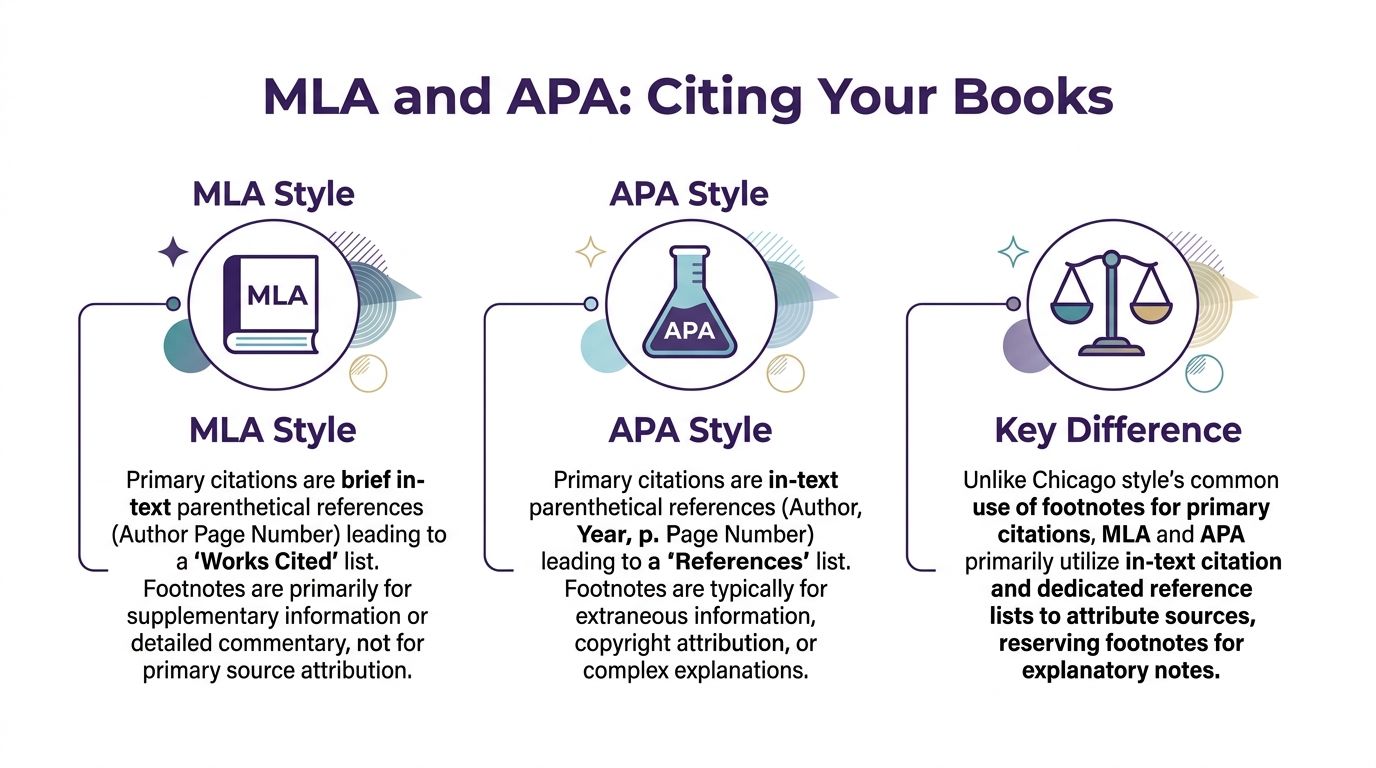
MLA and APA use notes differently
Here is the practical distinction:
| Style | Primary source attribution | Typical use of footnotes |
|—|—|
| Chicago notes-bibliography | Footnotes | Main citation system |
| MLA | In-text parenthetical citations | Supplemental commentary |
| APA | In-text parenthetical citations | Extra explanation, copyright notes, side remarks |
So if you are citing a book in footnotes under MLA or APA, you are often not using the footnote as the main source marker. You are using it to add context that would interrupt the flow of the paragraph.
MLA in practice
MLA usually wants the source in the text itself, often with author and page number in parentheses, tied to a Works Cited list.
A footnote in MLA is better reserved for something like this:
- A brief methodological aside
- A clarification that would clutter the paragraph
- A translation note
- A comment on source history
The key mistake is importing Chicago habits into MLA and turning every citation into a bottom-of-page source note. That usually creates the wrong texture for the document.
APA in practice
APA is even more committed to in-text citation. The usual pattern is author, year, and page if needed, tied to a References list.
APA footnotes are typically for:
- Additional explanation that is useful but not central
- Copyright or permission details
- Dense side remarks better moved out of the body
That means book attribution in APA generally belongs in the parenthetical citation and references section, not in a Chicago-style footnote trail.
Switching from Chicago to MLA or APA is not a formatting tweak. It is a change in how the document carries authority.
If you need a straightforward refresher on the differences, Natural Write’s guide on how to cite sources correctly in APA, MLA, and Chicago styles is a useful cross-check. For a more practical workflow mindset, this companion piece on adding citations also helps creators think about citations as part of the writing process rather than a cleanup task.
The Trade-off
Chicago gives readers immediate source visibility at the bottom of the page. MLA and APA keep the page visually lighter and push full retrieval data to the back matter.
Neither choice is superior in every context.
Chicago tends to work well when readers expect source texture on the page itself. MLA and APA work well when the prose needs to stay visually uninterrupted and the field already expects parenthetical shorthand.
The professional move is not to defend one style as universally best. It is to recognize which environment you are writing for and adapt cleanly.
Navigating Complex Book Citations Like a Pro
A manuscript is clean, the argument holds, and the footnotes look finished. Then an editor checks one note and finds that the quoted passage came from a chapter in an edited collection, but the note cites the book as if the editor wrote the whole volume. Confidence drops fast.
That kind of mistake does more than break style rules. It weakens the source trail behind your work. For professional creators, that source trail is part of the asset. It affects how easily a piece can be fact-checked, licensed, updated, repurposed, or folded into a larger content library.
Edited books and chapter citations
Chapter citations cause problems because they require you to identify the container correctly. You are often citing one author’s contribution inside a book assembled by someone else. If the note collapses those roles, the reader cannot tell what you used.
The Chicago pattern is:
First Last, "Chapter Title," in Book Title, ed. Editor Name (Place: Publisher, Year), pages.
Example:
- Sarah Lewis, “On Seeing,” in Ways of Reading, ed. Martin Hale (Boston: Beacon Press, 2019), 44.
The words “in” and “ed.” are functional metadata. They mark the relationship between chapter, book, and editor. The Chicago Manual of Style treats that distinction as standard practice in notes for contributions to edited volumes, and the publisher’s own citation guide shows the same structure for chapters in edited books (Chicago-Style Citation Quick Guide).
Editors notice these details because they affect retrieval. If a reader goes looking for a quotation and your note points them to the whole book instead of the chapter, you have made the source harder to verify.
Multivolume works and editions
Volume numbers and edition statements are not decorative. They tell the reader which text you had in front of you.
Use the exact volume cited:
Author, Title, vol. 2 (Place: Publisher, Year), page.
Include the edition when it matters:
Author, Title, 2nd ed. (Place: Publisher, Year), page.
This matters in practice because editions change more than covers. Pagination shifts. Introductions are revised. Notes are expanded or cut. In translated or scholarly editions, the wording can change enough to affect the meaning of a quoted passage.
For multivolume works, one missing volume number can turn a usable note into a dead end.
Other tricky book cases
These are the cases I see repeatedly in edited manuscripts and creator archives:
Translated book
Add the translator after the title.
Pattern: Author, Title, trans. Translator (Place: Publisher, Year), page.Anonymous book
Start with the title if no author appears on the title page.
Pattern: Title (Place: Publisher, Year), page.Ebook with stable pages
Cite it close to the print form, then add the format or URL if the style or publisher asks for it.Ebook without stable pages
Use a chapter number, section heading, or another fixed locator. Do not invent page numbers from a screen view.Book with multiple authors
Keep the author order exactly as listed on the title page.
One rule helps with all of them. Use the title page and copyright page as your authority. Retail listings, catalog snippets, and memory introduce bad data.
Why professionals should care
Complex citations show up as soon as a body of work starts to mature. A short article becomes a white paper. A newsletter archive turns into a book proposal. A research memo becomes client-facing analysis. At that point, footnotes stop being mere formatting. They become part of your documentation system.
Handled well, they increase trust and lower friction. A good note lets an editor verify a claim in minutes. It lets your future self reuse a source without reopening five tabs and guessing which edition you meant. It also gives structure to your knowledge base, especially if you already have a workflow for organizing research notes.
The same logic applies across your support material. If the project includes annexes or supplemental matter, keep the citation logic consistent across the whole apparatus, including related elements like how to reference an appendix.
Writers who handle these cases well produce work that is easier to audit, easier to publish, and easier to reuse. This offers a distinct professional advantage.
Streamline Your Workflow with Footnote Tools and Tips
Manual footnote work can consume an absurd amount of time. The problem is not that the rules are impossible. The problem is repetition.
You should spend your attention on source quality and exact page references, not on renumbering note markers because one paragraph moved.
Use the built-in footnote tools first
Microsoft Word and Google Docs already solve the first operational headache. They insert superscript note numbers, place notes at the bottom of the page, and renumber everything when the draft changes.
That matters because drafts always change.
A practical minimum workflow looks like this:
- Insert notes through the application menu, not by typing superscripts manually.
- Keep one citation style for the entire project unless a publisher directs otherwise.
- Add the note at the moment you use the source, not during a desperate cleanup pass.
- Review every note before filing or publication.
If you wait until the end, you create two risks. You forget where a claim came from, and you start citing from memory.
Bring in a citation manager when the project grows
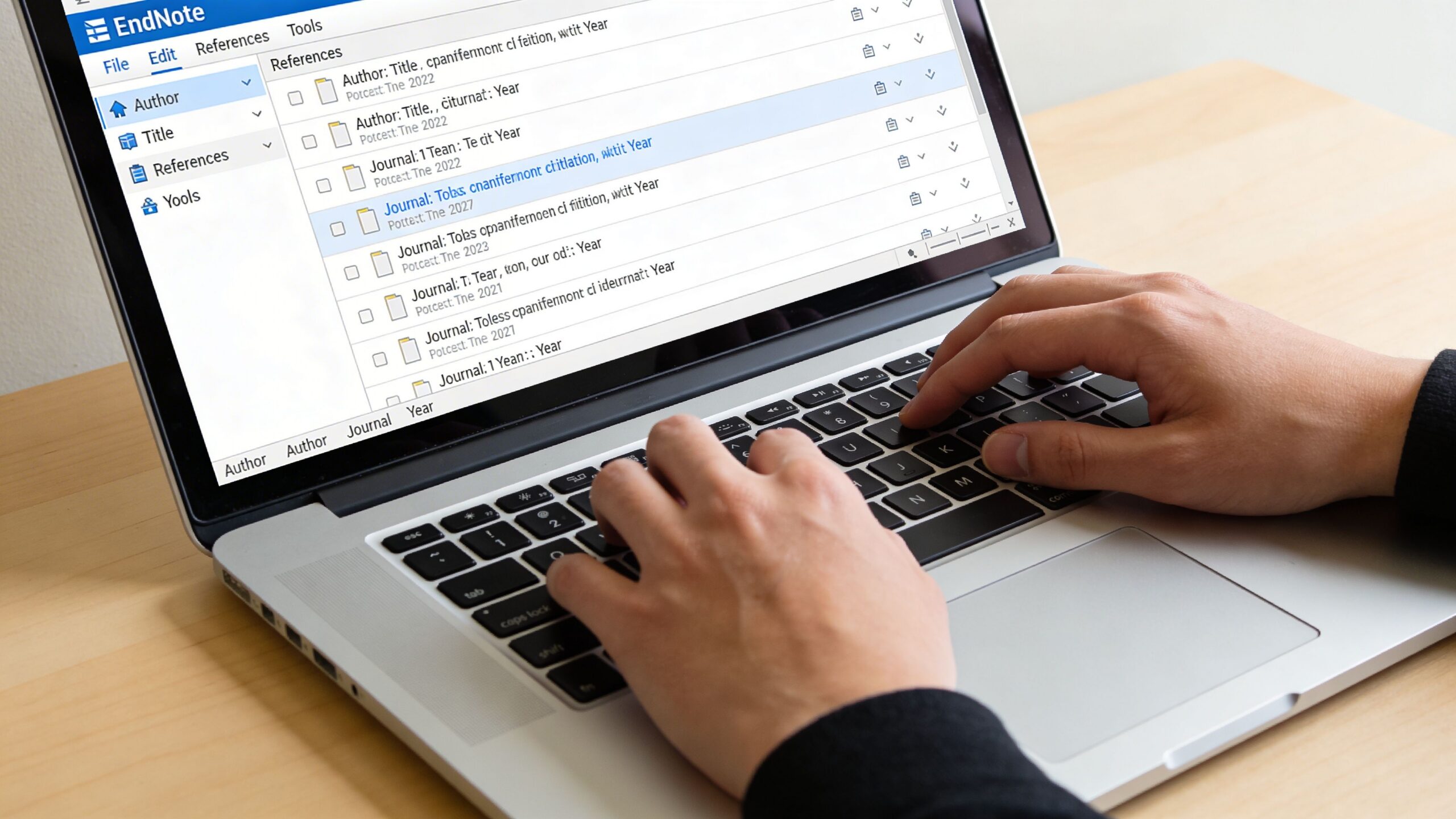
For anything beyond a short essay, citation software earns its place quickly.
Three common tools are:
- Zotero for flexible collection building and browser capture
- EndNote for larger academic or institutional workflows
- Mendeley for source storage and reference management
These tools help you collect book metadata, store PDFs or notes, and output citations in the required style. They are especially useful when you work across multiple formats and need the same source library to feed articles, reports, scripts, and books.
Good tools still need good inputs. Check imported metadata against the title page. Publisher names, subtitles, and edition statements are often imported imperfectly.
Organize source notes like assets, not scraps
The best workflow improvement usually happens before formatting.
If your research notes are chaotic, your footnotes will be chaotic later. That is why I recommend separating three layers clearly:
| Layer | What belongs there |
|---|---|
| Source record | Full book details |
| Extract note | Quote, paraphrase, or idea with page reference |
| Draft note | The sentence or argument where you used it |
That structure gives you traceability. It also makes source reuse much easier. If you want a practical companion read on this part of the process, Typist’s piece on organizing research notes is a helpful operations-focused guide.
See the workflow in action
A visual walkthrough helps when you are setting up tools or checking whether your process is too manual.
What works best in long documents
In longer publishing projects, a few habits save a lot of rework:
- Name your source files clearly so you can find the exact edition again
- Capture page numbers immediately while reading
- Store chapter-level notes separately for edited books
- Run a final consistency pass just for footnotes, apart from copyediting
Citation tools automate formatting. They do not automate judgment.
That is the right division of labor. Let software handle numbering and style output. Let the writer or editor handle source identity, page precision, and contextual fit.
Avoid These Common Book Citation Errors
A manuscript can read like authority on the page and still lose trust in the notes. I see it when a strong chapter reaches copyedit and the footnotes reveal hesitation: one title shortened three different ways, a missing page reference on a quote, a translator named once and then dropped. Readers may not say "the metadata is weak," but that is what they are seeing. The source trail is incomplete.

For professional creators, these are not minor academic blemishes. They affect credibility, fact-check speed, reuse rights, and the long-term value of the work. Clean footnotes make a book, article, white paper, or report easier to verify, update, license, and repurpose later.
The book citation mistakes editors catch first
A few errors show up repeatedly in review:
Inconsistent italics
One note treats the book title correctly. The next turns it into plain text.Unstable shortened titles
A source appears as History of Memory in one note and Memory in another, which makes matching references slower than it should be.Missing locator details
The note identifies the book but leaves out the page for the quoted or paraphrased passage.Role confusion
Editors, translators, and chapter authors are listed as if they all did the same job.Manual note numbering
A late revision inserts a note, then every number after it needs repair.
These errors have a common cause. The writer treats footnotes as formatting instead of source control.
That distinction matters. A good note does more than satisfy a style manual. It preserves source identity. It tells an editor which edition you used, tells a fact-checker where to verify the claim, and tells your future self what can be reused without another round of source hunting.
The digital mistake many otherwise careful teams miss
Print-era habits often break down in digital publishing. A tiny superscript may look fine on the page and still fail readers in a PDF, web article, or knowledge base if the note marker is hard to see, hard to tap, or unclear when read aloud by assistive technology.
Footnote accessibility is now part of citation quality. Weak note markers, low-contrast superscripts, and bare anchor text such as “1” create friction for readers who rely on keyboard navigation or screen readers. That is not a design edge case. It affects whether your sources can be reached and checked.
Better digital footnote practice
If your work will be read on screens, treat notes as part of the reading interface:
- Use descriptive note labels where the platform allows it, rather than relying only on a bare number.
- Check contrast on superscripts and note markers.
- Test note movement with a keyboard, including the return path from note to text.
- Review exported PDFs, not just the source document, because accessibility often breaks during export.
This is publishing discipline, not extra polish.
A citation readers cannot reliably reach is only half doing its job.
What the stronger standard looks like
The practical goal is simple. Every footnote should help a reader identify the source, find the exact passage, and move through the document without friction.
Teams that get this right usually make three choices consistently. They standardize short titles early, keep contributor roles precise, and run a final pass focused only on notes. The trade-off is a little more care at the end of production. The payoff is a cleaner source record and a more valuable content asset.
Quick Answers to Your Footnote Questions
A few questions come up in almost every editorial workflow, especially when people start citing a book in footnotes regularly rather than occasionally.
Footnote or endnote
Footnotes appear at the bottom of the page. Endnotes gather at the end of a chapter or document.
Choose footnotes when readers benefit from immediate access to the source without leaving the page. Choose endnotes when the page would become visually crowded or when a publisher’s design requires a cleaner layout.
For heavily sourced nonfiction, footnotes usually create a better reading and checking experience.
Do you still need a bibliography
Often, yes.
Even if your footnotes are complete, a bibliography still helps readers scan the full source base quickly. It also gives editors, researchers, and collaborators a cleaner list for retrieval. Some Chicago workflows can function with full notes alone, but in professional publishing a bibliography usually adds value.
How do you cite the same book many times
Use the full note the first time. After that, use a short note with the author’s last name, a shortened title, and the relevant page.
If the same source appears in consecutive notes and your style allows it, ibid. can work. But the short-note form is often clearer in revised drafts and digital environments.
What if the book has no page numbers
Use the most stable locator available.
That may be a chapter number, section heading, ebook chapter, or another internal marker. Do not invent pagination. The goal is always to help the reader find the same passage you used.
Should you cite every paraphrase
If the paraphrase relies on a specific author’s argument, evidence, or wording structure, cite it.
A paraphrase is not your original material merely because you changed the phrasing. If the thought came from the book, the note should say so.
Where should the footnote number go
Place the superscript where the borrowed material ends, usually after the relevant clause or sentence and typically after punctuation according to house style.
Consistency matters. A document with wandering note placement feels less controlled than one with a reliable rule.
How short can a shortened title be
Short enough to be clean, long enough to be unmistakable.
The test is simple. Could a reader distinguish this title from the author’s other works in your notes? If yes, it is short enough. If not, keep more of the title.
What is the best habit to build first
Track source details while reading, not after drafting.
Most citation trouble starts upstream. The writer copied a quote without the page number, saved a photo of a title page without the edition, or pasted notes into a draft without a source label. Once that trail breaks, every later step gets harder.
Proper footnotes are not hard because the format is mysterious. They are hard when the source record is sloppy.
If your team is sitting on articles, transcripts, research files, videos, episodes, and old drafts, citation discipline can become something larger than compliance. It can become part of how you organize knowledge and turn past work into new value. Contesimal helps creators and publishers structure their content libraries, collaborate with AI and human teams, and surface useful source material across existing assets so research-backed content is easier to find, reuse, and grow into new formats.