
You already have more Twitter content than you think.
If you are a podcaster, publisher, blogger, or video creator, you are probably sitting on transcripts, episode notes, old articles, research docs, YouTube scripts, newsletter drafts, and half-forgotten ideas that took real effort to make. Yet your follower count on Twitter stays flat, and the usual advice tells you to make more from scratch.
That advice burns people out.
The better question is not, “How do I create more tweets?” It is, “How do I turn the work I already made into a repeatable Twitter growth system?” That shift matters when you are moving from hobbyist mode into a real content business. It saves time, protects quality, and gives your library a second life instead of letting it collect dust.
This is the practical version of how to gain followers on twitter without living on the app all day. It starts with your profile, runs through a repurposing workflow, adds an engagement habit that expands reach, and ends with a measurement loop that helps you improve month after month.
Transform Your Content Library Into Twitter Followers
A lot of creators are trapped on the content treadmill. They publish something substantial, then open Twitter and feel like they need to invent fresh takes all over again. That is backward.
Most Twitter growth advice leans hard on new content creation and barely addresses a systematic way to repurpose your archive. One review of Twitter growth guidance notes that creators can mine past blog posts, videos, and podcasts into a steady stream of Twitter content, and that someone could theoretically audit 100 past blog posts and build a 12-month Twitter calendar from that material alone (reviewnprep.com).

That gap is your opportunity.
If you already publish long-form work, you are not starting from zero. You are starting with raw material. A strong podcast episode can become a thread, a quote post, a contrarian one-liner, a question for your audience, and a visual takeaway. A deep blog post can become a week of tweets. A research-heavy article can become a recurring series.
Why repurposing beats starting from scratch
Repurposing works because Twitter rewards repetition with variation. People do not need every idea to be brand new. They need it to be useful, clear, and native to the platform.
Three things happen when you lean on your archive:
- You protect quality: Your best ideas are usually already buried in your long-form work.
- You reduce friction: Editing an existing insight into a tweet is easier than inventing one.
- You create consistency: A library gives you enough material to show up regularly.
Treat your content library like inventory, not storage. Every finished episode or article should feed future distribution.
If you need a clean way to think about that system, this guide on a content repurposing strategy is a useful starting point.
The creators who grow steadily are rarely the ones chasing novelty every day. They are the ones who know how to pull value from what they have already made and package it for the feed in ways people want to share.
Optimize Your Profile for Maximum Follow-Worthiness
Tweets earn attention. Profiles convert it.
Someone sees a sharp reply, a useful thread, or a clipped insight from your archive. Then they click your profile and make a snap decision. Follow or leave. If your profile is vague, stale, or visually inconsistent, strong content leaks followers.
Write a bio that answers one question
A good bio tells people why they should care. Fast.
One source on Twitter growth notes that profiles should communicate why someone should follow you in about three seconds, often by signaling one of five value types: teach, motivate, entertain, provoke thought, or empathize. That is a practical filter. Pick the lane you want to own and make it obvious.
Try this simple formula:
- Who you are
- Who you help or speak to
- What kind of value they get
Bad bio:
Writer. Podcaster. Coffee.
Better bio:
Podcast host sharing practical storytelling lessons for indie creators and media teams.
The second one gives people a reason to stay.
If you want help shaping that messaging, this resource on ideas for about me can help tighten the wording.
Use visuals that reduce doubt
Your profile photo should make you recognizable. For most creators, that means a clear face photo rather than an abstract logo. Publishers and media brands can use a logo, but only if the brand is already visually known to the audience they want.
Your header should support the bio, not compete with it. Keep it simple. Show your show title, your publication focus, or the type of insight you publish.
A messy header sends the same signal as a messy homepage. It makes the account feel temporary.
Pin something that proves your value
Your pinned tweet is your homepage trailer. Do not waste it on an old announcement.
A strong pinned tweet usually does one of these jobs:
- Show your best thread from a blog post, podcast, or research piece.
- Introduce your content world with a short welcome post and links.
- Highlight a flagship asset such as a newsletter, episode, or guide.
The profile visitor should immediately understand what following you will feel like.
Here is a practical checklist:
| Profile element | What it should do | Common mistake |
|---|---|---|
| Bio | Explain your value fast | Listing roles with no audience benefit |
| Profile photo | Build recognition and trust | Tiny logo or low-quality image |
| Header | Reinforce your niche | Cluttered design with too much text |
| Pinned tweet | Showcase your best proof | Pinning outdated promotions |
If a stranger lands on your profile after seeing one tweet, your profile has to finish the sale.
A profile does not need to look fancy. It needs to look intentional.
Build Your Content Engine by Repurposing Your Archives
The easiest way to stall on Twitter is to ask, “What should I tweet today?” every morning.
The better move is to build a content engine. That means you stop treating Twitter as a place for spontaneous invention and start treating it as a distribution layer for ideas you already own.
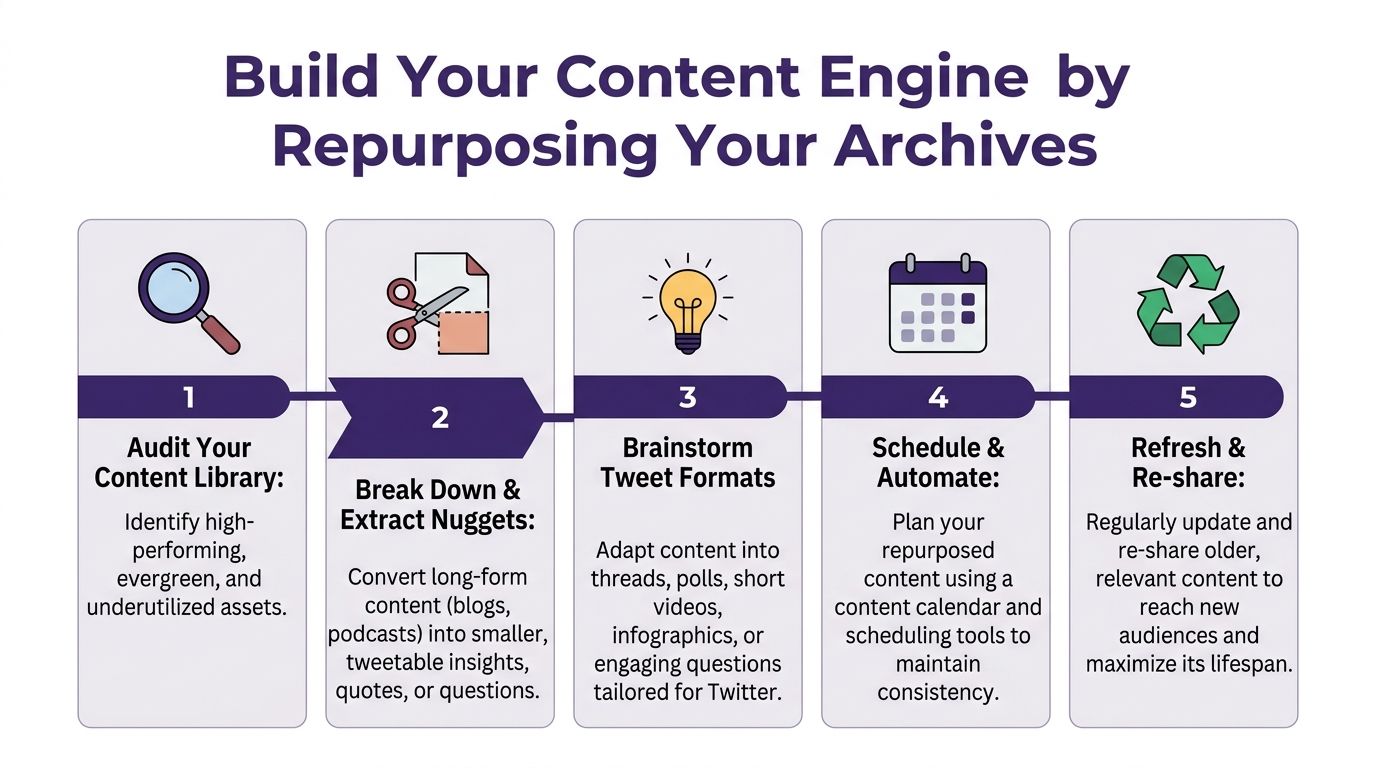
Start with an archive audit
Your backlog is not all equally useful. Some pieces deserve heavy reuse. Some should stay buried.
Pull together your strongest source material:
- Evergreen articles: Tutorials, explainers, opinion pieces with lasting value.
- Podcast episodes: Interviews, solo episodes, and recurring segments.
- Videos and webinars: Especially anything that already had a strong reaction.
- Research notes: Outlines, quote collections, internal briefs, transcripts.
Then sort each asset into one of these buckets:
| Bucket | What belongs there | Best Twitter use |
|---|---|---|
| Evergreen | Timeless advice or frameworks | Threads, tips, recurring series |
| Timely but reusable | Trend reactions with lasting lesson | Quote posts, opinion tweets |
| High authority | Research-heavy or original thinking | Threads, visuals, pinned posts |
| Underused gems | Strong content that got little distribution | Re-share in new formats |
Experienced creators pull ahead at this stage. They do not assume their archive is “old.” They judge each asset by whether it still solves a problem, sparks curiosity, or gives the audience language they can reuse.
Extract the tweetable parts
Once you have source material, break it down.
A single podcast episode often contains:
- one strong claim
- several usable quotes
- a story
- a disagreement
- a practical takeaway
- a listener question you can recycle into a public prompt
A blog post often contains:
- a hook
- a list structure
- examples
- one sentence that can become a standalone tweet
- one section that can become a thread
That is the raw material for growth. You do not need to publish the whole idea every time. You need to package one angle well.
Turn one source into multiple formats
Many creators leave reach on the table at this stage. They repurpose once, then stop.
Instead, build format variety around one source asset. Take an interview with a screenwriter. You can pull from it for days:
- A single insight tweet with the sharpest lesson
- A question tweet asking others how they handle the same problem
- A thread summarizing the best takeaways
- A quote graphic with a clean line from the guest
- A short clip with captions
- A follow-up post disagreeing with a common assumption raised in the episode
The idea stays the same. The packaging changes.
Here is a simple cheatsheet.
Content Repurposing Cheatsheet
| Original Content Type | Twitter Format 1 | Twitter Format 2 | Twitter Format 3 |
|---|---|---|---|
| Podcast episode | Key-takeaway thread | Quote post | Short video clip |
| Blog post | Contrarian single tweet | Numbered thread | Visual summary |
| YouTube video | Clip with captions | Question tweet | Lesson recap thread |
| Webinar | Myth-busting post | Screenshot carousel | Audience poll |
| Research article | Insight thread | Data commentary post | Visual chart post |
Use thread architecture correctly
Threads are one of the best ways to turn long-form thinking into follower growth. Guidance on Twitter growth notes that strong threads can bring in hundreds to thousands of followers when executed well, especially when they include an irresistible hook, a body with short sentences and white space, clear numbering like 2/7, and visuals such as charts, screenshots, or GIFs (microposter.so).
That matters because a thread is not just a longer tweet. It is a conversion format.
A useful thread usually has three parts:
The hook
Open with tension, novelty, or a promise.
Examples:
- The writing advice most creators repeat is wrong.
- I turned one podcast episode into a week of Twitter content. Here is the workflow.
- Most content libraries are full of tweets nobody has extracted yet.
The body
Keep sentences short. Make each tweet earn the next one. Cut intros, filler, and throat-clearing.
Bad thread body:
A lot of people have asked me about my thoughts on repurposing and how it can maybe help with content strategy in a broad sense.
Better:
Many creators publish once and move on.
That wastes the hardest part of the work.
The idea already exists. Distribution is the missing layer.
The close
End with one of these:
- a summary
- a practical next step
- an invitation to reply
- a soft profile-level call to follow for similar material
Build a repeatable workflow
The strongest repurposing systems are boring in a good way. They run on habit.
A practical weekly workflow looks like this:
- Pick one source asset from your archive.
- Highlight ten useful moments inside it.
- Group those moments by format, not by chronology.
- Draft a small batch of tweets, threads, and questions.
- Schedule the planned posts, then leave room for live interaction.
- Revisit the asset later and package it differently.
The goal is not to squeeze one piece of content dry in a single week. The goal is to create multiple entry points into the same idea over time.
If you do this well, your archive stops feeling like a pile of finished work and starts acting like a renewable source of distribution.
Amplify Your Reach with a Smart Engagement Routine
A lot of creators post solid material and then disappear. That limits reach.
Twitter growth comes from participation. The feed rewards content, but the network rewards people who join conversations, answer replies, and show up around other accounts in their space.

The first thirty minutes matter
One of the clearest signals in Twitter growth guidance is early engagement. Tweets that get strong activity in the first 30 minutes tend to receive broader distribution, and engaging with replies to your own tweets can boost the main tweet’s engagement by as much as 150x according to the cited analysis of algorithm behavior (tweetarchivist.com).
That changes how you should behave after posting.
Do not post a repurposed thread and vanish. Stay near it. Answer replies. Like thoughtful responses. Ask a follow-up question if someone adds a good point. Give the post a chance to gather momentum while the platform is still deciding how widely to distribute it.
A simple daily routine that does not eat your day
Think like a working creator, not a full-time social media manager.
A useful routine looks like this:
- Right after posting: Stay active around your tweet for a short stretch. Reply fast if someone comments.
- Later in the day: Leave thoughtful replies on peer accounts in your niche.
- A separate pass: Comment on a few larger accounts when you have something real to add.
The key is relevance. You want your name to appear in conversations your ideal audience already reads.
Here is what that looks like in practice.
Scenario one
A podcaster publishes a thread distilled from an interview episode. Instead of dropping the thread and moving on, they answer every early reply with an extra detail from the recording that did not make the original thread.
That does two useful things:
- It gives readers more value.
- It tells the platform the conversation is active.
Scenario two
A publisher turns an old feature article into a sharp opinion tweet. Then they spend time in the replies of adjacent writers discussing the same topic. They do not paste links. They add context, disagreement, or examples.
That is how profiles get discovered by the right people.
Here is a good explainer to watch before you tighten your routine:
Engage in ways that make people curious
Most weak engagement falls into two buckets. Empty praise or self-promotion.
Better replies do one of three things:
- Add a missing angle
- Sharpen the original point
- Bring in a relevant example from your own archive or experience
For example, if a creator posts about burnout from daily content creation, a weak reply is “Great point.”
A strong reply is:
We saw the same problem when we treated every platform like it needed original material. Repurposing a single long-form piece into multiple formats made the workflow manageable.
That kind of reply earns profile clicks because it sounds like someone with a process.
Posting gets you seen. Replies make you legible.
Build around peers, not only big names
Many creators waste energy trying to get noticed only by giant accounts. That is unreliable.
A healthier network usually comes from consistent interaction with peers in the same category. Other podcasters. Other media operators. Other writers with a clear point of view. Those relationships create repeat visibility, shared audiences, and better conversations.
Large accounts still matter, but only when you can add something distinct. The goal is not to flatter them. The goal is to appear in front of readers who care about the same topic and might want more of what you post.
That is the difference between broadcasting and building.
Mastering Content Velocity for Consistent Growth
Consistency on Twitter is not a motivational slogan. It is an output problem.
Data on tweet volume and growth makes that plain. On average, users need about 9.37 tweets to gain one follower, with a median of 7.58, and the same analysis found a strong positive correlation between tweet volume and follower acquisition. It also reported an average of 548 tweets per month, with a median of 200 as a more realistic benchmark for many users (ptg-marketing.com).
That does not mean you should spam the timeline. It means growth usually requires more volume than creators expect.
Why content libraries solve the volume problem
Many hear “post more” and immediately think “create more.” That is the wrong equation.
A deep archive gives you the raw material to maintain velocity without lowering your standards. Instead of inventing every post, you can rotate through:
- evergreen tips from old articles
- reframed arguments from past episodes
- fresh hooks built from proven ideas
- clips, quotes, and questions derived from the same core material
This makes consistency sustainable.
Build a cadence you can keep
You do not need a heroic schedule. You need one you can maintain when work gets busy.
A practical rhythm for many creators looks like this:
| Timeframe | Focus |
|---|---|
| Daily | Publish a mix of repurposed value posts and live replies |
| Weekly | Batch-draft content from one or two archive assets |
| Monthly | Review what resonated and refresh older ideas |
If you need structure, a well-organized social media calendar template can help you map archive-based posts, thread slots, and engagement windows without turning your workflow into chaos.
Quality still matters
High velocity only works when the posts are useful or interesting. Repetition without adaptation feels lazy. Repetition with new framing feels consistent.
That is why repurposing matters so much in the answer to how to gain followers on twitter. It lets you produce enough volume to stay visible while keeping the substance anchored in real work you already did.
The point of a content schedule is not to fill space. It is to give your best ideas more chances to be discovered.
Creators who grow steadily usually stop asking whether they have enough ideas. They build a system that lets existing ideas travel farther.
Measure What Matters and Iterate Your Strategy
Follower count alone is too blunt to guide decisions.
If you want to grow professionally, you need a small set of metrics that tell you whether your profile is attracting the right people, whether your repurposed content is converting attention into follows, and whether your posting habit is improving over time.

Track monthly follower growth rate
A strong benchmark is 5% monthly follower growth, calculated as net new followers divided by starting followers, multiplied by 100. The useful part of that metric is that it normalizes performance across account sizes. For example, gaining 250 followers from a 5,000-follower base equals 5%, while the same gain on a 10,000-follower base equals 2.5% (tweetarchivist.com).
That is much more meaningful than celebrating raw follower gains in isolation.
A smaller account can be growing more efficiently than a larger one. That matters when you are trying to judge whether your strategy is working.
Look for conversion signals, not vanity only
A tweet with lots of likes is nice. A tweet that causes profile visits and follows is better.
The useful questions are:
- Which posts make people click through to your profile?
- Which formats lead to new followers?
- Which archive sources keep producing your best tweets?
If you are still fuzzy on top-of-funnel visibility, this guide to understanding Twitter impressions helps put that metric in context so you do not confuse reach with conversion.
Review by source asset, not just by tweet
Archive-first creators gain an advantage in this approach.
Do not only ask, “Which tweet performed best?” Ask:
- Did this tweet come from a podcast, a blog post, or a video?
- Does one category of source material consistently produce stronger Twitter content?
- Are certain old pieces worth reusing again in new formats?
That tells you where the greatest impact is found within your library.
A practical review can happen once a month:
- List your top-performing tweets
- Tag each one by source asset
- Note the format, such as thread, question, clip, or visual
- Identify repeat patterns
- Create more from the winning sources
Good analytics do not just tell you what happened. They tell you what to make next.
Run small creative tests
You do not need formal experiments. You need controlled variation.
Try testing:
- one hook versus another on similar thread topics
- quote posts against clips from the same episode
- direct advice posts against curiosity-led posts built from the same article
Keep the source idea similar so the packaging is what changes.
If you want a better process for reviewing what your library is already telling you, this guide on how to analyze content performance is worth bookmarking.
The creators who plateau often stay attached to intuition. The creators who keep growing use intuition to generate ideas, then let results shape the next round.
Your Playbook for Sustainable Twitter Growth
The durable answer to how to gain followers on twitter is less glamorous than many desire. It is not a hack. It is a system.
Make your profile easy to follow. Pull ideas from your archive instead of forcing yourself to invent from scratch. Package one strong source into multiple Twitter-native formats. Stay present after posting so early engagement can build. Maintain a realistic content rhythm. Measure what moves the account forward.
That combination works because it respects how creators really operate.
Podcasters already have conversations worth clipping and summarizing. Publishers already have articles full of arguments, quotes, and research angles. Bloggers already have frameworks that can become threads. Video creators already have scripts and moments that can be cut into sharp posts. The value is usually there before the tweet exists.
The big shift is mental. Stop treating your older work as finished. Treat it as feedstock.
When you do that, Twitter stops being a daily creativity tax and starts becoming a distribution channel for ideas that have already earned their place. You reduce burnout, increase consistency, and build authority from material you already own.
That is the overlooked edge.
A strong content library is not a graveyard. It is a growth asset. Organize it well, revisit it often, and let it do more than it did the first time around.
If you want a better way to turn your archive into usable ideas, Contesimal helps creators and content teams organize, search, and activate their libraries so past work can fuel new output across channels, including Twitter.