So, you've got ideas. Lots of them. A running list of blog posts, podcast episodes, and YouTube videos that feels a mile long. But turning that chaotic brainstorm into a steady stream of high-quality content that actually grows your audience? That's a different beast entirely.
A real content calendar is more than just plugging topics into a spreadsheet. It’s your strategic roadmap, dictating what you’ll publish, when it goes live, and on which channels. It’s what separates creators who just "post stuff" from those who build a real, predictable, and profitable content machine.
Why Your Content Needs a Strategic Calendar
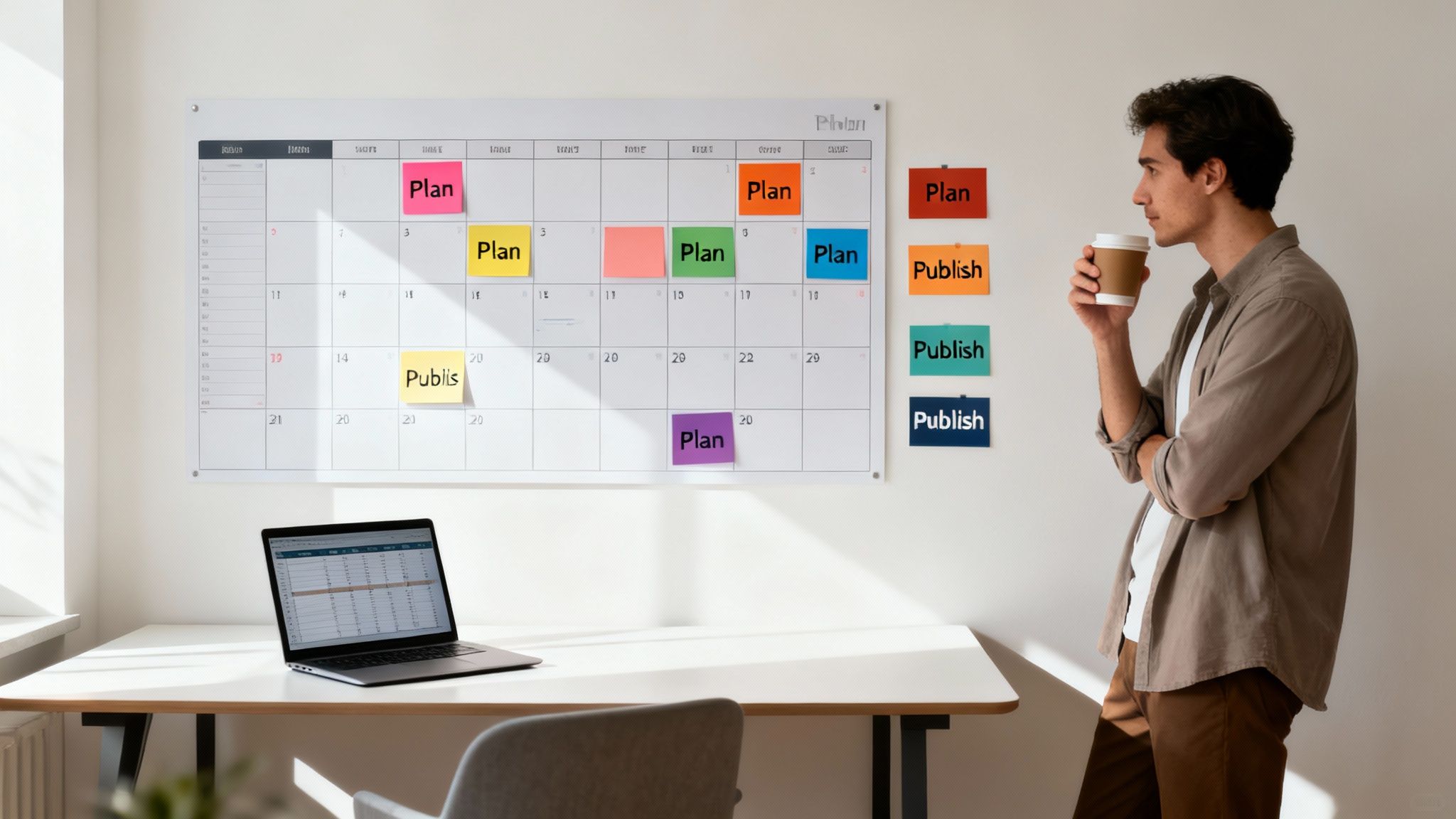
We’ve all been there—staring at a blank screen, desperately trying to figure out what to post today. That reactive, last-minute scramble is a huge bottleneck for growth. It’s draining, and honestly, it doesn’t produce your best work.
Shifting to a planned calendar isn't just about getting organized; it's an operational upgrade. It becomes the central nervous system for your entire content engine, delivering tangible benefits that help you move from hobbyist to professional.
Achieve Consistent Output
Consistency is king. Full stop. When your audience knows a new video drops every Tuesday or a fresh podcast episode lands every Friday morning, they build you into their routine. That's how you turn casual viewers into loyal fans who drive engagement and views.
A calendar makes this possible. It removes the daily guesswork and helps you maintain a predictable publishing rhythm that keeps people coming back for more. It also signals reliability to platform algorithms, which can boost your visibility over time. You stop chasing deadlines and start building a sustainable, manageable creative process.
Align Your Team and Vision
The moment you bring on help—an editor, a writer, a social media manager—a shared calendar becomes non-negotiable. It’s the single source of truth that clarifies who’s doing what and when it’s due. No more crossed wires, missed deadlines, or duplicated work.
A content calendar isn't just a scheduling tool; it's a strategic document that aligns your entire team around shared goals. It ensures every piece of content, from a tweet to a long-form video, is purposeful and contributes to the bigger picture.
It also keeps your content thematically tight. You can plan out entire series or content "buckets" that build on successful concepts, reinforcing your authority and making a much bigger impact than a bunch of random, one-off posts.
Unlock Your Content Library's Potential
Your archives are a goldmine. Seriously. A strategic calendar forces you to think beyond the "one and done" post and consider the entire lifecycle of your content. You can schedule time to update old blog posts—a key tactic for optimizing content for search engines—or plan to slice up a long-form video into a dozen social media clips.
This approach ensures you’re squeezing every drop of value from the assets you've already created. Instead of constantly grinding on the content treadmill, you can intelligently upcycle and reignite older material. This is how you organize your library to create new value and ultimately make money from it.
To get the most out of your planning, check out this comprehensive guide to content strategy to dial in your goals and ideas. Ultimately, a content calendar is about building a scalable engine that turns your creative output into a reliable, revenue-generating asset.
Laying the Foundation for a Powerful Calendar
Before you even think about opening a spreadsheet, you need a blueprint. A content calendar without a solid foundation is like building a house on sand—it might look good for a minute, but it's doomed to collapse. This early stage is all about asking the right questions so that every single thing you create actually moves the needle.
Don't skip this part. This isn't just busywork; it's the strategic core that turns a simple to-do list into a machine that drives real results. By getting clear on your goals, audience, and channels first, your calendar becomes an engine for growth, not just a schedule of posts.
First, Define Your Content Goals
Okay, let's get real: what are you actually trying to accomplish here? "More views" isn't a goal; it's a wish. A real goal is specific, measurable, and tied directly to what you're trying to build.
Are you a podcaster trying to go from hobbyist to pro? Your primary goal might be to boost monthly downloads by 20% to finally start attracting sponsors. For a marketing team, the goal could be to generate 50 qualified leads a month using gated content you promote on the blog. Your goals dictate absolutely everything that follows.
Most content goals fall into one of these buckets:
- Audience Growth: Getting more YouTube subscribers, podcast downloads, or newsletter sign-ups.
- Lead Generation: Capturing contact info from potential customers by offering them something valuable.
- Brand Authority: Positioning yourself or your company as the go-to expert in your niche.
- Community Engagement: Building a die-hard community through interactive, genuinely helpful content.
Pick one or two primary goals to obsess over each quarter. This clarity becomes your North Star. When you're staring at a list of 20 potential content ideas, you can ask, "Does this actually help me hit my goal?" Every single item on your calendar should have a direct line back to this "why."
Understand Your Audience and Channels
Once you know your "why," it's time to lock in your "who" and "where." Who are you actually talking to? A YouTuber chasing brand deals with tech companies is creating for a completely different person than a publisher focused on literary fiction. You have to get inside their heads—know their pain points, what keeps them up at night, and what problems they're desperately trying to solve.
Your audience doesn't care about your content; they care about what your content can do for them. A deep understanding of their needs is the secret to creating content that resonates and gets shared.
With a clear picture of your audience, map out where you'll reach them. And don't just list your channels—think critically about them. What works on YouTube (long-form, educational videos) is a world away from what flies on Instagram (short, visual, punchy clips).
Channel & Format Mapping Example
Let's imagine you're a content marketer talking to a B2B audience. Your map might look something like this:
- Blog: This is home base. It’s where you post detailed, SEO-driven articles and beefy guides that build your authority.
- YouTube: Perfect for product demos, tutorials, and interviews with other experts in your field.
- Podcast: The best place for deep-dive conversations that build a personal, trust-based connection with listeners.
- Newsletter: Your direct line to your most loyal followers. Use it to share exclusive insights and point them to your most important content.
The point isn't to be everywhere. It's to be on the right platforms for your audience and to create content that feels native to each one. Nail this strategic groundwork, and your calendar will be more than just organized—it will be ruthlessly effective, making every piece of content a deliberate step toward your goals.
Building Your Calendar from the Ground Up
Okay, the strategic legwork is done. Now it’s time to roll up your sleeves and actually build this thing. We’re moving from high-level goals into a tangible, day-to-day plan that your whole team can run with.
Think of a good content calendar as more than a glorified to-do list. It’s a living, breathing document that steers your entire content operation. It’s about building a sustainable system—one that keeps your audience hooked without burning out your creative team.
The goal is to turn content creation into a well-oiled machine. This simple flow shows how everything connects, from your core goals to the channels where you’ll reach your audience.
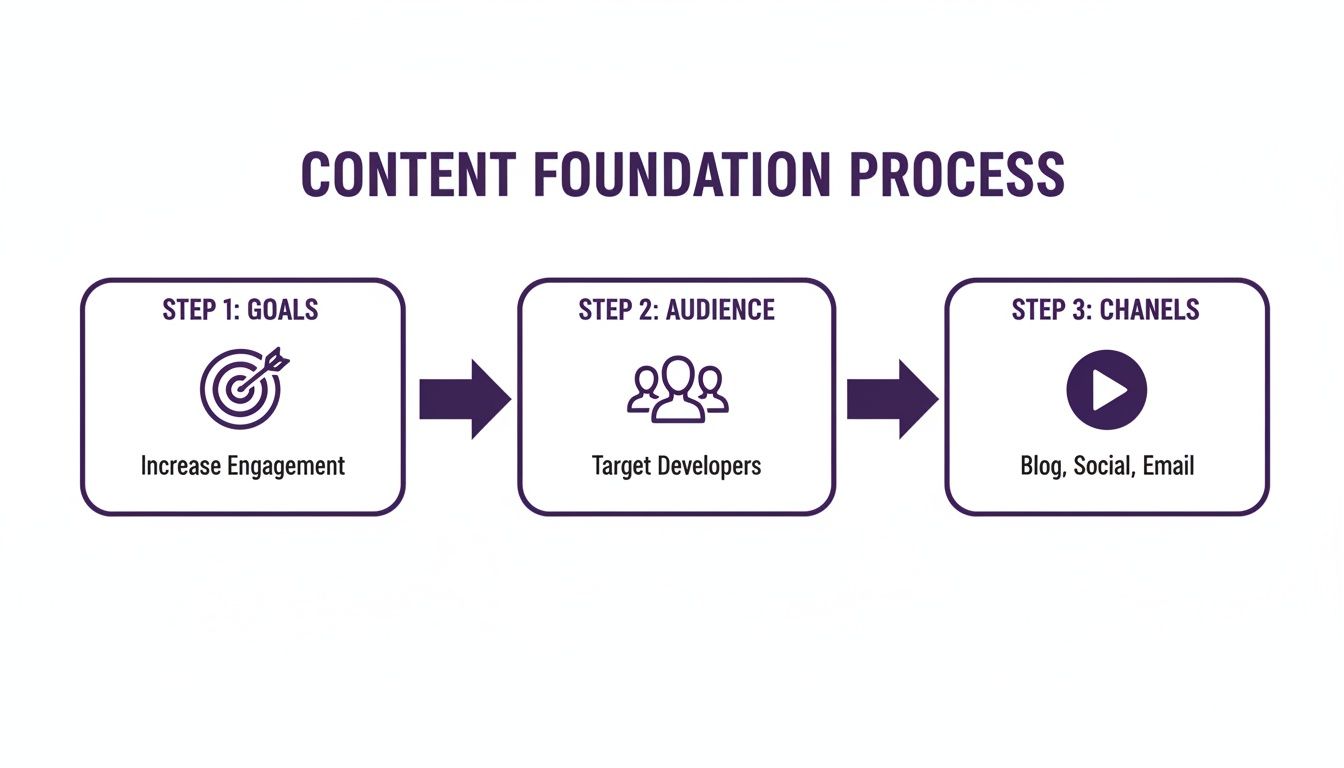
Every single piece of content should tie directly back to a goal and be shaped for a specific audience on a specific channel. That’s the secret sauce.
Develop Your Content Pillars
Want to create focused, impactful content? Stop chasing one-off ideas. The real pros build their calendars around content pillars—those big, overarching themes your brand wants to own.
Let’s say you’re a YouTuber who talks about personal finance. Your pillars might be:
- Investing for Beginners
- Debt Reduction Strategies
- Side Hustle Ideas
- Retirement Planning
Each pillar is a well you can draw from for dozens of specific videos. The "Side Hustle Ideas" pillar alone could spawn videos like "5 Online Businesses You Can Start for Under $100," "My Honest Take on Freelance Writing," or "Interview with a Six-Figure Etsy Seller." This approach keeps your library cohesive and stamps you as the go-to expert in your niche.
Establish a Realistic Publishing Cadence
One of the fastest ways to fail is to set an insane publishing schedule you can't possibly maintain. Sure, posting a new video every day sounds great for growth, but it's a direct flight to burnout city if you don't have the resources.
Your cadence needs to be a perfect balance between what your audience expects and what your team can actually deliver. Forget maximum frequency; aim for maximum consistency. It's far better to drop one amazing podcast episode every single week than to release three mediocre ones and then vanish for a month.
Your publishing cadence is a promise to your audience. Whether it's daily, weekly, or bi-weekly, consistency builds trust and turns casual viewers into dedicated subscribers who anticipate your next release.
Be brutally honest with yourself. How long does it really take to research, script, shoot, and edit a video? Once you have that number, build in a buffer. A realistic cadence is one you can stick to even when everything goes wrong.
Mine Your Existing Content Library for Gold
Your back catalog is probably your most underrated asset. Before you start jamming your new calendar with brand-new ideas, take a look in the rearview mirror. That archive of past videos, blog posts, and podcasts is a goldmine of proven topics and repurposing opportunities.
Think about it. That one-hour podcast interview you did last year? It could easily become:
- 10-15 short-form video clips for social media.
- A "Top 5 Takeaways" blog post.
- An audiogram featuring a powerful quote.
- A text-based carousel post for LinkedIn.
This is where AI-powered tools like Contesimal can be a game-changer. Instead of manually scrubbing through hours of old footage, you can organize, understand, and take action on your entire library. It helps you find specific keywords, themes, or quotes in seconds, turning your archive from a dusty old storage unit into a dynamic engine for fresh content.
Planning ahead like this makes a huge difference. One analysis found that brands planning their marketing activities three months in advance saw an average 47% increase in conversion rates.
With this foundation in place, you can finally start slotting specific ideas into your calendar. If you want to see how this translates to a specific platform, check out this practical guide on creating a LinkedIn content calendar. It’s a great example of turning themes and cadence into a concrete schedule.
Choosing the Right Tools for the Job
Your content calendar is only as powerful as the platform you build it on. The right tool can turn a simple schedule into a dynamic command center for your entire operation. The wrong one? It just creates more friction and headaches.
Picking the right technology is one of those moments that separates hobbyists from professionals. The good news is, you've got options. The key is to find a tool that fits your team's size, workflow, and budget—what works for a solo YouTuber is overkill for a publishing team, and vice versa.
From Simple Spreadsheets to Sophisticated Software
Lots of creators start with the basics, and there’s absolutely nothing wrong with that. A well-organized Google Sheet or a clean Trello board can be surprisingly effective when you're managing a straightforward publishing schedule. They’re free, familiar, and you can get one running in minutes.
But as your content operation grows, you'll eventually hit a wall. Spreadsheets get messy, version control becomes a nightmare, and trying to collaborate feels clunky and disconnected. This is the point where dedicated content calendar software stops being a "nice to have" and becomes a necessity.
This shift is happening everywhere. The global calendar app market was valued at USD 5.71 billion in 2023 and is projected to hit USD 16.37 billion by 2030. More importantly, organizational use of scheduling apps shot up from 26.37% in 2021 to 51.68% in 2023. That means over half of all organizations have already ditched basic spreadsheets for proper tools. If you want to dig into the numbers, you can read the full research on calendar platform statistics.
A Quick Comparison of Popular Tools
When you're ready to graduate from spreadsheets, you'll find a whole world of options out there. Each one has its own quirks and strengths, tailored for different kinds of content teams. To help you get started, here’s a quick look at a few popular choices.
Content Calendar Tool Comparison
Here's a breakdown of a few common tools to give you a sense of the landscape.
| Tool | Best For | Key Features | Limitations |
|---|---|---|---|
| Trello / Asana | Small teams, visual workflows, task management | Kanban boards, checklists, integrations | Limited long-term calendar views, less focused on content specifics |
| CoSchedule | Content marketers, bloggers, social media managers | Social media scheduling, content analytics, WordPress integration | Can become expensive as your team and needs grow |
| Airtable | Creators who need a highly customizable database | Flexible views (grid, calendar, gallery), powerful filtering and sorting | Steeper learning curve, requires setup to function as a calendar |
Ultimately, the best tool is the one that feels like an extension of how your team already works. It should make your process smoother, not force you into a new, complicated system.
The Next Frontier: AI-Powered Platforms
The most forward-thinking tools today do a lot more than just schedule future posts. They plug into your content library to help you organize, search, and actually understand everything you've ever made. For any creator sitting on an archive of videos, podcasts, or articles, this is a total game-changer.
A modern content calendar shouldn't just be a planner for the future; it should be an intelligent gateway to your past. The ability to instantly search and repurpose your old content is a massive competitive advantage.
Instead of just telling you when to post, these systems help you decide what to post. They can analyze your back catalog to find evergreen topics, pull out clips perfect for repurposing, and surface insights that spark your next big idea. Contesimal is a great example of this, revolutionizing research and collaboration for content library owners to expand value across their existing assets.
For creators serious about turning their library into a revenue-generating asset, understanding these tools is critical. You can learn more about these next-generation Content Intelligence Platforms in our detailed guide.
Bringing Your Calendar to Life with Your Team

So, you’ve built the perfect content calendar. Looks great, right? But here’s the thing: a beautiful calendar is completely useless if it just sits there collecting digital dust. Its real value kicks in the moment your team starts using it to drive their daily work.
This is where your strategy stops being a document and becomes a living, breathing part of your content operation. It guides every piece of content from a raw idea scribbled on a napkin to a fully polished, published masterpiece. To get there, you need more than just a schedule. You need a workflow.
Create a Standardized Production Workflow
A solid workflow is your team's playbook. It’s the set of repeatable steps that ensures every video, podcast, or article moves smoothly through the production line without anyone having to ask, "What happens next?"
Without a clear process, you get chaos. You get bottlenecks, missed deadlines, and a whole lot of shoulder-shrugging. Your workflow doesn't need to be some hundred-page manual, but it absolutely needs to be documented and visible to everyone.
A typical content workflow usually breaks down into a few key stages:
- Ideation & Pitching: Where new concepts get thrown on the table and vetted.
- Research & Outlining: The creator digs in, gathers the goods, and structures the piece.
- Drafting / Filming: This is the heads-down creation phase.
- Review & Approval: Where editors, producers, or stakeholders jump in to give feedback.
- Final Edits & Polish: Revisions are made and the content gets ready for its debut.
- Scheduling & Distribution: The piece is loaded into the CMS and promo assets are prepped.
When you define these steps, you create a seamless system of handoffs. A writer finishes their draft and knows it goes straight to the editor. The editor wraps up their review and knows it’s time for the designer to work their magic on the graphics. That clarity is the secret sauce to scaling up your content without letting quality slide.
Your content calendar shows what you're creating and when. Your workflow shows how it gets done. The two must work together seamlessly for your content engine to run smoothly.
Set Clear Roles and Responsibilities
One of the biggest productivity killers on a content team is fuzzy ownership. Who’s handling the keyword research for this post? Who has the final say on the video edit? When roles are ambiguous, tasks get dropped, and approvals grind to a halt. It’s infuriating.
The fix is simple: assign clear roles for each stage of your workflow. This doesn't mean you need a massive team—a single person can easily wear multiple hats. What matters is documenting who is accountable for what.
Think about defining these key roles:
- Content Strategist: The big-picture thinker who owns the calendar and plans the themes.
- Creator: Your writer, podcaster, or videographer doing the hands-on creation.
- Editor / Producer: The quality control expert, checking for clarity and brand voice.
- Designer: The visual wizard creating thumbnails, infographics, and social graphics.
- Publisher: The technical guru who manages scheduling and gets the content live.
Getting these roles down on paper removes friction and empowers your team to act without constantly needing to ask for permission. If you need a starting point, check out some helpful process documentation examples to see how you can structure your own team's playbook.
Manage High-Volume Content Production
For professional creators, the pressure is always on. You have to post. A lot. Research shows that brands trying to maximize engagement might need to publish between 48 and 72 times per week across their networks. That kind of volume is simply impossible to manage without a rock-solid system.
This is where leaning on AI-assisted tools becomes a game-changer. The same study found that 83% of social marketers say AI helps them create significantly more content. These tools can automate research, brainstorm topics, and even generate first drafts, freeing up your team to focus on the human stuff—creativity, storytelling, and polish.
Ultimately, putting your calendar into action is about building a reliable system. It’s what turns the often chaotic creative process into a predictable, manageable, and scalable operation that delivers real value to your audience, every single time.
Got Questions About Content Calendars? We've Got Answers
Even with the best plan in the world, you're going to have questions once you start building and using a content calendar day-to-day. It’s just part of the process.
Let's walk through some of the most common hurdles I see teams run into. Getting these details ironed out is often the difference between a calendar that becomes the team’s lifeline and one that gathers digital dust.
How Far Out Should We Plan Our Content?
This is the classic question, and the sweet spot for most creators is planning one to three months ahead. A quarterly view gives you enough runway to map out bigger themes or campaigns, and it gives your team plenty of time to produce high-quality work without that constant feeling of being behind. You can actually see the forest, not just the next tree.
But here’s the key: don’t treat that plan like it’s set in stone. The trick is to build in some breathing room. I always recommend leaving a few open slots each month specifically for timely, reactive content. When a topic suddenly starts trending in your niche, you want the freedom to jump on it.
Think of your calendar as a framework, not a straitjacket. It’s there to guide you, not hold you back from a great opportunity.
What Are the Absolute Must-Haves to Include?
While every team’s calendar will look a little different, there are a few non-negotiable elements that keep everything running smoothly. The goal is for anyone on your team to look at a calendar entry and know exactly what's going on at a glance.
At the bare minimum, every single item needs:
- Publish Date & Time: The moment it goes live. No ambiguity.
- Content Topic/Title: What is this thing we're making?
- Content Owner: Who is the single person responsible for getting this across the finish line?
- Current Status: Where is it in the workflow? (e.g., Idea, In Progress, Review, Published)
- Primary Channel: Where is this being published? (Blog, YouTube, Podcast, etc.)
If you want to level up, I’d also add fields for things like the target persona, primary keywords, and the call-to-action. You're trying to build a single source of truth that kills confusion before it can even start.
How Do I Stop My Calendar from Feeling So… Rigid?
I hear this fear all the time—that a calendar will suck the soul out of the creative process. But the best calendars do the exact opposite. They build flexibility right into the plan from day one.
A content calendar isn't meant to lock you in; it's meant to free you up. By handling the logistical heavy lifting, it gives you more mental space to focus on what truly matters—creating amazing content.
Instead of scheduling every post for the next three months down to the specific title, use your content pillars as guides. Maybe you know that every Tuesday is a "How-To" video and every Thursday is a "Creator Interview." That gives you structure without dictating the exact topic weeks in advance.
Also, treat your calendar like a living, breathing document. Quick weekly check-ins with the team to review what’s coming up can make all the difference. It's the perfect time to swap ideas, make adjustments, and react to what's actually working.
How Can I Weave My Old Content into My Calendar?
Your archive of past content isn't just a dusty digital shelf—it's a goldmine. Seriously. The first step is to do a quick audit of your old blog posts, videos, and podcast episodes to find your "evergreen" superstars. These are the pieces that are just as valuable today as they were a year ago. Schedule those winners to be re-promoted or even updated and republished for a whole new audience.
This is where things get really fun. You can use tools to slice up your best-performing content into brand-new formats. That one in-depth video you made? It can be chopped into 10 social media clips, 5 quote graphics, and 3 audiograms.
Plugging this repurposed material into your calendar is one of the smartest, most efficient ways to fill gaps in your schedule. You save a ton of time and get way more mileage out of the hard work you’ve already done.
Ready to turn your content library from a dusty archive into a dynamic asset? Contesimal uses AI to help you organize, search, and repurpose your existing videos, podcasts, and articles, making it easier than ever to fill your content calendar with high-impact material. Discover how you can unlock new value from your content.