Every content creator, from YouTubers and podcasters to major publishers, sits on a goldmine: their existing content library. The challenge isn't a lack of material, but knowing how to transform those archives into fresh, engaging social media content that drives views, builds community, and generates revenue. This article moves beyond generic advice to provide a strategic playbook of powerful social media posts examples.
We will explore 12 distinct post types, complete with real-world examples, deep strategic analysis, and actionable takeaways. You'll learn not just what to post, but why it works and exactly how you can replicate that success. For creators transitioning from hobbyist to professional, organizing your content library is the first step toward creating new value. We'll show you how to reignite your archives and use tools to streamline collaboration for your team. For practical strategies on content repurposing, consider this detailed guide on transforming old posts into AI images to give your old text-based content a new visual life.
The goal is to upcycle your old content, generate new audience engagement across platforms, and ultimately, turn your past efforts into future profits. This collection of social media post examples is designed to help you organize your assets, understand their potential, and take decisive action. Let's dive into the examples that will help you create infinite content value from the work you've already done.
1. Behind-the-Scenes Content Archive Transformation
One of the most compelling social media posts examples for content-heavy businesses is the "before-and-after" transformation. This format visually demonstrates the value of organization by showcasing a messy, underutilized content library transformed into a streamlined, searchable, and profitable asset. For creators, publishers, and marketers, this approach directly addresses the common pain point of managing a growing archive of videos, podcasts, and articles.
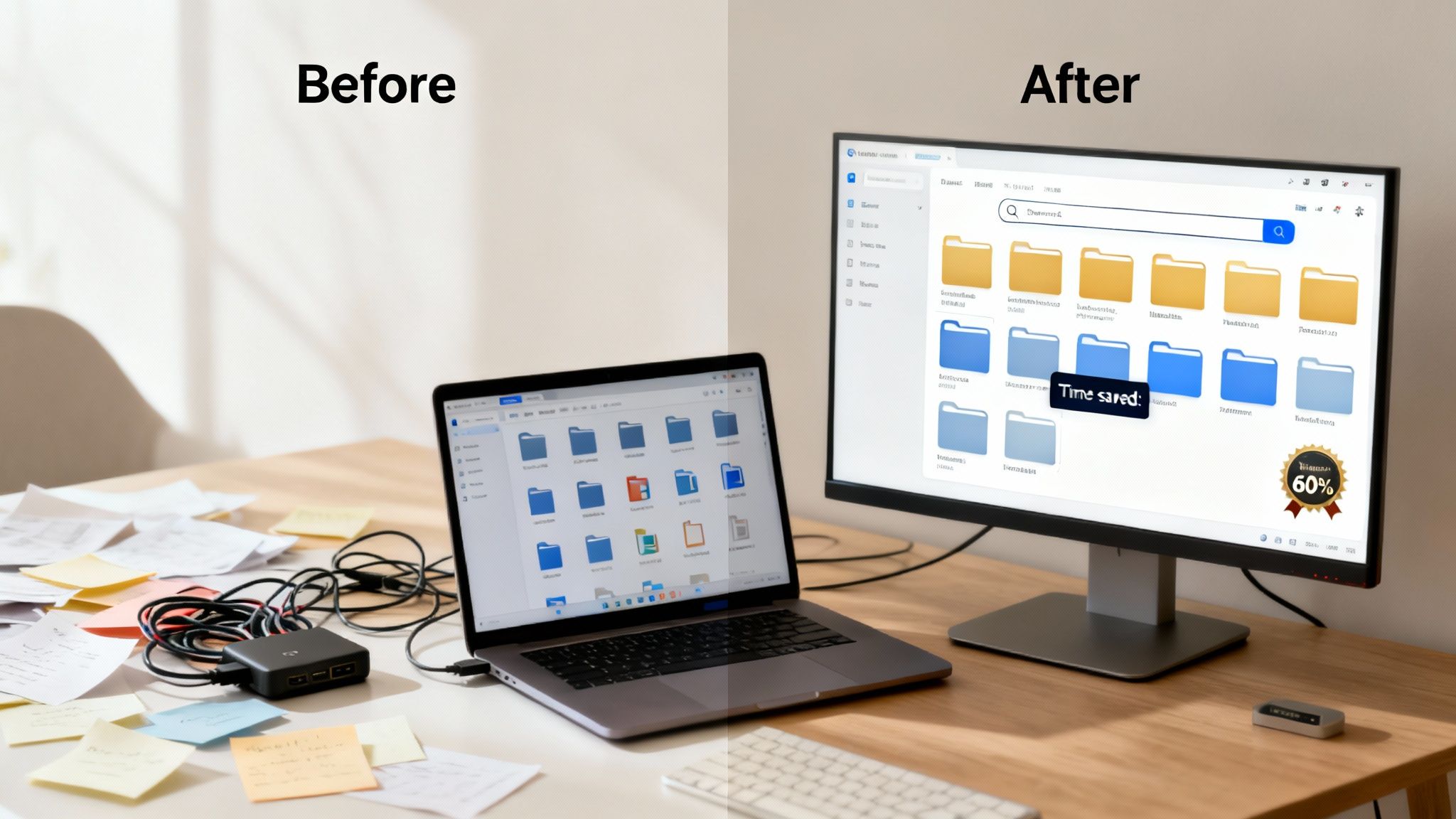
By presenting a clear visual narrative of chaos turned into order, you tap into your audience's desire for efficiency and control. This strategy is particularly effective for SaaS companies and consultants in the content management space.
Why This Post Format Works
This format excels because it provides tangible proof of value. Instead of just telling your audience your product saves time, you show them precisely how. For instance, a carousel post on LinkedIn or Instagram can walk users through the chaotic state of an old digital folder system versus a new, AI-tagged, and easily navigable interface.
Strategic Insight: The "before-and-after" model works because it creates a relatable problem and presents an aspirational solution. Audiences immediately recognize their own struggles in the "before" image and are drawn to the "after" as a desirable outcome.
Actionable Takeaways & Tips
- Create a Carousel Walkthrough: Dedicate each slide to a specific step in the transformation. For example: Slide 1: The messy "downloads" folder. Slide 2: Introducing the new system. Slide 3: AI-powered auto-tagging in action. Slide 4: The final organized dashboard.
- Focus on Quantifiable Metrics: Don't just show a prettier interface. Include hard data. Use text overlays like, "Reduced content search time by 75%" or "Increased content repurposing by 200%."
- Anonymize Client Data: To protect privacy, use blurred or generic file names and user data while still showing the structural improvement.
- Incorporate Testimonials: End your carousel with a powerful quote from a happy client confirming the benefits shown.
This approach is ideal for product launches, case study promotions, and lead-generation campaigns. It effectively communicates the power of strategic organization, a core principle for anyone looking to scale their content operations with tools like a modern digital asset management software.
2. Quick-Tip Educational Carousels
One of the most effective social media posts examples for establishing thought leadership is the quick-tip educational carousel. This format breaks down complex topics like AI-powered discovery techniques or content taxonomy strategies into a series of digestible, visually appealing slides. For creators and marketers struggling to convey their expertise, these carousels offer a perfect vehicle to provide immense value in a bite-sized, shareable package.

By sequencing information logically across multiple slides, you guide your audience through a mini-lesson, positioning your brand as a helpful and knowledgeable resource. This strategy is highly effective on platforms like LinkedIn and Instagram, where users are primed for professional development and learning.
Why This Post Format Works
This format succeeds by delivering concentrated value and immediate utility. Instead of a long blog post, a user can gain actionable knowledge in under a minute of swiping. This builds trust and authority quickly. For podcasters or YouTubers, a carousel can distill key takeaways from a long-form episode, serving as a powerful promotional tool that drives traffic back to the original content.
Strategic Insight: Educational carousels work because they tap into the micro-learning trend. They satisfy the audience's desire for quick, actionable information while creating a 'saving' and 'sharing' habit, which dramatically boosts post engagement and reach.
Actionable Takeaways & Tips
- Lead with a Strong Hook: Your first slide must clearly state the value proposition. For instance, use a title like "5 Steps to Build a Profitable Content Taxonomy" to grab attention instantly.
- Use Consistent Branding: Apply your brand’s colors, fonts, and logo across all slides to build recognition and a cohesive, professional look.
- One Key Idea Per Slide: Avoid overwhelming the viewer. Dedicate each slide to a single, powerful tip with minimal text and a strong visual element.
- End with a Clear Call-to-Action (CTA): The final slide should guide the user. Prompt them to "Save this for later," "Share your top tip," or "Learn more about organizing your content library."
This approach is perfect for repurposing long-form content, nurturing an audience, and showcasing the depth of your expertise. It transforms passive scrollers into an engaged community looking to you for guidance on managing and monetizing their content archives.
3. Creator Success Story/Case Study Posts
One of the most powerful social media posts examples is the creator-centric case study. This format leverages social proof by telling a detailed story of how a specific podcaster, YouTuber, or publisher used your tool to achieve tangible results. For a platform like Contesimal, this means showcasing how creators organized their archives to find new repurposing opportunities, enhance SEO, or speed up their production workflow.
This approach moves beyond abstract benefits and grounds your product's value in a relatable, human-centered narrative. It resonates deeply with an audience of creators because it features their peers, making the promised success feel more attainable and authentic.
Why This Post Format Works
This format is effective because it builds trust through authentic validation. Instead of the company making claims, a fellow creator shares their genuine experience and success. This peer-to-peer endorsement is often more persuasive than traditional advertising. For example, a LinkedIn or Instagram post can feature a quote from a blogger explaining how they turned one long-form article into ten micro-videos, complete with performance metrics.
Strategic Insight: Success stories work because they transform product features into real-world outcomes. An audience of content creators doesn't just want to know what your tool does; they want to see what it can do for them. A case study provides that clear, aspirational roadmap.
Actionable Takeaways & Tips
- Feature Diverse Creators: Showcase success stories from creators with varying audience sizes and niches to broaden the post's relatability.
- Use Compelling Quotes: Pull out the most impactful quote from the creator and use it as a text overlay on your main image or video.
- Focus on Before-and-After Metrics: Quantify the success. Use specific data points like, "Discovered 50+ repurposing opportunities in our back catalog" or "Accelerated new video ideation by 40%."
- Link to the Full Story: Use the social media post as a hook to drive traffic to a more detailed case study or blog post on your website.
This strategy is perfect for building brand credibility and driving consideration-stage leads. It effectively demonstrates how your platform helps creators organize their library to unlock new value from their content.
4. Poll and Question-Based Interactive Posts
One of the most effective social media posts examples for boosting direct audience interaction is the poll or question-based post. This format directly invites your community to share their opinions on topics like content organization challenges, repurposing strategies, or AI tool preferences. It transforms passive scrolling into an active conversation, generating valuable insights while increasing engagement metrics.
For content creators and marketers, this approach is a powerful tool for market research and community building. By asking targeted questions, you gather firsthand data about your audience's pain points and preferences, which can inform future content and product development.
Why This Post Format Works
This format succeeds because it leverages the inherently social nature of these platforms. People love to share their opinions and feel heard. A well-crafted poll or question lowers the barrier to entry for engagement; a simple tap or a short comment is all that's required. This is particularly useful for platforms like LinkedIn, Instagram Stories, and X (formerly Twitter), where algorithms favor posts with high interaction rates.
Strategic Insight: Question-based posts create a feedback loop. You're not just broadcasting a message; you're starting a dialogue. This positions your brand as a listening, responsive entity, fostering a stronger sense of community and loyalty among your followers.
Actionable Takeaways & Tips
- Ask Specific, Relevant Questions: Instead of a vague "What are you working on?", ask something targeted like, "What's your biggest bottleneck when repurposing a 1-hour podcast into social clips?"
- Engage Immediately: Dedicate time to respond to every comment within the first two hours of posting to fuel the algorithm and encourage more replies.
- Use Native Features: Leverage Instagram's poll and question stickers in Stories for easy, one-tap participation. On LinkedIn and X, use the built-in poll functionality for structured feedback.
- Close the Loop: Follow up with a new post summarizing the poll results or addressing the insights gathered from the questions. For example, "You told us finding specific quotes was your biggest challenge. Here’s how our AI-powered transcript search solves it."
This approach is ideal for audience research, validating content ideas, and driving high-velocity engagement. It effectively turns your social media feed into a direct line to your audience, helping you understand their needs and position your solutions more accurately.
5. Data-Driven Insight/Research Posts
One of the most authoritative social media posts examples involves sharing data-driven insights from original research. This format positions your brand as a thought leader by providing proprietary data on industry trends, creator challenges, or technology adoption. For content marketers, publishers, and professional creators, these posts offer immense value by answering critical questions with hard numbers, making them highly shareable and credible.
This strategy moves beyond simple content creation to establishing your brand as a primary source of information. Much like HubSpot's State of Marketing reports or Spotify's Wrapped campaigns, presenting unique data captures audience attention and generates significant industry buzz.
Why This Post Format Works
This format is powerful because it provides exclusive, undeniable value. Instead of opinions, you are offering facts and insights that can directly inform your audience's strategy. For creators and publishers managing large content libraries, data on consumption habits or monetization trends is not just interesting; it is essential for growth. An infographic on LinkedIn or a series of stat cards on Instagram can distill a complex report into easily digestible, shareable nuggets.
Strategic Insight: Data-driven posts build trust and authority. When audiences see you've done the research, they are more likely to trust your conclusions, recommendations, and ultimately, your product or service.
Actionable Takeaways & Tips
- Highlight the "Aha!" Moment: Lead with the single most surprising or impactful statistic from your research in your post's headline and visual.
- Create Snackable Graphics: Convert key data points into individual graphics like charts or quote cards. This allows you to create multiple posts from a single research report, extending its lifespan.
- Gate the Full Report: Offer the headline insights for free on social media, but direct users to a landing page to download the full report in exchange for their email, generating valuable leads.
- Partner for Amplification: Collaborate with industry publications or influencers to co-release or comment on your findings, expanding your reach significantly.
This approach is ideal for building brand authority, generating high-quality leads, and earning backlinks. It showcases a deep understanding of the market, a core principle for anyone leveraging the different forms of research to create strategic content.
6. Product Feature Deep-Dives/Explainer Videos
One of the most effective social media posts examples for software and tech companies is the feature explainer video. This format breaks down a specific product function into a quick, digestible video, demonstrating its value in seconds. For content creators and publishers, this approach clearly communicates how a tool like Contesimal can solve a specific problem, such as finding a particular clip within a massive video archive.
By isolating a single feature, like AI-powered search or automated content classification, you make complex technology feel accessible and immediately useful. This strategy is ideal for platforms like TikTok, Instagram Reels, and YouTube Shorts, where users consume information rapidly.
Why This Post Format Works
This format succeeds because it offers instant gratification and clarity. Instead of describing a feature with text, a short-form video shows the "magic" in action. For example, a 30-second reel can show a user typing a simple query ("speaker mentions 'content repurposing'") and instantly getting timestamped results from hundreds of hours of video, a powerful demonstration for podcasters and YouTubers.
Strategic Insight: Explainer videos work by transforming an abstract benefit into a concrete, visual experience. The audience doesn't just hear that a feature saves time; they watch it happen, which builds trust and makes the value proposition undeniable.
Actionable Takeaways & Tips
- Follow a Problem-Solution Arc: Start the video by stating a common pain point ("Can't find that one perfect clip?"). Then, present your feature as the hero that solves it.
- Use Captions and Text Overlays: Design for sound-off viewing. Use clear, bold text overlays to highlight key actions and benefits, like "AI finds your moment in seconds."
- Keep it Under 60 Seconds: Capture and maintain attention quickly. Focus on one feature per video to avoid overwhelming the viewer.
- End with a Clear Call-to-Action: Guide the viewer on what to do next. Use a verbal and on-screen CTA like, "See it for yourself. Try it free at the link in our bio!"
This approach is perfect for driving feature adoption, educating new users, and generating high-quality leads. It effectively showcases how specific tools within a platform like Contesimal can streamline a creator’s workflow and unlock new value from their content library.
7. Industry Trend and Future-Gazing Posts
Forward-looking content that analyzes emerging trends is one of the most powerful social media posts examples for establishing thought leadership. This format involves discussing future shifts in content creation, AI adoption, or media distribution. For creators and publishers aiming to stay ahead, these posts position a brand as an innovative, authoritative voice guiding the industry forward.
By forecasting what's next, you tap into your audience's need to prepare for the future and stay relevant. This strategy is highly effective for B2B tech companies, industry analysts, and consultants who want to be seen as indispensable partners in a rapidly changing landscape.
Why This Post Format Works
This format succeeds because it demonstrates strategic foresight and authority. Instead of just reacting to the present, you are shaping the conversation about the future. For example, a LinkedIn post or a Twitter thread breaking down Gartner's Hype Cycle for AI in content creation can spark significant engagement and position your brand as a go-to resource for strategic insights.
Strategic Insight: Future-gazing posts attract a high-value audience of decision-makers and innovators. They work because they address a fundamental business need: mitigating future risk and capitalizing on emerging opportunities. This builds trust and credibility.
Actionable Takeaways & Tips
- Base Predictions on Data: Ground your forecasts in existing data, recent studies, or emerging patterns. Use phrases like, "Based on a 40% rise in AI tool adoption, we predict…" to add credibility.
- Create Discussion Questions: End your post with an open-ended question to fuel comments and community discussion, such as, "Which of these content trends will impact your strategy the most in 2024?"
- Connect Trends to Audience Benefits: Don't just list trends. Explain their direct impact. For example, "The rise of generative AI means creators can reduce production time by 30%, freeing up resources for creative development."
- Revisit and Update Predictions: Create a recurring content series where you review your past predictions quarterly or annually. This shows accountability and keeps the conversation going.
This approach is ideal for building brand authority, nurturing a community of forward-thinkers, and generating leads from a strategically-minded audience. It solidifies your role not just as a service provider but as an essential industry guide.
8. User-Generated Content (UGC) Showcase Posts
One of the most authentic social media posts examples involves showcasing content created by your own users. This strategy, known as a User-Generated Content (UGC) showcase, leverages social proof and community by highlighting real people achieving real results with your product. For a platform like Contesimal, this could mean featuring how a podcaster organized their episode archive or how a writer discovered new connections in their research.

This format turns your customers into advocates and provides relatable, trustworthy content that speaks directly to the challenges and goals of your target audience. It transforms your feed from a monologue into a community-driven dialogue, building brand loyalty and trust.
Why This Post Format Works
UGC excels because it provides authentic social proof. Prospects are more likely to trust a peer's success story than a brand's direct advertisement. Seeing someone just like them successfully organize a chaotic content library or find a new angle for a video is incredibly persuasive. It validates your product's claims through the voice of the community.
Strategic Insight: UGC works by shifting the spotlight from the brand to the user. This builds a powerful sense of community and belonging, making customers feel seen and valued while providing a stream of genuine, high-impact marketing assets.
Actionable Takeaways & Tips
- Create a Branded Hashtag: Encourage users to share their successes using a unique hashtag (e.g., #ContesimalWins) to easily track and discover content to feature.
- Always Ask for Permission: Before reposting any user content, reach out directly to request permission and ensure you credit them properly in your post.
- Feature Diverse Use Cases: Showcase a variety of creators, from Youtubers and podcasters to researchers and authors, to demonstrate the broad applicability of your solution.
- Incentivize Submissions: Offer a small reward for featured content, such as a shout-out, a discount on a subscription, or company swag to encourage participation.
This strategy is perfect for building community, gathering powerful testimonials, and generating a consistent supply of authentic content for your social media channels.
9. Comparison/vs Posts
One of the most effective social media posts examples for B2B tech and service providers is the "Comparison/vs" post. This format directly contrasts an outdated, inefficient workflow with a modern, streamlined alternative. For content teams, publishers, and creators, this approach highlights the hidden costs of sticking with old methods like manual spreadsheets or disorganized cloud drives, positioning a new tool as the obvious evolution.
This strategy frames the conversation around progress, not just features. By comparing the pain of the "old way" (e.g., hours spent searching for a specific clip) against the benefit of the "new way" (e.g., finding the clip in seconds with AI-powered search), you make the value of your solution immediately clear.
Why This Post Format Works
This format is persuasive because it validates the audience's existing frustrations while presenting a clear path forward. Instead of just listing features, it tells a relatable story of a common problem and introduces a superior solution. Companies like Asana and Slack have used this to great effect, comparing their platforms to the chaos of email chains and siloed documents.
Strategic Insight: The "vs" model works by creating a gentle "us vs. them" narrative where "them" is an outdated process, not a competitor. This educates the audience on a better way of working and positions your brand as a helpful guide leading them toward efficiency.
Actionable Takeaways & Tips
- Focus on the Workflow, Not the Rival: Position your comparison as "AI-powered search vs. manual folder digging" rather than naming a specific competitor. This keeps the focus on your value proposition.
- Use Visuals for a Stark Contrast: Create a simple side-by-side graphic. On one side, show a confusing web of folders and spreadsheets. On the other, display a clean, organized dashboard from your platform.
- Quantify the Difference: Add powerful metrics to your visuals and copy. Use text overlays like, "5 hours per week on manual tagging" vs. "Automated AI tagging in 5 minutes."
- Keep the Tone Helpful: Frame the post as an evolution, not a revolution. Use language that shows you understand why people used the old methods but that a better way now exists.
This approach is perfect for demonstrating the ROI of modern tools like Contesimal, which transforms disorganized content archives into valuable, easily searchable assets. It helps audiences self-identify inefficiencies in their current process and see your solution as the logical next step.
10. Micro-Content/Repurposing Demonstration Posts
One of the most powerful social media posts examples for demonstrating content ROI is the repurposing demonstration. This format visually breaks down how a single piece of long-form content, like a podcast or video, can be atomized into dozens of micro-assets for various platforms. For creators, publishers, and marketers, this directly showcases the value of a content-first strategy, addressing the pain point of constantly needing new material.
By illustrating the transformation from one core asset into a multifaceted campaign, you provide a tangible roadmap for expanding reach and maximizing the value of existing content. This strategy is highly effective for content marketing platforms, consultants, and brands aiming to establish thought leadership in content strategy.
Why This Post Format Works
This format is effective because it provides a blueprint for efficiency. Instead of just telling your audience to "work smarter, not harder," you show them exactly how to do it. For example, an Instagram carousel or a LinkedIn document post can start with a primary video clip and then dedicate subsequent slides to showcasing the different assets derived from it: a quote graphic, an audiogram, a blog embed, and a series of tweets.
Strategic Insight: This demonstration works by demystifying the content creation process. Audiences often feel overwhelmed by the need to be present on multiple channels. Showing a clear, replicable system makes content multiplication seem achievable and less daunting.
Actionable Takeaways & Tips
- Create a Visual Flowchart: Use a carousel or video to map out the journey. Start with the "pillar" content (e.g., a 60-minute webinar) and branch out to show the "micro" content (e.g., 5 video clips, 10 quote graphics, 3 blog sections).
- Focus on Reach Expansion: Quantify the potential impact. Use text overlays like, "1 Podcast Episode = 15+ Social Posts" or "Turn 1 Hour of Video into a Full Week of Content."
- Showcase Platform-Specific Formats: Demonstrate that you understand different channels. Show how a video is cut vertically for Reels, horizontally for YouTube, and as a square for a LinkedIn feed.
- Feature Creator Success Stories: End with a testimonial from a creator who successfully implemented this model to grow their audience, validating the strategy's effectiveness.
This approach is perfect for educational content, promoting strategic services, and lead generation. It effectively communicates the power of smart asset management, a core tenet of modern content repurposing strategies.
11. AMA (Ask Me Anything) and Q&A Sessions Posts
An AMA (Ask Me Anything) or Q&A session is an interactive social media post example that builds community and establishes authority. These posts announce live or asynchronous Q&A sessions with experts, content strategists, or featured creators, inviting audience questions on specific topics. For creators with a deep archive, this format allows them to leverage their expertise on content organization, AI-powered discovery, or creator workflows, providing genuine value while fostering engagement.
This format directly invites your audience into a conversation, turning passive consumption into active participation. It's a powerful tool for building trust and demonstrating the human expertise behind a brand or a large content library.
Why This Post Format Works
This format succeeds because it democratizes access to expertise. It breaks down the barrier between the audience and the expert, creating a direct line for communication and learning. Instead of pushing out pre-packaged content, you are co-creating value based on the audience's most pressing questions. A LinkedIn Live Q&A or a Reddit AMA allows your audience to guide the conversation, ensuring the content is maximally relevant.
Strategic Insight: Q&A sessions position your brand as a generous, accessible resource. When audiences get their specific questions answered, they build a stronger connection and are more likely to see you as the go-to authority in your niche.
Actionable Takeaways & Tips
- Choose Relatable Experts: Feature a team member who is hands-on with the subject, not just a high-level executive. A lead content strategist is often more relatable than a CEO.
- Use a Branded Hashtag: Create a consistent, easy-to-remember hashtag like #AskTheCreator or #ContentQnA to track questions and build recognition for the event.
- Prepare and Seed Questions: Have a few pre-prepared questions ready to kickstart the conversation if the audience is initially hesitant to participate.
- Record and Repurpose: The entire Q&A session is a valuable long-form asset. Record it and repurpose the best questions and answers into short video clips, blog posts, or quote graphics.
This approach is perfect for community building, lead nurturing, and showcasing deep domain knowledge. It highlights the human intelligence that powers tools like Contesimal, which helps creators organize and understand their vast content libraries.
12. Limited-Time Offer/Launch Announcement Posts
Among the most effective social media posts examples for driving immediate action are limited-time offers and launch announcements. This format leverages urgency and scarcity to promote new features, special pricing, or exclusive access. For creators and publishers, it's a powerful way to convert followers into customers by framing a promotion as a valuable, time-sensitive opportunity rather than just a hard sales pitch.
By creating a clear deadline, you interrupt passive scrolling and encourage decisive action. This strategy is a staple for SaaS companies like ConvertKit launching creator funds, educational platforms like Skillshare offering free trials, and any brand looking to boost conversions during a specific window.
Why This Post Format Works
This format succeeds because it directly taps into the psychological principle of Fear of Missing Out (FOMO). When an audience sees that a valuable offer has an expiration date or limited availability, it creates a sense of urgency that compels them to act now rather than later. For content marketers, this turns a standard announcement into an engaging event.
Strategic Insight: The key is to balance urgency with genuine value. The offer must feel like a unique opportunity that solves a real problem for your audience, such as gaining a competitive edge with a new tool or accessing premium content at a lower price point.
Actionable Takeaways & Tips
- Lead with the User Benefit: Start your copy with what the user gains, not just the discount. For instance, instead of "20% Off," try "Unlock your entire content library's potential for less."
- Be Explicit with Deadlines: Clearly state the end date and time (including the time zone) to avoid confusion and reinforce urgency. Use phrases like "Ends Friday at Midnight PST" or "Only 48 hours left."
- Use Visual Countdown Timers: Platforms like Instagram Stories allow you to add a countdown sticker, which is a highly effective visual cue that boosts engagement and reminds users of the deadline.
- Pair with an Email Campaign: Announce the offer on social media but use an email campaign to send targeted reminders to your most engaged subscribers, maximizing your reach and impact.
This approach is perfect for product launches, seasonal promotions, and driving sign-ups for beta programs. It effectively accelerates the customer journey from awareness to conversion by creating a compelling reason to act immediately.
12 Social Media Post Types Comparison
| Post type | Implementation complexity | Resource requirements | Expected outcomes | Ideal use cases | Key advantages |
|---|---|---|---|---|---|
| Behind-the-Scenes Content Archive Transformation | Medium–High | Design, anonymized content samples, analytics | Demonstrates ROI and workflow improvements | Publishers with legacy libraries, case studies | Tangible efficiency proof and credibility |
| Quick-Tip Educational Carousels | Medium | Design templates, short copy, data points | High engagement and authority building | Social education (LinkedIn, Instagram, TikTok) | Shareable, repurposable, algorithm-friendly |
| Creator Success Story / Case Study Posts | High | Creator relationships, interviews, metrics, approvals | Builds trust and drives conversions | Showcasing measurable creator outcomes | Strong social proof and emotional resonance |
| Poll and Question-Based Interactive Posts | Low | Minimal design, moderation time | Fast audience insights and high engagement | Community research, feedback, trend spotting | Quick feedback and visibility boost |
| Data-Driven Insight / Research Posts | High | Research budget, data analysis, infographic design | Thought leadership, backlinks, press pickup | B2B positioning, industry reports | High credibility and shareability |
| Product Feature Deep-Dives / Explainer Videos | Medium–High | Video production, screen recordings, scripting | Clear product understanding and demo conversions | Feature launches, onboarding, tutorials | Concrete demonstration of value, high engagement |
| Industry Trend and Future-Gazing Posts | Medium | Expert input, citations, thoughtful copy | Sparks discussion and positions brand as forward-thinking | Thought leadership, event tie-ins | Encourages debate and attracts visionary audience |
| User-Generated Content (UGC) Showcase Posts | Low–Medium | Curation, permissions, incentives | Community growth and authentic social proof | Community highlights, campaign-driven content | Low production cost and authenticity |
| Comparison / vs Posts | Low–Medium | Visual design and clear messaging | Quick comprehension of relative advantages | Positioning against old workflows or pain points | Easily digestible and highly shareable |
| Micro-Content / Repurposing Demonstration Posts | Medium | Sample content, design, distribution mapping | Shows ROI and extended reach from one asset | Creators focused on efficiency and scale | Directly illustrates core product value |
| AMA (Ask Me Anything) and Q&A Sessions Posts | Medium | Expert time, moderation, scheduling tools | Direct engagement, community trust, follow-up content | Community building and product education | Humanizes brand and generates real-time interaction |
| Limited-Time Offer / Launch Announcement Posts | Low–Medium | Landing page, creative, tracking, clear terms | Short-term conversions and buzz | New features, promotions, trials | Creates urgency with measurable conversion impact |
Your Blueprint for Action: Organize, Understand, and Monetize
We've journeyed through a comprehensive gallery of social media posts examples, moving beyond simple templates to uncover the strategic thinking that powers successful content. From transforming behind-the-scenes footage into compelling narratives to leveraging user-generated content for authentic connection, the lesson is clear: your greatest content opportunities are likely already sitting in your archives.
The examples showcased, whether they are quick-tip carousels derived from a long-form podcast or data-driven insights pulled from a detailed research paper, all point to a single, powerful truth. The most effective creators, publishers, and marketers don't just create more content; they create smarter by unlocking the hidden value within what they already possess. This isn't just about reposting old material; it's a strategic process of deconstruction, recontextualization, and redeployment.
The Shift from Content Creation to Content Intelligence
The core takeaway from this extensive list is the shift from a chaotic, one-off content creation mindset to an organized, intelligent content ecosystem. For too long, content libraries have been treated as digital graveyards, places where valuable assets go to be forgotten after their initial publication. This approach is inefficient and unsustainable, especially for creators looking to transition from a hobby into a revenue-generating enterprise.
The modern content professional, whether you're a YouTuber, author, or content marketing executive, must view their library as a living, breathing asset. Each podcast episode, blog post, or video is a repository of ideas, quotes, data points, and stories. The challenge lies in making that repository searchable, understandable, and actionable for you and your team. This is the foundation of turning your content backlog into a content engine.
Your Actionable Next Steps: From Archive to Asset
So, where do you begin? The sheer number of social media posts examples can feel overwhelming, but the path forward can be broken down into manageable steps.
-
Choose Your Starting Point: Don't try to boil the ocean. Select just one or two post types from this article that resonate with your goals. Perhaps start with a "Micro-Content Demonstration" to showcase how a single long-form video can be sliced into a dozen powerful clips, or a "Creator Success Story" that highlights how your work has impacted someone.
-
Conduct a Content Audit: Pick one of your most successful long-form pieces, a "pillar" piece of content. This could be your most downloaded podcast, your highest-traffic blog post, or your most-viewed YouTube video. Watch, read, or listen to it again, but this time with a specific mission: to mine it for smaller, standalone concepts.
-
Map Assets to Post Types: As you review your pillar content, actively map the gold you find to the post types we've discussed. Did you mention a surprising statistic? That’s a "Data-Driven Insight Post." Did you share a personal anecdote? That's perfect for a "Behind-the-Scenes" story. This simple exercise will reveal just how much potential is locked away.
For those focused on professional networks, the nuances of formatting and engagement are critical. To further explore a wide range of effective post formats and discover new ways to connect with your audience, consider these LinkedIn post examples to emulate.
By adopting this system of organization, understanding, and action, you begin the crucial process of monetizing your intellectual property at scale. You move beyond chasing fleeting trends and start building a resilient content strategy that creates infinite value from your existing work, reigniting your library and bringing it back to life for new audiences on new platforms. This methodical approach is what separates fleeting content creators from enduring media brands.
Ready to move from inspiration to implementation? The examples above show the what, but Contesimal provides the how, giving you the platform to organize your entire content library, collaborate with your team, and intelligently repurpose your assets at scale. Stop letting your valuable content collect digital dust and start building your content engine today with Contesimal.