
Qualitative content analysis is a fancy term for a simple idea: systematically digging through your text, video, or audio to find patterns, themes, and big ideas. It’s how you move past just counting views and start to understand why certain content truly connects with your audience. For creators, this is the key to reigniting your entire content library and bringing it back to life.

Unlocking Your Content Library's Hidden Value
Think of your content library—all those podcasts, videos, and articles—as a treasure chest. Qualitative content analysis is the map showing you exactly where the gold is buried. Instead of getting stuck on surface-level metrics, this method helps you piece together the deeper story your content is telling over time, so you can upcycle old content and create new value.
For creators, this is a game-changer. It turns a dusty, passive archive into an active asset you can actually use to generate your next big hit.
Your job is to become a content detective. The mission? Uncover the hidden themes, audience pain points, and breakthrough ideas locked away in your own work. By systematically breaking down the words and concepts in your content, you can breathe new life into old material and make smarter, data-backed decisions for what to create next. Organize. Understand. Take Action.
From Raw Data to Actionable Insights
The real magic here is how this method combines deep, interpretive insights with a structured, almost data-driven process. It’s not just about casually re-watching old videos or skimming comments. It’s about building a repeatable system to pull out meaningful patterns that you can actually act on.
This is a fundamental step for any creator—from a YouTuber to a publisher—who’s ready to shift from being a hobbyist to a revenue-generating professional. You can see how this fits into the bigger picture in our guide to the different forms of research.
This structured approach allows you to organize your content library in a way that reveals what your audience truly cares about. Instead of guessing what to create next, you can base your strategy on patterns and themes that have already proven successful.
Content analysis is unique because it can be both qualitative and quantitative. It lets you "code" your content to spot recurring ideas, but you can also run some numbers to see how often those ideas appear. When done well, it's incredibly powerful; variations of this method have been used in as many as 60% of historical trend studies in fields like health and media.
Ultimately, this process is about building a body of knowledge from your own library, making sense of it, and creating new value from what you already have. With a clear framework, your archive stops being a storage problem and starts being a powerful tool for growth.
To give you a clearer picture, here’s a quick breakdown of what qualitative content analysis involves.
Qualitative Content Analysis At a Glance
| Component | Description | Example for Creators |
|---|---|---|
| Purpose | To systematically identify, analyze, and interpret patterns and themes within qualitative data (text, audio, video). | A podcaster reviews 20 episode transcripts to find the most frequently discussed topics their guests mention. |
| Primary Goal | To understand the deeper meanings, contexts, and relationships within a body of content. | A YouTuber analyzes viewer comments on their top 10 videos to understand the emotional reactions and pain points their content addresses. |
| Content Types | Best suited for unstructured or semi-structured data like interview transcripts, open-ended survey responses, social media posts, and video/audio content. | A blogger sorts through 50 of their most popular articles to identify the core questions their audience is trying to answer. |
This table shows how the method takes you from a mountain of raw content to focused, actionable insights that can guide your entire creative strategy.
Choosing Your Analytical Approach
Alright, so you're ready to dig into your content. Before you start, you have a big decision to make, and it will shape your entire project. Think of it like this: are you heading into the wild on an exploratory mission, or are you following a map to a specific treasure?
This choice boils down to two core methods: the inductive and deductive approaches. These might sound like terms from a dusty textbook, but for a creator, they’re incredibly practical. Are you in "Discovery Mode," letting your content tell you what’s important? Or are you in "Validation Mode," checking to see if a hunch you have is actually true?
Picking the right path from the get-go makes all the difference. It ensures your analysis is sharp, efficient, and actually answers the questions you care about, whether that’s finding your next hit series or proving your new editorial strategy is working.
The Inductive Approach: Discovery Mode
The inductive approach is all about pure exploration. You start with a clean slate—no theories, no preconceived notions. You just dive straight into your content, whether it’s podcast transcripts, YouTube comments, or old blog posts, and let the patterns and themes bubble up to the surface on their own.
Imagine you're a detective showing up at a crime scene with no suspects in mind. You’re not looking for anyone in particular; you're just gathering clues, letting them point you toward a theory. This method is perfect when you’re asking a broad question like, "What do my most loyal fans actually talk about?"
Creator Scenario: A YouTuber with a growing channel is trying to figure out what her next big series should be. She decides to analyze the comments from her 10 most popular videos. Using an inductive approach, she isn’t searching for specific keywords. Instead, she just reads, and a clear pattern emerges: viewers are constantly asking detailed "how-to" questions about a particular software she uses. This theme, discovered organically, gives her a fantastic, audience-approved idea for a new tutorial series.
This bottom-up method is your best bet for:
- Exploring new topics where you don't know what to expect.
- Understanding your audience’s true perspective, without your own biases coloring the results.
- Generating fresh content ideas you might never have thought of otherwise.
The Deductive Approach: Validation Mode
The deductive approach flips the script entirely. With this method, you start with a specific theory or an existing framework already in mind. Your goal is to search your content for evidence that either supports or debunks your idea.
This is more like a scientist testing a hypothesis. You have an idea—for instance, "I bet my videos that include personal stories get more positive comments"—and you design an experiment to see if you’re right. You’d create codes like "Personal Story Mention" and "Positive Sentiment" before you even look at the data, then systematically comb through your content to see if they show up together.
This top-down method is a powerhouse when you need to:
- Test a specific content strategy or assumption.
- Confirm if a new editorial guideline is having the effect you wanted.
- Measure your content against an established industry benchmark.
So, which one is for you? The table below breaks down the key differences to help you decide. Sometimes, the answer is even a blend of both!
Inductive vs. Deductive: Which Approach Is Right for You?
Choosing between these two isn't about right or wrong; it's about matching your method to your mission. This table should make it clear which path—or combination of paths—will help you unlock the most valuable insights from your content library.
| Factor | Inductive Approach (Discovery Mode) | Deductive Approach (Validation Mode) |
|---|---|---|
| Starting Point | You begin with the raw data (your content) and let themes emerge organically. No preconceived ideas. | You begin with a pre-existing theory, hypothesis, or framework that you want to test. |
| Goal | To build a new theory or understanding from the ground up, based purely on what the data says. | To test or confirm an existing theory or assumption. Is your hunch correct? |
| Best For | Exploratory research, generating new ideas, and understanding audience perspectives without bias. | Confirming a specific strategy, measuring content against a standard, or validating a hypothesis. |
| Example | A podcaster analyzes audience emails to discover what topics resonate most, leading to a new show segment. | A publisher tests the theory that "articles over 2,000 words get more shares" by coding their archive. |
Ultimately, both approaches are powerful tools. The inductive path helps you find the questions worth asking, while the deductive path helps you find the answers.
A Practical Guide to Analyzing Your Content
Alright, we've talked about the "what" and "why" of qualitative content analysis. Now it's time to roll up our sleeves and get our hands dirty. This is where theory hits the road. Think of this section as your playbook for turning a mountain of raw content into a goldmine of genuine insights.
We're going to break the whole process down into five clear, manageable stages. This isn't about getting lost in dense academic jargon; it’s a practical map for creators, podcasters, and publishers who need results they can actually use. Let's walk through everything from nailing your research question to spotting the patterns that tell the real story.
Stage 1: Frame Your Research Question
Before you even think about looking at a single transcript or comment, you need a mission. A sharp, well-defined research question is your compass—it keeps your analysis focused and stops you from getting hopelessly lost in a sea of data. Without one, you're basically just wandering around your own content library.
A good question is specific, not vague. "What does my audience think?" is way too broad. You need to sharpen the point.
- For a Podcaster: Instead of asking, "What do listeners like?" try this: "What specific pain points do my listeners mention in episode comments that I could solve in a future series?"
- For a Blogger: Ditch "Which posts are popular?" for something like, "What common storytelling elements appear in my top 10 most-shared articles?"
This kind of focus guides every single decision you'll make from here on out, making sure your effort leads somewhere meaningful.
Stage 2: Select Your Content Sample
You don't need to analyze every piece of content you've ever made. In fact, trying to do that is a surefire recipe for burnout. The real goal is to choose a representative sample that's both manageable and packed with information.
It’s all about quality over quantity. The key concept here is data saturation—that magic moment when you stop hearing new things and start seeing the same patterns pop up again and again. That's when you know you have enough.
- YouTuber Example: To figure out viewer pain points, you could analyze the comment sections of your 15 most-viewed videos from the past year.
- Publisher Example: To decode your "secret sauce," you might select 20 articles: the 10 with the highest engagement and the 10 with the lowest. Pitting them against each other will reveal a ton.
A smart sample gives you a reliable snapshot of your entire library without demanding months of your life to analyze.
Stage 3: Develop Your Coding System
This is the absolute heart of qualitative content analysis. Coding is just a fancy word for labeling chunks of your content with short descriptions, or "codes," that capture the main idea. Think of it like using hashtags to organize concepts so you can find them later.
Your coding system can be simple, but it has to be consistent. Start by creating a basic codebook, which is nothing more than a simple document listing your codes and what they mean.
A codebook ensures everyone on your team (even if it's just you) applies labels the same way every time. It's the rulebook that keeps your analysis rigorous and trustworthy.
Here’s a quick example of how a YouTuber might code viewer comments to hunt for new video ideas:
| Code | Definition | Example Comment |
|---|---|---|
| Technical Question | A specific question about how to use a tool or software. | "How did you get that smooth transition effect at 2:15?" |
| Success Story | A viewer sharing a positive outcome from applying advice. | "I tried your editing tip and my latest video got 2x the views!" |
| Content Request | A direct suggestion for a future video topic. | "You should do a deep dive on color grading for beginners." |
This systematic process takes messy, unstructured feedback and turns it into clean, organized data you can actually work with.
Stage 4: Code Your Content and Identify Themes
With your codebook in hand, it's time to dig into your sample. Read, watch, or listen to each piece of content, applying your codes as you go. Pretty soon, you'll start to see patterns take shape. Certain codes will pop up more often than others, or maybe they'll appear together.
This is the point where you move from individual codes to bigger-picture themes. A theme is the story your codes are telling when you group them together.
- If you keep seeing codes like "Software Confusion," "Workflow Problems," and "Technical Questions," they could all roll up into the theme: "Audience Seeks Technical Solutions."
- If codes like "Personal Anecdote," "Vulnerable Moment," and "Relatable Struggle" are common, they might form the theme: "Authentic Storytelling Drives Connection."
To get a better sense of how this works, check out this flow diagram. It shows the two main paths you can take: the discovery-focused (inductive) approach versus the validation-focused (deductive) one.
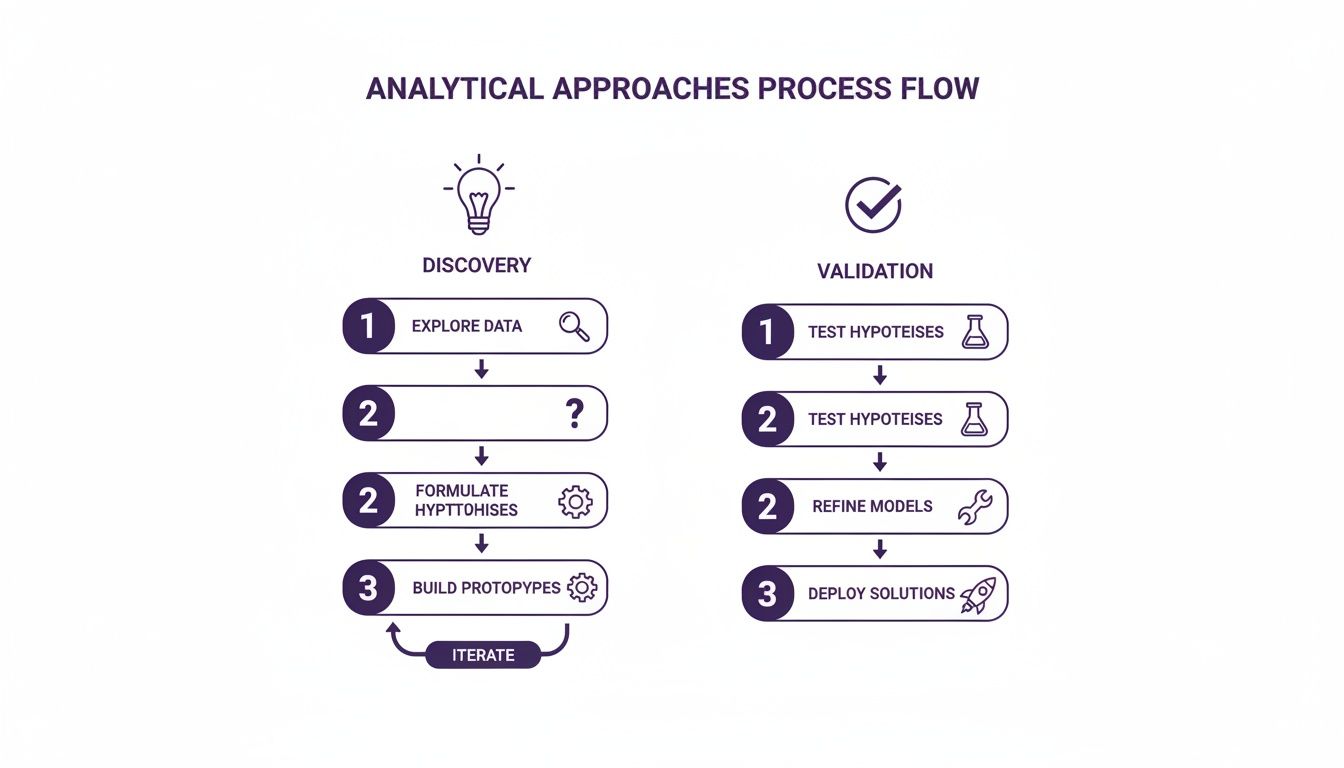
Whether you let themes bubble up naturally from the data or you're testing a specific hypothesis, the goal is always the same: build meaningful categories from your codes. Trying to manage this by hand in a spreadsheet can be a massive headache, which is why many creators use specialized software. For a deeper look at your options, check out our guide to qualitative data analysis tools.
Stage 5: Interpret and Report Your Findings
The final stage is all about making sense of what you've found. What do these themes actually mean for your content strategy? This is where you connect the dots and turn those findings into concrete actions.
Your report doesn't need to be some stuffy, formal paper. A simple summary that outlines the following is perfect:
- Your Key Themes: List the 3-5 biggest patterns you uncovered.
- Supporting Evidence: Back up each theme with a few powerful quotes or direct examples from your content.
- Actionable Insights: For each theme, write down one or two specific actions you'll take. For example, if you found the theme "Audience Seeks Technical Solutions," your next step might be to launch a new "Tech Tuesday" tutorial series.
Follow these five stages, and you'll turn your content library from a passive archive into an active, breathing source of inspiration and growth.
How AI Transforms Content Analysis
Let’s be honest, the biggest hurdle in traditional qualitative content analysis is the sheer time it takes. Manually sifting through hours of video, transcribing podcasts, or just combing through hundreds of articles is a monumental task. This is where modern tools completely change the game.

AI-powered platforms act as your tireless research partner. They automate the most grueling parts of the process, freeing you up to focus on strategy. Imagine ingesting your entire content library and having it automatically transcribed, categorized, and analyzed for key themes in minutes, not weeks. This isn’t about replacing human insight; it’s about amplifying it through healthy and seamless collaboration.
From Manual Labor to Intelligent Collaboration
Historically, doing a deep dive into your content meant a painful tradeoff. You could either spend weeks meticulously coding a few key pieces of content, or you could skim the surface of your entire library and risk missing crucial patterns. AI eliminates that choice.
This human-AI partnership frees you from the tedious work so you can focus on what really matters—discovering breakthrough ideas and creating new value from your existing content. It shifts your role from data processor to strategic thinker, helping you organize your content library to ultimately make money with it.
To really get a feel for how AI is reshaping this space, it’s worth exploring the evolving landscape of AI and its broader uses. Understanding the core tech makes it clear how it can partner so effectively with human researchers to get better, faster insights.
Automating the Heavy Lifting
So, what does this actually look like in practice? AI-driven tools tackle the most laborious steps of content analysis, giving you a massive head start. These platforms organize your content library to unlock new value and ultimately make it easier to monetize your work.
Here’s how they streamline the workflow:
- Instant Transcription: AI can convert hours of audio and video into searchable text almost instantly. This alone saves you from a tedious and costly manual process.
- Automated Coding: Instead of manually reading and applying codes line by line, AI can identify and suggest key concepts, topics, and even sentiment across your entire library in a fraction of the time.
- Pattern Recognition: AI excels at spotting connections and patterns across thousands of documents—things that would be nearly impossible for a human to detect on their own.
This automation directly attacks the biggest historical weakness of content analysis. Manually analyzing 500 pages can take up to 50 hours, a major roadblock for busy creators. AI platforms can classify themes 10x faster, blending search with deep insights. As a real-world example, bloggers using these tools have seen a 28% engagement uplift by optimizing posts based on historical patterns.
The goal of AI in content analysis isn't to take over. It’s to handle the repetitive, scalable tasks so that you, the creator, can spend your time on high-level interpretation, creative strategy, and connecting with your audience on a deeper level.
For creators moving from hobbyist to professional, tools like content intelligence platforms provide the structure needed to organize, understand, and act on insights from your library.
The Power of Human and AI Collaboration
Ultimately, the future of qualitative content analysis lies in a seamless partnership between human creativity and machine efficiency. AI provides the scale, speed, and data-processing power to surface patterns from vast content libraries that we could never manage alone.
But it's the human researcher, creator, or publisher who provides the essential context, curiosity, and strategic interpretation. You are the one who knows your audience, understands the nuances of your niche, and can ask the critical "why" questions that lead to true breakthroughs.
This collaborative model lets you reignite your entire content library. By organizing your past work and understanding its hidden patterns, you can take strategic action to create infinite new value, turning old assets into your next big success.
Putting Content Analysis Into Action
Theory is great, but seeing real results is what really matters. Let's bring qualitative content analysis to life with a few stories from creators who used it to find some serious growth. These three case studies show how turning a curious eye on your own content library can completely reshape your strategy.
These examples prove that analysis isn't just some stuffy academic exercise. It's a practical tool for driving real impact, showing that your best ideas for future content are often hiding in your past work.
The YouTuber Who Mapped Audience Needs
One YouTuber, known for her sharp commentary videos, started to feel like she was losing touch with what her audience really wanted. So, she decided to do a content analysis of the viewer comments on her 20 most-viewed videos from the last year.
Her process was simple but incredibly effective. She created a few basic codes to sort the comments: "Follow-Up Question," "Personal Story," and "Topic Suggestion." After digging through several hundred comments, an undeniable theme jumped out. Viewers were asking the exact same follow-up questions about a specific ethical framework she often mentioned.
This was her 'aha' moment. The audience wasn't just passively watching; they were actively trying to apply her ideas and getting stuck at the same point. This single insight led her to create a brand new series, "Ethics in Practice," which became her most successful content bucket, doubling her subscriber growth rate in just three months.
The Publisher Who Rediscovered Storytelling
A mid-sized digital publisher was battling inconsistent blog engagement. The editorial team had a hunch that certain types of articles did better than others, but they couldn't prove it. They kicked off a content analysis project, comparing their 50 highest-performing articles against their 50 lowest-performing ones from the past two years.
The analysis zeroed in on coding for structural and narrative elements. After a few weeks, the data was crystal clear: articles that featured a strong personal narrative from the author had 70% higher engagement and triple the number of shares compared to the more generic, list-style posts. This insight completely flipped their editorial strategy on its head. They shifted their focus to finding writers who could weave personal stories into their expertise, which led to a lasting increase in reader loyalty and time-on-page.
The Podcaster Who Mastered Emotional Pacing
A popular history podcaster was trying to figure out why some of his episodes had fantastic listener retention while others saw huge drop-offs. He decided to run a qualitative content analysis on the transcripts of his ten most and least popular episodes.
He came up with a unique coding system to map the "emotional arc" of each episode, labeling segments as things like "Tension Building," "Surprising Reveal," or "Character Empathy." The analysis showed that his most successful episodes all followed a predictable emotional rhythm, with a surprising reveal consistently landing around the 30% mark. The less popular episodes? They were emotionally flat or had reveals that came way too late.
Armed with this new understanding of narrative pacing, the podcaster refined his storytelling formula. The result was a boost in his average listener retention by over 15%.
These stories show that content analysis is a powerhouse tool for growth. To see how researchers in other fields are applying these same methods, it's worth exploring different researcher use cases. By systematically digging into your own work, you can uncover exactly what your audience is craving and build a much more successful content engine.
Frequently Asked Questions
Jumping into a systematic analysis of your own content is exciting, but it's natural for a few questions to pop up, especially when you're just getting your sea legs. Let’s tackle some of the most common ones we hear from creators.
My goal here is to give you clear, straightforward answers to demystify the process and get you feeling confident. Think of this as clearing the path so you can start digging for those hidden gems in your content library today.
How Big Does My Content Sample Need to Be?
This is the question everyone asks, and the answer is refreshingly simple: there's no magic number. Qualitative analysis is all about depth and richness, not just counting stuff. The right sample size really just depends on your question and how complex your content is.
For example, a podcaster wanting to spot emerging themes in a new series might only need to analyze the transcripts of 5-10 information-rich episodes. That’s often more than enough to see patterns. But if a publisher wants to understand broad trends across their entire blog archive, they might need to sample 50-100 articles to get the full picture.
The real goal is to hit data saturation. That’s the point where you stop hearing new ideas and start seeing the same patterns over and over again. Once you hit saturation, you can feel pretty good that your sample size is big enough.
The best advice? Start small and add more if you need to. A deep, thorough analysis of a small, well-chosen sample is way more valuable than a shallow skim of an overwhelmingly large one.
What's the Difference Between a Code and a Theme?
It’s super easy to mix these two up, but getting the distinction right is key to a solid analysis. The best way to think about it is like building with LEGOs.
A code is a single LEGO brick. It's a simple, descriptive label you slap onto a specific idea you find. For instance, digging through your YouTube comments, you might use codes like "technical question," "positive feedback," or "success story." These codes are the tiny, raw data points you're collecting.
A theme, on the other hand, is the cool spaceship you build with all those bricks. It’s the bigger, more interpretive pattern that starts to take shape when you group your related codes together.
Let’s say you keep seeing the codes "technical question," "software confusion," and "workflow problem." When you cluster them, they tell a much bigger story—the overarching theme that "The Audience is Looking for Actionable Technical Help."
- Codes are the what—the individual pieces of data.
- Themes are the so what—the story that data tells when you put it all together.
Do I Need to Be a Trained Researcher to Do This?
Not at all. While academics get formal training in this stuff, the core ideas are incredibly intuitive for any creator. You definitely don’t need a Ph.D. to pull powerful insights from your own work.
Honestly, the most important skills are ones you already have in your toolbox as a creator: a natural curiosity, a good eye for detail, and a genuine desire to understand your audience. The process is systematic, sure, but it’s also really creative. It's about being methodical while staying open to the unexpected patterns you’ll find along the way.
Plus, modern tools are built to do a lot of the heavy lifting, like transcription and organization. This frees you up to focus on the fun part—interpreting what you find and deciding what to do about it. If you can start with a clear question and stick to your process, you’re more than ready to uncover some game-changing information.
How Do I Make Sure My Own Bias Doesn't Affect the Results?
This is a fantastic question, and the fact that you’re asking it shows you're already thinking like a researcher. The first and most important step is just admitting that bias is a real thing. We all have our own perspectives and assumptions. The trick is to have a few practical guardrails in place.
First, create a clear codebook. This is just a simple document where you define each code and spell out exactly when to use it (and when not to). It forces you to be consistent and stops you from coding based on a gut feeling that changes from day to day.
Second, if you can, grab a friend or colleague and ask them to code a small chunk of the same content using your codebook. Then, compare your notes. This little exercise, called "inter-coder reliability," is an incredibly powerful way to see where your personal interpretations might be coloring the results.
Finally, actively play devil's advocate with yourself. Once you think you've spotted a theme, go back to the content and deliberately look for evidence that contradicts it. This practice, known as "negative case analysis," makes your final conclusions so much stronger because you know they can hold up to scrutiny. Being aware of your blind spots is the best way to produce findings that are both insightful and trustworthy.
Ready to stop guessing and start knowing what your audience truly wants? Contesimal helps you organize your content library to create new value and ultimately make money with it. Turn your old longform content into a money maker today. https://contesimal.ai