A Video Sales Letter (VSL) is basically a sales page that talks. It’s a direct-response video built to convince someone to take a very specific action, like whipping out their credit card and making a purchase. Instead of relying on text alone, it uses video, voice, and storytelling to deliver a much more personal and persuasive pitch.
What Are Video Sales Letters And Why They Convert

Ever found yourself glued to a video that just gets you? One that lays out a problem you’ve been struggling with and then, step by step, reveals the perfect solution? Chances are, you were watching a VSL.
Unlike a quick social media ad, a video sales letter is deliberately structured to walk a viewer through an entire sales argument. It grabs their attention, builds a powerful case, and closes the deal. It’s a specialized corner of the video marketing for social media world, but with one obsessive focus: conversion.
The real genius of a VSL is its psychological framework. It isn't just a product demo; it’s a carefully crafted narrative. The script pinpoints a specific pain, pokes at it by detailing the consequences of ignoring it, and then presents your product as the only logical—and emotionally satisfying—way out.
The Psychology Behind Their Success
A solid VSL forges an intimate connection that text just can't replicate. The human voice, with all its natural tone, passion, and inflection, is a powerful trust-builder. When viewers feel like they're being spoken to directly by someone who genuinely understands their problem, their defenses drop. That direct-to-camera or voiceover style feels less like a sales pitch and more like getting advice from a trusted expert.
The narrative structure also lets you get ahead of objections before they even form. Just as a viewer thinks, "But will this really work for me?" your script is already rolling a testimonial or case study that proves it will. This is a fundamental principle of great copywriting for a website, just supercharged by the dynamic energy of video.
At its core, a VSL doesn't just sell a product; it sells a transformation. It paints a vivid picture of the viewer's life after their problem is solved, making the decision to buy feel less like a transaction and more like an investment in their own future success.
To help you map this out, here’s a quick breakdown of what makes a VSL tick.
Anatomy Of A High-Performing VSL
This table breaks down the essential elements every VSL needs to be effective, providing a quick reference for planning.
| Component | Purpose | Key Takeaway |
|---|---|---|
| The Hook | Grab attention immediately. | Start with a bold claim, a relatable story, or a shocking statistic. |
| Problem Agitation | Make the pain point feel urgent. | Describe the real-world consequences of not solving the problem. |
| Solution Intro | Introduce your product as the "hero." | Position your solution as the answer they've been searching for. |
| Credibility | Build trust and authority. | Use testimonials, case studies, data, and social proof. |
| The Offer | Clearly state what they're getting. | Detail the product, bonuses, and the total value proposition. |
| Call to Action | Tell them exactly what to do next. | Use clear, urgent language like "Click the button below to get started." |
Each of these components works together to guide the viewer from skepticism to action, making the VSL a powerful conversion machine.
A Proven Tool for Modern Marketers
VSLs have come a long way from being a niche tactic to a cornerstone conversion tool, all thanks to the explosion of online video. It's a simple equation: as video consumption soared, so did the potential for long-form sales content.
By 2025, it's estimated that video will make up 82% of all global internet traffic. Combine that with a projected ad spend on video hitting over $190 billion in 2025, and it’s crystal clear why marketers are pouring resources into formats like VSLs to cut through the noise and drive real revenue. Understanding these powerful video marketing trends is key to seeing why VSLs aren't just a trend—they're a fundamental part of a modern sales strategy.
Lay the Groundwork Before You Ever Hit Record
A killer video sales letter is made long before you even think about cameras and microphones. The VSLs that feel the most natural and persuasive are actually the product of some serious strategic work. This early stage is where you build the entire case for your product, making sure every word you eventually write hits with purpose.
Jumping straight into scripting is like building a house without a foundation. Sure, you might end up with something that looks okay, but it'll crumble under the first hint of skepticism from a viewer. The goal here is to get inside your audience's head so deeply that your VSL feels like a one-on-one conversation answering the questions they haven't even thought to ask yet.
Get to Know Your Audience—Really Know Them
First things first, you need a detailed customer profile. But I'm talking about going way beyond the basic demographics. Knowing their age and location is fine, but a VSL that actually converts speaks to your audience's internal world.
Your mission is to uncover their deepest pain points and their secret desires. What are the nagging, frustrating problems they deal with every single day that your product solves? You have to dig deeper than the surface stuff. For example, if you're a content creator, the pain isn't just "being disorganized." It’s the constant anxiety of missing deadlines, the gut-wrenching frustration of working late again, and the quiet fear of falling behind your competition.
Just as important are their dreams. What does their ideal "after" state look like? They don't just want a neat content calendar; they want to feel in control, to reignite their content library, and to finally build a revenue-generating entity from their passion.
A powerful VSL doesn't sell features; it sells a transformation. It’s the bridge between your customer's current, frustrating reality and the future they desperately want. Your script is just the map showing them how to cross it.
To get this kind of intel, you have to become an obsessive researcher.
- Read the reviews: Go through the reviews for your products and your competitors' products. Look for the exact words and phrases people use to talk about their problems and what they loved (or hated) about the solutions they've tried.
- Haunt the forums: Dive into Reddit, Facebook Groups, and wherever else your audience of YouTubers, Podcasters, and Marketers hangs out. Pay close attention to their rants, their questions, and what they wish they had.
- Survey your people: If you've got an email list or a social media following, just ask them. Send out a simple survey asking about their biggest challenges with creating new value from their existing content.
This isn't just about understanding them; it's about borrowing their language. When your VSL script uses the same words they use, it creates an instant connection and builds a ton of trust.
Unlock the Gold in Your Own Content Library
If you’re a creator with a backlog of videos, podcasts, or blog posts, you have a goldmine of proven ideas and authentic customer language. The only problem? Sifting through hours of it manually to find the next great concept or the perfect soundbite for a VSL is a total nightmare.
This is where a tool like Contesimal becomes a game-changer. It's software that allows content creators to organize their library to create new value. You can upload your entire content archive and instantly search across everything you've ever created to pull out themes, discover insights, and collaborate with your team or even AI.
Let's say you're a YouTuber who makes tutorials for other creators. You could ask Contesimal to find every single time your audience asked a question about "getting more views" in your video comments. In seconds, you'd have a list of their most urgent concerns, in their own words, ready to be dropped right into your VSL script.
You can also use it to reignite your best stuff.
- Find Your Best Stories: Quickly pull up the most compelling case studies or personal stories you've ever shared—the ones that got the most comments and shares.
- Identify Proven Hooks: Figure out which of your video intros or blog headlines got the most engagement. That's a proven starting point for your VSL hook right there.
- Source Authentic Language: Pull direct quotes from old Q&A sessions or interviews to make sure your script sounds like a real person talking, not a corporate robot.
By mining your own content, you're not just guessing what might work. You’re using cold, hard data from your own greatest hits to build a VSL that's authentic, targeted, and way more likely to convert. It ensures your message isn't just what you think your audience wants to hear—it's what they've already told you they need.
How To Script A VSL That Persuades and Sells
The script is the soul of your video sales letter. It’s the invisible engine pushing every second of your viewer's journey, steering them from mild curiosity all the way to a firm decision. A solid script doesn't just rattle off features; it weaves a story that clicks emotionally, builds undeniable logic, and makes your offer feel like the only choice that makes sense.
This simple flowchart breaks down the core path from understanding who you're talking to, to grabbing their attention, and finally, crafting the perfect offer they can't refuse.
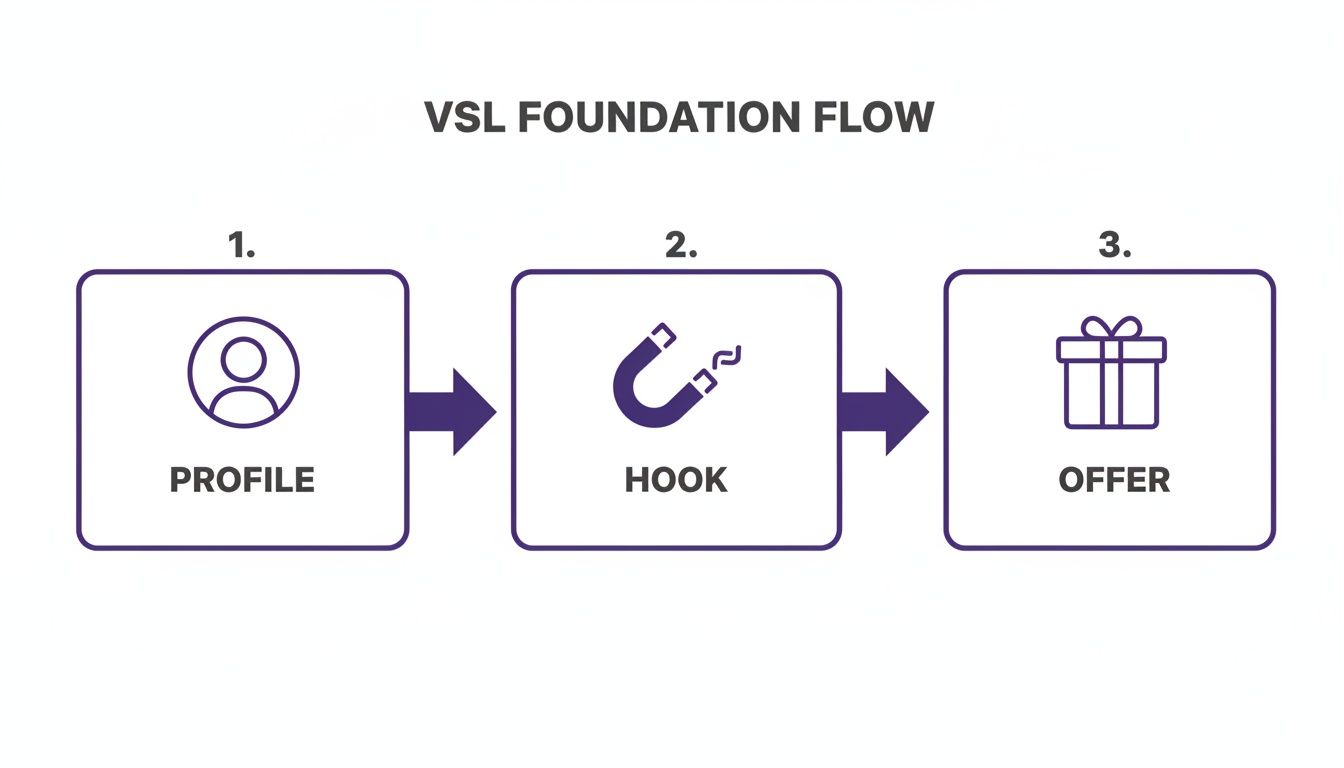
As you can see, it all starts with a deep audience profile, moves to a magnetic hook, and ends with an irresistible offer. Let's dig into each part.
Crafting a Hook That Demands Attention
You’ve got less than 15 seconds to convince someone your video is worth watching. A weak opening is a death sentence—they'll just keep scrolling, no matter how amazing the rest of your video is. Your hook needs to be sharp, specific, and instantly relevant to their world.
Forget the generic "Hi, my name is…" intros. Lead with a bold claim, a surprising statistic, or a deeply relatable question that pokes at their biggest frustration. The goal is to make them stop and think, "Wait, this is for me."
Here are a few hook formulas I’ve seen work wonders:
- The "What If" Hook: "What if you could turn your old content into your biggest money-maker without filming a single new video?" This paints a vivid picture of their ideal future.
- The Shocking Statistic Hook: "Did you know that 7 out of 10 content creators burn out before they ever monetize their channel? Here’s how you can avoid becoming one of them." Using data creates instant urgency.
- The Relatable Story Hook: "I still remember the feeling of staring at a blank page, totally out of ideas, with a deadline breathing down my neck. I was convinced my creativity was gone for good." This builds an immediate emotional bridge.
This initial grab is everything because it sets the stage for your entire argument. Once you have their attention, your next job is to make them feel completely understood.
Agitating the Problem with Storytelling
Now that you've hooked them, it’s time to twist the knife a little. This is where so many creators miss the mark. They'll state the problem and immediately jump to their solution, which just feels like a rushed, impersonal sales pitch.
Don't do that. Instead, you need to agitate the problem. Use storytelling to paint a clear picture of what happens if they don't solve it. Talk about the frustration, the wasted hours, the missed opportunities, and the emotional drain of having a massive, disorganized content library you can't use. This isn't about fear-mongering; it's about building genuine empathy and showing them you get their struggle.
The most persuasive VSLs make the viewer feel seen. They don't just sell a product; they validate the customer's frustration and then offer a clear path forward.
For example, if you're selling a tool that helps YouTubers script videos, don't just say, "Writing scripts is hard." Talk about that soul-crushing feeling of spending days on a video only to see it flop because the story just didn't connect. A well-written script is more than just talking points; our guide on how to write a script for a YouTube video really unpacks how it can fundamentally change your audience engagement.
Presenting Your Irresistible Solution and Offer
Only after you’ve thoroughly agitated the problem should you bring in your product as the hero of the story. Position it not as a list of features, but as the exact solution to the specific pain you just spent time detailing.
This needs to be the "aha!" moment for your viewer. You have to frame every feature as a direct benefit that solves a piece of their problem.
| Feature | Connects to… | Benefit (What you say in the VSL) |
|---|---|---|
| AI-powered search | Writer's block | "So you can instantly find your best ideas and never stare at a blank page again." |
| Collaboration tools | Feeling isolated | "Which means you can get feedback from your team in real-time, making content creation faster and more fun." |
| Content repurposing | Wasting old content | "Allowing you to upcycle one great video into ten new pieces of content without any extra work." |
After you’ve revealed the solution, it's time to present the offer. This is where you lay out the price, pile on any bonuses, add a guarantee to reverse their risk, and give them a clear reason why they need to act now. Scarcity (like "Only 50 spots available") and urgency (like "This offer ends Friday") are classic for a reason—they work.
The Final Push: A Powerful Call to Action
Your Call to Action (CTA) must be impossible to misunderstand. Tell the viewer precisely what to do next, step-by-step. Use clear, command-oriented language like "Click the big red button below this video" or "Enter your information on the right to get started."
Remind them of the value they’re about to get and the painful "before" state they're leaving behind. This final instruction is critical for turning passive viewers into paying customers. The data backs this up—sales teams that send a video can boost proposal engagement by 56% and close deals about 26% faster. In fact, an incredible 83% of sales opportunities started when a video was the first point of contact, proving just how powerful a well-made VSL can be. You can dive deeper into the numbers by checking out the full research on video sales and marketing stats.
Think of your script as a strategic conversation. A strong CTA is the perfect, persuasive closing line.
Bringing Your VSL to Life With the Gear You Already Have
Alright, you've got a killer script in hand. Now it's time to actually record the thing. This is where a lot of people freeze up, imagining they need a professional studio and a budget the size of a small country to create a VSL that works.
Let me tell you right now: you don't.
The entire point of a VSL isn't to win an Oscar for cinematography. It's about authentic connection and crystal-clear communication. Your audience cares way more about the solution you're offering than the model of camera you used. In fact, an overly polished, slick production can sometimes feel corporate and untrustworthy. A simple, direct-to-camera video often feels more genuine.
The truth is, the smartphone in your pocket is more than powerful enough to create a VSL that converts like crazy. It's all about knowing how to use it.
First, Pick Your VSL Style
Before you hit that big red record button, you need to decide what this VSL will actually look like. This choice should be based on your script, your offer, and honestly, your own comfort level. You don't have to be on camera to make a successful VSL.
Here are a few of the most popular and effective styles I've seen work time and time again:
- The Talking Head: This is the classic. It's just you, speaking directly to the camera. This style is fantastic for building a personal connection and establishing yourself as an authority. People see your face, they connect with your passion, and they're more likely to trust you.
- The "Doodle" or Text-on-Screen: Some of the highest-grossing VSLs of all time are nothing more than text and simple graphics on a plain background, driven by a powerful voiceover. This style forces 100% of the focus onto your words and is the perfect escape hatch if you're camera-shy.
- The Screencast or Demo: If you're selling software, a digital tool, or some kind of process, a screen recording is incredibly powerful. You can literally walk viewers through your product in real-time, showing them exactly how it solves their problem.
Your voice and your script are doing all the heavy lifting in a VSL. The visuals are just there to support the message, not overshadow it. Pick the style that lets you deliver your script with the most confidence and clarity.
And don't feel like you're locked into just one. Many of the best VSLs mix and match. You might start with a talking head intro to build that initial rapport, then switch to a screencast to demo your product in action.
Nail the Two Things That Actually Matter: Audio and Lighting
If you're going to spend a little extra time and effort on just two parts of your production, make it audio and lighting. These two elements have a massive impact on how professional and trustworthy your video feels, and you can get amazing results with barely any gear.
For Crystal-Clear Audio
Your phone's built-in mic is designed to pick up sound from all directions. That means it's also picking up the echo from your room, the air conditioner hum, and your dog barking downstairs. Bad audio is infinitely more distracting than slightly grainy video. Getting it right is non-negotiable.
A simple, inexpensive lavalier microphone that clips onto your shirt will make a night-and-day difference. It isolates your voice and gives you that crisp, clear sound you hear on podcasts. These mics often plug right into your phone's headphone jack and can cost less than a pizza.
For Flattering Lighting
Forget about complex, three-point lighting setups. The best and cheapest light source you own is a window.
Just set up your camera or phone between you and the window, so you're facing the natural light. This will light up your face evenly and get rid of any weird, harsh shadows.
If you're recording at night or don't have a good window, a simple ring light is your next best friend. They're affordable and designed to create soft, appealing light that makes anyone look good on camera.
Delivering Your Lines with Confidence
Recording yourself can feel awkward at first, but your delivery is what makes the script connect. You want to sound like you're having a passionate, one-on-one conversation with a friend, not like you're reading an essay for English class.
A teleprompter app on your phone or tablet can be an absolute lifesaver. It scrolls your script right over the camera lens, so you can read your lines while maintaining that crucial eye contact with your viewer.
Before you record for real, practice your script out loud a few times. This helps you find a natural rhythm and smooth out any phrases that sound clunky when spoken. Remember to speak just a little bit slower than you normally would and use pauses to add emphasis. Your energy and genuine belief in what you're selling will shine through and make your VSL that much more persuasive.
Launching and Optimizing Your VSL for Maximum Impact
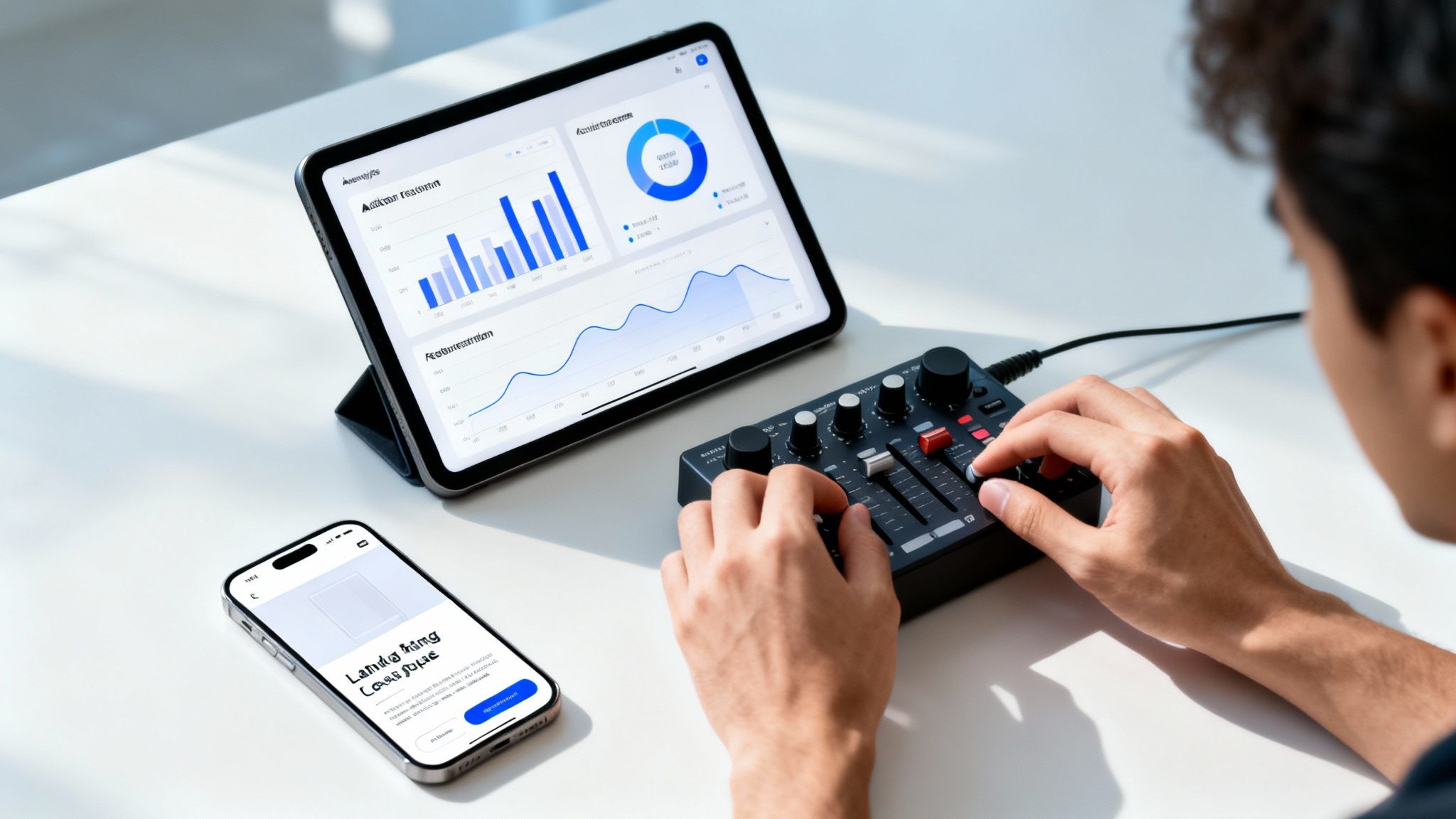
Creating a brilliant video sales letter is only half the battle. Let's be honest, if the right people never see it, even the most persuasive script in the world won't make a dime.
An effective launch is all about creating the perfect environment for your VSL to succeed and then getting it in front of your ideal customer. This process starts with its home base: the landing page.
Your VSL should be the undeniable star of the page, placed front and center, usually above the fold. The headline needs to grab attention and perfectly mirror the core promise you made in the first 15 seconds of your video.
And that call-to-action (CTA) button—the "Buy Now" or "Get Started"—has to be unmissable. Make it visually distinct and place it strategically so it’s right there the moment your offer is revealed.
Building the Perfect Home for Your VSL: The Landing Page
A high-converting landing page is designed with a single goal: get the visitor to watch the VSL and click the button. That’s it. Simplicity is your best friend here.
- Eliminate Distractions: Kill any unnecessary navigation, links, or sidebars. Every single element on the page should either support the VSL or guide the user straight to the CTA.
- Reinforce the Message: Use subheadings and bullet points below the video to hammer home the key benefits of your offer. This gives skimmers a reason to stop and press play.
- Inject Social Proof: Add a few powerful testimonials or trust badges directly below the video player. This builds instant credibility and eases that natural purchase anxiety.
Beyond just the VSL itself, understanding how the entire page performs is key. It's about improving landing page relevance and boosting your ROAS to make sure every ad dollar is working as hard as possible for you.
Getting Your VSL in Front of the Right Eyeballs
Once your landing page is locked and loaded, it’s time to drive targeted traffic. Don't just post it once and hope for the best. A multi-channel distribution strategy gives your VSL the best shot at success.
Your email list is almost always the best place to start. These are people who already know you, so they're the warmest possible audience. Send a dedicated email campaign that builds curiosity and drives them directly to your VSL page.
Targeted social media ads are another beast entirely. Platforms like Facebook and YouTube let you show your VSL to hyper-specific audiences based on their interests, behaviors, and demographics.
A common mistake is using the full-length VSL as a social media ad. Don't do it. Instead, create a short, 30-60 second "trailer" version of your VSL that acts as a powerful hook, then drive clicks to the landing page where the full sales argument can unfold.
This hybrid approach works wonders with modern viewing habits. While 83% of video marketers lean on short-form content for social engagement, the long-form VSL remains a conversion king on landing pages. Viewers who click through from an ad are showing higher buying intent, making them much more receptive to your full pitch.
Tracking the Metrics That Actually Matter
Launching is just the beginning. The real magic happens when you start optimizing based on real data. To do that, you need to ignore vanity metrics (like total views) and focus on the numbers that tell you what’s working and what’s falling flat.
Here are the three most important metrics to obsess over for your video sales letters:
- Audience Retention Rate: This graph is your truth-teller. It shows you exactly where viewers are dropping off. A huge dip in the first 30 seconds? Your hook is weak. A mass exodus when you introduce the price? Your value proposition isn't strong enough.
- Click-Through Rate (CTR) on your CTA: This measures the percentage of viewers who actually clicked your "buy" button. A low CTR often means your call to action isn't clear, urgent, or compelling enough.
- Conversion Rate: This is the bottom line—the percentage of landing page visitors who become customers. This tells you how well the entire system (the ad, the landing page, and the VSL) is working together.
By closely watching these key performance indicators, you can make informed tweaks to your script, your page design, and your distribution strategy. For a deeper dive into this process, check out our guide on how to analyze content performance. This data-driven approach is what turns a good VSL into an automated, reliable sales machine for your business.
Have Lingering Questions About VSLs? Let's Clear Them Up.
Even with a killer script and a solid production plan, a few questions always seem to pop up, especially if this is your first time creating a video sales letter. It's totally normal. These are the little practical details that can trip people up, but the answers are usually simpler than you think.
Let's tackle the most common ones so you can move forward and get your VSL launched.
How Long Should My Video Sales Letter Be?
The honest, no-fluff answer? It needs to be as long as it takes to make the sale, and not a single second longer. There’s no magic number.
For simpler, lower-priced products, you can often get the job done in the 5-12 minute range. That’s usually enough time to hook your viewer, agitated the problem, and deliver a compelling offer without them bouncing.
But when you're dealing with high-ticket offers or an audience that needs a lot more convincing, VSLs can easily run 20-45 minutes or even longer. That extra time gives you the runway to build a much stronger case, tell more compelling stories, and systematically dismantle every objection a viewer might have.
Don't get fixated on the clock; focus on delivering value and holding attention. An engaging 30-minute VSL that builds an airtight case will always crush a rushed 5-minute video that fails to connect.
The real key is to keep an eye on your audience retention data. If you see a massive drop-off at a specific point, that's a signal to tighten up your script—not a sign that your video is just "too long."
Do I Have To Be On Camera For My VSL To Work?
Not at all. While showing your face can definitely build a personal connection and boost trust, many of the highest-grossing video sales letters are completely faceless. Your persuasive script and a clear, engaging voiceover are what truly matter.
The most popular alternative by far is the "Doodle" or text-on-screen style. This is where text and simple graphics pop up on the screen to match your narration, forcing the viewer to hang on your every word.
Other faceless VSL styles that work incredibly well include:
- Animated Slides: Simple presentation slides with dynamic transitions can be shockingly effective. Think of it as a PowerPoint on steroids.
- Screen Recordings: This is the gold standard for software or any digital product. You're not just telling them your solution works; you're showing them.
- Stock Footage: Weaving in relevant B-roll and stock video clips can add a ton of visual interest and emotional punch to support your voiceover.
If your voice connects with the viewer and tells a powerful story, the visuals can be dead simple and still drive huge conversions.
What Are The Biggest Mistakes To Avoid?
The most critical errors in a VSL almost always happen before you even think about hitting "record." They are strategic mistakes, not technical ones.
The first is a weak hook. If you don’t grab someone's undivided attention in the first 15 seconds, it's over. The rest of your brilliant script is wasted because they've already clicked away.
Second is getting bogged down in product features instead of the customer's transformation. Nobody buys a list of specs. They buy a better version of themselves. You have to frame every feature as a direct benefit that solves their biggest pain points.
The third mistake, and probably the most common, is a vague or weak Call to Action (CTA). After you’ve spent all this time building a powerful, emotional case, you have to tell your viewer exactly what to do next, why they need to do it right now, and what amazing thing will happen after they click. Be direct, be clear, and be confident in your close.
As you refine your VSL scripts, remember that your existing content is a goldmine of proven ideas, customer language, and compelling stories. Contesimal helps you instantly organize, understand, and take action on your entire video and text library to find those winning elements, ensuring every VSL you create is built on a foundation of what already works for your audience. Discover how you can turn your content archive into your next big seller at https://contesimal.ai.