
Content marketing solutions are simply the tools and strategies that help you organize, repurpose, and monetize your content library. If you’re a creator—whether you’re a YouTuber, podcaster, or an established publisher—you’re likely sitting on a massive archive of past work. That history holds untapped potential, but turning it into fresh value can feel completely overwhelming without the right approach to upcycle your old content and create new value.
The Hidden Goldmine in Your Content Library
Think about it. Every piece of content you've ever created—every blog post, video, podcast episode, or social media update—is an asset. Together, they form a library that documents your expertise, chronicles your brand's journey, and holds countless clues about what truly connects with your audience. Reignite your content library and bring it to life!
The problem? For most creators, this library is just a disorganized and dormant archive. It’s like a filmmaker with reels of incredible footage scattered across unlabeled hard drives. This "archival chaos" makes it nearly impossible to find what you need, let alone build upon past successes. You might have amazing evergreen content that could drive traffic today, but it’s buried under years of new material. That’s a huge missed opportunity to generate engagement and ultimately make money.
From Hobbyist to Professional
Making the leap from a hobbyist creator to a professional, revenue-generating operation demands a systematic approach to your content. It’s not just about what you’re creating next; it's about building a sustainable content engine that works for you. This is where modern content marketing solutions become a total game-changer, especially for creators needing to align content across many platforms.
These tools are built to breathe new life into your content library. They introduce a crucial idea: content value expansion. Instead of letting old work fade into the digital ether, you can actively upcycle it to create new value. To truly transform your content library into a goldmine, you’ll want to adopt advanced knowledge management strategies that get the most out of every single asset.
The core idea is simple but powerful: Organize your library to understand what works, then take action to monetize those insights. This process is the key to scaling your reach and impact across every platform.
The Power of AI-Powered Organization
So, how do you even begin to tackle a library with hundreds or even thousands of assets? The answer is in platforms that help humans and AI collaborate in a healthy, seamless way. These solutions can ingest your entire history and automatically build a searchable, intelligent system out of it.
This unlocks the ability to:
- Organize: Instantly categorize and tag every single piece of content by topic, theme, format, or performance. No more manual sorting.
- Understand: Discover the hidden patterns in your most successful work. You can see which concepts consistently drive engagement or which video formats lead to the most subscribers.
- Take Action: Effortlessly find clips, quotes, or data points from your past work to create new, high-value assets like social media shorts, "best-of" compilations, or detailed guides.
By putting the right solution in place, you can finally unlock that hidden goldmine in your archives. You’ll turn your content history from a dusty closet into your greatest asset for future growth, allowing you to create infinite content value.
Understanding the Modern Content Marketing Ecosystem

Today’s creators are swimming in a sea of content marketing solutions. The market is jam-packed with tools for every stage of the process, from sparking that first idea to analyzing the final click. While it can feel a bit dizzying, most of these tools fall into a few simple buckets.
You've got your creation tools, like AI writers that can bust through a tough case of writer's block. Then there are distribution platforms, like social media schedulers that push your content out to the world. And of course, there are the analytics and SEO tools that tell you what’s hitting the mark and what’s falling flat.
Each one has its place. But here’s the thing—they almost always miss the biggest headache for experienced creators, publishers, and brands: the mountain of content you've already made. This is where "archival chaos" sets in.
The Challenge of Archival Chaos
Picture a huge, beautiful library filled with priceless books and films, but there's no librarian and no card catalog. That’s what archival chaos feels like. Your best work—the clips that could become your next viral hit or the article that could anchor a new product—is lost in a digital mess of random folders, forgotten hard drives, and disconnected cloud accounts.
This disorganization traps you in a hamster wheel of constantly creating brand-new content from scratch. Why? Because digging up and repurposing your old gold is just too hard. This is a massive drag on your efficiency, especially as you grow from a hobbyist into a pro who needs to generate real, consistent revenue.
The global content marketing market is expected to explode from $413.2 billion in 2022 to an unbelievable $2 trillion by 2032. With 71% of marketers saying content has become more important in the last year alone, finding a smart way to manage and reuse your existing work isn't just a nice-to-have. It's a must-have for survival. You can get the full scoop on these trends and see why AI-powered library tools are becoming so important in this deep dive into content marketing statistics.
Comparing Content Management Approaches
To really get what's happening in content management, it helps to put the old ways side-by-side with modern, AI-powered solutions. The change isn't just about making things easier; it's about unlocking abilities you never had before.
Traditional vs Modern Content Library Management
The table below breaks down the fundamental shift from juggling spreadsheets and folders to using an intelligent platform to manage and monetize your life's work.
| Feature | Traditional Methods (Spreadsheets, Folders) | Modern Solutions (e.g., Contesimal) |
|---|---|---|
| Searchability | Limited to basic keyword or filename searches. Finding a specific concept or clip is nearly impossible without perfect memory. | AI-driven semantic search understands context. You can ask complex questions like, "Show me all video clips where we discussed audience growth." |
| Organization | Entirely manual. Requires hours of diligent tagging, sorting, and folder structuring that quickly becomes outdated and inconsistent. | Automated taxonomy and tagging. The system analyzes content and organizes it by topic, theme, sentiment, and performance metrics. |
| Collaboration | Fragmented and inefficient. Sharing files via email or links leads to version control issues and siloed knowledge. | Centralized, collaborative hub. Teams can work together within the platform, sharing insights and brainstorming new ideas from the same source of truth. |
| Insight Generation | Relies on manual analysis of disparate data points. Identifying trends across your entire library is a massive undertaking. | Proactive, AI-driven insights. The system reveals hidden patterns, identifies top-performing content clusters, and suggests new opportunities for repurposing. |
At the end of the day, old-school methods leave you with a static, dusty archive. In contrast, modern content marketing solutions turn your library into a living, breathing engine for your business. It's about more than just organizing your past—it's about understanding what truly connects with your audience and being able to act on that knowledge instantly.
What a Powerful Content Solution Actually Needs
What separates a good tool from a great one? When you're looking at content marketing solutions to get more out of your library, it’s not about flashy features. The best platforms share a core set of capabilities that work together, turning archival chaos into actionable creativity.
These aren't just bells and whistles. They’re the engine that helps you organize your past work, understand what made it successful, and act on those insights fast. Think of it as upgrading your content library from a dusty storage unit into an active growth engine.
AI-Driven Semantic Search
Let's be honest, standard keyword search is on its way out. If you’re trying to find a specific clip in a video or a concept in an old blog post, you shouldn't have to guess the exact phrase you used years ago. This is where semantic search changes the game.
Instead of just matching words, it understands the meaning and context behind what you're asking. It lets you ask complex, conversational questions and get back genuinely relevant results in seconds.
For example, a podcaster could just ask:
"What were our top three most popular guest topics related to marketing last year?"
An AI-powered solution would scan hundreds of hours of transcripts, check audience engagement data, and spit back a data-backed answer, complete with links to the exact moments in each episode. This feature alone can turn a week-long research project into a five-minute task. That's more time you can spend planning your next hit season.
Automated Taxonomy and Content Tagging
Trying to manually organize a huge content library is a recipe for inconsistency and burnout. A top-tier solution automates this headache by building an intelligent taxonomy—a smart, structured classification system for every single asset you own.
As soon as you upload your content, the platform gets to work, automatically analyzing and tagging every video, article, and audio file based on things like:
- Themes and Topics: Finding recurring concepts and subject matter clusters you might not have noticed.
- Performance Metrics: Tagging content based on what actually performed well—views, engagement, or even conversions.
- Sentiment: Understanding the tone and emotional vibe of each piece.
Suddenly, you have a dynamic, searchable map of your entire content universe. You can instantly filter for all your highest-performing "how-to" videos or find every blog post that got rave reviews from your audience. This kind of organization is the foundation for any good content repurposing strategy. If you want to go deeper, our guide on content intelligence platforms breaks down exactly how these systems operate.
Seamless Human-AI Collaboration
The best content marketing solutions don't replace human creativity; they supercharge it. They’re built to feel less like rigid software and more like an incredibly knowledgeable creative partner. The goal is a seamless collaboration between you and the AI, especially when you need to bring more people in to grow.
Imagine you're trying to brainstorm a new video series. You could prompt the AI with, "Analyze our most-shared content from the last six months and suggest five new video ideas that build on those themes." The AI becomes your research assistant, serving up data-driven suggestions. You then take that raw material and refine it with your own unique vision and storytelling flair.
This blend of machine-speed analysis and human ingenuity is where the magic really happens. It’s how you create more resonant content, faster than ever before.
Bringing Your Content Archive Back to Life
So, you've built up a massive library of content. Awesome. But let's be honest, most of it is probably sitting in a digital dusty corner, not doing much of anything. It’s time to change that. Turning that dormant archive into an active engine for growth isn't some mystical process; it's about having a practical plan to turn your old longform content into a money maker today.
This is where you move from theory to action, transforming a jumble of forgotten assets into a source of near-infinite value. The whole thing starts with a simple first step: getting all your stuff in one place. After all, you can’t organize what you can’t see.
A Roadmap to Reignite Your Library
Unlocking the gold hidden in your archive comes down to a clear, repeatable process. Each stage builds on the last, giving you a system for finding, repurposing, and even monetizing your best work. Think of it as a framework for systematically mining the insights you've already created.
Here’s how it breaks down:
- Consolidate All Your Assets: Pull everything together—every video, blog post, podcast, and transcript—into a single, accessible location. This is ground zero. You can't start the real work until this is done.
- Ingest and Tag the Entire Library: Now, feed it all into a smart platform. The right tool will automatically watch, read, and listen to every piece of content, applying intelligent tags based on topics and keywords without you having to lift a finger.
- Identify High-Performing Clusters: This is where the magic happens. Use AI-powered search to find your evergreen topics. You can ask natural questions like, "What were our most-shared videos about productivity?" to instantly surface the content clusters that your audience absolutely loves.
This diagram shows you just how straightforward the workflow can be, moving from raw assets to organized ideas.
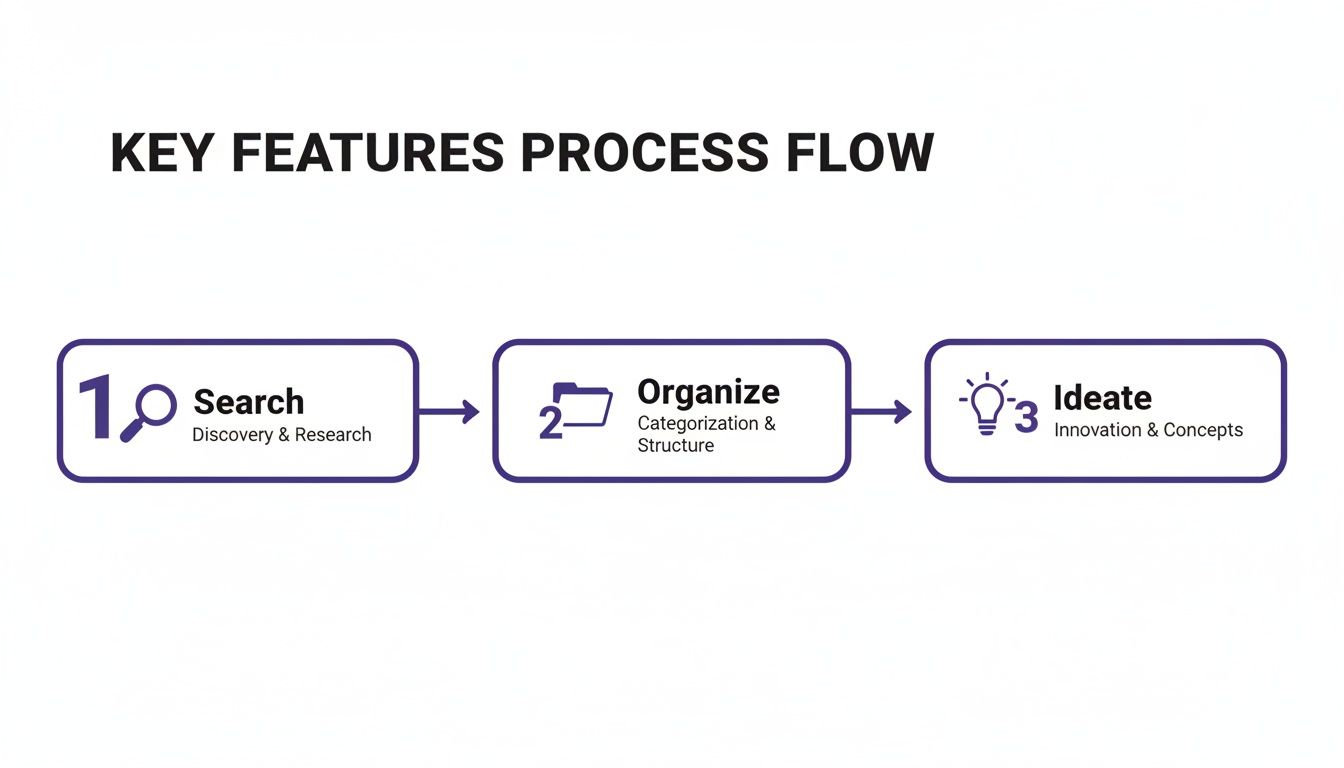
This simple flow—search, organize, ideate—turns what used to be a monumental task into three manageable steps. It empowers creators to stop guessing and start systematically finding their best material.
Turning Insights into Action
Okay, your content is organized and you’ve pinpointed your winning topics. The final steps are all about creation and distribution. This is where those newfound insights become tangible assets that expand your reach and fire up your audience all over again.
- Brainstorm New Content Angles: Take that old material and give it a fresh spin. A successful blog series can become the script for a new video. A popular podcast episode can be chopped into a dozen social media clips. For a deeper dive, check out our complete guide on powerful content repurposing strategies.
- Develop a Cross-Platform Plan: Map out a distribution schedule. A single piece of revived content can fuel your social media, email newsletter, and blog for weeks, squeezing every last drop of value out of it.
The importance of this can't be overstated. A whopping 71% of marketers say content marketing has become more important to their business. And while 54% of businesses spending over $2,000 per piece see big success, many still get bogged down by disorganized processes (25%) and the struggle to produce quality material (24%).
This is exactly where AI-driven platforms are stepping in to close the gap, helping creators finally overcome those hurdles and turn their libraries into real, revenue-generating assets.
Real-World Creator Success Stories
Theory is great, but the real test for any content marketing solution is how it actually performs in the wild. Let’s look at how different creators are turning their archive chaos into a real strategic advantage. They're moving from just having a library to actively making money from it.
These examples show how the right platform solves specific, high-stakes problems for creators who are serious about growth. They aren’t just organizing old files; they’re building new value by finally understanding what their audience truly cares about. This is the critical leap from hobbyist to professional.
The Podcaster With a 200-Episode Archive
Picture a podcaster sitting on over 200 hour-long episodes. That's a massive goldmine of content, but it's completely unsearchable. Manually scrubbing through all that audio just to find one shareable clip for social media is a nightmare. It’s the kind of task that always gets pushed to the bottom of the to-do list.
But what happens when they feed their entire audio archive and transcripts into an intelligent platform? Their whole workflow changes.
- Clip Creation on Demand: They can now just ask, "Find all segments where we talked about 'imposter syndrome' with our guests." The system instantly serves up timestamped clips, ready to become TikToks or Instagram Reels.
- Theme Identification: Planning a "Best Of" episode is suddenly simple. A quick query like, "What were our most talked-about topics in Q2?" reveals popular themes, backed by actual data.
- Guest Value-Add: They can send guests a searchable transcript of their appearance. This makes it incredibly easy for guests to share specific moments with their own audiences, driving new listeners right back to the podcast.
This systematic approach turns a static, forgotten backlog into an active promotional engine that works around the clock.
The Publisher Digitizing a Decades-Old Archive
For a magazine or book publisher, decades of print articles are a rich historical asset. The problem? If that content is locked away in physical copies or non-searchable PDFs, it’s practically useless for any modern digital strategy. This is a huge roadblock for publishing professionals and editors trying to extract more value from their content.
Once that archive is digitized and ingested into a modern content solution, it comes alive. Writers can now track how the conversation around certain topics has evolved over decades. They can find historical context for new articles in seconds and unearth forgotten stories that are suddenly relevant again.
This allows the publisher to create entirely new digital products, like curated e-books on specific historical events or themed digital collections, generating fresh revenue from assets that were previously just collecting dust.
The YouTuber Who Needs to Double Down on What Works
A YouTuber with hundreds of videos needs to know which formats and topics actually drive subscriber growth, not just empty views. Trying to analyze this manually across an entire library is nearly impossible.
AI is now at the heart of content marketing. Half of all professionals use it for creation, and 67% of small businesses are integrating it for strategy and SEO. This shift is solving major pain points like resource shortages (54% of B2B marketers) and SEO struggles (35%).
Tools that blend search with AI insights let creators ask real questions of their archives, find trending topics, and optimize posts on the fly. This turns their content history into a competitive edge, especially in a market where 89% of marketers call content crucial. You can discover more insights about AI in content marketing on Power Digital.
With a powerful content solution, this YouTuber can finally ask, "Which of my interview-style videos led to the biggest subscriber spikes within 48 hours of publishing?" The data-backed answer helps them double down on what works and experiment smarter, turning their content process from a guessing game into a predictable growth strategy.
Measuring the ROI of Your Content Engine
Investing in a proper content marketing solution isn't just about getting organized. It's about turning that sprawling library of yours into a predictable growth machine. But how do you actually prove it’s working? To justify the spend, you have to look past vanity metrics like views and focus on the real return on investment (ROI) that hits your bottom line.
Measuring success means tracking specific, meaningful key performance indicators (KPIs). Once your content library goes from a chaotic mess to an intelligent, searchable asset, you can finally start measuring improvements in areas that actually matter. That data is the proof you need to show everyone what your content engine is really worth.
Key Metrics That Prove Your Content Is Working
To see how effective your content solution is, zero in on four critical areas. Each one draws a straight line between a well-managed library and real business growth. These aren't just numbers on a dashboard; they're the vital signs of a healthy, high-performing content strategy.
- Increased Content Output Velocity: Seriously, how much faster can you create high-quality content? When your team can find clips, data points, and evergreen ideas in seconds instead of digging for hours, your production speed just naturally shoots up. Track the number of repurposed assets—social clips, blog posts, video shorts—you create each week to see this efficiency gain in action.
- Audience Growth from Repurposed Assets: Don't just track overall audience growth; connect it directly to your repurposed content. Measure the subscribers, followers, or email sign-ups that come specifically from assets you spun up from your archive. This shows you're not just making more content—you're making content that pulls in new fans.
Shifting your focus to these metrics is a game-changer. It moves the conversation from "How many views did we get?" to "How did our content library contribute to business growth this quarter?"
From Old Content to New Revenue
The ultimate test for any content strategy is whether it makes money. A modern content solution unlocks new ways to monetize that were just too difficult or time-consuming to even think about before. To make sure your content engine is truly valuable, you need to know how to get a positive return. Learning the proven methods for measuring content marketing ROI will absolutely sharpen your strategy.
These last two KPIs connect your library directly to your bank account.
- Improved SEO Performance: An organized library lets you spot topics where you already have authority and double down on them. Track your organic search rankings for key themes you find in your archive. As you repurpose old content into new, SEO-friendly pieces, you should see a tangible lift in your search visibility.
- New Revenue Streams: This is the most direct ROI metric of all. Did you spin up a paid course, an ebook, or a premium newsletter using your existing content? Track the revenue generated from these new products. This is how you prove that a content solution turns your past work into future income.
A dedicated platform gives you the data needed to watch these KPIs closely. To get the complete picture, it's vital to learn how to analyze content performance across all your channels. By tracking these metrics, you can confidently prove the value of investing in a solution that makes your content library finally work for you.
Frequently Asked Questions
It's natural to have questions when you're thinking about a totally new way to handle your creative work. Most creators and marketers hit a few common roadblocks before they decide to jump in. Let's tackle those hesitations head-on so you can get a clear picture of how to breathe new life into your content library.
My Content Library Is a Mess. Where Do I Even Start?
Don't panic. The first step isn't trying to manually organize the chaos—it's just getting everything in one place. Your job is to consolidate, not to curate.
Think of it like dumping a giant box of LEGOs onto the floor. You don't need to sort them by color or size yourself. Just get all your assets—videos, blog posts, podcast audio, transcripts—into a single spot a modern tool can access. The platform's AI handles the heavy lifting, automatically classifying, tagging, and making it all searchable. Let the tech build the system so you can focus on being creative.
Will AI Replace Human Creativity in Content Marketing?
Not a chance. Think of AI as the ultimate research assistant, not the creative director. Its real power is in handling tasks that are tedious for humans but simple for a machine.
AI can sift through your entire archive in seconds to find hidden connections or suggest topics for your next viral video based on what’s worked before. But it can't tell a compelling story, connect with your audience on an emotional level, or come up with a truly original idea. That's still your job. The best tools just free you up to do more of what you do best. It’s a partnership, not a replacement.
How Do I Justify the Cost of a Content Management Solution?
You justify it by looking past surface-level metrics and focusing on tangible returns. The right solution isn't just an expense; it's an investment that generates value in a few key ways.
First, measure the time your team saves on research and planning. That time directly translates into lower production costs and the ability to ship more content, faster. Then, track the performance of repurposed content. Are you getting more traffic, leads, or subscribers from assets you've revived?
Finally, and most importantly, look for new revenue streams. If you can bundle your existing content into a new digital product—like an ebook or a course—in a fraction of the time it would normally take, the platform pays for itself. You’re turning assets that were collecting digital dust into things that actively make you money.
Ready to unlock the hidden value in your content library? Contesimal is the AI-powered solution built for creators and publishers who want to organize their archives, discover powerful insights, and create new revenue streams from their past work. Stop letting your best content collect dust and start building your future with it today. Learn more about Contesimal.